Washington Post: Persistent rumors on ‘blogs’ that BP’s oil continues to spew into Gulf — FSU Expert: May be freshly released from Macondo reservoir
Published: October 12th, 2012 at 5:58 pm ET
By ENENews
We’ve just seen Tepco indirectly blame the anti-nuclear movement for the Fukushima disaster— Now there’s the Washington Post claiming that ‘blogs’, rather than experts, are behind the allegations that BP’s Macondo reservoir “is not truly dead”:
[…] a BP internal slide presentation said the new oil sheen probably came from the riser […] “the size and persistence of this slick, the persistent location of the oil slick origin point, the chemistry of the samples taken from the slick … suggest that the likely source of the slick is a leak of Macondo … oil mixed with drilling mud that had been trapped in the riser of the Deepwater Horizon rig.”
But Ian MacDonald, a professor of oceanography at Florida State University and a spill expert, cautioned said [sic] that the origin of the new oil remains uncertain. “The jury is out here,” he said, adding that it was too early “to rule out that this is oil freshly released from the reservoir.”
[…] there have been persistent rumors and allegations on blogs that Macondo is not truly dead, and that it is continuing to spew oil into the gulf. […]
More from Professor MacDonald via Washington’s Blog, Oct. 12, 2012: “The key statement in the BP discussion was the fact that oil recovered on the ocean surface was not biodegraded. This is not consistent with a pool of oil supposedly trapped in the wreckage of the riser, which would have been exposed to ambient bacterial activity for over two years.”
The Washington Post reporters may want to consider a follow-up article using information provided by experts (not ‘blogs’) such as these:
- University of California Scientist: “It could be a persistent, significant, continuous oil spill again, and that would require BP to go back
- Stanford geophysicist suggests BP blowout could be traced to “cracks that formed in an underwater formation”
- Engineer who worked for BP: Geology around blow-out is “fractured” and “could keep leaking for years”
WSJ: Tepco in stunning reversal — Admits knowing of problems before 3/11 and doing nothing… then blames actions on anti-nuclear movement
Published: October 12th, 2012 at 2:34 pm ET
By ENENews
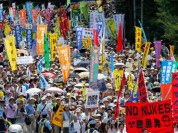
[Tecpo] said in a report that the company failed to adequately prepare for a disaster and that it knew it wasn’t prepared, and yet it did nothing, out of fear for the economic and social consequences.
“There was a worry that if the company were to implement a severe-accidentresponse plan, it would spur anxiety throughout the country and in the community where the plant is sited, and lend momentum to the antinuclear movement,” said the report
Rihanna and Shakira -Azerbaijan -The abuse of Zaur Gurbanli and Tony Blairs love of formaldehyde
“A regular blogger, he recently posted an article criticizing government corruption and nepotism. The piece ridiculed the inclusion of a poem by President Ilham Aliyev’s daughter as mandatory reading in the country’s school curriculum.
“It looks very much like the Azerbaijani authorities decided Zaur Gurbanli crossed the line when he poked fun at the president’s family,” said Dalhuisen. “If he is being targeted because of his legitimate political or online activity, he must be released immediately.”
Criticism of the president’s family frequently provokes a swift and harsh response from the Azerbaijani authorities. In March this year two musicians were arrested and tortured after they insulted the president’s late mother during a performance.”
Joint Letter Details Country’s Human Rights Violations
Contact: Sharon Singh, ssingh@aiusa.org, 202-675-8579, @spksingh
(New York) — Top-selling artists Rihanna and Shakira should bear in mind the human rights abuses being inflicted on the people of Azerbaijan before they perform in the country’s capital later this month, Amnesty International and Sing for Democracy warned in a letter addressed to the singers before their concerts. The two singers are appearing in Baku during the current FIFA U-17 Women’s World Cup 2012.
In a joint letter, the two organizations draw attention to the current state of human rights and freedom of expression in Azerbaijan. Stadiums may cheer for internationally renowned recording artists like Rihanna and Shakira, but citizens within the European country do not enjoy such freedom of expression and are often persecuted when attempting to speak out.
As the letter informs these artists, the 2005 murder of reporter Elmar Huseynov still remains unsolved. Today, many Azerbaijani journalists, bloggers and political activists have been arrested and persecuted multiple times.
A connection between Chernobyl and a recent Japanese study on PTSD in dogs
“There is more and more evidence of a “Chernobyl dementia” phenomena (deterioration of memory and motor skills, occurrence of convulsions, pulsing headaches), caused by the
destruction of brain cells in adult people (Sokolovskaya, 1997).”
Cortysol level raised interritories with 1 – 15 Ci/km2, and lowered in territories with a greater level of pollution in healthy newborns, Gomel and Mogyliov areas, Belarus
(Danil’chik et al., 1996; Petrenko, et al., 1993)
Table 11 presents some research showing correlations between the Chernobyl
radioactive pollution with the development of hormone/endocrine diseases.
Table 11 Endocrine/hormonal diseases in some Chernobyl polluted territories
On page 16 of this report
http://www.progettohumus.it/include/chernobyl/dintorni/dossier/chernobylbook.pdf
Dogs who survived tsunami show signs of PTSD — much like those found in humans
 Dogs that survived the 2011 earthquake, tsunami and nuclear disaster in Japan show symptoms not unlike those experienced by humans who suffer from post-traumatic stress disorder, a new study by a Japanese university says.

The research compared abandoned dogs rescued from Fukushima, site of the nuclear disaster, and Kanagawa, with non-disaster affected dogs abandoned in 2009 and 2010, before the earthquake.
Experts doubt! -Russian defense ministry says it will raise two sunken nuclear subs
Charles Digges, 12/10-2012
Bellona
The Russian Ministry of Defense says it is planning to raise and scrap two sunken nuclear submarines from the depths of the Barents and Kara Seas in an effort to stem radioactive contamination from the vessels, whose reactors are both loaded with spent nuclear fuel, Izvestia newspaper reported.
 |
| A subsea photo of the K-159’s bow section taken during radiation tests after its sinking |
| http://www.gremicha.narod.ru |
The ministry said it will announce an international tender, which may include companies from the France, the Netherlands, South Korea and United States, as the Russian Navy does not have the necessary equipment to carry out deep-sea salvage operations, Izvestia said, citing a military source that the paper did not name.
The source reported that the project to lift the two submarines, the K-27 and the K-159, is a part of a revised government draft for strategic development of Russia’s Arctic zone.
“A broad range of measures for cleaning Arctic waters of pollution is specified [in the draft],” the source told Izvestia. “In addition to the sunken submarines, particular attention is given to removal of dangerous waste left behind after the military units on Franz Josef Land, New Siberian Islands and Bely Island,” said the source.
Indeed, an accumulation of reports from Russia to the Norwegian Radiation Safety Authority (NRPA) reveal the Soviet and Russian Navies littered the Kara Sea with all manner of nuclear and radioactive waste over a period of decades, stopping in the early 1990s.
Artic nuclear waste zone
According to NRPA, the catalogue of waste in the Kara Sea includes 19 ships containing radioactive waste; 14 nuclear reactors, including five that still contain spent nuclear fuel; 735 other pieces of radioactively contaminated heavy machinery; 17,000 containers of radioactive waste,
Rossi: We Are Close To Present Our 1 MW Hot Cat Reactor – (But doesnt add up!) -Fail
“So the attachments, including Penon’s report, are missing again? And the calculations are still ambiguous/incorrect? This is getting a bit surreal, even by Rossi’s standards.”
On his official e-cat blog Journal of Nuclear Physics, Italian inventor Andrea Rossi made a very interesting revelation concerning his high temperature reactor. A frequent JONP poster Joseph Fine asked:
“Does the power rating of a module (1 kW, 5 kW, 10 kW) affect the time of startup or shutdown? If smaller or lower power modules heat up faster than larger ones (or vice versa), it might be possible to ramp up or ramp down a startup or shutdown by sequencing the startup or shutdown of several modules in order to avoid major power jumps.”
Rossi responded and surprisingly disclosed what seems to be very important information he may be sharing in the upcoming e-cat conference in Pordenone Italy on October 12.
“No, it does not affect. We are close to present our 1 MW Hot cat, which will have a tremendous elasticity. I think that at Pordenone we will get some fun.”
Rossi’s answer is absolutely unexpected because he hasn’t talked about a 1 megawatt high temperature reactor before. The latest information we received about the Hot Cat is it has now steam and pressure to generate electricity. When asked when he expects to start trials with turbines etc to make electricity, Rossi said it will be “as soon as possible, hopefully in 2013”.
UAE and Turkey to build second nuclear power plant – And does Turkey have the nuclear bomb?
“The US has supplied some 480 B61 thermonuclear bombs to five so-called “non-nuclear states”, including Belgium, Germany, Italy, the Netherlands and Turkey. Casually disregarded by the Vienna based UN Nuclear Watchdog (IAEA), the US has actively contributed to the proliferation of nuclear weapons in Western Europe.”
“According to a recent report, former NATO Secretary-General George Robertson confirmed that Turkey possesses 40-90 “Made in America” nuclear weapons at the Incirlik military base”.
12 October 2012 – 3:19pm

The UAE may become the Turkish partner for building the second nuclear power plant Sinop if South Korea wins the tender, Turkish Minister for Natural Resources Taner Yildiz said, Trend reports.
Canada, China, South Korea and Japan are tendering for construction of the Sinop nuclear power plant. The facility is expected to be launched before 2019. Construction of another power plant is planned for 2023.
Akkuyu is the first power plant of Turkey. It has four WWER-1200 reactors (Russia). Turkey and Russia signed the construction deal in May 2010. Each block will produce 1200 MW (4800 MW in total). They will be launched one by one with an interval of a year each.
http://vestnikkavkaza.net/news/politics/32517.html
Europe’s Five “Undeclared Nuclear Weapons States”
Are Turkey, Germany, Belgium, The Netherlands and Italy Nuclear Powers?
Amazing banned video – Unheard voices! Soma high school -Brilliant and very moving (Video)
h/t
FUKUSHIMA APPEAL THURSDAY, 11 OCTOBER 2012
http://fukushimaappeal.blogspot.co.uk/2012/10/blog-post.html
“Unheard voice” from high school girls in Fukushima
Greenpeace action in Vilnius: “Nuclear plant is dangerous”
“The international community is concerned about the reactors that Japanese company Hitachi-GE is planning to build in Lithuania. Greenpeace notes that the same companies built reactors in Fukushima. When the plant was struck by a tsunami wave, the situation was made worse by technological flaws that the companies knew about but still failed to fix for decades, as revealed by an investigation carried out by the Japanese Government.”
“”I would like to draw attention to the fact that, as analysts and the press have noted, Greenpeace has sometimes deviated from its ideas, ideaologies, sometimes even in terms of its financial sources,” Kubilius said, refraining from elaborating further.”

Greenpeace, an international non-governmental environmental organization, staged an event in Vilnius, warning people about the hazards of nuclear energy and urging Lithuanians to vote against building a new nuclear facility in Sunday’s referendum.
Wednesday morning, Greenpeace volunteers put a banner on the White Bridge in Vilnius, with four climbers hanging on ropes underneath, reading “Nuclear plant is dangerous – vote NO” in Lithuanian.
“There is no such thing as safe nuclear power,” said Greenpeace activist Andrea Zlatnanska. “They’ve been telling us for the last sixty years that nuclear power is safe, but history begs to differ. Lobbyist of the industry keep insisting that a catastrophe is impossible – the same thing that they said before Chernobyl, before Fukushima, but disasters do happen around the world. Lithuania cannot afford to be one more “impossible” catastrophe.”
New! Fukushima meltdowns -50,000 Bq/square meter in bird feces – Ibaraki, Japan
Published on Oct 12, 2012 by 148production
Oct 12,2012
.
Story of Hitachi City, Ibaraki Prefecture.
Video showing measurements with some translation:
Also, 18,000 Bq/square meter found on wooden tables and chairs in a park
Air in park 0.37 mcSv/h
The city is currently building a nuclear power plant even thought the Japanese are getting rid of nuclear?
The city DOES NOT measure the city for contamination?
85 Km from Daichi meltdowns.
http://www.youtube.com/watch?v=ZIYhAzzQmHw
updated measurements as initially wrong
College of Engineering Receives DOE Funds to Improve Nuclear Safety -USA
The University of Tennessee, Knoxville, will take part in two U.S. Department of Energy (DOE) projects totaling more than $9 million which involve a team of institutions to improve upon nuclear energy safety and efficiency.
The projects draw upon lessons learned from the 2011 Fukushima Dai-ichi Nuclear Power Plant accident.
The two awards are part of the DOE’s 2012 Nuclear Energy University Programs (NEUP) Integrated Research Programs (IRP).
A proposal by Kurt Sickafus, head of the Department of Material Science and Engineering, was awarded $3.5 million to improve the nuclear fuel cladding in light water reactors. Cladding refers to the metallic tube that protects the fuel in a nuclear reactor from the surrounding coolant such as water.
“Currently, the alloys in the cladding when at high temperatures can oxidize, releasing hydrogen gas which can cause an explosion similar to the one we saw in Japan,” Sickafus said.
Citizen group to sue Entergy -USA Plymouth
Sheehan acknowledges that the EPA has previously asserted, in a letter sent subsequent to the issuance of the discharge permit, that it gave permission to Energy to discharge tolytriazole.
“But we assert this is illegal,” Sheehan said. “The EPA can’t make closed-door deals with polluters to change permits. It has to be done in the prescribed manner under the law, with public notice and comment.”
[…]
All told, the NOI sent to Entergy, various officials from state and federal environmental entities and U.S. Attorney General Eric Holder, cites 15 separate violations
Frustrated at a lack of penalties for what they believe are ongoing violations of the Clean Water Act by the Entergy at its Pilgrim Station nuclear facility, local residents have taken the unusual step of filing written notice of their intent to sue the Louisiana-based corporation.
The Clean Water Act includes specific provisions that allow citizens the right to enforce its regulations if government fails to do so. The notice of intent (NOI) filed officially Oct. 5, claims that since 2006 Entergy has violated the Act more than 33,000 times. If upheld, each violation carries a $25,000 civil penalty, for a total potential liability of more than $800 million.
This citizen action is being supported by the offices of EcoLaw, whose lead Attorney Margaret Sheehan is also a member of Cape Cod Bay Watch, which has unsuccessfully lobbied state and federal government officials on the same issues over the last few years.
But Sheehan said this isn’t simply a new tactic.
“This is one of the most effective ways that the 40-year-old Clean Water Act is enforced,” Sheehan said. “There is a long history of groups and citizens suing under the ‘citizen suit; provisions of the federal Clean Water Act to get penalties from polluters and stop the pollution from happening.’”
Areva delays $1 bln Namibia uranium mine
11 October 2012
WINDHOEK (Reuters) – French energy group Areva said on Thursday it had delayed the start of its $1 billion Trekkopje uranium mine in Namibia until market conditions improve.
“Considering both the continued decrease of uranium prices coupled with the investments yet to be made on site, AREVA has no other option than to postpone the launch of the Trekkopje mine,” the company said in a statement.
Uranium prices have been on the decline since the nuclear disaster at Fukushima in Japan in March 2011, with some countries questioning the safety and viability of nuclear energy and some suspending their plans to build new plants altogether.
The uranium spot price hit a new two-year low last week at $45.75 per lb. That compares with the February 2011 average spot price of $69.63.
Areva said the project, which makes use of the “heap-leaching” extraction process and is about 80 percent complete, was only viable at a price of $75 per lb or more. It will cost the company $10 million a year to keep the project under care and maintenance.
The company plans to finish all ongoing construction by December.
Trekkopje was expected to produce 3,000 tonnes of uranium oxide per year. Areva said it was committed to the project once economic conditions improve.
http://news.yahoo.com/areva-delays-1-bln-namibia-uranium-mine-140919124–sector.html
Anti-nuclear group sets up hotline -high cancer rates -Canada
“We’re not trying to shut it down, we’re trying to make it run safely and right now we don’t believe it is safe at all.”
By Ashley Wills
paNOW staff
Submitted on October 11, 2012 – 7:46am
A hotline has been set up by an anti-nuclear group in Saskatchewan for people to confidentially voice their concerns about uranium mine safety.

“They feel that they can’t ask the mining companies the questions, or the regulators, for fear of losing theirjobs,” said Pat McNamara, an activist who works with the Committee for Future Generations (CFFG).
The whistle-blower hotline will act as a buffer between employees and companies. The information that is gathered will be presented to Health Canada and the Canadian Nuclear Safety Commission. If the regulators do not act on the information, CFFG will publicize the issues as much as possible, said McNamara.
“We’re not trying to shut down the mining industry … but we’re getting so many complaints and so many concerns raised about it,” he said.
So far, four uranium miners from northern Saskatchewan have used the hotline to ask questions about chest pains they experience on the job.
“Like heartburn that builds up over the days that they’re working in the mine, and it gets progressively worse until they go home and then it clears up during their days off,” said McNamara, who has written several books on nuclear safety issues.
Russia to Salvage Sunken Nuclear Subs
Thursday, 11 October 2012
The Russian Defense Ministry is planning to raise and scrap two sunken nuclear submarines in the northern Barents and Kara seas in order to prevent potential radioactive pollution of the area, the Izvestia newspaper said on Thursday.
The ministry will announce an international tender, which may include companies from the France, the Netherlands, South Korea and United States, as the Russian Navy does not have the necessary equipment to carry out deep-sea salvage operations, Izvestia said, citing a military source.
The B-159 (K-159), a November class nuclear submarine, sank in the Barents Sea in August 2003, 790 feet (238 m) down, with nine of her crew and 1760 lbs (800 kg) of spent nuclear fuel, while being moved for dismantling.
The K-27 was an experimental attack submarine built in 1962 and decommissioned in 1979 due to its troublesome nuclear reactors. Her reactor compartment was sealed and the submarine was scuttled in the eastern Kara Sea in 1982 at the depth of 220 feet (75 m).
1 This Month





PLEASE OPPOSE HR 8255 AND S.3639 – bills would accelerate satellite deployment, with no environmental review or safeguards – https://ncstd5li.quorum.us/campaign/169331/
To see nuclear-related stories in greater depth and intensity – go to https://nuclearinformation.wordpress.com
-
Archives
- October 2026 (19)
- September 2026 (339)
- August 2026 (330)
- July 2026 (355)
- June 2026 (287)
- May 2026 (306)
- April 2026 (356)
- March 2026 (251)
- February 2026 (267)
- January 2026 (308)
- December 2025 (358)
- November 2025 (359)
-
Categories
- 1
- 1 NUCLEAR ISSUES
- business and costs
- climate change
- culture and arts
- ENERGY
- environment
- health
- history
- indigenous issues
- Legal
- marketing of nuclear
- media
- opposition to nuclear
- PERSONAL STORIES
- politics
- politics international
- Religion and ethics
- safety
- secrets,lies and civil liberties
- spinbuster
- technology
- Uranium
- wastes
- weapons and war
- Women
- 2 WORLD
- ACTION
- AFRICA
- Atrocities
- AUSTRALIA
- Christina's notes
- Christina's themes
- culture and arts
- Events
- Fuk 2022
- Fuk 2023
- Fukushima 2017
- Fukushima 2018
- fukushima 2019
- Fukushima 2020
- Fukushima 2021
- general
- global warming
- Humour (God we need it)
- Nuclear
- RARE EARTHS
- Reference
- resources – print
- Resources -audiovicual
- Weekly Newsletter
- World
- World Nuclear
- YouTube
-
RSS
Entries RSS
Comments RSS

