“Hato Bus Co., which used to organize tours to the lake every year, plans no such visits this autumn because of the ban on taking the smelt home. Furthermore, elementary and junior high schools have canceled student trips.”
October 29, 2012
Asahi Shimun
By SEIKO SADAKUNI/ Staff Writer
Akagi Onuma, a caldera lake atop Mount Akagiyama in northern Maebashi, usually attracts 25,000 tourists to fish for freshwater smelt during a seven-month season starting in September.

But visitor numbers to the area in Gunma Prefecture have fallen by 90 percent compared with levels prior to the March 2011 disaster at the Fukushima No. 1 nuclear power plant. This autumn, about 100 boats lie idle along the shore. On autumnal weekends in the past, all boats would have been rented out.
“Revenue has almost dried up since the earthquake,” said Takeshi Aoki, 48, a manager at Aoki Ryokan, a lakeside inn.
Continue reading →
October 29, 2012
Posted by arclight2011 |
Uncategorized |
Leave a comment
Page added on October 27, 2012
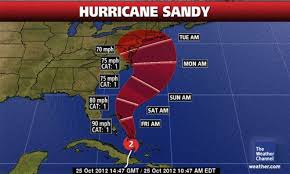
Bloomberg reports:
“Because of the size of [Hurricane Sandy], we could see an impact to coastal and inland plants,” Neil Sheehan, a spokesman based in Philadelphia for the U.S. Nuclear Regulatory Commission, said by phone today. “We will station inspectors at the sites if we know they could be directly impacted.”
The NRC met earlier today to discuss the necessary precautions to take for the storm, Sheehan said. Plants must begin to shut if wind speeds exceed certain limits, he said.
As of 2 p.m. New York time, Sandy had winds of 75 miles (121 kilometers) per hour, according to the National Hurricane Center in Miami. It was about 430 miles south-southeast of Charleston, South Carolina, moving north at 7 mph.
The current Hurricane Center track calls for the system to come ashore just south of Delaware Bay on Oct. 30.
Reuters provides a list:
The following lists the nuclear reactors and utilities in Sandy’s potential path.

While we don’t foresee any problems, the risk of nuclear accident in the U.S. is actually much greater than it was in Japan before Fukushima.
Continue reading →
October 29, 2012
Posted by arclight2011 |
Uncategorized |
1 Comment
Tokyo prepares for the ‘Big One’
“In the past five years, nearly 300 seismographs have been installed in Tokyo schools at a cost of over 1.0 billion yen, transmitting data to a central authority.
But the plan has also revealed worrying subterranean activity: fault lines far shallower than previously thought.
“It was a great shock to me,” said Sakai at Tokyo’s quake research institute, as he stared as his seismograph-connected laptop. “It’s constantly moving down there.””
[…]
Concern about the so-called “Big One” spiked again over the summer when the government unveiled a worst-case disaster scenario that estimated 323,000 people would die if a 9.0 magnitude unleashed a 34-meter tsunami along the coastline south of Tokyo.
City officials said it was intended to encourage improvements in quake warning systems, evacuation planning and disaster reduction.

[…]
Sahara added that the association has ramped up efforts to keep track of its residents, especially the elderly.
“After March 11, we made a list of old people in the district, especially those living alone. There is a sense of solidarity here,” Sahara said.
As Japan become better prepared for the inevitable disaster, new knowledge also brings new uncertainty.
Continue reading →
October 29, 2012
Posted by arclight2011 |
Uncategorized |
Leave a comment
5:59 PM, Oct 27, 2012
Written by

Nuclear energy preparing for retirements, growth
U.S. aims to broaden its electricity sources while curbing emissions and an impending glut of retirement-eligible workers promise major changes in the nuclear induustry work force.
The Nuclear Energy Institute says 39 percent of the country’s nuclear-industry workers will reach retirement age by 2016, which could lead to a significant loss of experience and knowledge of how to safely use nuclear power — an issue that has great import in the wake of last year’s earthquake and tsunami that battered a reactor in Japan.
Continue reading →
October 29, 2012
Posted by arclight2011 |
Uncategorized |
Leave a comment
There are 104 nuclear reactors in the United States. If one of them lost both primary and backup power for even a matter of hours, it could lead to a meltdown and an airborne radioactive plume. See what could have happened if a reactor in your area had a severe nuclear accident on March 11, 2011.
- Threshold for Radiation Sickness (75 rads)*
- Maximum Radiation Dose Recommended for Emergency Responders (25 rads)*
- Evacuation Recommended (5 rads)*
- Sheltering Recommended (1 rad)*
- 10-mile Evacuation Zone
- 50-mile Potential Contamination Zone
* Acute radiation dose based on 48 hour exposure, assuming no sheltering. Sheltering can reduce radiation dose by a factor of ten or more.
Why U.S. nuclear power plants are vulnerable to severe accident with nuclear fallout
A future severe nuclear accident at a U.S. nuclear power plant is a real possibility. In 2011 five nuclear power plants in the United States lost primary power due to earthquake or extreme weather events, including tornados, hurricanes, and flooding. Fortunately backup power systems kicked in at these plants and a disaster was averted. But weather is not the only risk factor. Other risk factors include:
- Type of reactor – There are two types of reactors operating it the United States: Boiling Water Reactors (BWRs) and Pressurized Water Reactors (PWRs). Some experts judge that the design and structure of BWRs do not protect against the release of radiation during a severe accident as effectively as PWRs. The four reactors involved in the Fukushima nuclear crisis were BWRs. On the map, NRDC experts assigned a red flag to a reactor if it is a BWR.
- Age of reactor – Reactors were designed to operate for 40 years, yet the regulatory body that oversees nuclear safety in the United States, the Nuclear Regulatory Commission, has re-licensed some nuclear power plants to operate for 60 years, well beyond their originally engineered design lifetime. On the map, NRDC experts assigned a red flag to a reactor if the NRC has approved the reactor to operate for 60 years.
- Power level of reactor – The NRC has approved many utility operators to increase the operating power of their nuclear reactors, including for Fukushima-type reactors, and in some cases multiple times and to significantly higher power levels. These so-called “power uprates” push reactors beyond what they were originally engineered to do, and could increase the radiation hazard if a nuclear accident occurred. On the map, NRDC experts assigned a red flag if the NRC has granted a reactor a power uprate.

If a person received one rad of radiation from a nuclear accident, it would increase one’s chance of getting cancer by 1 in 1,000 (averaged over all ages and both sexes). And although the NRC believes that the chances of a severe accident with fallout in a core meltdown for any one of the 104 U.S. nuclear reactors is small (probability of less than 1 in 10,000 per year), can we afford the risk? Millions of Japanese people were exposed to radiation from Fukushima, increasing their risk of developing cancer, and the cost of the Fukushima accident is projected to exceed US$100 billion, and the environmental effects will last for generations. What if a meltdown occurred at one of the 65 nuclear power plants in the United States?
Why we need urgent federal action to reduce the risks of U.S. nuclear accident fallout
With 6 million Americans living within 10 miles of a U.S. nuclear power plant – the evacuation zone defined by the federal government – and more than 120 million Americans living within 50 miles of a U.S. nuclear power plant – the distance the U.S. government told Americans to evacuate from the area around the Fukushima plant – we cannot afford to stand by and hope the worst won’t happen here, especially with extreme weather intensifying around the globe.
Continue reading →
October 29, 2012
Posted by arclight2011 |
Uncategorized |
Leave a comment
A Contest To Build A Disaster-Ready Robot
When disasters hit, relief workers often have to put their own lives at risk. Many workers at the Fukushima nuclear reactor in Japan received dangerous doses of radiation after the accident there last year. The Pentagon hopes a contest to build a better robot will make it easier and safer to mitigate disasters.
Immediately after the tsunami and explosions that damaged the Fukushima plant, workers had no way to access areas where radiation levels were lethal. Robots from Massachusetts-based iRobot had to be rushed in. iRobot CEO Colin Angle says valuable time was lost as personnel were trained how to use them.
“Robots on site would have saved days. Appropriate training would have saved days and potentially could have minimized the venting of some of the radioactive gasses,” Angle says.
That’s why DARPA, the Defense Advanced Research Projects Agency, this week launched a “Robotics Challenge,” to encourage the development of robots that anyone can use.

A Robot The Size Of A 10-Year-Old Boy
Seven hardware teams announced this week will compete for a $2 million prize. Among the robot competitors is an entry called “Hubo.”
Professor Paul Oh, who leads the Drexel University team that built Hubo, says the robot is about 4-feet-3 inches tall — about the size of a 10-year-old boy.
This week, Drexel and the other teams learned some of the challenges Hubo will face in a junkyard-wars-style competition next year. The robots will have to open a blocked door, operate a valve, climb a ladder. And perhaps the toughest: get into and drive a vehicle.
Oh says when we drive, we rely on lots of sensations. When you hit an obstacle, you can feel it with your wheel, and you can hear it.
An unnamed robot that the Carnegie Mellon National Robotics Engineering Center plans to build for the DARPA Robotics Challenge.
Courtesy of Carnegie Mellon
“These are all perceptual challenges that we have to teach our robot,” he says.
Oh and the other researchers have until next year to teach their robots these tasks. During the actual challenge, DARPA folks will be throwing a lot of curves at the competitors, like messing with their communications. You’d expect a lot of radio interference if you were working in a damaged nuclear reactor or in a collapsed building after a terror attack.
Continue reading →
October 29, 2012
Posted by arclight2011 |
Uncategorized |
1 Comment
TIME: OCTOBER 30 (TUESDAY), 2012, 14:00-16:00
1: Mr Katsutaka IDOGAWA: mayor of Futaba town which was “worst hit by Fukushima fallout” Organized by Japanese Association for the Right to Freedom of Speech (JRFS), Association of Fukushima Collective Evacuation Trial for the Right to Education in a Safe Place
2. Professor Michel Fernex: Professor Emeritus, Medical Faculty, University of Basel, will speak about the effects of radiation on children.
3: Mr Toshio YANAGIHARA: lead lawyer representing the Fukushima Collective Evacuation Trial for the Right to Education in a Safe Place representing 14 children plaintiffs for a collective evacuation (whole school) from heavily contaminated Koriyama city, Fukushima.
Continue reading →
October 29, 2012
Posted by arclight2011 |
Uncategorized |
Leave a comment
http://enenews.com/100000-tepco-employees-expected-to-go-to-fukushima-in-2013-all-of-companys-workers-to-be-sent
Published: October 27th, 2012 at 5:30 pm ET
By ENENews
Oct. 27 ,2012 report in Nikkei with summary translation by Fukushima Diary:
In the mid-term administration plan, Tepco decided to send all of their employees to Fukushima for decontamination from 2013.
They are sent to Fukushima for 2~3 times a year, about 100,000 people in total will go to Fukushima annually.
This is not volunteer, this is obligation.
More detail on the comments on the enenews article concerning manpower resources available
October 28, 2012
Posted by arclight2011 |
Uncategorized |
Leave a comment
“Next month, Okamura’s group plans to flip the switch on new purifying equipment using Toshiba Corp. technology that is supposedly able to decontaminate the water by removing strontium and other nuclides, potentially below detectable levels, he said.
TEPCO claims the treated water from this new system is clean enough to be potentially released into the ocean”
By Mari Yamaguchi
NATIONAL OCT. 28, 2012
Japan Today
[…]
“…….To deal with the excess tainted water, the utility has channeled it to more than 300 huge storage tanks placed around the plant. The utility has plans to install storage tanks for up to 700,000 tons—or about three more years’ worth—f contaminated water. If that maxes out, it could build additional space for roughly two more years’ worth of storage, said Mayumi Yoshida, a company spokeswoman.
But those forecasts hinge on plans to detect and plug holes in the damaged reactors to minimize leaks over the next two years. The utility also plans to take steps to keep ground water from seeping into the reactor basements.
Both are tasks that TEPCO is still not sure how to accomplish: Those areas remain so highly radioactive that it is unclear how humans or even robots could work there.
Continue reading →
October 28, 2012
Posted by arclight2011 |
Uncategorized |
Leave a comment
“In 2012, the Da Lat University offers the scholarship of one million dong a month and seats at dorms when enrolling students for the nuclear power major. However, the school could enroll 17 students only, while it planned to enroll 50.”
“As you receive this letter, seventeen Vietnamese social activists, including bloggers and citizen journalists have been in jail for up to a year. Most have not even been brought to trial. These seventeen individuals have been arbitrarily detained because of their work as citizen journalists, environmental advocates, anti-corruption crusaders and human rights defenders.”
Saturday, 27 October 2012
Mr Vuong Huu Tan, Head of the Vietnam Agency for Radiation and Nuclear Safety VARANS
The press briefing held on October 24 in Vietnam was introduced as the meeting to introduce the 2012 nuclear power exhibition to be inaugurated the next day.
However, the questions raised by the reporters at the press briefing did not relate to the exhibition. The biggest matter of interest of the participants was the safety of the nuke power plants to be built in Vietnam.
After the Fukushima accident in March 2011, some big countries in the world, including Germany and Switzerland, are considering shut a part or the whole nuclear power plans. This has once again, triggered the big worries about the safety of the nuke plants in Vietnam.
However, Vuong Huu Tan, Head of the Vietnam Agency for Radiation and Nuclear Safety VARANS, has affirmed that the nuclear power plants still have been on the development over the last 18 months, after the Fukushima catastrophe, simply because no alternative energy source has been found.
Continue reading →
October 28, 2012
Posted by arclight2011 |
Uncategorized |
Leave a comment
After the decomposed carcass was discovered, U.S. officials gave strict instructions to the crew aboard the vessels that no information or photographs were to be released. NOAA did later issue a press release about the dead whale, though it was soon edited in such a way that it appeared to minimize the oil’s effect on whales.
“We believe a full throated debate over the settlement amount needs to happen before any deal is done,” said John Kostyack, a vice president at the National Wildlife Federation, who estimates BP’s potential liability at more than $50 billion.
Oct 26, 2012
Yulia Monakhova
Greenpeace obtained documents relating to the 2010 BP oil spill indicating that Obama administration officials tried to restrict information about whales and other wildlife affected by the disaster. The newly released pictures and emails show that, two years ago, the U.S. government tried to cover up the number of whales which came into close contact with BP’s leaking oil well after the Gulf of Mexico spill.

The environmental organization obtained the pictures and emails in late September through a Freedom of information request. The pictures were taken in the summer of 2010 and show the carcass of a sperm whale whose skin had been burnt black. According to The Guardian, the dead whale was sighted at sea, south of the Deepwater Horizon oilrig.
It is thought the photos were taken by crewmembers of the National Oceanic and Atmospheric Administration’s (NOAA) research vessel,Pisces, who found the dead whale on June 15, 2010. It was floating 77 miles from the Deepwater Horizon. The young sperm whale’s skin had been burned and partially eaten by sharks. On the same day, NOAA observers aboard another vessel spotted five whales covered in oil. After the decomposed carcass was discovered, U.S. officials gave strict instructionsto the crew aboard the vessels that no information or photographs were to be released. NOAA did later issue a press release about the dead whale, though it was soon edited in such a way that it appeared to minimize the oil’s effect on whales.
There were believed to be about 1,200 sperm whales in the Gulf of Mexico at the time of the spill, making it one of the biggest populations in the world. Environmental organizations and the U.S. government still need to determine the exact impact of the oil spill on wildlife in the area, particularly on endangered species, such as sea turtles and sperm whales. The outcome may have enormous financial implications for BP.
Continue reading →
October 28, 2012
Posted by arclight2011 |
Uncategorized |
4 Comments
14 October 2012 – The medics in prison go on hunger strike to demand that all charges are dropped and their immediate release.
Sat Oct 27, 2012 3:54PM GMT
Saudi-backed Bahraini forces have attacked anti-regime protesters in the village of Nuwaidrat, using tear gas and rubber bullets to disperse them.
http://www.presstv.ir/detail/2012/10/27/269053/bahraini-forces-attack-protesters/
more info on the link below with video pleas for help
26/10/2012 – 2:19 p | Hits: 66

Doctors and medics volunteered to offer assistance to injured protesters during the uprisings in Bahrain (Photo/Bahrainmujaz)
Roula al-Saffar was arrested in March 2011 by the Bahraini authorities.
Roula is the head of nursing at the Salmaniya Medical Complex in Manama, and like many other Bahraini medics and doctors she had assisted injured protesters during the uprising in Manama.
They were then accused of inciting sectarian hatred and the overthrow of the regime. These medics were detained, tortured and harassed for nearly two months and many were initially sentenced to 15 years in prison by a military court.
The individual stories can be found on the human rights websites Doctors in chains and Physicians for human rights.
Continue reading →
October 27, 2012
Posted by arclight2011 |
Uncategorized |
Leave a comment
TOKYO | Sat Oct 27, 2012 11:29am BST
(Reuters) – Hitachi Ltd (6501.T), Japan‘s largest industrial electronics maker, is close to buying British nuclear new-build project Horizon in a deal expected to be worth more than 50 billion yen ($628.46 million), Japanese media said on Saturday.
Horizon, which plans to build 6 gigawatts of nuclear capacity, was put up for sale by its German owners E.ON AG (EONGn.DE) and RWE AG (RWEG.DE) in March, as Germany‘s decision to pull out of nuclear power hurt the utilities’ finances.
“Hitachi has made the best offer and has a good chance to get Horizon,” a source inside the consortium familiar with the process told Reuters, speaking on condition of anonymity. Another person with knowledge of the proceedings also said Hitachi was likely to be the winner.
Hitachi is expected to hold a board meeting on Tuesday to approve the deal and officially announce it later that day, both the Asahi daily newspaper and Kyodo newswire reported, citing sources familiar with the matter.
Another newspaper, the Mainichi daily, reported that in addition to building the nuclear units, Hitachi is also expected to win a contract for about 40 years to operate and maintain the reactors.
Hitachi officials were not immediately available to comment on the report.
Officials at E.ON and Horizon declined to comment, while a RWE spokesman said: “We are in the final stages. We will probably say more in the coming days.”
On Thursday, a RWE said it was in advanced talks to sell Horizon, after a German newspaper reported that a consortium led by Hitachi was the front runner for the Gloucester-based venture.
Continue reading →
October 27, 2012
Posted by arclight2011 |
Uncategorized |
Leave a comment
The Project on Nuclear Issues (PONI) aims to build and sustain a networked community of young nuclear experts from the military, national laboratories, industry, academia, and policy communities.
About the Project on Nuclear Issues
Addressing the complex array of nuclear weapons challenges will require a solid foundation of expertise across numerous sectors. Because most of these challenges are long-term, the Project on Nuclear Issues (PONI) aims to build and sustain a vibrant community of young nuclear experts from the military, national laboratories, industry, academia, and the policy community. To that end, PONI maintains an enterprise-wide membership base, hosts four major conferences and several smaller events each year, maintains an online blog, holds live debates on critical nuclear weapons issues, runs a six-month academic program for young experts, organizes bilateral exchanges involving young experts from the U.S. and abroad, oversees a working group of top young professionals, and distributes bi-weekly news and event announcements to members.
The project has three primary objectives. First, PONI aims to build and sustain a networked community of young nuclear experts from across the nuclear enterprise, including in the laboratories, military, industry, academia, and policy world. Second, the project seeks to help develop the next generation of leaders with both the necessary subject matter expertise and the professional skills to be effective in shaping and implementing policy. Third, PONI works to mobilize the wide-ranging nuclear expertise within its membership ranks to generate new ideas and advance the public debate on all issues concerning nuclear weapons.
There are over 1,100 PONI members and affiliated programs in the UK and France. Membership is open to anyone working in the nuclear field or studying nuclear weapons issues. Members receive a biweekly newsletter containing updates on activities, invitations to events and information on job opportunities in the field. Visit the PONI Membershippage to the left for more information about the community, including the PONI chapters in the UK and France, or click here to go directly to the application.
Follow Our Work
-
This blog pushes the nuclear debate forward with daily posts, original contributions by members, and guest commentary from senior experts.
-
Each year PONI hosts four conferences that bring together people from across the nuclear enterprise to discuss a range of nuclear issues.
Continue reading →
October 27, 2012
Posted by arclight2011 |
Uncategorized |
Leave a comment
Beregin: The American people are, more and more, making their voices heard against
Bush and his warrior clones. Bush and his minions slip out of control, determined to go to war, determined to go it alone, determined to endanger the Palestinians further, determined to control Iraqi oil, determined to ravage further a suffering people and their shattered society. The American people can stop Bush, can yank his feet closer to the fire, can banish the war makers from Washington D.C., can turn this society around and restore it to faith and sanity.
Obuszewksi: Absolutely. The Obama administration has asked for USD 585 billion to upgrade the nuclear arsenal. It is a crying shame. The dangers are evident. The radiation is poisoning.
Obuszewksi: Well, it is our government officials. It is our military. Your listeners should know this. December 19th, 1999, four peace activists went to a military base outside of Baltimore to disarm helicopters which fired depleted uranium. This was Philip Berrigan and three of his colleagues. Philip Berrigan is now dead. He was the founder of the Plowshares Movement but they recognized, far back, the dangers of depleted uranium.
Tuesday Aug 07, 2012
Japan marks the 67th anniversary of the atomic bombing of Hiroshima by the US, the first-ever case of the use of the bomb against human beings, which resulted in the death of tens of thousands of people.
Tens of thousands of people, including the survivors, victims’ relatives, and government officials attended the annual ceremony at Hiroshima Peace Memorial, commonly called the Atomic Bomb Dome, on Monday.
Hiroshima was devastated on August 6, 1945 after the US B-29 bomber Enola Gay dropped an atomic bomb on the city, killing an estimated 140,000 people instantly or gradually from radiation sickness and cancers. Three days later, another atomic bomb was dropped on Nagasaki, killing more than 70,000.
Press TV has conducted an interview with Max Obuszewksi, peace activist from Baltimore, to further discuss the issue.
The video also offers the opinions of two other guests: senior editor of Veterans Today (VT) website, Gordon Duff and Vietnamese-American political analyst and writer, Linh Dinh.
The following is a rough transcription of the interview. (And link to the video)
Continue reading →
October 27, 2012
Posted by arclight2011 |
Uncategorized |
Leave a comment








