We are JAN UK (januk.org), Japanese residents that live and work in the UK, campaigning on anti-nuclear platform to stop all nuclear power plants in Japan, the UK and everywhere in the world.
Three events were held in London in March 2013, to mark the two-year anniversary of the triple disasters in Japan (the earthquake, tsunami, and ongoing nuclear accident), and especially to speak out against nuclear power:
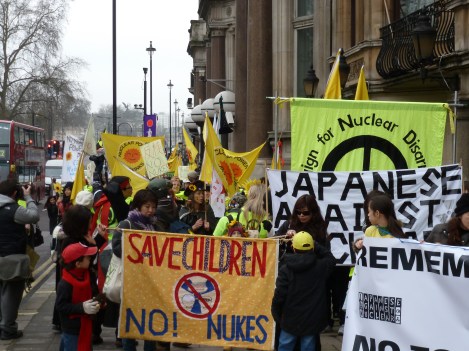
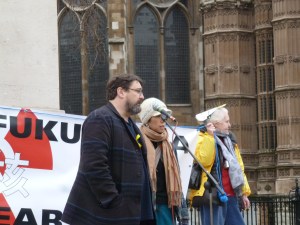
Fukushima Solidarity march was held in central London on Saturday, March 9th, co-organised by JAN UK, Kick Nuclear, and CND (Campaign for Nuclear Disarmament). Candle-lit vigil was held in front of the Japanese Embassy in London in the evening of March 11th, the very day the disaster happened two years ago. Then, straight after that, a public meeting was held in Committee Room 8, at the House of Commons. Main theme of the public meeting was: “The situation in Japan two years on from Fukushima, and the lessons we can learn for a nuclear-free world”.
The speech in this video was made by one of the JAN members. Three events were held in London in March 2013, to mark the two-year anniversary of the triple disasters in Japan (the earthquake, tsunami, and ongoing nuclear accident), and especially to speak out against nuclear power:
Fukushima Solidarity march was held in central London on Saturday, March 9th, co-organised by JAN UK, Kick Nuclear, and CND (Campaign for Nuclear Disarmament). Candle-lit vigil was held in front of the Japanese Embassy in London in the evening of March 11th, the very day the disaster happened two years ago. Then, straight after that, a public meeting was held in Committee Room 8, at the House of Commons. Main theme of the public meeting was: “The situation in Japan two years on from Fukushima, and the lessons we can learn for a nuclear-free world”.
The speech in this video was made by one of the JAN members.
Videos – Voices of nuclear protest and support for Fukushima victims – London UK 9 March 2013
Here are snippets of the speeches given on the day!
“Basically, only fish that enter the distribution network is subject to studies. The eel fishing season also does not start until summer.” The Chiba prefectural government was more downright blunt, saying, “No one in the prefecture catches eels for a living.” But eventually, the Japanese central government compelled both local units to sanction studies because eels were being consumed as food, which is a logical connection to make – not that it was logical enough for the two local government units.
High cesium levels discovered in Tokyo river eels, local governments make belated study
Posted on May 17, 2013 by John Hofilena
A worrying phenomenon has been discovered in Tokyo river eels that have been caught by local residents living near the Edogawa River – the eels that they have been catching, and may have eaten at one time or another, have very high cesium levels, in most cases higher than the safe levels required by the Japanese government.
Cesium-137 – normally called just “cesium” – is usually a byproduct of radioactive and nuclear processes, and is one of those isotopes that are easily spread in nature. The ingestion of high levels of cesium in the body would cause many negative effects to the health of humans. This is why the Japanese central government sets the safe limit in animals and the environment at 100 becquerels per kilogram.
The phenomenon at hand was officially noted starting with a 47-year-old self-employed woman who caught an eel from the Edogawa River in Tokyo’s Katsushika Ward n March 9. There have been reports of high cesium levels in fish from the river, so the woman sent the eel to Hideo Yamazaki, a professor of environmental analysis at Kinki University in Osaka Prefecture. Yamazaki then found that the eel had 147.5 becquerels of radioactive cesium per kilogram, higher than the central government standard of 100 becquerels. Professor Yamazaki passed on his findings to the Fisheries Agency in late March because he felt there was a need for an official investigation to back up his findings, and maybe look into other species as well. But the local governments of Tokyo and Chiba Prefecture refused to sanction official studies.
http://www.yonaoshi311.com
Seiichi Motohashi 本橋 成一
Photographer / Photographe / 写真家
EN
Seiichi Motohashi (1940-) is a renowned Japanese photographer famous for his documentary style and social themes. He directed two movies about families who decided to stay in Tchernobyl.
Image source ; http://before-after3-11.jimdo.com/english/
FR
Seiichi Motohashi (1940-) est un photographe connu pour ses photos documentaires et ses choix de thèmes sociaux. Il a réalisé deux films dont un primé à Berlin, sur des familles qui ont choisi de rester vivre à Tchernobyl.
“I didn’t go away. I never left the village.”
From “Alexei and the Spring”
“Nadezhda” Photograph Exhibition of Seiichi Motohashi in St.Petersburg
—————————————-—-
Interview conducted by Keiko Courdy for 霧の向こう*AU-DELA DU NUAGE°Yonaoshi 3.11_ Japan Webdoc project in Tokyo on June 18, 2012
All rights reserved – Copyrights KI 2013
The Japanese people love cherry blossoms and also enjoy eating, drinking and having parties outdoors, especially, when under a row of cherry blossom trees in full bloom. Sadly, the situation in the 20km radius of the crippled plant, “radiation control area” is different.
Tomioka-machi is one such town that the Japanese government has announced recently, that from 28th of May2013, it’s going to be safe to live there.Very high levels of ionizing radiation have been measured since the disaster in Tomioka-machi.But the government is still encouraging the residents to go back and live there.
The notice board in Tomioka-mach says:
放射線が高い地域になります。
観桜は車内から、お願いします。ご協力ありがとうございます。
“Very high ionizing radiation has been measured here.
Please enjoy viewing cherry blossoms while staying in your car.
Thank you for your corporation.”
Isn’t that crazy.Who would come and enjoy viewing cherry blossoms in your car, thinking it’s normal.Japan is clearly in an alert state with radioactive contamination.
(Reference) The Japanese government supports UNSCEAR (standard: up to 100mSv/y is ok for living in , used to be 5 mSv/y).
In this episode of the Keiser Report, Max Keiser and Stacy Herbert behold the Sacred Dow, worshipped by economists and analysts around the world and to which whole economies and jobs have been sacrificed to keep it rising. They compare the Japanese bond market to Fukushima. Markets have become so distorted by manipulation, they argue that like godzilla, one day the market will go where it needs to go and it will smash down buildings and economies with it. In the second half, Max talks to John Butler of Amphora about confusing price signals caused by market manipulating central bankers and the misallocation of capital this encourages. They also talk about Japan’s economy, Krugman’s bond allegations and Mrs. Watanabe’s gold shopping spree.
As Boy-wonder speaks of Japanese sex industry as solution to Marines in Okinawa and doubles down on his “opinion” that comfort women were necessary and they were no sex slaves and everyone did it, The Economist magazine puts wrinkled Abe as a superman of some sort flying over Tokyo accompanied by two Japanese fighter jets, and puts out an article titled “Japan and Abenomics: Once more with feeling” with the opening paragraph talking about price hike at “soapland” outfits in Tokyo that offer sexual massage.
Welcome to “Awanomics”. (“Awa” is bubble, as in soap bubble used in the soapland massage.)
The Shinzo Abe shaking up Japan’s economy seems a different man from the one whose previous premiership was marked by nationalistic posturing. He isn’t
IN “SOAPLAND”—Sopurando, a Tokyo red-light district—the price of a basic half-hour “massage” has recently gone up for the first time since 1990. Demand for the top-end, “highly technical” massage service, costing ¥60,000 ($600) a go, has also been soaring, according to Akira Ikoma, editor of My Journey, which covers the sex industry. He says it is all thanks to the surging stockmarket.
In Sopurando they are cheekily calling this reinvigoration “awanomics”, from awa, meaning bubble or lather. Elsewhere in Japan they call it Abenomics in honour of Shinzo Abe, elected prime minister in December 2012. Japan, Mr Abe declared as he took office, was back, and he lost not a moment in proving it. Having quickly assembled his cabinet, in January he announced a ¥10.3 trillion fiscal stimulus.
A Korean former comfort woman, who is already in Japan to meet with Mr. Hashimoto on May 24, criticizes Mr. Hashimoto’s remarks, saying “I experienced exactly that. How can he say there is no evidence?” It seems to highlight the difference of opinion.
Boy-wonder doubles and triples down on his remarks that “comfort women” were necessary, that everybody did it, and that his remarks were misunderstood by foreigners because he can’t speak English because of Liberal Democratic Party.
(Huh?)
According to the world of Toru Hashimoto, mayor of Osaka City and co-president of Japan Restoration Party, these women were “pros”, and not “sex slaves”. Tell that to the Japanese, Korean, Chinese, Dutch, Philippino, and other women in Japan-occupied Asia from that time.
Kyodo News has a tepid coverage of Hashimoto’s plan, and reduces everything to “difference of opinion“.
Toru Hashimoto, mayor of Osaka City and co-president of Japan Restoration Party, appeared in a TV program on May 19, and talked about the comfort women of the Japanese imperial army. He said, “It is said that the whole nation raped, threatened and abducted these women and forced them against their will to become (comfort women) and thus “sex slaves”. But that’s not true.” He said he will explain his opinion at the Foreign Correspondents’ Club of Japan in Tokyo on May 27.
Below is a list of the organisations that spoke out in defence of the children of Fukushima.No individual countries made any statement concerning the Fukushima disaster and the plight of local residence at the UN meeting.
Save the Children International appreciated the acceptance by Japan of recommendations relating to the ratification of the third Optional Protocol to the Convention on the Rights of the Child and to the adoption of measures to protect the right to health of Fukushima residents. Japan should facilitate and encourage democratic deliberations to implement the act on the protection and support for the children and other victims of the TEPCO disaster.
Reporters Without Borders International said that Japan, which could be proud about the freedom of press, had experienced a free fall in the ranking compiled by Reporters Without Borders, due to lack of information available about the accident at Fukushima. It was hoped that Japan would respect the right of its citizens to information.
Human Rights Now urged Japan to implement the recommendation concerning the protection of the right to life and health of the people affected by the nuclear accident in Fukushima. The response of the Government was not sufficient and Japan should provide sufficient compensation and support for the relocation of people living in contaminated areas.
Japanese Association for the Right to Freedom of Speech said that during the consideration of its Universal Periodic Review report in October 2012, Japan had made a deceptive reply regarding the issue of political tract distribution. This type of detention violated the provisions of the Universal Declaration of Human Rights and the International Covenant on Economic, Social and Cultural Rights.
TAKASHI OKADA, Deputy Permanent Representative of Japan to the United Nations Office at Geneva, said
With regard to the Fukushima disaster, the Government had provided financial and medical support to Fukushima residents. Japan would spare no effort in making further improvements in its situation of human rights.
The Council then adopted the outcome of the Universal Periodic Review of Japan.
[Editors note] The Japanese delegation had made this statement on the 14 March 2013. This document of the summary of that meeting was placed on a Chinese speaking part of the UN website.
In this document we find this statement;
[…]Takashi Okada, Deputy Permanent Representative of Japan to the United Nations Office at Geneva, said that out of the 174 recommendations it had received, Japan had agreed to follow up or partially follow up on 125 of them, including those promoting the protection of the rights of women, children, and persons with disabilities, but was unable to accept 26 of the recommendations. Regarding the remaining 23 recommendations, Japan already had sufficient measures in place to address the issues raised by those.
Japan had been using the ICRP standard (20mSv/y) during the emergency situation after the Fukushima disaster. Now two years passed, they don’t want to change 20mSv/y standard in the highly radioactive contaminated areas in Fukushima Prefecture.
Now they have applied that UNSCEAR recommend (up to 100mSv/y is safe.)
日本政府は、福島事故後、ICRPの緊急事態における暫定基準20mSv/yを、福島県の汚染地域に、適用してきた。 事故から、2年たち、、それでは、通用しなくなり、現在は、100mSv/yまでなら、安全としているUNSCEARの基準を、適用しています。In the Prime Minister’s web-page, it says that the Japanese Government supports the UN General Assembly, UNSCEAR’s activities.
“The report was officially approved by the UN General Assembly and would serve to inform all countries of the world when setting their own national radiation safety policies.
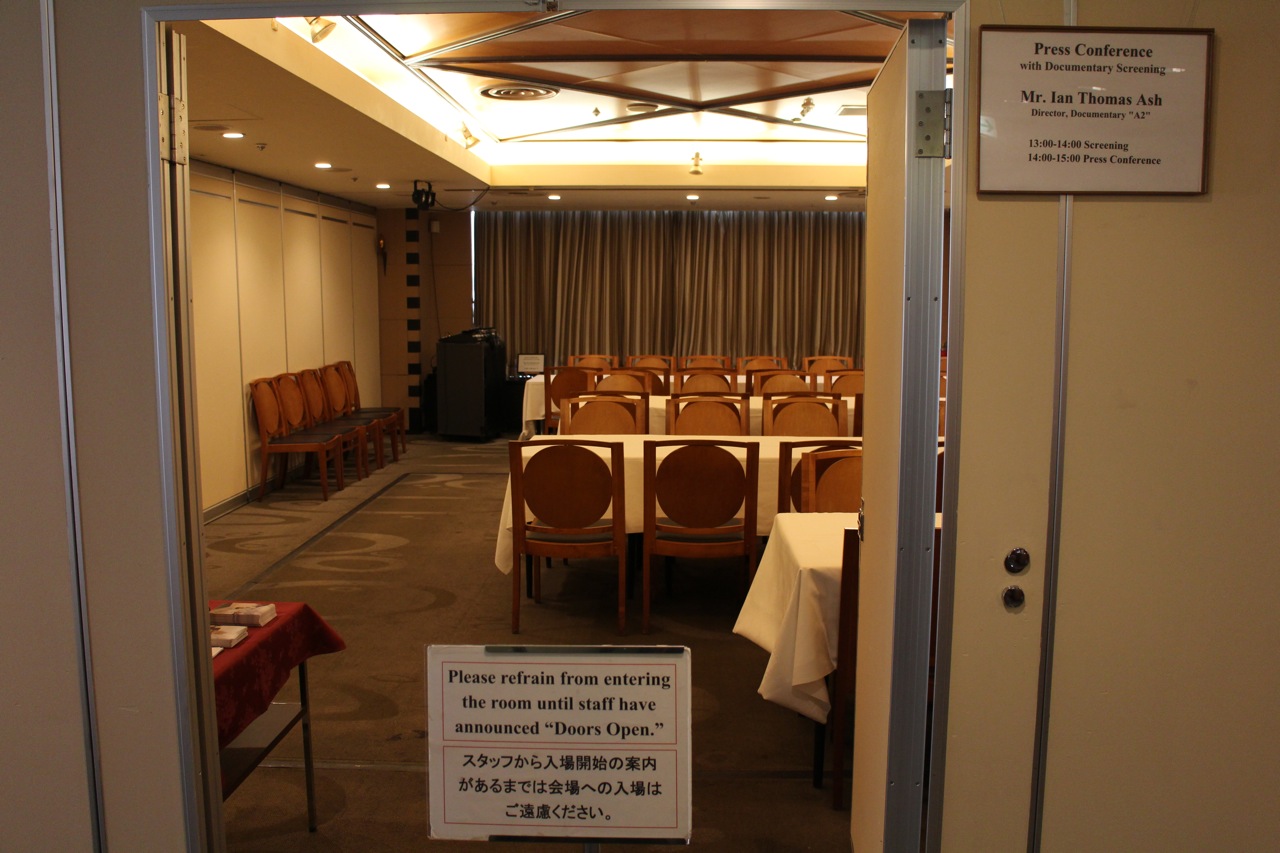
The preview screening and press conference of my feature documentary ‘A2’ (WEBSITE) was held today at the Foreign Correspondent’s Club of Japan (press release HERE).
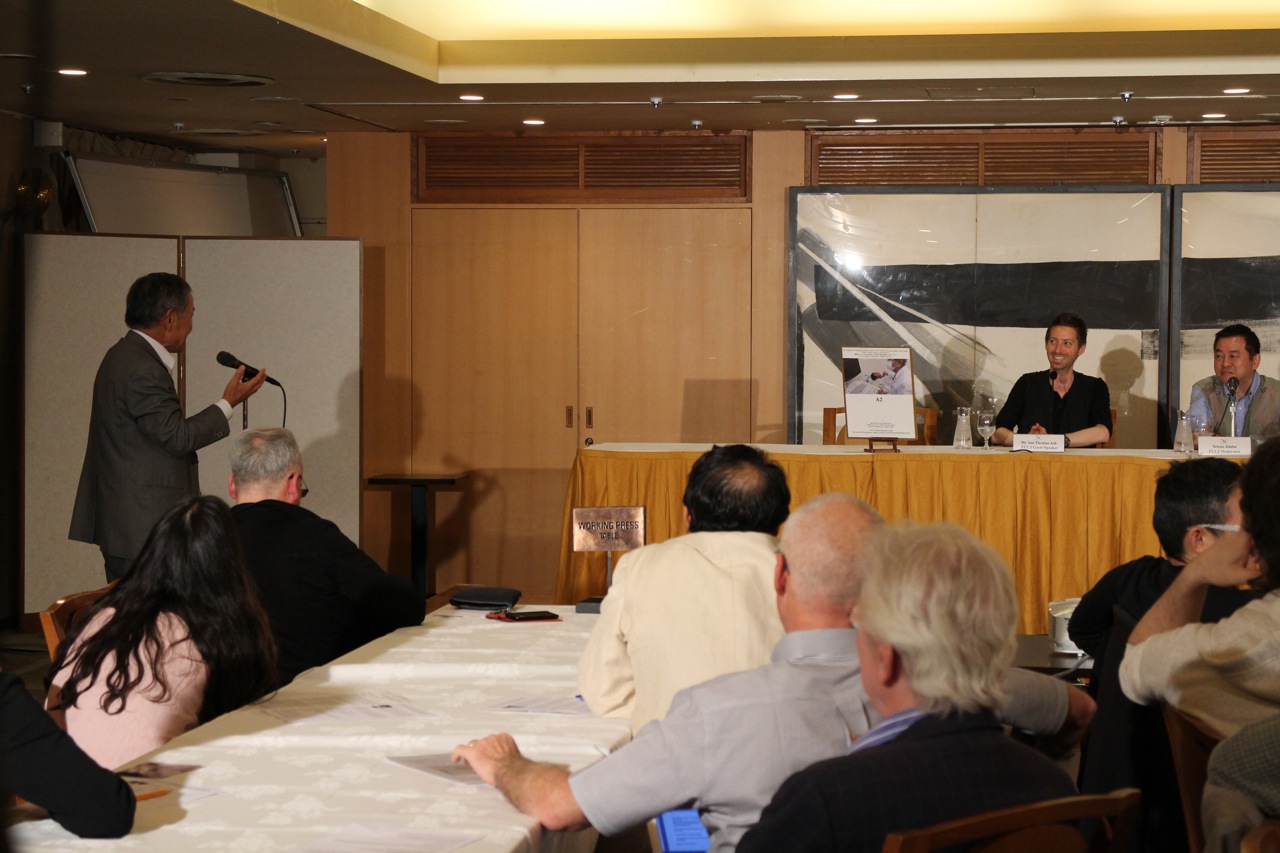
There were a total of 88 press club members and their guests in attendance. It was an immense honour to have my work screened by my colleagues, and an additional honour to have the opportunity to receive their questions during the press conference that was led by journalist Tetsuo Jimbo.
Photo: Chiemi Takahashi
One of the highlights of the press conference was when Mr. Mitsuhei Murata (pictured below), the former Japanese Ambassador to Switzerland, stood up to speak. Last year I had the honour of hearing Mr. Murata give a press conference, and I have followed closely his work in trying to bring about transparency following the nuclear meltdown in Fukushima.
Mr. Murata complimented my film and then asked an interesting question:
“Given the continued precariousness of the damaged nuclear power plant in Fukushima, do you think the government should be bidding to hold the 2020 summer Olympics in Tokyo?”
Photo: Chiemi Takahashi
After the press conference, there was time to exchange business cards and speak freely with those in attendance. There was talk of featuring my work in news articles, speaking at a local university and even of bringing the film (and me!) to Switzerland as part of an educational program.
I am so humbled and honoured at the interest in my work and am thankful for all of the support and encouragement I have received over the past two years. Peace.
The Japanese limits are based on the assumption that 50% of nationally distributed foods are contaminated
[…]
A suggestion of a member to introduce additional values for food corresponding to non-accidental situations,such as releases of radioactive effluents,was not supported, as it was noticed that such releases are under regulatory control.
[…]
One member suggested reconsidering the previous situation of the GLs in 1989 with a single food category, as that was protective of both infants and adults. Other members of the eWG did not support this proposal, stating that society expects infants and young children to receive better protection.Another member proposed to add the category of dairy foods. There was also no support for this suggestion. Both members withdrew the proposals
[…]
Besides, most drinking water originates from groundwater that will not suffer from direct contamination from fallout, and the presence of different sources of drinking water makes is possible to refrain from contaminated water.
[…]
Various suggestions were made for improving the annexes, like adding better clarifications of arguments of choices such as the intervention exemption level of 1mSv/year and the age-dependent ingestion dose coefficient, and the elaboration of the definition of “minor foods”.
[…]
As it was concluded not to change the current GLs of radionuclides in foods into MLs, and not to change the present approach using GLs for groups of radionuclides to be assessed independently, and not to change the current values, it is recommended to the 7th to consider to discontinue the work on the revision of GLs for radionuclides in the GSCTFF
[…]
There is no new scientific information that supports the need of a new risk assessment.
[…]
Image source ; the IAEA
JOINT FAO/WHO FOOD STANDARDS PROGRAMME
CODEX COMMITTEE ON CONTAMINANTS IN FOODS
Seventh
Session
Moscow, Russian Federation, 8
–
12 April 2013
The Committee noted the importance of involving theInternational Atomic Energy Agency (IAEA) and other relevant organizations in this work
To comply with the request ofthe 6th CCCF the chairs of the Netherlandsand Japan have contacted the IAEA in this regard. The IAEA assured its cooperation regarding the scientific background of the paper.
Codex GL is the maximum level of a substance in a food or feed commodity which is recommended by the Codex Alimentarius Commission (CAC)
ML is the maximum concentration of a contaminant in a food or feed commodity, recommended by the CAC to be legally permitted in that commodity.
MLs shall only be set for those foods that contribute significant for the total exposure of the consumer.
According to the CAC the preferred format of a Codex standard in food or feed is an ML. Existing or proposed Gls shall be reviewed for conversion to a ML after a risk assessment is performed by JECFA, if appropriate
The Gls presented in the Committee on Contaminants in Foods (GSCTFF) are for radionuclides in “infant foods”and “foods other than infant foods”. According to the text of the GSCTFF these levels apply to radionuclides in foods for human consumption and traded internationally, which have been contaminated following a nuclear or radiological emergency. The levels are based on an intervention exemption level of 1mSvin a year, assuming that a maximum of 10% of the diet consists of contaminated food.
The activities of each radionuclide in the same group should be added together, but each group should be treated independently.
Image from PDF
In the comments it is stated that the levels do not include all radionuclides. Included are those emitted from human activities and important for food for human consumption. Radionuclides from natural origin are excluded from consideration.
In Annex1 to radionuclides int he GSCTFF, the scientific justification for the Gls is given. Annex2 describes how the human internal exposure can be assessed when the Gls are applied:how the intake of radioactivity in foods (Bq) can be converted into the internal dose in humans (mSv).
Immediately after the accident at the Tokyo Electric Power Company’s Fukushima Daiichi Nuclear Power Planton 11March 2011, the Japanese Government set provisional regulation values by adopting the “Index relating to limits on food and drink ingestion”which had been determined by the Japanese Government in preparation for nuclear emergencies on a basis of an intervention level of 5mSv/year.
On 1 April 2012, the Japanese Government adopted 1mSv/year consistent with the current Codex GLs as an intervention exemption level, and established new limits. The limit of total radioactivity attributable to Cs-134 and Cs-137 is 100Bq/kg for general foods, 50Bq/kg for milk and infant foods, or 10Bq/kg for drinking water. In comparison: the Codex GL of these two radionuclides in the GSCTFF is 1000Bq/kg.
The difference is largely due to the difference in assumed ratio of contaminated foods: while Codex targeting imported foods uses 10%; and Japan targeting domestically produced foods uses 50%.The other important cause of difference is how radionuclides other than radioactive cesium are dealt with: Japan established limits for a total of cesium-134 and cesium-137 taking into consideration a factor of 1.2 to cover other radionuclides.
The United States says it has completed a transfer of 75 kilograms (165 pounds) of salt coolant material to the Czech Republic as part of cooperation between the two countries in developing new nuclear reactors.
The U.S. Embassy in Prague says the fluoride salt comes from the Department of Energy’s Oak Ridge National Laboratory and will be used for experiments at the Czech Nuclear Research Institute in Rez near Prague.
The TriHyBus is the product of a cooperation agreement between Czech nuclear research institute Rez, Skoda Electric, Linde Gas, Veolia Transport, Proton Motor (Germany) and IFE Halden (Norway). 2009
In Friday’s statement, it says both countries will share the results of the testing, the goal of which is to help “U.S. and Czech research and development on a new generation of more efficient, high temperature, lower cost and passively-safe reactors.”
The move follows President Barack Obama’s 2009 speech in Prague during which he called for international civil nuclear cooperation.
Little progress in Fukushima radiation cleanup An NHK survey has found that little progress is being made to clean up radioactive material in areas near the Fukushima Daiichi nuclear power plant. Work is underway in 47 municipalities in Fukushima Prefecture. The national government is in charge of restricted areas near the plant. Municipalities take charge of outer areas. The government has carried out cleanup in around 4 percent of the land in the restricted areas. Municipalities have cleaned up nearly 5 percent of houses that need to be decontaminated.
US approves shale gas exports to Japan The US Energy Department has for the first time approved exports of liquefied natural gas to Japan. Friday’s decision defies the long-held US policy of not allowing shipments of LNG to non-free trade agreement countries. Should the plan proceed, exports of cheap natural gas from the southern US state of Texas will begin in 2017.
US anxious to sell nuclear technology to Vietnam The US government has dispatched a senior White House official and members of the domestic nuclear power industry to Vietnam with the aim of exporting its technology. Under Secretary of Commerce Francisco Sanchez and representatives of the private sector took part in a nuclear power-related seminar held in Hanoi on Friday to brief participants on what the US has to offer.
JAEA head quits over Monju ills The president of the state-run Japan Atomic Energy Agency resigned Friday over the body’s failure to properly inspect the troubled Monju prototype fast-breeder reactor in Tsuruga, Fukui Prefecture, science and technology minister Hakubun Shimomura said. http://www.japantimes.co.jp/news/2013…
San Onofre at the No Nukes Brink In January, it seemed the restart of San Onofre Unit 2 would be a corporate cake walk. With its massive money and clout, Southern California Edison was ready to ram through a license exception for a reactor whose botched $770 million steam generator fix had kept it shut for a year. But a funny thing has happened on the way to the restart: a No Nukes groundswell has turned this routine rubber stamping into an epic battle the grassroots just might win. http://www.commondreams.org/view/2013…
Hanford waste moved across town with parade permit When organizers put on their annual Cool Desert Nights car show and parade in Richland, they need a permit. When the Department of Energy and its contractors want to truck radioactive waste short distances, they need the very same permit. http://www.king5.com/news/Hanford-was…
Bad Radioactive Waste Bill Increases Threats to Texas Read more:The Gilmer Mirror – Bad Radioactive Waste Bill Increases Threats to Texas
The nuclear disaster at Fukushima, Japan is far from over. Our guest, Mari Inoue, Esq. will give an update on the ongoing challenges of Fukushima and discuss the lack of an international framework to protect local citizens from being exposed to high-level radiation in the future. Ms. Inoue is a New York based lawyer specializing in immigration law and a representative of the New York office of Human Rights Now.
Editor’s note: This is the 12th part of a new series that has run in the past under the title of The Prometheus Trap. This series deals with how pets and livestock fared in the evacuation zone around the Fukushima No. 1 nuclear power plant. The series will appear on Mondays, Wednesdays and Fridays.
***
Starting in May 2011, veterinarian Seido Watanabe of Tomioka, Fukushima Prefecture, repeatedly entered the no-entry zone around the crippled Fukushima No. 1 nuclear plant along with people affiliated with the nuclear power industry and Diet members.
He saw many dead cattle in their pens. Horrendous odors emanated from the enclosures, which were infested with maggots and flies. Seeing the scenes, however, Watanabe felt unmoved. “If the cattle died, their suffering ended here,” he thought.
What did pain him was seeing cattle that were leisurely grazing, but would be soon put down.
Watanabe did not understand why the cattle had to be killed just because they were exposed to radiation.
“We will return to Tomioka in the future,” he thought. “Even if it is impossible to ship adult cattle, we could ship calves someday. By doing so, we will reconstruct our town. For the reconstruction, we should refrain from killing cattle.”
Watanabe called livestock farmers who were acquaintances. Sometimes, he went to evacuation centers where those farmers were staying. In his discussions with them, he persuaded them not to give their consent to putting down their cattle.
Yasuaki Tashiro, 59, a livestock farmer of Tomioka, thought that what Watanabe was saying was correct.
While working in the Fukushima No. 1 nuclear power plant, he was raising cattle with his wife. He even gave names to 12 head of cattle, and took care of them, petting their heads each day.
Though the cattle were “tools of his job,” he regarded them the same as he did the pets he had affectionately taken care of for more than 10 years. Even if he was ordered by the central government to kill his cattle, he would not be able to obey the directive.
On a bus for evacuees’ temporary return to their houses, however, Tashiro overheard the conversation of two passengers. “My storehouse for miso (fermented soybean paste) was damaged by cattle,” one said. The other replied, “My garden trees were damaged.”
Tashiro was shocked by the reality that roaming cattle were causing damage throughout the area, though the nuclear accident in reality was what created the situation.
Later, Tashiro knew that the Tomioka town office was receiving complaints about wandering cattle. He also heard a rumor that some residents were considering demanding that livestock farmers pay compensation.
“Is our desire not to kill our cattle preventing reconstruction (of our town)?” Tashiro asked himself. After thinking seriously about the issue, Tashiro called veterinarian Watanabe, and said, “It is impossible to continue opposing the killing of our cattle. We have to give up.”
Tashiro was eager to improve the quality of the meat and milk coming from cattle. His willingness was having a positive effect on other livestock farmers.
“If Tashiro, who was carefully taking care of his cattle, concluded that there is no other way except for killing them, I must respect his conclusion,” Watanabe thought.
On July 29, 2011, the veterinarian wrote in his diary, “White flag” (meaning surrender).
Some scientists and stock farm operators began to round up cattle, which had been exposed to radiation, without killing them to study any radioactive materials in their bodies. However, Watanabe began to distance himself from such activity.
* * *
The previous installments of this series are available at:













 nuclear-news