The Medical and Ecological Consequences of the Fukushima Nuclear Accident; March 11, 2013, 9:00am to 6:15pm EST
LIVE STREAM HERE: http://www.totalwebcasting.com/view/?…
Press Conference: People were trying to commit suicide aboard USS Reagan during Fukushima mission — Some tried to get off ship — It was living in fear every day, it was horrible (AUDIO) http://enenews.com/press-conference-p…
U.S. Navy Sailor: They had to remove three layers of skin off my hands and arms after Fukushima exposure — Treated almost as if I had the plague (AUDIO) http://enenews.com/navy-sailor-press-…
Thank you Jrae50021 http://www.youtube.com/user/jrae50021 for this upload from Dr. Helen Caldicott’s Foundation Fukushima Symposium.
The Medical and Ecological Consequences of the Fukushima Nuclear Accident; March 11, 2013, 9:00am to 6:15pm EST
LIVE STREAM HERE: http://www.totalwebcasting.com/view/?…
Press Conference: People were trying to commit suicide aboard USS Reagan during Fukushima mission — Some tried to get off ship — It was living in fear every day, it was horrible (AUDIO) http://enenews.com/press-conference-p…
U.S. Navy Sailor: They had to remove three layers of skin off my hands and arms after Fukushima exposure — Treated almost as if I had the plague (AUDIO) http://enenews.com/navy-sailor-press-…
Title: Press conference with US Navy Quartermasters (retired) Maurice Enis and Jaime Plym
HELEN CALDICOTT FOUNDATION FUKUSHIMA SYMPOSIUM: 3-11-13 http://enenews.com/watch-live-stream-…
The Medical and Ecological Consequences of the Fukushima Nuclear Accident.
Steven Starr, a program director at the University of Missouri, presented data from Chernobyl that showed, 14 years later, that 40 percent of high school graduates suffered chronic blood disorders and malfunctioning thyroids. Starr predicted similar problems in Fukushima.
Activist physicians have accused the World Health Organization of downplaying the health impact of nuclear fallout from the Fukushima nuclear disaster.
In a New York symposium marking the two-year anniversary of the Fukushima nuclear plant explosion and meltdown in Japan, the physicians took issue with WHO’s conclusion in a recent report that it did not expect a significant surge in cancer in Japan or elsewhere due to radiation leaks, AFPreports.
“It’s a report that was meant to reassure people who, almost certainly, many will develop leukemia and cancer,’’ said Helen Caldicott, a prominent anti-nuclear activist whose foundation, the Helen Caldicott Foundation, co-sponsored the symposium, along with Physicians for Social Responsibility. “What is going to happen is there will be a high incidence of cancer and leukemia and genetic disease,” due to the leaks, she said.
The WHO report drew criticism from Japanese government officials because it projected an increase in some cancers among those living near the plant. Japanese officials said the report was based on faulty assumptions and would unnecessarily upset residents.
But Caldicott said the report, released February 28, understated the problem because of key issues it either “ignored’’ or “glossed over.’’
For one, she said, WHO did not take actual radioactive emissions into account, relying on estimates. The UN health body also did not examine the effects on children comprehensively, including what the impact would be of eating radiation-contaminated food over a lifetime. The agency also did not closely examine the impact on workers at the Fukushima plant or on people from the area who evacuated through the plume of radiation that came from the plant, she said.
“As a physician, I abhor what they’ve done,” Caldicott said.
The two-day conference at the New York Academy of Medicine marked the anniversary of the 9-magnitude sub sea earthquake and tsunami which rocked Japan on March 11, 2011, leaving nearly 15,881 people dead and 2,668 others still unaccounted for. The quake and tsunami damaged the cooling systems of the Fukushima nuclear plant, causing explosions of the reactor buildings and partial meltdowns in several units and spilling radioactive particles into the air, land and sea.
The first fuel assemblies for unit 1 of China’s Taishan plant have been produced by Areva. The EPR unit – the first of two currently under construction at the site – is expected to begin operating next year.
An EPR reactor core consists of 241 fuel assemblies, comprising over 63,850 fuel rods. Areva said that it has now completed the first of three production campaigns for Taishan 1’s fuel assemblies at its plant in Romans, France. The fuel will be delivered to the plant in 2014. Areva said that as it is a new type of fuel, the company had faced additional engineering and production challenges.
Areva CEO Luc Oursel commented, “We can all be proud to have achieved this milestone. I would like to congratulate all the Areva employees who have worked on this project, from assembly design to component supply, and production of the final assemblies.”
Taishan 1 and 2 are the first two reactors based on Areva’s EPR design to be built in China and form part of an €8.0 billion ($10.4 billion) contract signed by Areva and the Guangdong Nuclear Power Group (CGNPC) in November 2007. The Taishan project – 140 kilometres west of Hong Kong – is owned by the Guangdong Taishan Nuclear Power Joint Venture Company Limited, a joint venture between EDF (30%) and CGNPC.
First concrete for unit 1 was poured in October 2009, with the dome of the reactor building being lowered into place on top of the containment building in October 2011. In January 2013, Areva announced that installation of the heavy components – the reactor pressure vessel, the four steam generators and the pressurizer – had been completed within the reactor building. At that time, the company said that the construction of the unit had “entered a significant new stage.”
Unit 1 should begin operating in 2014, with unit 2 following in 2015. Two further EPRs are planned for the site.
Analysts say that predicting the direction of Japan’s atomic future is difficult and that J-Power’s decision is a risky one — even with a pro-nuclear party back in power — because a majority here opposes long-term nuclear dependence.
[…]
Their timing “was terrible,” said Hiroshi Takahashi, an energy industry expert at the Fujitsu Research Institute in Tokyo. “If I can make some advice to J-Power, it is to get out of nuclear power right now before they encounter even more problems.”
Video: Atsuko Ogasawara has watched a nuclear power plant be built from her yard for the past five years. Her choice to remain in her home is driven by her determination to carry on her late mother’s fight against nuclear power.
In Japan, two years after Fukushima nuclear accident, work resumes on new plant
OMA, Japan — At the remote northwestern tip of a snowy peninsula, beyond a small road of fishing shacks and empty one-story homes, 600 construction workers and engineers are building a brand-new nuclear plant for a country still recovering from the most severe atomic accident since Chernobyl.
The main reactor building is already at its full height, though draped in heavy fabric to protect it from the wind and freezing temperatures. A 500-foot crane swivels overhead. A completed power line stretches along a nearby ridge, where it might one day carry electricity down the peninsula and back toward the Japanese mainland — a place still fiercely divided over the long-term role of nuclear power.
In the aftermath of March 2011 meltdowns in Fukushima that contaminated 700 square miles with radiation and forced 150,000 to flee their homes, most never to return, Japan’s utility companies paused nearly all nuclear-related projects. The accident sparked a global debate about nuclear power, but it was especially fierce in Japan, where all 50 operable reactors were taken offline and work was halted on three new plants where building had been underway.
But two of the existing reactors are back in action, and the resumption of construction at the Oma Nuclear Power Plant here — a project that broke ground in 2008 and was halted by the operator, J-Power, after the accident — marks the clearest sign yet that the stalemate is breaking.
The green light for the new plan was, at its root, a bet by the energy company that Japan will come to again support and rely on nuclear power, which provided some one-third of Japan’s electricity before the Fukushima crisis.
Analysts say that predicting the direction of Japan’s atomic future is difficult and that J-Power’s decision is a risky one — even with a pro-nuclear party back in power — because a majority here opposes long-term nuclear dependence.
Still, experts see modest evidence of nuclear power’s resiliency. Japan has traditionally built its nuclear plants in far-flung towns that depend on the facilities for the subsidies and tax dollars — as well as the jobs — they bring. Consumers and big businesses fear the long-term economic pain of a nuclear phaseout — increased dependence on imported fossil fuels, annual trade deficits, higher energy bills.
At the national level, Japan has cycled through three prime ministers since Fukushima — the first fiercely anti-nuclear, the next moderately anti-nuclear, the current one cautiously pro-nuclear. The previous ruling party tried last fall to plot a nuclear phaseout by the 2030s, but anti-nuclear advocates say the pledge was watered down to the point of being meaningless. The new prime minister, Shinzo Abe, plans this month to convene the latest in a series of expert panels to help overwrite the phaseout plan, and its makeup suggests that he prefers a role for nuclear power.
Paladin Energy Ltd., PDN.AU -3.74% whose shares are listed in Toronto and Sydney, operates another Namibian uranium mine, known as Langer Heinrich. In the last quarter of 2012, Paladin lost $147.6 million, compared with a profit of $3.2 million a year earlier. The loss included a write-down of $96 million on a mine in Malawi “due to the continued low uranium price,” the company said. Paladin’s stock-market value has shrunk to under $1 billion from $9 billion in early 2007.
“We’re still recuperating post-Fukushima,” said Mark Chalmers, the company’s production general manager. Paladin is cutting costs by deferring some construction projects, managing inventories, reducing the number of contractors and increasing volume to cut unit costs.
NAMIB DESERT, Namibia—Martin Hirsch kicks a loose rock. “Uranium,” says the 56-year-old German geologist with a smile, wiping his sweaty forehead under the baking sun. “And watch out for the snakes.”
John W. Miller/The Wall Street JournalDavid Oliver,a metallurgist at a Paladin Energy mine in Namibia that has been wracked by lower uranium prices.
By an accident of geology, this tiny African desert republic of 2.1 million people is one of the world’s top five uranium producers. It accounts for about 10% of the global supply of nuclear fuel, trailing Kazakhstan, Canada and Australia and running neck-and-neck with Niger.
Namibia’s costs are also the highest of any major producing country. “Namibia has desert locations that are expensive and hard to get to, so if the uranium price is much under $70 a pound, it’s going to be a tough place to turn a profit,” says Rob Chang, an analyst at Cantor Fitzgerald.
The current index price: $42.25 a pound, pressured by, among other things, a pullback in nuclear power by several big countries.
The country’s two major operating uranium mines are losing money. One is controlled by giant Rio Tinto. The company said this month it would lay off about 276 people, or 17% of its workforce, at the Rössing mine in Namibia because of falling prices. The start of a third mine in the country, owned by French nuclear giant Areva SA, AREVA.FR +0.35% is delayed pending a pickup in prices.
Mr. Hirsch and his employer, so-called junior mining company Forsys Metals Corp. FSY.T -2.90% of Toronto, have yet to find an investor willing to invest $460 million needed to build the two mines and a processing plant it hopes to operate in the country. So-called junior miners like Forsys explore and map out a geological deposit before securing a partnership or sale with a major mining company with the capital needed to develop the mine.
A crisis of confidence in the nuclear-power industry, set off by Japan’s Fukushima Daiichi disaster in March 2011, has trickled down to Namibia, where uranium accounts for 12% of the country’s exports.
Uranium prices are down 70% over the past six years, while most other minerals have gotten stronger. Iron-ore prices, for example, have quadrupled. Prices first took a hit with the global financial crisis. Then the Fukushima disaster nixed a recovery, putting all but two of Japan’s 50 reactors out of service and triggering safety shutdowns at many reactors elsewhere.
That reduced uranium demand even as supply grew as a result of the past decade’s mining boom. Though reactors are still being built in China and Saudi Arabia, among other places, Germany is phasing out its nuclear program by early next decade due to environmental concerns.
In addition, Russia is still unloading uranium from discarded nuclear weapons for use as reactor fuel, as part of a 1993 disarmament treaty. Russia exports up to 24 million pounds of uranium a year—or one-fifth of global supply—according to the terms of the treaty. That program expires at the end of 2013, which could be a boon to uranium miners.
EPISODE BREAKDOWN: On this episode of Breaking the Set, Abby Martin talks to Jim Riccio, Nuclear Policy Analyst at Greenpeace USA, about the ongoing nuclear crisis in Fukushima, Japan and why the world continues to pursue nuclear energy given the dangers associated with the technology.
Abby then talks to Christopher Noland, Director of the film ‘3.11: Surviving Japan’, about the 2nd anniversary of the Fukushima nuclear disaster and how dangerous radiation levels continue to affect local residents today.
BTS wraps up the show with a look at milk, it’s association with radiation and the facts pointing at how milk consumption is unnatural and certainly doesn’t do your body good.
“Ukraine and especially Belarus are not known for their nuclear safety, so the establishment of the one milliseivert factor is amazing in comparison to what the nuclear savvy government of Japan is proposing,” said Bøhmer.
Eiko Kanno, an evacuee from the area of the Fukushima nuclear plant speaking
FUKUSHIMA PREFECTURE, Japan – Two years ago on March 11, Hiroshi Kanno, 72, was fixing the roof of his garlic drying shed on his farm near the village of Iitate in Japan’s Fukushima prefecture when he heard what he called a sound in the earth that echoed off the jagged mountains whose trees were just beginning to show signs of spring foliage amid a light snow cap.
Immediately he sensed an earthquake. He was right.
“The buildings started jumping, my little truck started dancing and I was thrown to the ground,” he told Bellona in an interview on the second anniversary of the disaster at the Fukushima Daichii Nuclear Power Plant here in Fukushima City, to where he was relocated.
“As I was on the ground, I could feel the earth moving in my hands,” he said. “The vibrations lasted for 10 minutes.”
When it was apparent the worst of the tremors had ended, he jumped in his truck and drove to is farmhouse and fortunately found it still standing. But there was no electricity, or phone and mobile towers had been destroyed. He returned to the television he had in his truck to get information, and heard there was an imminent threat of a tsunami.
Hiroshi Kanno speaking with Bellona in Fukushima City.
Nils Bøhmer/Bellona
The 9.0 earthquake off the coast of eastern Japan ultimately claimed 15,881 lives, and according to figures release by Japanese media today, some 2668 still missing, the Japan Times reported Monday. Some 160,000 were set adrift from Fukushima prefecture over the ensuing days due to radiation leaks.
As Kanno was only 35 kilometres from Fukushima Daichii, he said his worries went directly on the fate of the nuclear plant. The 11-meter tsunami did come, and destroyed all power to the plant leading to three reactor meltdowns and enormous cast-offs of radiation.
“I was more worried about what would happen to the nuclear power plant than even cities,” he said. The next day brought even more bad news. He watched on television as hydrogen explosions destroyed the reactor buildings of the Fukushima plant’s reactor Nos 1, 2 and 3, signalling meltdowns. He also worried for the fate of Fukushima prefecture’s other nuclear power plant, Fukushima Daini, which switched off during the quake.
“Had both plants gone, it would have taken half of Japan,” he said.
The Hanford Nuclear Salute – UP YOURS http://www.youtube.com/watch?v=0ARqqA…
thank you artrant https://www.youtube.com/user/artrant on YouTube for your Excellent Presentation of the RT news coverage of such a terrible situation we find ourselves in.
He’s a GREAT Artist, by the way, and has a keen eye for all things nuclear. Please subscribe to him if you wish. 🙂 I love his art and his videos.
Chernobyl study shows need for caution in Fukushima http://www.japantimes.co.jp/text/nn20121114f2.html# UKO27Xhzxqg.twitter Kyodo A study released Thursday by a U.S. research team links protracted exposure to low-level radiation to a higher risk of leukemia among workers engaged in the cleanup of the 1986 Chernobyl nuclear disaster, and points to the need to protect those involved in dealing with the Fukushima crisis. In the U.S. study, scientists did a follow up health survey covering 110,645 clean up workers through 2006 and found 137 developed leukaemia…….
Fukushima workers with high internal radiation doses
High thyroid radiation doses in 178 Fukushima workers Asahi Shimbun, December 01, 2012 By YURI OIWA Dozens of workers received potentially cancerous doses of radiation to their thyroid glands during recovery work at the Fukushima No. 1 nuclear power plant, according to data submitted to the World Health Organization.
Tests on workers suspected of having high whole-body internal doses found 178 individuals whose thyroid glands displayed doses greater than 100 millisieverts, the generally accepted threshold for a raised risk of thyroid cancer…….
A man in his 50s hopes that a new government to be formed after the Dec. 16 Lower House election will protect the health of workers like himself at the stricken Fukushima No. 1 nuclear plant […]
The man said workers at the Fukushima No. 1 plant are being exploited. […]
“Many people work without seeing a doctor because they fear they might be told not to come anymore from the next day,” he said. “It is a distortion caused by the layers of subcontractors involved. I want the government to protect us.” […]Man in his 40s who worked at the plant until recently……
Shortage of workers at Fukushima nuclear plant resulted in high radiation exposure
Worker shortages revealed at nuclear plant after disaster http://www.yomiuri.co.jp/dy/national/T130113003104.htm 14 Jan A manager’s calls for reinforcements to help contain a series of crises at Tokyo Electric Power Co.’s Fukushima No. 1 nuclear power plant were ignored, newly released TEPCO teleconference footage has revealed…..
Workers say Fukushima radioactive debris dumped in a river
Fukushima cleanup workers break silence: Ordered to dump ‘debris’ into river — Gov’t “appeared not to believe him”http://enenews.com/fukushima-cleanup-workers-break-silence-ordered-to-dump-debris-into-river-govt-appeared-not-to-believe-him March 2nd, 2013 Asahi Shimbun,, March 1, 2013: CROOKED CLEANUP:Workers break silence to allege boss ordered corner-cutting […] Three laborers involved in radioactive cleanup around the Fukushima No. 1 nuclear plant have alleged that a supervisor told them to dump debris in a river […] At a news conference in the Diet building on Feb. 28, the men said a foreman ordered them to discard fallen branches and leaves into a river in an upland forest in Tamura, Fukushima Prefecture, in November 2012. […] this is the first time that decontamination workers have publicly come forward. […] The third man, in his 40s, said he related what had happened to officials at the Environment Ministry. He spoke to them for more than an hour, he said, but they appeared not to believe him. […] See also: Asahi: River turned brown after dumping radioactive waste into water — “I was following an order, I am sorry for polluting
Misleading information masks true level of radiation received by Fukushima workers
63 workers exposed to higher radiation than logged in their records, March 02, 2013, THE ASAHI SHIMBUN by Toshio Tada and Jun Sato Dozens of workers at the crippled Fukushima No. 1 nuclear power plant were exposed to radiation levels higher than those registered in their personal records, according to a health ministry investigation.
Misleading information was kept in at least 63 cases….. In the largest discrepancy, one worker’s monthly exposure was revised from 4.4 millisieverts to 6.35 millisieverts. Those whose records are not updated could end up working at a nuclear facility beyond the legal annual limits for radiation exposure.
The number of workers with inaccurate personal radiation exposure records is expected to increase because the ministry has yet to start an investigation into the eight-month period immediately following the disaster that unfolded in March 2011….
High radiation levels prevent workers from entering Fukushima nuclear reactors
Inside Fukushima two years on: radiation levels too high to enter reactors Telegraph UK, 6 March 13,Two years on from the second-worst nuclear disaster in history, The Telegraph’s Julian Ryall visits the Fukushima nuclear plant to see what progress – if any – is being made. By Julian Ryall, Fukushima Nuclear Plant, Japan
Radiation levels within three of the reactor buildings at the Fukushima Nuclear plant in Japan are still too high for people to start decommissioning the reactors, two years on from the second-worst nuclear disaster in history.
Scientists still do not have a firm understanding of the precise conditions of the reactor cores in three of the six units at the Fukushima Daiichi plant, and are resorting to using remote-controlled vehicles to get inside the tangle of wires, pipes and rubbles that has lain untouched since the tsunami tore through the facility….
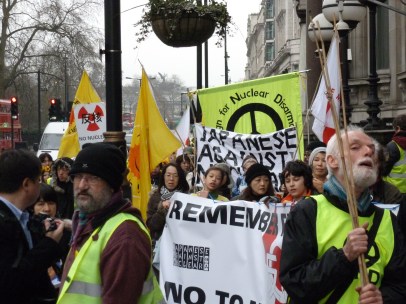
Ladies and gentlemen, it is a great pleasure to send my message to all of you who have gathered here today in London.
It has been two years since the onset of the Fukushima nuclear catastrophe. However, this nuclear crisis is far from over. Every day, highly damaging amounts of ionizing radiation are released into the environment from the stricken Fukushima Daiichi Nuclear Power Plant. At this plant, the workers – our husbands, brothers and sons are daily exposed to high concentrations of radioactivity.
The great majority of decontamination projects in Fukushima Prefecture have not yet started.
Many children are trapped in highly contaminated areas due to the government policy.
Radioactivity in these areas is comparable to, or above the level of the current compulsory evacuation zone in Chernobyl.
Housing assistance for evacuees living outside Fukushima prefecture is to be terminated to influence them to return to contaminated areas.
The International Atomic Energy Agency and the Japanese Government jointly held a conference in Fukushima and discussed ways to conceal the extent of nuclear devastation.
The New Japanese government is also eager to expand unclear technology.
This all adds to the anger and despair in our hearts.
It is however a great comfort to know that far away, in London, people are standing beside us.
We must never allow the tragedy of Fukushima to be repeated.
It is people like you and I who can stop the dangerous development of nuclear power. We would like to walk with every one of you towards a nuclear-free society.
Ladies and gentlemen, it is a great honour to address all of you who have gathered here today in solidarity with Fukushima and our anti-nuclear movement. Your actions to support us across Europe give us courage and strength.
The new Japanese government is debating an Energy Bill with total disregard to the tragedies and lessons from the Fukushima nuclear catastrophe. They are returning to the old pro-nuclear stance that resulted in the current disaster. We say “No!” to such inhumane and insane policies.
Since the explosions at Fukushima Daiichi, ionizing radiation has contaminated everything. It’s poisoned the air, the sea, the rivers, the soil, and the forests. It has driven people from their beautiful land and beloved homes for ever. The people are suffering, both materially and spiritually. The radiation has also been spreading across the globe.
The terror of nuclear damage is continuing to emerge. Fish are still highly contaminated, and some children have already developed thyroid cancer. In no time, we will be hearing about nuclear casualties amongst workers in the clean-up operation. Despite such profound tragedies, with no end in sight, the new government is poised to restart nuclear reactors for short term economic gains. Nuclear energy has no future and is destined to become extinct. It is extremely dangerous. It will soon destroy its nuclear-dependent economies.
We want to exchange materialism for sustainability. We want to live in harmony with others rather than sacrificing them. We want to live with respect for all living things around us.
Nuclear power is a by-product of nuclear weapon making. It is a crime against life, and a blind worship of man’s ability to manipulate nature. Three Mile Island, Chernobyl and Fukushima have proven that we cannot control nuclear fission. Repeating the same mistake would be criminal and a proof of our fatal arrogance and ignorance. How many more disasters can we have before annihilating ourselves and the earth?
Over the past two years, we have been campaigning for a nuclear free society, with help from many conscientious and rational people like you here, both within and outside Japan. Nuclear power will destroy our future if we allow it to continue, but together, we shall get rid of it!
Together, let us stand with the people of Fukushima who bear the major burden of nuclear brutality. Let us show our solidarity by joining in their struggle. We are walking towards a nuclear free world. Thank you.
Many fellow Japanese citizens and myself salute you in solidarity. We have been protesting against nuclear power in Japan, a nuclear slave state. You have been campaigning against nuclear energy in Britain, a major nuclear master state.
We must not die before getting rid of the nuclear curse. We will fight for our children and future children so that they can live in a world full of hope.
Japan has enough nuclear materials to annihilate the world many times over. The unfolding nuclear catastrophe in Japan is being ignored, and TEPCO’s crime remains unpunished.
The Japanese nuclear empire is powerful. In collusion with the financial, industrial, political, legal and media sectors, they are poised to continue nuclear development. This, despite the fact Japan is a land of earthquakes and is undergoing an active seismic phase.
It is unacceptable that we, the 99%, are sacrificed for the greedy 1%. They love nothing but money and do not care about the future.
We are all united against the nuclear evil.
We send to you all in Britain our warmest support and heart-felt respect from Japan.
After the nuclear attacks on Hiroshima and Nagasaki the world became aware that exposure to radiation could cause sickness and death. However, the United States government was able to limit this awareness through the careful managing of public perceptions. It was the prompt burst of gamma radiation from the detonation of a nuclear weapon that caused the radiation sickness among the hibakusha, the survivors of the nuclear attacks claimed US experts. This prompt burst lasted only seconds following the moment of detonation. The fact that people continued to live in Hiroshima & Nagasaki after the attacks seemed to reinforce this belief. The truth is that even before these attacks, after the Trinity Test in July 1945 Manhattan Project employees had traced the deposit of downwind radioactive fallout in the area surrounding the test site. Cardboard boxes made from strawboard from a field over 1,000 miles away in Illinois that had been contaminated with fallout from the Trinity Test had blurred film later packed in the boxes by the Eastman Kodak company.1
Rongelapese (Marshall Islands) child exposed to radiation from the Bravo Test
The US managed to keep awareness of downwind fallout relatively secret for almost ten years. That ended with the Bravo Test at Bikini Atoll in 1954. Bravo tested the first deliverable H-bomb and produced such an immense amount of downwind radioactive fallout that its presence could not be managed or denied.2 That doesn’t mean the US did not work feverishly to both manage and deny awareness of fallout. The Bravo cloud engulfed hundreds of fishing boats located outside of the protective exclusionary zone, but one boat in particular, the Lucky Dragon #5 (the Daigo Fukuryu Maru) would be so contaminated that it became impossible for the US to control perceptions of what had happened to the boat and crew. Thirteen days after the Bravo test the boat pulled into port in Yaizu, Japan with the entire crew suffering from radiation sickness, one of whom would die weeks later from his exposure. Until that day the US had succeeded in keeping a very tight lid on awareness of the radiation disaster, even though whole populations of downwind atolls in the Marshall Islands had all been exposed and evacuated (many military personnel were also exposed). The simple fact of the contaminated and sick crew of the Lucky Dragon brought awareness of what had happened in the Marshall Islands to the world’s attention.
Responding immediately, and strictly focused on containing information and awareness, the US Atomic Energy Commission (AEC) feverishly denied the obvious. AEC Chairman Lewis Strauss first claimed that the crew was sick because of a “chemical” reaction of undersea coral in the explosion and not exposure to radioactivity. As the wonderful historian of worldwide antinuclear movements Lawrence Wittner reports:
The chair of the AEC, Lewis Strauss, publicly declared that the Marshall Islanders were “well and happy.” The Japanese fishermen, he conceded, had experienced a few minor problems; but, in any case, he stated falsely, they “must have been well within the danger area.” Privately, he was more caustic. The Lucky Dragon, he told the White House press secretary, was really a “Red spy outfit,” a component of a “Russian espionage system.” At the request of Strauss, the CIA investigated this possibility and categorically denied it. Nonetheless, Strauss continued to maintain that the irradiation of the Lucky Dragon ‘was no accident,’ for the captain of the vessel must have been “in the employ of the Russians.” He also told authors to ignore the contention of the “propagandists” that a crew member of the vessel had died of radiation exposure.3
On the second anniversary of the Fukushima Daiichi nuclear disaster in Japan, Dr. Helen Caldicott is hosting a two day symposium on “The Medical and Environmental Consequence. The symposium will be Live Webcast.


![[image]](https://i0.wp.com/si.wsj.net/public/resources/images/MK-CB509_URANIU_NS_20130311165104.jpg)






 On the second anniversary of the Fukushima Daiichi nuclear disaster in Japan, Dr. Helen Caldicott is hosting a two day symposium on “The Medical and Environmental Consequence. The symposium will be Live Webcast.




 nuclear-news