The ongoing Fukushima nuclear disaster: Eyewitness Report

Published on May 28, 2013
Host Margaret Harrington speaks with Arnie Gundersen of Fairewinds Energy Education, and Chiho Kaneka, Artist and Journalist, who has been to Fukishima several times after the disaster and Chikako Nishiyama who lives near Fukushima-Daiichi who gives an eyewitness report on the current status.
Failing Uranium mining companies rely on China to help survive
….which estimates that 210 million pounds U3O8 will be needed by 2025 to fill a supply gap…..
…Zhou said that today’s market price is not a significant concern as he believes it is sufficient for new development. However, he also expects a market correction if one is needed to stimulate new production in the future…..

Image source ; http://www.smh.com.au/opinion/politics/play-the-china-game-or-lose-out-20101112-17q7t.html
Denver Post
MAY 29, 2013
DENVER, CO–(Marketwired – May 29, 2013) – Nuclear industry participants gathered in Beijing, China, for the 9th Annual China Nuclear Energy Congress (CNEC) on May 15-16, which focused on China’s nuclear power industry and culminated with a panel discussion moderated by TradeTech Business Development Director Bahi Sivalingham, which provided insight into supply and demand concerns in today’s global uranium market.
The panel discussed challenges of bringing new uranium mining projects into production, including the effects of today’s uranium market on exploration and development activities. Panelists included CNEC speakers Zhou Zhenxing, chairman of China General Nuclear Power Group and Chen Yuehi, vice general manager and vice director of China Uranium Corporation and China National Nuclear Corporation’s Department of Geology & Mining, as well as James Dobchuk, president of Cameco Inc., who all agreed that market price may play a pivotal role in the future uranium supply industry.
NKorea sanctions squeeze cash for aid groups
…The U.S. Treasury Department hit the North Korean bank with sanctions in March, effectively cutting it off from the U.S. financial system after accusing the country’s main foreign exchange institution of funding Pyongyang’s missile and nuclear programs….
“We are concerned regarding possible unintended effects of certain sanctions, in particular with regard to humanitarian assistance, and stress the need to overcome these unintended effects,”

May 30, 2013
PYONGYANG, North Korea (AP) — New international sanctions aimed at thwarting North Korea’s nuclear weapons program are having unintended consequences: halting money transfers by foreign humanitarian groups working to help those most in need and forcing some agencies to carry suitcases of cash in from outside.
At the same time, some restrictions are meant to sting the country’s elite by crippling the import of luxury goods, such as yachts, fancy cars and jewelry. But they do not appear to be stopping the well-heeled from living large in the capital Pyongyang.
Much of the aid group difficulties are linked to the state-run Bank of China’s decision earlier this month to follow Washington’s lead and sever ties with the North’s Foreign Trade Bank, the main money transfer route for most foreign organizations, U.N. agencies and embassies in Pyongyang. With that line cut, aid workers in North Korea say they are left with few other options to receive foreign currency for expenses including rent, bills and salaries for local staff.
The sanctions are not supposed to affect humanitarian aid, but six Pyongyang-based aid organizations headquartered in Europe issued a communique earlier this month spelling out their frustrations and calling the difficulties in transferring money to North Korea a “big problem.” They warned that they may be forced to suspend their operations if they cannot find ways to access cash. A handful of American non-governmental organizations also work in North Korea, but they cycle in and out and do not maintain a permanent presence.
Gerhard Uhrmacher, program manager for German humanitarian aid organization Welthungerhilfe, said when recent bank transfers failed, he managed to keep projects running by routing 500,000 euros ($643,000) to Chinese or North Korean accounts in China to pay for building supplies and other goods.
He said Welthungerhilfe, which signed the communique and works on agriculture and rural development projects in North Korea, has some reserves in Pyongyang but must also resort to carrying cash into the country by hand.
“It doesn’t give a good impression. We’re trying to be transparent, to be open to all sides and now we’re more or less forced to do something that doesn’t really look very proper because people who carry a lot of cash are somehow suspect,” said Uhrmacher who is based in Germany and has worked in North Korea for the past 10 years.
“Whatever you’re doing, everybody looks at you very closely,” he said. “That’s why we don’t like it because bank accounts are proper. Everybody can have a look at it and everybody can control it. Now we are forced to do something else.”
Some analysts said aid groups were simply “collateral damage” and that they will find a way to work around the sanctions as they have been forced to do in other countries. Others said the poorest North Koreas would be hurt if some humanitarian groups have to pull out of the country. The aid groups work on a range of issues from food security to improving health and assisting with disabilities.
Aid groups “may not provide as much support as governments, but they have the ability to reach the deep corners of the impoverished North where people are in most need,” said Woo Seongji, a professor of international relations at Kyung Hee University in Seoul. “Their help is both symbolic and substantial. It reaches kids, hospitals and food shelters that outside governments may not be able to support consistently because of political considerations.”
The U.S. State Department said Wednesday it was aware of the concerns of humanitarian groups and was exploring ways to address them. But spokeswoman Jen Psaki said the onus was on North Korea to provide for its people and make alternative financial services available to international organizations.
“This is essentially on the plate of the North Korean government which has made the decision not to provide funding and the necessary aid to their own people, which is the reason why this (aid) is so necessary from the outside,” spokeswoman Jen Psaki told reporters in Washington. “We are aware of the challenges. We want aid to make its way to the people of North Korea.”
The latest sanctions have added challenges to the already difficult system of getting money into North Korea since ally China has restrictions on how much foreign currency can be legally taken beyond its borders.
Sanctions and trade embargoes have long been used by the international community to put an economic squeeze on troublesome regimes from Iraq and Myanmar to Cuba. But they are a blunt tool that can unintentionally add to the suffering of people living under oppressive rule by hindering development and the delivery of aid.
How lethal are Pakistan’s nuclear weapons? How much damage would there be to india?
How lethal are Pakistan’s nuclear weapons? How much area would be immediately destroyed in a single attack?
h/t Geoff Olynyk and Joseph Boyle for links and commentary
So according to the Pakistan and weapons of mass destruction article on Wikipedia, Pakistan possesses four delivery mechanisms for a nuclear attack in the area:
- Medium-range ballistic missile (MRBM). Range, 2500 km. Estimated yield 300–500 kt (kilotons of TNT equivalent).
- Nuclear-tipped Babur cruise missiles. Range, 700 km. Yield – ?
- Nuclear bombs carried by fighter-bombers. Estimated yield up to 150 kt.
- Cruise missiles carried by fighter-bombers. Warhead estimated yield 20–25 kt.
The fighter-bombers likely drop 150 kt bombs or launch cruise missiles with 20–25 kt warheads. The most powerful warheads in Pakistan’s arsenal are estimated to have a yield 300–500 kt, delivered by the Ghauri-I MRBM:
Ghauri medium-range ballistic missiles.
Note that this would be a very similar yield to the U.S.’s most advanced warhead, the 475 kt W88. (Although the Pakistani one is probably much heavier due to the less advanced technology, and thus you can’t carry as many of them on a missile.)
As we start discussing the effects, keep in mind the pictures of the destruction in Hiroshima (the Little Boy bomb had a yield of 13 kt), and remember that a 500 kt weapon is nearly 40 times more powerful.
Effects of a 13 kt air burst.
They are also apparently working on a sea-launched cruise missile (a naval variant of the Babur) and a smaller nuclear warhead that can be put on Pakistan’s Chinese-made C-802 and C-803 anti-ship missiles, but these delivery mechanisms are not operational yet.
Taking the upper end of the estimated range of Pakistani warheads (500 kilotons) is convenient because the U.S. government published a bunch of graphs on the effects of a 500 kt blast in the report Nuclear Attack Environment Handbook (FEMA, August 1990). The graphics below are taken from here, which reproduces the FEMA book.
Here is an overview of the effects of a 500 kt surface burst:
There is heavy damage (5 psi overpressure) out to a radius of about 2.2 miles.
If they are smarter about it and detonate it 1.1 miles in the air (see Geoff Olynyk’s answer to Bombs: Why doesn’t the blast from a nuke take place on the ground?), the damage radius is larger:
There is now heavy damage out to a radius of 3.2 miles. The government also helpfully calculated the winds produced by a 500 kt air burst:
Sweden favours renewables to nuclear
“We have found a very cost-effective way to stimulate the development (of renewables), and they are driving down power prices.”

Image source ; http://www.treehugger.com/renewable-energy/sweden-to-build-2000-new-wind-turbines-aims-for-50-renewables-by-2020.html
30 May 2013
Reuters
Sweden’s government will not subsidise new nuclear power stations, the energy minister said, sticking by a policy that casts doubt on the sector’s long-term survival after the major operator sought to delay new investment.
The centre-right coalition government in 2010 overturned a nuclear phase-out policy, dating from the 1980s, by permitting construction of new plants to replace Sweden’s existing 10 reactors, which now provide about 40 per cent of its electricity.
But it insisted this would not involve financial support from the government, although the high initial costs mean companies hesitate to invest in nuclear without help.
Reflecting this reluctance, operator Vattenfall last week said it was seeking leave from regulators to run five of its seven reactors for a decade longer than planned, which would put off a decision on fresh investments.
Energy Minister Anna-Karin Hatt said the government had not changed its stance.
“There will be no public subsidies for new nuclear in Sweden,” Hatt said in an interview.
“We say to the market: it’s up to you to decide on the energy sources you want to invest in,” she added.
According to the International Energy Agency (IEA), Sweden must replace its ageing nuclear fleet between by 2022 and 2035, assuming an operational lifespan of 50 years for each reactor. Its policy on state support is unlikely to result in investment in new nuclear capacity.
“Very few examples of successful outcomes using such an approach exist and it is the reason why countries such as the United Kingdom have opted for introducing some price certainties for investors in nuclear power plant construction,” the agency, energy adviser to 28 industrialised countries, said in a report earlier this year.
Germany’s E.ON and Finnish utility Fortum also have investments in Sweden’s nuclear sector.
Head of company overseeing leaking nuclear tanks at Hanford to step down
….The Energy Department is building a $12.3 billion plant at Hanford to convert the dangerous waste to a stable form, but that project is years behind schedule….

Image source ; http://www.indeed.com/salary/Washington-River-Protection-Solutions.html
Posted 2013-05-30 03:08:36 –
by Isaac Ibiyemi
The disposal facility for mixed and low-level radioactive waste at the Hanford Nuclear Reservation in Washington State is shown in an aerial image.
The head of the contracting company responsible for containment tanks found to be leaking radioactive liquid at the Hanford, Wash., Nuclear Reservation announced his retirement Wednesday.
The head of the contractor overseeing cleanup operations at the Savannah River Site in South Carolina will replace Mike Johnson, president and project manager of Washington River Protection Solutions, or WRPS, Johnson said in an email message to employees obtained by NBC station KING of Seattle.
Johnson gave no reason for his retirement, which he said would take effect at the end of June.
WRPS has been the subject of extensive federal scrutiny since it was learned in February that at least six of 177 underground tanks housing highly radioactive nuclear waste at the site were leaking. The tanks are believed to be losing about three gallons of waste liquid a day, the Tri-City Herald of Richland reported after Rep. Jaime Herrera Beutler, R-Wash., toured the site late last month.
The Herald also obtained Johnson’s message Wednesday.
The Energy Department is building a $12.3 billion plant at Hanford to convert the dangerous waste to a stable form, but that project is years behind schedule.
French Nuclear-Waste Repository Postponed by Protests
French Debates on Nuclear-Waste Repository Postponed by Protests

Stock Greenpeace picture from 2011
By Tara Patel – May 29,
French plans to build a nuclear-waste repository were set back when two public meetings were postponed by local opposition.
A debate scheduled for tomorrow in Saint Didier, northeastern France, and another in the nearby town of Joinville on June 6 have been pushed back, organizers said in a statement yesterday. The new dates are yet to be determined.
France is looking to store radioactive waste from Electricite de France SA’s 58 reactors, as well as from Areva SA (AREVA) and atomic-research organization CEA, at a site near Bure, which straddles the Meuse and Haute-Marne regions. The plans have already faced opposition as protests last week forced the cancellation of the first in a series of public consultations.
Debates on projects that have an impact on the environment and regional development “are a right and are protected by the law,” the organizers said in the statement, calling for “tolerance and openness.” The meetings, scheduled through Oct. 15, must be held before the government and the regulator can decide whether to approve the project.
Andra, the waste-management agency spearheading the plan, is seeking to start construction in 2019 and begin operations in 2025.
Octopousse supporting the children of Fukushima!


Link to fundraising site
Target 97 percent there for the kids Becquerel free holiday – 17 days left
http://octopousse.com/projets/accueil-denfants-de-fukushima/lang/en
French link
Bombing Iran’s Nuclear Facilities – leaves the entire Gulf States region uninhabitable
by Wade Stone
Global Research
“In individuals, insanity is rare; but in groups, parties, nations and epochs, it is the rule.” ~ Friedrich Nietzsche
Every Spring and Summer, during a period of low pressure over the Persian Gulf, powerful winds known as the “shamals and sharqi,” sweep down from the north and north east into Saudi Arabia, whipping up ever more grains of sand as they head south and south west across the Arabian Desert. Frequently, these sandstorms become gargantuan in size – hundreds of meters high and kilometers wide and in length of dense roiling particulate, choking the lungs of those exposed, blocking out the sun completely and, by the time they are over, burying whole towns, sometimes even large cities like Riyadh, in a meter deep or more of sand.
The wind speeds range from 30 to 300 kilometers per hour, and they generally take a semi-circular route, heading back out to the southern gulf and the remaining Gulf States. Indeed, on an annual basis all of the Gulf States combined – UAE, Qatar, Bahrain, Oman, Kuwait and Saudi Arabia, suffer through literally hundreds of such sand and dust storms. And most often the winds driving those sandstorms originate from the north and north east (Iran, Iraq, Kuwait, and sometimes even Turkey).

NASA satellite image of typical shamal wind directions
Below is a map showing the location of Iran’s nuclear facilities and uranium mines. Now look again at the previous NASA satellite image and note the primary shamal wind direction.

Think “Fukushima x 10”: Bombing Iran’s nuclear facilities would leave the entire Gulf State region virtually uninhabitable.
Exposed: Japanese Officials Upped Radiation yardsticks to Dodge Compensation Costs
H/t Mia
Exposed: Japanese Officials Upped Radiation yardsticks to Dodge Compensation Costs発覚! 日本政府は、賠償金の支払いを軽減するために、年間被爆許容線量を20mSv/yに、上げた!

http://www.commondreams.org/headline/2013/05/26
Andrea Germanos, staff writer
An investigation by The Asahi Shimbun shows that a higher level was sought to lower the number of evacuees and thus, limit compensation
A 5-millisieverts per year dose, the same level of exposure used as a yardstick to relocate residents after the Chernobyl nuclear disaster, was proposed at an unofficial meeting of ministers in October of 2011, seven months after the disaster began, they then reported.
But just weeks later, the yardstick was upped to 20 millisieverts per year.
… at a meeting on Oct. 28, joined by Chief Cabinet Secretary Osamu Fujimura and Tatsuo Kawabata, internal affairs minister, the participants appeared reluctant to approve a yardstick other than 20 millisieverts.
[…]
“The prefectural government could not function with the population drain under the 5-millisievert scenario,” said a state minister who attended the meeting. “In addition, there were concerns that more compensation money will be needed, with an increase in the number of evacuees.”
[…]
The Abe administration in March decided to release by the end of this year a set of protection measures for evacuees returning to areas with doses of up to 20 millisieverts.
The move is apparently aimed at setting the stage for return of evacuees even if decontamination operation fails to achieve the target of 1 millisievert.
[…]
Fukushima Rad News 5/29/13: Tepco Tools-Duct Tape
MissingSky101
Published on May 29, 2013
Photo: Duct tape, upside down orange traffic cone used to manage leaking material at Fukushima Unit 4
http://enenews.com/photo-dangling-rol…
All no-entry zones in Fukushima now revised
The boundaries of the last remaining no-entry zone near the crippled Fukushima nuclear power plant have been revised, giving former residents access to at least part of their community.
The town of Futaba co-hosts the Fukushima Daiichi power plant that suffered a meltdown accident in the March 2011 quake and tsunami. All of the townspeople have been forced to evacuate.
S.Korean reactors shut down over fake certificates
South Korea’s nuclear regulators have shut down 2 reactors amid revelations they used cables supplied with fake safety certificates.
The South’s Nuclear Safety and Security Commission said control signal cables for 4 reactors had failed to meet safety standards in performance tests, but the body that carried out the tests had forged their safety certificates. The plants are in Busan and Gyeongju.
The commission ordered 2 of the reactors shut down, and all the cables replaced. The other 2 were not in operation.
Panel reopens debates on nuclear waste disposal
A Japanese government panel has resumed discussions to review policy on disposing of high-level nuclear waste.
The government enacted a law in 2000 to bury vitrified waste deep underground. But the plan has been stalled amid objections from local authorities. The Science Council of Japan last year recommended overhauling the policy.
Monju reactor restart won’t happen in FY2013
Japan’s Nuclear Regulation Authority has officially decided not to prepare the restart of the Monju fast-breeder reactor in Tsuruga City in central Japan.
This means the currently offline prototype reactor will unlikely to be restarted before the end of next March. The reactor generates power using plutonium extracted from spent nuclear fuel.
http://fukushima-diary.com/2013/05/ma…
http://fukushima-diary.com/2013/05/cs…
http://fukushima-diary.com/2013/05/st…
http://enenews.com/source-very-intere…
http://www.youtube.com/watch?feature=…
http://fukushima-diary.com/2013/05/sp…
http://fukushima-diary.com/2013/05/po…
http://fukushima-diary.com/2013/05/te…
Fukushima & San Onofre breaking news COVER-UP THE SMOKING GUNS
Kevin Blanch 5/29/13
http://www.youtube.com/watch?v=TqxLbk…
Solutions sought to eliminate “stockpiling” of spent nuclear fuel at Plymouth
Attorney General Martha Coakley and Senate President Therese Murray are lobbying members of the U.S. Senate to address some long unresolved issues
http://www.capecodtoday.com/article/2…
North Korea ‘will target Japan first’: Chilling new warning from rogue communist state as White House insists it does NOT have nuclear powers
North Korea has threatened to target Japan first and attack its capital, after the pariah state’s leader threatened to start war and launch nuclear missiles.
http://www.dailymail.co.uk/news/artic…
Iran may be cleaning nuclear site to foil IAEA
UN nuclear watchdog official said it may not find anything after sanitization efforts at Parchin, diplomat says.
http://www.jpost.com/Iranian-Threat/N…
U.N.: Post-Fukushima collective thyroid dose about 3.3% the dose from Chernobyl
The health effects from the Fukushima nuclear accident are substantially smaller than those from the Chernobyl disaster, and the increase in cancer incidence in Japan will be negligible, according to a U.N. panel’s estimates.
http://ajw.asahi.com/article/0311disa…
Jeremy Hammond: Assault on Hacktivism
Published on May 29, 2013
Abby Martin talks to Abi Hassen, mass defense coordinator for the National Lawyers Guild, about the case of Jeremy Hammond, his plea deal, and its larger implications on freedom of information and online activism.
Protesters demand that the IAEA consider the radiation effects seriously – December 15 2012
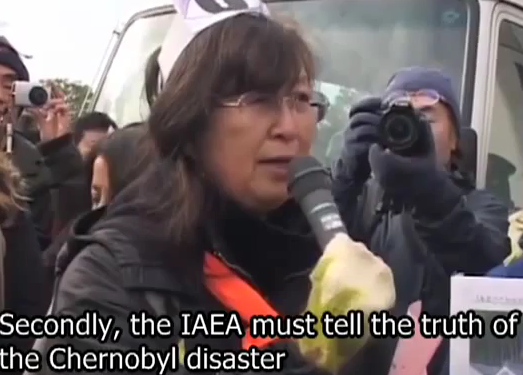
Video published on May 29, 2013
Muto Ruiko and the Movement of Fukushima Residents to Pursue Criminal Charges against Tepco Executives and Government Officials
The Fukushima Complainants for Criminal Prosecution of the Nuclear Accident
Group Statement
June 11, 2012
Today we 1,324 residents of Fukushima Prefecture filed a complaint with the Fukushima Public Prosecutors Office, demanding that it press charges of criminal responsibility for the Fukushima nuclear accident.
We who have been robbed of our daily life, we whose human rights have been trampled upon by the accident—we have pooled our strength and raised our voices in anger.
To take the first step toward seeking prosecution required a great deal of courage on our part.
To ask that criminal charges be brought against other human beings has meant that we had to examine our own way of life.
We believe, however, that this process has profound significance.
•We are challenging a society that fails to value all who live in it, in which sacrifice is always being imposed on some members;
•We are coming together again, even expanding our ties after being divided and torn asunder by the accident;
•We who were hurt and lost in despair are reclaiming our strength and dignity.
We believe that this is the way to fulfill our responsibility towards children and young people.
Standing together with those who cannot raise their voices and with other living things, it is each of us individuals who will change the world.
Refusing to be divided, recognizing the power of our unity, unflinching, we will continue to pursue responsibility for the accident.
Muto Ruiko is a long-time antinuclear activist based in Fukushima. She is also one of 1,324 Fukushima residents who filed a criminal complaint in June 2012 pressing charges against Tepco executives and government officials.
This article introduces Muto’s activism on nuclear energy, her life before and after the Fukushima Dai’ichi disaster, and her recent effort to mobilize citizens for the criminal complaint. An English translation of Muto’s speech at the University of Chicago on May 5, 2012, follows.
More on link..
http://japanfocus.org/-Muto-Ruiko/3784
Press Release 2013/05
IAEA RANET Capacity Building Centre in Fukushima Begins Work
27 May 2013 | Fukushima City, Japan — The designation of the IAEA Response and Assistance Network (RANET) Capacity Building Centre, which will coordinate several training activities related to nuclear and radiological emergency preparedness and response, was marked with a ceremony today.
Huge explosion after freight train crash in Rosedale, Maryland

Published on May 29, 2013
A huge explosion has happened after a freight train carrying tetrathphalic acid and sodium chlorate crashed into a rubbish truck and derailed in Rosedale, near Baltimore, in Maryland..
“.. Neither should cause an immediate effect on the public…”
“… Cars were allowed to drive by …”
Wiki Entries
Sodium chlorate comes in dust, spray and granule formulations. There is a risk of fire and explosion in dry mixtures with other substances, especially organic materials, and other herbicides, sulfur, phosphorus, powdered metals, and strong acids. In particular, when mixed with sugar, it has explosive properties. If accidentally mixed with one of these substances it should not be stored in human dwellings.[6]
Marketed formulations contain a fire retardant, but this has little effect if deliberately ignited. Most commercially available chlorate weedkillers contain approximately 53% sodium chlorate with the balance being a fire depressant such as sodium metaborate or ammonium phosphates.
Toxicity in humans
Due to its oxidative nature, sodium chlorate can be very toxic if ingested. The oxidative effect on hemoglobin leads to methaemoglobin formation, which is followed by denaturation of the globin protein and a cross-linking of erythrocyte membrane proteins with resultant damage to the membrane enzymes. This leads to increased permeability of the membrane, and severe hemolysis. The denaturation of hemoglobin overwhelms the capacity of the G6PD metabolic pathway. In addition, this enzyme is directly denatured by chlorate reducing its activity.
Therapy with ascorbic acid and methylene blue are frequently used in the treatment of methemoglobinemia. However, since methylene blue requires the presence of NADPH that requires normal functioning of G6PD system, it is less effective than in other conditions characterized by hemoglobin oxidation.
Acute severe hemolysis results, with multi-organ failure, including DIC and renal failure. In addition there is a direct toxicity to the proximal renal tubule.[4] The treatment will consist of exchange transfusion, peritoneal dialysis or hemodialysis.[5]
Terephthalic acid is used as a filler in some military smoke grenades, most notably the American M83 smoke grenade, producing a thick white smoke when burned.
Exposed: Japanese Officials Upped Radiation Yardsticks to Dodge Compensation Costs
by Andrea Germanos / Common Dreams / May 26, 2013 /
Japanese officials raised the level of acceptable radiation doses for evacuees of the Fukushima nuclear disaster to avoid increasing costs for compensation, Japan’s Asahi Shimbun reported on Saturday.
A 5-millisieverts per year dose, the same level of exposure used as a yardstick to relocate residents after the Chernobyl nuclear disaster, was proposed at an unofficial meeting of ministers in October of 2011, seven months after the disaster began, they report.
But just weeks later, the yardstick was upped to 20 millisieverts per year.
… at a meeting on Oct. 28, joined by Chief Cabinet Secretary Osamu Fujimura and Tatsuo Kawabata, internal affairs minister, participants appeared reluctant to approve a yardstick other than 20 millisieverts. […]
“The prefectural government could not function with population drain under the 5-millisievert scenario,” said a state minister who attended the meeting. “In addition, there were concerns that more compensation money will be needed, with an increase in the number of evacuees.” […]
The Abe administration in March decided to release by the end of this year a set of protection measures for evacuees returning to areas with doses of up to 20 millisieverts.
The move is apparently aimed at setting the stage for return of evacuees even if decontamination operation fails to achieve the target of 1 millisievert. […]
1 This Month


10 March A LIVE WEBINAR THE REAL EFFECTS OF NUCLEAR POWER
What the Industry Isn’t Telling Us
1:00 PM Mountain, 2 pm Central, 3 pm Eastern. Live on the Keepers of the Water Facebook page


18 March Webinar @ 1 PM EST: An Assessment of SMR Projects: The Case of Canada
register for the zoom:
https://us02web.zoom.us/webinar/register/WN_o8BIIOUvQ2ONJR1nta65DQ#/registration


of the week – STOP SMALL MODULAR REACTORS IN CANADA
To see nuclear-related stories in greater depth and intensity – go to https://nuclearinformation.wordpress.com
-
Archives
- March 2026 (74)
- February 2026 (268)
- January 2026 (308)
- December 2025 (358)
- November 2025 (359)
- October 2025 (376)
- September 2025 (258)
- August 2025 (319)
- July 2025 (230)
- June 2025 (348)
- May 2025 (261)
- April 2025 (305)
-
Categories
- 1
- 1 NUCLEAR ISSUES
- business and costs
- climate change
- culture and arts
- ENERGY
- environment
- health
- history
- indigenous issues
- Legal
- marketing of nuclear
- media
- opposition to nuclear
- PERSONAL STORIES
- politics
- politics international
- Religion and ethics
- safety
- secrets,lies and civil liberties
- spinbuster
- technology
- Uranium
- wastes
- weapons and war
- Women
- 2 WORLD
- ACTION
- AFRICA
- Atrocities
- AUSTRALIA
- Christina's notes
- Christina's themes
- culture and arts
- Events
- Fuk 2022
- Fuk 2023
- Fukushima 2017
- Fukushima 2018
- fukushima 2019
- Fukushima 2020
- Fukushima 2021
- general
- global warming
- Humour (God we need it)
- Nuclear
- RARE EARTHS
- Reference
- resources – print
- Resources -audiovicual
- Weekly Newsletter
- World
- World Nuclear
- YouTube
-
RSS
Entries RSS
Comments RSS
 nuclear-news