Mothers of Fukushima Trailer – We need to move all the children out!
Published: April 10th, 2013 at 10:34 am ET
By ENENews
Title: Mothers of Fukushima Trailer
Source: laborvideo
Date Published: Apr 9, 2013
At 2:15 in
Speaker: There is going to be a catastrophic disaster happening right in front of our eyes.
How can the government stand by and do nothing?
We need to move all the children out.
We are running against time.
A tribute to the UK`s Depleted Iron Lady – Margaret Thatcher and an unforseen bonus by Parliamentarians!
Published on 10 Apr 2013
The artist taxi driver
Viewer discretion advised.. some swearing and aggressive angst lies within!!
“…. Wheres daddies F^%$%£&g pig!! …. ” for example…
STOP THE FOREIGN & COMMONWEALTH OFFICE WITHDRAWING GRATIS VISAS FOR CHERNOBYL CHILDREN COMING TO UK FOR RECUPERATIVE HOLIDAYS FROM BELARUS & UKRAINE
http://epetitions.direct.gov.uk/petitions/37945
Responsible department: Foreign and Commonwealth Office
Are you a British citizen or UK resident?

Image source ; http://www.chernobyl-children.org.uk/what-we-do/recuperative-holidays (Unrelated website to this petition)
The future of vital recuperative holidays for children living with the after effects of the Chernobyl disaster is threatened because the FCO has announced that gratis visas for Chernobyl Children will end in March 2013.
The UK will be only government in the EU to start charging. All others grant gratis visas as they acknowledge the important work done helping children living with the after effects of radiation by boosting their immune systems & improving their health.
This would add £86 per child to the cost of bringing them to the UK, placing a heavy burden on charities already struggling to raise funds. Consequently this will result in either less children coming to the UK for recuperative breaks or the closure of smaller charities.
Many MPs support us, having met these children in their constituencies. Government departments also support our work as does the PM. Now they must prove it by withdrawing plans to charge for these vital visas.
Victor Mizzi MBE & Linda Walker MBE
- Number of signatures: 10,039
- http://epetitions.direct.gov.uk/petitions/37945
Soldier dying after being exposed to uranium in Iraq must raise £110,000 for treatment because the NHS can’t help her
Please click on link for petition/support details
- Katrina Brown, 30, was exposed to radioactive material in Basra
- Diagnosed with rare systemic sclerosis which is slowly attacking her organs
- She believes the illness is linked to exposure to depleted uranium
- Says her only hope is having stem-cell transplant to regenerate her organs
PUBLISHED: 13:47, 3 April 2013 | UPDATED: 02:28, 4 April 2013


A soldier who developed a deadly illness after being exposed to uranium in Iraq is facing a race against time to raise the money she needs for potentially life-saving treatment
Katrina Brown, 30, was exposed to radioactive material while serving as a medic at a 600-bed military clinic in Basra in 2003.
She was diagnosed with rare systemic sclerosis in 2008 which is slowly attacking her major organs – and will eventually lead to her death if left untreated.
Mrs Brown, who joined the Army at the age of 17, believes the illness is linked to exposure to depleted uranium.
She was handed a card before flying home from her 2003 tour warning her she had been in contact with radioactive materials.
She currently survives on 18 pills a day, costing over £3,000 a month.
Shut out of BARC! U.S. scientist foresaw Indian nuclear test – Wikileaks!
CHENNAI, April 9, 2013
Murali N. Krishnaswamy

Image source ; http://ibnlive.in.com/news/wikileaks-cablegate-little-to-fear-about-india-having-nuclear-weapons/136094-53.html 2010
A year before India conducted its first nuclear test in 1974, a Bombay-based scientific representative of the U.S. Atomic Energy Commission was quite certain it would do so ‘in the not too distant future.’ Concurring with his assessment, a senior U.S. diplomat felt Prime Minister Indira Gandhi would take the step to offset public disenchantment with her government and the country’s growing economic troubles.
The American scientist’s suspicions grew, according to a U.S. diplomatic cable obtained by WikiLeaks, when the Indian nuclear establishment shut its doors on him, afraid that he was being used by the U.S. government to spy on them and would find out too much.
It is generally thought that the world was taken by surprise when the ‘Buddha smiled’ in Pokhran on May 18, 1974. But the cable sent by the U.S. Consul General in Bombay on April 4, 1973, was quite certain that India was on the verge of testing a nuclear device.
“As aura of Indo-Pak victory and 1970/72 electoral successes dim and as public disenchantment with PM and GoI mount reflecting increased economic distress it occurs to us in Bombay that in addition usual scapegoats, ‘demonstration’ of a nuclear device for peaceful purposes in not too distant future,” the U.S. Consul-General in Bombay wrote in the cable (1973NEWDE03743_b, secret).
The main source for the assessment was the AEC representative, John Pinajian, who had shared his ‘personal evaluation’ of India’s nuclear position with the Consul General, based on his own observations at ‘various levels in India, broad extrapolations based on technical papers presented at Indian scientific meetings as well as impression gathered from public and personal comments made by member atomic energy community.’
Dr. Pinajian told the U.S. Consul General that it was “fully within the capabilities” of India to “demonstrate its nuclear capability by exploiting peaceful application of a nuclear device” in the “near future and indications available to this end suggest that GoI may be working to this end.”
Dr. Pinajian was also of the view that the Department of Atomic Energy was laying the groundwork for the export by India of “largely ingenous [sic] atomic reactors (200 MWe).”
His impressions, Dr. Pinajian told the diplomat, were based on several things. Although he had “excellent credentials and contacts dating back to Oak Ridge” (the Tennessee city where some U.S. nuclear research facilities are located), he was being rebuffed by top scientists at the Bhabha Atomic Research Centre (BARC) and the Tata Institute for Fundamental Research (TIFR).
Despite an agreement with AEC India that the USAEC was making Dr. Pinajian “available as an expert,” and a suggestion by Dr. Homi Sethna, then AEC India chairman, that the scientist should ‘immediately’ go to work at BARC, Dr. Raja Ramanna, the head of BARC avoided meeting him until Dr. Sethna personally intervened to get him the appointment.
But the meeting was fruitless for the American scientist, as the BARC chief said it would be ‘impractical’ for him to work in the particular division he wanted to be in, as that would require permission from the Centre.
Dr. Ramanna pushed him off to TIFR instead. There too, Dr. Pinajian tried in vain to meet the institute’s boss, Dr. M.G.K. Menon. A member of Dr. Menon’s staff, Professor B.V. Thosar, had asked for permission to work with Dr. Pinajian, but “months have passed” and neither had heard anything.
The scientist felt this was significant as both BARC and TIFR would be “principal Orgnaisations [sic] involved in any move toward development of a nuclear device.”
Ottawa’s contemplation of higher nuclear liability limits too narrow: Greenpeace
….Greenpeace is urging Canada to move to unlimited liability, arguing that taxpayers should not have to foot any of the bill for industrial activity. But that option is given short shrift in the consultation document. In a footnote, Natural Resources Canada says that in practice, liability would be limited to an operator’s assets…..
Image source : http://www.ec.gc.ca/energie-energy/default.asp?lang=En&n=A4E62A79-1

Heather Scoffield
OTTAWA — The Canadian Press
Published Monday, Apr. 08 2013, 2:51 PM EDT
Last updated Monday, Apr. 08 2013, 3:19 PM EDT
Newly released government documents suggest Ottawa wants nuclear operators to be on the hook for more than $650-million in damages in case of an accident.
But Greenpeace Canada says the documents also suggest Ottawa is talking only to the nuclear industry as it redefines its nuclear liability regime.
“We’re concerned that the Harper government’s cozy relationship with industry is putting the interests of the nuclear lobby above the safety of Canadians,” said Shawn-Patrick Stensil, a nuclear analyst with Greenpeace Canada.
Using access to information laws, Greenpeace obtained a consultation paper that Natural Resources Canada sent out to stakeholders in May, 2011 – a couple of months after the disaster at the Fukushima plant in Japan – outlining why Canada needs to modernize its nuclear civil liabilities rules.
The paper says Canada’s current liability of $75-million is hopelessly out of date, but also suggests that even more recent proposals to set the cap at $650-million are now looking too low.
“Recent developments may warrant that the amount of $650-million be re-examined,” the paper states, pointing to expenses involved in the Fukushima accident and the 2010 oil spill in the Gulf of Mexico, as well as moves by other countries to significantly increase operator liability.
The Conservatives have put forward bills in the past proposing that the $75-million cap be raised to $650-million to better reflect international norms. But the bills were never passed, and now the norms have shifted, the paper says.
U.N. Chief Urges Full Chemical Disarmament by 2018

Image source :
http://www.nti.org/gsn/article/us-reaches-chemical-disarmament-milestone/ 2009
April 9, 2013
By Diane Barnes
Global Security Newswire
http://www.nti.org/gsn/article/un-chief-demands-chemical-disarmament-years-ahead-us-schedule/
THE HAGUE, Netherlands — The head of the United Nations on Monday pressed for destruction of the world’s declared chemical warfare stockpiles by 2018, even though the two major possessor states might not complete disarmament operations for years afterward.
The United States, Russia and Libya all failed to finish dismantling their chemical arsenals by April 29, 2012, the “final extended” destruction deadline set by the Chemical Weapons Convention. The treaty bans production, storage and use of chemical arms, and it requires signatory governments to eliminate any stocks they held upon joining the regime.
The United States presently intends to wrap up destruction of its chemical arms by 2023, though officials have called that a conservative schedule. Russia has indicated it would finish demilitarization efforts by 2015, but new reports have suggested vestiges of the world’s largest arsenal that once held more than 40,000 tons of lethal substances could persist into 2020. Libya expects its far smaller stockpile to be gone by December 2016.
German Nuclear Operators to Pay for $2.6 Billion Waste Site – “we’re looking for a new beginning.”
….The difference between last century’s and today’s protest is of course that more people have access to the internet and hence the word can be spread wider and faster – which probably explains the high number in activists…..
…..“The cost of dealing with nuclear waste will be borne by those who produced it,”…..
By Alan Crawford – Apr 9, 2013 8:11 PM GMT+0100
German nuclear-power operators will have to pay an estimated 2 billion euros ($2.6 billion) for identifying and building an atomic-waste depository, Environment Minister Peter Altmaier said.
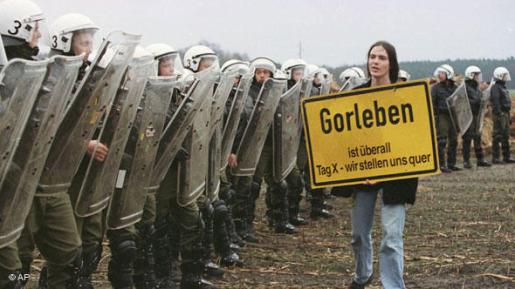
“The cost of dealing with nuclear waste will be borne by those who produced it,” Altmaier said today in an interview on N24 television. “In the end, it’s also in the interests of the nuclear operators that we identify a depository.” RWE AG (RWE), EON SE and EnBW Energie Baden-Wuerttemberg AG (EBK) currently operate the country’s remaining nine nuclear plants, one of which is shared with Vattenfall AB.
Altmaier, a member of Chancellor Angela Merkel’s Christian Democratic Union party, is seeking political consensus on energy policy as federal elections approach in less than six months. He is due to meet today with state leaders and the heads of Germany’s main political parties to begin anew the search for a facility to handle the country’s most dangerous nuclear waste amid public opposition to the sole existing provisional site, at Gorleben in Lower Saxony state.
He wants a cross-party commission to draw up criteria for identifying a permanent site by the end of 2015, with an operational facility to be in place by 2031. A draft for identifying the depository should be created “as soon as possible” with the goal of pushing through the law before parliament’s summer break, Altmaier said in a statement today.
Party Talks
Altmaier’s predecessor, Norbert Roettgen, tried and failed to restart the search after holding cross-party talks in November 2011. At that point, Germany, which plans to close all its atomic reactors by 2022, had already spent more than 1 billion euros of taxpayers’ money since the 1980s to determine whether the Gorleben site was appropriate. The previous government of Social Democrats and Greens blocked research at the site for 10 years through 2010.
“In the last 30 years the search has been so difficult because it’s been so controversial politically,” Altmaier said. After Japan’s Fukushima disaster and the decision to shutter Germany’s nuclear plants, “we’re looking for a new beginning.”
Altmaier said that he had pledged no further nuclear waste will be transported to Gorleben “while the search goes on,” and that Germany “will do everything to ensure that no German nuclear transport goes outside the country.”
Gorleben became a focus of anti-nuclear protests after exploration began in 1979 with the aim of setting up a permanent underground storage site. Work was halted with the 2000 nuclear shutdown law brought in the then ruling Social Democrats and Greens.
Merkel, a former minister for the environment and reactor safety in Chancellor Helmut Kohl’s government from 1994 to 1998, appeared before a parliamentary inquiry in September 2012 to explain her role in planning the Gorleben facility.
Deutsches Atomforum, a lobby group of the operators of German nuclear power plants, said it saw no legal grounds for funding the search for alternative sites to Gorleben until a final judgment on the former salt mine’s suitability has been made.
To contact the reporter on this story: Alan Crawford in Berlin at acrawford6@bloomberg.net
To contact the editor responsible for this story: James Hertling at jhertling@bloomberg.net
Time for critical consideration of nuclear power – Ghananian Energy Minister
The Minister for Energy and Petroleum, Mr Emmanuel Kofi Buah, has Ghana is committed to considering nuclear energy as a viable option in power generation.

He said the Ministry was putting the necessary measures in place to ensure the realization of that great goal.
According to him, the increasing demand for power in the country called for accelerated measures to venture into nuclear power, adding that the time had come for critical consideration of this option.
A statement issued by the Ministry said, the Minister made the disclosure when the Head of Africa section of the International Atomic Energy Agency (IAEA), Dr Dazhu Yang currently in Ghana, called on him at his office.

The Minister urged Dr Yang to provide the necessary assistance to Ghana to realize the goals of its nuclear energy programme.
The IAEA Africa Head pledged his support for Ghana in its quest to venture into that area, saying that if the country was to achieve higher middle income status, it needed cheap and clean energy to power its developing industries.
Dr Yang said the IAEA would provide technical support for countries which consider nuclear power as an option, adding that as a bonafide member of the IAEA, Ghana qualified for technical assistance in that venture.
Professor Benjamin Jabez Botwe Nyarko, Director General of the Ghana Atomic Energy Commission (GAEC) said preparations were underway to construct the first Nuclear Power Plant in Ghana, including the finalization of techno-economic assessment and financing process.
GAEC Director General said Ghana’s Nuclear Energy Programme Implementation Organization, called the Ghana Nuclear Power Programme Organization was inaugurated in September, last year forming part of the first milestone required by the IAEA.
Prof Nyarko added that a bill on the establishment of an autonomous regulatory body, another prerequisite for operating a Nuclear Power Plant had been sent to Parliament for approval.
GNA
Ghana to have nuclear energy in 15 years
“The Chinese are interested in a cooperation with Russia on uranium production in third countries. “It is possible, we have mentioned African countries, in particular”, Rosatom head Sergei Kiriyenko announced. (RIA Novosti Aug. 30, 2010)”
[…]
“The acting Director of Ghana Atomic Energy Commission
(GAEC), Dr B.J.B. Nyarko, has said that the country stands the chance of striking uranium deposits in commercial quantities since there is an association between gold and uranium. He explained that a study of gold tailings at the Nuclear Research Reactor at Kwabenya revealed traces of uranium in pits in gold-mining areas in the country. Dr Nyarko said the research, carried out by GAEC, was not on a large scale and that a major prospecting and exploration was needed to establish the link. (MJFM Apr. 22, 2008)”
[…]
24/11/2012
https://nuclear-news.net/2012/11/24/ghana-to-have-nuclear-energy-in-15-years/
N-power to increase shelf life of fruits; – Experts discuss the use of gamma rays to preserve food at BARC
….Rays of hope are in sight to increase the shelf life of litchis from Muzaffarpur and Jardalu mangoes from Bhagalpur….…..He added that potatoes and onions can also be preserved for more than four to five months by passing them through gamma rays…..…..In the first stage, 10 scientists from the Bihar Agriculture University would visit BARC to study irradiation technology………..“……All nuclear-spent fuel from India is being brought to BARC, Tarapur, for reprocessing and later, cooling, storing and intermediate burial-storage, amounting to high concentration of nuclear activity material in Tarapur. Tandel explains that NPCIL has no evacuation routes for the villagers in case of emergency, or even any medical facilities, food or a shelter plan. Also, residents of Palghar and Dahanu are also at high risk.……
By OUR CORRESPONDENT
Rays of hope are in sight to increase the shelf life of litchis from Muzaffarpur and Jardalu mangoes from Bhagalpur.
Scientists and officials attending a workshop in Patna on Tuesday stressed that the use of nuclear energy could go a long way to preserve fruits, much in demand in the state, and vegetables.
Bihar Agriculture University, Sabour, vice-chancellor (VC) M.L. Chaudhary said with irradiation technology, litchi can be preserved up to 48 days. Normally, the small luscious fruits are destroyed in three days. Similarly, he said, Jardalu mango from the Bhagalpur area can be preserved for 10 to 15 days against the usual three to four days.
He added that the use of nuclear energy in agriculture could particularly help in the development of new varieties of seeds.
The workshop on the use of nuclear energy in agriculture, food and veterinary services was organised on the Bihar Veterinary College campus in Patna by the Sabour varsity. In attendance were officials from the Department of Atomic Energy and scientists from Bhabha Atomic Research Centre (BARC), Mumbai.
KAP Sinha, joint secretary, department of atomic energy, said: “The use of irradiation technology in food processing can be of a great help. Litchis from Muzaffarpur and Jardalu mangoes from the Bhagalpur area can be exported to other countries where they are much in demand.”
Nuclear safety? Depends on who you ask
But for their governments and most of the regulators gathered in Ottawa this week “nuclear safety” means something entirely different: protecting the profits of nuclear companies.

Blogpost by Shawn-Patrick Stensil – April 9, 2013 at 16:10
Nuclear safety regulators from around the world are in Canada’s capital this week to discuss what lessons they should learn from the Fukushima disaster. It’s a bad choice of venue.
Canada’s approach to nuclear safety isn’t one to emulate. In Canada, the nuclear regulator is a promotional agency first and a safety watchdog second.
After investigating the disaster, the Japanese government’s Independent Investigation Commission conclude Fukushima was not the result of a freak act of nature and was instead due to collusion between the government, the regulator and plant operator TEPCO.
This collusion was driven by the Japanese government’s desire to promote its nuclear industry. There was an implicit understanding between the Japanese government, reactor operators and the national reactor safety watchdog that nuclear profits go before nuclear safety.
In this topsy-turvy world, greed is a virtue and respect for human security a vice and as a Canadian, I’ve seen this same reversal of priorities at play here in Canada’s nuclear industry.
In 2008, Canada’s federal government fired Canadian Nuclear Safety Commission (CNSC) president Linda Keen. Behind her firing was Keen’s imposition of more modern international reactor safety standards on Canada’s nuclear industry.
SNC-Lavalin wanted to boost its profits building new reactors in Ontario by cutting back on safety systems. It hoped to build a reactor on the cheap with a pre-Chernobyl, pre-September 11 Canadian reactor design. Because of Keen saying safety came first, SNC-Lavalin lost the contract.
More than a little enraged, SNC-Lavalin used its backroom influence over Canada’s Conservative government to get Keen fired and replaced with a more industry-friendly regulator. We quickly saw the impact on Canada’s nuclear regulator.
The Canadian commission’s new president was quick to establish his mandate and put industry profits ahead of safeguarding Canadians. He even provided promotional quotes for Canadian reactors in industry press releases.
And remember that outdated reactor design that couldn’t pass modern, post September 11 safety standards under Linda Keen? Under Canada’s new industry-friendly nuclear safety watchdog, it curiously now seems to meet Canadian safety standards.
Senate advances bill to put brakes on nuclear fees
Source: Miami Herald

For the first time in seven years, a Senate committee has stood up to the state’s utility companies and unanimously passed a bill that would weaken a law that has allowed them to charge customers for nuclear projects before they are built.
The Senate Communications, Energy and Public Utilities Committee voted unanimously Monday for SB 1472, which would impose strict new requirements on utility companies by demanding that they obtain a license to build a plant before they can continue to charge customers.
The bill is opposed by the state’s largest utility companies, who for years have persuaded legislators not to change the 2006 law known as the Nuclear Cost Recovery Clause even though costs of the plants has quadrupled and their construction plans were postponed.
“What we’ve done is we hit the reset button and then we move forward,” said Sen. John Legg, R-Lutz, one of the bill’s sponsors. “This is not an anti-nuclear bill. This is a responsible piece of legislation that we think puts reasonable parameters going forward.”
<snip>
Read more: http://www.miamiherald.com/2013/04/08/3330606/senate-advances-bill-to-put-brakes.html
Former U.S. Nuclear Chief: American Nuclear Plants Should Be Phased Out — “Can’t Guarantee Against Accident Causing Widespread Land Contamination”
……The biggest problem with the NRC continues to be the heavy influence that the industry has in selecting the members of the commission. It is a very political process.There are few commissioners who ever get onto the commission who are not endorsed by the industry…….
Nuclear Regulators Just “Rolling the Dice”
Energy intelligence reports:
Former Nuclear Regulatory Commission (NRC) Chairman Gregory Jaczko says that the current fleet of operating plants in the US should be phased out because regulators can’t guarantee against an accident causing widespread land contamination. In two key decisions last week Jaczko said the agency “damaged significantly” its international reputation for upholding safety and he accused the five commissioners of “just rolling the dice” in dealing with severe accidents.
Jaczko is correct that “the current fleet of operating plants in the US [is unsafe] regulators can’t guarantee against an accident causing widespread land contamination”.

An investigation by Associated Press found that 75 percent of all U.S. nuclear sites have leaked radioactive tritium.
And whistleblowers at the Nuclear Regulator Commission say that the risk of a major meltdown at U.S. nuclear reactors is much higher than it was at Fukushima.
And an accident in the U.S. could be a lot larger than in Japan … partly because our nuclear plants hold a lot more radioactive material. Radiation could cause illness in huge numbers of Americans, and a major nuclear accident could literally bankrupt America.
And yet the nuclear regulators have dragged their feet in demanding even modest upgrades to prevent Fukushima-type disasters. We reported more than a year ago:
The geniuses at the Nuclear Regulatory Commission have given the green light for new nuclear power plants in the U.S. [over Jaczko’s objections] which don’t include safety upgrades which were demonstrated vital by the Fukushima meltdown.
Japan nuclear safety protocols still fall short, investigators say
Published Monday, April 8, 2013 6:33AM EDT

TOKYO — Experts who investigated Japan’s nuclear crisis say a watchdog’s oversight of the crippled plant’s operator is still too lax.
The Fukushima Dai-ichi plant has been plagued with glitches. A blackout last month left the plant’s fuel storage pools without cooling for more than a day. Last Friday another cooling failure occurred, and hours later the operator reported a massive contaminated water leak from underground tanks.
The investigators said Monday that the Nuclear Regulation Authority is only rubber-stamping work by operator Tokyo Electric Power Co. at the plant that runs on makeshift equipment.
Nine of the 10 members testified at a lower house nuclear committee for the first time since releasing their findings in July. The report called the March 2011 disaster “manmade,” and blamed regulator-operator collusion and botched crisis management.
FUKUSHIMA NUCLEAR ACCIDENT: ‘RESULT OF COLLUSION’
Thursday, 5 July 2012
- “The accident at the Fukushima Daiichi Nuclear Power Plant cannot be regarded as a natural disaster.”
- “It was a profoundly manmade disaster — that could and should have been foreseen and prevented.”
- “…a multitude of errors and wilful negligence…”
- “It’s fundamental causes are to be found in the ingrained conventions of Japanese culture: our reflexive obedience; our reluctance to question authority; our devotion to ‘sticking with the program’; our groupism; and our insularity.”
- “The accident was the result of collusion between the government, the regulators and TEPCO, and the lack of governance by said parties.”
- “TEPCO was too quick to cite the tsunami as the cause of the nuclear accident and deny that the earthquake caused any damage.”
- “The residents’ confusion over the evacuation stemmed from the regulators’ negligence.”
- “The government and regulators are not fully committed to protecting public health and safety; that they have not acted to protect the health of the residents and to restore their welfare.”
- “The safety of nuclear energy in Japan and the public cannot be assured unless the regulators go through an essential transformation.”
- “Replacing people or changing the names of institutions will not solve the problems.”
http://www.ourmaninabiko.com/2012/07/fukushima-nuclear-accident-result-of.html
Russian NGOs blast Putin’s estimate they have receive $1 billion in last four months
….. An overwhelming majority of these NGOs, including ERC Bellona, could now face fines as much as $20,000, ostensibly for health and fire code violations. …

NGO representatives on Monday harshly questioned the validity of President Vladimir Putin’s comments to a German television station that NGOs in Russia have received about $1 billion from abroad since the “foreign agent” law was adopted in 2012. Charles Digges, 09/04-2013
In the interview broadcast Friday, Putin said there were 654 active NGOs in Russia being funded from abroad, meaning each organization receives an average of $382,000 a month.
Putin made the comment while dismissing criticism of the recent wave of inspections of nongovernmental organizations.
“For four months after we adopted the respective law on these organizations’ accounts, can you imagine how much money came [to them] from abroad? You can’t imagine […] 28.3 billion rubles ($1 billion),” he told Germany’s ARD television channel.
“These are organizations engaged in domestic political activities. Shouldn’t our society know who is getting this money and what it is for?” Putin said without elaborating.
Alexander Nikitin, chairman of the Environmental Rights Center (ERC) Bellona immediately slammed the figures presented by Putin as vastly overestimated to the point of being an “outright lie.”
“They have a problem with basic arithmetic – I don’t know where Putin and his inner circle went to school, and further have no idea on what they base this overestimation,” said Nikitin. “ I think he just made it up, because I don’t know of a single NGO in Russia that received anywhere near $382,000 a month.”

Nikitin said Putin’s remarks were a disingenuous shot at NGOs in Russia to make them look bad.
“This is obviously an attempt to make NGOs look bad, as if they are rolling in money,” said Nikitin. “But this is a lie, and at such high level politics, Putin cannot lie.”
Government agency says Putin’s figure five times too high
Nikitin added that Putin was recently more and more prone to evading the truth, and that ERC Bellona had not received “even a fraction of the amounts” Putin cited as flowing from foreign donors.
According to the Ministry of Economic Development, as cited by Vedomosti, losses in financing from foreign donors put yearly figures received from abroad by NGOs at about five times less than the billion-dollar figure cited by Putin.
Russian daily Vedomosti on Monday quoted Putin’s spokesman, Dmitry Peskov, as saying the president was citing confidential information obtained by the security services.

Scolded by Merkel and greeted by topless protesters
Putin’s remarks to German television came during a visit to a trade fair in Hannover, Germany, where he was greeted by topless female protesters who had written “Go to hell Putin” across their backs in Russian.
1 This Month
10 March A LIVE WEBINAR THE REAL EFFECTS OF NUCLEAR POWER
What the Industry Isn’t Telling Us
1:00 PM Mountain, 2 pm Central, 3 pm Eastern. Live on the Keepers of the Water Facebook page



18 March Webinar @ 1 PM EST: An Assessment of SMR Projects: The Case of Canada
register for the zoom:
https://us02web.zoom.us/webinar/register/WN_o8BIIOUvQ2ONJR1nta65DQ#/registration


of the week – STOP SMALL MODULAR REACTORS IN CANADA
To see nuclear-related stories in greater depth and intensity – go to https://nuclearinformation.wordpress.com
-
Archives
- March 2026 (99)
- February 2026 (268)
- January 2026 (308)
- December 2025 (358)
- November 2025 (359)
- October 2025 (376)
- September 2025 (258)
- August 2025 (319)
- July 2025 (230)
- June 2025 (348)
- May 2025 (261)
- April 2025 (305)
-
Categories
- 1
- 1 NUCLEAR ISSUES
- business and costs
- climate change
- culture and arts
- ENERGY
- environment
- health
- history
- indigenous issues
- Legal
- marketing of nuclear
- media
- opposition to nuclear
- PERSONAL STORIES
- politics
- politics international
- Religion and ethics
- safety
- secrets,lies and civil liberties
- spinbuster
- technology
- Uranium
- wastes
- weapons and war
- Women
- 2 WORLD
- ACTION
- AFRICA
- Atrocities
- AUSTRALIA
- Christina's notes
- Christina's themes
- culture and arts
- Events
- Fuk 2022
- Fuk 2023
- Fukushima 2017
- Fukushima 2018
- fukushima 2019
- Fukushima 2020
- Fukushima 2021
- general
- global warming
- Humour (God we need it)
- Nuclear
- RARE EARTHS
- Reference
- resources – print
- Resources -audiovicual
- Weekly Newsletter
- World
- World Nuclear
- YouTube
-
RSS
Entries RSS
Comments RSS
 nuclear-news