……“Following the signature in 2011 of contracts for supplying DAEWOO with low enriched uranium and for delivering prototype fuels to the KAERI/DAEWOO consortium, this success confirms the quality of the collaboration between AREVA and its Korean partners in the sector of nuclear fuel for research reactors.”…. 1st article
……”Oursel told Al Arabiya that the firm is already training Saudi engineers to prepare them for nuclear energy projects, which he said are expected to create “thousands of jobs”.
Areva and EDF have already set up an office in Riyadh to lay the groundwork for a possible bid for tender, and have established links with local Saudi companies and engineers. That followed a 2011 agreement between France and Saudi Arabia that offered the Saudis atomic know-how and training for local staff.
“Thanks to the subsidiary we have created in Riyadh with EDF, we are contacting all the Saudi suppliers which can play a role in this very important program,” said Oursel.”……. 2nd article
…..Following the lessons learned from Fukushima, the U.S. nuclear industry developed an approach to reinforce the safety measures at nuclear power plants, which includes the development of the regional response centers…….. 3rd article
(Please note the peak after the financial crash of 2008.. straight after the crash 200 billion Euros, to begin with, went into the only “safe” financial bet.. nuclear, the “green” saviour .. Arclight2011)
AREVA to Supply Nuclear Fuel for a Jordanian Research Reactor
AREVA has just signed a contract with the Korean KAERI/DAEWOO consortium to supply fuel elements for the JRTR (Jordan Research and Training Reactor) currently being built in Jordan –
The agreement concerns the supply of nuclear fuel for the first reactor core and for a reload batch. Delivery of the fuel elements is scheduled for the beginning of 2015.
Construction of the JRTR research reactor by the KAERI/DAEWOO consortium is an essential step for Jordan in acquiring the capabilities required for nuclear R&D and producing nuclear power. AREVA (areva.com) is proud to be a part of this project together with the Korean consortium, who is one of the research reactor suppliers, and stands ready to offer its experience regarding construction of a power reactor in Jordan, for which the selection of a supplier is now in progress.
Benoît Bazire, Senior Vice President of the Propulsion and Research Reactors BU, stated:
“Following the signature in 2011 of contracts for supplying DAEWOO with low enriched uranium and for delivering prototype fuels to the KAERI/DAEWOO consortium, this success confirms the quality of the collaboration between AREVA and its Korean partners in the sector of nuclear fuel for research reactors.”
The thermal power of the JRTR will be 5 MW, which can be extended to 10 MW in the future. It will be used for neutron beam research, neutron irradiation services such as medical radioisotope production, and training of Jordanian engineers and scientists.
French aim to subcontract Saudi firms in hope of nuclear win
France’s Areva says it aims for the majority of its subcontractors to be local firms should it win an expected tender to build nuclear power plants in Saudi Arabia.
Saudi Arabia plans to build 17.6 gigawatts of nuclear power capacity by 2032, according to the King Abdullah City for Atomic and Renewable Energy (KACARE).
Areva, which develops nuclear power plants, and the French utility firm EDF, hope to win a slice of the nuclear energy market in the Kingdom.
…….The pressure was so strong that the United States accepted it in principle and claims to be committed to it, but Hillary Clinton said the time’s “not ripe for establishing the zone.” And the administration just endorsed Israel’s position, essentially saying, “Yes, but only after a comprehensive peace agreement in the region,” which the US and Israel can delay indefinitely.
So, that’s basically saying, “it’s fine, but it’s never going to happen.” And this is barely ever reported, so nobody knows about it. Just as almost nobody knows about Obama informing India and Israel that the resolutions don’t apply to them.
All of this just increases the risk of nuclear war…….
The following is an excerpt from the new book Nuclear War and Environmental Catastrophe, by Noam Chomsky and Laray Polk, which takes the form of a series of interviews with MIT Professor Noam Chomsky (Seven Stories, 2013).
Laray Polk:
What immediate tensions do you perceive that could lead to nuclear war? How close are we?
Noam Chomsky:
Actually, nuclear war has come unpleasantly close many times since 1945. There are literally dozens of occasions in which there was a significant threat of nuclear war. There was one time in 1962 when it was very close, and furthermore, it’s not just the United States. India and Pakistan have come close to nuclear war several times, and the issues remain. Both India and Pakistan are expanding their nuclear arsenals with US support. There are serious possibilities involved with Iran—not Iranian nuclear weapons, but just attacking Iran—and other things can just go wrong.
It’s a very tense system, always has been. There are plenty of times when automated systems in the United States— and in Russia,it’s probably worse—have warned of a nuclear attack which would set off an automatic response except that human intervention happened to take place in time, and sometimes in a matter of minutes. That’s playing with fire. That’s a low-probability event, but with low-probability events over a long period, the probability is not low.
There is another possibility that, I think, is not to be dismissed: nuclear terror. Like a dirty bomb in New York City, let’s say. It wouldn’t take tremendous facility to do that. I know US intelligence or people like Graham Allison at Harvard who works on this, they regard it as very likely in the coming years—and who knows what kind of reaction there would be to that. So, I think there are plenty of possibilities. I think it is getting worse. Just like the proliferation problem is getting worse. Take a couple of cases: In September 2009, the Security Council did pass a resolution, S/RES/1887, which was interpreted here as a resolution against Iran. In part it was, but it also called on all states to join the Non-Proliferation Treaty. That’s three states: India, Pakistan, and Israel. The Obama administration immediately informed India that this didn’t apply to them; it informed Israel that it doesn’t apply to them.
If India expands its nuclear capacity, Pakistan almost has to; it can’t compete with India with conventional forces. Not surprisingly, Pakistan developed its nuclear weapons with indirect US support. The Reagan administration pretended they didn’t know anything about it, which of course they did. India reacted to resolution 1887 by announcing that they could now produce nuclear weapons with the same yield as the superpowers. A year before, the United States had signed a deal with India, which broke the pre-existing regime and enabled the US to provide them with nuclear technology—though they hadn’t signed the Non-Proliferation Treaty. That’s in violation of congressional legislation going back to India’s first bomb, I suppose around 1974 or so. The United States kind of rammed it through the Nuclear Suppliers Group, and that opens a lot of doors. China reacted by sending nuclear technology to Pakistan. And though the claim is that the technology for India is for civilian use, that doesn’t mean much even if India doesn’t transfer that to nuclear weapons. It means they’re free to transfer what they would have spent on civilian use to nuclear weapons.
And then comes this announcement in 2009 that the International Atomic Energy Agency has been repeatedly trying to get Israel to open its facilities to inspection. The US along with Europe usually has been able to block it. And more significant is the effort in the international agencies to try to move toward a nuclear-weapon-free zone in the Middle East, which would be quite significant.6 It wouldn’t solve all the problems, but whatever threat Iran may be assumed to pose—and that’s a very interesting question in itself, but let’s suppose for the moment that there is a threat—it would certainly be mitigated and might be ended by a nuclear-weapon-free zone, but the US is blocking it every step of the way.
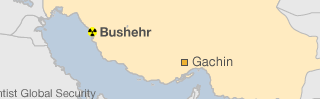
Laray Polk: Now that Iran’s reactor at Bushehr is running, the current fear is that they’re going to use the plutonium produced from the fuel cycle to make weapons. The questions raised about Iran’s possible nuclear weapons program are similar to those asked of Israel–
The February 2013 report by the World Health Organization on the predicted radiation effects of the Fukushima No. 1 nuclear disaster provided some welcome news indeed.
For example, Richard Wakeford of the University of Manchester wrote:
“The additional risk is quite small and will probably be hidden by the noise of other (cancer) risks like people’s lifestyle choices and statistical fluctuations.”
If true, the Japanese government can, for example, now confidently inform mothers living in the irradiated areas of Fukushima Prefecture and beyond that there is no need to worry about their children’s health or futures.
Unfortunately, many international experts take strong exception to these optimistic findings. This disagreement was starkly revealed at a recent symposium held in New York on March 11-12 titled – “The Medical and Ecological Consequences of the Fukushima Nuclear Accident.”
Addressing the symposium, Alexey Yablokov of the Russian Academy of Sciences said:
“Using criteria demanded by the International Atomic Energy Agency (IAEA), the World Health Organization (WHO) and the United Nations Scientific Committee on the Effects of Atomic Radiation (UNSCEAR) resulted in marked underestimates of the number of fatalities and the extent and degree of sickness among those exposed to radioactive fallout from Chernobyl.” Yablokov continued:
“The Chernobyl catastrophe has already killed several hundred thousand human beings in a population of several hundred million that was unfortunate enough to live in territories affected by the fallout. The number of Chernobyl victims will continue to grow over many future generations.”
Prime Minister, I know many of your advisers claim that the amount of radiation released at Fukushima No. 1 was far less than at Chernobyl. However, a report released by the U.K.-based non-profit Institute of Science in Society in November 2012 said:
“Analysis based on the most inclusive data sets available reveals that radioactive fallout from the Fukushima meltdown is at least as big as Chernobyl andmore global in reach.”
That conclusion was reached based on work with state-of-the-art atmospheric dispersion models by an international team led by Andreas Stohl at the Norwegian Institute for Air Research. Further, nuclear researcher Hiroaki Koide of Kyoto University told the conference:
“The cesium-137 that was released into the atmosphere by Units 1 through 3 was 168 times that of the Hiroshima bomb, according to the Japanese government report to the IAEA, an international organization which promotes nuclear power.
“However, I myself believe this is probably an underestimate, and two or three times that amount, that is, 400 to 500 times the amount of cesium-137 of the Hiroshima atomic bomb, has already been dispersed into the atmosphere. I believe almost the same amount of radioactive material released into the air has probably flowed into the ocean.”
Steven Starr of the University of Missouri pointed out that the WHO is not a reliable source of objective information since it is required to base its research on data submitted to it by member governments. Further, beginning in 1959, all WHO reports on nuclear contamination must first be approved by the IAEA, whose charter requires it to do its utmost to promote the use of nuclear power.
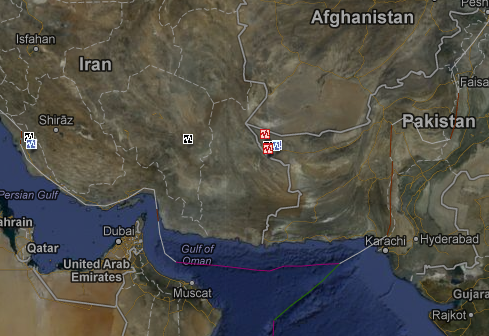
M7.8 quake hits Iran-Pakistan border area
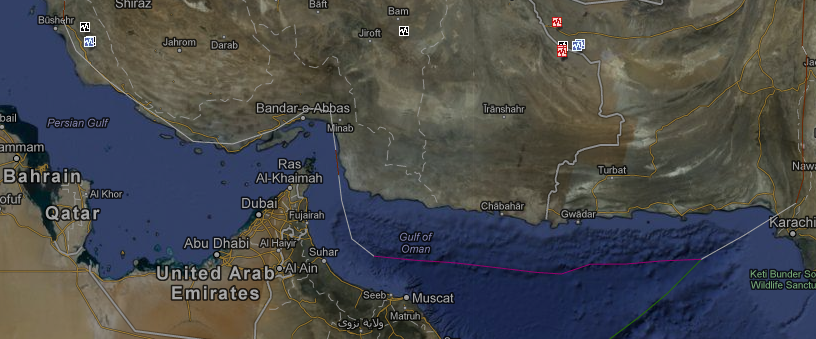
A 7.8 magnitude earthquake struck Iran near its border with Pakistan at 10:44 UTC on Tuesday.
The epicenter of the quake is estimated to be about 86 kilometers east-south-east of Khash, a town in Iran’s Sistan and Baluchistan Province.
The US Geological Survey first estimated the focus at a depth of 15.2 kilometers, but later changed it to 82 kilometers.
Details on the damage are not known. Iranian TV says at least 40 people were killed.
The tremor was felt in wide areas, including New Delhi in India, about 1,500 kilometers from the epicenter, and Dubai in the United Arab Emirates, 700 kilometers away.
TEPCO moves irradiated water to ground tanks
The operator of the crippled Fukushima Daiichi nuclear power plant has begun moving contaminated water from leaking underground storage pools to tanks above ground.
Tokyo Electric Power Company, or TEPCO, plans to move most of the contaminated water to tanks above ground after a series of leaks were found in some of the 7 underground storage pools.
Osaka court rejects demand to halt nuclear reactor
A Japanese court has rejected a suit by local residents demanding 2 nuclear power reactors in central Japan be turned off. The court said the reactors are safe.
The No. 3 and 4 reactors at the Ohi nuclear power plant in Fukui Prefecture are the only 2 online in Japan following the 2011 Fukushima nuclear disaster.
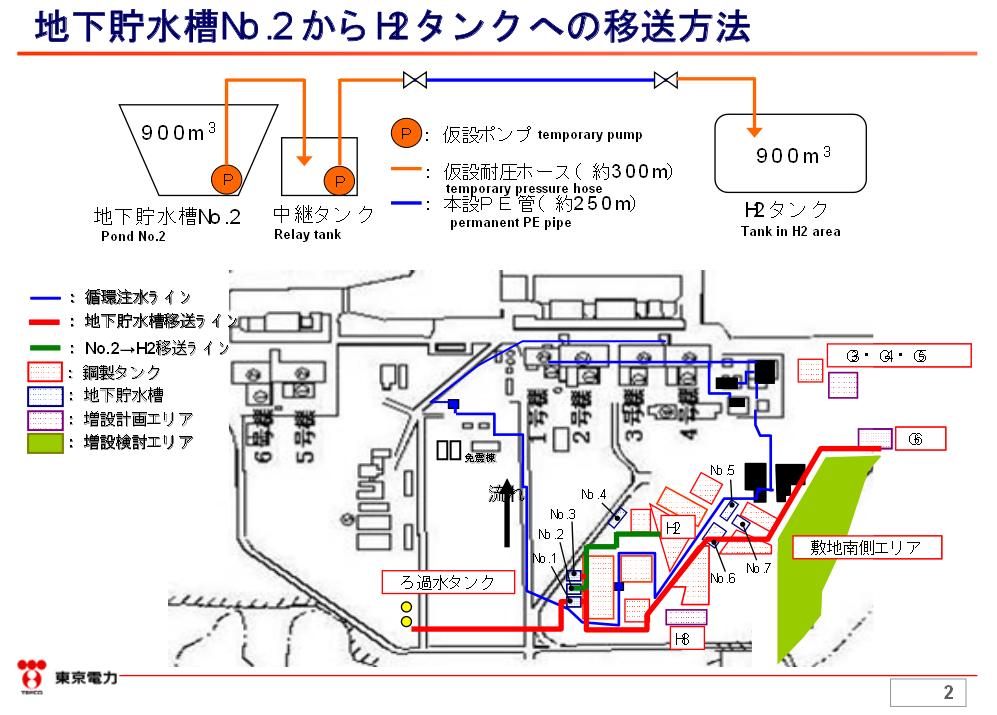
OK, so it will be 150 tonnes per day, using temporary pipes and a temporary tank between the Pond No.2 and the final destination which is about 550 meters away.
In-the-ground water storage ponds and where the RO waste water is going. Green line in the map is where the waste water from the Pond 2 is travelling:
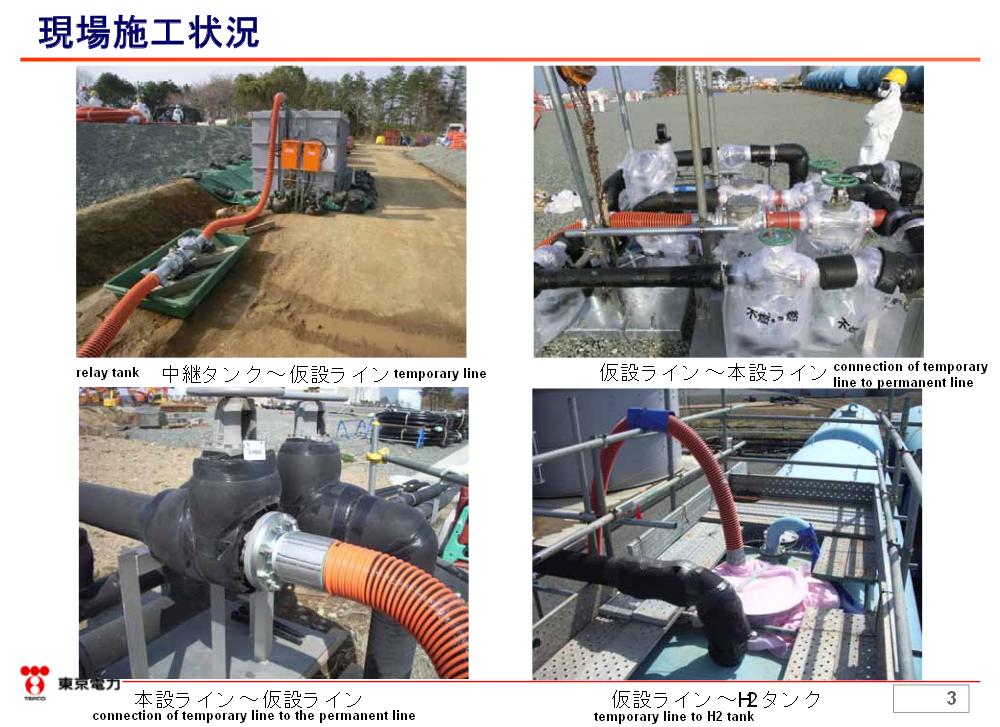
The physical set up to transfer the waste water in the Pond No.2 to a steel tank in H2 area. (I seems to be hallucinating the leak already…):
In the handout, I don’t find any reference to any effort to make any of the temporary contraptions since March 11, 2011 into a permanent, stable one.
Here’s page 26, showing photographs of electrical panel for the Reactor 2 Spent Fuel Pool cooling system, which was rigged up after the accident. “Look what we found! A small animal (rat) can get inside!” So what did TEPCO do? Cover the lines with plastic sheets:
From my experience in living in a countryside, rats and mice can easily chew through plastic sheets.
I hear that Mr. Naomi Hirose, TEPCO’s president, is a very smart guy, with MBA from Yale University. He’s from sales and marketing, and not an engineer. He was in charge of TEPCO’s highly successful push for “all-electric” homes, which significantly boosted the electricity consumption in large cities, which in turn was used to justify building more nuclear power plants. Yale MBA Program apparently wrote it up as a case study. I’d love to see it.
I can see that he is indeed an MBA, as he sets up a new “communication” department to better communicate with the press, the government, and citizens as if communication is what’s wrong with TEPCO and Fukushima I Nuclear Power Plant.
On the morning of Nov. 11, 1972, Oak Ridge stood still — or nearly so — while a hijacked Southern Airways jetliner circled above.
“It was a very, very scary situation,” Jim Alexander, a retired public affairs officer at the Department of Energy, recalled in a 2001 interview.
The hijackers threatened to crash the airplane into the Oak Ridge nuclear facilities if their demands, including $10 million in cash, were not met. […]
The threat was real, according to a 1977 book, “The Odyssey of Terror.”
The author, Ed Blair, wrote that the hijackers went berserk after placing a call to the White House and being shunned by John Ehrlichman, an aide to President Nixon, who apparently was unaware of the crisis. Blair reported that the hijackers held a grenade to the pilot’s head and ordered him to dive the plane toward the Oak Ridge reactor. The plane was actually in a nosedive when a report came over the radio that the money demands were being met […]
Former NRC Chairman Gregory Jaczko was forced out of the NRC by Congress for not adequately supporting the nuclear industry. The NRC claims all nuclear plants are still safe, but how are they doing their math?
…..According to reports of the US Geological Survey (USGS), the epicenter of the quake was 86km from the city of Khash. It had a depth of 15.2 kilometers. At least 10 people have been reportedly killed in Pakistan…..
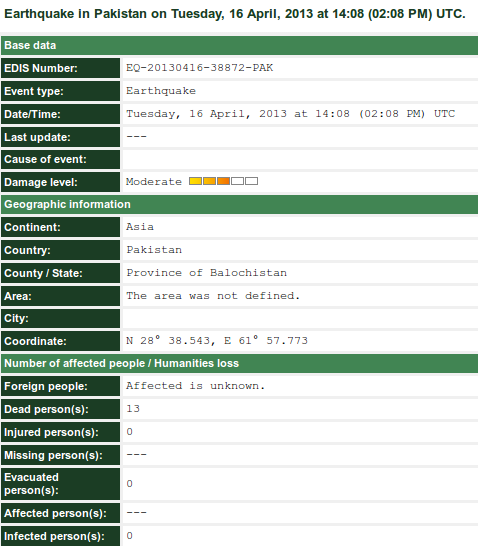
Earthquake
Event date: 16.04.2013 14:08:46 Country: Pakistan State: Province of Balochistan Location: – [The area was not defined.]
Pakistan’s Nuclear Facilities
Chagai Hills
Pakistan’s nuclear test site. First used on May 28, 1998.
Golra
Possible uranium enrichment R&D facility/pilot plant. Like many other sites in Pakistan, it is not subject to inspection by the International Atomic Energy Agency.
Security analysts have detected an ongoing attack that uses a huge number of computers from across the Internet to commandeer servers that run the WordPress blogging application.
The unknown people behind the highly distributed attack are using more than 90,000 IP addresses to brute-force crack administrative credentials of vulnerable WordPress systems, researchers from at least three Web hosting services reported. At least one company warned that the attackers may be in the process of building a “botnet” of infected computers that’s vastly stronger and more destructive than those available today. That’s because the servers have bandwidth connections that are typically tens, hundreds, or even thousands of times faster than botnets made of infected machines in homes and small businesses.
“These larger machines can cause much more damage in DDoS [distributed denial-of-service] attacks because the servers have large network connections and are capable of generating significant amounts of traffic,” Matthew Prince, CEO of content delivery network CloudFlare, wrote in a blog post describing the attacks.
It’s not the first time researchers have raised the specter of a super botnet with potentially dire consequences for the Internet. In October, they revealed that highly debilitating DDoS attacks on six of the biggest US banks used compromised Web servers to flood their targets with above-average amounts of Internet traffic. The botnet came to be known as the itsoknoproblembro or Brobot, names that came from a relatively new attack tool kit some of the infected machines ran. If typical botnets used in DDoS attacks were the network equivalent of tens of thousands of garden hoses trained on a target, the Brobot machines were akin to hundreds of fire hoses. Despite their smaller number, they were nonetheless able to inflict more damage because of their bigger capacity.
There’s already evidence that some of the commandeered WordPress websites are being abused in a similar fashion. A blog post published Friday by someone from Web host ResellerClub said the company’s systems running that platform are also under an “ongoing and highly distributed global attack.”
“To give you a little history, we recently heard from a major law enforcement agency about a massive attack on US financial institutions originating from our servers,” the blog post reported. “We did a detailed analysis of the attack pattern and found out that most of the attack was originating from [content management systems] (mostly WordPress). Further analysis revealed that the admin accounts had been compromised (in one form or the other) and malicious scripts were uploaded into the directories.”
The blog post continued:
“Today, this attack is happening at a global level and WordPress instances across hosting providers are being targeted. Since the attack is highly distributed in nature (most of the IPs used are spoofed), it is making it difficult for us to block all malicious data.”
According to CloudFlare’s Prince, the distributed attacks are attempting to brute force the administrative portals of WordPress servers, employing the username “admin” and 1,000 or so common passwords. He said the attacks are coming from tens of thousands of unique IP addresses, an assessment that squares with the finding of more than 90,000 IP addresses hitting WordPress machines hosted by HostGator.
“At this moment, we highly recommend you log into any WordPress installation you have and change the password to something that meets the security requirements specified on the WordPress website the company’s Sean Valant wrote. “These requirements are fairly typical of a secure password: upper and lowercase letters, at least eight characters long, and including ‘special’ characters (^%$#@*).”
Operators of WordPress sites can take other measures too, including installing plugins such as this one and this one, which close some of the holes most frequently exploited in these types of attacks. Beyond that, operators can sign up for a free plan from CloudFlare that automatically blocks login attempts that bear the signature of the brute-force attack.
Already, HostGator has indicated that the burden of this mass attack is causing huge strains on websites, which come to a crawl or go down altogether. There are also indications that once a WordPress installation is infected it’s equipped with a backdoor so that attackers can maintain control even after the compromised administrative credentials have been changed. In some respects, the WordPress attacks resemble the mass compromise of machines running the Apache Web server, which Ars chronicled 10 days ago.
With so much at stake, readers who run WordPress sites are strongly advised to lock down their servers immediately. The effort may not only protect the security of the individual site, it could help safeguard the Internet as a whole.
Thanks to UK column for some dedicated investigative journalism that alerted me to this. Heres the whole program looking at a range of topics including changes to policing in the UK.
The Electronic Frontier Foundation (EFF) has created this Surveillance Self-Defense site to educate the American public about the law and technology of government surveillance in the United States, providing the information and tools necessary to evaluate the threat of surveillance and take appropriate steps to defend against it.
Surveillance Self-Defense (SSD) exists to answer two main questions: What can the government legally do to spy on your computer data and communications? And what can you legally do to protect yourself against such spying?
After an introductory discussion of how you should think about making security decisions — it’s all about Risk Management — we’ll be answering those two questions for three types of data:
First, we’re going to talk about the threat to the Data Stored on Your Computer posed by searches and seizures by law enforcement, as well as subpoenas demanding your records.
Second, we’re going to talk about the threat to your Data on the Wire — that is, your data as it’s being transmitted — posed by wiretapping and other real-time surveillance of your telephone and Internet communications by law enforcement.
Third, we’re going to describe the information about you that is stored by third parties like your phone company and your Internet service provider, and how law enforcement officials can get it.
In each of these three sections, we’re going to give you practical advice about how to protect your private data against law enforcement agents.
Finally, we’ve collected several articles about specific defensive technologies that you can use to protect your privacy, which are linked to from the other sections or can be accessed individually. So, for example, if you’re only looking for information about how to securely delete your files, or how to use encryption to protect the privacy of your emails or instant messages, you can just directly visit that article.
Legal disclaimer: This guide is for informational purposes only and does not constitute legal advice. EFF’s aim is to provide a general description of the legal and technical issues surrounding you or your organization’s computer and communications security, and different factual situations and different legal jurisdictions will result in different answers to a number of questions. Therefore, please do not act on this legal information alone; if you have any specific legal problems, issues, or questions, seek a complete review of your situation with a lawyer licensed to practice in your jurisdiction……
….On Monday, a US federal appeals court upheld the governments decision to allow uranium production at Energy Fuels (TSX:EFR) Arizona 1 mine near the Grand Canyon National Park…..
…..The ending of a moratorium on uranium mining in Greenland, host to the worlds fifth-largest uranium deposit, stands a better chance, according to recent news. The government of Denmark is expected to vote soon on lifting a uranium mining ban in Greenland, reported MINING.com, and the majority of the Danish parliament seems amenable to the proposition. Greenland is a former Danish colony, and its government, which is in favor of allowing mining and exports of the nuclear fuel, must first seek the approval of the Danish government as the decision concerns security and defense…
…Russia is prepared to provide Belarus with a $10-billion loan for the construction of a nuclear plant that will have two 1,200-MW units, the first of which is scheduled for commission in November 2018….
Reported by crusherella | April 16th, 2013 @ 05:50 AM
The uranium spot price bounced up$1.50, to $43.75 per pound U3O8, in the last week of January, although some transactions are fetching $44 per pound, TradeTech reported. Important factors at play in supply/demand fundamentals going forward include recent production cutbacks and the political crisis crusher grinding millng plants sale for quartz sand powder production line and military contingent in Mali and the recent news regarding stringent new safety measures proposed by Japans new Nuclear Regulatory Authority, according to the consultancy firm.
An extremely destructive storm in the Sozak region of Kazakhstan last month led to a temporary suspension of uranium mining in the area, reported World Nuclear News. This week, state-owned nuclear company Kazatomprom announced that it may take up to six weeks to restore power to a key power line, which includes several of its uranium mining operations. However, the company limited the power cuts impact by installing temporary power systems within four days of the storm. Kazkhstan is the worlds leading uranium producer, with about 37 percent of global output.
The Nigerian government is in talks with Frances AREVA (EPA:AREVA) to glean a bigger piece of the profits that the miner reaps from its uranium mines in the African country, reported Reuters. Niger is the worlds third-biggest producer of uranium, but is extremely impoverished with an estimated 2011 GDP of about $6 billion. AREVA is currently working on a bringing its third Nigerian uranium mine, Imouraren, into production; it could reportedly produce 5,000 metric tons (MT) of yellowcake annually.
Virginia Energy Resources (TSXV:VUI) and Virginia Uranium, its subsidiary, experienced a huge setback last week in plans to bring the Coles Hill project into construction. Citing insufficient support, Senator John C. Watkins withdrew the bill that if passed would have essentially lifted the uranium mining ban in the state of Virginia, reported The Wall Street Journal.
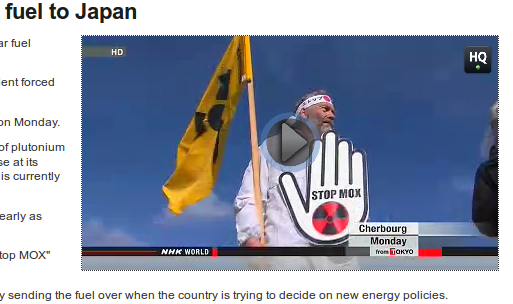
Dozens of French activists have staged a protest ahead of a nuclear fuel shipment to Japan.
The shipping was halted after the Fukushima Daiichi nuclear accident forced most of Japan’s nuclear plants to shutdown.
About 50 activists gathered at the northwestern port of Cherbourg on Monday.
A French energy firm has been producing the MOX fuel, a mixture of plutonium and uranium. The Kansai Electric Power Company ordered it for use at its Takahama nuclear plant in Fukui Prefecture, Central Japan, which is currently off-line.
A cargo ship loaded with the fuel is scheduled to leave the port as early as Wednesday.
The activists wore headbands with the Japanese slogan saying “Stop MOX” and called for a halt to the delivery.
A spokesperson for the activists said France is pressuring Japan by sending the fuel over when the country is trying to decide on new energy policies.
The activists say the fuel would be brought from a facility about 20 kilometers away from the port and loaded onto 2 vessels.
Campaign for Evacuation of the Children from the Highly Contaminated Areas
Can you Help us Send Messages to the Court from All Over the World?
Appealing at UN Human Rights Council
Can you help us send messages to the court from all over the world? We are collecting messages to judges from international celebrities and campaigners. The Japanese authorities tend to be vulnerable to criticism from abroad. In order to show the strong international interest and support for the trial, the trial support team would like to film as many video messages as possible to the judges from all over the world. If you sympathise with our struggle, please do get in touch. Do let us know if you have a contact with any international celebrities, politician or well-known campaigners who are prepared to give us a short message. Volunteers from the trial support team will make an arrangement with them and decide when and where filming can take place. Please contact: fukuchima-picture@song-deborah.comMr. Yves Lenoir, President of NPO Children of Chernobyl Belarus
…….The new source term obtained in this study is a first guess value; therefore, these results contain uncertainty. Various types of models that include physical processes and parameters, resolutions, and regions in addition to environmental data are needed to determine the probable source term. Detailed source term estimation obtained using the coupled atmospheric and oceanic dispersion simulation remains a topic for future research…….
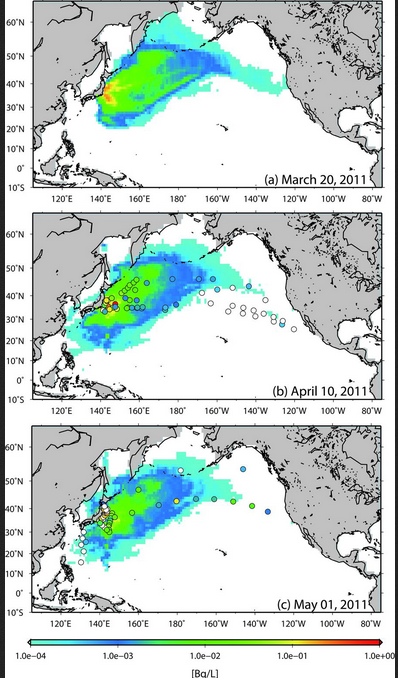
…..However, the simulation results for the eastern North Pacific showed a tendency of underestimating observed sea surface concentration of 134Cs. We believed that this tendency resulted from an underestimation of the initial source term. Therefore, the source term of the atmospheric release of radionuclides, hereafter the new source term, was refined to reduce the underestimation of observed sea surface concentration of 134Cs collected from the Pacific Ocean. This refinement of the source term is a first effort to feed oceanic dispersion analysis results back into atmospheric dispersion analysis……
Source term estimation of atmospheric release due to the Fukushima Dai-ichi Nuclear Power Plant accident by atmospheric and oceanic dispersion simulations
The source term of the atmospheric release of 131I and 137Cs due to the Fukushima Dai-ichi Nuclear Power Plant accident estimated by previous studies was validated and refined by coupling atmospheric and oceanic dispersion simulations with observed 134Cs in seawater collected from the Pacific Ocean. By assuming the same release rate for 134Cs and 137Cs, the sea surface concentration of 134Cs was calculated using the previously estimated source term and was compared with measurement data. The release rate of 137Cs was refined to reduce underestimation of measurements, which resulted in a larger value than that previously estimated. In addition, the release rate of 131I was refined to follow the radioactivity ratio of 137Cs. As a result, the total amounts of 131I and 137Cs discharged into the atmosphere from 5 JST on March 12 to 0 JST on March 20 were estimated to be approximately 2.0 × 10¹⁷ and 1.3 × 10¹⁶ Bq, respectively.
1. Introduction
A large amount of radionuclides was discharged into the atmosphere by the Fukushima Dai-ichi Nuclear Power Plant (FNPP1) accident in Japan, which was caused by the great east Japan earthquake and tsunami on March 11, 2011. The radionuclides released from the FNPP1 were transferred eastward by a strong jet stream and reached the west coast of North America within four days [1]. A portion of the airborne radionuclides was deposited into the Pacific Ocean by a dry/wet deposition process. Moreover, water used to cool a damaged nuclear reactor leaked into the ocean.
Tokyo Electric Power Company (TEPCO) estimated that 4.7 × 10¹⁵ Bq of radioactive materials including 131I, 134Cs, and 137Cs were released directly into the ocean from a pit of the Unit 2 reactor during April 1–6, 2011 [2]. In addition, TEPCO confirmed the following accidental/intentional direct releases into the ocean: (1) an intentional discharge of 1.5 × 10¹¹ Bq of low-level wastewater during April 4–10, (2) an accidental release estimated at 2.0 × 10¹³ Bq from the Unit 3 reactor on May 11, and (3) an accidental leakage of 2.6 × 10¹⁰ Bq from a desalination plant on December 4.
Assessment of the accident’s influence on the marine environment should include a fundamental understanding of the actual conditions of radionuclide release into the ocean through direct and atmospheric pathways. Numerical simulations of radionuclide migration near the coastal region attributed to the FNPP1 accident have been performed by several authors [3–6].
In addition, long-term climatological simulation models that include 10–30 year forecasting results for the entire Pacific region have been reported [7,8]. These studies performed atmospheric dispersion simulations of the radionuclide release into the ocean through the atmospheric pathway on the basis of the source term estimated by previous studies [9–12]. However, it should be noted that while the source term for the period in which the plume flowed over land in Japan is reasonable, that for the period in which the plume flowed into and deposited over the ocean could not be verified [12]. Therefore, it is important to validate the source term of atmospheric release through measurements of the seawater collected from the Pacific Ocean.
In this study, as a first step toward a better understanding of radionuclide dispersion in the Pacific Ocean due to the FNPP1 accident, the source term of atmospheric release estimated by a previous study [12] was validated by coupling atmospheric and oceanic dispersion simulations with 134Cs observed in the seawater collected from the Pacific Ocean.
…..Gribkov said, the Soviet field commanders in Cuba had authority to use these tactical nuclear warheads against American invading forces without clearance from Moscow.
The American delegates at the conference were appalled. Such an act would have quickly led to nuclear retaliation and if true would alter our whole understanding of the crisis….
Phillip Knightley (One Man’s View) / 16 April 2013
The 50th anniversary of the Campaign for Nuclear Disarmament’s first march is coming up and the air is heavy with learned articles in the newspapers and magazines trying to decide what it all meant and whether is made any difference.
I was at that first protest march myself so I found myself the other day trying to answer some of the crunch questions. Well no one has dropped an atomic bomb since Hiroshima, so that’s a good start but whether that has been the result of the Campaign for Nuclear Disarmament’s work is unprovable.
So I looked back on what I had written about atomic matters over those 50 years to see if anything stood out. One fact did. Throughout the Cold War nuclear confrontation, we were constantly reassured by our leaders that there was absolutely no danger of nuclear war by accident. Politically, they said if things hot there were safeguards in place to make sure that a decision to use the bomb would be taken only at the highest level. The man with his finger on the button would be the leader of the Western world advised by the finest political and military minds of the day. All wrong or misleading nonsense!
After the collapse of the Soviet Union, military leaders of both the old Soviet Union and the West thought it would be interesting and instructive to get together and discuss the Cuban Missile crisis. They hoped to learn what their opposite numbers were thinking in response to moves by the West or the old Soviet Union, as the case might be. “Why did you do so-and-so? Who took the decision to do such-and such?”
It may have been an instructive conference for those taking part but for those reading about it was terrifying. No one seemed to be able to agree on what had happened during those days in October 1962 when a Soviet force was steaming towards Cuba in spite of an American warning that if it continued it would mean war.
Nuclear power plants in Massachusetts and New Hampshire have increased security after two bombs exploded in Boston on Monday, killing at least two people and injuring dozens. The Pilgrim Nuclear Power Station in Plymouth, Massachusetts, and the Seabrook Station in Seabrook, New Hampshire, heightened checks of vehicles, materials and individuals entering the plants.
Pilgrim, about 45 miles south of Boston, was already shut down for refueling when the explosions occurred. Seabrook is about 45 miles north of Boston in Seabrook, New Hampshire.
Eliot Brenner, a spokesman for the Nuclear Regulatory Commission, said federal officials have not ordered changes in security at other US nuclear reactors in the wake of the Boston explosions.








 Nuclear power plants in Massachusetts and New Hampshire have increased security after two bombs exploded in Boston on Monday, killing at least two people and injuring dozens. The Pilgrim Nuclear Power Station in Plymouth, Massachusetts, and the Seabrook Station in Seabrook, New Hampshire, heightened checks of vehicles, materials and individuals entering the plants.




 nuclear-news