……Over 93 million gallons of radioactive tailing and acidic tailing solution poured into the Rio Puerco.
More radiation was released into the environment during this disaster than during the well-known Three Mile Island accident four months earlier.
After the 1979 spill, the Navajo Nation asked then governor Bruce King of New Mexico to declare a disaster area so they could receive disaster assistance. King refused. The people of the Navajo Nation had no choice but to resume using the contaminated Rio Puerco….
Decades of dealing with environmental degradation, racism
Since European settlers first arrived on this continent, they set out to accumulate as much wealth and land as humanly possible. Their reign of terror on the indigenous populations —destructive of land, culture and entire communities—was the basis for immense fortunes that spurred the global economy and advancing capitalism.
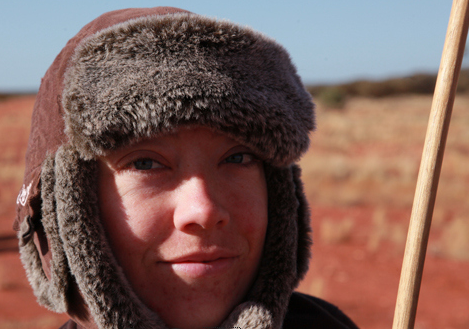
Bethany Woody (l) and Arizona Navajo activist Jerilene Jensen (r), Dec 1, 2012
Photo: Preston Wood
This struggle, now over 500 years in the making, is ongoing on many fronts, including the Navajo Nation’s current battle over U.S. companies’ uranium extraction.
In early 2013, uranium companies approached the Navajo Nation in hopes they will allow them to renew mining operations on their land. These companies claim that they have developed newer and safer methods for extracting uranium, after decades of environmental destruction and abuse led the Navajo Nation to officially ban their mining.
This decades-long battle for environmental justice is part and parcel of the struggles for workers’ rights and Native self-determination, and against the forces of militarism and capitalism.
Exploitation of Navajo lands
The Navajo Nation sits on 27,425 square miles in the four corners area of the southwestern United States. The area holds a vast amount of uranium ore and thus has become a center in the struggle over nuclear energy and weaponry.
Since the end of World War II, and the onset of the so-called Cold War, the U.S. government began mining uranium domestically in order to not rely on foreign supplies. Uranium is one of the most common naturally occurring radioactive metals on the planet, and was understood as essential for the development of nuclear weapons and technology.
Due to the unique geology and consistent climate of the Southwest, mining companies saw the Navajo reservation as the most profitable site to open mining operations in the 1940s. In 1948, the United States Atomic Energy Commission declared it would be the sole purchaser of all uranium mined in the country, initiating a mining boom of private companies and contractors who knew they had a guaranteed buyer.
Of the thousands of uranium mines, 92% were located in the Colorado Plateau on which the Navajo Nation is located. Between 1944 and 1986 approximately 4 million tons of uranium ore was mined from Navajo Tribal land.
In the early days of mining, Navajo people flocked to the low-wage work given the scarcity of jobs around the reservation. The Navajo workers dealt with racist bosses and co-workers while going into the most dangerous and undesirable jobs at lesser pay. Nonetheless, after Navajo Code Talkers’ had famously contributed to U.S. forces in World War II, many Navajo workers believed they had a patriotic duty and responsibility to the United States.
Mineworkers were also lied to about the dangers of Radon poisoning.
Radon poisoning
Before the 1950s, there were no real regulations on the disposal of radioactive waste on tribal lands, mine ventilation and what concentrations of Radon were safe. The waste that was produced was dumped back on the land, contaminating water supplies, crops, livestock, and inevitably the human population.
Rates of illness skyrocketed, and the contamination manifested into cancer, mainly lung. It also caused illnesses like tuberculosis, pneumoconiosis, chronic obstructive respiratory disease, and various blood diseases.
The U.S. Nuclear Regulatory Commission released some information regarding a deadly accident that happened at the Arkansas Nuclear One plan in Russellville in March.
A new report talks a nuclear accident report that occurred in March 2013 that has just been released now. The accident injured several workers and one worker was killed by the crane failure, that was holding a 500 ton turbine. Also, as a result, water was released that short circuited the electrics circuit boards. Additional findings to follow. The other nuclear reactor on the site is still operational. Video on link.
….Against the rise of a sinister level of British State spying on ordinary people, press and media controls, secret arrests, secret courts and the bullying, arrest and trial of whistleblowers, it is obvious that dark actors are at work amongst the elites and political powers…
Calling all those that believe in the power of a Free Press and Media
The truth behind the British Government’s Plan for A Police State by the back door
Many people in the United Kingdom, across the whole spectrum of the General Public, have been shocked at the blatant attempt by the Leveson Inquiry to hijack and gag the British Press and Media.
Using a deliberate and calculated network of Common Purpose infiltrated and aligned organisations, including the Media Standards Trust, Hacked Off, Full Fact and others, this highly political and subversive campaign was designed to bring mainstream press and media under direct control of the State.
“Todd has done a magnificent job; Sellafield’s safety record is the best it has ever been and we have produced the first credible plan for the future of the site. And, we have delivered ($840 million) in efficiencies..”
(Editor’s note: This article corrects several inaccuracies in an article printed in the Aiken Standard on Wednesday, May 8.) [ AND GOT ALTERED AGAIN ! Arclight2011 🙂 ]
Former Savannah River National Laboratory Director Dr. Todd Wright is assuming a new position as chairman of the board for Sellafield Ltd., a company tasked with cleaning up British nuclear site Sellafield.
Wright was mostly recently the managing director of the site and will now be succeeded by Tony Price, who has experience with working in senior positions in the nuclear industry. He was most recently the executive officer of Sellafield Ltd.
Sellafield is located on the northwest coast of England. URS, a major player at SRS, is one of three major contractors to make up Nuclear Management Partners, which owns Sellafield Ltd.
Wright will ensure a smooth transition and develop an ongoing program to deepen stakeholder engagement and enhance governance and strategic business performance, according to Nuclear Management Partners.
“Todd has done a magnificent job; Sellafield’s safety record is the best it has ever been and we have produced the first credible plan for the future of the site. And, we have delivered ($840 million) in efficiencies for the U.K. taxpayer and built a strong foundation for the future,” said Tom Zarges, chairman of Nuclear Management Partners.
Wright was the director of the Savannah River National Laboratory when it achieved national lab status in 2004. He served as managing director at Sellafield for two years and has been a leader with Sellafield Ltd. for five years.
Price joined Sellafield Ltd. from URS three months ago.
“On taking over the running of the site in 2008, Nuclear Management Partners promised that they would utilize the global expertise and experience of the parent body organizations by bringing employees from these organizations to enhance Sellafield operations in partnership with the workforce. Tony (Prices)’s appointment is another example of the success of that strategy,” Zarges said.
Shocking findings on effects of MOX processes on miscarriage and respiratory illness in the UK (Repost)
“…Placing the actual national numbers gleaned from the vaccine/miscarriage study of 2009 against the Watford Hospital, the national figures for pollutant caused miscarriage might be in the tens of thousands, at the very least, if you looked at these figures as representative nationally, this too will effect countries adjacent to the UK…”
Commission rejects UK application to delay compliance with nitrogen dioxide laws in 12 zones
16 of the UK’s 31 other zones, including London which does not expect compliance until 2025, also face infringement action. Commission is seeking separate clarification on five issues in London
Mr. Bass said that the Japanese government was “insolvent” and described recent accounting moves that included issuing a new form of debt called Japanese compensation bonds as “adding a Ponzi scheme to a Ponzi scheme”
He said that believing it was possible to understand these risks with concepts such as “value at risk”, a popular analytical framework used by banks [And insurance – Arclight2011] to assess trading risk, was “naive”.
Japan will be consumed by a debt crisis surpassing the U.S. subprime crash, a leading U.S.-based hedge fund manager has warned, telling investors that “the beginning of the end has begun” for Japan’s finances.
Over-indebted governments, and especially the precarious state of Japan’s finances, set the tone for the high-profile Ira Sohn investment conference in New York on Wednesday.
Kyle Bass of Hayman Capital, a $1.8 billion Texas-based hedge fund and a noted Japan bear, said signs of the crisis had started to emerge, as banks and dealers become less willing to take the other side of negative bets from funds such as his.
…..The last one was plutonium241, which had radiation dose about 50 times as much as the total of the other three(PU238, PU239 & PU240)…..
….The underground tanks were meant to store low level of radioactive water after being filtered through ALPS. But they have been using them to store high level of radioactive water (including β (beta) emitting nuclide, Strontium and α (alpha)emitting nuclide, Plutonium)…..
Thursday, 18 April 2013
A MBS radio interview with Prof. Koide: the repeated leaking problems at Fukushima Crippled Plant. Additional report: Plutonium should be in the leakage! 汚染水問題に関する小出先生のコメント、報道するラジオより。 追加報告:プルトニウムも汚染水に混じっているはず!
The most recent report on the leakage problem said that about 22 liters of radioactive water had leaked from gaps between the pipes used to transfer it from underground water storage tank into an another tank, and that the level of radioactivity in the water was 290,000Bq/m3.
This is so high that the leakage is unsafe to approach. Prof. Koide commented that according to Japanese law, the safety level of radioactive water that can be discharged into the environment is 0.05Bq/m3, or 0./03Bq/m3 if it contains strontium, so it is easy to imagine how high 290,000Bq/m3 actually is!
Dousing it or injecting it with water is the only way of continuing to cool the molten fuel, and this requires 400tons of water every day. Prof. Koide also observed that the leaks will carry on for as long as Tepco keeps using water to cool the molten fuel, possibly for at least 40 more years, or as long as it takes to decommission the plant.
He also commented that although Tepco keeps making new tanks to combat the problem, this solution would not work for ever, and urged the company again to bring a tanker to store the water.
On top of the reported leakage problems, Prof. Koide reckons that there must have been many cracks in many different places in the trenches and pits and also in the concrete basements of the reactor and turbine buildings, which must have been damaged by the M9 earthquake in March 2011.
He has kept on advising right from the beginning that Tepco should have arranged to bring a tanker to store the contaminated water and should have built a huge underground dam to stop it leaking into the environment. However Tepco has never followed his advice, citing cost as one of the reasons.
But one not so small thing remained unchanged, post-Fukushima: the tightly capped insurance system. Of course, raising the amount of insurance required to operate nuclear plants would be expensive. The nuclear industry, which provides 20 percent of all of the country’s electrical power, is not eager to incur additional expenses like higher insurance premiums for more coverage. Oh, but the nuclear power industry doesn’t actually pay premiums on most of the insurance coverage that supposedly is available…
Going without insurance is described as “going naked” in insurance industry lingo. Going without insurance for the worst hazards in the nuclear power industry is business as usual.
One need not look back very far to see the problem. In March 2011, the Fukushima-Daiichi nuclear power plant disaster, triggered by an earthquake followed by a tsunami that overwhelmed all of Japan’s safeguards, melted down three reactors, displaced 160,000 people and caused an estimated $250 billion in damages and other still-unfolding economic consequences.
Today, in the United States, we have 104 operating nuclear plants producing electricity. The owners, operators, and government regulators who oversee them say an event like Fukushima will not happen here. And even if it did, they insist, there is enough liability insurance in place to cover the damages. The actual amount of that insurance coverage: just $12.6 billion.
You don’t need an advanced degree in calculus or risk analysis to see that something doesn’t add up, and to start feeling a bit…naked. But when it comes to nuclear insurance, naked is the fashion designed for the American public.
A catastrophic accident in the US could cost way more than $12.6 billion. A worst-case scenario study in 1997 by the Brookhaven National Laboratory estimated that a major accident could cost $566 billion in damages and cause 143,000 possible deaths. Another such study, by Sandia National Laboratories in 1982, calculated the possible costs at $314 billion. Adjusted for inflation, that would put both estimates close to the trillion dollar range today. So $12.6 billion wouldn’t cover much.
Asked about volunteers who braved the radiation danger to rescue animals in the evacuation zone, such as Yoshida, Okura said, “Honestly, we were grateful.”
Editor’s note: This is the eighth part of a new series that has run in the past under the title of The Prometheus Trap. This series deals with how pets and livestock fared in the evacuation zone around the Fukushima No. 1 nuclear power plant. The series will appear on Mondays, Wednesdays and Fridays.
After the government on April 22, 2011, banned entry into a 20-kilometer radius from the disaster-stricken Fukushima No. 1 nuclear power plant, declaring it to be an evacuation zone, many people still began to enter the area illegally to rescue pets left behind.
One of them was Mieko Yoshida, a 63-year-old cram school teacher who lived in Odaka Ward in the city of Minami-soma.
Yoshida was living with 12 cats when the nuclear disaster broke out at the plant in March 2011. Despite her desperate search, she couldn’t find four of the cats that went missing amid the pandemonium created by the disaster. For Yoshida, who lives alone, they were all precious members of her family.
Yoshida started a one-woman campaign for the rescue and protection of pets left behind in the no-go zone.
When she stood in front of the city office, carrying a placard reading, “Give me back my family,” many pet owners approached her, saying, “The same here.”
Yoshida compiled a list of some 80 houses in the off-limits zone where pets had been left behind. She secretly went to these houses to feed and rescue the animals.
After the verdict the defendants were taken into custody and a hearing was scheduled for Thursday morning to determine the merits of detention. Sentencing will be held at a later date. Together, the two felonies carry a maximum 30 years in prison.
KNOXVILLE, Tenn. — An 83-year-old Catholic nun and two of her fellow peace activists were found guilty Wednesday of intending to injure the national defense for intruding last July onto the Y-12 National Security Complex, a nuclear weapons production facility in Oak Ridge, Tenn.
After hearing two days of testimony and arguments, and then deliberating for nearly 2½ hours, the jury also found the defendants guilty of damaging more than $1,000 of government property at the Y-12 site, where they cut through four chain-link fences and spray-painted biblical messages on a building that warehouses an estimated 400 tons of highly enriched uranium, the radioactive material used to fuel a nuclear bomb.
During the trial about 100 spectators filled two courtrooms to support Sister Megan Rice and 64-year-old Vietnam veteran Michael Walli, both of whom live in the District, and Greg Boertje-Obed, 57, a house painter who lives in Duluth, Minn.
As the jury of nine men and three women left the courtroom, supporters sang softly: “Love, love, love, love. People, we are made for love.”
In the pre-dawn hours of July 28, 2012, the three defendants hiked over a wooded ridge and were able to enter the site unimpeded because of a series of deficient security measures, including inoperable security cameras and an alarm system inundated by routine false alarms. The intrusion triggered a two-week shutdown of operations at Y-12 — a Department of Energy site that is overseen by the National Nuclear Security Administration and operated and managed by private contractors — and prompted four congressional hearings on nuclear security and a shake up in the U.S. nuclear security enterprise.
After the verdict the defendants were taken into custody and a hearing was scheduled for Thursday morning to determine the merits of detention. Sentencing will be held at a later date. Together, the two felonies carry a maximum 30 years in prison.
For more on the defendants, the intrusion and the fallout, visit wapo.st/prophets.
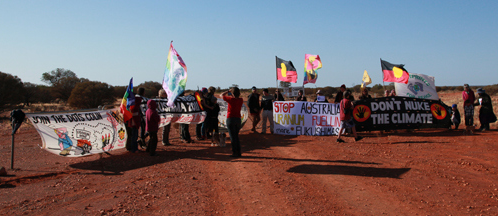
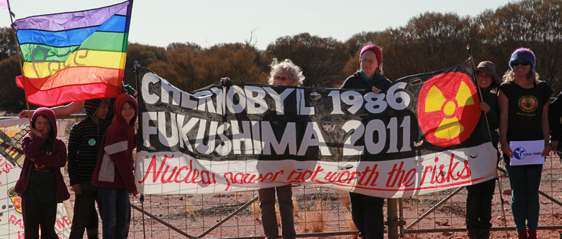
Indigenous and international protesters have begun a 250 km-long walk to campaign against uranium mining in Western Australia.
A month-long anti-uranium walk has begun in the gold fields of Western Australia.
Traditional owners and international protesters are walking 250 kilometres from Yellirrie to Leonora campaigning against uranium mining in the resource-rich state.
But their march comes less than a month after the federal government approved a proposed uranium mine about 100 kilometres away.
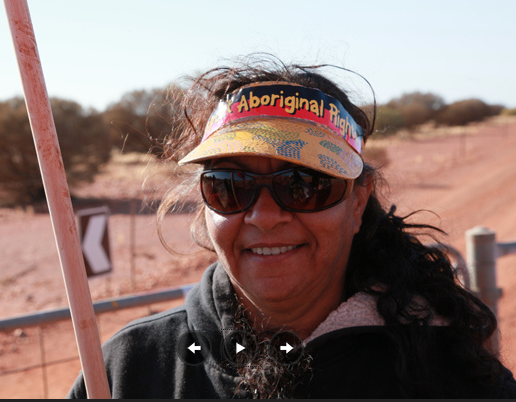
Walking for country is to reconnect people with land and culture. The Walkatjurra Walkabout is a pilgrimage across Wangkatja country in the spirit of our ancestors so together, we as present custodians, can protect our land and our culture for future generations.
My people have resisted destructive mining on our land and our sacred sites for generations. For over forty years we have fought to stop uranium mining at Yeelirrie, we stopped the removal of sacred stones from Weebo and for the last twenty years we have stopped destruction of 200 sites at Yakabindie.
We are not opposed to responsible development, but cannot stand wanton destruction of our land, our culture, and our environment.
We invite all people, from all places, to come together to walk with us, to send a clear message that we want the environment here, and our sacred places left alone.
Kado Muir, Traditional Owner, Yeelirrie
Join us for a one month walk from Yeelirrie to Leonora from May 4thth – 28th May. This walk will be lead by the Walkatjurra Rangers, in partnership with Footprints for Peace, Western Australian Nuclear Free Alliance (WANFA), the Anti Nuclear Alliance of Western Australia (ANAWA) and the Conservation Council of Western Australia (CCWA).
While this walk is a valuable personal experience, it is also a Non-violent Direct Action that plays an important role in the broader environmental and Aboriginal sovereignty movements. It is a partnership to share knowledge, culture and environmental awareness in a campaign supporting the sovereign rights of Aboriginal people to protect their lands and support a nuclear free future.
Abby Martin talks about BP’s license to pollute, highlighting irresponsible practices that have led to massive oil spill and resulted in only minor penalties against the company. All the while, BP receives new government contracts and is reporting record profits.
Editors note: As an introduction to this post I would like to say that finding this report was difficult.. the link on the UN website search would not allow me there.. However, I found a way!
I will post a short video up of the fun I had getting the link maybe, but the important and relevant bits are here below!
At the bottom I will leave a link to the issues brought up by the rapporteur to Japan in November 2012.. Were those issues just brushed aside here? WHO is responsible? You decide!
Image source ; courtesy of the err IAEA 🙂
[…]
Regarding those that survived the atomic bombing, their medical needs related to their exposure was subsidised and this would allow them to maintain a suitable level of living.
[…]
On a more technical point, it was explained that annual exposure to radiation was at the level advised by the International Commission on Radiological Protection.
[…]
On another point, the delegation said there was financial support available for refugees as they waited for their file to be processed.
[…]
In case of the loss of a head of household as a result of Fukushima, there was a 5 million yen compensation payment – and for the loss of a female, the compensation was half as much.
[…]
Policies to realise public policies on the promotion of science and technology were in place, as well as awareness raising on the ability of technology to improve quality of life.
[…]
More information was now being disclosed through information materials and press conferences on Fukushima, said a member of the delegation, and this was to make decision making more transparent.
Continued reviews were required on the part of operators of nuclear power plants to ensure operations were as safe as possible.
[…]
On science and technology, the country was trying to connect it to the overall development of Japan, as their greatest resource was the people. The idea was to use this knowledge for the benefit of the whole world.
[…]
The concluding remarks of the Committee would be adopted on 17 May, and as a group they looked forward to the follow-up.
[…]
Committee on Economic, Social and Cultural Rights considers Report of Japan
Committee on Economic, Social and Cultural Rights
30 April 2013
The Committee on Economic, Social and Cultural Rights today considered the third periodic report of Japan on how that country implements the provisions of the International Covenant on Economic, Social and Cultural Rights.
Introducing the report of Japan, Hideaki Ueda, Ambassador in charge of Human Rights and Humanitarian Affairs at the Ministry for Foreign Affairs of Japan, said Japan had a target for increasing the number of women in leadership positions and an action plan to combat human trafficking. The number of persons with disabilities in employment had risen and persons with disabilities were offered vocational guidance carefully tailored to their abilities and aptitudes. The Government had implemented emergency support measures in the wake of the financial crisis, and support for employment for youth had been strengthened. An integrated reform of the social security system had taken place and insurance payment requirements for pension payments had been relaxed.
The Committee asked about the labour force supply and demand structure, working hours, labour agreements, the National Wage Council, the linkage between the minimum wage and the benefit programme, the health insurance system, social security, nuclear accidents and how the comments of the Committee were considered in Japan. Also issues concerning the impact of the financial situation on Japan’s ability to implement the provisions of the Covenant, austerity measures, the Fukushima nuclear power station accident and alternative forms of energy were raised.
Some extracts here to help locate quotes above in document below
OnMay 10, 2012, YouTube closes the accountofTokyobrowntabby.
Tokyobrowntabbyiscertainly arespectable lady , who lives in Tokyo.Like many others, since thedisasterin March 2011, she decided to publishsome videos, adding an Englishand / orJapanesetranslationto inform anddraw attention tothe dangersthat threatenits citizens, because of the status ofFukushimanuclear power plant that was destroyedandcrisis managementby the authorities of this country.
Her crime,was to usesome videosextractspublished byAsahi,Yomiuri, NHK, BBC, etc... And thereforeprotected bycopyright.Several complaints have beenfiled bythese companies toYouTube, which obviously havebetter things to dothan risklosing moneyincostly litigation,so they close the accountof offendersto the thirdclaim.
No matter that it is “criminal” it represents hoursand hours ofvolunteer worklost,without tryingto hurtanyoneorderive anypersonal profit. Regardless of whetherthis workwas costingabsolutelynothingto“shamefully injuredvictims” but rather minimised the scope andaccessibility of theirmessage. Guard dogshavedone their job. Injusticeprevails.
And shouldthese famouscopyrightsexcuses bean excuse?
It’sup to you tomakeup your own mind. Be curiousand objectives. “Learn to think for yourself, otherwise someoneelse will do itfor you.”
Bande son, musique libre de droits :
Consortium, Return to The Urban Tale – OST2, the Urban Tale – Xcyril & Nabru Elat – Eissyk http://altermusique.org/Consortium/Re…




 One need not look back very far to see the problem. In March 2011,









 nuclear-news