Norwegian Nuclear Committee says no to nuclear power in Norway
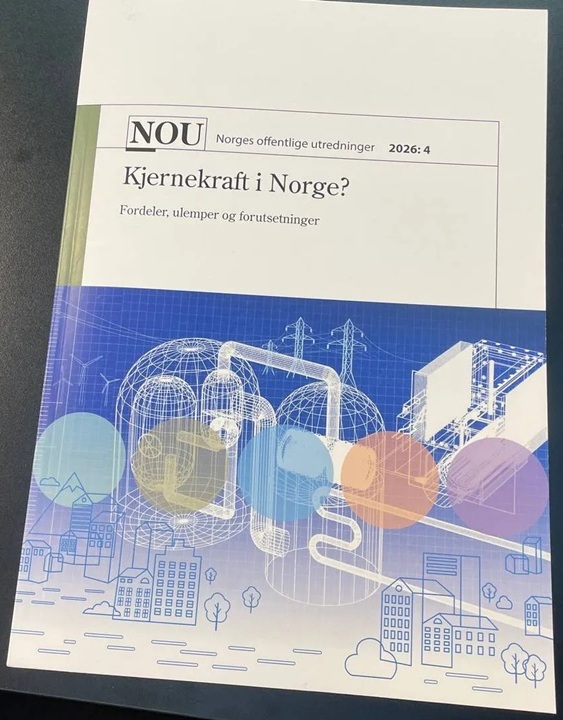
It is too expensive, Norway lacks the necessary expertise, and the process takes too long, according to the Committee. It unanimously rejects nuclear power.
Johannes Enli Kalleberg and NTB , 8 April, 26, https://energywatch.com/EnergyNews/Renewables/article19180637.ece
The government-appointed Norwegian Nuclear Committee – which has consisted of experts in physics, technology, economics, law, ethics, and social sciences – will submit its report to Norwegian energy minister Terje Aasland on Wednesday after a year and a half of work.
In the report “Nuclear Power in Norway? Advantages, Disadvantages, and Prerequisites,” the committee arrived at the following two main recommendations:
- Norway should not initiate a full-scale nuclear power process at the current moment.
- But we should build up expertise that will make it easier to make such a decision in the future.
Extensive support
A key rationale is economics. The committee’s calculations show that nuclear power, even under the most optimistic assumptions, requires electricity prices of at least NOK 1.13 (EUR 0.10) per KWh to cover costs. The estimated long-term electricity price in Norway is NOK 0.50-0.80.
“If nuclear power is to be established in Norway, private investors must find it profitable to invest in nuclear power. In that case, investment costs must be 70-80% lower,” the report states.
The committee points out that this aligns well with the situation in Sweden and Finland. There, major energy companies such as Vattenfall and Fortum say they cannot build new nuclear power plants without extensive government support.
”However, the committee does not see any sound socio-economic justifications for the government to support the establishment of nuclear power in Norway.”
Not before the 2040s
A time-consuming process also argues against nuclear power. Even if Norway decided go ahead with nuclear construction today, the committee estimates that production is not realistic before the mid-2040s at the earliest. First, legislation, regulatory frameworks, and professional communities must be developed.
”In any case, nuclear power production will not come in time to help achieve the Paris Agreement’s 2050 goals, and we must expand other sources in the meantime. And we have other alternatives. These include upgrading hydropower plants and expanding wind and solar power,” the committee concludes.
The committee also warns that the prospect of future nuclear power could hinder the development of these alternatives.
”If there is a prospect of nuclear power coming to Norway in 20 years, it will become less profitable to build other types of power plants. With nuclear power, we thus risk having less power and less transition in the coming decades.”
100,000 years
Much of the Norwegian debate has centered on small modular reactors (SMRs). The committee is skeptical of these as an immediate solution: no factories have been established, no models have been standardized, and it is highly uncertain how affordable SMRs will be.
The committee also highlights the management of spent fuel as a major challenge. Spent fuel emits harmful radiation for thousands of years, and there is international consensus that it must be stored at a depth of around 500 meters in stable rock for 100,000 years.
Finland is the only country in the world to have completed such a repository.
”Accidents can have major consequences and necessitate very strict safety requirements that apply specifically to nuclear power […] It is a challenge that we do not know what the probability is, and that it is difficult to assess what consequences an accident might have.”
Knowledge – not power plants
Nuclear power is not, however, entirely negative. The committee points out that it is possible to produce large amounts of stable, emission-free power in a small area over a long period. The fact that it is not dependent on sun and wind is also a plus.
The report makes it clear that building expertise in nuclear power is important.
This involves strengthening academic environments at universities, participating more actively in international cooperation, staying up to date on technological developments, and considering cooperation with Sweden and Finland.
”Therefore, we think the smartest thing we can do today is to build knowledge, not power plants,” the committee writes.
On June 21, 2024, the Ministry of Energy appointed the committee that has examined nuclear power as a potential energy source in Norway. The goal has been to review and assess various aspects of a possible future establishment of nuclear power in Norway.
This article was provided by our sister media in Norway, EnergiWatch.
English edit by Christian Radich Hoffman.
No comments yet.
1 This Month
Chernobyl: The Lost Tapes – A good documentary on Chernobyl on SBS available On Demand for the next 3 weeks– https://www.sbs.com.au/ondemand/tv-program/chernobyl-the-lost-tapes/2352741955560

of the week–London Campaign for Nuclear Disarmament

Tell the Ukrainian Government to Drop Prosecution of Peace Activist Yurii Sheliazhenko
To see nuclear-related stories in greater depth and intensity – go to https://nuclearinformation.wordpress.com
-
Archives
- April 2026 (139)
- March 2026 (251)
- February 2026 (268)
- January 2026 (308)
- December 2025 (358)
- November 2025 (359)
- October 2025 (376)
- September 2025 (257)
- August 2025 (319)
- July 2025 (230)
- June 2025 (348)
- May 2025 (261)
-
Categories
- 1
- 1 NUCLEAR ISSUES
- business and costs
- climate change
- culture and arts
- ENERGY
- environment
- health
- history
- indigenous issues
- Legal
- marketing of nuclear
- media
- opposition to nuclear
- PERSONAL STORIES
- politics
- politics international
- Religion and ethics
- safety
- secrets,lies and civil liberties
- spinbuster
- technology
- Uranium
- wastes
- weapons and war
- Women
- 2 WORLD
- ACTION
- AFRICA
- Atrocities
- AUSTRALIA
- Christina's notes
- Christina's themes
- culture and arts
- Events
- Fuk 2022
- Fuk 2023
- Fukushima 2017
- Fukushima 2018
- fukushima 2019
- Fukushima 2020
- Fukushima 2021
- general
- global warming
- Humour (God we need it)
- Nuclear
- RARE EARTHS
- Reference
- resources – print
- Resources -audiovicual
- Weekly Newsletter
- World
- World Nuclear
- YouTube
-
RSS
Entries RSS
Comments RSS
 nuclear-news
Leave a comment