They Reject American Israel Public Affairs Committee (AIPAC)—But Not the War Machine
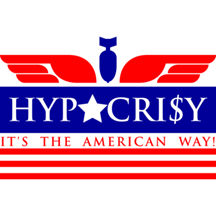
what does it mean for a state to claim a right to exist if that existence is sustained through the death, displacement, and destruction of others?
April 7, 2026 Joshua Scheer, https://scheerpost.com/2026/04/07/they-reject-aipac-but-not-the-war-machine/
In Washington, a quiet rebrand is underway.
One by one, prominent Democrats positioning themselves for 2028 are announcing that they will no longer accept money from the American Israel Public Affairs Committee (AIPAC). On its face, this seems like a meaningful break from decades of bipartisan deference. For years, AIPAC has functioned as a gatekeeper of acceptable discourse on U.S. policy toward Israel—rewarding loyalty, punishing dissent.
But look closer, and the shift begins to feel less like a rupture—and more like a recalibration.
Because while the money may be refused, the machinery of war remains firmly intact.
A Political Adjustment, Not a Moral One
Recent polling shows a dramatic shift among Democratic voters, with overwhelming sympathy now leaning toward Palestinians rather than Israelis. Currently, 65 percent of Democrats say their sympathies lie more with the Palestinians, while 17 percent say they sympathise more with the Israelis. That reality has forced politicians to adapt. For the first time in a generation, the moral ground beneath U.S. support for Israel is cracking—driven not by politicians, but by a public no longer willing to ignore the scale of destruction in Gaza.
So candidates pivot.
They distance themselves from AIPAC. They speak in softer tones. Some even flirt with language once considered taboo—words like “apartheid,” quickly walked back when backlash arrives.
Yet beneath this rhetorical repositioning lies a stubborn continuity: unwavering support for military aid, strategic alliance, and the broader architecture of U.S. dominance in the Middle East.
This is not transformation. It is triangulation.
To demonstrate that most clearly, here is the front-runner for 2028 discussing his reversal of calling Israel an apartheid state and his reverence for the country. Newsom’s reversal—pairing regret over the word “apartheid” with an insistence that he “revere[s] the state of Israel”—captures where Democrats are now: distancing from Netanyahu without challenging the system itself.
However, Cory Booker defended the group—from which he has received significant funding—arguing that the intense focus on AIPAC is misplaced. He noted that many ethnic and interest groups raise and bundle political donations, often for causes he personally disagrees with, yet AIPAC has become a singular target of criticism. As he put it, “There are Iranian Americans that bundle money. There are Turkish Americans that bundle money. There are a lot of ethnic groups that bundle money… but somehow AIPAC seems to be drawing a lot of attention, and that’s problematic to me.” At the same time, Booker has said he would no longer accept PAC money in general. Still, at least he stands by his position.
The Illusion of Courage
Rejecting AIPAC donations is being framed as a bold stand. In reality, it is the lowest bar imaginable.
What would actual political courage look like?
It would mean voting to halt weapons transfers used in devastating campaigns across Gaza, Lebanon, and beyond. It would mean openly confronting the human cost of U.S. foreign policy—not just its public relations problem. It would require breaking not just with a lobbying group, but with a system that treats military force as the default instrument of policy.
Few are willing to go that far.
Instead, we see a familiar pattern: symbolic gestures paired with substantive silence.
Blaming Individuals, Protecting Systems
Another tactic has emerged in this moment of discomfort—one as old as politics itself.
Blame the leader, not the structure.
Criticism is carefully directed at Benjamin Netanyahu, portrayed as an outlier or aberration. The implication is that without him, the underlying policies would somehow be more humane, more restrained, more just.
But this framing obscures more than it reveals.
Netanyahu did not create the system—he operates within it. A system sustained by decades of U.S. military funding, diplomatic shielding, and bipartisan consensus. To isolate him as the problem is to avoid confronting the deeper reality: that the policies themselves, not just their most visible architect, are responsible for the devastation.
Here is that dynamic in clear focus with former Chicago mayor Rahm Emanuel. A longtime supporter of Israel—whose father was Israeli. At the same time, he has also vowed not to take AIPAC’s money.
Kentucky Gov. Andy Beshear underscored again what we have been saying: that the party cannot change its ways despite cutting off one group that has become politically problematic, further showing the disconnect between the people they represent and Israel.
Here, Beshear sticks to familiar pro-Israel talking points in a recent interview and resists labeling the devastation in Gaza as “genocide,” dismissing such language as an unwelcome party “litmus test.” Rep. Ro Khanna pushed back, arguing that defending human rights should be the most basic standard—and that the party must find a new moral direction.
The Money Isn’t the Whole Story
Even as AIPAC becomes politically radioactive in some circles, its influence persists—often through parallel organizations, aligned donors, and entrenched institutional relationships.
More importantly, AIPAC has never been the sole driver of U.S. policy. It is a symptom of a broader alignment between American power and Israeli military strategy—an alignment rooted in geopolitics, not just lobbying.
Which means that removing AIPAC from the equation, while leaving everything else intact, changes very little.
The pipeline of weapons continues.
The bombs keep falling.
The rhetoric adjusts.
And while AIPAC often dominates the conversation, it is far from the only force shaping pro-Israel advocacy in U.S. politics. A wide network of organizations operates across the political spectrum, each reinforcing the U.S.-Israel relationship in different ways. Christians United for Israel (CUFI), the largest pro-Israel group in the country with over seven million members, mobilizes grassroots evangelical support rooted in Christian Zionist beliefs. J Street, founded in 2008, presents itself as a more progressive alternative, advocating for a two-state solution and diplomacy over military approaches, even as it maintains a pro-Israel stance. Within party politics, the Democratic Majority for Israel (DMFI) works to ensure the Democratic Party remains firmly aligned with Israel, while the Republican Jewish Coalition (RJC) advances similar priorities within Republican circles. Other groups, such as Pro-Israel America PAC and the Israeli-American Coalition for Action, focus on supporting candidates and advancing legislation that strengthens bilateral ties, including efforts like anti-BDS laws at the state level. Additional organizations—including NORPAC, the Joint Action Committee for Political Affairs (JAC), and Americans for Good Government (AGG)—further reinforce this ecosystem by backing candidates who support a strong U.S.-Israel relationship. While these groups differ in strategy—ranging from grassroots mobilization to direct political funding and lobbying—they collectively demonstrate that AIPAC is not an isolated actor but part of a broader, deeply embedded network.
At the same time, opposition has begun to coalesce through the “Reject AIPAC” coalition, which includes groups like IfNotNow, Jewish Voice for Peace Action, and Justice Democrats, signaling a growing pushback against this entrenched influence.
The Bottom Line
The deeper problem is not rhetorical—it is structural. Israel is a settler-colonial state, and until that truth is spoken plainly—alongside the histories of the United States, South Africa, and others built on dispossession—we are not having an honest conversation. We are circling it, softening it, avoiding it. Because the real question cuts too deep: what does it mean for a state to claim a right to exist if that existence is sustained through the death, displacement, and destruction of others? That is the question buried beneath every speech, every careful statement, every political pivot.
Instead, we are handed villains. Netanyahu becomes the embodiment of the problem—like Trump, grotesque enough to absorb our outrage. But this is a sleight of hand. Systems do not begin or end with men like him; they outlive them, operate through them, and are protected by those who claim to oppose them. By narrowing the blame, we absolve the structure.
And so the language collapses. Even Gavin Newsom, for a fleeting moment, brushed against the truth—only to retreat, unable to hold the weight of the word “apartheid,” unable to let it stand. That retreat is not incidental; it is the boundary of acceptable politics. Because to name the system is to implicate ourselves—our history, our alliances, our silence.
Until that boundary is broken, until the words match the reality, there is no path forward—only repetition, only evasion, only the quiet normalization of what should be unthinkable.
No comments yet.
1 This Month
Chernobyl: The Lost Tapes – A good documentary on Chernobyl on SBS available On Demand for the next 3 weeks– https://www.sbs.com.au/ondemand/tv-program/chernobyl-the-lost-tapes/2352741955560

of the week–London Campaign for Nuclear Disarmament

Tell the Ukrainian Government to Drop Prosecution of Peace Activist Yurii Sheliazhenko
To see nuclear-related stories in greater depth and intensity – go to https://nuclearinformation.wordpress.com
-
Archives
- April 2026 (139)
- March 2026 (251)
- February 2026 (268)
- January 2026 (308)
- December 2025 (358)
- November 2025 (359)
- October 2025 (376)
- September 2025 (257)
- August 2025 (319)
- July 2025 (230)
- June 2025 (348)
- May 2025 (261)
-
Categories
- 1
- 1 NUCLEAR ISSUES
- business and costs
- climate change
- culture and arts
- ENERGY
- environment
- health
- history
- indigenous issues
- Legal
- marketing of nuclear
- media
- opposition to nuclear
- PERSONAL STORIES
- politics
- politics international
- Religion and ethics
- safety
- secrets,lies and civil liberties
- spinbuster
- technology
- Uranium
- wastes
- weapons and war
- Women
- 2 WORLD
- ACTION
- AFRICA
- Atrocities
- AUSTRALIA
- Christina's notes
- Christina's themes
- culture and arts
- Events
- Fuk 2022
- Fuk 2023
- Fukushima 2017
- Fukushima 2018
- fukushima 2019
- Fukushima 2020
- Fukushima 2021
- general
- global warming
- Humour (God we need it)
- Nuclear
- RARE EARTHS
- Reference
- resources – print
- Resources -audiovicual
- Weekly Newsletter
- World
- World Nuclear
- YouTube
-
RSS
Entries RSS
Comments RSS
 nuclear-news
Leave a comment