Trump accelerates new nuclear warhead production, nearly doubles funding for plutonium “pit” bomb core production.
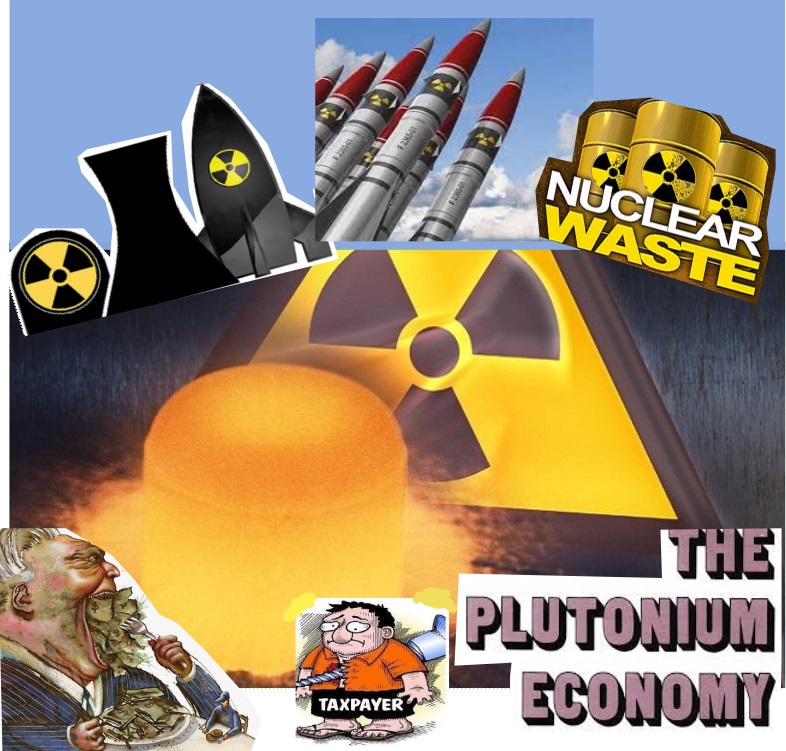
The Pentagon has always explicitly rejected “minimum-deterrence” in favor of keeping “counterforce” capabilities to wage nuclear war. This is why the U.S. has thousands of nuclear weapons and a $2 trillion “modernization” program to keep them forever. Indefinitely maintaining and expanding nuclear capabilities is contrary to the 1970 NonProliferation Treaty
None of this future pit production is to maintain the safety and reliability of the existing stockpile, but instead is entirely for new-design nuclear weapons
The Trump 2027 budget speeds up this backwards trend. For nuclear warhead production:
April 6, 2026, Jay Coghlan, Nuclear Watch, New Mexico, https://nukewatch.org/wp-content/uploads/2026/04/Trump-Accelerates-Nuclear-Warhead-Production-PR.pdf
Santa Fe, NM – The Trump Administration has released military budget numbers for the federal fiscal year 2027 (which begins October 1, 2026). This still current fiscal year 2026 is already a record breaker for military spending at one trillion dollars. Trump now proposes nearly $1.5 trillion in military spending in FY 2027, of which $1.1 trillion is base funding for the Department of War and an additional $350 million is through so-called budget reconciliation.
On top of all this, Trump will likely seek $200 billion in supplementary appropriations for the war in Iran, for a potential total of $1.7 trillion in military spending in FY 2027 (a 70% increase above FY 2026). At the same time, there is a 10% across-the-board cut to non-military spending. Much of the remaining discretionary funding for education, wildfire protection, environmental regulations, health care, etc., will be constrained by a focus on border control and immigration enforcement.
Trump proposes $53.9 billion for the Department of Energy (DOE) in FY 2027. Sixty-one per cent ($32.8 billion) is for its semi-autonomous nuclear weapons agency, the National Nuclear Security Administration (NNSA). DOE’s Office of Science is gutted by $1.1 billion which “eliminates funding for climate change and Green New Scam research.” DOE’s Office of Energy Efficiency and Renewable Energy is eliminated. Nationwide cleanup of legacy Cold War radioactive and toxic wastes at DOE sites is cut by $386 million to $8.2 billion ($3 billion of which is reserved for the Hanford Site; other site-specific cleanup budget numbers are still not yet available).
With respect to the Department of Energy’s nuclear weapons agency, the Trump FY 2027 budget:
“… focuses NNSA on its most important mission—producing a robust, credible, and modern nuclear deterrent that protects the American people. The United States must maintain and expand its set of nuclear capabilities that allow the President flexibility to protect the homeland and deter adversaries. Specifically, the Budget makes strong investments to develop new warheads that would bolster deterrence, modernize NNSA’s supporting infrastructure, and extend the life of existing warheads.”
The Pentagon has always explicitly rejected “minimum-deterrence” in favor of keeping “counterforce” capabilities to wage nuclear war. This is why the U.S. has thousands of nuclear weapons and a $2 trillion “modernization” program to keep them forever. Indefinitely maintaining and expanding nuclear capabilities is contrary to the 1970 NonProliferation Treaty, which required the nuclear weapons powers to “to pursue negotiations in good faith on effective measures relating to cessation of the nuclear arms race at an early date and to nuclear disarmament…” After more than a half-century that has never even begun. An NPT Review Conference, held every five years, is scheduled to begin April 27 at the United Nations. It is widely expected to fail for the third time over fifteen years to make any progress whatsoever toward nuclear disarmament.
The Trump 2027 budget speeds up this backwards trend. For nuclear warhead production:
• A feasibility study for a new B61-13 limited earth-penetrating bomb is funded at $46.4 million in FY 2027. A full budget request of $1 billion is expected for FY 2028 followed by an average of $870 million for each fiscal year 2029 – 2031.
• The W80-4 warhead for the Long-Range Stand-Off weapon (i.e., air-launched cruise missile) is funded at $1 billion in FY 2027. There is an average of $970 million in projected costs for each fiscal year 2028-2031.
• No funding is requested in FY 2027 for the W80-5 warhead for the Sea-Launched Cruise Missile. However, there is an average of $1.4 billion in projected costs for each fiscal year 2028-2031.
• The W87-1 nuclear warhead program is for the new Sentinel intercontinental ballistic missile, with likely multiple warheads for each missile (which is particularly dangerous and destabilizing). The Sentinel ICBM itself is already massively over budget. The W87-1 warhead program is increased 41% from $650 million in FY 2026 to $913 million in FY 2027, with an astounding average of $3.5 billion in projected costs for each fiscal year 2028-2031.
• The submarine-launched W93 nuclear warhead program, which the United Kingdom has actively lobbied for, is increased 37% from $807 million in FY 2026 to $1.1 billion in FY 2027. There is an average of $1.95 billion in projected costs for each fiscal year 2028-2031.
• There is a new “Future Programs” budget line item of $99.8 million in FY 2027 for feasibility studies for other new-design nuclear weapons, followed by an average of $92 million for each fiscal year 2028-2031.
Plutonium “pit” bomb core production: Plutonium pits are the essential “triggers” for modern nuclear weapons. Pit production has been the chokepoint for resumed industrial-scale nuclear weapons production by the U.S. ever since an FBI raid investigating environmental crimes stopped operations at the Rocky Flats Plant in 1989.
Trump’s FY 2027 budget proposes:
An 83% increase in funding for pit production at the Los Alamos National Laboratory from $1.3 billion in FY 2026 to $2.4 billion in FY 2027. There is an average of $2.3 billion in projected costs for each year FY 2028-2031. NNSA has directed LANL to double pit production to at least 60 pits per year because of increasing delays at the Savannah River Site (SRS).

• An 87% increase in funding for pit production at SRS from $1.2 billion in FY 2026 to $2.25 billion in FY 2027. There is an average of $2.5 billion in projected costs for each year FY 2028-2031. The Savannah River Plutonium Processing Facility’s upper range in estimated costs is now $25 billion, which would make it by far the most expensive building in U.S. history. Gloveboxes at SRS for canceled “dilute and dispose” of surplus plutonium are being diverted to “purification instead of disposition” to create feedstock for manufacturing new plutonium pits. There is only one glovebox left at SRS to process and remove excess plutonium, which could lead to resumed legal conflict with the State of South Carolina.
Total “Plutonium Modernization” for expanded plutonium pit production at both sites is increased 87% from $2.6 billion in FY 2026 to $4.9 billion in 2027. There is an average of $5.1 billion in projected costs for each year FY 2028-2031.
None of this future pit production is to maintain the safety and reliability of the existing stockpile, but instead is entirely for new-design nuclear weapons. This is despite the fact that in 2006 independent experts found that pits have serviceable lifetimes of at least 100 years. The average age of pits is now around 43 years. NNSA has avoided any full pit lifetime studies since 2006 (however, a new one is reportedly pending).
At least 15,000 pits are already stored at NNSA’s Pantex Plant. The independent Government Accountability Office has repeatedly reported that NNSA has no credible cost estimates for pit production, its most expensive and complex program ever. New pits cannot be tested because of the existing international testing moratorium, which could erode confidence in the stockpile. Or, conversely, new pits could prompt the U.S. to resume testing (which Trump has already threatened), after which other nuclear weapons powers would surely follow, thereby rapidly accelerating the new nuclear arms race.
Other nuclear weapons production programs:
• The “Tritium and Defense Fuels” program is increased by 79% from $520 million in FY 2026 to $881 million in 2027. There is an average of $1.8 billion in projected costs for each fiscal year 2028-2031.
“Non-Nuclear Capability Modernization” for non-nuclear components manufacturing, primarily at the Sandia National Laboratories, is increased 130% from $195.5 million in FY 2026 to $449 million in FY 2027. There is an average of $370 million in projected costs for each fiscal year 2028-2031.
• “Weapons Dismantlement and Disposition” is increased 10% from $82.3 million in FY 2026 to $90.7 million in FY 2027 (a mere 1.3% of total warhead funding). Rather than being a worthy step toward nuclear disarmament, the stated objective of weapons dismantlements is to “recover critical components and materials to support existing weapon programs, Naval Reactors, and other national priority missions.” There is an estimated backlog of up to 1,500 retired warheads to dismantle and dispose. However, NNSA’s Pantex Plant is so busy rebuilding existing nuclear warheads with new military capabilities that dismantlements have been at a historic low since the end of the Cold War.
In all, NNSA’s budget category of “Total Weapons Activities” is increased 35% from $20.4 billion in FY 2026 to $27.4 billion in FY 2027. There is an average of $29 billion in projected costs for each fiscal year 2028-2031.
Jay Coghlan, Director of Nuclear Watch, commented, “New nuclear weapons won’t give us more security as our nation is being hollowed out by tax cuts for the ultrarich, cuts to domestic programs, and the gutting of programs to address adverse climate change. It is way past time for the nuclear weapons powers to honor their obligations under the 1970 NonProliferation Treaty to negotiate verifiable nuclear disarmament instead of keeping nuclear weapons forever. We should be cleaning up, not building up new nuclear weapons.”
Sources:……………………………………………………………..
Ceasefire on the Brink — The Day Genocide Became a Negotiating Tactic

once a leader openly invokes the destruction of an entire civilization, the threshold has already been crossed. The unthinkable has been spoken—and therefore made thinkable.
April 7, 2026 , Joshua Scheer. https://scheerpost.com/2026/04/07/ceasefire-on-the-brink-the-day-genocide-became-a-negotiating-tactic/
In the span of a single day, the United States came terrifyingly close to crossing a line that cannot be uncrossed.
A president publicly threatened the destruction of “a whole civilization,” only to pivot hours later to a fragile, last-minute cease-fire brokered through frantic diplomacy.
That whiplash is not strategy. It is the normalization of annihilation as a negotiating tool.
And now, the world’s leading human rights bodies are saying exactly what Washington refuses to confront: this is not just reckless rhetoric—it may be criminal.
Amnesty International warned that such threats reflect a “staggering level of cruelty and disregard for human life,” and could constitute a threat of genocide under international law.
Not hyperbole. Not partisan outrage. Legal language.
Let’s be clear about what was on the table.
The deliberate targeting of power plants, water systems, bridges, and essential infrastructure is not some abstract military option. It is the dismantling of civilian life itself—the systems that make survival possible. As Amnesty and medical experts warned, such attacks would deprive millions of access to water, food, healthcare, and basic human dignity, while potentially triggering environmental and even nuclear catastrophe.
This is not war in the conventional sense. It is the engineering of societal collapse.
And yet, in today’s Washington, even genocidal rhetoric is spun as leverage.
This is the deeper crisis: not just the war itself, but the erosion of boundaries that once constrained power. The idea that you can threaten mass civilian death to force compliance—and then walk it back as part of a deal—is not diplomacy. It is coercion dressed up as statecraft, a performance of dominance in which human lives become bargaining chips.
The cease-fire, reportedly mediated by Pakistan under intense global pressure, buys two weeks.
Two weeks to negotiate.
Two weeks to pause the bombing.
Two weeks for markets to stabilize and headlines to cool.
But what does it not do?
It does not undo the more than 1,600 civilians already reported killed.
It does not rebuild the infrastructure already shattered.
It does not erase the terror inflicted on tens of millions of people suddenly forced to contemplate their own annihilation.
And it does not undo the precedent.
Because once a leader openly invokes the destruction of an entire civilization, the threshold has already been crossed. The unthinkable has been spoken—and therefore made thinkable.
Human rights experts are warning that the danger is not only what might happen next, but what has already been normalized. As Amnesty put it, the very act of making such threats “brazenly shreds core rules of international humanitarian law.”
That is the real story here.
Not just a war spiraling toward catastrophe—but a global order in which the rules meant to prevent catastrophe are being openly discarded.
We have seen this trajectory before. Iraq was justified with certainty that did not exist. Afghanistan became a forever war without a clear end. Now Iran sits at the edge of something even more dangerous—not just invasion or occupation, but the explicit threat of civilizational erasure.
Even some of the president’s allies have recoiled, recognizing that this is not strength but instability masquerading as resolve. When threats alienate allies, embolden adversaries, and horrify the world, they are not strategic—they are reckless.
Meanwhile, Congress drifts. Calls for oversight, war powers votes, even removal from office have surfaced—but only after the rhetoric crossed into territory that international law was designed to prevent.
This is the central failure of American governance in the age of permanent war: the abdication of responsibility until crisis becomes catastrophe.
The cease-fire should not be mistaken for success. It is a pause forced by global alarm and the sheer gravity of what was nearly unleashed. It is proof that diplomacy still exists—but only under the shadow of something far darker.
Because the question now is unavoidable:
If threatening to destroy a civilization is part of the negotiating playbook, what happens when threats stop working?
History offers a grim answer: escalation.
And next time, there may be no last-minute intervention.
No diplomatic scramble.
No two-week pause.
Only the consequences of a line already crossed.
Could a New Nuclear Reactor Double or Triple Electricity Rates in New Brunswick?

The implication of these experiences and proposals is that a new 1,000-MW reactor for New Brunswick could carry a price tag of $15 to $26 billion. Estimates of the costs of electricity needed to cover the capital costs of new nuclear plants, if they’re financed through electricity rates, range from the mid-20¢ to more than 40¢ per kilowatt-hour—nearly double to even triple current consumer electricity costs in New Brunswick. Such increases would undermine energy affordability, economic competitiveness, and any plans for decarbonization through electrification.
April 9, 2026, Mark Winfield and Susan O’Donnell, https://www.theenergymix.com/could-a-new-nuclear-reactor-double-or-triple-electricity-rates-in-new-brunswick/
At the end of last month, the NB Power Review Panel report recommended considering building a new large nuclear reactor at the Point Lepreau site in New Brunswick. That recommendation raises a series of questions, not least whether the province can afford a new reactor, how it would be paid for, and its impact on electricity rates and the province’s overall financial position.
It is important to grasp the scale of such a project and its potential economic impacts. Based on recent experience in other jurisdictions, a new large reactor of the types likely to be considered for Lepreau could cost between $15 and $26 billion. That would be a far higher capital expenditure than the original Point Lepreau reactor, which itself came in at more than $5 billion in 2026 dollars.
If the cost of a new reactor were passed on directly to NB Power customers through electricity rates, those rates could double or even triple.
Already, the costs of the original construction and later refurbishment of New Brunswick’s existing reactor at Lepreau make up $3.6 billion of the utility’s current crippling debt, the NB Power Review noted. That debt, plus the fact that the reactor has been operating below capacity since the refurbishment, is costing ratepayers dearly.
But despite New Brunswick’s costly nuclear experience, a new reactor has been in the cards since 2023, when NB Power and the provincial government published plans calling for 600 megawatts (MW) of new nuclear power by 2035 at the Point Lepreau site on the Bay of Fundy.
The original plan was to build two small modular nuclear reactors (SMRs). After spending almost $130 million in public funds for SMR activities, New Brunswick found it couldn’t attract the private investment the designs needed to move forward.
The NB Power Review Panel strongly advised against SMRs, echoing a statement by Energy Minister René Legacy six months ago. He rejected the notion of building first-of-a-kind SMRs because of the technological and economic risks associated with their incomplete and unproven designs.
Instead, the review panel recommended that the province consider “initiating the planning assessment phase for an additional large scale, proven technology nuclear plant to be sited alongside the Point Lepreau facility.”
The last new full-scale nuclear reactor project in Canada, the Darlington nuclear power plant east of Toronto, was completed more than 30 years ago. The enormous cost overruns on that project contributed significantly to the effective bankruptcy of the province’s utility, Ontario Hydro, leading to its eventual break-up.
As the memories of these previous experiences with large nuclear construction projects have faded, new projects are now being proposed in Ontario and Alberta. These projects, and experiences with the handful of new-build nuclear projects initiated in Europe and the United States in the last two decades, give us some indication of the reactor options, and their potential costs, for New Brunswick.
At the end of last month, the NB Power Review Panel report recommended considering building a new large nuclear reactor at the Point Lepreau site in New Brunswick. That recommendation raises a series of questions, not least whether the province can afford a new reactor, how it would be paid for, and its impact on electricity rates and the province’s overall financial position.
It is important to grasp the scale of such a project and its potential economic impacts. Based on recent experience in other jurisdictions, a new large reactor of the types likely to be considered for Lepreau could cost between $15 and $26 billion. That would be a far higher capital expenditure than the original Point Lepreau reactor, which itself came in at more than $5 billion in 2026 dollars.
If the cost of a new reactor were passed on directly to NB Power customers through electricity rates, those rates could double or even triple.
Already, the costs of the original construction and later refurbishment of New Brunswick’s existing reactor at Lepreau make up $3.6 billion of the utility’s current crippling debt, the NB Power Review noted. That debt, plus the fact that the reactor has been operating below capacity since the refurbishment, is costing ratepayers dearly.
But despite New Brunswick’s costly nuclear experience, a new reactor has been in the cards since 2023, when NB Power and the provincial government published plans calling for 600 megawatts (MW) of new nuclear power by 2035 at the Point Lepreau site on the Bay of Fundy.
The original plan was to build two small modular nuclear reactors (SMRs). After spending almost $130 million in public funds for SMR activities, New Brunswick found it couldn’t attract the private investment the designs needed to move forward.
The NB Power Review Panel strongly advised against SMRs, echoing a statement by Energy Minister René Legacy six months ago. He rejected the notion of building first-of-a-kind SMRs because of the technological and economic risks associated with their incomplete and unproven designs.
Instead, the review panel recommended that the province consider “initiating the planning assessment phase for an additional large scale, proven technology nuclear plant to be sited alongside the Point Lepreau facility.”
The last new full-scale nuclear reactor project in Canada, the Darlington nuclear power plant east of Toronto, was completed more than 30 years ago. The enormous cost overruns on that project contributed significantly to the effective bankruptcy of the province’s utility, Ontario Hydro, leading to its eventual break-up.
As the memories of these previous experiences with large nuclear construction projects have faded, new projects are now being proposed in Ontario and Alberta. These projects, and experiences with the handful of new-build nuclear projects initiated in Europe and the United States in the last two decades, give us some indication of the reactor options, and their potential costs, for New Brunswick.
In Ontario and Alberta, two reactor designs, the CANDU MONARK and the Westinghouse Electric AP1000, have been considered for the expansion of the Bruce Nuclear power plant on Lake Huron, a proposed 10,000-MW Ontario Power Generation plant at Wesleyville on Lake Ontario, and the proposed 4,800-MW Peace River Nuclear Project in Alberta.
The 1,000-MW CANDU MONARK, intended as a successor to the existing CANDU reactors in Ontario and New Brunswick, is owned by Montreal-based multinational AtkinsRéalis (formerly known as SNC Lavalin). Although it’s being aggressively promoted to potential international customers, the MONARK design remains incomplete. The situation has already led the Alberta project’s proponents to switch their proposal to favour the AP1000 design by Westinghouse Electric.
Westinghouse is a U.S.-based company owned by two Canadian firms: infrastructure developer Brookfield Renewable Partners; and uranium miner Cameco Corporation.
Cost information is available on the AP1000 reactor, as two units were completed in 2024 at the Vogtle nuclear power plant in Georgia. The total estimated cost of those two 1,100-MW reactors was US$36 billion, or about $26 billion per reactor in 2026 Canadian dollars. The plant has been described as “the most expensive power plant ever built on Earth.” When it went into service, Vogtle resulted in a nearly 24% increase in Georgia Power’s electricity rates, the largest jump in the utility’s history.
AtkinsRéalis is currently pitching the CANDU MONARK to Poland, with a reported estimated cost of $45 to $50 billion for a three-reactor plant, or about $15 billion per unit. The company has also proposed an “Enhanced CANDU 6” design, an updated version of the existing plant at Point Lepreau.
The implication of these experiences and proposals is that a new 1,000-MW reactor for New Brunswick could carry a price tag of $15 to $26 billion. Estimates of the costs of electricity needed to cover the capital costs of new nuclear plants, if they’re financed through electricity rates, range from the mid-20¢ to more than 40¢ per kilowatt-hour—nearly double to even triple current consumer electricity costs in New Brunswick. Such increases would undermine energy affordability, economic competitiveness, and any plans for decarbonization through electrification.
The province could also try to finance the costs through its general tax base. That is the approach that Ontario seems to be taking, at an estimated cost to the provincial treasury of $7 to $8.5 billion per year. Electricity subsidies now account for more than half of Ontario’s deficit, exceeding annual capital expenditures on education and health care by wide margins.
In New Brunswick, the annual costs of that approach, even spread over the decade or more of construction, could exceed the province’s current, record $1.39 billion deficit, and match or exceed its entire annual capital spending plans in all other areas. Adding the cost to New Brunswick Power’s current $6-billion debt would further cripple the utility and likely put it on a path to the kind of de facto bankruptcy that befell Ontario Hydro.
In addition to the financial risks for New Brunswick, a single large reactor project would repeat and magnify a key problem associated with the original Lepreau project—putting an even higher portion of the province’s electricity supply eggs in a single, very expensive and high-risk basket.
The delivery of the NB Power Review Panel report gives New Brunswick an opportunity to reflect on its future electricity pathways. Those directions need to emphasize affordability, decarbonization and sustainability, reliability, and the capacity to adapt to changing economic, technological, and geopolitical circumstances. A single large nuclear project is unlikely to meet those criteria.
Mark Winfield is a professor at the Faculty of Environmental and Urban Change at York University in Toronto, and co-chair of the faculty’s Sustainable Energy Initiative. Susan O’Donnell is adjunct research professor and lead researcher on the CEDAR project in Sustainability and Environmental Studies at St. Thomas University.
Creating bases on the Moon

April 07, 2026, Bruce Gagnon, https://space4peace.blogspot.com/2026/04/creating-bases-on-moon.html
Video on original
NASA outlines this $20 billion project to build bases on the moon.
The speaker in the video mentions RTG’s – which are nuclear power sources for the base. The nuclear industry views space as a new market. Imagine the dirty nuclear fabrication process at DoE labs across the country and then a series of launches that could be a disaster for life on Earth if there are accidents on take off.
The US has had a plan for military base control of the moon since the 1950’s.
The US (and some allies) are in a race to take control of the moon before China & Russia can get there.
In this 1989 Congressional study ‘Military Space Forces’ they discuss the Earth-Moon gravity well and state that who ever covers the top of the well would be able to control access on and off the planet earth. This has relevance not only for deciding who can control the Earth below, but also who can mine the sky, etc.
Thus all of this is connected to current US mission to the moon.
Moon has helium-3 and water which the competitors will want to control. So we now face a duplication of the current global war system on Earth moving into space.
Mars has magnesium, cobalt, uranium, etc and the nuclear-powered rovers driving around Mars are doing planetary mapping and soil ID operations.
Everyone says that a moon-based colony would be a launch pad for deeper space exploration and mining operations so again ‘control’ becomes a priority for those who have such ambitions.
I find it sad that we have competing space missions, goals, and priorities.
I’d wish we’d go off into space when we were a more mature human race here on Earth rather than carrying the ‘bad seed of war, greed, and environmental degradation’ that we’ve sown into the depths of our Mother Earth.
I’d rather we had a global informed debate about what kind of seed we should carry into space when we do go – and then go as united and clear thinking Earth people. Like envisioned in Star Trek.
Imagine the money for human development on Earth we’d save if we went as one people rather than competing national blocs spending massive amounts of taxpayer funds.
This has been the work of the Global Network since our founding in 1992 – to help usher in such a needed global consciousness, debate and organizing.
We also need a renewed effort to create international space law that bans weapons/war in space, regulates launches into the shrinking and contested parking spaces in Lower Earth Orbit (LEO), renewed treaties for the planetary bodies and determining just who can benefit from resource extraction in space.
Let’s not create a new ‘Wild West Show’ in space.
The bomb and the ayatollah: Islamic just war and the nuclear question in post-Khamenei Iran

What gives Khamenei’s death a particular doctrinal significance is that he had, over more than two decades, publicly framed weapons of mass destruction—including nuclear and chemical weapons—as contrary to Islam.
Khamenei extended this logic to the nuclear realm. He first issued an oral fatwa in October 2003 declaring nuclear weapons as forbidden (haram) in Islam, and repeated this position in an official statement at the emergency meeting of the International Atomic Energy Agency in August 2005.
April 5, 2026 , by Dr Sajid Farid Shapoo, https://www.middleeastmonitor.com/20260405-the-bomb-and-the-ayatollah-islamic-just-war-and-the-nuclear-question-in-post-khamenei-iran/
The killing of Ayatollah Ali Khamenei in the opening phase of the US-Israeli war against Iran has generated a striking argument in strategic and theological circles alike: that the killing may have removed not merely a political leader but a normative brake on Iran’s possible march toward nuclear weapons. Reports indicate that Iranian decision-making has since hardened under intense military pressure and an increasingly securitised internal environment.
What gives Khamenei’s death a particular doctrinal significance is that he had, over more than two decades, publicly framed weapons of mass destruction—including nuclear and chemical weapons—as contrary to Islam. If that position represented a genuine religious constraint rather than mere diplomatic rhetoric, then his death may have removed more than a leader: it may have weakened the doctrinal restraint that helped keep Iran a threshold nuclear state.
Islamic just war theory places moral constraints on indiscriminate violence, constraints that Khamenei appeared to project onto state policy. With that authority now gone, the central question is whether a moral tradition can discipline a state that increasingly experiences its insecurity as existential. Whether the next supreme leader can impose doctrinal restraint on a system drifting toward hard security logic.
The Islamic just war theory
The Islamic conception of war begins from a premise different from the caricatures often projected onto it. Classical Islamic thought does not treat war as an unbounded field of religious violence. Rather, it regulates warfare through a moral-legal framework derived from the Qur’an, the practice of the Prophet, and the juristic traditions that developed in subsequent centuries. The foundational Qur’anic injunction is taken from verse 2:190: “Fight in the way of God those who fight you, but do not transgress. Indeed, God does not love transgressors.” The verse both permits fighting and limits it: war is accepted as a political reality, but not treated as morally autonomous.
The duality of permission and restraint thus runs through the Islamic just war tradition. War may be legitimate in cases of defence, resistance to aggression, or protection of the community. But even a just cause does not license unlimited means. Islamic jurists emphasised proportionality, legitimate authority, fidelity to agreements, and the protection of non-combatants—including women, children, the elderly, monks, and peasants— developing a norm of discrimination that restricted violence to active combatants.
It is from this perspective that nuclear weapons become especially difficult to reconcile with Islamic ethics. A weapon whose essence is mass, uncontrolled devastation, sits uneasily with any tradition that treats non-combatant immunity as morally central. In Islamic terms, the problem is not simply the scale of destruction, but the very structure of the act: the means themselves are transgressive.
The fatwa: Genuine constraint or strategic cover?
Ayatollah Ruhollah Khomeini’s reputed opposition to chemical weapons during the Iran-Iraq War established an early precedent for this kind of doctrinal restraint. Iraq used chemical agents extensively, and Iran suffered enormously—some 20,000 Iranians were killed and over 100,000 severely injured. Yet the Islamic Republic did not respond in kind on a comparable scale. Whether that restraint was entirely theological or also strategic remains debated. Recent evidence suggests limited Iranian chemical weapons development during the war. Still, the episode reinforced the notion that certain weapons lay beyond the moral threshold that Iran’s clerical leadership was prepared to cross openly.
Khamenei extended this logic to the nuclear realm. He first issued an oral fatwa in October 2003 declaring nuclear weapons as forbidden (haram) in Islam, and repeated this position in an official statement at the emergency meeting of the International Atomic Energy Agency in August 2005. Over subsequent years, Iranian officials repeatedly invoked his religious decree as evidence of the Islamic Republic’s peaceful nuclear intentions.
But the fatwa’s authenticity and legal weight have always been contested. Some have argued that no formal written fatwa was ever issued and that what Iran marketed as a religious ruling was, in origin, merely the closing paragraph of a message to a 2010 nuclear disarmament conference, later retroactively framed by Iranian diplomats as a fatwa. Others have documented that Khamenei’s pronouncements on nuclear weapons were inconsistent: at times he categorically forbade development, stockpiling, and use; at other times he appeared to permit development and stockpiling while forbidding use.
None of this entirely strips the fatwa of significance. In political systems where legitimacy is partly theological, a public prohibition articulated by the supreme jurist, even if ambiguous in its legal form, raises the political and doctrinal cost of reversal. As one scholar observes, such declarations make it costly for the Islamic Republic to overturn the publicly stated position even if they do not constitute binding juridical rulings in the formal sense.
Succession and the question of doctrinal inheritance
The critical question of whether Khamenei’s successor would inherit his political and moral authority looms large. On March 9, 2026, the Assembly of Experts named Mojtaba Khamenei, the 56-year-old son of Ali Khamenei as Iran’s third supreme leader. Whether he would inherit his father’s doctrinal commitments, especially on nuclear weapons, is far from clear. Not known as a jurist of comparable standing to his father, Mojtaba’s authority derives primarily from his revolutionary and security credentials rather than from the depth of his theological learning, a fact noted critically within Iran’s clerical establishment, which has historically resisted father-to-son succession as uncomfortably monarchical.
Khamenei’s nuclear prohibition carried weight because it came from the state’s highest religious authority. Mojtaba’s standing is far more contested, which means that any comparable prohibition would likely carry less doctrinal force—while any tacit relaxation would accelerate the erosion of the barrier his father maintained. The IRGC commanders who manoeuvred his appointment to power have long been among those pressing for a reassessment of Iran’s nuclear posture.
Rented Power, Borrowed Strength: The Illusion of Gulf Power in War
Islamic restraint vs strategic realism
This leads to the final and perhaps hardest question: would Iran, if acting as a pure realist state, pursue nuclear weapons regardless of the Islamic just war tradition? The realist answer is straightforward. States seek survival in an anarchic international system. When a state faces stronger adversaries, recurring coercion, and the credible prospect of regime-change violence, it has every incentive to pursue the ultimate deterrent. From this perspective, the logic of nuclear acquisition is not theological but strategic: a bomb would promise not battlefield utility but regime survival, deterrence, and insulation from future attack.
And yet Iran is not a pure realist state in the abstract. It is a political order where ideology, clerical authority, national security, and regime survival have long coexisted in uneasy combination. The more interesting possibility, therefore, is not that realism simply replaces theology, but that realism gradually colonises it. In that scenario, doctrine is not openly discarded; it is reinterpreted and subordinated to necessity, allowing the state to retain Islamic language while moving toward a posture that the older Khamenei publicly resisted.
The greater danger is that the Islamic Republic’s language of restraint may cease to anchor policy and instead begin to trail behind it. If so, Iran’s nuclear future will be decided not only in centrifuge halls or command bunkers, but in the struggle between theological limits and strategic fear.
WHO warns of catastrophic risks after strike on Bushehr nuclear plant
April 6, 2026 , Middle East Monitor,
Tedros Adhanom Ghebreyesus has warned of catastrophic consequences following the targeting of Iran’s Bushehr Nuclear Power Plant, amid escalating conflict in the region.
In a statement posted on X, the Director-General of the World Health Organisation said he shares the concerns of the International Atomic Energy Agency regarding the safety of nuclear facilities in Iran.
He stressed that any attack on a nuclear site could trigger a nuclear accident, warning that such an event would have long-term and far-reaching health consequences.
“The recent attack on the Bushehr nuclear plant is a stark reminder,” Tedros said, adding that the risks are increasing with each passing day of the ongoing war.
He called for urgent de-escalation, stating that peace remains “the best medicine” to prevent further deterioration.
The Bushehr facility was reportedly targeted on Saturday, marking the fourth such attack since the start of the US-Israeli offensive against Iran on 28th February……………………………………………………. https://www.middleeastmonitor.com/20260406-who-warns-of-catastrophic-risks-after-strike-on-bushehr-nuclear-plant/
Blocking Iran’s Other Option: A Plutonium Bomb

By Henry Sokolski, April 03, 2026, https://www.realcleardefense.com/articles/2026/04/03/blocking_irans_other_option_a_plutonium_bomb_1174454.html
America and Israel want to prevent Tehran from getting a bomb. That’s why the Pentagon and Israel Defense Forces continue to target Tehran’s ability to make weapons uranium. Washington and Jerusalem claim they have obliterated Tehran’s uranium enrichment capability. Perhaps. But, Iran has another pathway to a bomb.
U.S. and Israeli leaders have yet to fully consider Iran’s option to make nuclear weapons from plutonium, a material Iran can extract from spent fuel at its largest reactor at Bushehr. Washington should make sure that Iran doesn’t remove Bushehr’s spent fuel and strip out the plutonium. This can and should be done without bombing the plant.
ROSATOM, the Russian firm that built and has operated Bushehr since 2011, says there are 210 tons of spent reactor fuel at the plant. If you check the ROSATOM figure against International Atomic Energy Agency (IAEA) reactor performance logs, the 210 tons of waste contain enough plutonium to make more than 200 nuclear weapons – as many or more than SIPRI estimates Israel has.
It would not take Iran long to remove Bushehr’s spent fuel and chemically strip the plutonium out. In 1977, the U.S. General Accounting Office evaluated leading U.S. nuclear chemist Floyd Culler’s proposed quick and dirty method of plutonium chemical separation. The facility Culler described was 130 feet by 60 feet by 30 feet (approximately the size of a standard basketball court). It employed technology little more advanced than that required for the production of dairy and the pouring of concrete. Such a plant could fit within a large warehouse and would take no more than six months to build. Until the plant was operational, it would send off no signal and could separate a bomb’s worth of plutonium after only ten days of operation. After that, the plant could separate a bomb’s worth of plutonium in a day.
Two more steps are needed to convert separated plutonium into an insertable metallic core for a nuclear implosion device First, turn the plutonium solution into an oxide and another to convert this oxide into metal. Second, cast and machine this material into a hemisphere. Assuming Iran already had an (implosion) device on the ready, the completion of a bomb could take one to two weeks. This plutonium weapon production timeline is similar to what it would take to extract the uranium hexafluoride in the rubble at Isfahan and then to chemically convert that gas into insertable metal uranium bomb cores. For that reason, the Trump administration should pay as much attention to this back end of the fuel cycle as it is to the front-end, which features uranium enrichment.
What’s odd is that there’s been next to no public discussion of Iran exploiting the Bushehr plutonium option. This may be due to the popular myth that “reactor-grade plutonium” can’t be used to make workable bombs. Robert Selden and Bruce Goodwin, two of America’s top plutonium weapons designers, put this fable to rest, most recently in 2025. As the U.S. Department of Energy has explained, with Iran’s level of weapons sophistication it could use reactor-grade and produce Hiroshima or Nagasaki yields.
The U.S. government used to worry about this possibility. In 2004, the State Department spotlighted Bushehr as a worrisome nuclear weapons plutonium producer. Late in 2012, after Iran shut Bushehr down and withdrew all of the fuel – roughly 20 bombs-worth of near-weapons-grade plutonium – the Pentagon swung into action, launching surveillance drones over the reactor to make sure the plutonium-laden spent fuel didn’t leave the plant to be reprocessed elsewhere. The Iranians put the fuel back, but the concern that Iran was trying to pull a fast one remained.
Now, the Trump Administration is threatening to bomb the largest of Iran’s electrical generating plants, of which Bushehr is in the top ten. Bombing it, much less its spent fuel pond, however, would be a big mistake. The last thing the United States should risk is prompting a radiological release. NPEC-commissioned simulations indicate radiological releases from Bushehr’s reactor core could force the mandatory evacuation of tens of thousands to millions of Iranians. Attacking the spent fuel pond could result in even larger numbers. Of course, Bushehr would be a legitimate military target if it supported Iranian military operations. However, it doesn’t. Even before U.S. Israeli forces hit the site with two projectiles, the plant was on cold shutdown.
What, then, should our government do? First, the Pentagon should watch to make sure Iran does not remove any of the spent fuel at Bushehr. It could do this with space surveillance assets or, as it did in 2012, with drones. Second, any “peace” deal President Trump cuts with Tehran should include a requirement that there be near-real-time monitoring of the Bushehr reactor and spent fuel pond, much as the IAEA had in place with Iran’s fuel enrichment activities. The IAEA actually asked for this back in 2015. Iran refused. Unfortunately, President Obama didn’t push back. That was a mistake, one the Trump Administration should not continue to make.
Henry Sokolski is executive director of the Nonproliferation Policy Education Center. He was deputy for nonproliferation policy in the Department of Defense (1989–1993), and is the author of China, Russia, and the Coming Cool War (2024).
NuScale Power Corporation Class Action Reminder – Robbins LLP Encourages SMR Stockholders to Contact the Firm for Information About Their Rights

Business Wire Apr 4, 2026, https://www.morningstar.com/news/business-wire/20260403532096/nuscale-power-corporation-class-action-reminder-robbins-llp-encourages-smr-stockholders-to-contact-the-firm-for-information-about-their-rights
NuScale Power Corporation Class Action Reminder – Robbins LLP Encourages SMR Stockholders to Contact the Firm for Information About Their Rights
Robbins LLP reminds stockholders that a class action was filed on behalf of all investors who purchased or otherwise acquired NuScale Power Corporation (NYSE: SMR) Class A shares between May 13, 2025 and November 6, 2025. NuScale is a nuclear technology company focused on scalable, modular reactors.
For more information, submit a form, email attorney Aaron Dumas, Jr., or give us a call at (800) 350-6003.
What is the class period? May 13, 2025 – November 6, 2025
What are the allegations? Robbins LLP is Investigating Allegations that NuScale Power Corporation (SMR) Mislead Investors Regarding its Business Prospects
According to the complaint, NuScale’s core technology, the NuScale Power Module (“NPM”), is a small modular nuclear reactor designed to generate energy within a broader power plant. Prior to the start of the class period, NuScale entered into a global commercialization partnership with ENTRA1 Energy LLC (“ENTRA1”). Defendants claimed that this critical partnership would allow the Company to take its NPM technology from development to deployment, enabling NuScale’s NPMs to serve as meaningful, revenue-generating components in power plants. During the class period, defendants emphasized ENTRA1’s purported wide-ranging capabilities and deep experience in power plant development in their communications with investors. However, during its entire operating history ENTRA1 had never built, financed, or operated any significant project, let alone one in the highly technical and difficult field of nuclear power generation.
On November 6, 2025, NuScale surprised investors by revealing that the Company’s general and administrative expenses had ballooned more than 3,000% to $519 million during its third fiscal quarter, up from $17 million in the prior year period, due largely to NuScale’s payment of $495 million to ENTRA1 for its TVA agreement. As a result, NuScale’s quarterly net loss skyrocketed to $532 million, up from $46 million in the prior year period. On this news, the price of NuScale Class A shares declined more than 12% over a two-day trading period, from approximately $32 per share on November 6, 2025 to approximately $28 per share on November 10, 2025. The price of NuScale Class A stock continued to fall in subsequent days, dropping to a low of just $17 per share by November 21, 2025 – more than 70% below the class period high of more than $57 per share.
Plaintiff alleges that defendants failed to disclose that: (i) ENTRA1 had never built, financed, or operated any significant projects – let alone projects in the highly technical and complicated field of nuclear power generation – during its entire operating history; (ii) NuScale had entrusted its commercialization, distribution, and deployment of its NPMs and hundreds of millions of dollars of NuScale capital to an entity that lacked any significant prior experience owning, financing, or operating nuclear energy generation facilities; (iii) the purported experience and qualifications attributed to ENTRA1 by defendants during the class period in fact referred to the purported experience and qualifications of the principals of the Habboush Group, a distinct entity without significant experience in the field of nuclear power generation; and (iv) as a result, NuScale’s commercialization strategy was exposed to material, undisclosed risks of failure, delays, regulatory challenges, or other negative setbacks.
What can shareholders do now? You may be eligible to participate in the class action against NuScale Power Corporation. Shareholders who wish to serve as lead plaintiff for the class must submit their papers to the court by April 20, 2026. The lead plaintiff is a representative party who acts on behalf of other class members in directing the litigation. You do not have to participate in the case to be eligible for a recovery. If you choose to take no action, you can remain an absent class member. For more information, click here.
Labour and SNP clash over nuclear power for Scotland amid Holyrood campaign.

Labour touts “stability” while SNP blasts “misguided” nuclear
plan. Torness power station — could nuclear become a key battleground
ahead of the May poll?
The SNP and Scottish Labour have traded barbs over
energy policy as the debate on new nuclear power in Scotland took centre
stage on the Holyrood campaign trail. It comes as the Scottish Greens
pledged to deliver 40,000 new green energy jobs in Scotland by the end of
the next Holyrood term in 2031. In a statement, Scottish Labour leader Anas
Sarwar vowed to end what he called the SNP’s “ideological and
anti-science” prohibition on new nuclear power.
Opposition to nuclear
energy has a long history in Scotland, beginning in the 1970s with the
construction of the Torness Point reactor in East Lothian. Sarwar said the
SNP stance against nuclear power is costing Scotland high-quality jobs,
investment, and energy security. Scottish Labour said it would immediately
end a ban on new nuclear in office, and begin the process of securing sites
for next-generation technologies such as small modular reactors (SMRs).
Sarwar said the SNP’s nuclear policy leaves Scots “vulnerable to
tyrants abroad”. The SNP have chosen misinformation and scaremongering on
nuclear power — leaving Scotland with less energy security, higher bills
and fewer jobs,” he said.
The Scottish Liberal Democrats have also backed
new nuclear in Scotland ahead of the May elections, with the party open to
supporting projects at Hunterston and Torness.
SNP warns of high costs from
nuclear In response, the SNP said Scottish Labour’s nuclear plans would
“hammer Scottish bill payers”. The party pointed to North Sea neighbour
Norway, where a government-appointed commission this week recommended
against investing in nuclear power at present. SNP depute leader Keith
Brown said Scottish families “already pay a ‘nuclear tax’ to fund the
two most expensive nuclear plants in the world”, referring to Hinkley
Point C and Sizewell C. “Why on earth does Anas Sarwar want to inflict
more of this on Scotland?” Brown questioned.
Energy Voice 9th April 2026,
https://www.energyvoice.com/renewables-energy-transition/nuclear/595535/labour-and-snp-clash-over-nuclear-power-for-scotland-amid-holyrood-campaign/
An Open Letter to Washington: The World Cannot Afford Silence
7 April 2026 Michael Taylor, https://theaimn.net/an-open-letter-to-washington-the-world-cannot-afford-silence/
To Members of the United States Congress and the Vice President,
I write to you as an observer from outside the United States, but not outside the reach of its power. What happens in Washington does not stay in Washington. It reverberates across the globe.
A recent public statement by President Donald Trump, circulated widely from his Truth Social account, contains language and threats relating to Iran that are alarming in both tone and substance. The message invokes destruction of infrastructure, uses inflammatory and profane language, and concludes with a phrase that appears to praise a religious figure in a context that is, at best, deeply incongruous and, at worst, dangerously provocative.
Taken together, this is not normal rhetoric for the holder of the most powerful office in the world.
Many across the world are beginning to ask a question that would once have seemed unthinkable: whether the behaviour being displayed is that of a rational leader, or something far more dangerous. In blunt terms – terms now increasingly heard in public discourse – there is a growing fear that the President is acting like a madman.
The concern here is not political disagreement. It is the apparent abandonment of restraint, clarity, and responsibility in matters that could have immediate and catastrophic international consequences. Words at this level are not symbolic – they can signal intent, trigger reactions, and escalate conflict.
If such rhetoric is not constrained by the institutions designed to provide oversight, the consequences could be severe. Miscalculation or escalation in relation to Iran risks drawing multiple nations into conflict, destabilising an already fragile region, and placing countless civilian lives in jeopardy. It risks disrupting global energy markets, triggering economic shocks far beyond the United States, and increasing the likelihood of direct military confrontation between major powers. In the worst case, it opens the door to a broader and more devastating war whose impacts would be felt worldwide.
The United States Constitution anticipates moments when the conduct of a President raises serious questions about their fitness to discharge the duties of the office. It provides lawful mechanisms to respond: the power of impeachment vested in Congress, and the provisions of the 25th Amendment, which empower the Vice President and Cabinet to act where incapacity or inability is evident.
These are not partisan tools. They are safeguards.
No one outside your system can invoke them. Only you can.
History will not judge this moment solely by what was said, but by what was done – or not done – in response. Silence or inaction in the face of credible concern carries its own consequences.
The world is watching the United States not for perfection, but for proof that its institutions still function as intended: that power is checked, that accountability exists, and that no individual is beyond the reach of the law.
I urge you to consider, with the utmost seriousness, whether this moment calls for the use of those constitutional safeguards.
Respectfully,
Michael Taylor
The Mass Media Are Evil But They’re Also Really Dumb,
Apr 04, 2026. Caitlin Johnstone
The New York Times has printed an article with the headline “A North American Treaty Organization Without America?”, apparently having spent the entire Ukraine war completely unaware that NATO stands for North ATLANTIC Treaty Organization.
At the same time, CNN ran a segment on an American bomber whose plane was shot down over Iran in which analyst Amy McGrath suggested that the Iranians might help the pilot because they’re “happy” he’s bombing their country, saying the pilot would be worried because they don’t know “if you’re gonna be picked by somebody who is going to turn you over to the Iranian forces that are gonna use you and capture you, or is the population happy that you’re there?”
Really illustrates how fucked western journalism is, doesn’t it?
I mean, this is some serious baby-brained thinking on display here. That New York Times headline made it through multiple checkpoints before publication without it ever even occurring to anyone to at least do a quick Google search to find out if the A in NATO really does stand for “American”, and, if so, why are there so many European countries in it? That CNN analyst really does have such an infantile, children’s cartoon worldview on American wars that she thinks the people being bombed by American pilots will want to hug them and kiss them and give them presents when they emergency eject into enemy territory. It’s kind of amazing that any of the people involved in either of these incidents are working in news media at all.
If you’ve ever wondered why so many Americans are so ignorant about what’s going on in their world, it’s because for generations these have been the kinds of people informing them about world events. These are the news outlets who’ve been responsible for creating an informed populace. And their reporting is shared with the entire western world.
I constantly criticize the western press for its role in propagandizing the public to manufacture consent for evil wars and normalize an abusive political status quo. You cannot despise these manipulators enough for their role in the world’s dysfunction today. But these two incidents highlight the fact that the people running the western press aren’t just evil — they’re also really, really stupid.
The New York Times is also running narrative cover for Israel’s ethnic cleansing operation in Lebanon, running a story on the ethnically motivated mass expulsion with the obscene headline “Israel’s Message to Southern Lebanon: Shiites Must Go”.
The Times then goes on to make it clear that what they’re softly framing as “Israel’s message” is in fact a brazen ethnic cleansing operation, saying Israel’s evacuation orders in Lebanon apply exclusively to Shiite Muslims, while Christians and Druse may be permitted to remain as long as they don’t shelter any Shiites among them:
“As fighting reignited, Israel issued blanket evacuation guidance for a vast stretch of southern Lebanon — extending 25 miles from the Israeli border — publicly urging all civilians to flee to the north.
“But behind-the-scenes, Israeli officials have conveyed a more targeted message.
“In private calls to local leaders across southern Lebanon, Israeli military officials have assured several Christian and Druse communities that they could remain in the evacuation zone. They have pressed them, however, to force out any Lebanese from neighboring Shiite Muslim communities who have sought refuge among them as Israeli bombardment flatten Shiite towns, according to local Christian, Druse and Shiite leaders who spoke to The New York Times. The Shiites make up the majority of southern Lebanon.”
The fact that Israel is explicitly warning people of one ethnicity not to hide members of another ethnicity from the invading force which wants to eliminate them should be drawing Holocaust comparisons around the world. Instead it’s going completely ignored while the west pretends Jews are the ones in imminent danger…………………………………………………………………………………………………………..https://www.caitlinjohnst.one/p/the-mass-media-are-evil-but-theyre?utm_source=post-email-title&publication_id=82124&post_id=193128305&utm_campaign=email-post-title&isFreemail=true&r=1ise1&triedRedirect=true&utm_medium=email
Audit cites DOE oversight failures on NuScle nuclear project

E&E News 1st April 2026
The Department of Energy mismanaged a landmark nuclear project to construct the country’s first small modular reactor, according to an audit by DOE’s Office of Inspector General released Tuesday.
The Carbon Free Power Project was a partnership between the federal government, NuScale Power and a coalition of Utah utilities that included $1.36 billion in DOE cost-share financial assistance. The government grant would help fund construction of the company’s first units at the Idaho National Laboratory.
The project that launched in 2015 was ultimately canceled in 2023 after NuScale and the Utah Associated Municipal Power Systems mutually agreed to terminate development of the plant. Cost estimates for the first-of-a-kind advanced reactors had climbed, giving the utilities that had agreed to purchase the power cold feet. NuScale’s stock price had collapsed. The canceled project left the U.S. government out $183 million………………………………..(Subscribers only) https://www.eenews.net/articles/ig-cites-doe-oversight-failures-on-nuscale-nuclear-project/
Faced with new energy shock, Europe asks if reviving nuclear is the answer
Katya AdlerEurope Editor, BBC 5 Apr 26
“…………………….nuclear energy seems to be back in fashion as part of a home-grown European energy mix – in the UK as well as the EU. But how quick a fix can nuclear be – and how safe and reliable is it really?
…………………………A renewed enthusiasm for nuclear power is palpable in Europe:
………………………………………….Italyis preparing draft laws to repeal its longstanding ban
Belgium seems to be making a complete U-turn after years of reluctance about investing in nuclear energy
Greece, historically cautious because of seismic concerns, has opened a public debate on advanced reactor designs
Sweden reversed a four-decade old decision to abandon nuclear technology
In the UK, Chancellor Rachel Reeves recently announced streamlining regulation to help advance nuclear projects.
“To build national resilience, drive energy security and deliver economic growth, we need nuclear,” said Reeves.
………………………..No prizes for guessing that France is the loudest nuclear cheerleader. President Emmanuel Macron is ever eager to point to the industry’s credentials as a low carbon-emitter, potentially helping the EU towards its net zero goals.
He told Europe’s nuclear summit that “nuclear power is key to reconciling both independence, and thus energy sovereignty, with decarbonisation, and thus carbon neutrality”.
He also emphasised the increased energy demand from AI and his belief that nuclear power could give Europe a competitive edge or “the ability to open data centres, to build computing capacity and to be at the heart of the artificial intelligence challenge.”
But Berlin has since agreed to the removal of anti-nuclear bias. A cynic might say that could have something to do with defence and security concerns, provoked by deteriorating relations with the Trump administration.
Germany has asked France to extend its independent nuclear deterrent to European partners, something France agreed to this month.
But beware of viewing nuclear as an energy panacea.
Nuclear development is a long-term project, not a short-term fix to current energy insecurity.
Building nuclear reactors can be subject to extremely long delays, as recent examples in France and the UK have illustrated, at Flamanville-3 and Hinkley Point C.
Waste management and public concerns regarding the safety of nuclear energy persist.
Environmental groups warn investment in nuclear energy can divert funds and political attention from speeding up the development of renewables, and an added layer of strategic risk is that a number of Central European countries, especially Hungary and Slovakia, still depend on Russian nuclear technology and uranium.
“You’re ignoring the history of nuclear in Europe if you think it can just slot in [as an easy energy crisis solution],” Chris Aylett told me. He’s a Research Fellow at the Environment and Society Centre, Chatham House.
Nuclear energy is part of the solution, he believes, but many European nuclear reactors are old and governments need to invest considerably just to maintain or extend their working life.
“The main challenge is maintaining existing share [of nuclear power]. If governments really want to increase the share, they need a lot of time and a lot of money.”
But many of Europe’s governments are indebted, cash-strapped and faced with numerous, competing priorities – such as how to maintain welfare and boost defence spending to the levels promised to US President Donald Trump.
Nuclear is also being beaten on price as the costs of wind and solar have gone down, Aylett points out.
So, with price and practicality in mind, the European Commission has rushed to embrace the concept of small modular reactors (SMRs).
………………………….The focus on SMRs is international. Last week, the US and Japan announced a $40bn project to develop SMRs in Tennessee and Alabama, while last month Emma Reynolds, the environment secretary, published the regulatory justification for Rolls-Royce’s plan to become the first company to try to build SMRs in the UK.
But as attractive as they sound, SMRs are viewed as unproven at commercial scale. As of early 2026, no construction licences had been granted anywhere in the EU…………………..
https://www.bbc.co.uk/news/articles/c4g8k8vq8gno
1 This Month
Chernobyl: The Lost Tapes – A good documentary on Chernobyl on SBS available On Demand for the next 3 weeks– https://www.sbs.com.au/ondemand/tv-program/chernobyl-the-lost-tapes/2352741955560

of the week–London Campaign for Nuclear Disarmament

Tell the Ukrainian Government to Drop Prosecution of Peace Activist Yurii Sheliazhenko
To see nuclear-related stories in greater depth and intensity – go to https://nuclearinformation.wordpress.com
-
Archives
- April 2026 (126)
- March 2026 (251)
- February 2026 (268)
- January 2026 (308)
- December 2025 (358)
- November 2025 (359)
- October 2025 (376)
- September 2025 (257)
- August 2025 (319)
- July 2025 (230)
- June 2025 (348)
- May 2025 (261)
-
Categories
- 1
- 1 NUCLEAR ISSUES
- business and costs
- climate change
- culture and arts
- ENERGY
- environment
- health
- history
- indigenous issues
- Legal
- marketing of nuclear
- media
- opposition to nuclear
- PERSONAL STORIES
- politics
- politics international
- Religion and ethics
- safety
- secrets,lies and civil liberties
- spinbuster
- technology
- Uranium
- wastes
- weapons and war
- Women
- 2 WORLD
- ACTION
- AFRICA
- Atrocities
- AUSTRALIA
- Christina's notes
- Christina's themes
- culture and arts
- Events
- Fuk 2022
- Fuk 2023
- Fukushima 2017
- Fukushima 2018
- fukushima 2019
- Fukushima 2020
- Fukushima 2021
- general
- global warming
- Humour (God we need it)
- Nuclear
- RARE EARTHS
- Reference
- resources – print
- Resources -audiovicual
- Weekly Newsletter
- World
- World Nuclear
- YouTube
-
RSS
Entries RSS
Comments RSS
 nuclear-news