Trump and Netanyahu: Two Madmen Playing God
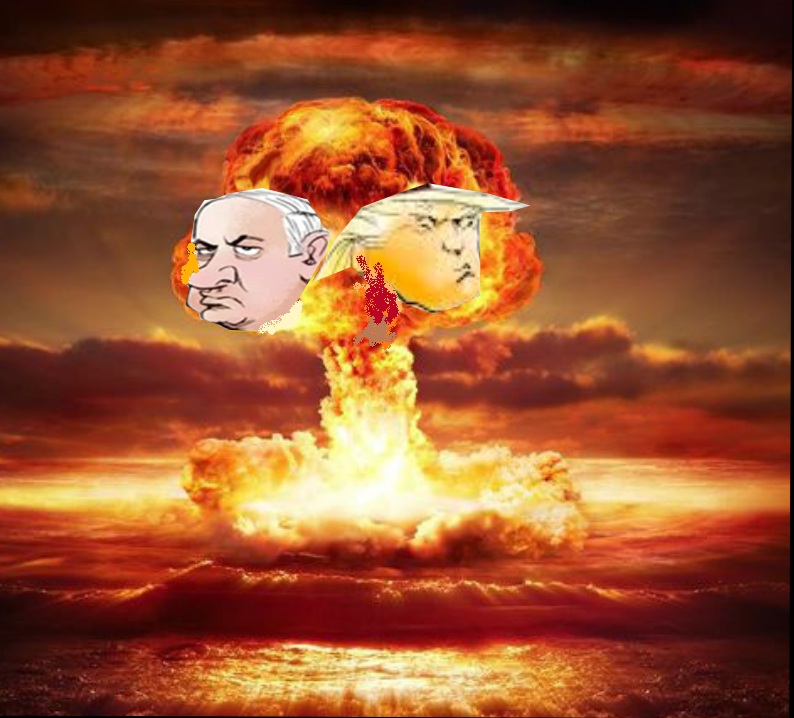
When deranged leaders invoke divine catastrophe as a political instrument, it is not only their enemies who are consumed. Unless they are stopped, we will all be victims of these two psychopaths.
Jeffrey D. Sachs, Apr 06, 2026, Common Dreams, https://www.commondreams.org/opinion/netanyahu-trump-psychopaths-war-criminals?utm_source=Common+Dreams&utm_campaign=05f9359cac-Top+News+%7C+Thu.+1%2F8%2F26_COPY_01&utm_medium=email&utm_term=0_-c56d0ea580-601318790
Here is Donald Trump’s Easter message to the world:
Tuesday will be Power Plant Day, and Bridge Day, all wrapped up in one, in Iran. There will be nothing like it!!! Open the Fuckin’ Strait, you crazy bastards, or you’ll be living in Hell – JUST WATCH! Praise be to Allah. President DONALD J. TRUMP
Donald Trump and his partner in war crimes, Benjamin Netanyahu, are jointly waging a war of murderous aggression against Iran, a nation of 90 million people. They are in the grip of three cascading pathologies. The first is personality: both are malignant narcissists. The second is the arrogance of power: men who possess the power to command nuclear annihilation and feel, in consequence, no restraint. The third, and most dangerous of all, is religious delusion: two men who believe, and are told daily by those around them, that they are messiahs doing God’s work. Each pathology exacerbates the others, so that together they put the world in unprecedented dangerThe result is a glorification of violence not seen since the Nazi leaders. The question is whether the world’s few grownups—responsible national leaders who remain committed to international law and are willing to say so—can restrain them. It will not be easy, but they must try.
Let us start with the underlying psychological disorder. Malignant narcissism is a clinical term, not an insult. The social psychologist Erich Fromm coined the phrase in 1964 to describe Adolf Hitler, as a merger of pathological grandiosity, psychopathy, paranoia, and antisocial personality into a single character structure. The malignant narcissist is not merely vain. He is structurally incapable of genuine empathy, constitutionally immune to guilt, and driven by paranoid conviction that enemies surround him and must be destroyed. Already back in 2017, psychologist John Garnter and many other professionals were warning of Trump’s malignant narcissism.
When power faces no limit, the only remaining internal check is conscience. And the psychopath has no conscience.
Several respected psychologists and psychiatrists have evaluated Trump for psychopathy using the standardized Hare Scale and have come up with scores well above the diagnostic cutoff. See, for example, here. Psychopathy is best characterized as a lack of conscience or compassion for other human beings.
Both Trump and Netanyahu fit this profile with precision. Trump’s psychopathy was on full display when US forces destroyed a civilian bridge in Tehran, of no military significance, with at least eight civilians killed and 95 or more injured. Trump did not grieve. He gloated and promised more destruction. Netanyahu’s Passover address similarly contained not one word for the dead. No pause. No shadow of doubt. Only the triumphant catalog of enemies he has destroyed.
Paranoia drives the threat that Trump and Netanyahu have manufactured. Trump’s own Director of National Intelligence, Tulsi Gabbard, testified in writing that Iran’s nuclear program had been “obliterated” and that the intelligence community “continues to assess that Iran is not building a nuclear weapon.” The IAEA stated flatly there was no evidence of a bomb. Trump’s own counterterrorism official resigned in protest, writing that “we started this war due to pressure from Israel and its powerful American lobby.” The paranoid does not need a real threat. He will make one up if he must, to match his feelings of exaggerated fear.
The Machiavellianism operates without shame. Trump told the world that diplomacy was always his “first preference,” while boasting in the same breath about ripping up the nuclear deal with Iran: “I was so honored to do it. I was so proud to do it.” He destroyed the diplomatic framework with his own hands, then blamed Iran for the wreckage. He then admitted, casually, that the war has no self-defense rationale: “We don’t have to be there. We don’t need their oil. We don’t need anything they have. But we’re there to help our allies.” Under the UN Charter, self-defense is the only legal basis for force. Trump has confessed that no such basis exists.
There is a particular deformation that power inflicts on certain personalities, and it is especially acute when the power in question is unbounded or seems to be so. With the command of nuclear arsenals, Trump and Netanyahu do not experience the world as others do. The availability of nuclear weapons, for these malignant narcissists, is not a burden of responsibility but an extension of their grandiose selves: I can do anything. I can level anything. Watch me. There will be no self-restraints by Netanyahu and Trump on this delusional grandiosity.
Trump and Netanyahu do not experience the world as others do.
Trump has completely internalized this sense of impunity. On April 1, he stood before the cameras and promised to bomb Iran “back to the Stone Ages, where they belong.” The phrase “where they belong” is the verdict of a man who feels divinely licensed to judge the worth of 90 million people and dehumanizes them without hesitation. He has repeatedly threatened to destroy Iran’s civilian electrical infrastructure—a war crime under the laws of armed conflict, announced openly as a negotiating position, to a global audience that mostly changed the channel.
Netanyahu commands a state with an estimated 200 nuclear warheads, has never signed the Non-Proliferation Treaty, and operates under no international inspection regime. He has watched Trump wield American military power with unchecked aggression and concurs that there are no consequences. The second madness feeds the third: when power faces no limit, the only remaining internal check is conscience. And the psychopath has no conscience.
The lack of conscience is the most dangerous pathology of the three, because it is the one that removes the last possible internal brake. The strategist who wages an unjust war may eventually calculate that the costs exceed the gains and stop. The malignant narcissist who wages war for ego may eventually exhaust the ego’s demands and stop. The psychopath escalates because there are no limits.
And, if you can believe, it gets even worse. Both Trump and Netanyahu are would-be messiahs. They are self-proclaimed agents of God. For them, stopping the war on Iran would mean God was wrong. And the self-proclaimed messiah cannot be wrong, either, because the messiah and God have become, in the grandiose psyche, effectively the same.
Both Trump and Netanyahu have claimed this messianic identity explicitly. Trump has called himself “the chosen one.” Regarding the assassination attempt on Trump in 2024, he declared, “I felt then and believe even more so now that my life was saved for a reason. I was saved by God to make America great again.” Netanyahu, in his address on the eve of Passover, did not merely invoke God. He appropriated God’s role in the Exodus narrative—enumerating ten “accomplishments” of what he calls the “War of Redemption” and naming each one a plague. The killing of Ayatollah Khamenei he named the “Plague of the Firstborn.” He then warned the world:
After the ten plagues of Egypt, I remind you that Pharaoh still tried to harm the People of Israel, and we all know how that ended.
In the Book of Exodus, that ending is the drowning of Pharaoh’s entire army. Netanyahu was threatening the annihilation of Iran, on television, in the language of holy scripture.
Surrounding each of these men is a court of flatterers and fanatics whose function is to sustain the delusion and prevent reality from entering their consciousness.
Trump’s Court: Hegseth, Huckabee, and the Christian Nationalists
Pete Hegseth, the Secretary of Defense, has turned the Pentagon into a theater of holy war. He sports a Jerusalem Cross tattoo on his chest and the words “Deus Vult,” “God Wills It,” the battle cry of the medieval Crusades, on his arm. He hosts monthly Christian worship services in the Pentagon’s auditorium. He has asked the American people to pray “every day, on bended knee” for military victory in the Middle East “in the name of Jesus Christ.” At one of these services, he prayed aloud for US troops to inflict:
Overwhelming violence of action against those who deserve no mercy … We ask these things with bold confidence in the mighty and powerful name of Jesus Christ.
At a press briefing on the Iran war, Hegseth said the United States “negotiates with bombs.” He described Iran’s leaders as “religious fanatics” seeking nuclear capability for “some religious Armageddon,” while presiding over monthly prayer services at the Pentagon and declaring that “the providence of our almighty God is there protecting those troops.” He appears to have no awareness of the mirror he is holding up. A defense secretary who prays for “overwhelming violence” in the name of Jesus, while calling his enemies religious fanatics, has defined the word “projection.”
Mike Huckabee, the US Ambassador to Israel, provides the theological architecture. A Baptist minister and avid Christian Zionist, Huckabee believes the Israel-Iran conflict is the fulfillment of biblical prophecy—a necessary step toward the Rapture and the second coming of Christ. He sent Trump a message—which Trump then posted on social media—comparing the moment to Truman in 1945 and the dropping of atomic bombs on Japan, urging Trump to listen to “HIS voice,” meaning God.
In an interview, Huckabee was asked about the biblical land grant stretching from the Nile to the Euphrates—encompassing Lebanon, Syria, Jordan, and parts of Saudi Arabia and Iraq—and whether Israel had a divine right to it all. His answer was direct: “It would be fine if they took it all.”
Israel’s far-right Finance Minister Smotrich, for his part, posted on social media: “I ♥ Huckabee.” Christian Zionist pastor John Hagee, whose organization Christians United for Israel has been a major driver of US evangelical support for Israel’s wars, looked at the Iran war and said simply: “Prophetically, we’re right on cue.” Franklin Graham, at a White House Easter prayer service, fed Trump’s messianic delusions: “Today the Iranians, the wicked regime of this government, wants to kill every Jew and destroy them with an atomic fire. But you have raised up President Trump. You’ve raised him up for such a time as this. And Father, we pray that you’ll give him victory.”
Netanyahu’s Court: Ben-Gvir, Smotrich, and the Messianic Settlers
On the Israeli side, the inner court is composed of two figures whose radicalism is so extreme that they were considered political pariahs until Netanyahu used their votes to stay in power. Itamar Ben-Gvir, the National Security Minister, is an admirer of the late Rabbi Meir Kahane, whose Kach party was designated a terrorist organization. Bezalel Smotrich, the Finance Minister, draws his ideology from Rabbi Zvi Yehuda Kook, who taught that Israel’s 1967 military victory was divinely mandated and that the settlement of Palestinian territory is the will of God. Together, they hold 20 seats in Netanyahu’s 67-seat coalition. They do not merely advise the prime minister, they share in his messianic beliefs and vision.
Ben-Gvir has used his control of the Israeli police to enable settler paramilitaries operating against Palestinians in the West Bank. He has consistently blocked ceasefire negotiations and has openly claimed credit for delaying them. He pushed for Jewish ritual rights on the Temple Mount in defiance of a status quo maintained for decades, a move Israeli security officials warned would lead directly to bloodshed. In August 2023 he declared: “My right, and my wife’s and my children’s right to get around on the roads in Judea and Samaria, is more important than the right to movement for Arabs.” The United Kingdom, Canada, Australia, New Zealand, Norway, Slovenia, the Netherlands, and Spain have all sanctioned him for inciting violence, yet the United States, under Marco Rubio, defended Ben-Gvir and criticized those sanctions.
Smotrich is the more methodical of the two: less theatrical and more dangerous. He has systematically transferred civilian governance of the West Bank from the Israeli military to his own ministry, channeling hundreds of millions of shekels to settler infrastructure while Palestinian Authority budgets are deliberately strangled. He has directed his office to formulate “an operational plan for applying sovereignty” over the West Bank. During the Iran war, he called for Israel to annex southern Lebanon up to the Litani River, declaring that the war “needs to end with a different reality entirely.” Smotrich’s ideology draws on Kook’s teaching that the settlement enterprise is not political but sacred—a divine obligation that must be completed regardless of international law, Palestinian rights, or the opinion of the world. The 1967 borders, in this theology, are not a temporary military reality. They are God’s unfinished business.
The world’s grownups must try to stop the madness.
Neither Ben-Gvir nor Smotrich was anything more than a fringe extremist before Netanyahu legitimized them by bringing them into government and his inner court. He gave them power over Israeli society, and they gave him the religious-nationalist firepower to call his wars a divine mission.
Into this landscape of holy war, one voice has spoken with world-saving grace and clarity. Pope Leo XIV has consistently called for an end to the violence. During a Holy Thursday Mass in Rome, he addressed the arrogance of power:
We tend to consider ourselves powerful when we dominate, victorious when we destroy our equals, great when we are feared. God has given us an example — not of how to dominate, but of how to liberate; not of how to destroy life, but of how to give it.
On Palm Sunday, the pope was again direct, saying that Jesus “does not listen to the prayers of those who wage war, but rejects them.” Hegseth followed up by holding another worship service at the Pentagon, where he again prayed for “overwhelming violence” in Christ’s name.
Professor John Mearsheimer has stated precisely that the crimes now being committed by Trump and Netanyahu are the same crimes for which the Nazi leadership was hanged at Nuremberg: aggressive war, annexation of foreign territory, deliberate targeting of civilian infrastructure, and collective punishment. This is not rhetorical excess. These are legal categories. The Nuremberg Tribunal called the crime of aggression the “supreme international crime”—the one that “contains within itself the accumulated evil of the whole”—because it is the crime that makes all the other crimes possible. These men have confessed to it, publicly, in speeches carried by international broadcasters.
The institutional mechanisms that exist to prevent exactly this kind of catastrophe, including the UN Security Council, the International Criminal Court, the non-proliferation regime, and the laws of armed conflict, are being actively subverted by the United States.
And yet the world’s grownups must try to stop the madness. The multilateral effort in Islamabad, including the foreign ministers of Pakistan, Turkey, Egypt, and Saudi Arabia, working alongside the China-Pakistan five-point peace initiative, is an important start. It should be joined by the full weight of the BRICS nations, the UN General Assembly, and every state that wishes to live in a world governed by rules rather than by the delusions of two malignant narcissists.
When deranged leaders invoke divine catastrophe as a political instrument, it is not only their enemies who are consumed. We will all be the victims of Netanyahu’s plagues and Trump’s bombing of Iran to the stone ages, unless other leaders place limits on these two madmen.
14 April – Zoom -Nuclear Power is Not the Solution
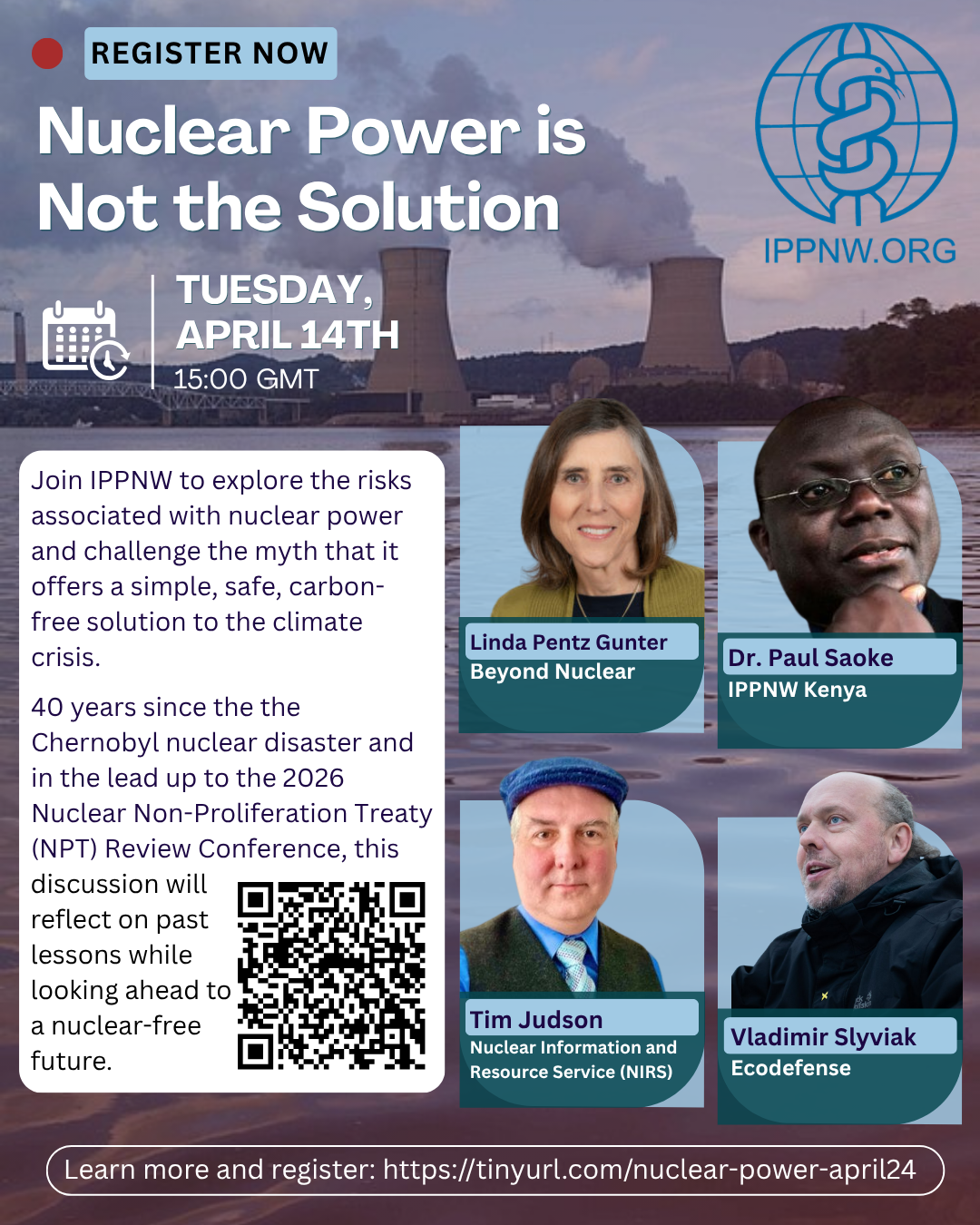
Nuclear Power is Not the Solution – (Apr 15, 2026 01:00 AM in Canberra, Melbourne, Sydney)
Join the International Physicians for the Prevention of Nuclear War (IPPNW) on Tuesday, April 14th for a timely webinar exploring the risks associated with nuclear power and challenging the myth that it offers a simple, safe, carbon-free solution to the climate crisis. Taking place in the context of the 40th anniversary of the Chernobyl nuclear disaster and the upcoming Nuclear Non-Proliferation Treaty (NPT) Review Conference, this discussion will reflect on past lessons while looking ahead to a nuclear-free future.
Taking place in the context of the 40th anniversary of the Chernobyl nuclear disaster and the upcoming Nuclear Non-Proliferation Treaty (NPT) Review Conference, this webinar will explore the risks associated with nuclear power and challenge the myth that it offers a simple, safe, carbon-free solution to the climate crisis.
Expert speakers include:
- Linda Pentz Gunter, Beyond Nuclear, highlighting overall dangers of nuclear power
- Dr. Paul Saoke, IPPNW Kenya, highlighting reflections from his 2025 book on extractive practices of uranium mining across the continent
- Tim Jusdon, Nuclear Information and Resource Service, highlighting nuclear power expansion in response to AI energy needs
- Vladimir Slyviak, Ecodefense, highlighting Zaporizhzhia and risks in war zones
- Moderator: Laura Wunder, IPPNW Germany
Trillions Hidden, Humanity Starving: The Super-Rich vs. the Rest of Us
April 6, 2026, Josh Scheer, https://scheerpost.com/2026/04/06/trillions-hidden-humanity-starving-the-super-rich-vs-the-rest-of-us/
Ten years after the world first glimpsed the Panama Papers, the shadow empire of the super-rich is no less formidable. New analysis from Oxfam reveals a staggering truth: the untaxed wealth hidden offshore by the richest 0.1 percent now exceeds the combined wealth of the poorest 4.1 billion people on Earth. That’s not a statistic—it’s a moral indictment.
Oxfam estimates that $3.55 trillion in untaxed wealth was stashed in tax havens and unreported accounts in 2024 alone—more than the GDP of France and over twice the combined GDP of the world’s 44 least developed countries. Within this minuscule elite, the top 0.01 percent controls roughly $1.77 trillion of that hoard. Meanwhile, ordinary people continue to shoulder the burden: underfunded schools, crumbling hospitals, and fraying social safety nets are the collateral damage of a system engineered to let the wealthiest operate above the law.
Within this microscopic elite, the top 0.01 percent controls roughly $1.77 trillion. Meanwhile, billions of people are left with underfunded schools, crumbling hospitals, and social safety nets that barely function. The system isn’t “broken” — it’s working exactly as it was designed to work, just not for the vast majority of us.
The consequences are brutally clear. Public services starved of funding. Ordinary people shouldering the cost of inequality. A global economy rigged to reward the few and punish the many. Trillions of dollars that could fund hospitals, schools, clean water, and climate solutions are instead parked in secret accounts, out of reach and untaxed.
“This isn’t clever accounting; it’s power and impunity,” says Christian Hallum, Oxfam International’s Tax Lead. “The consequences are as predictable as they are devastating: ordinary people pay for the privileges of a tiny few.”
Progress has been made. The Automatic Exchange of Information (AEOI), launched in 2016-2017, has nudged down the share of untaxed offshore wealth to about 3.2 percent of global GDP. But the gains are uneven. Many countries in the Global South—the nations that need tax revenue the most—remain excluded from the system.
- Two Bold Proposals to Tax Wealth Across the Land
Oxfam calls for bold, global action: taxing extreme wealth, strengthening financial transparency, and ensuring the richest 1 percent pay their fair share—especially multimillionaires and billionaires. A UN-led Framework Convention on International Tax Cooperation, approved in 2024 and under negotiation through 2027, could be a turning point—but only if nations have the courage to confront entrenched power.
The Panama Papers were meant to be a wake-up call. A decade later, the alarm still blares—but the world seems content to hit snooze while trillions slip offshore, untaxed and untouchable. Meanwhile, billions of people scrape by.
Inequality isn’t an abstract concept—it’s a crisis of fairness and morality. And as long as the super-rich are allowed to hide fortunes beyond reach, the rest of us will pay the price.
Why an attack on Bushehr nuclear plant would be catastrophic for the Gulf
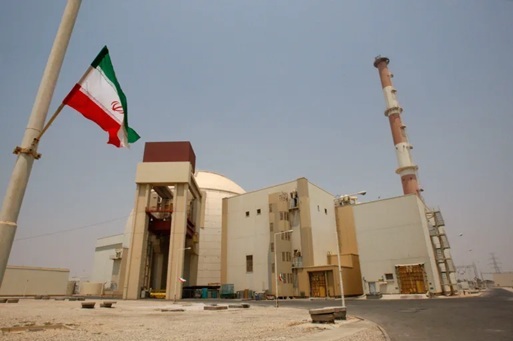
The US and Israel have repeatedly hit the nuclear power plant, raising risks of radioactive contamination far beyond Iran’s borders.
By Al Jazeera Staff, 5 Apr 2026, https://www.aljazeera.com/news/2026/4/5/why-an-attack-on-bushehr-nuclear-plant-would-be-catastrophic-for-the-gulf
Iran’s only functioning nuclear plant, the Bushehr power plant, has come under repeated attacks in the ongoing Israel and US war on Iran, raising fears of a possible nuclear incident that could prove “catastrophic” across all Gulf countries.
The latest attack on the plant came on Saturday, after missiles hit a location close to the plant, killing one security guard and causing damage to a side building, according to the state-run Atomic Energy Organisation of Iran (AEOI) which has condemned the strike.
In a statement criticising the attack, Iran’s Foreign Minister Abbas Araghchi claimed the Bushehr facility had now been “bombed” four times since the war erupted on February 28. He criticised what he said was a “lack of concern” for nuclear safety on the part of the United States and Israel.
On Monday, the AEOI asked the United Nations nuclear oversight body to also explicitly condemn the attacks on Bushehr. The organisation’s head, Mohammad Eslami, said the attacks were “a clear violation of international law and an instance of a war crime” in a letter to Rafael Grossi, Director General of the International Atomic Energy Agency (IAEA).
Nuclear experts and regional authorities have long sounded the alarm over the incredible damage that bombing Bushehr would do, not just to Iran and Iranians, but to neighbouring countries as well.
Here’s what to know about the Bushehr plant and why its safety is paramount:
What is the Bushehr plant?
The Russia-built Bushehr plant is a nuclear power plant located in the coastal city of Bushehr, which has a population of 250,000.
Work on it initially started in 1975 by German companies, but it was eventually finished in 2011 by Russia’s atomic energy ministry. To date, hundreds of Russian personnel are stationed in Bushehr, with some having been evacuated following recent strikes.
It’s the first nuclear power plant in the Middle East, with one operational reactor. Bushehr Unit 1 currently provides about 1,000MW to the national grid. Two additional reactor units are expected to be operational by 2029.
What would happen if Bushehr were attacked?
Iranian officials say Bushehr has now been attacked four times in the course of the US-Israel war on Iran.
That’s separate from an initial strike on February 28, when the US and Israel first launched attacks, sparking off the war. Strikes hit Bushehr city, a few hundred metres from the plant.
A strike on a nuclear reactor or storage pools for used fuel would cause the release of radiological particles, specifically the hazardous isotope Caesium-137, into the atmosphere.
These can be spread far beyond the release point by wind and water and can contaminate food, soil, or drinking water sources for decades. Close exposure to such material would burn the skin and increase cancer risks.
What has the UN nuclear watchdog said about strikes targeting Bushehr?
The International Atomic Energy Agency (IAEA), the United Nations’ atomic watchdog, has been warning against targeting the plant for months.
During Israel’s 12-day war on Iran last year, IAEA Director-General Rafael Grossi told the UN Security Council that an Israeli strike on the Bushehr power plant could trigger a regional catastrophe.
Directly hitting the plant, which tonnes of nuclear material, could “result in a very high release of radioactivity”, with “great consequences” beyond Iran’s borders, Grossi warned, calling for “maximum restraint”.
A strike on the lines supplying electricity to Bushehr, which keep the cooling system operating, could cause a reactor meltdown and trigger a radioactive leak, he said. Evacuation orders would have to be issued within several hundred kilometres of the plant, extending to countries outside Iran.
He said authorities would also have to administer iodine to those within the area and potentially restrict food supplies due to possible radioactive contamination. Areas beyond the immediate danger zones would then have to be monitored as well for hundreds of kilometres.
Grossi, in the wake of the latest attack on Saturday, reiterated calls for restraint
What are the risks of water contamination for the Gulf?
There are also fears that damage at Bushehr could contaminate the waters of the entire Gulf region. Radioactive contamination would affect marine life in the area, and the Gulf’s shallowness could see the negative effects remain over a long period, research finds.
It would also affect drinking water supplies. Most Gulf countries lack groundwater and rely heavily on desalination of seawater. But desalination plants are not inherently built to filter radioactive material, and not all plants at the moment have the technologies required.
Alan Eyre of the Middle East Institute told Al Jazeera that academic research has shown that the concentration of radioactive material at Bushehr might not be enough to cause Chornobyl-level disasters, referencing the 1986 tragedy in then-Soviet Ukraine.
But “more serious is the threat of radioactive material in the water because once you get an appreciable amount of radioactivity in the water, that precludes desalination”, he said, explaining that high radioactive material could halt desalination altogether.
Last year, Qatar’s Prime Minister Sheikh Mohammed bin Abdulrahman bin Jassim Al Thani revealed in an interview with right-wing US media personality Tucker Carlson that a hit on the plant would affect “all of us”.
Sheikh Mohammed said that Qatar, which is about 190km (118 miles) south of Iran, had simulated the possible effects of a Bushehr attack. Authorities found that the sea would be “entirely contaminated” and the country would “run out of water in three days”, he said.
“No water, no fish, nothing… no life,” he added.
Is there a law against targeting civilian nuclear facilities?
Yes, there are international frameworks protecting nuclear facilities during conflict. Launching attacks on energy or nuclear facilities while knowing it could cause extensive loss of life and environmental damage is a war crime.
Article 56 (Protocol I) of the Geneva Conventions prevents the targeting of “works and installations containing dangerous forces”, including those containing nuclear material.
Warring parties are also meant to differentiate between facilities serving civilians, as opposed to military targets. The Bushehr plant provides electricity for national use.
The IAEA’s guidelines similarly prohibit indiscriminate targeting of a nuclear facility. They include that countries must avoid physically hitting reactors and stored fuel, that they must ensure the safety of staff, ensure power to the grid to prevent reactor core melt, and have systems in place to monitor radiation.
Has the Western response been muted compared to Ukraine’s Zaporizhzhia?
Iran’s Aragchi on Saturday called out Western nations for failing to speak up about the possible dangers of targeting Bushehr in the same way they did over Ukraine’s Zaporizhzhia Nuclear Power Plant during the ongoing Russia-Ukraine war.
“Remember the Western outrage about hostilities near Zaporizhzhia Nuclear Power Plant in Ukraine?” he said in a post on X. “Radioactive fallout will end life in GCC capitals, not Tehran,” he added.
Russia attacked the plant in March 2022 using heavy tanks and artillery, causing a major fire. In reaction, the United Kingdom and Ukraine called an emergency UN Security Council meeting.
The UN, the US, the EU, and dozens of other countries issued immediate statements condemning the action. NATO warned that any radioactive fallout reaching a member state would trigger its collective defence mechanism.
French President Emmanuel Macron later spoke with Russian President Vladimir Putin about the incident and requested that IAEA staff be allowed to monitor the occupied site.
The European Union has not, in this instance, commented on the attacks on Bushehr. Russia, which has scores of staff there, has meanwhile issued a statement raising concern and “strongly condemning the atrocity”.
What nuclear accidents have happened in the past?

COMMENT. This section of this article is a gross understatement.
and
Japan’s Fukushima nuclear reactors melted following an earthquake in 2011.
Some 160,000 residents were evacuated to avoid radiation risks. There was one recorded death from lung cancer as a result of clean-up activities later in 2018. However, the stress of evacuation, trauma, and general disruption at the time of the disaster led to thousands of deaths.
In the April 1986 Chornobyl disaster, a reactor exploded during tests, resulting in a massive explosion that blew off the facility’s heavy roof and resulted in a fire that burned for days.
High levels of radiation were released in the explosion. Some 30 people died at the time of the blast or in the immediate aftermath. About 20,000 others would later develop thyroid cancer, especially children. More than 300,000 were evacuated, and the area is still largely deserted.
Marjorie Taylor Greene’s Statement Condemning Trump
Marjorie Taylor Green’s Statement from X: April 5, 2026, https://scheerpost.com/2026/04/05/marjorie-taylor-greenes-statement-condemning-trump/
On Easter morning, this is what President Trump posted. Everyone in his administration that claims to be a Christian needs to fall on their knees and beg forgiveness from God and stop worshipping the President and intervene in Trump’s madness. I know all of you and him and he has gone insane, and all of you are complicit. I’m not defending Iran but let’s be honest about all of this. The Strait is closed because the US and Israel started the unprovoked war against Iran based on the same nuclear lies they’ve been telling for decades, that any moment Iran would develop a nuclear weapon.
You know who has nuclear weapons? Israel. They are more than capable of defending themselves without the US having to fight their wars, kill innocent people and children, and pay for it. Trump threatening to bomb power plants and bridges hurts the Iranian people, the very people Trump claimed he was freeing. On Easter, of all days, we as Christians should be reminded that the son of God died and rose from the grave so that we can be forgiven once and for all of our sins. Jesus commanded us to love one another and forgive one another. Even our enemies. Our President is not a Christian and his words and actions should not be supported by Christians. Christians in the administration should be pursuing peace. Urging the President to make peace. Not escalating war that is hurting people. This NOT what we promised the American people when they overwhelmingly voted in 2024, I know, I was there more than most. This is not making America great again, this is evil.
Secrets and Shortcuts: The US Uranium Enrichment Rush

LYNDA WILLIAMS, 6 April 2026, https://www.counterpunch.org/2026/04/06/secrets-and-shortcuts-the-us-uranium-enrichment-rush/
The United States keeps going to war over uranium enrichment.
We started a war in Iraq over it after Secretary of State Condoleezza Rice said, “We don’t want the smoking gun to be a mushroom cloud,” which later proved to be false. We bombed Iran’s enrichment facilities in June 2025, with Trump declaring he had “completely and totally obliterated” them.
Eight months later, we started another war with Iran over enrichment, even though the International Atomic Energy Agency (IAEA) found no evidence of a structured nuclear weapons program. Now, Trump is considering sending special forces into Iran to physically seize the enriched uranium — except nobody knows exactly where it is.
Now the US is actively pursuing its own domestic uranium enrichment after decades of dependence on foreign suppliers, including Russia, which, after it invaded Ukraine, the Biden administration cut off. The US currently has only one operating commercial enrichment facility, which cannot begin to supply the “nuclear renaissance” the Trump administration is promoting. Five companies are simultaneously seeking NRC licenses, backed by $2.7 billion in DOE contracts, under a regulatory framework being dismantled in real time — gutting environmental review, eliminating radiation safety standards, and compressing public participation timelines to get them built fast.
The first to apply is Global Laser Enrichment LLC — a Delaware shell company majority-owned by Silex Systems Limited of Australia and Cameco Corporation of Canada — and their application is shrouded in secrecy and regulatory shortcuts. The license application looks like a redacted Epstein file: 274 pages of black bars.
Why the Big Secrecy?
The problem with enrichment is proliferation. Natural uranium consists of two isotopes — uranium-238 and uranium-235 (U-235), the fissile isotope you need for both nuclear reactors and nuclear bombs. In its natural state, uranium contains only 0.7% U-235, so it must be enriched artificially.
Nuclear fuel for a nuclear power plant needs uranium enriched to about 5% U-235. A nuclear bomb needs it at 90% or above. Same basic process, same basic equipment — just keep enriching. Iran had enriched to 60% according to the IAEA before the June 2025 strikes — well past reactor fuel and closing in on weapons grade. That’s proliferation. North Korea had a proliferation problem the Clinton administration was successfully negotiating — until Bush came in, put North Korea on the “axis of evil,” and within months they turned off their IAEA monitoring cameras and expelled inspectors, testing their first nuclear bomb four years later.
On March 27, 2026, the NRC published a draft Environmental Impact Statement (EIS) for a proposed $1.76 billion uranium enrichment facility in Paducah, Kentucky — next to the former Paducah Gaseous Diffusion Plant (PGDP), a Cold War uranium enrichment site that operated from 1952 to 2013 and left behind a Superfund cleanup still running today. The federal government sold GLE over 200,000 metric tons of publicly owned depleted uranium to process from the PGDP — but the price is secret.
The secrecy traces to a single act. In June 2001, the Secretary of Energy classified the SILEX laser enrichment technology under the Atomic Energy Act of 1954. The entire public record of that decision is five sentences in the Federal Register — no technical justification, no public comment period, no congressional notification, no appeal process. The Federation of American Scientists called it “constitutionally questionable.” It has never been legally challenged. The PLEF would be licensed to enrich to a maximum of 6% U-235 — reactor fuel grade. The irony is that independent peer-reviewed research suggests SILEX cannot be efficiently cascaded to weapons grade, making the classification that drives all this secrecy scientifically questionable as well.
What’s in the EIS?
GLE proposes to build a $1.76 billion laser enrichment facility on 322 acres of former public wildlife land — until eighteen months ago part of the West Kentucky Wildlife Management Area, managed for hunting, fishing, and horseback riding, and home to bald eagles, golden eagles, monarch butterflies, and eastern box turtles. The site contains 38 wetlands, 20 streams, and 6 ponds — all of which would be destroyed to build the facility. GLE proposes to discharge 60,000 gallons of wastewater per day, some of it radioactive, into Little Bayou Creek, which flows to the Ohio River — drinking water for five million people downstream. Fish consumption in Little Bayou Creek is already not supported due to PCB contamination from the adjacent Cold War plant.
The facility would take in depleted uranium hexafluoride — the tails left over from Cold War enrichment — re-enrich it, and produce more uranium hexafluoride waste. Over 40 years the PLEF would generate 290,574 metric tons of new radioactive waste with nowhere to go. The EIS waste table lists the largest waste stream — 18,161 tons per year — with three words in the disposal column: “subject to availability.” The EIS also declines to quantify what fraction of the DOE stockpile contains reprocessed uranium — known as RepU — material that passed through a reactor and carries transuranic contaminants, including neptunium-237 and plutonium, with half-lives of thousands to millions of years. RepU cannot go to a standard low-level waste site and may require disposal at WIPP in New Mexico, which was never designed for it. GLE’s website says the PLEF will “reduce the legacy environmental footprint” of the former Paducah plant. Re-enriching depleted uranium hexafluoride produces more uranium hexafluoride. The chemical form never changes, and the volume increases. That’s not cleanup. That’s more radioactive waste with nowhere to go.
What We Don’t Know: Safety
The comment period for the EIS closes May 11, but the government’s Safety Evaluation Report (SER) – which is normally completed alongside the EIS -won’t be completed until January 2027. GLE received special NRC permission to submit the environmental and safety portions of its application separately, meaning the public must comment on the facility’s EIS without ever seeing the safety analysis. The safety analysis submitted with the license application is classified. The emergency plan is withheld as a corporate trade secret on the grounds that releasing it would, in the sworn, notarized words of GLE’s licensing manager Tim Knowles, “reduce or foreclose the availability of profit opportunities.” The Integrated Safety Analysis Summary — which NRC regulations require to be placed on the public docket — has been removed from the federal docket entirely. Not redacted. Removed. (NRC ADAMS accession ML25179A002 not publicly available) In case of emergency, the EIS says the facility relies on local volunteer fire departments – departments with no legal right to read the emergency plan for the facility in their jurisdiction.
Meanwhile, Kentucky approved nearly $100 million in public incentives to bring this facility to Paducah — some of it under a nondisclosure agreement so complete that the McCracken County judge told public radio he legally cannot tell you how much his county committed or what the terms are. The undisclosed county portion alone is nearly twice McCracken County’s entire annual operating budget.
The Regulatory Shortcut
For the EIS, the NRC borrowed conclusions from NUREG-2249, a draft Generic Environmental Impact Statement written for nuclear reactors — not enrichment facilities — that was published in September 2024, never finalized, and never applied to any proceeding before this one. Using this unfinished reactor document, the NRC pre-answered 34 environmental questions for the PLEF, declaring them all SMALL without site-specific analysis — including water use in the region, sedimentation impacts on aquatic species, and contaminated stormwater from outdoor uranium cylinder storage pads. SILEX laser enrichment appears nowhere in NUREG-2249. These 34 conclusions can still be challenged before May 11. Once NUREG-2249 is finalized, that window closes permanently.
What You Can Do
The most impactful comments challenge the application of NUREG-2249 — a draft reactor document — to pre-answer 34 environmental questions for a laser enrichment facility without legal authority; the waste disposal analysis for which no confirmed to put 290,574 metric tons of new radioactive waste; and the requirement to comment on facility safety before the Safety Evaluation Report exists.
Submit comments on the PLEF draft EIS by May 11, 2026 at: https://www.regulations.gov/docket/NRC-2025-1007
Lynda Williams is a physicist and environmental activist living in Hawaii. She can be found at scientainment.com and on Bluesky @lyndalovon.bsky.social
Flotilla coalition prepares renewed mission to break Gaza siege
The international flotilla of over 80 boats and 1,000 activists will sail from Barcelona to challenge Israel’s blockade on Gaza and demand humanitarian access
APR 3, 2026, https://thecradle.co/articles/flotilla-coalition-prepares-renewed-mission-to-break-gaza-siege
A coalition of pro-Palestine activists announced on 3 April that it will launch a new maritime mission from Barcelona on 12 April to challenge Israel’s blockade on Gaza, according to reports citing statements by the Global Sumud Flotilla.
The group said more than 80 boats and around 1,000 international participants will take part in the initiative in a renewed attempt to reach the besieged enclave by sea.
It follows a previous high-profile journey across the Mediterranean that drew global attention before Israeli forces illegally intercepted the vessels and detained activists near Gaza.
Organizers said the earlier interception, which involved arrests and reports of physical and psychological torture, came as Gaza faced severe shortages of food, water, medicine, and fuel.
Jailed activists described being subject to abuses ranging from starvation to physical assault, intimidation, and humiliation.
The new mission carries the same aim of breaking the humanitarian siege on Gaza, as conditions continue to worsen under Israel’s ongoing blockade.
“The cost of inaction is too high to bear,” the group said, warning that continued restrictions risk deepening deprivation inside the territory.
Parallel land-based mobilization is planned across multiple countries to increase pressure and expand international engagement.
Describing the initiative as a “principled, nonviolent intervention,” organizers said the effort aims to defend human dignity, secure humanitarian access, and push for international accountability.
The flotilla’s return comes after its first mission ended without reaching Gaza, despite widespread attention and condemnation following the Israeli illegal interception and seizure of humanitarian aid.
In mid-March, Palestinian officials warned that Gaza was once again being pushed toward famine as Israel strangled aid deliveries to just 10 percent of agreed levels, allowing only 640 of 6,000 expected trucks into the strip – deepening a crisis driven by its prolonged blockade.
The restrictions triggered severe shortages of food, fuel, and basic goods, disrupting hospitals, sanitation systems, and daily life, while prices for essential items surged by up to 300 percent, highlighting Gaza’s dependence on external aid.
Gaza’s Government Media Office said more than 1.5 million people now face food insecurity, with conditions worsening as Israel tightens control over the strip, exploiting global distraction with the US war on Iran.
Inside Iran’s ‘underground fortress’: How Iran’s missile bases survive most powerful US and Israeli bombs
Aastha Sharma, News 24, Fri, 03 Apr 2026, https://www.sott.net/article/505568-Inside-Irans-underground-fortress-How-Irans-missile-bases-survive-most-powerful-US-and-Israeli-bombs
While Donald Trump claimed that Iran’s capabilities were mostly destroyed, data shows that Iran continues to launch a high number of missiles and drones without major decline.
A recent report by U.S. intelligence agencies says that Iran still has strong attack capabilities, even after more than a month of U.S. and Israeli strikes. According to the report, nearly half of Iran’s missile launchers are still intact, and it also has thousands of one-way attack drones. A source said that Iran is still capable of causing major destruction across the region. In addition, Iran still has a large number of missiles and coastal defense cruise missiles, which could play an important role in controlling the Strait of Hormuz.
Claims vs Reality: What Did the U.S. President Say?
The U.S. President, Donald Trump, claimed that Iran’s missile and drone capabilities have been almost destroyed. However, the actual situation appears different. Since February 28, Iran has launched around 6,770 missiles and drones targeting Jordan, Gulf countries hosting U.S. military bases, and Israel. The pace of these attacks has remained steady without any major decline. Iran has carried out the highest number of attacks on the UAE. According to the Institute for National Security Studies, Iran launched 600 missiles and 765 drones at Israel alone. In the past week, 215 drones and 200 missiles were fired.
If Iran’s missile capacity had really been reduced by 90%, these numbers would have dropped below 25%. But the figures remain above 30%, showing that Iran’s strike power is still strong.
Where Is Iran Hiding Its Missiles?
Iran has built large underground facilities known as “missile cities” over the past several years. These are located deep inside the Zagros and Alborz mountains, with tunnels and bunkers reaching depths of up to 500 meters. Missiles are stored, fueled, and even launched directly from these underground bases.
The largest missile city is in Khorramabad in Lorestan province. Another major site is in Tabriz in East Azerbaijan. Important missile storage areas are also located near Kermanshah, Isfahan, and in nearby islands and hilly regions around Tehran. Some of these sites are believed to be hidden under civilian areas for added protection.
Why Are U.S. ‘Bunker-Buster’ Bombs Failing?
These underground tunnels are extremely strong and cannot be easily destroyed by regular airstrikes. The U.S. and Israel have mainly targeted surface-level launchers and entry points, but the stockpiles hidden deep inside remain largely safe. U.S. intelligence estimates that only about one-third of Iran’s missile stock has been confirmed destroyed. Another one-third may be damaged or buried, but the remaining stockpile is still significant.
Where Did Iran Get So Many Missiles?
1. Large Existing Stockpile:
Before the war began, Iran already had one of the largest ballistic missile arsenals in the Middle East, with an estimated 2,500 to 3,000+ missiles and thousands of drones, including low-cost Shahed-136 drones.
2. Domestic Production:
Iran manufactures its own missiles and drones, with some factories located underground. Drones, in particular, are cheap and can be produced quickly.
3. Mobile Launchers and Decoys:
Iran uses mobile transporter-erector launchers, which can be easily moved and hidden. It also uses decoys (fake targets) to confuse enemy strikes.
4. Foreign Assistance:
In the past, Iran received designs and parts from countries like North Korea, Russia, and China. However, new supplies are difficult during the current conflict, so most attacks rely on existing stock and domestic production.
Iran’s Strategy: Fighting an Underground War
Iran’s strategy is clearly based on underground warfare. While U.S. and Israeli airstrikes are damaging surface infrastructure, the “missile cities” hidden inside mountains are still providing Iran with the ability to continue attacks. How long the war will last now depends largely on which side runs out of stockpiles first.
Area around Iran’s Bushehr nuclear power plant has been attacked for the fourth time
The area around Iran’s Bushehr nuclear power plant has been attacked for
the fourth time during the current war, Iranian officials say, as the US
and Israel continue to target energy and other industrial sites. One of the
plant’s employees was killed in the attack, Iran’s Atomic Energy
Organisation said. It blamed the US and Israel for the attack, but neither
country has confirmed carrying it out. Bushehr is Iran’s only operational
nuclear power plant and was completed with Russia’s help. The International
Atomic Energy Agency – the UN’s nuclear watchdog – said it had been
informed of the strike and had expressed “deep concern”.
BBC 4th April 2026, https://www.bbc.co.uk/news/articles/c5y90jl8veyo
‘Warhawks licking your lips’: Details on Iran’s nuclear program leaked
A UN diplomat has quit his post in disgust, claiming he “gave up his diplomatic career” to leak information about “warhawks” preparing for the unthinkable.
Alex Blair, 2 April 2026, https://www.news.com.au/world/middle-east/warhawks-licking-your-lips-un-diplomat-quits-in-disgust-leaks-alleged-iran-nuke-plan/news-story/b21aeb7adce9d1b0066de2d7b03d1ab6
The public resignation of a UN-affiliated diplomat has injected a new layer of controversy into the already volatile conflict in the Middle East.
Casting himself as a whistleblower, Lebanese Mohamad Safa stepped down with a damning list of allegations against what he describes as elements within the United Nations.
He claims some players in the pact are preparing for the possible use of nuclear weapons against Iran. Donald Trump insists the war will be over in a matter of weeks, but the can of worms is already open. Iran’s anti-West rhetoric has been emboldened by the sudden and extreme escalation by the US and Israeli militaries, with officials now saying they will not accept the war is over until both nations are “humiliated” and forced into “deep regret”.
US Secretary of War Pete Hegseth has done little to ease those fears, reposting comments today from Donald Trump about sending Iran “back to the stone age”.
In a now-viral post on X, Safa framed his departure as an act of protest, attacking the “warhawks licking your chops” at the prospect of civilian misery.
“I don’t think people understand the gravity of the situation as the UN is preparing for possible nuclear weapon use in Iran … I gave up my diplomatic career to leak this information. I suspended my duties so as not to be part of or a witness to this crime against humanity.”
He called on the world to consider the humanity of the 9.7 million people residing in the Iranian capital. While the ruling regime has severe human rights offences against its name, Safa pointed to one of the most tragic constants of war — the civilian toll.
“This is a picture of Tehran. For you uneducated, untravelled, never-served, warhawks licking your chops at the thought of bombing it. It’s not some low population desert,” he continued.
“There are families, children, family pets. Regular working class people with dreams. You’re sick to want war. Tehran is a city of nearly 10,000,000 people. Imagine nuking Washington, Berlin, Paris, London, or beyond, bombed with nuclear weapons.”
His concerns reflect a real shift in global discourse. Since the collapse of the Joint Comprehensive Plan of Action, nuclear escalation has re-entered the strategic conversation.
Reports that the World Health Organisation is preparing for a “worst case” nuclear scenario have also stirred up chatter amongst analysts.
However, as a representative of an NGO with consultative UN status, Safa was not a senior decision-maker. His claim that the UN is “preparing for possible nuclear weapon use” remains unverified.
He sent millions in the US a warning that “history will remember us”, urging them to prioritise what he says is the greatest existential threat of our time.
“Yesterday, nearly ten million people protested “No Kings” in the United States,” he continued
“The possibility of the use of nuclear weapons must be taken very seriously. It’s dangerous. Act now. Spread this message worldwide. Take the streets. Protest for our humanity and future. Only the people can stop it.
“History will remember us.”
Mohamad Safa’s full resignation letter:
Excellencies,
After much reflection, after three years of patience since I wanted to resign in 2023, and after it became clear to me that some UN seniors are serving a powerful lobby and not the UN, I have decided to suspend all my duties as PVA Main Representative at the UN in New York, Geneva and Vienna, and from all UN committees/groups of which I am a member.
I cannot in good conscience be part of or witness to what is happening at a time when the top UN officials refuse to describe what is happening in Gaza as genocide, what is happening in Lebanon as war crimes and ethnic cleansing, that the war on Iran is illegal under international law, that Iran posed no imminent threat to world peace, and clearly they do not want to accuse Israel and the United States of violating international law and committing war crimes — effectively shielding decision-makers from such designation — all due to pressure from powerful lobby.
Early this year, senior officials and influential diplomats, supported by global media and social media algorithms, deployed a misinformation campaign claiming an Iran nuclear threat and sowed pro-war sentiments to encourage a war with Iran but throughout the region, further their own agenda.
This lobby was used to deceive you into believing that Iran posed an imminent threat to world peace. This was a lie and is the same tactic used to commit genocide in Gaza and the same tactic is being used now to ethnic cleansing and the occupation of Lebanon. The UN cannot make this mistake again. Until the reform process outlined by the UN Secretary-General is meaningfully implemented, I regret that I must suspend all my duties.
Yours sincerely,
Mohamad Safa, Executive Director and Main Representative at the United Nations.
Cuba has saved millions of lives across the world – we must fight for its survival as a duty to humanity
By Mike Treen, GPJA, Global Peace and Justice, AOTEAROA, 5 April 26
Since the Cuban revolution triumphed on January 1, 1959, Cuba has initiated a medical revolution as part of the social revolution. As Wikipedia noted:
The new Cuban government stated that universal healthcare would become a priority of state planning. In 1960 revolutionary and physician Che Guevara outlined his aims for the future of Cuban healthcare in an essay entitled On Revolutionary Medicine, stating: “The work that today is entrusted to the Ministry of Health and similar organizations is to provide public health services for the greatest possible number of persons, institute a program of preventive medicine, and orient the public to the performance of hygienic practices.”[15] These aims were hampered almost immediately by an exodus of almost half of Cuba’s physicians to the United States, leaving the country with only 3,000 doctors and 16 professors in the University of Havana’s medical college.
The Cuban leaders ordered new medical schools to be built to train the doctors needed to replace those who left with doctors who adhered less to the mercenary spirit of the leavers. The doctor-resident ratio increased six-fold by the late 1990s. Cuba has three times the rate of the US, UK or New Zealand – 9 per 1000 compared to 2.5 for the US and UK and 3.5 for New Zealand.
By 2012, infant mortality had dropped to 4.8 per 1,000 live births compared to 6 for the US. Life expectancy is one year less that the US (although it exceeded the US briefly during Covid). Cuba’s GDP per capita is one tenth of the US when measured in US dollars.
UK academic and Cuban expert, Helen Yaffe writes in the March 8, 2025, Jacobin entitled “Cuba Sends Doctors, the US Sends Sanctions”:
“Since 1960, some 600,000 Cuban medical professionals have provided free health care in over 180 countries. The government of Cuba has assumed the lion’s share of the cost of its medical internationalism, a huge contribution to the Global South, particularly given the impact of the US blockade and Cuba’s own development challenges. ‘Some will wonder how it is possible that a small country with few resources can carry out a task of this magnitude in fields as decisive as education and health,’ noted Fidel Castro in 2008.”
Cuba has also helped train doctors from across the globe at no cost to the tens of thousands given scholarships. Helen Yaffe writes: “In the 1960s, it began training foreigners in their own countries when suitable facilities were available, or in Cuba when they were not. By 2016, 73,848 foreign students from eighty-five countries had graduated in Cuba while that nation was running twelve medical schools overseas, mostly in Africa, where over 54,000 students were enrolled. In 1999, the Latin American School of Medicine (ELAM), the world’s largest medical school, was established in Havana. By 2019, ELAM had graduated 29,000 doctors from 105 countries (including the United States) representing 100 ethnic groups. Half were women, and 75 percent from worker or campesino families.”
There are currently 20,000 Cuban doctors working in 50 countries. The US NPR reported March 24, 2026, that the U.S. also recently passed a law allowing it to impose sanctions on countries that work with Cuban doctors.
“The countries that have broken off these contracts are afraid. They are afraid of retaliation by the United States,” says William LeoGrande, a professor of government in the School of Public Affairs at American University. “This is typical of Donald Trump’s foreign policy, which is based essentially on coercive diplomacy: ‘Do it our way, or else.’ So: ‘Get rid of the Cuban doctors, or else.’ ”
Sanctions deepened in 2019 by US President Trump
The deepening of sanctions since 2019 has resulted in the first deterioration of health statistics in Cuba ever. Even during the very difficult period in the early 1990s when the Soviet Unon collapsed and Cuba lost 90% of its trade partners and GDP declined 25%, they were able to maintain progress on health care. That is not the case today. The fuel blockade has resulted in blackouts that prevent medical institutions from functioning. Infant mortality is increasing. Life expectancy is declining.
A Science Magazine report from March 30, 2026 headed “As US blockade bites, Cuba’s health care and science suffer” is very dark and worth quoting at some length:
Cuba’s downward spiral accelerated in January, after the U.S. capture of Venezuelan President Nicolás Maduro choked off oil from Cuba’s main benefactor. (As Science went to press, the U.S. signaled it would allow a Russian tanker full of crude oil to reach Cuba this week.) The U.S. government hopes the crisis will finally dislodge the island’s Communist regime. “I do believe I will have the honor of taking Cuba,” U.S. President Donald Trump told journalists this month. Cuba’s science is collateral damage. “There’s an effort to degrade everything Cuba has achieved in education and science, and send us back to the Stone Age,” says Mitchell Valdés Sosa, director of the Cuban Neurosciences Center.
Nationwide electricity blackouts lasting 20 or more hours a day are forcing doctors to triage care and putting lives at risk. At the Hermanos Ameijeiras Hospital in Havana, “we receive the most complex neurosurgical cases in the country,” says neurosurgeon Marlon Manuel Ortiz Machín. “Surgeries must not stop; it’s sometimes a patient’s last chance.” Yet he’s been “caught in the dark” during complex operations. “All you can do is pray until the generator comes back on.”
Gail Reed, a volunteer for the U.S. nonprofit MEDICC who was in Havana last week, fears Cuba’s medical system is on the brink of collapse. “Hospitals are running out of supplies. It’s heartbreaking and unconscionable,” she says. With Cuba’s infant mortality rate rising, MEDICC is “trying to protect women with high-risk pregnancies” by installing solar panels in maternity homes, Reed says.
“We’re seeing malnourishment, people losing weight,” says Angela Garcia, executive director of Global Links, a Pittsburgh-based nonprofit. Flying into Havana last month, she says, “the first thing I noticed was an acrid odor”—from burning mounds of trash that has gone uncollected because of fuel shortages.
Damage to Cuba’s vaunted biotech sector could have an outsize impact on health and the economy. The 51 enterprises that make up BioCubaFarma, a government entity, produce scores of drugs, vaccines, and reagents, many of which are exported to 77 countries. One high-profile compound is CIMAvax-EGF, an immunotherapy against lung cancer that had positive results in early clinical trials in the U.S., done in partnership with the Roswell Park Comprehensive Cancer Center in Buffalo, New York.…………………………………………………………………………………………………………………………………………………………………………………………………………………………………………………………..
Cuba’s role fighting the Ebola crisis………………………………………………………………………………………………………………………………………………………………
Cuba’s role in training doctors for Timor Leste and many Pacific Islands
Unknown to most of us in this part of the world, Cuba is also providing doctors and training locals in most of the Pacific Island states in a special medical school in Cuba, The Latin American School of Medicine. The Australian Development Policy Centre blog reported in February 2012: (https://devpolicy.org/cuba-in-the-pacific-more-than-rum-and-coke-2-20120224/):………………………………………………………………………………………………………………………………………………………………………………………………………………………
Cuba has also run a programme over the last two decades that has cured millions of people of functional blindness. It is very similar to great programme established by the late New Zealand doctor Professor Fred Hollows who was a renowned New Zealand-born eye surgeon who dedicated his life to restoring sight. A good socialist himself, he was horrified at the neglect that Aboriginal Australians in particur were forced to endure. The Fred Hollows Foundation NZ continues his legacy by fighting to end avoidable blindness in the Pacific region, training local eye care specialists, and conducting thousands of sight-restoring surgeries.
Set in motion on July 8, 2004, Operation Miracle took shape within the context of the Bolivarian Alliance for the Peoples of Our America – otherwise known as ALBA – which Cuba and Venezuela established that year also.
By 2019, over four million people in 34 countries had been cured of their ailments through a similar but far larger programme run by Cuban doctors dubbed Operation Milagro. One recipient in 2007 was a pensioned sergeant from the Bolivian Army who had captured and executed the great Argentine-born Cuban revolutionary Che Guevara in 1967………………………………………………………………………
In 2019, Cuba was itself hit by the Covid crisis and had to invent three vaccines to treat itself and achieved the same 90% effectiveness as the Western drugs they were not allowed to get. Cuba has also developed advanced medical sciences and hundreds of patented drugs that we can’t access. This includes treatments for Dementia, Cancer, and Polio that would be very welcome in our own communities which suffer significantly from these ailments. My own brother has dementia and look at what Cuba has achieved here. U.S. Citizens in Cuba for New Breakthrough Alzheimer’s Treatment
But the lockdowns saw a collapse in tourism to Cuba, which was their main foreign currency earner. The newly elected US President Trump also imposed new extreme sanctions, which were maintained by President Biden despite promises to remove them during the election period. When Trump returned in 2025, Cuba was subjected to a renewed and even more extreme embargo from the US empire (including fuel). This has led to very harsh conditions in Cuba and a collapse in their ability to deliver the same medical internationalism as before, including for the Pacific.
Working people worldwide need to take our own lessons from the Ebola, Covid, and similar health crises facing the world. Public health should be promoted and available to everyone on Earth. Ebola and Covid demonstrated that neglect of the Earth and its people anywhere will ultimately be a threat to human survival everywhere. Putting profits before people is a dead end, literally. The monopoly control over drugs and other aspects of medical research by the drug companies needs to be broken. Finding an alternative way of running this world which puts people and the planet before profit also must involve defending Cuba and its revolutionary example.
The world owes a giant debt to Cuba. The Nuestra America solidarity convoys are an example of what needs to be done until Cuba is free of all threats. What we can be sure of is that Cuba will not surrender despite the hardship they face. Hundreds of thousands will fight if invaded. Cuba’s most famous singer, 79-year-old Silvio Rodriguez, volunteered to fight and demanded an AK47 which was delivered by the Cuban President. This week, fuel has arrived on a Russian ship despite threats. More will come as the world increasingly wins its freedom from the US empire and its domination. That empire is declining and nations are asserting their independence as best they can. Some (like Cuba, Iran, Palestine, Lebanon, Venezuela) are fighting for their survival and we must fight side by side with them for the future of humanity and the planet. The empire’s alternative is permanent war and economic collapse. Peace with justice comes when we defeat that empire once and for all. https://gpja.org.nz/2026/04/05/cuba-has-saved-millions-of-lives-across-the-world-we-must-fight-for-its-survival-as-a-duty-to-humanity/
1 This Month

of the week – Shut Down Drone Warfare!


Tell the Ukrainian Government to Drop Prosecution of Peace Activist Yurii Sheliazhenko

Petition to revoke the licensing of the Near Surface Nuclear Disposal Facility (NSDF) at Chalk River. https://www.ourcommons.ca/petitions/en/Petition/Details?Petition=e-7247
To see nuclear-related stories in greater depth and intensity – go to https://nuclearinformation.wordpress.com
-
Archives
- April 2026 (114)
- March 2026 (251)
- February 2026 (268)
- January 2026 (308)
- December 2025 (358)
- November 2025 (359)
- October 2025 (376)
- September 2025 (257)
- August 2025 (319)
- July 2025 (230)
- June 2025 (348)
- May 2025 (261)
-
Categories
- 1
- 1 NUCLEAR ISSUES
- business and costs
- climate change
- culture and arts
- ENERGY
- environment
- health
- history
- indigenous issues
- Legal
- marketing of nuclear
- media
- opposition to nuclear
- PERSONAL STORIES
- politics
- politics international
- Religion and ethics
- safety
- secrets,lies and civil liberties
- spinbuster
- technology
- Uranium
- wastes
- weapons and war
- Women
- 2 WORLD
- ACTION
- AFRICA
- Atrocities
- AUSTRALIA
- Christina's notes
- Christina's themes
- culture and arts
- Events
- Fuk 2022
- Fuk 2023
- Fukushima 2017
- Fukushima 2018
- fukushima 2019
- Fukushima 2020
- Fukushima 2021
- general
- global warming
- Humour (God we need it)
- Nuclear
- RARE EARTHS
- Reference
- resources – print
- Resources -audiovicual
- Weekly Newsletter
- World
- World Nuclear
- YouTube
-
RSS
Entries RSS
Comments RSS
 nuclear-news