UN nuclear agency chief ‘deeply concerned’ by reports of latest attack on Iran power plant
4 April 2026 , https://news.un.org/en/story/2026/04/1167250
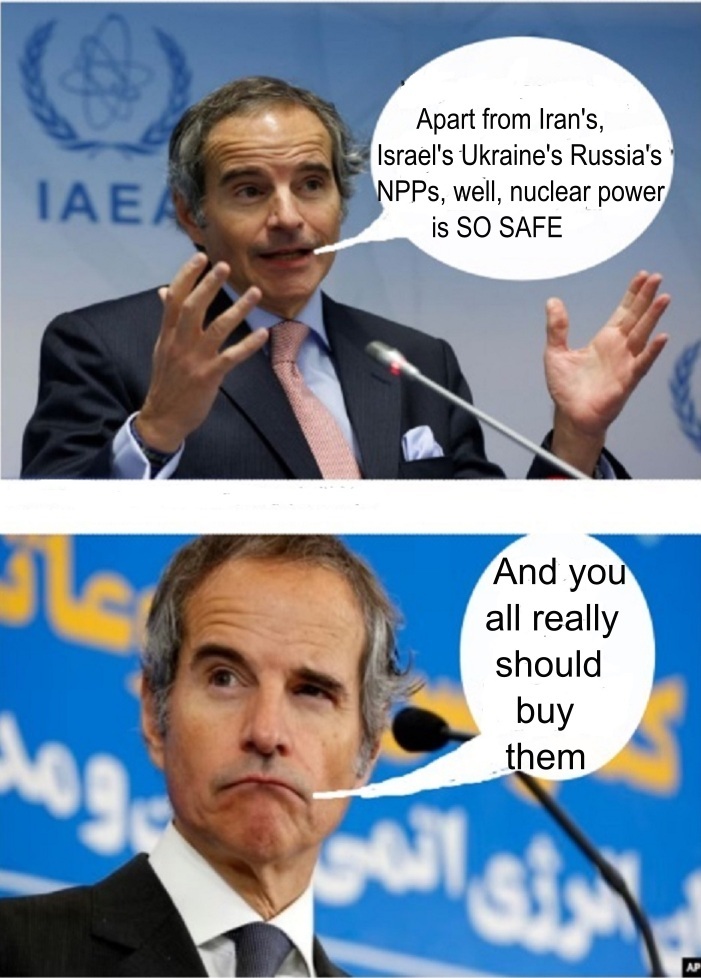
Reports of yet another projectile strike near the Bushehr nuclear power plant prompted Rafael Grossi, head of the International Atomic Energy Agency (IAEA), to register his deep concern on Saturday.
The IAEA was informed of the strike – the fourth such incident in recent weeks – by Iranian officials. Iran also informed the agency that a member of the site’s physical protection staff members was killed by a projectile fragment and that a building on site was affected by shockwaves and fragments.
Mr. Grossi emphasised that nuclear power plant sites or nearby areas must never be attacked, noting that auxiliary site buildings may contain vital safety equipment. No increase in radiation levels was reported, following the latest incident.
Reiterating call for maximum military restraint to avoid risk of a nuclear accident, Mr. Grossi again stressed the paramount importance of adhering to the IAEA’s seven pillars for ensuring nuclear safety and security during a conflict (see below).
The previous strike on Bushehr took place on 18 March, when a structure about 350 metres from the reactor was hit and destroyed. No damage to the reactor or injuries were reported, but the agency warned that any attack near nuclear facilities risks violating key safety principles.
Earlier in the month, in an address to the IAEA Board at the agency’s headquarters in Vienna, Austria, Mr. Grossi underscored the risk of a nuclear incident from the military escalation since Iran “and many other countries in the region that have been subjected to military attacks have operational nuclear power plants and nuclear research reactors”.
The seven pillars for nuclear safety and security in armed conflict
The Seven Indispensable Pillars were introduced by the IAEA Director General in March 2022 to address the unprecedented challenge of maintaining nuclear safety and security when facilities are in a warzone.
- The physical integrity of facilities – whether it is the reactors, fuel ponds or radioactive waste stores – must be maintained.
- All safety and security systems and equipment must be fully functional at all times.
- The operating staff must be able to fulfil their safety and security duties and have the capacity to make decisions free of undue pressure.
- There must be a secure off-site power supply from the grid for all nuclear sites.
- There must be uninterrupted logistical supply chains and transportation to and from the sites.
- There must be effective on-site and off-site radiation monitoring systems, and emergency preparedness and response measures.
- There must be reliable communication with the regulator and others.
No comments yet.
1 This Month

of the week – Shut Down Drone Warfare!


Tell the Ukrainian Government to Drop Prosecution of Peace Activist Yurii Sheliazhenko

Petition to revoke the licensing of the Near Surface Nuclear Disposal Facility (NSDF) at Chalk River. https://www.ourcommons.ca/petitions/en/Petition/Details?Petition=e-7247
To see nuclear-related stories in greater depth and intensity – go to https://nuclearinformation.wordpress.com
-
Archives
- April 2026 (102)
- March 2026 (251)
- February 2026 (268)
- January 2026 (308)
- December 2025 (358)
- November 2025 (359)
- October 2025 (376)
- September 2025 (257)
- August 2025 (319)
- July 2025 (230)
- June 2025 (348)
- May 2025 (261)
-
Categories
- 1
- 1 NUCLEAR ISSUES
- business and costs
- climate change
- culture and arts
- ENERGY
- environment
- health
- history
- indigenous issues
- Legal
- marketing of nuclear
- media
- opposition to nuclear
- PERSONAL STORIES
- politics
- politics international
- Religion and ethics
- safety
- secrets,lies and civil liberties
- spinbuster
- technology
- Uranium
- wastes
- weapons and war
- Women
- 2 WORLD
- ACTION
- AFRICA
- Atrocities
- AUSTRALIA
- Christina's notes
- Christina's themes
- culture and arts
- Events
- Fuk 2022
- Fuk 2023
- Fukushima 2017
- Fukushima 2018
- fukushima 2019
- Fukushima 2020
- Fukushima 2021
- general
- global warming
- Humour (God we need it)
- Nuclear
- RARE EARTHS
- Reference
- resources – print
- Resources -audiovicual
- Weekly Newsletter
- World
- World Nuclear
- YouTube
-
RSS
Entries RSS
Comments RSS
 nuclear-news
Leave a comment