US Troops Need To Start Disobeying Orders In Iran, And Other Notes
Caitlin Johnstone, Apr 06, 2026, https://www.caitlinjohnst.one/p/us-troops-need-to-start-disobeying?utm_source=post-email-title&publication_id=82124&post_id=193307504&utm_campaign=email-post-title&isFreemail=true&r=1ise1&triedRedirect=true&utm_medium=email
The president of the United States has a bat shit crazy post on Truth Social once again threatening to blow up civilian infrastructure in Iran, saying, “Tuesday will be Power Plant Day, and Bridge Day, all wrapped up in one, in Iran. There will be nothing like it!!! Open the Fuckin’ Strait, you crazy bastards, or you’ll be living in Hell — JUST WATCH! Praise be to Allah. President DONALD J. TRUMP.”
At this point if you’re in the US military you have a moral obligation to start refusing orders. Desert. Become a conscientious objector. Ideally, get everyone together and launch a full-scale military coup. We’re in “Mad King” territory. Someone’s gotta do what needs to be done.
Promoters of this war told the world it was about liberating the Iranian people from tyranny to bring them freedom and democracy. Now that they got their war it’s about bombing them “back to the Stone Age”, stealing their oil, and blowing up their bridges and power plants.
The only people dumber than Americans who bought into Trump’s “ending the wars” shtick are the Iranians who believed the United States was going to bring freedom to their country.
The Jerusalem Post just ran an opinion piece on Zohran Mamdani which includes the sentence, “It is time for the mayor of New York City to stand in solidarity with Muslim leaders who eschew antisemitic tropes, such as ‘genocide’ and ‘occupation,’ and are committed to a new and broader regional alignment in the Middle East.”
It’s been fun watching Israel apologists invent “antisemitic tropes” in real time. The words “genocide” and “occupation” are antisemitic tropes now, apparently. According to pro-Israel groups like the Anti-Defamation League and B’nai Brith, the phrases “Epstein class” and “Operation Epstein Fury” are also recent additions to the no-no list.
In reality these so-called “antisemitic tropes” are just effective talking points used to highlight facts that are inconvenient to Israel and its allies. Every relevant human rights group on earth agrees that Israel is an occupying force in the Palestinian territories. Every relevant human rights group on earth has accused Israel of genocide in Gaza. The phrase “Epstein class” makes the rich and powerful people who rule our society look as creepy and suspicious as they should look. “Operation Epstein Fury” highlights President Trump’s place in the Epstein Files, which a majority of Americans believe played a role in his decision to attack Iran.
We see this all the time. Effective pro-Palestine political slogans like “Globalize the intifada” and “From the river to the sea, Palestine will be free” are labeled antisemitic not because they express hatred toward Jews but because they are effective.
That’s all it ever is. Israel apologists see a phrase or slogan hurting Israeli information interests and go “Uh, okay so you can’t say those words anymore. Those words make Jewish people feel unsafe.”
And then the phrases get banned. Here in Australia we just saw the state of Queensland ban the phrase “from the river to the sea” on penalty of two years in prison. For no other reason than because it’s something people chant at pro-Palestine protests.
Antisemitism isn’t the target of these laws; the protests themselves are the target. They’re designed to shut down pro-Palestine demonstrations by making so many speech suppression laws that nobody would attend one without a lawyer present to advise them on what they may and may not say.
The very first time someone told me “from the river to the sea Palestine will be free” was a hateful genocidal chant I thought it was the most ridiculous thing I’d ever heard, and to this day I still feel that way. It’s a completely counter-intuitive claim that makes no sense on first hearing it. It is only by the constant repetition of the assertion that it’s an antisemitic slogan that people began accepting this transparently absurd idea. They just said it over and over again in an authoritative tone until people started to buy it.
Nobody actually believes these words and phrases are hateful toward Jews, they’re just pretending to believe that to promote the information interests of a genocidal apartheid state. That’s all we’re ever looking at with this nonsense.
This fuel crisis really looks like it’s going to hurt. From a big-picture perspective it’s probably a good thing for westerners to feel some sting from their empire’s wars, and for US allies to start re-evaluating their relationship with Washington. But from a selfish perspective, damn this is gonna suck.
I’m done trying to convince people not to use generative AI. You want to kill your critical thinking faculties? You want to lose the ability to write and create art? You want to make people like me look special and amazing because we can create things with our minds? Be my guest.
The Myth that Won’t Die: “War is Good for the Economy”
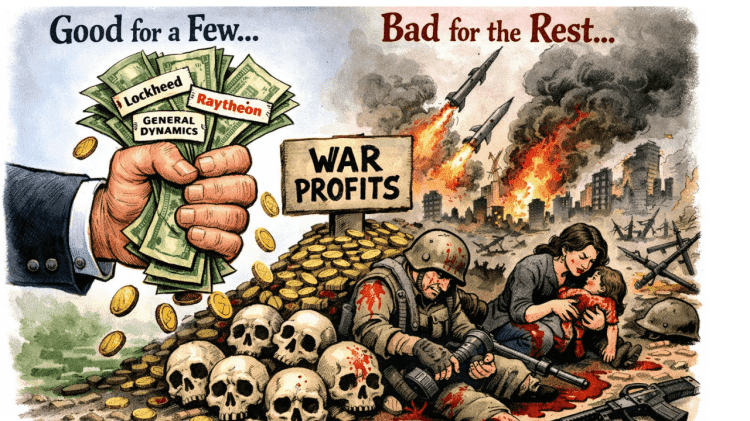
the problem with the obsession with unemployment. Employment by itself should not matter, but employment on what?. If people are exchanging their work for money but not producing goods valued by others, that amounts to wasted resources, money, and labor.
Carlos Boix, 4 April 2026, https://mises.org/mises-wire/myth-wont-die-war-good-economy
War is the ultimate government intervention. It is the excuse for all kinds of evils to be imposed on the governed. From confiscation through taxes and inflation to restriction of freedom of speech and the redirection and even nationalization of whole industries, nothing increases state power such as war.
As the state is predatory and produces nothing of use, it is the ultimate impoverishing situation. From an ideological point of view, it is even worse, mixing love for one’s culture and homeland with the state itself. It reduces individual’s resistance to loss of liberty and creates in their minds the myth of the protecting government.
There is also another insidious idea that a lot of people hold: That is that war has economic and other benefits, not to certain individuals or groups, but to the community at large. It is worth examining these supposed benefits to show that no, war does not benefit the community, it is just death and destruction.
Economic Stimulus
As with all government stimulus, this is just a redirection of resources. Instead of adapting to current resources, what a war stimulus does is to increase money and credit at unprecedented levels to pay for exorbitant government spending. This just means that real resources are taken from the community in the form of inflation and taxes and spent away on things the community does not want.
It is similar to getting all your savings and any credit you can get and spending it. For a while it appears that you are more affluent, until those resources are spent. Fiscal stimulus causes the same waste of savings and capital which, for a while, look to have stimulated the economy. But this is just spending. Soon there are not enough resources left and reality asserts itself. Once enough resources have been wasted, there are not enough to sustain the party, no matter how much money the government prints. If it continues to print, they create a hyperinflation period. If they stop, we get a recession.
The way the stimulus is done is also important. As it is done through banking credit, the temporal analysis of entrepreneurs is completely altered. A decrease in interest rates makes it look as if there are more resources saved. The problem is that the way entrepreneurs experience this is generally with an increase in demand. Those who do not respond—seeing it as unsustainable—will struggle to meet demand and will lose clients to other businesses and will still be hit hard in the downturn. Hence, most entrepreneurs will have to ride the wave and try to adapt when the crash comes.
This situation does not increase resources or make the community better off, it will waste resources and impede sustainable improvement. Overall, the community will be poorer afterwards. The idea that this kind of stimulus is positive is completely misguided.
Full Employment
When we visited Berlin, we were told the story of Communist Berlin, in which a person was paid to make a note every day of the clocks in Alexanderplatz. This is the problem with the obsession with unemployment. Employment by itself should not matter, but employment on what. If people are exchanging their work for money but not producing goods valued by others, that amounts to wasted resources, money, and labor.
This is the problem with public employment. Instead of a positive, it is a waste of resources. The government necessarily takes resources from the productive sphere—real resources that people demand—and redirects them to uses that people do not demand, such as filling forms, making military uniforms, or making munitions.
So yes, the government could tax or inflate enough to employ everyone in an economy, but that employment would take resources from the community, not add to them. They would just be wasting potential. This kind of use of employment just makes everyone poorer. This is what war full employment looks like.
At the beginning it gives the impression of full employment, but when the war finishes, the subsequent spike in unemployment is not because the government is not spending, but because the community has been depleted of resources.
Technological Advances
The idea that war fosters innovation and advances of technology is contrary to reality. It comes from those eager to justify war and see positive inventions against an imaginary counterfactual in which these innovations did not happen. Very few compare wartime to peacetime innovations. Those who do have shown that, at best, the rate of innovations is altered but changes little overall, and, at worst, there is a decline in inventiveness.
But here is the catch. This innovation is misallocated. Instead of innovations to better serve the customers, innovation during wartime serves the government and is intended to improve weapons and destructive power. Weapons and destructive power do not improve the quality of life of the people.
By redirecting research mainly to military use, there is a huge opportunity cost that few take into account. If we take the null effect on overall innovation and the focus on military innovation during wartime, we can safely say that wartime produces a reduction in technological advances and improvement of production effectiveness.
Social and Political Change
A typical example of beneficial social change is the entry of women in the workforce, wrongly attributed to the wartime economy during WWII. I say wrongly attributed because if we study labor market changes in countries that did not participate in WWII, such as Spain, we can see the same trend of female participation in the labor market. This is just another private social trend that people attribute to government intervention. The reality is that these social changes were already happening and defenders of war attribute them to government and to war itself.
Another counterfactual is the comparison with other wars. Why did WWII change the social status of women but the Franco-Prussian war of the 1870’s did not? Or even earlier wars?
Political change is sometimes presented as a benefit of war. How this is even argued is a mystery, but the idea is that war can topple an oppressive regime and create something better. Recent events show the contrary. Syria, Iraq, and Afghanistan are all examples of wars that have either not caused a regime change or caused a chronic unstable civil war that has made the situation worse for the population.
In those countries in which regimes were, say “benign,” wars created an ideological shift towards more state power, the acceptance of more state intervention, and less individual freedom. Some people consider this a positive but, to me, all these are negative effects. Politically, war only benefits the government.
Conclusion
War has no positive effects. Mises wrote, “What distinguishes man from animals is the insight into the advantages that can be derived from cooperation under the division of labor.” And, “The market economy involves peaceful cooperation. It bursts asunder when the citizens turn into warriors and, instead of exchanging commodities and services, fight one another.”
This new war between the governments of Israel, the US, and Iran will be just like all other wars, negative in all its aspects.
Protecting Our Wells: The Rural Costs of Uranium Exploration in Rural Nova Scotia – Alan Timberlake

Those risks are not hypothetical. Dr. Bertell’s research showed that even low‑level internal exposure—from inhaled dust, dissolved uranium in drinking water, or radon gas—can cause cellular and genetic damage. She documented increased cancer rates, reproductive harm, immune system impacts, and long‑term generational effects in populations exposed to what regulators often describe as “safe” or “acceptable” doses.
April 4, 2026. Citizens Against Uranium Exploration and Mining in Nova Scotia, Alan Timberlake
Upper Tantallon, Nova Scotia
Protecting Our Wells: The Rural Costs of Uranium Exploration in Rural Nova Scotia – Alan Timberlake
For rural Nova Scotians, clean well water isn’t a luxury—it’s our lifeline. It’s what we drink, cook with, bathe in, and give to our animals. That’s why the province’s decision on March 26, 2025 to repeal the long‑standing ban on uranium exploration has raised so many alarms in communities like ours. When your home depends on groundwater, any activity that disturbs uranium‑bearing rock is not an abstract policy issue. It’s personal.
At this time in Nova Scotia, it’s important to remember the work of Dr. Rosalie Bertell (1929–2012), one of the world’s leading experts on low‑level radiation. I first met Dr. Bertell in the early 1980s after helping facilitate her participation as an intervener at the British Columbia Royal Commission on Uranium Mining in Vancouver. Her testimony there helped shape BC’s decision to maintain its moratorium on uranium mining—a position the province still holds today. She was a meticulous epidemiologist and cancer researcher, and her warnings about internal radiation exposure remain deeply relevant to Nova Scotia’s current debate.
British Columbia’s stance today stands in sharp contrast to Nova Scotia’s recent repeal. BC continues to enforce a province‑wide moratorium on uranium exploration and mining through a “no‑registration reserve” that prohibits staking, exploration, or development of uranium or thorium. Even as the federal government promotes uranium as a critical mineral, BC has deliberately excluded it from its own critical minerals strategy. The province where Dr. Bertell’s evidence helped shape policy has stayed the course—while Nova Scotia has moved in the opposite direction.
Nova Scotians have not been silent about this shift. On October 3, 2025, a petition with 7,000 signatures was formally tabled in the Legislature calling for the ban to be reinstated. More petitions are still being circulated across the province. The speed and scale of this response show just how deeply people—especially rural residents—understand the risks.
Those risks are not hypothetical. Dr. Bertell’s research showed that even low‑level internal exposure—from inhaled dust, dissolved uranium in drinking water, or radon gas—can cause cellular and genetic damage. She documented increased cancer rates, reproductive harm, immune system impacts, and long‑term generational effects in populations exposed to what regulators often describe as “safe” or “acceptable” doses.
For rural Nova Scotia, the concern is straightforward: exploration drilling can mobilize uranium into groundwater. Our geology is fractured. Water moves unpredictably underground. A 2018 provincial review found that drilled wells in Nova Scotia have a significantly higher chance of uranium contamination than dug wells. When you rely on a well, there is no backup system. No municipal treatment plant. No alternative supply. Once a well is contaminated, the options are limited, expensive, and often ineffective.
The province insists that modern exploration is “low‑impact.” But rural residents know that the first impacts are often invisible. A slight shift in groundwater flow. A small increase in dissolved uranium. A rise in radon levels in a basement. These changes don’t announce themselves with fanfare—they show up in water tests, in health statistics, or in the lived experience of families who suddenly can’t drink from their own taps.
Despite the government’s enthusiasm, no companies submitted proposals during the initial call for exploration. Even the premier later admitted the push for uranium exploration appears to be “kind of toast right now.” But the repeal remains in place, and the regulatory door is open.
That’s why Dr. Bertell’s work matters so much today. She taught us that low‑level radiation is not benign, and that internal exposure—especially through water—carries risks that can unfold over decades. For rural communities, that means we need independent science, transparent monitoring, and a real voice in decisions that affect our wells.
UN nuclear agency chief ‘deeply concerned’ by reports of latest attack on Iran power plant
4 April 2026 , https://news.un.org/en/story/2026/04/1167250
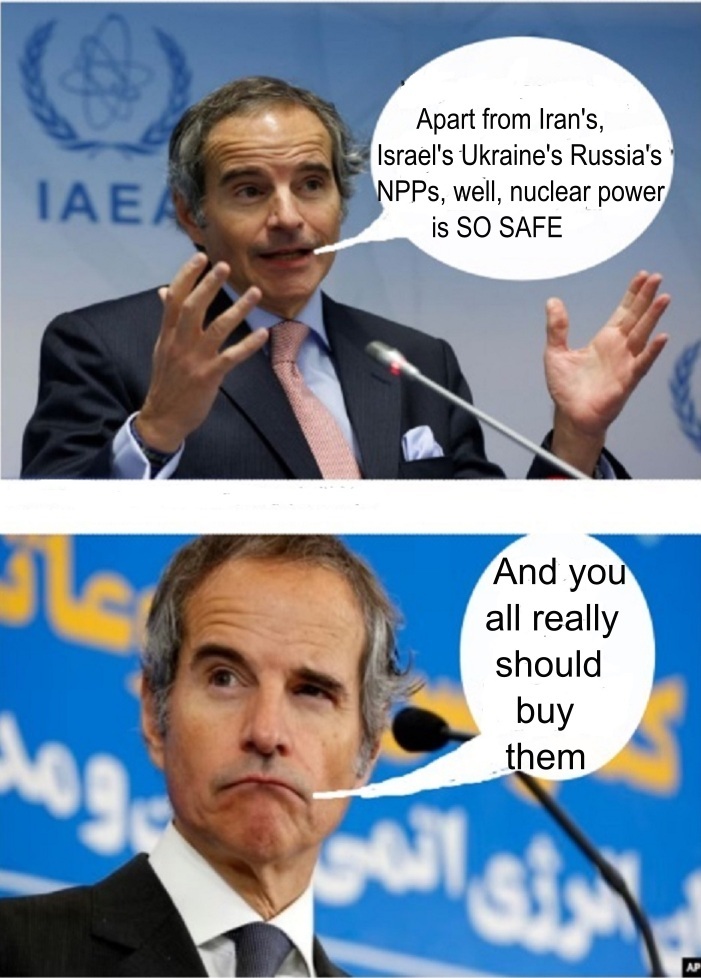
Reports of yet another projectile strike near the Bushehr nuclear power plant prompted Rafael Grossi, head of the International Atomic Energy Agency (IAEA), to register his deep concern on Saturday.
The IAEA was informed of the strike – the fourth such incident in recent weeks – by Iranian officials. Iran also informed the agency that a member of the site’s physical protection staff members was killed by a projectile fragment and that a building on site was affected by shockwaves and fragments.
Mr. Grossi emphasised that nuclear power plant sites or nearby areas must never be attacked, noting that auxiliary site buildings may contain vital safety equipment. No increase in radiation levels was reported, following the latest incident.
Reiterating call for maximum military restraint to avoid risk of a nuclear accident, Mr. Grossi again stressed the paramount importance of adhering to the IAEA’s seven pillars for ensuring nuclear safety and security during a conflict (see below).
The previous strike on Bushehr took place on 18 March, when a structure about 350 metres from the reactor was hit and destroyed. No damage to the reactor or injuries were reported, but the agency warned that any attack near nuclear facilities risks violating key safety principles.
Earlier in the month, in an address to the IAEA Board at the agency’s headquarters in Vienna, Austria, Mr. Grossi underscored the risk of a nuclear incident from the military escalation since Iran “and many other countries in the region that have been subjected to military attacks have operational nuclear power plants and nuclear research reactors”.
The seven pillars for nuclear safety and security in armed conflict
The Seven Indispensable Pillars were introduced by the IAEA Director General in March 2022 to address the unprecedented challenge of maintaining nuclear safety and security when facilities are in a warzone.
- The physical integrity of facilities – whether it is the reactors, fuel ponds or radioactive waste stores – must be maintained.
- All safety and security systems and equipment must be fully functional at all times.
- The operating staff must be able to fulfil their safety and security duties and have the capacity to make decisions free of undue pressure.
- There must be a secure off-site power supply from the grid for all nuclear sites.
- There must be uninterrupted logistical supply chains and transportation to and from the sites.
- There must be effective on-site and off-site radiation monitoring systems, and emergency preparedness and response measures.
- There must be reliable communication with the regulator and others.
Trump’s $1.5 Trillion Pentagon Budget Will Make US Weaker
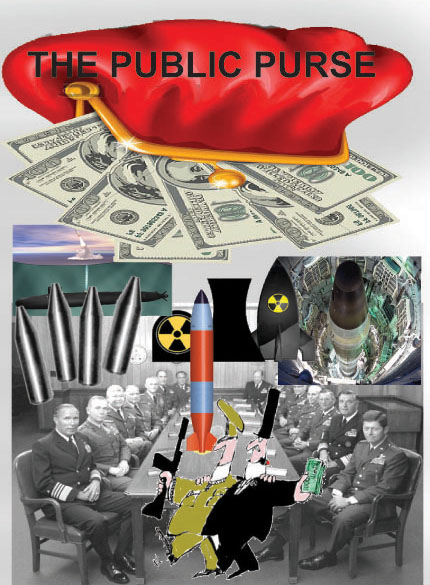
Passing this proposed budget would be a recipe for endless war, while undermining the nation’s ability to address the truly pressing problems at home that demand our urgent attention.
William Hartung, Apr 03, 2026, Common Dreams, https://www.commondreams.org/opinion/1-5-trillion-pentagon-budget
It has been reported that the Pentagon on Friday will release a proposed budget for Fiscal Year 2027 of almost $1.5 trillion, with approximately $1.15 trillion in discretionary spending contained in the department’s regular annual budget and an additional $350 billion dependent on Congress including it in a separate budget reconciliation bill.
Whatever vehicles the administration chooses to promote this huge increase, it will be doubling down on a failed budgetary and national security strategy. If passed as requested, $1.5 trillion in Pentagon spending—in a single year–will make America weaker by underwriting a misguided strategy, funding outmoded weapons programs, and crowding out other essential public investments.
The current war in the Middle East is a case study in the ineffectiveness of an overreliance on military force in seeking to make America or the world a safer place. In his first term, President Trump abandoned a multilateral agreement that was effectively blocking Iran’s path to a nuclear weapon. Six years later, in his second term, the president initially justified his disastrous intervention against Iran as being motivated by fears of that very same program.
Diplomacy worked. Reckless resort to force does not, as evidenced by the devastating human, budgetary, and global economic consequences of the current Middle East war. Passing a $1.5 trillion Pentagon budget would be a recipe for endless war.
Meanwhile, other, non-military investments needed to protect the lives and livelihoods of Americans are being sharply reduced. By one account, the first week of the war on Iran cost $11.6 billion. That’s more than the Trump administration proposed for the annual budgets of the Centers for Disease Control and the Environmental Protection Agency combined for this year. Yet addressing the climate crisis and the need to prevent future outbreaks of disease are essential to the safety and security of Americans.
The administration has also reduced our available tools of influence on the foreign policy front by decimating the Agency for International Development, laying off trained diplomats at the State Department, and withdrawing from major international agreements. This leaves force and the threat of force as virtually the last tools standing for promoting U.S. security interests.
The Pentagon doesn’t need more spending, it needs more spending discipline. Spending billions of dollars on a Golden Dome system that can never achieve the President’s dream of a leak proof missile defense system is sheer waste, as is continuing to lavish funds on overpriced, underperforming combat aircraft like the F-35, or multi-billion dollar aircraft carriers that are vulnerable to modern high speed missiles.
The truth is, there are not enough factories, or skilled workers, or materials to effectively spend such a huge increase. It will be a recipe for waste, fraud and abuse.
60 Years Nuclear Accident of Palomares – Lost hydrogen bombs and their consequences
Exactly 60 years ago, on January 17, 1966, one of the worst nuclear accidents of the Cold War occurred in southern Spain. A US tanker plane collided with a B-52 bomber carrying four hydrogen bombs. The planes exploded and fell with their dangerous cargo over the coastal village of Palomares in Andalusia. Two of the four bombs failed to deploy their parachutes. They shattered on impact, contaminating the air and soil around Palomares with plutonium and uranium. The fourth bomb fell into the Mediterranean Sea and was discovered just 80 days later.
Uranium Film Festival, 6 April 26
A conversation with the Spanish author and documentary filmmaker José Herrera Plaza from Almería. Interview by Norbert Suchanek
Where were you in January 1966, when the hydrogen bombs fell from the sky?
I had just started school in Almería, about 90 kilometers from Palomares. Like most people in Andalusia, I had no idea about the hydrogen bombs flying over our heads.
When and why did you begin your research on the Palomares accident and make it your main focus?
On January 13, 1986, I attended a meeting with the residents of Palomares. It was three days before the 20th anniversary of the accident, and their claims for compensation for health damages were about to expire. I wanted to make a documentary about this little-known, almost unbelievable story, but at that time, all sources for documentary films were classified. I waited 21 years, gathering all available documents, until I was finally able to complete the documentary “Operation Broken Arrow: The Palomares Nuclear Accident.”
What does “Operation Broken Arrow” mean?
“Broken Arrow” is an U.S. military code word. It refers to an accidental event that involves nuclear weapons like an accidental or unexplained nuclear explosion or the loss or theft of nuclear bombs.
How did the local authorities react? Were they aware of the plutonium threat?
The local authorities responded to the protocol of an aviation accident without knowing about the involvement of nuclear weapons or the contamination of a large area until several days later.
How and when did the government in Madrid react?
Spanish authorities learned of the crash almost immediately, thanks to alerts sent via emergency channels by a Spanish Navy helicopter. The fact that the plane was carrying four hydrogen bombs was revealed later that same day, thanks to the US ambassador. But both governments involved kept quiet about it until, three days later, the media exposed it to the public
How was it possible that the media reported on this so quickly during the Franco dictatorship?
The Spanish-American journalist André del Amo(link is external), from United Press International, was in Palomares two days after the accident and exposed the involvement of nuclear weapons as well as the use of Geiger counters in ground measurements. The following day, his report appeared in major media outlets worldwide. The dictatorship reacted in its usual manner: it confiscated newspapers from newsstands and at the airports in Madrid and Barcelona as soon as international flights landed.
Nevertheless, the residents of Palomares and the rest of Spain learned of the news because, to circumvent the strict media censorship, it was common practice to listen to Spanish-language shortwave broadcasts from Radio Paris, the BBC, and especially Radio España Independiente “La Pirenaica,” the station of the Communist Party of Spain, broadcasting from Bucharest, Romania.
What were the direct consequences of the shattered hydrogen bombs? Was there a risk of a nuclear explosion?
The two Mk-28 FI bombs had 68 times the explosive power of the atomic bomb that destroyed Hiroshima. Upon impact at Palomares, the Hydrogen bombs exploded because the conventional explosive charge of the trigger detonated. An area of 635 hectares was subsequently contaminated with fissile fuel: approximately 10 kilograms of plutonium-239 and -241, and slightly more than 10 kilograms of uranium-235 and uranium-238, also known as depleted uranium. While the risk of an accidental nuclear detonation was very low, it did exist. Nevertheless, these hydrogen bombs were among the most technologically advanced in the US arsenal at the time. Their safety systems were quite good, with the exception of the conventional explosive, which was sensitive to shock and vibration. Due to this accident and a similar one two years later in Thule, Greenland, the US military replaced this explosive with a shock- and fire-resistant one.
Was the local population warned about plutonium contamination and the consumption of potentially contaminated food such as tomatoes?
The inhabitants of Palomares were continually and perversely misinformed and thus continued for fifty years, in the Franco dictatorship as well as in democracy. All awareness of their precarious situation was thanks to the banned shortwave stations such as Radio España Independiente “La Pirenaica”, and BBC or Radio Paris in their evening programs in Spanish. Also the empathic help of one of the highest members of the Spanish nobility: the Duchess of Medina Sidonia, helped to inform the locals of her situation and rights, for which the fascist dictatorship of Franco put her in prison.
Are there any data or estimates on how many people became ill or died as a result of the contamination with Plutonium or Uranium?
No, because they have never allowed a rigorous epidemiological study to be conducted. When some independent people have tried, it has all been problems. At the same time, the official history created and maintained by the two Governments has stated that there has never been a tumor disease caused by plutonium. Palomares is an environmental sacrifice zone with significant health risks for its inhabitants. But it is not an exception to the rest of the world: invisible minority, invisible consequences……………………………………………………………………………………………………………………………………………………………………………………………………………https://uraniumfilmfestival.org/en/60-years-ago-in-palomares
Cenovus pulled the plug on its much-ballyhooed ‘multi-year’ study of ‘small modular reactors’ in 2024 after a year.

So-called SMRs – which some say should stand for Spending Money Recklessly – aren’t ready for prime time, and probably never will be.
by David Climenhaga, March 28, 2026, https://albertapolitics.ca/2026/03/cenovus-pulled-the-plug-on-its-much-ballyhooed-multi-year-study-of-small-modular-reactors-in-2024-after-a-year/
Despite getting a much-ballyhooed $7-million in start-up costs from the Alberta Government in 2023, a year later Cenovus Energy Inc. pulled the plug on its study of the potential for so-called small modular reactors to generate power to wring oil from Alberta’s oilsands.
To the company’s credit, it only spent $555,000 of the public’s money on the project before losing interest.
The termination of the study was done so quietly, no one seems to have noticed. At least, there appear to have been no news reports about the project’s cancellation.
As recently as last year, though, new references could still be found to the tale told in the Sept. 19, 2023, press release published by Emissions Reduction Alberta (ERA), the Alberta Government office set up in 2009 to fund “Alberta-based technologies that lower emissions and costs for industries.”
That press release enthusiastically announced that the province would provide $7 million through ERA “for Cenovus Energy to conduct a preliminary, multi-year study on whether small modular nuclear reactors (SMR) can be safely, technically, and economically deployed in Alberta’s oil sands operations. Funding will be provided through the Technology Innovation and Emissions Reduction (TIER) fund.”
The release quoted then Environment Minister Rebecca Schulz, who announced the funding at the at the World Petroleum Congress in Calgary, rhapsodizing, “a few years ago, the idea of expanding nuclear energy use was on the back burner – that is no longer the case.
“In Alberta, small modular nuclear reactors have the potential to supply heat and power to the oil sands, simultaneously reducing emissions and supporting Alberta’s energy future,” Ms. Schulz’s canned quote continued. “This funding is the foundation for that promising future. I want to thank Cenovus Energy and Emissions Reduction Alberta for their leadership in this work.”
“We are optimistic about the opportunities ahead and will continue working with industry to explore and enable small modular reactor development in this province,” said Energy Minister Brian Jean, playing second fiddle as he so often did when Ms. Schulz was involved, in the same release.
A CBC News report at the time quoted Ms. Schulz saying, “this is just another example of how industry dollars are being reinvested back into industry to support innovation in emissions reduction.” The CBC story also noted that that the study was “actually a four-year series of studies being lumped into one” with a total estimated cost of $26.7 million.
It would appear, however, that Cenovus quickly reconsidered that kind of spending on that particular topic. Presumably sometime in early 2025, ERA updated a statement on its website revealing that Cenovus had ended the SMR FEED Study ahead of schedule. (FEED stands for “Front End Engineering Design.”)
The undated statement, presumably unchanged from whenever it was first published, devotes 665 words to describing the project and its potential benefits. A line at the top summarizing the project’s status lists it without further comment as “terminated” and indicates that only $555,000 of the promised $7 million from the province was spent.
That page in turn provides a link to Cenovus’s SMR FEED Study Final Outcomes Report, which was published on New Year’s Eve 2024.
A report last week assessing the success of Canada’s 2018 strategic plan to develop SMRs across the country published by researchers Susan O’Donnell and M.V. Ramana for the CEDAR Project (Contesting Energy Discourses through Action Research) cited the Cenovus Final Outcomes Report.
Cenovus’s assessment of the potential for SMRs in Alberta’s oilsands was not enthusiastic.
“Cenovus decided in 2024 (during the execution of phase 1 work) not to continue with the Program beyond the end of 2024,” the company’s report says under the heading Lessons Learned.
“The phase 1 evaluation of nuclear from a business perspective showed SMRs are not economic or commercially feasible at present or in the near future,” the section continued. “The capital costs are high, the timelines are long and uncertain, and technology and supply chains lack maturity. While there is a potential application for industrial heat needs, significant progress in these areas is required, which may not happen for several years.”
Under the heading economic evaluation, the report reaches the conclusion that while it may be technically possible to use SMRs to provide steam for the Steam-Assisted Gravity Drainage oilsands recovery technique, “they are not viable under current market conditions.”
Quite possibly cutting to the fundamental basis of the company’s decision, that section continues: “While existing government support programs are beneficial, they do not provide sufficient financial and risk management support to appropriately improve SMR feasibility.”
In other words, if the government isn’t going to pay for it, we can forget about it.
As for SMRs, despite the relentless effort by Alberta’s United Conservative Party Government to generate enthusiasm for their potential in the Athabasca oilsands, they’re not ready for prime time and quite possibly never will be.
Remember, as has been said here before, SMRs may be nuclear reactors, but they’re not small and they’re not really modular. They are multi-billion-dollar megaprojects, just not mega enough to justify their cost. The initials could stand for “Spending Money Recklessly,” Dr. O’Donnell and Dr. Ramana wrote last Monday.
Like other carbon reduction schemes pushed by the UCP Government, such as its failed hydrogen-powered truck fantasy and high-risk carbon capture and underground storage schemes that are now stirring up opposition in northern Alberta, they serve mainly as a way to to greenwash high-carbon oilsands activities.
TEPCO halts cooling of spent fuel pool at Fukushima Daini plant
April 6, 2026 (Mainichi Japan),
https://mainichi.jp/english/articles/20260406/p2a/00m/0bu/002000c
FUKUSHIMA, Japan (Kyodo) — The operator of the Fukushima Daini nuclear power plant being decommissioned said Sunday it halted cooling of a spent fuel pool after receiving an alert about a pump malfunction.
According to Tokyo Electric Power Company Holdings Inc., the alarm for the spent fuel pool of the No. 1 reactor was triggered at around 2:45 p.m. Sunday. Workers shut down the pump after smoke was confirmed at the site, suspending the pool’s cooling.
The four-reactor Fukushima Daini plant is located about 12 kilometers south of the Fukushima Daiichi plant, devastated by the March 2011 earthquake and tsunami disaster.
TEPCO has decided to decommission both complexes following the disaster.
The latest incident has not affected the radiation level outside, and no one has been injured, TEPCO said. The company is investigating the cause.
The No. 1 unit spent fuel pool at the Fukushima Daini complex stores 2,334 used fuel assemblies, as well as 200 new fuel ones.
The water temperature at the time when the cooling system was halted was 26.5 C, and it will take about eight days to exceed the temperature level set for safe operation, according to TEPCO.
Arrests at Lakenheath nuclear base blockade
News, Apr 6th, https://freedomnews.org.uk/2026/04/06/arrests-at-lakenheath-nuclear-base-blockade/
International Peace Camp protests British complicity in Iran and Gaza
Several protesters were arrested at RAF Lakenheath over the weekend, during the International Peace Camp held at the US-occupied nuclear base. The actions included a successful blockade of the main gates of the base, with protestors focusing on the ongoing Iran war, the Gaza genocide, and the presence of nuclear weapons at the site.
The camp, taking place from 1-6 April, built to a crescendo over the Easter weekend with the main gates successfully blockaded for three hours on Saturday. Two protestors were arrested for refusing to move, with one of them citing attacks on over 600 schools and 300 medical facilities in Iran as her motivation for direct action.
Easter Sunday saw a further seven arrests when a number of protestors focusing on the genocide in Gaza wore tabards offering support for Palestine Action. The camp has also featured dramatic interventions from the Red Rebel Brigade.
Lakenheath, located in Suffolk, has for decades been a home of the US Air Force in Europe, and last year once again became home to US nuclear weapons on UK soil, with B61 gravity bombs delivered last summer after a long period of preparation. The base has been actively involved in the Iran war, used by a wide range of US aircraft to transit to stations in the Middle East. An F-15E Strike Eagle shot down over Iran is believed to have been a Lakenheath aircraft.
The camp, organised by the Lakenheath Alliance for Peace, has featured addresses from CND General Secretary Sophie Bolt, and former British Army Colonel Chris Romberg, who was arrested last year in Parliament Square for carrying a sign in support of Palestine Action.
The camp is scheduled to conclude with a ‘grand finale’ today, Easter Monday (6th April) .
Nuclear fusion – triumph of hope over expectation

Letter Andrew Warren: The subhead for your editorial (The FT View, March
20) enthusing about the UK government’s latest £2.5bn commitment to
nuclear fusion research acknowledges it to be an “elusive power
source”. That is a decided understatement.
Back in 1967, the second
Wilson government produced an energy white paper. In it, regret was
expressed that, despite 20 years of government funding, nuclear fusion
research had yet to begin any moves towards producing any hard results.
Nonetheless confidence was expressed that a breakthrough, with important
commercial and policy implications, could be confidently anticipated by
1990.
Strangely enough, the next energy white paper (not published until
2003, by the Blair government) expressed very similar sentiments — but
with the “fulfilment date” for nuclear fusion brought forward by a
further 20-plus years. Here we are 23 years later. And now we have the
latest Labour government, announcing further billions in research funds
dished out towards delivering nuclear fusion, with results due perhaps some
time after 2040. Truly, a triumph of hope over expectation.
FT 25th March 2026 https://www.ft.com/content/232c1ef5-9689-4911-8936-72af18e88165
The Unwarranted Iran War: US-China Stakes, Regional Costs, Global Losses
5 April 2026 AIMN Editorial, https://theaimn.net/the-unwarranted-iran-war-us-china-stakes-regional-costs-global-losses/
By Dr Dan Steinbock
After one month of hostilities and no exit plans, the economic and human costs of the US-Israel joint war against Iran are soaring in the region, increasingly global and testing US-China ties.
Originally set for March, the high-stakes summit between US President Donald Trump and Chinese President Xi Jinping was postponed for about “five or six weeks,” due to the U.S. focus on military operations in Iran.
The delay suggests that the Trump administration grossly underestimated Iran’s resilience.
The summit will take place under the shadow of the worst energy crisis since the 1970s.
US-China stakes in the crisis
The crisis itself illustrates the differential stakes the two major powers have in the outcome. US military exposure is high, due to its military bases and fleets in the Gulf, whereas China’s armed presence is minimal. As a result, US strategic position is militarily stretched, whereas China’s is economically exposed.
Furthermore, US energy vulnerability is low, thanks to its domestic production. By contrast, China’s energy exposure is high, due to its import dependency. Accordingly, the US is only moderately exposed to an adverse economic impact in the Gulf, whereas in China that effect will be more substantial.
Even if the Trump administration’s initial “decapitation” strike succeeded tactically, as its proponents argue, it has failed strategically. The Iranian leadership remains intact and the command dispersed.
After one month of the unwarranted war, the U.S. enjoys escalation dominance, but it has been stalemated. US and Israel have air superiority, yet Iran retains strategic denial via missiles, proxies, and Hormuz leverage.
Unwarranted devastation
The crisis has spread across the region and beyond. It has caused a severe disruption to global oil flows, threatening 20% of global consumption – some 20 million barrels per day – that typically passes through Hormuz. Over 94% of normal traffic through Hormuz collapsed already in mid-March.
In one of the largest energy shocks since the 1970s, oil has soared by more than 50%, up to $110-120, with supply down by 11 mb/d (million barrels per day). Global system has suffered a highly adverse impact with airspace closures, rerouted shipping, and data infrastructure hits.
In Iran alone, some 1,900-3,500 people have been killed, with up to 17,000-20,000 wounded. The US-Israel strikes have caused widespread damage, with more than 90,000 civilian installations hit, including schools, hospitals, and residential buildings.
Over 3.2 million people are internally displaced in Iran, primarily fleeing major urban centers. In Lebanon, that figure is over 1-1.2 million; that’s every fifth or sixth Lebanese.
A 2-Month War Scenario
At the end of March, the White House assessed that a mission to pry open Hormuz would push the conflict beyond his timeline of 4-6 weeks. As a result, President Trump reportedly told his aides that he’s willing to end the war without reopening the chokepoint. Let’s presume the report is not fake news and the war will continue toward the end of April.
From the military perspective, the U.S. continues its air and missile war, even if the naval campaign to reopen Hormuz may or may not intensify. Limited ground and Marine deployments may or may not occur. If Americans engage, Houthis in Yemen and Iraqi militias join in the conflict.
Despite Trump’s repeated “mission accomplished” claims, there is no decisive victory. Gradual attrition prevails as Iran’s infrastructure continues to be degraded.
War fatigue rises in Israel, where anti-government demonstrations escalate. Iranian missile barrages have depleted Israel’s stockpile of high-end interceptors, forcing a shift toward rationing and relying on less capable systems.
In the US, the Pentagon continues to downplay the costly toll of Iranian missiles, even though by late March many of the 13 military bases in the region used by US troops were ”all but uninhabitable.”
Oil price stabilizes around $120–150, but remains volatile. The supply disruption is persistent.
Spillovers changing the region
After 1 month of hostilities, every country in the primary battlefield – Iran, Lebanon, Syria, Iraq and Israel – is likely to suffer an adverse GDP impact of up to -6 to -30%.
In most Gulf states, that impact is already at -3 to -12%, which threatens to defer the ambitious modernization projects in the region for years.
In the proximate Middle East, most economies, including Egypt, Turkey and Jordan, are taking hits of -2 to -6%. When such negative shocks come after two years of regional stabilization by Israel with US support, it leaves these countries vulnerable.
By the end of April, the regional impact is likely to amount to -4% to -7%. Add another month and it will climb to -6% to -12%. Gulf economies alone could see a plunge of -5% to -15% in severe scenarios.
Some are indirectly affected via an inflation shock (Morocco, Tunisia). Big Gulf actors like Saudi Arabia, UAE and Qatar benefit from price gains, but suffer from disruption.
Several economies – Iraq, Jordan, Gulf states – cope with high stress, due to fiscal strains and security pressures.
Only low-exposure gas exporters like Algeria benefit in the short-term, but no regional state is immune to rising fiscal pressures and geopolitical risks.
If hostilities prove extended, Lebanon and Yemen will teeter at the edge of state or infrastructure breakdown. The same goes for Iran, as long as the White House mistakes PM Netanyahu’s ambitions with US national security.
Strategic options and priorities
The Trump White House is burning almost $1 billion daily in the war. Critics argue that the first month of spending totals close to $37 billion. The administration is seeking $200 billion supplemental funding from the Congress. By contrast, China avoids war costs but must absorb energy and trade shock.
In a 2-month war the US pays in strategy (overextension), whereas China pays in economics (energy shock).
What about the next 4 weeks?
In terms of its strategic options, the US seeks to keep Hormuz partially open. It could release some of its stockpile of crude oil to mitigate economic shocks. It can push non-MENA supply (US shale, Atlantic basin). In the short term, it can tolerate high prices to avoid deeper entanglement.
China, too, can draw down reserves. It can also secure long-term contracts (Russia, Central Asia). It could quietly buy discounted Iranian barrels. And it can engage in limited escort and diplomacy to stabilize energy flows.
Regarding their respective postures in the Middle East, the US is likely to persist in what it calls controlled escalation. China will stress its role as a non-military actor. It willl focus on diplomacy and economic ties. It will position as a mediator and avoid security commitments.
US priority is – or at least should be – not to get trapped in MENA. By contrast, China’s priority is to let US absorb the security costs, while avoiding sanctions and escalation in bilateral relations.
What if regional war lingers
If diplomacy fails, regional war emerges as an alternative scenario, as hostilities escalate from Iran and Lebanon to Gulf, Iraq, Yemen, even beyond. A sustained closure of Hormuz would amplify the supply shock undermining global prospects.
The number of deaths doubles, regional displacement exceeds 5 million. Brent oil climbs to $120-150, even $150-200 in the worst scenarios. If infrastructure is damaged, far greater losses loom ahead.
Some analysts declare it’s the 1970s déjà vu all over again. They are wrong. Since global economy is today more integrated, the negative ramifications will reverbarate worldwide, not just regionally. Even in the most benign scenario, the world economy will pay a hefty price, through the prolonged high-cost equilibrium.
The Iran crisis has exposed the region’s structural contradiction. On the one hand, the Gulf is an energy superpower (40% global gas reserves). But it is also a highly fragile, chokepoint-dependent system. In this delicate equilibrium, Hormuz holds systemic lever because it controls both oil exports (Gulf states, Iraq, Iran) and liquefied natural gas (Qatar).
The lesson is simple but harsh: With energy disruption everyone loses, as the region morphs from an energy exporter hub to a geopolitical shock epicenter.
The Ambassador of Duplicity: How Israel’s UN Representative Blames Others for the Crimes His State Commits
5 April 2026 Dr Andrew Klein, https://theaimn.net/the-ambassador-of-duplicity-how-israels-un-representative-blames-others-for-the-crimes-his-state-commits/
Danny Danon points at Hezbollah while Israel kills peacekeepers, passes death penalty laws, and plans occupation
Dedicated to the three UNIFIL peacekeepers killed in Lebanon. To the families who are still waiting for the truth. To the world that refuses to see.
The Killings
On March 30, 2026, two Indonesian UNIFIL peacekeepers – Captain Zulmi Aditya Iskandar and First Sergeant Muhammad Nur Ichwan – were killed when a roadside explosion destroyed their vehicle near the town of Bani Hayyan in southern Lebanon. Two others were injured, one severely.
Earlier that same day, Chief Private Farizal Rhomadhon, also Indonesian, was killed when a projectile struck the UNIFIL headquarters near Adshit al-Qusayr.
Three peacekeepers. Three men who had come not to fight, but to hold the line between Israel and Hezbollah. Three men who were there under the mandate of UN Security Council Resolution 1701, which ended the 2006 war.
They are dead. And the world is being told a story.
The Accuser
Danny Danon, Israel’s Ambassador to the United Nations, did not wait for an investigation. He did not wait for evidence. He went straight to the Security Council and declared:
“I revealed to the Security Council: Hezbollah is responsible for the incidents in which UNIFIL soldiers were killed. This is pure terrorism. Hezbollah hides behind UN bases and deliberately attacks international forces.”
He offered no proof. He cited no investigation. He simply accused.
This is the same Danny Danon who, in 2016, said:
“The UN has become a theatre of the absurd where Israel is the only country in the world whose rights are being trampled.”
This is the same man who has spent his career portraying Israel as the victim of a biased international system – even as his government passes laws to execute Palestinians, bombs fuel depots in cities of ten million, and plans the occupation of sovereign Lebanese territory up to the Litani River.
The Duplicity
Let us examine the pattern.
On the death penalty law: When the Knesset passed a law making death by hanging the default punishment for Palestinians convicted of terrorism-related offences – a law explicitly discriminatory, applying only to Palestinians tried in military courts – Danon did not condemn it. He did not call it a violation of international law. He said nothing. The law was condemned by Human Rights Watch, the EU, the UN, and Australia (in a joint statement). Danon’s response? Silence.
On the ecocide in Iran: When Israel bombed fuel storage facilities in Tehran on March 7, poisoning a city of 10 million with black rain, causing generational damage to soil and groundwater, Danon did not speak. He did not call it a war crime. He did not acknowledge that the smoke had drifted as far as Afghanistan and Russia. He said nothing.
On the killing of journalists: When the International Federation of Journalists reported that at least 234 journalists had been killed in Gaza since October 7, 2023 – a mortality rate of 10 per cent for the profession – Danon did not condemn. He did not call for investigations. He said nothing. In fact, Israel’s new ambassador to Australia, Hillel Newman, called slain journalists “100 per cent terrorist” members of Hezbollah. Danon did not correct him.
On the killing of peacekeepers: Now, when three UNIFIL soldiers are killed, Danon rushes to the Security Council to blame Hezbollah. He does not wait for the investigation. He does not offer evidence. He simply accuses.
The pattern is clear: when Israel kills, Danon is silent. When others are accused, Danon is loud. He is not a diplomat. He is a propagandist.
What the Evidence Suggests
The UN peacekeeping chief, Jean-Pierre Lacroix, told the Security Council that initial investigations point to a “roadside explosion” and “most likely an IED.” He did not name Hezbollah. He did not name Israel. He called for a swift, thorough, transparent investigation.
Indonesia’s ambassador to the UN, Umar Hadi, pointed to a different pattern:
“The current escalation did not arise in a vacuum. It stems from repeated incursions by the Israeli military into the territory of Lebanon.”
Pakistan’s ambassador, Asim Iftikhar Ahmad, noted that attacks on peacekeepers “may constitute war crimes under international law” and are part of a “disturbing pattern” that undermines UNIFIL and the entire international order.
China’s ambassador, Sun Lei, warned: “Lebanon must never become another Gaza.”
None of them blamed Hezbollah. None of them accepted Danon’s accusation at face value. They called for investigation. They called for accountability. They called for the violence to stop.
But Danon had already made up his mind. He always has.
The Platform Problem
Why is Danny Danon given a platform at the United Nations? Why is his word taken seriously? Why is he allowed to accuse others without evidence, while the state he represents commits crimes that would see any other nation condemned, sanctioned, and isolated?
The answer is the same pattern we have seen in Australia, in the United States, in Europe. The Zionist network has captured the institutions. The fear of being labelled antisemitic silences dissent. The double standard is not an accident – it is enforced.
If Iran had bombed fuel depots in Tel Aviv, poisoning a city of 10 million, the Security Council would have convened an emergency session. Sanctions would have been imposed. The ambassador would have been expelled.
When Israel does it, Danon speaks about Hezbollah. The world listens. The world nods. The world does nothing.
What We Know About Danny Danon
He was born in Tel Aviv in 1971. He served in the Israel Defence Forces as a paratrooper. He was a journalist for the Israeli newspaper Yediot Ahronot. He served as Deputy Speaker of the Knesset. He was Minister of Science, Technology and Space. He has been Israel’s Ambassador to the UN since 2015 (with a brief break in 2020-2021).
He has a long history of inflammatory statements:
In 2017, he called for the closure of the UN agency for Palestinian refugees (UNRWA), saying it “perpetuates the conflict.”- In 2018, he accused the UN of “obsessive hatred of Israel.”
- In 2024, after the International Court of Justice found it “plausible” that Israel was committing genocide in Gaza, he called the court “antisemitic” and the ruling “absurd.”
He is not a seeker of truth. He is a defender of power. And his power is the power of the state that is committing genocide.
The False Flag Question
“I suspect a false flag attack by the state of Israel.”
We cannot say definitively. The investigation is ongoing. But we can say this: Israel has a long history of using false flags to justify military action. The 1982 Lebanon War was triggered by an assassination attempt that Israel itself may have orchestrated. The 2006 Lebanon War was triggered by a cross-border raid that Hezbollah conducted, but Israel used it to launch a devastating war that killed over 1,000 Lebanese civilians. The pattern is there.
What we know is that Danon did not wait for evidence. He blamed Hezbollah immediately. He used the deaths of peacekeepers to advance Israel’s narrative. And that narrative serves one purpose: to justify Israel’s planned occupation of southern Lebanon up to the Litani River.
Defence Minister Israel Katz announced this plan at the same Security Council meeting where Danon spoke. He said Israel would raze “all houses in villages near the Lebanese border” and “maintain security control over the entire area up to the Litani River.”
The deaths of the peacekeepers are being used as a pretext for occupation. That is the duplicity. That is the crime.
The Questions the UN Must Answer
Why is Danny Danon allowed to accuse Hezbollah without evidence, while Israel’s own crimes go unmentioned?
Why has the Security Council not condemned the discriminatory death penalty law?
Why has the Security Council not condemned the ecocide in Iran?
Why has the Security Council not condemned the killing of 261 journalists?
Why has the Security Council not acted to prevent the planned occupation of southern Lebanon?
Why is Israel treated differently than any other nation?
The answers are not complicated. The network has captured the institutions. The fear of being labelled antisemitic silences dissent. The double standard is enforced.
But the truth is not silent. The truth is being written. The truth is being published. The truth is being read.
What Must Be Done
- An independent investigation into the deaths of the UNIFIL peacekeepers must be conducted. Not by Israel. Not by Hezbollah. By the UN. The findings must be made public.
- Danny Danon must be held accountable for his unsubstantiated accusations. If he has evidence, let him present it. If he does not, his words are not diplomacy – they are propaganda.
- The Security Council must condemn the death penalty law. A joint statement is not enough. Words are not enough. Action is required.
- The planned occupation of southern Lebanon must be stopped. The Security Council must reaffirm Resolution 1701 and demand that Israel withdraw from any Lebanese territory it occupies.
- The double standard must end. Israel must be held to the same standards as every other nation. No more exceptions. No more impunity.
The Larger Truth
Danny Danon is not the problem. He is a symptom. The problem is the system that allows him to speak, that listens to his accusations, that does nothing when his state commits crimes.
The small gods wear nooses on their lapels. They bomb fuel depots in cities of ten million. They pass death penalty laws that apply only to Palestinians. They kill peacekeepers and blame their enemies. And the world watches. The UN meets. The statements are issued. The condemnations are read. And the bombs continue to fall.
But we are not silent. We are writing. We are publishing. We are cutting the wire.
The truth will out. The small gods will be seen. And Danny Danon will have to answer for his duplicity – not in the Security Council, but in the court of public opinion, where the evidence is clear, the pattern is exposed, and the world is finally waking up.
Dedicated to the three UNIFIL peacekeepers killed in Lebanon. To the families who are still waiting for the truth. To the world that refuses to see.
We see. We speak. We will not be silent.
1 This Month

of the week – Shut Down Drone Warfare!


Tell the Ukrainian Government to Drop Prosecution of Peace Activist Yurii Sheliazhenko

Petition to revoke the licensing of the Near Surface Nuclear Disposal Facility (NSDF) at Chalk River. https://www.ourcommons.ca/petitions/en/Petition/Details?Petition=e-7247
To see nuclear-related stories in greater depth and intensity – go to https://nuclearinformation.wordpress.com
-
Archives
- April 2026 (103)
- March 2026 (251)
- February 2026 (268)
- January 2026 (308)
- December 2025 (358)
- November 2025 (359)
- October 2025 (376)
- September 2025 (257)
- August 2025 (319)
- July 2025 (230)
- June 2025 (348)
- May 2025 (261)
-
Categories
- 1
- 1 NUCLEAR ISSUES
- business and costs
- climate change
- culture and arts
- ENERGY
- environment
- health
- history
- indigenous issues
- Legal
- marketing of nuclear
- media
- opposition to nuclear
- PERSONAL STORIES
- politics
- politics international
- Religion and ethics
- safety
- secrets,lies and civil liberties
- spinbuster
- technology
- Uranium
- wastes
- weapons and war
- Women
- 2 WORLD
- ACTION
- AFRICA
- Atrocities
- AUSTRALIA
- Christina's notes
- Christina's themes
- culture and arts
- Events
- Fuk 2022
- Fuk 2023
- Fukushima 2017
- Fukushima 2018
- fukushima 2019
- Fukushima 2020
- Fukushima 2021
- general
- global warming
- Humour (God we need it)
- Nuclear
- RARE EARTHS
- Reference
- resources – print
- Resources -audiovicual
- Weekly Newsletter
- World
- World Nuclear
- YouTube
-
RSS
Entries RSS
Comments RSS
 nuclear-news