Projectile hits near Iran’s Bushehr nuclear plant, killing one: IAEA

Tehran says it is the fourth attack near the nuclear plant amid the US-Israel war on Iran.
By Al Jazeera Staff and Reuters 4 Apr 2026, https://www.aljazeera.com/news/2026/4/4/iaea-says-projectile-hits-near-irans-bushehr-nuclear-plant-killing-one
One person has been killed by projectile fragments after United States-Israeli strikes targeted a location close to Iran’s Bushehr nuclear plant, according to the International Atomic Energy Agency.
The agency, citing confirmation from Iranian authorities, said in a statement on X that there was “no increase in radiation levels” after Saturday’s attack.
Iran’s Foreign Minister Abbas Araghchi claimed the Bushehr facility had been “bombed” four times since the war erupted on February 28, criticising what he described as a lack of concern for its safety.
The strike comes as the US and Israel escalate their targeting of Iranian industrial sites, even as experts warn of the high risks of striking nuclear or petrochemical facilities.
IAEA Director General Rafael Grossi expressed “deep concern about the reported incident and says [nuclear] sites or nearby areas must never be attacked, noting that auxiliary site buildings may contain vital safety equipment”, the statement read.
Grossi also reiterated a “call for maximum military restraint to avoid risk of a nuclear accident,” the IAEA added.
The Atomic Energy Organization of Iran (AEOI) confirmed the incident in a post on X.
An “auxiliary” building on the site was damaged, but the main sections of the power plant were not affected by the strike, the government agency said, adding that the person killed was a member of security personnel.
The head of Russia’s state nuclear company, Rosatom, said 198 Russian staff had evacuated the plant following the attack, state news agency Interfax reported.
“As planned, we began the main wave of evacuations today, about 20 minutes after the ill-fated strike. Buses departed from the Bushehr station toward the Iranian-Armenian border. 198 people, to be exact – the largest wave of evacuation – are on the buses,” Alexei Likhachev said.
Rosatom has been evacuating staff from the plant since the US-Israeli war on Iran began. Saturday’s evacuations had been planned before the attack.
The Bushehr plant is Iran’s only operational nuclear power plant. It is located in Bushehr city, home to 250,000 people, and is one of Iran’s most important industrial and military nodes.
Meanwhile, US and Israeli strikes on Saturday hit several petrochemical plants in the southern Khuzestan region, an important energy hub, according to Iranian media.
At least five people were injured, Iranian media reported, citing a provincial official.
Explosions were heard, and smoke was also seen rising after missiles hit several locations across the Mahshahr Petrochemical Special Economic Zone.
The state-run Bandar Imam petrochemical complex, which produces chemicals, liquefied petroleum gas (LPG), polymers and a range of other products, was struck and sustained damage, Iran’s Mehr news agency reported.
A provincial governor in Khuzestan added that the Fajr 1 and 2 petrochemical companies, as well as other nearby facilities, were also hit, according to the Fars news agency. The extent of damage is unclear.
Iran’s Islamic Revolutionary Guard Corps (IRGC) claimed it shot down an MQ-1 drone over central Isfahan province on Saturday, hours after authorities said they forced down two US warplanes.
Isfahan, which houses an underground uranium conversion and a research site, was one of three facilities bombed during US and Israeli strikes on Iran last June.
Not the Corporate Nuclear News – week to 5 April

Some bits of good news –
UNESCO’s new Global Education Monitoring Report reveals a dramatic expansion in global education since 2000. Lead in archived hair documents a decline in lead exposure to humans since the establishment of the US Environmental Protection Agency with regulation of leaded petrol and other major sources. Australia’s tiny marsupial ampurta is making a big comeback
TOP STORIES. Chernobyl at 40: The World’s Worst Nuclear Power Accident and Where It Stands Now.
A ‘small’ nuclear war would still be global catastrophe.
From ISIS to Iran: Joe Kent Says Washington Keeps Repeating the Same Catastrophic Playbook – https://www.youtube.com/watch?v=teapZxaBgDI
Golden Dome as a Leaky Golden Shower: Trump’s $4 Trillion Missile Defense System Ridiculed in DC. – https://www.youtube.com/watch?v=A8zcu-ZM0jQ&t=1s
Christian Nationalists in US Government Push Attacks on Iran as Holy War.
It’s all about the nukes.Israeli nuclear city emerges as focal point in escalating Iran–Israel confrontation.
Climate. Data centers are creating ‘heat islands’ on land around them – warming them by up to 16 degrees, researchers warn. Funding gap threatens next round of Intergovernmental Panel on Climate Change (IPCC) climate science reports. Climate change will push venomous snakes towards highly populated coastlines, study finds. US scientists are escaping to Norway because of Trump’s anti-climate agenda, minister says.
AUSTRALIA For Australia the Price is Always Right.
The war they sold us, the price we pay. US war on Iran exposes Australia’s frail defence, AUKUS even more. UniSuper members ‘divest from death’ on Palestine Land Day . Zomi Frankcom killing– Press Club takes on Israel’s ambassador. The Platform of Shame: How Australia Normalised a Genocidal Regime. 15 April – Zoom –Nuclear Power is Not the Solution
21 April Webinar: No Nuclear Weapons in Australia.
ATROCITIES.
‘The rope is for Arabs only’: Israel’s new death penalty law for Palestinians recycles a colonial playbook. ‘This Arrogant Enemy’: Israel’s Colonial Reversion to the Noose.
- Trump’s $1.5 Trillion Pentagon Budget Will Make US Weaker.
- So much winning.
- New Brunswick power bills will continue to rise, panel warns.
- Who Else, Besides Pete Hegseth, is Trying to Use the War in Iran to Get Rich?
- Ukrainian Economy ‘Collapsing’.
ENERGY. Will the New Brunswick Power Review finally shake up New Brunswick Power? DONALD TRUMP: THE GREAT ILLUMINATOR. How Iran war energy crisis strengthens case for renewables.
| ETHICS and RELIGION. Trump’s Divine War: How Christian Nationalists Are Running U.S. Policy in Iran and at Home.The Empire Is Losing Its Ability To Hide Its Ugly Nature.On Good Friday, Pope Leo speaks with presidents of Israel and Ukraine, calling for an end to war.Kucinich Statement on President Trump’s Address on Iran. |
| EVENTS 7 April – WEBINAR – Australia and the Doomsday Clock – Preventing nuclear war through NoFirstUse and other policies.14 April – Zoom –Nuclear Power is Not the Solution21 April – No Nuclear Weapons in Australia – Civil Society Declaration. |
| HISTORY. Trump’s “New” Mideast: False Promises of Peace Through War. |
| INDIGENOUS ISSUES. Progress, push back and Indigenous rights. |
| LEGAL. NuScale’s ENTRA1 “Veterans” Had Zero Nuclear Projects — Investors Lost 70%.Legal challenge against nuclear site plan rejected. |
| MEDIA They attack, we defend: how the media toe the line on Iran. Washington Post Promotes Nuclear Agenda Tied to Bezos’ Investments.Inspiring the Authentic Journalist: The Pentagon’s Renewed attack on Press Credentials.No To Nuclear- Why Nuclear Power Destroys Lives, Derails Climate Progress and Provokes War. |
| OPPOSITION to NUCLEAR . Back to Pentagon on Good Friday.Protestors target RAF Lakenheath amid evidence of US nuclear weapons and role in illegal war on Iran. |
| PERSONAL STORIES. US negotiator in 2015 Iran nuclear deal says Donald Trump ‘delusional’ on nuclear and regime change. |
POLITICS. New US war team needed to end Iran war on Iran’s sensible terms. Scotland won’t pursue ‘unproven’ SMRs and ‘experimental’ fusion as focus remains renewables.
POLITICS INTERNATIONAL and DIPLOMACY.
- Trump and Greenland: Key war fighting base for Arctic control
- Ukraine actively involved in US-Israeli aggression against Iran: Envoy to UN.
- Dimona’s shadow: How Israel’s nuclear monopoly warps Middle East security.
- Why is Iran being singled out while others escape scrutiny? : Erase nuclear apartheid.
- How the Iran War undermines the nuclear nonproliferation regime.
- Trump’s Non-Address: The Strait of Trump and the Vandalism of Global Order.
| PUBLIC OPINION. War front updates: America opposes war on Iran |
| RADIATION. The Impact Of Radiation On Health | March 25, 2026. |
| SAFETY. UN nuclear agency chief ‘deeply concerned’ by reports of latest attack on Iran power plantUS-Israel war on Iran heightening nuclear accident risk – CND.EBRD donors back plan to repair Chornobyl’s protective shield. |
| SECRETS and LIES. Massacre of UK aid workers: two years of obfuscation from Britain.UK submarine captain steps down after link to Chinese spy case. |
| SPACE. EXPLORATION, WEAPONS. The US has declared ‘space superiority’ over Iran – What does that mean?. |
| SPINBUSTER. The “Nuclear Energy Paradox”– Investigating nuclear imaginaries in energy projections.No Three Mile Island in Suffolk!Sanctity Lost: Even Neocon Pantheon Declares US a ‘Rogue Superpower’. |
| TECHNOLOGY. Bypass the Strait of Hormuz with nuclear explosives?- The US studied that in Panama and Colombia in the 1960sFusion power unlikely to become competitive.Atlanta robot security dogs now giving commands to Americans. |
| URANIUM. Does the Trump administration understand how ‘enriched’ uranium is made into weapons? |
| WASTES. France plans inquiry as cost of nuclear waste project hits €33bn.Scenario Analysis for Partitioning and Transmutation(P&T) in a Phase-out Scenario.Decommissioning. Manchester Professor appointed expert reviewer for Government nuclear decommissioning review |
WAR and CONFLICT.
- Ambassador Chas Freeman: Trump PUSHES ESCALATION — Israel’s Strategy COLLAPSES Overnight. Escalating To Catastrophe.
- Experts Warned For Years That A War With Iran Would Happen This Way.
- After murdering thousands in criminal Iran war, Trump to surrender during address to nation tonight.
- Implications of a Possible US Ground Invasion of Iran.
- Two Faces of Peace: How Trump’s “Peacemaker” Presidency Waged War Across the Globe.
- Trump Willing to End War on Iran without opening Hormuz Strait?
- Netanyahu woke up on Iran war day 31 with a 3-front war he cannot win.
- Israel is making sure Trump can’t find an off-ramp in Iran.
- Trump weighs highly-complex military plan to fly special ops forces into Iran’s nuclear facility and seize enriched uranium.
- Thousands of Iranians Who Live on Kharg Island Face Possibility of US Invasion
- What Happens When a Nuclear Site Is Hit?
WEAPONS and WEAPONS SALES. Did Trump bomb Iranian schoolgirls with UK-made weaponry?
What to Know About the ‘Massive’ Military Bunker Beneath Trump’s Ballroom.
It Takes Years To Refuel A Nuclear Submarine – Here’s Why.
France plans inquiry as cost of nuclear waste project hits €33bn

After France raised the cost of its Cigéo nuclear waste storage project to €33.3 billion, an increase of more than €8 billion, authorities are preparing to open a public inquiry into the plan – which has long faced opposition from anti-nuclear groups.
01/04/2026 , By:RFI,
https://www.rfi.fr/en/france/20260401-france-plans-inquiry-as-cost-of-nuclear-waste-project-hits-%E2%82%AC33bn-cig%C3%A9o
The new estimated cost replaces a €25 billion figure set in 2016. It reflects updated costs and sits within a €26.1 to €37.5bn range set in May 2025 by the National Agency for Radioactive Waste Management, which is leading the project.
The government order, signed by Economy Minister Roland Lescure and Energy Minister Maud Brégeon, covers the entire lifespan of the site – from design and construction to operation and closure – over 151 years.
It puts the initial construction cost at €9.74 billion. Taxes linked to the project are estimated at €3.66 billion.
The revised estimate will be used as a reference by EDF, Orano and the Atomic Energy Commission, the three nuclear operators that fund the project under the “polluter pays” principle.
Deep underground
Cigéo is designed to store France’s most radioactive nuclear waste 500 metres underground at a site in Bure in eastern France. The site would hold 10,000 cubic metres of high-activity waste and 73,000 cubic metres of long-lived medium-activity waste produced by nuclear power plants.
When the cost was first set at €25 billion in 2016, based on earlier economic conditions, campaigners said it was “largely underestimated”.
The National Agency for Radioactive Waste Management filed a formal request for authorisation in January 2023. A final government decision is not expected before late 2027 or early 2028.
French media reports said the public inquiry had initially been planned for autumn and was still expected in early December when the ASNR, France’s nuclear safety and radiation watchdog, issued its final opinion on the construction authorisation request.
Race against the calendar
Speaking at a meeting of public inquiry commissioners in Euville on Thursday, Meuse prefect Xavier Delarue said the public inquiry would begin on 18 May.
He said around 50 elected officials had been consulted before the schedule was brought forward, with a strong response rate and 75 percent of the opinions returned favourable.
“There was every reason to launch the public inquiry,” he said.
Three commissioners, along with three alternates, have been appointed to examine the roughly 10,000-page file.
They will produce a report, which the agency must respond to by the end of the summer. “In September, I will write an overall report and send it to the ministry,” Delarue said.
Opposition pushback
Nine environmental organisations have criticised the decision and called for the consultation to be delayed.
In a joint statement, groups including Greenpeace France, France Nature Environnement and the Nuclear Phase-Out Network denounced “an unacceptable new attempt to push the project through” and said the file does not show that the project would be feasible and safe.
They also said the timetable reflects an electoral aim, with the goal of approving Cigéo before next year’s presidential election.
Fusion power unlikely to become competitive

Nature Energy 1 April(2026) https://www.nature.com/articles/s41560-026-02022-9
While nuclear fusion power is often hailed as a future source of abundant, clean energy, current dominant fusion designs, magnetic and laser inertial, are unlikely to become competitive due to their expected low experience rates. Accordingly, policymakers should not rely on, or fund, fusion power as a core pillar of future clean energy systems unless designs with different characteristics are developed.
Messages for policy
- Current cost reduction assumptions for nuclear fusion power plant technologies are overly optimistic.
- Current designs for fusion power will likely have low experience rates and high capital costs, preventing it from competing with alternative clean energy technologies, even in the long term.
- Given the low likelihood of fusion power reaching cost-competitiveness with competing technologies, policymakers should re-evaluate public funding in this area.
- Public research and development agencies should assess alternative fusion power concepts and direct funding to those with more promising technological characteristics that can result in high experience rates.
If assessing the relevance of nuclear fusion power in a future energy system, policymakers should ensure that energy system models use empirically and theoretically backed experience rates of 2–8%.
based on Tang, L., Noll, B., Panda, A. & Schmidt, T.S. Nat. Energy https://doi.org/10.1038/s41560-026-02023-8 (2026)
The policy problem
Governments are committing substantial public funding to nuclear fusion power as a potential source of safe, dispatchable low-carbon electricity to support power-sector decarbonization. These investments should be based on the certainty that fusion power plants (FPPs) may affordably serve an important role in future power systems. However, due to the technology’s nascency and lack of empirical cost data, current assumptions about future cost reductions are weakly substantiated. With inaccurate cost projections overestimating FPPs’ role in future power systems, this distorts investment priorities and funding allocations. Providing empirically grounded cost trajectories for fusion power is therefore key to ensuring that scarce public resources are directed towards technologies most likely to deliver affordable, reliable, timely, and clean electricity.
The findings
We find that the two dominant nuclear FPP designs, magnetic and laser inertial, are inherently large in unit size, extremely complex in design, and require moderate to high customization. Existing technologies with similar characteristics have historically had experience rates (ERs) of 2–8%. We also find that cost estimates for first-of-a-kind FPP vary widely from US$1,400 to $43,000 per kW. Using the interquartile range of these cost estimates and projecting the future cost using our empirically grounded ER of 5%, our results indicate that fusion power is likely to remain uncompetitive relative to other low-carbon electricity supply technologies (see Fig. 1). This casts considerable doubt on the future role of fusion power in a net-zero energy system and whether current investment levels from both the public and private sectors are justified.
The study
We conducted semi-structured interviews with 28 nuclear fusion experts from the public and private sectors, covering both magnetic and laser inertial fusion approaches. Interviewees were guided through a structured survey to assess three technology-inherent characteristics of future FPPs: unit size, design complexity, and the need for customization. Drawing on existing academic evidence, these characteristics were matched to experience rates observed historically in technologies with similar characteristics. Since ERs of existing technologies are derived from empirical cost data, this approach is well-suited to estimating future cost reductions for FPPs, an early-stage technology with no historical data. During the interviews, cost estimates for future first-of-a-kind FPPs were also elicited to supplement those from the literature and to estimate the cost reduction trajectories for fusion power technologies.
Further reading……………………………………………………………………………………………
EBRD donors back plan to repair Chornobyl’s protective shield
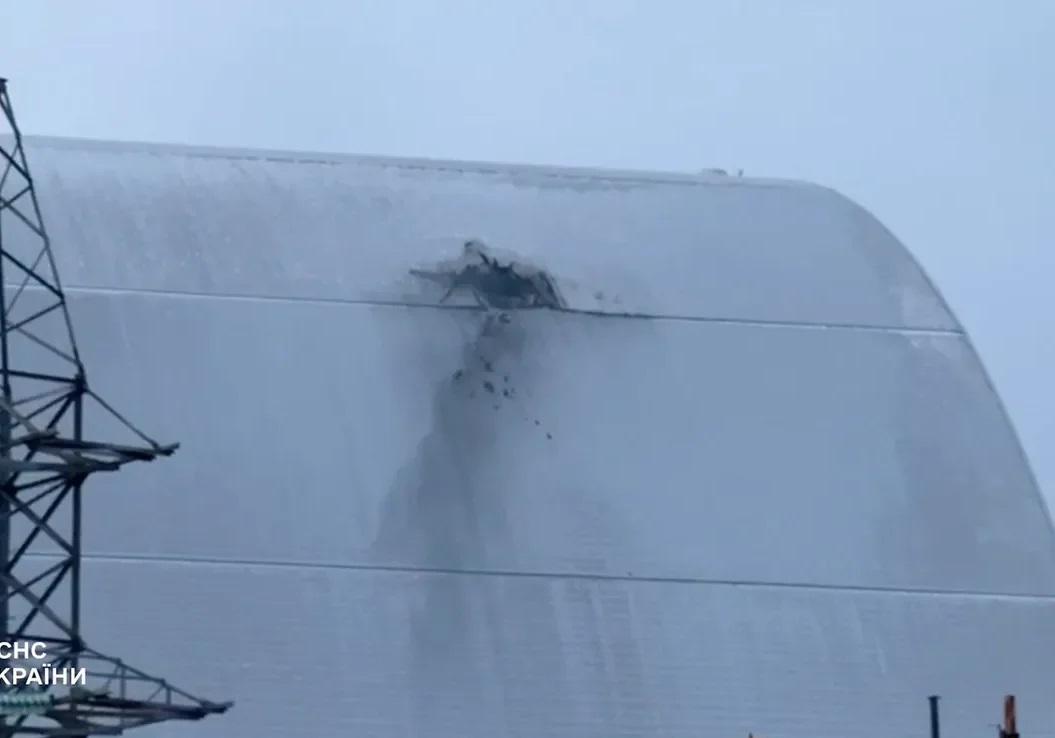
Donors to the International Chornobyl Cooperation Account (ICCA), managed by the
European Bank for Reconstruction and Development (EBRD), have endorsed
plans for early engineering and procurement works that will pave the way
for potential repairs to the New Safe Confinement (NSC) at the Chornobyl
Nuclear Power Plant in Ukraine.
A Russian drone strike in February 2025
damaged the NSC, the giant structure built to contain the remains of
Reactor Four and enable the safe dismantling of the original sarcophagus,
which was hastily built after the 1986 accident.
Preliminary assessments by
Novarka 2 (comprising the original NSC designer-builder Bouygues Travaux
Publics and Vinci Construction Grands Projets) estimated that the corrosion
of the steel arch threatened the long-term safety of the NSC, and that work
was needed to restore the structure to full functionality by 2030. Repairs
could cost at least €500 million.
EBRD 1st April 2026, https://www.ebrd.com/home/news-and-events/news/2026/ebrd-donors-back-plan-to-repair-chornobyl-s-protective-shield.html
Progress, push back and Indigenous rights
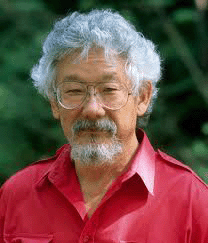
by David Suzuki, April 2, 2026, https://rabble.ca/environment/progress-push-back-and-indigenous-rights/
As seatbelt and smoking regulations — and many other examples — show, people eventually adapt. Uncertainty shouldn’t be used to frustrate progress.
In Canada, progress on social and ecological justice often faces roadblocks………………………………………………………………………………………………………………
Corporations and politicians are now trying to get Canada and British Columbia to walk back commitments to uphold Indigenous rights and obligations under the United Nations Declaration on the Rights of Indigenous Peoples.
The Kebaowek First Nation’s legal challenge against Canadian Nuclear Laboratories over a proposed nuclear waste facility near the Ottawa River illustrates how progress on Indigenous rights often meets resistance. In a landmark ruling, Justice Julie Blackhawk affirmed that Canada’s commitments under the UNDRIP must meaningfully inform federal decision-making. Canadian Nuclear Laboratories appealed the decision, arguing against application of the UN Declaration Act and the requirement to obtain free, prior and informed consent from Indigenous nations.
Uncertainty is also being used by opponents of Indigenous-led marine protected areas. They promote and leverage the fears and uncertainties of concerned small businesses while also opposing the interests of other small-scale operators, including recreational fishers, that support MPAs.
It’s a familiar refrain: Those with established power seek to prevent change, hiding behind the concerns and doubts of community members, but quickly turn on them when it’s in their interest to do so……………………………………………….
Indigenous Peoples lived on these lands before European settlers arrived. Recent efforts to advance co-governance models and uphold Indigenous rights prior to extraction activities are meant to advance social justice and address the colonial legacies embedded in Canada’s history.
A recent joint letter from B.C. unions, academics, doctors and conservation organizations says, “We are deeply troubled by the recent rise in anti-Indigenous rhetoric and fearmongering in this province that has framed the realization of the fundamental human rights of Indigenous peoples as detrimental to economic growth, security, and the interests of others,” adding, “We believe that our futures are intertwined and our collective prosperity is inextricably linked.”
As the Yellowhead Institute states, “Aboriginal rights in Canadian law do not give Indigenous people rights — they merely recognize Crown obligations.” Indigenous people have inherent rights that are fundamental to treaty, human and constitutional rights.
We have a chance to do things right in Canada. Let’s put aside the fearmongering, push back against the pushback and continue our journey forward together.
David Suzuki is a scientist, broadcaster, author and co-founder of the David Suzuki Foundation. Written with David Suzuki Foundation Boreal Project Manager Rachel Plotkin.
Climate change will push venomous snakes towards highly populated coastlines, study finds

Climate change will drive venomous snakes away from arid interiors and
towards densely populated coastlines, increasing the risk of deadly
encounters for millions of people, a new global study says. It notes that
snake populations will broadly move towards higher latitudes and more
heavily populated areas as rising temperatures make their current habitats
less suitable. In Australia, the shift is expected to be especially
pronounced along the east coast where snakes will move from the arid centre
into more heavily populated southern areas.
Independent 2nd April 2026,
https://www.independent.co.uk/climate-change/news/venomous-snakes-climate-change-b2950023.html
Funding gap threatens next round of Intergovernmental Panel on Climate Change (IPCC) climate science reports.

The latest IPCC session in Bangkok was clouded by persistent
differences over when its flagship reports should be published and concern
over cost-cutting proposals. A lack of money is hampering the work of the
Intergovernmental Panel on Climate Change (IPCC) and a substantial funding
boost is needed to ensure its scientists can complete their next set of
flagship reports, the chair of the UN body has warned.
Funding from
governments fell in 2024 and 2025 and the organisation could run out of
money by 2028 unless it receives fresh funds or implements spending cuts,
chair Jim Skea told an official meeting of IPCC scientists in Bangkok last
week, according to the Earth Negotiations Bulletin (ENB), which provides
coverage of UN negotiations. Skea told the IPCC’s 64th session that
without a substantial increase in contributions, the completion of the next
set of reports, known as AR7, would be jeopardised.
Climate Home News 1st April 2026,
https://www.climatechangenews.com/2026/04/01/funding-gap-threatens-next-round-of-ipcc-climate-science-reports-chair-warns/
How the Iran War undermines the nuclear nonproliferation regime
Bulletin, By George Perkovich | Analysis | April 2, 2026
When President Trump withdrew the United States from the Joint Comprehensive Plan of Action in 2018, he cracked the brittle foundation of the global nonproliferation regime based on the 1970 Non-Proliferation Treaty (NPT). This was not seen clearly at the time, so its implications could not be fully addressed. Now the ramifications are becoming clearer: The war on Iran raises doubt that the NPT can be a central pillar of international security. If not, will more countries seek nuclear weapons, including US allies or friends? And will China and Russia be emboldened to follow the US-Israeli example to forcibly try to stop them?
The US and Israeli leaders who pushed withdrawal from the JCPOA, including President Trump, did not know or care much about the NPT. Israel saw the Iranian nuclear program as an ipso facto direct threat, not as something that could be managed through the treaty’s core bargains. Those bargains posited that states that already had nuclear weapons as of 1967—the United States and Russia, most importantly—would reward states that forego such weapons. The non-nuclear-weapon states would gain security, cooperation in civil nuclear energy development, and progress toward the equity of global nuclear disarmament……………………………………………………………………..
Today it is clear that when the United States broke the JCPOA, Iran was condemned to a fate like Iraq’s in 2003. Objectives beyond nuclear proliferation became decisive for powerful actors in Washington, Israel, and the Gulf. Regime change. Reducing threats to the United States’ oil-exporting Arab friends and Israel. Countering terrorism. The JCPOA had “solved” the nuclear issue within the framework of the NPT bargains, but it did not address these other issues……………………………….
Now that Prime Minister Netanyahu and President Trump have attacked Iran without regard for international law or Iran’s rights under the NPT (and the UN-supported JCPOA), many commentators say nuclear weapon proliferation will be more likely. They say, the “lesson” of Iran today, like that of Iraq, Libya, and Ukraine—contrasted with North Korea—is that a country should acquire nuclear weapons if it doesn’t want to be attacked by a big nuclear power………………………………….
All of this highlights the shakiness of the NPT as an organizing construct for managing security, nuclear energy, and nonproliferation going forward. If nuclear-weapon states have clearly abandoned their commitments under Article VI of the NPT to cease arms racing and pursue nuclear disarmament, and nuclear-armed states have attacked other non-nuclear countries in violation of international law, why wouldn’t more countries feel justified to seek their own nuclear deterrents? If powerful countries have made trade and security accommodations for nuclear-armed India, how should others seek to apply limits on nuclear fuel-cycle activities?………………………………………..
More than threatening the NPT, the US-Israel war on Iran has removed bargaining from adversarial international relations more broadly. Washington and Tel Aviv demand that Iran stop all fuel-cycle activity, surrender all enriched uranium and ballistic missiles, end clerical rule, disarm the Revolutionary Guard, and cease supporting other regional actors that threaten Israel. The American and Israeli governments offer Iran no immediate or near-term benefits in response, except the possible end of military attacks and vague promises of Western corporate investment to help revive the Iranian economy. Essentially, the demand is for unconditional surrender. This is a different model of international affairs than the NPT was predicated on……………………………………https://thebulletin.org/2026/04/how-the-iran-war-undermines-the-nuclear-nonproliferation-regime/
UK submarine captain steps down after link to Chinese spy case
Navy previously conducted investigation into senior officer to examine potential
blackmail risk. The captain of one of Britain’s nuclear-armed submarines
has stepped back from his role this week after being investigated over his
relationship with Joani Reid, the Labour MP whose husband has been arrested
on suspicion of spying for China.
FT 31st March 2026,
https://www.ft.com/content/93beaf9c-e1c8-4875-b446-2cd148529f6a
Ambassador Chas Freeman: Trump PUSHES ESCALATION — Israel’s Strategy COLLAPSES Overnight
3 April 26,
COMMENT by Robert Anderson
The US, and its administration are on the losing end of this war, there’s a coverup going on. The military hospitals in Germany are full, we have many more casualties from the war in the Gulf/Iran/Israel. Iran is essentially winning this war. We will quit the war while we are behind (losing in this case. Epstein will come back to the forefront at some point. If nothing else this will bring Trump down, he’s being blackmailed by Israel which forced him into this war,
Massacre of UK aid workers: two years of obfuscation from Britain

Hamza Yusuf, Declassified UK, Apr 3, 2026
April 1st marked the two year anniversary of Israel’s massacre of World Central Kitchen (WCK) aid workers in Gaza. Seven members of the organisation were killed by Israeli drones while travelling in a convoy in Deir el-Balah in Central Gaza, after unloading 100 tonnes of food aid at its Gaza warehouse. The group was travelling in a “deconflicted zone” in two armoured vehicles that were clearly branded with the WCK logo and had coordinated their movements with the Israeli military. |
| The attack was not an anomaly, but a feature of Israel’s systematic targeting of aid workers in Gaza. The United Nations said that 383 aid workers were killed in 2025, with nearly half of them in Gaza. As Declassified previously revealed, Britain’s Ministry of Defence holds video footage of Gaza from the day of the attack but is refusing to publish it – footage taken by a Royal Air Force surveillance plane which spent approximately five hours above Gaza that day. |
n December 2025, the family of James Henderson renewed their demand for the MoD to release the recording. “The reason for not supplying that footage from the Ministry of Defence is a bit of an insult,” his father told Declassified.
The cousin of another of the victims, James Kirby, said in a statement released on the anniversary of his killing: “It is especially difficult to see that men who were so loyal and committed to their country have not yet received the justice they deserve.
The cousin of another of the victims, James Kirby, said in a statement released on the anniversary of his killing: “It is especially difficult to see that men who were so loyal and committed to their country have not yet received the justice they deserve.”Two years on, communication from the government has been limited, and the family remains unsure whether a full and formal investigation is underway.” A tepid statement from the UK’s Middle East Minister Hamish Falconer published on the two-year anniversary saidthe UK “will continue to push for justice”. But Falconer is only calling on Israel to investigate itself. “I urge Israel to swiftly conclude and publish their findings into this attack. The families of those killed must know why this happened. Lessons must be learnt”, Falconer said. |
But the accountability the British government is demanding would be much clearer if it released its own spy flight footage.
True to form, however, where Israel is involved, Britain prefers at best silence in the face of crimes and at worst smokescreens and deceit.
1 This Month

of the week – Shut Down Drone Warfare!


Tell the Ukrainian Government to Drop Prosecution of Peace Activist Yurii Sheliazhenko

Petition to revoke the licensing of the Near Surface Nuclear Disposal Facility (NSDF) at Chalk River. https://www.ourcommons.ca/petitions/en/Petition/Details?Petition=e-7247
To see nuclear-related stories in greater depth and intensity – go to https://nuclearinformation.wordpress.com
-
Archives
- April 2026 (57)
- March 2026 (251)
- February 2026 (268)
- January 2026 (308)
- December 2025 (358)
- November 2025 (359)
- October 2025 (376)
- September 2025 (257)
- August 2025 (319)
- July 2025 (230)
- June 2025 (348)
- May 2025 (261)
-
Categories
- 1
- 1 NUCLEAR ISSUES
- business and costs
- climate change
- culture and arts
- ENERGY
- environment
- health
- history
- indigenous issues
- Legal
- marketing of nuclear
- media
- opposition to nuclear
- PERSONAL STORIES
- politics
- politics international
- Religion and ethics
- safety
- secrets,lies and civil liberties
- spinbuster
- technology
- Uranium
- wastes
- weapons and war
- Women
- 2 WORLD
- ACTION
- AFRICA
- Atrocities
- AUSTRALIA
- Christina's notes
- Christina's themes
- culture and arts
- Events
- Fuk 2022
- Fuk 2023
- Fukushima 2017
- Fukushima 2018
- fukushima 2019
- Fukushima 2020
- Fukushima 2021
- general
- global warming
- Humour (God we need it)
- Nuclear
- RARE EARTHS
- Reference
- resources – print
- Resources -audiovicual
- Weekly Newsletter
- World
- World Nuclear
- YouTube
-
RSS
Entries RSS
Comments RSS
 nuclear-news