Titanic misconceptions that things will be OK
Last night I watched a terrific programme on SBS world television. It was all about the sinking of the Titanic, covering so many aspects never shown on TV before. I was struck by the atmosphere on the ship, in the early hours of the sinking, with many people, particularly the rich upper-class passengers, taking the whole process as something not really serious, rather fun even. Of course, not all of them saw it that way. But enough of them – to be able to have quite a good party on the upper deck lounge, and to regard the messenger calling them up on deck as rather a nuisance, an ignorant lower-class person. And indeed, some people just refused to leave their (temporarily comfortable) beds, on such a cold night.
And here was I, trying to get my mind away form the rather scary world news. I suppose I’d have been better watching some “reality” show, or that good old Australian standby – sport.
Anyway, the thing was – the Titanic story showed how people are inclined not to take a critical event seriously, not to worry about it, until it’s too late.
And lo and behold, the same sort of thing is happening now. Today DW reports Iran war: Israel hits Iranian heavy water nuclear reactor. The good old news.com.au writes ‘Worst case scenario’: Wall St craters, oil surges as nuclear sites hit’. The fascinating part of this coverage, as shown by that last headline, is that the financial aspect is the first priority.. Yeah, I know that the world economy is important, and it’s not a good thing to have Wall St stocks going down, and investors “mashing the panic button”. I’m not saying that this is a trivial matter. It’s just that drone or missile strikes on a nuclear facility could be a helluva lot more serious than a drop on the stock exchange.
We don’t need an actual nuclear bombing to create a massive environmental and health catastrophe, a drone strike can do that job.
Both articles focus on this economic crisis, paying barely lip service to the fearful physical danger of a nuclear site being exploded, or even just damaged. Israeli air strikes hit a nuclear research reactor in Iran’s Khondab region, and a uranium processing plant in Yazd in Central Iran. The reports hastened to tell us there was no release of radioactive material. How reassuring! We can focus on the main issue – the share prices.
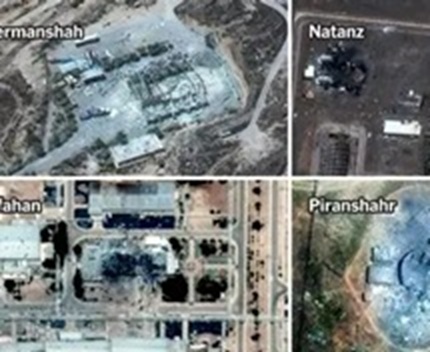
Questions come to mind. Will Iran retaliate by striking Israel’s Dimona reactor and other nuclear sites? How come it’s so terrible for Iran to have legally permitted nuclear research facilities, but apparently OK for Israel to have nuclear weapons. Estimates of Israel’s nuclear warheads range from 90 to 200, but Israel “does not confirm or deny” its nuclear weaponry numbers. So that’s apparently OK.
Yes, we’re all anxious about our petrol and diesel prices, and naturally so. But the possible ramifications of these Israeli strikes on nuclear facilities add up to something more horrendous. I don’t want to rave on here about the health, environmental, social toll that will ensue, if the warring states decide to use this very convenient weaponry – no need to have your own expensive nuclear bomb, just send a few cheap drones to attack your enemy’s nuclear sites.
As with those rich passengers on the Titanic, it’s time that world leaders woke up.
Greenpeace warns Trump’s threat to bomb Iran’s power grid risks humanitarian and nuclear disaster

Greenpeace International, 23 Mar 26, https://www.greenpeace.org/international/story/82295/trump-threat-bomb-iran-power-grid-risks-humanitarian-nuclear-disaster/
Amsterdam – Greenpeace International has condemned threats by Donald Trump to target Iran’s electricity infrastructure, warning it could trigger a humanitarian catastrophe, trigger a blackout over a large part of the country and risk nuclear disaster escalating into a wider regional crisis.
Greenpeace warns that attacks on the grid could have a knock-on effect that increases the danger of a nuclear emergency at the Bushehr Nuclear Power Plant, with potential consequences across the region.[1]
“Bombing civilian electricity infrastructure is illegal under international law. The electricity grid is essential for hospitals, clean water, desalination and the operation of nuclear facilities. Cutting it off puts millions of lives at risk,” said Jan Vande Putte, senior nuclear and radiation protection expert with Greenpeace International.[2]
“A blackout could force the Bushehr nuclear facility into depending completely on backup diesel generators, causing a heightened risk of overheating, which can lead to a Fukushima-like disaster.”[3]
Iran’s grid is already under strain due to war, climate change and sanctions leading to underinvestment.[4]
“If Trump carries through with this reckless threat to knock out critical infrastructure, it could lead to cascading failures, from blackouts to nuclear danger far beyond national borders, with the potential to escalate into a wider regional crisis,” says Vande Putte.
The US, Israel and Iran have all targeted energy infrastructure, and several attacks in Iran and Israel already appear to have come close to hitting nuclear facilities. Iran is also threatening to target water and energy infrastructure in neighbouring countries.[5] Greenpeace is urging all parties to step back from escalation and pursue a diplomatic solution now, warning that further escalation will only deepen human suffering and increase global instability.
The Bushehr nuclear plant was built and is operated by Iran’s nuclear enabler, Rosatom, the Russian state nuclear corporation.
Oceans take in a lot of heat as Earth’s energy imbalance hits record.
The Earth’s energy imbalance reached record levels last year, as the
rate of solar radiation that entered the planet exceeded the amount leaving
the system at a faster rate, the World Meteorological Organization said.
The measure was included for the first time in the UN agency’s State of
the Climate annual report, as the rate had more than doubled in the past 20
years while greenhouse gases continued to accumulate. Under a balanced
system, incoming heat from the sun is about the same as outgoing energy.
The levels are measured by satellite data, collected since 2000, as well as
a host of land, ice and sea monitors used since 1960. The oceans had
absorbed most of the excess heat, storing about 91 per cent of the energy.
Another 5 per cent had warmed the land, 3 per cent heated the ice and 1 per
cent warmed the air, the report said. The 2015-2025 period was the warmest
11 years since observations started, with ocean heat and acidification at
record levels, and continuing rises in sea levels and the retreat of
glaciers.
FT 23rd March 2026 https://www.ft.com/content/e8390d64-63d3-4d27-9c73-6a59dda2045b
Donald Trump’s ‘new’ 15‑point plan is the biggest sign yet that Washington fears it is losing this war
Iran.. does not need military victory. It only needs to endure, impose costs, and outlast its adversaries. This is the logic of asymmetric conflict: the weaker power wins by not losing, while the stronger one loses when the costs of continuing become unsustainable.
March 26, 2026, Bamo Nouri, Honorary Research Fellow, Department of International Politics, City St George’s, University of London, Inderjeet Parmar, Professor in International Politics, City St George’s, University of London. https://theconversation.com/donald-trumps-new-15-point-plan-is-the-biggest-sign-yet-that-washington-fears-it-is-losing-this-war-279001?utm_medium=email&utm_campaign=The%20Weekender%20-%2028%20March%202026&utm_content=The%20Weekender%20-%2028%20March%202026+CID_09f9907cac66b0e5c3e3ca794f0c8c0c&utm_source=campaign_monitor&utm_term=Donald%20Trumps%20new%2015-point%20plan%20is%20the%20biggest%20sign%20yet%20that%20Washington%20fears%20it%20is%20losing%20this%20war
The language of power often reveals more than it intends. In a rare moment of candour on March 7, the US president, Donald Trump, described the confrontation with Iran as “a big chess game at a very high level … I’m dealing with very smart players … high-level intellect. High, very high-IQ people.”
If Iran is, by Trump’s own admission, a “high-level” opponent, then the sudden revival of a 15-point plan previously rejected by Iran a year ago suggests a disconnect between how the adversary is understood and how it is being approached. It’s a plan already examined in negotiation by Iran and dismissed as unrealistic and coercive. Despite this, the Trump administration is once again framing the “roadmap” as a pathway to de-escalation. Tehran has once again dismissed the gambit as Washington “negotiating with itself” – reinforcing the perception that the US is attempting to impose terms rather than negotiate them.
The US president is right about one thing – Iran is not an opponent that can be easily dismissed or overwhelmed. Trump’s own description is a tacit acknowledgement that this is a far more capable and complex adversary than those the US has faced in past Middle Eastern wars, such as Iraq. And that is why the odds are increasingly stacked against the United States and Israel.
This conflict reflects a familiar but flawed imperial assumption: that overwhelming military force can compensate for strategic misunderstanding. The US and Israel appear to have misjudged not only Iran’s capabilities, but the political, economic and historical terrain on which this war is being fought.
Unlike Iraq, Iran is a deeply embedded and adaptable regional power. It has resilient institutions, networks of influence, and the capacity to impose asymmetric costs across multiple theatres. It knows how to manage maximum pressure.
The most immediate problem is lack of legitimacy. This war has authorisation from neither the United Nations or, in the case of America, the US Congress. Further, US intelligence assessments indicate Iran was not rebuilding its nuclear programme following earlier strikes – contradicting one of Washington’s justifications for war. The resignation of Joe Kent as head of the National Counterterrorism Center on March 17, was even more revealing. In his resignation letter Kent insisted that Iran posed no imminent threat.
This effectively collapses one of the original narratives underpinning the US decision to start the war – a further blow to legitimacy.
A majority of Americans oppose the war, reflecting deep fatigue after Iraq and Afghanistan – hardly ideal conditions for what increasingly looks like another “forever war” in the Middle East. Current polling shows Trump’s Republicans trailing the Democrats ahead of the all-important midterm elections in November.
The war is both militarily uncertain and politically unsustainable. International allied support is also eroding. The United Kingdom — often trumpeted as Washington’s closest partner — has limited itself to defensive coordination, while Germany and France have distanced themselves from offensive operations. European allies also declined a US request to deploy naval forces to secure the strait of Hormuz. This reflects not just disagreement, but a deeper loss of trust in US leadership and strategic judgement.
US influence has long depended on legitimacy as much as force. That reservoir is now rapidly draining. Global confidence is falling, while images of civilian casualties — including over 160 schoolchildren killed in an airstrike on the first day of the war – have shocked international onlookers. Rather than reinforcing leadership, this war is accelerating its erosion.
Israel faces a parallel crisis of legitimacy – one that began in Gaza and has now deepened. The war in Gaza severely damaged its global standing, with sustained civilian casualties and humanitarian devastation drawing unprecedented criticism, even among traditional allies. This confrontation with Iran compounds that decline.
Striking Iran during active negotiations — for the second time — reinforces the perception that escalation is preferred over diplomacy. The issue is no longer just conduct, but credibility.
Strategic failure, narrative defeat
The conduct of the war compounds the problem. The assassinations of Iranian leaders, framed as tactical victories, are strategic failures. They have unified rather than destabilised Iran. Mass pro-regime demonstrations illustrate how external aggression can consolidate internal legitimacy.
The issue is no longer just the conduct of the war, but the credibility of the conflict itself. Regardless of how impressive the US and Israeli military are, it doesn’t compensate for reputational collapse. When building support for a conflict like this – domestically and internationally – legitimacy is a strategic asset. Once eroded across multiple conflicts, it is extraordinarily difficult to rebuild.
Rather than stabilising the system, US actions are fragmenting it. Allies are distancing themselves, adversaries are adapting, and neutral states are hedging.
The most decisive factor may be economic. The war is already destabilising global markets – driving up oil prices, inflation, and volatility at levels that combine the effects of 1970s and Ukraine war oil shocks.
This is a war that cannot be contained geographically nor economically. The deployment of 2,500 US marines to the Middle East (and reports that up to another 3,000 paratroopers will also be sent), reportedly with plans to secure Kharg Island – and with it Iran’s most important oil infrastructure – would be a dangerous escalation.
For Gulf states, the assumption that the US can guarantee security is increasingly questioned. Some states are reportedly now looking to diversify their partnerships and turning toward China and Russia, mirroring post-Iraq shifts, when US failure opened space for alternative powers.
Iran holds the cards
Wars are not won by destroying capabilities alone, but by securing sustainable and legitimate political outcomes. On both counts, the US and Israel are falling short.
Iran, by contrast, does not need military victory. It only needs to endure, impose costs, and outlast its adversaries. This is the logic of asymmetric conflict: the weaker power wins by not losing, while the stronger one loses when the costs of continuing become unsustainable.
This dynamic is already visible. Having escalated rapidly, Trump now appears to be searching for an off-ramp — reviving proposals and signalling openness to negotiation. But he is doing so from a position of diminishing leverage. In contrast, Iran’s ability to threaten energy flows, absorb pressure, and shape the tempo of escalation means it increasingly holds key strategic cards. The longer the war continues, the more that balance tilts.
Empires rarely recognise when they begin to lose. They escalate, double down, and insist victory is near. But by the time the costs become undeniable – economic crisis, political fragmentation, global isolation – it is already too late. The US and Israel may win battles. But they may be losing the war that matters: legitimacy, stability and long-term influence.
And, as history suggests, that loss may not only define the limits of their power, but mark a broader shift in how power itself is judged, constrained, and resisted.
Fox News’ united front in support of Trump’s Iran war may be breaking down.
Host Laura Ingraham warns escalation could produce “cascading problems for the region,” political turmoil for the GOP
by Matt Gertz, MEDIA MATTERS 03/26/26
Four weeks after President Donald Trump launched a poorly conceived war of choice against Iran, the lockstep support for the conflict that has characterized coverage from Fox News’ star hosts is beginning to fray. The power struggle is significant — it is not an exaggeration to suggest the course of the war might hinge on which Fox shows the president is watching.
Trump is clearly approaching a decision point over whether to further escalate the war. U.S. and Israeli forces have done a lot of damage to Iranian military targets, but its regime is intact, still controls its stockpiles of enriched uranium, and has closed the Strait of Hormuz, threatening the global trade in oil, natural gas, and fertilizer. The Pentagon is sending thousands of troops to the region and reportedly prepping options for a “final blow” — some of which would involve deploying U.S. forces on Iranian soil.
When Trump is considering policy options, he often takes guidance from his loyal propagandists at Fox. This Fox-Trump feedback loop has in recent months played a role in the president’s decisions to send White House border czar Tom Homan to oversee immigration enforcement in Minnesota; prioritize the SAVE Act over all other legislation; order the deployment of ICE agents to airports; and start the war against Iran.
Against that backdrop, Fox News host Laura Ingraham warned on Wednesday’s show that further U.S. action could produce devastating unintended consequences and suggested that Trump should refocus his attention on the domestic economy and political situation.
“Iran knows it cannot win militarily, so it’s using the leverage it has by prolonging the conflict,” she said during her monologue at the top of the show. “Now, what do they want to do? They want to inflict maximum economic pain on the region, on the U.S., [on] the global economy as much as possible until they think Trump relents. But the White House doesn’t seem to be blinking.”
The host then aired a clip of White House press secretary Karoline Leavitt warning at her press briefing that day that “President Trump does not bluff, and he is prepared to unleash hell” against Iran.
Ingraham did not seem impressed by Leavitt’s rhetoric.
“Well, the problem is obviously unleashing hell means destroying infrastructure, which itself causes a series of cascading problems for the region, including maybe outside the region — political problems for the president in a midterm election year,” she said.
Her air of skepticism continued throughout the show.
While interviewing Sen. Josh Hawley (R-MO), she noted Pentagon reports of thousands of successful missions but commented, “I mean, this is a devastating blow, yet you know, we’re still there.”
“It’s not even a month old, obviously,” she continued, before asking, “But are you concerned about the public and people? Again, very short attention spans, very impatient for victory, as is President Trump, I might add. But in an election year, it’s easy to say politics don’t matter, but at some point politics do come into play.”
And in a third segment, she highlighted the disastrous polling on the Iran war, commenting, “It looks like people are pretty impatient. The American people are sending a message to President Trump that it’s time to put the focus back on the home front.”
Ingraham is inching toward the type of dissent that has been virtually absent from Fox’s coverage of the war, even as the broader right-wing media has split. Her colleagues have played key roles in convincing Trump to attack in the first place and are pushing for risky escalations. Ingraham herself briefly quibbled with Trump’s handling of an apparent U.S. strike that leveled an Iranian school, killing scores of children, but had supported the war itself, which she declared three weeks ago that Trump had already won.
But if Ingraham is getting cold feet and trying to convince Trump not to escalate a war the public has soured on, she remains an outlier at the network. Indeed, if the president tuned in for the two hours following Ingraham’s program, he saw her prime-time colleagues Jesse Watters and Sean Hannity argue not only that the war is going well and that Trump will inevitably lead the U.S. to victory, but that anyone who disagrees must want America to lose the war because they hate the president.
Watters began his show with a 10-minute monologue whose thesis was that “the Iranian regime is losing leverage fast as we continue to carry out thousands of sorties over enemy airspace.” After detailing various tactical victories, he touted a potential escalation………………………………………………. https://www.mediamatters.org/us-iran-relations/fox-news-united-front-support-trumps-iran-war-may-be-breaking-down
Sure, killing kids is fine, just don’t put American boots on the ground!
LBC has a report titled “Republicans ‘storm out’ of Iran briefing as they claim US ‘war machine’ is trying to put boots on ground” about MAGA lawmakers whining that Trump’s war looks set to turn into a land invasion.
LBC reports:
A number of usually loyal MAGA Republicans left the Iran briefing early — including US congresswoman Nancy Mace, who told the waiting media “we were misled” about the war after walking out of a Pentagon briefing.
Mace, a widely controversial lawmaker, was seen to urge President Trump to remove Lindsey Graham from the Situation Room — the White House’s round-the-clock command centre — as tensions rose.
The lawmaker claims Graham “brags about” advising the president and his aggressive war strategy
It comes as the US is reportedly considering a massive troop deployment that would include ‘infantry and armoured vehicles,’ according to the Wall Street Journal.
Tensions continue to rise from within Trump’s own party amid plans to put troops on the ground in Iran, as peace talks continue amid the constantly changing situation.
I get so tired of all this American hand-wringing about “boots on the ground”. It’s a symptom of a wildly sick dystopia that these people are fine with raining military explosives on a densely populated city but draw the line at putting American troops in the line of fire.
Sure, killing kids is fine, just don’t put boots on the ground!
Sure you can rain hellfire on hospitals, homes and schools for weeks, just make sure you do all your massacring from the sky where nobody can return fire.
Killing is okie dokie, so long as our troops aren’t the ones getting killed
These people have no compassion. No morality. No empathy. American conservatives are constantly wagging their fingers and bloviating puritanically about immorality and degeneracy, but they’re the least moral people in the country. Their positions aren’t driven by care for human life, no matter how hard they try to pretend otherwise. They are driven by blind loyalty to the empire and the groveling adoration of power.
If you only oppose mass military slaughter if it is carried out in a way that puts your own countrymen at risk, that makes you a piece of shit.
People should oppose the evil wars inflicted by their government and its allies because the wars are evil, not because they might impact someone you know. The people being murdered in Iran are no less human than Americans, and their lives don’t matter any less.
I want to live in a healthy world where self-evident statements like this don’t even need to be made. Instead I live in a world where the war on Iran is barely receiving any meaningful domestic opposition from the populations of the primary aggressor nations.
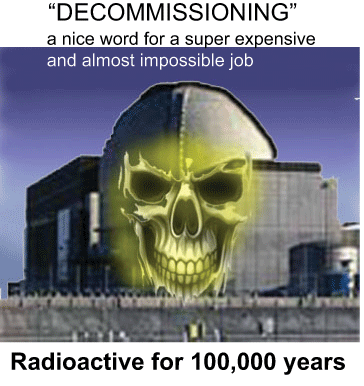
Nuclear decommissioning in the UK
Corporate report: The NDA group Technical Baseline Review
This report provides a high-level overview of the processes and associated technologies used or planned to be used to deliver our mission.
NDA 26th March 2026 Nuclear Decommissioning Authority NDA group Technology Baseline Review 2026
PDF, 4.76 MB, 67 pages
The UK’s nuclear energy programme, dating from the post-war years, has left a challenging decommissioning legacy to the country: numerous prototype reactors, fuel-manufacturing plants, research centres, reprocessing plants and 11 power stations. The Sellafield site in west Cumbria houses more than 200 nuclear facilities and 1,000 buildings, making it one of the world’s most complex environmental decommissioning challenges. Across the UK many ‘never-done-before’ decommissioning projects will need to be completed. The Nuclear Decommissioning Authority (NDA) was established under the Energy Act (2004) to ensure that the UK’s nuclear legacy sites are decommissioned and cleaned up safely, securely, cost-effectively and in ways that protect people and the environment.
This document provides a high-level overview of the current technology landscape across the NDA group. It outlines the NDA group technology baseline, current technologies being deployed, and the technology opportunities requiring development or adoption to underpin the delivery of our decommissioning mission……………
https://www.gov.uk/government/publications/nuclear-decommissioning-authority-rd-technical-baseline
1 This Month

of the week – Shut Down Drone Warfare!


Tell the Ukrainian Government to Drop Prosecution of Peace Activist Yurii Sheliazhenko

Petition to revoke the licensing of the Near Surface Nuclear Disposal Facility (NSDF) at Chalk River. https://www.ourcommons.ca/petitions/en/Petition/Details?Petition=e-7247
To see nuclear-related stories in greater depth and intensity – go to https://nuclearinformation.wordpress.com
-
Archives
- March 2026 (244)
- February 2026 (268)
- January 2026 (308)
- December 2025 (358)
- November 2025 (359)
- October 2025 (376)
- September 2025 (257)
- August 2025 (319)
- July 2025 (230)
- June 2025 (348)
- May 2025 (261)
- April 2025 (305)
-
Categories
- 1
- 1 NUCLEAR ISSUES
- business and costs
- climate change
- culture and arts
- ENERGY
- environment
- health
- history
- indigenous issues
- Legal
- marketing of nuclear
- media
- opposition to nuclear
- PERSONAL STORIES
- politics
- politics international
- Religion and ethics
- safety
- secrets,lies and civil liberties
- spinbuster
- technology
- Uranium
- wastes
- weapons and war
- Women
- 2 WORLD
- ACTION
- AFRICA
- Atrocities
- AUSTRALIA
- Christina's notes
- Christina's themes
- culture and arts
- Events
- Fuk 2022
- Fuk 2023
- Fukushima 2017
- Fukushima 2018
- fukushima 2019
- Fukushima 2020
- Fukushima 2021
- general
- global warming
- Humour (God we need it)
- Nuclear
- RARE EARTHS
- Reference
- resources – print
- Resources -audiovicual
- Weekly Newsletter
- World
- World Nuclear
- YouTube
-
RSS
Entries RSS
Comments RSS
 nuclear-news