Renewables are taking the wind out of new nuclear’s sails.
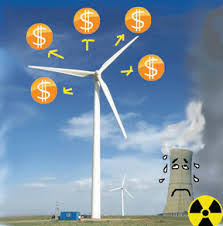
THERE’S been a lot of talk about and PR for new
nuclear in Scotland – but awkward facts intrude. Greenland, the
planet’s thermostat, lost 105 billion tonnes of ice last year, with sea
ice the lowest in the 47-year satellite record. The climate crisis is here
and the choices we make now will determine the success or failure of our
climate actions.
Cost is important, but time is the critical variable –
and time is running out. Global data reveals construction of a new nuclear
station takes 17 or more years. Nuclear power construction has an average
time over-run of 64%.
In comparison, utility-scale wind and solar take on
average only two to five years from planning phase to operation, and
rooftop solar PV projects are down to six months.
At a time when so much
looks grim, the renewable revolution holds out real hope. In 2025, more
power was generated worldwide from renewable energy than from coal and 91%
of new renewables are now cheaper than fossil fuels. The UN confirms that
renewables have increased their lead over fossil and nuclear in terms of
cost.
The result is, wind and solar worldwide now generate 70% more
electricity than nuclear. With each year nuclear adding only as much net
global power capacity as renewables add every two days, nuclear is facing
the same challenges as fossil fuel: uncompetitive costs, stranded assets, a
polluting legacy and severe competition from renewables.
Can new nuclear
generate power in time? In 2025, world net nuclear capacity increased by
4.4 GW, not much more than the UK’s Hinkley Point C project, and 180
times less than new solar and wind capacity. The International Energy
Agency (IEA) predicts 4600 GW new renewable capacity by 2030, meeting 90%
of global electricity demand growth.
Over the past decade we’ve seen
renewable electricity generation increase to triple that of nuclear. By the
end of this decade renewables will out-generate nuclear by up to seven
times. It is entirely possible to mitigate climate impact and sustain a
reliable power system by expanding renewable energy in all sectors, rapid
growth and modernisation of the electricity grid, storage technology
roll-out, increased international interconnections, and using power far
more effectively and efficiently via energy efficiency and management.
The compelling economics of renewables unmask those of fossil and nuclear. With
all key international and national energy organisations and institutes
agreeing that renewables will be doing the heavy lifting for the energy
transition, the future backbone of the global power supply system will be
renewable, sustainable and cost-effective. Scotland has very great
renewables potential and should play to its strengths. New nuclear is
already too late and too costly for the climate and energy crises.
The National 23rd March 2026,
https://www.thenational.scot/comment/25958295.renewables-taking-wind-new-nuclears-sails/
No comments yet.
1 This Month


Tell the Ukrainian Government to Drop Prosecution of Peace Activist Yurii Sheliazhenko

Petition to revoke the licensing of the Near Surface Nuclear Disposal Facility (NSDF) at Chalk River. https://www.ourcommons.ca/petitions/en/Petition/Details?Petition=e-7247


of the week – STOP SMALL MODULAR REACTORS IN CANADA
To see nuclear-related stories in greater depth and intensity – go to https://nuclearinformation.wordpress.com
-
Archives
- March 2026 (212)
- February 2026 (268)
- January 2026 (308)
- December 2025 (358)
- November 2025 (359)
- October 2025 (376)
- September 2025 (258)
- August 2025 (319)
- July 2025 (230)
- June 2025 (348)
- May 2025 (261)
- April 2025 (305)
-
Categories
- 1
- 1 NUCLEAR ISSUES
- business and costs
- climate change
- culture and arts
- ENERGY
- environment
- health
- history
- indigenous issues
- Legal
- marketing of nuclear
- media
- opposition to nuclear
- PERSONAL STORIES
- politics
- politics international
- Religion and ethics
- safety
- secrets,lies and civil liberties
- spinbuster
- technology
- Uranium
- wastes
- weapons and war
- Women
- 2 WORLD
- ACTION
- AFRICA
- Atrocities
- AUSTRALIA
- Christina's notes
- Christina's themes
- culture and arts
- Events
- Fuk 2022
- Fuk 2023
- Fukushima 2017
- Fukushima 2018
- fukushima 2019
- Fukushima 2020
- Fukushima 2021
- general
- global warming
- Humour (God we need it)
- Nuclear
- RARE EARTHS
- Reference
- resources – print
- Resources -audiovicual
- Weekly Newsletter
- World
- World Nuclear
- YouTube
-
RSS
Entries RSS
Comments RSS
 nuclear-news
Leave a comment