Renewables are taking the wind out of new nuclear’s sails.

THERE’S been a lot of talk about and PR for new
nuclear in Scotland – but awkward facts intrude. Greenland, the
planet’s thermostat, lost 105 billion tonnes of ice last year, with sea
ice the lowest in the 47-year satellite record. The climate crisis is here
and the choices we make now will determine the success or failure of our
climate actions.
Cost is important, but time is the critical variable –
and time is running out. Global data reveals construction of a new nuclear
station takes 17 or more years. Nuclear power construction has an average
time over-run of 64%.
In comparison, utility-scale wind and solar take on
average only two to five years from planning phase to operation, and
rooftop solar PV projects are down to six months.
At a time when so much
looks grim, the renewable revolution holds out real hope. In 2025, more
power was generated worldwide from renewable energy than from coal and 91%
of new renewables are now cheaper than fossil fuels. The UN confirms that
renewables have increased their lead over fossil and nuclear in terms of
cost.
The result is, wind and solar worldwide now generate 70% more
electricity than nuclear. With each year nuclear adding only as much net
global power capacity as renewables add every two days, nuclear is facing
the same challenges as fossil fuel: uncompetitive costs, stranded assets, a
polluting legacy and severe competition from renewables.
Can new nuclear
generate power in time? In 2025, world net nuclear capacity increased by
4.4 GW, not much more than the UK’s Hinkley Point C project, and 180
times less than new solar and wind capacity. The International Energy
Agency (IEA) predicts 4600 GW new renewable capacity by 2030, meeting 90%
of global electricity demand growth.
Over the past decade we’ve seen
renewable electricity generation increase to triple that of nuclear. By the
end of this decade renewables will out-generate nuclear by up to seven
times. It is entirely possible to mitigate climate impact and sustain a
reliable power system by expanding renewable energy in all sectors, rapid
growth and modernisation of the electricity grid, storage technology
roll-out, increased international interconnections, and using power far
more effectively and efficiently via energy efficiency and management.
The compelling economics of renewables unmask those of fossil and nuclear. With
all key international and national energy organisations and institutes
agreeing that renewables will be doing the heavy lifting for the energy
transition, the future backbone of the global power supply system will be
renewable, sustainable and cost-effective. Scotland has very great
renewables potential and should play to its strengths. New nuclear is
already too late and too costly for the climate and energy crises.
The National 23rd March 2026,
https://www.thenational.scot/comment/25958295.renewables-taking-wind-new-nuclears-sails/
A Remotely-Piloted Weapon That Targets Civilians in War Zones

By Thalif Deen, https://www.ipsnews.net/2026/03/a-remotely-piloted-weapon-that-targets-civilians-in-war-zones/?utm_source=email_marketing&utm_admin=146128&utm_medium=email&utm_campaign=A_RemotelyPiloted_Weapon_That_Targets_Civilians_in_War_Zones_Africas_Minerals_Boon_Cautious_Optimism
UNITED NATIONS, Mar 18 2026 (IPS) – As the world continues to be weighed down in political and military turmoil, drones are being increasingly used as weapons of war in a rash of ongoing conflicts—including Ukraine vs Russia, Israel vs Palestine, US vs Iran and Israel vs Lebanon, plus in civil wars in the Democratic Republic of the Congo (DRC), Sudan and Haiti.
Described as Unmanned Aerial Vehicles (UAV), drones have fundamentally transformed modern warfare, “offering a low-cost, high-impact form of air power, challenging traditional military doctrines and giving rise to new tactics and ethical debates”.
Once limited to major military powers like the U.S. and Israel, drones are now being used by numerous state and non-state actors, including militant groups and even organized crime cartels.
The use of drones, particularly in targeted killings and with increasing autonomy, has raised significant international debate regarding accountability, civilian casualties, and compliance with international humanitarian law
UN High Commissioner for Human Rights Volker Türk said last week he was “appalled by the devastating impact on civilians of increasing drone attacks”, amid reports that more than 200 civilians have been killed by drones since 4 March alone in the Kordofan region, and in White Nile state.
“It is deeply troubling that despite multiple reminders, warnings and appeals, parties to the conflict in Sudan continue to use increasingly powerful drones to deploy explosive weapons with wide-area impacts in populated areas,” said Türk.
“I renew my call on them to abide fully with international humanitarian law in their use of these weapons, particularly the clear prohibition on directing attacks against civilians and civilian objects and infrastructure, and against any form of indiscriminate attacks.”
Many homes, schools, markets and health facilities were damaged or destroyed in the attacks, compounding the impacts on civilians and local communities, he said.
Meanwhile drones are also being used in the politically-troubled Haiti and also in the conflict between the Democratic Republic of Congo (DRC) and Rwanda despite a peace agreement brokered by the US last year.
According to a report in Cable News Network (CNN) March 17, the war in Iran is continuing to disrupt travel across the Gulf after Iranian drone strikes triggered two major air incidents in recent days. Flights at Dubai International Airport were briefly suspended on Monday after a drone struck a nearby fuel tank, igniting a large fire.
The shutdown forced cancellations and diversions as aviation authorities closed the airport. Part of the UAE’s airspace was also closed for a few hours overnight after the country said it was responding to incoming missiles and drone strikes from Iran.
Meanwhile, the prices of many global airfares that bypass the Middle East are rising, as the conflict drives up oil prices and airlines warn of higher fuel costs ahead, said CNN.
Focusing on a military perspective, Siemon Wezeman, Senior Researcher, Arms Transfers Programme, Stockholm International Peace Research Institute (SIPRI), told IPS more and more states, (and also non-state armed- rebel – groups) acquire drones of all sizes.
“Some of the numbers are quite amazing – Ukraine getting not a few 1,000, but far over 10,000 drones from various suppliers, and Russia, Ukraine and Iran each use drones by the 100s almost every day in the current conflicts.”
And different from some 10 years ago, when most of the drones where for reconnaissance roles, he pointed out, today many drones are armed and many more are ‘one-way attack drones’ (also called suicide or kamikaze drones). The latter are becoming a cheap alternative for long-range missiles against ground targets.
In the SIPRI arms transfers database (https://armstransfers.sipri.org), he said, “we record transfers of all armed drones, and reconnaissance drones with a weight of at least 150kg (we had to put a weight limit to be able to keep monitoring drone transfers with the resources and sources we have)”.
“And we clearly see in recent years that a) the total numbers of drones transferred between states has grown, b) several non-state actors (e.g. Houthis and Hezbollah) have also been supplied with drones, c) the number of states and non-state actors that have acquired drone has grown – most states in the world have now acquired drones, many of them from foreign suppliers, d) the number of producers and suppliers has grown – the simpler drones are offered by dozens if not 100s of large and very small companies and that number is growing, and e) drones, and especially armed drones.”
That is the picture for flying drones, Wezeman said.
But also, sea drones (surface or submarine) are starting to become popular – even if not yet transferred in any significant number. And land drones are also starting to become popular, he declared.
At a press conference March 10, UN Under-Secretary-General for Humanitarian Affairs Tom Fletcher said: “I’m really worried about drones in particular. I think the world has decided that it’s far more interested in spending enormous amounts of money developing these increasingly deadly weapons than it is on saving lives, and it seems to have decided that it hasn’t got time to work on ensuring that the rules that govern these weapons, these lethal autonomous weapons, keep up with the pace of technology.”
So you’ve got this dangerous alliance between very innovative technology and huge amounts of money and people’s desire to kill more people – and that’s a toxic combination, he said.
“And last year, 90 per cent of all deaths caused by drones were civilians, many of them humanitarians. And we’re seeing that across the crises on which we work – whether it’s Gaza, Sudan or in Ukraine, we’re seeing these bad practices move between crises”.
In the DRC last week, a senior official of the UN children’s agency UNICEF and two civilians were killed in drone strikes.
Amplifying further Wezeman said all these drones and one-way attack drones have become more capable, especially in range (the simple Shahed, one-way attack drones used by Iran and sold to Russia have a range of up to 1500 to 2000km), changing them from tactical battlefield weapons to more strategic weapons.
Development is very rapidly continuing for all type of drones, including making them more autonomous and intelligent to be capable of independent targeting and other decision-making. AI plays a growing role in this process. This process leads to questions about control, but right now it seems the process is moving faster than the discussion on controlling the autonomous aspects (see also our programme on emerging technologies.
Will they replace systems with a human on board or in the loop? The development goes certainly that way and for missiles and one-way attack drones that has already started. For the larger, more capable and more complex systems such as combat aircraft, warships and larger combat vehicles that is still a future – but not a distant dream as development of for example drone combat aircraft is already moving into prototypes in the USA, China, Australia and Europe.
There still is an element of doubt however – drones need navigation that now is largely based on GPS-type systems, something that is not free from the risks of being jammed or stopped.
The simpler drones, with their simple technology, cheap and easy to produce are also not as effective as hoped. Most of them are rather easy prey for air-defence systems (or jamming) – while Russia, Iran and Ukraine send every day dozens or 100s to attack their opponents, most do no reach their target but are shot down or lost due to jamming or other causes, declared Wezeman.
Meanwhile Human Rights Watch said last week its latest research on “how Haitian security forces and private contractors working with them have conducted extensive and apparently unlawful lethal drone strikes in densely populated areas killing and injuring residents who were not members of criminal groups, including children”.
“We call on Haitian authorities to urgently rein in the security forces and private contractors working for them before more children die”, said HRW.
According to data from multiple sources reviewed by Human Rights Watch, at least 1,243 people were killed by drone strikes in 141 operations between March 1, 2025, and January 21, 2026, including at least 43 adults who were reportedly not members of criminal groups, and 17 children. The data also shows that the drone strikes injured 738 people, at least 49 of whom were reportedly not members of criminal groups.
“Dozens of ordinary people, including many children, have been killed and injured in these lethal drone operations,” said Juanita Goebertus, Americas director at Human Rights Watch. “Haitian authorities should urgently rein in the security forces and private contractors working for them before more children die.”
The United Nations Integrated Office in Haiti has attributed the drone attacks in Haiti to a specialized “Task Force” established by Prime Minister Alix Didier Fils-Aimé that is operated with support from the private military company Vectus Global.
The US ambassador to Haiti has confirmed that the US State Department issued a license to Vectus Global to export defense services to Haiti.
Thalif Deen, Senior Editor, Inter Press Service (IPS) news agency, was a former Director, Foreign Military Markets at Defense Marketing Services; Senior Defense Analyst at Forecast International; military editor Middle East/Africa at Jane’s Information Group and UN correspondent for Jane’s Defence Weekly, London.
Fears huge nuclear dump buried under concrete dome could be unleashed into the sea

Rory McKeown March 25, 2026,
https://metro.co.uk/2026/03/25/climate-change-unleash-huge-nuclear-dump-buried-concrete-dome-sea-27664599/
A Pacific Island is sitting atop a nuclear time bomb that could pollute the oceans for centuries.
Scientists have discovered that a concrete structure built to contain radioactive waste from Cold War-era testing is showing signs of deterioration.
The site, known as Runit Dome, sits on Runit Island in the Enewetak atoll in the Marshall Islands.
Although Runit itself is uninhabitable, the atoll is home to around 300.
The dome sits close to the ocean’s edge and rising sea levels and shifting groundwater bring seawater into close contact.
It dates back to a period of intensive nuclear testing. Between 1946 and 1958, the United States conducted 67 nuclear tests across Enewetak Atoll and Bikini Atoll, displacing more than 300 Marshallese people.
One test in particular, an 18-kiloton explosion known as “Cactus”, destroyed part of Runit Island and sent a mushroom cloud approximately six kilometres into the sky.
The Crater created by the Cactus explosion on May 5, 1958. It was later used as a burial pit to inter 84, 000 cubic meters of radioactive soil (Picture: US Defense Special Weapons Agency/Cover Media)
In the late 1970s, the 10 metre deep crater left by the blast was used to store more than 120,000 tonnes of radioactive soil and debris collected from across the atoll.
The site was then sealed with an 18-inch (46cm) concrete cap, forming what is now known as the Runit Dome.
More than five decades later, the structure is showing visible signs of ageing. Cracks have appeared across its surface, and groundwater is able to flow beneath it.
Researchers say this water moves in and out with the tides, potentially carrying radioactive material into the surrounding lagoon. Studies have also indicated that the dome is not watertight.
Ivana Nikolic-Hughes, of Columbia University and president of the Nuclear Age Peace Foundation, observed cracks during a visit in 2018 while measuring radiation levels.
‘These results provide further demonstration of the continuing impact of radioactive fallout on the Marshall Islands and will inform future work to understand how the presence of this isotope might affect current inhabitants and potential resettlement,’ she writes.
American officials have said the structure is not at immediate risk of collapse.
But experts have warned that some of the radioactive elements involved pose extremely long-term risks. Plutonium-239, used in nuclear weapons, remains hazardous for more than 24,000 years.
Arjun Makhijani, president of the Institute for Energy and Environmental Research, said no concrete structure could be expected to last even a fraction of that time.
He noted that cracks have already appeared within decades, highlighting the challenge of containing radioactive material over such long timescales.
‘There are already cracks in it in less than 50 years,’ he told Australian broadcaster ABC.
Scientists say the dome illustrates a broader problem. Certain places we regard as being safe spaces to dump toxic waste, may become less so due to climate change. If sea levels rise and rain increases, water and food supplies change.
Trump’s battle plan for Iran
Bruce Gagnon, Mar 26, 2026, https://brucegagnon177089.substack.com/p/trumps-battle-plan-for-iran?utm_source=post-email-title&publication_id=3720343&post_id=192096004&utm_campaign=email-post-title&isFreemail=true&r=ln98x&triedRedirect=true&utm_medium=email
Europe key to US ops in Iran
Another very interesting piece from the WSJ. These details have been available through OSINT sources but it’s a good roundup showing how key Europe is to US operations against Iran:
- The central command center for US operations against Iran is within Ramstein Air Base in Germany (unsurprising)
- US drone operations are conducted from there as well
- Ramstein is increasingly being used as a hub by the Americans. Military transport aircraft, in particular, land there and took off for the Middle East, including several Boeing C-17 Globemaster III (77.5 tons of load) and Lockheed C-130 aircraft (20 tons).
- American media reported that F-16 fighter jets had been transferred from US Spangdahlem AFB, Germany to the Middle East. According to the trade magazine Air and Space Forces, they are to be used in Iran to combat air defenses. BBC reported that the base is now operating “around the clock.”
- American aircraft stationed in Spain have been relocated to France and Germany after the Spanish government denied the use of the Morón and Rota air bases for attacks on Iran
- Bomber aircraft sorties out of bases in the UK like RAF Fairford
- Refueling operations are based out of Aviano Air Base in Italy and Tubé Air Base in France
- Lajes Air Base in the Azores (Portugal) is serving as a major logistical hub, with dozens of aircraft stationed there at various times during the conflict
- RC-135 Rivet Joint spy planes are operating out of Souda Bay in Crete
- Unspecified “logistics and intelligence assets” are being hosted by Romania
- The piece paints an amusing picture of European attitudes towards this. Keir Starmer’s justification for overcoming his reticence to allow the US to base out of British facilities in the initial wave of strikes is that bomber operations are now “defensive” in nature.
- Merz has said publicly that this “isn’t [Germany’s] war,” but he has no choice but to allow US operations out of German air bases due to pre-existing legal agreements.
- Meloni has spun Italian involvement as minor because only refueling missions are flown out of Aviano. Similarly, French defense minister Vautrin said, “a refueling aircraft is a gas station, not a fighter jet.”
- These technicalities may work on the European public, but it’s difficult to imagine they’ll work on the Iranians.
Let’s focus not on what Trump says, but on what he does.
These are the U.S. military units recently deployed to the Middle East against Iran.
- 160th SOAR (Night Hunters): An elite helicopter unit that secretly inserts and extracts special forces, often at night, using skilled pilots and modified aircraft.
- 75th Airborne Brigade: A light infantry force for rapid raids, airfield seizures, and close-quarters combat missions against high-value targets.
- Delta Force (1st SFOD-D): A top-tier counterterrorism and hostage rescue unit focused on high-risk, precision missions targeting high-value individuals.
- 1st Special Forces Group (1st SFG): Operates primarily in the Asia-Pacific; trains allied forces, conducts unconventional warfare, and supports insurgencies or partner militaries.
- 5th Special Forces Group (5th SFG): Focused on the Middle East; It specializes in counterterrorism, unconventional warfare, and advising local forces.
- US Navy SEALs: Special operations focused on the sea—raids, reconnaissance, direct action, and covert missions from the sea, air, or land.
- But for what mission?
- Islands within or near the Strait of Hormuz—Small but strategically important islands used by Iran to control shipping lanes. US special forces could quickly seize them to reopen the strait.
- An island outside—Iran’s main oil export terminal. Seizing or destroying it would cripple Iranian oil revenues.
- Iranian nuclear facilities or other high-value sites—Potential raids to destroy stockpiles of enriched uranium or related infrastructure.
The war against Iran: Lessons still unlearned
By William Briggs | 26 March 2026, https://independentaustralia.net/life/life-display/the-war-against-iran-lessons-still-unlearned,20853
The dreams of the U.S. President, that it would all be over in days – that the Iranian people would rise against their tyrannical regime – is now a nightmare that Trump has visited upon the world.
The global economy is on the brink of disaster as oil dries up. America and Israel have further isolated themselves from world public opinion and, apart from an ever- shrinking clique of semi-vassal states like Australia, Trump appears to be alone and increasingly dangerous.
The war offers a great many lessons, but while life and history can be great teachers, there seem to be precious few pupils ready to learn those lessons. This applies equally to apologists for U.S. power, to governments of all stripes and to many of those who inhabit the Left and lay claim to Marxist credentials.
The war was never about “liberating” the Iranian people from the right-wing theocracy. It was about securing a compliant regime that would ensure the flow of oil and to make sure that the USA, as a fading imperial power, maintained global hegemony — both politically and economically.
The slogan that accompanied the wars of aggression against Iraq, that tore Libya apart and which laid waste to so much of the Middle East was simply, No Blood for Oil! The years have slipped by, and yet the same foul motivation for despoiling the globe and destroying a people remains.
Our mainstream media know this to be true, even as the “story” turns its focus to the retaliation by Iran and to the oil pressure that the blocking of the Straits of Hormuz entails. The same media focuses on potential oil shortages, and rightly so, but seems less keen to link that invasion to the fact that people are paying stupid prices for petrol and diesel.
Fewer voices can be heard that would remind the people of how the war started and who is responsible. That has become largely the responsibility of the Left — the Marxists, the campaigners against war and imperialism.
This is as it should be, but something is very wrong. Marxism is quite clear that economics is the defining factor and that politics works with and responds to economic demands. The war, then, can only be understood from an economic perspective. But is it being understood in this way? Sadly, no.
Some see it as a political gamble by a beleaguered and dangerously unhinged U.S. President. Some portray it as a means, by Israel, of destroying any potential risk to its domination of the region. Some come a step closer by recognising the strategic desire to weaken China, as it is a principal customer for Iranian oil.
Any and all of these considerations are enough to allow blame to be sheeted home to the USA and Israel, but there is a deeper, more worrying aspect to this. The United States has been and remains the single biggest military force and greatest economic power that the world has seen. It is, as the Marxist Left will say, an imperialist power. It is also a declining power.
For decades, its main preoccupation has been how to hold back the rising tide of its one great rival. China’s rise, accompanied by a global capitalist economy that has run out of ideas and resilience, ensures that wars are either finishing, beginning, or in the planning stage. A failing economic structure is driving the world to the point of no return. The war against Iran is one battle in this endless spiral into decay. The USA, as the central power in the capitalist global economy, is more than willing to destroy entire nations in its quest to keep the sinking ship afloat.
No crime is too much. The U.S. bombing the girls’ school in Iran, the Israeli destruction of oil facilities on the edge of Tehran that have led to acid rain and an unimaginable civilian health disaster, sicken all reasonable people. But those who plan such actions are not among the reasonable.
These acts need to be condemned. Governments need to show at least a modicum of decency. Our Prime Minister needs to stop slinking in the shadows and act. He needs to denounce such actions. He needs to find the courage to say “No!” and to work to secure the natural resources needed to keep Australia functioning. This is unlikely. Our political structures are such that we remain totally subservient to the demands and interests of the USA..
Those whose anger compels them to take to the streets deserve better than the Babel that has become the protest movement. The most recent action in Melbourne, which was dominated by ever more shrill denunciations of Israel, while mention of the USA and its causal responsibility for the war was at best an afterthought. Protest has merit, it is necessary and has purpose. It also needs focus, if it is to have either merit or purpose.
Protest is also about winning the hearts and minds of people. Sound and fury might be a therapy for some, but numbers count and numbers must grow, people must be educated, encouraged to talk to others, to build a movement that can go beyond noise.
Part of that building process must include the raising of collective consciousness. It must be able to show and convince people that this or that crime of the USA, of Israel, of imperialism, is not isolated, or in any way an aberrant thing, but is a symptom of a deeper, structural crisis. It is not enough for the ideologues to make demands that cannot be achieved. The protest movement, the anti-war movement, should aim at providing a vehicle, a voice for those who want something better than news screens full of war stories and a Federal Government pathetically marching to the fifes and drums of a fading U.S. empire.
European Union leaders have been prepared to stand back a little; to say that the war is not their war. It is hard to imagine an Australian government being daring enough to question anything that comes from Washington. As the sun sinks on U.S. hegemony, Australia seems ready to go down with the American ship.
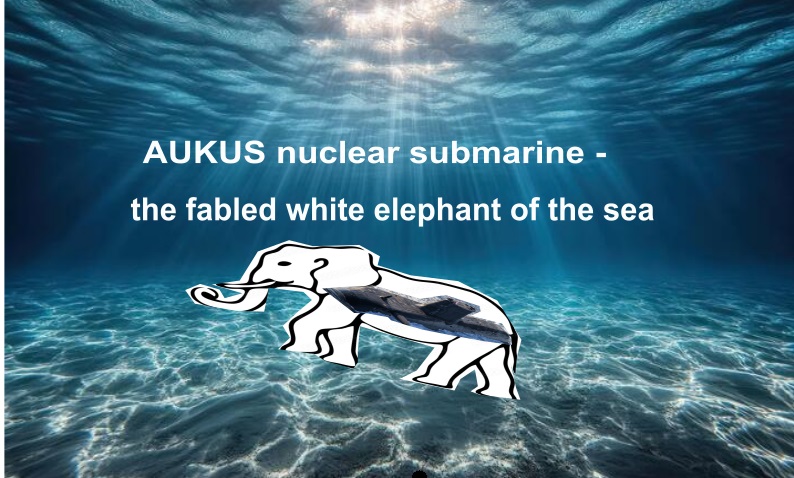
Nuclear to take up to quarter of British defence budget
26 Mar 2026
https://ukdefencejournal.org.uk/nuclear-to-take-up-to-quarter-of-british-defence-budget/
The UK nuclear enterprise is expected to absorb between 20 and 25 percent of the Ministry of Defence budget in the coming years, as spending rises across a growing portfolio of submarine, warhead, infrastructure and fuel programmes.
Giving evidence to the Public Accounts Committee, Permanent Secretary Jeremy Pocklington said defence nuclear spending totalled about £10.9 billion in 2024-25, equivalent to 18% of the department’s budget, and is expected to rise to around 20% in the current financial year.
He told MPs that the share would continue to grow, saying the Defence Nuclear Enterprise was on course to account for “between about 20% and 25% of the MOD’s overall budget.” That growth, he said, reflects both inflation and a broader expansion in the nuclear portfolio.
Pocklington said the increase was not being driven primarily by the core Dreadnought submarine build, which he said remains within the range previously set out to Parliament. “For Dreadnought, we are still within the range that the Department stated to Parliament,” he said, referring to the longstanding £31 billion programme cost plus £10 billion contingency.
Instead, he pointed to other pressures within the wider enterprise, including “scope changes related to AUKUS” and the re-establishment of a defence nuclear fuel capability, which he said had not featured in earlier forecasts in the same way.
He described the Defence Nuclear Enterprise as a large and increasingly complex portfolio, covering not only Dreadnought and Astute, but also warhead work, infrastructure at Barrow, naval bases at Clyde and Devonport, and fuel production. “There are nine programmes with a whole-life cost of over £10 billion in the Defence Nuclear Enterprise,” he said
Pressed repeatedly for a 10-year forecast, a more specific Dreadnought in-service date, and an update on how much of the £10 billion contingency has been drawn down, Pocklington declined to provide further detail, saying much of that would have to wait for the delayed Defence Investment Plan.
On timing, he said there had been no change to the government’s position that the first Dreadnought boat would enter service in the “early 2030s,” but did not narrow that window further.
Committee chair Sir Geoffrey Clifton-Brown argued that the exact date mattered, given the pressure on the existing deterrent fleet and the implications for long submarine patrols and support arrangements if replacement boats arrive later in the decade.
Taxpayers to cough up £65.6 million for nuclear “industry-informed” education in British universities
University of Derby helps drive UK nuclear skills expansion
The University of Derby is part of two university consortia that have been awarded funding to lead new doctoral training programmes designed to develop the UK’s future nuclear workforce. The Government has announced a £65.6 million investment for a bespoke nuclear Doctoral Focal Award
Delivered by UK Research and Innovation (UKRI) and match-funded by industry, the programmes will train more than 500 doctoral students at universities across the country, over the next four academic intakes. The University of Derby is a partner in two of the six new national doctoral training programmes announced.
The first consortium, led by Bangor University, has secured funding to establish PANDA (the Programme for Accelerating Nuclear Development and Applications), which will train up to 100 doctoral researchers. PANDA will be delivered in partnership with the UK National Nuclear Laboratory and the universities of Bristol, Birmingham, Cambridge, Derby, Imperial College London and Manchester. Together, these partners will support a new generation of researchers equipped to meet the UK’s future nuclear and clean‑energy needs, including a specific focus on defence.
Derby is also a partner in the STAND-UP (Skills and Training driving availability of National Defence Assets UP skilling) programme, led by the University of Strathclyde, which will train 80 Engineering Doctorate researchers.
This programme aims to develop the next generation of nuclear engineers and support the transition to ‘net zero’. It will help strengthen the UK’s capabilities in nuclear engineering, advanced manufacturing, digital technologies and nuclear decommissioning, bringing together partner universities Cumbria, Lancaster, Nottingham, Birmingham and Surrey.
Professor Kathryn Mitchell, vice-chancellor and chief executive of the University of Derby, said: “Developing the skills and expertise of the next generation is essential to securing a sustainable talent pipeline for the nuclear sector. The University of Derby is committed to working with partners to drive bold action on the UK’s nuclear skills shortage.”
She continued: “Together with our partners, we are creating clear pathways into specialised careers, delivering industry-informed education, and supporting cutting edge research. Through this work, we are helping to build a stronger national workforce and ensuring the future success of this vital sector.”
The announcement follows the Nuclear Skills Plan, launched in May 2024, which contained a recommendation to quadruple the number of nuclear fission doctoral students to address the shortage of high-level nuclear skills across both civil and defence and replace an aging workforce.
Over 500 doctoral students will be trained at universities across the country in academic years 2026/27 to 2033/34, quadrupling today’s intake of nuclear doctoral students. These doctoral students will be equipped with a broad range of advanced technical skills essential for the UK’s future civil and defence nuclear programmes, supporting the UK’s economic growth, energy and national security, and ‘net zero’ objectives.
Inside the Dirty, Dystopian World of AI Data Centers
The race to power AI is already remaking the physical world
The Atlanic By Matteo Wong, Photographs by Landon Speers, April 2026
s we drove through southwest Memphis, KeShaun Pearson told me to keep my window down—our destination was best tasted, not viewed. Along the way, we passed an abandoned coal plant to our right, then an active power plant to our left, equipped with enormous natural-gas turbines. Pearson, who directs the nonprofit Memphis Community Against Pollution, was bringing me to his hometown’s latest industrial megaproject.
Already, the air smelled of soot, gasoline, and asphalt. Then I felt a tickle sliding up my nostrils and down into my throat, like I was getting a cold.
This is Colossus: a data center that Musk’s artificial-intelligence company, xAI, is using as a training ground for Grok, one of the world’s most advanced generative-AI models. Training these models takes a staggering amount of energy; if run at full strength for a year, Colossus would use as much electricity as 200,000 American homes. When fully operational, Musk has written on X, this facility and two other xAI data centers nearby will require nearly two gigawatts of power. Annually, those facilities could consume roughly twice as much electricity as the city of Seattle.
To get Colossus up and running fast, xAI built its own power plant, setting up as many as 35 natural-gas turbines—railcar-size engines that can be major sources of smog—according to imagery obtained by the Southern Environmental Law Center. Pearson coughed as we drove by the facility. The scratch in my throat worsened, and I rolled up my window. As we approached, I heard the rumble of cranes and trucks, and then from behind a patch of trees emerged a forest of electrical towers. Finally, I saw it—a white-walled hangar, bigger than a dozen football fields, where Elon Musk intends to build a god.
To get Colossus up and running fast, xAI built its own power plant, setting up as many as 35 natural-gas turbines—railcar-size engines that can be major sources of smog—according to imagery obtained by the Southern Environmental Law Center. Pearson coughed as we drove by the facility. The scratch in my throat worsened, and I rolled up my window.
xAI’s rivals are all building similarly large data centers to develop their most powerful generative-AI models; a metropolis’s worth of electricity will surge through facilities that occupy a few city blocks. These companies have primarily made their chatbots “smarter” not by writing niftier code but by making them bigger: ramming more data through more powerful computer chips that use more electricity. OpenAI has announced plans for facilities requiring more than 30 gigawatts of power in total—more than the largest recorded demand for all of New England. Since ChatGPT’s launch, in November 2022, the capital expenditures of Amazon, Microsoft, Meta, and Google have exceeded $600 billion, and much of that spending has gone toward data centers—more, even after adjusting for inflation, than the government spent to build the entire interstate-highway system. “These are the largest single points of consumption of electricity in history,” Jesse Jenkins, a climate modeler at Princeton, told me……………………………………………………………………….(Subscribers only) https://www.theatlantic.com/magazine/2026/04/ai-data-centers-energy-demands/686064/
1 This Month


Tell the Ukrainian Government to Drop Prosecution of Peace Activist Yurii Sheliazhenko

Petition to revoke the licensing of the Near Surface Nuclear Disposal Facility (NSDF) at Chalk River. https://www.ourcommons.ca/petitions/en/Petition/Details?Petition=e-7247


of the week – STOP SMALL MODULAR REACTORS IN CANADA
To see nuclear-related stories in greater depth and intensity – go to https://nuclearinformation.wordpress.com
-
Archives
- March 2026 (212)
- February 2026 (268)
- January 2026 (308)
- December 2025 (358)
- November 2025 (359)
- October 2025 (376)
- September 2025 (258)
- August 2025 (319)
- July 2025 (230)
- June 2025 (348)
- May 2025 (261)
- April 2025 (305)
-
Categories
- 1
- 1 NUCLEAR ISSUES
- business and costs
- climate change
- culture and arts
- ENERGY
- environment
- health
- history
- indigenous issues
- Legal
- marketing of nuclear
- media
- opposition to nuclear
- PERSONAL STORIES
- politics
- politics international
- Religion and ethics
- safety
- secrets,lies and civil liberties
- spinbuster
- technology
- Uranium
- wastes
- weapons and war
- Women
- 2 WORLD
- ACTION
- AFRICA
- Atrocities
- AUSTRALIA
- Christina's notes
- Christina's themes
- culture and arts
- Events
- Fuk 2022
- Fuk 2023
- Fukushima 2017
- Fukushima 2018
- fukushima 2019
- Fukushima 2020
- Fukushima 2021
- general
- global warming
- Humour (God we need it)
- Nuclear
- RARE EARTHS
- Reference
- resources – print
- Resources -audiovicual
- Weekly Newsletter
- World
- World Nuclear
- YouTube
-
RSS
Entries RSS
Comments RSS
 nuclear-news