This Infamous Radioactive ‘Tomb’ Is Leaking, And Experts Are Worried
20 March 2026, ByJess Cockerill, https://www.sciencealert.com/this-infamous-radioactive-tomb-is-leaking-and-experts-are-worried
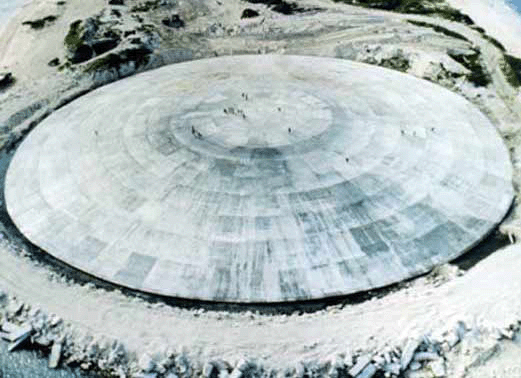
A gaping hole was left on a small island in the Pacific Ocean when the United States military released an 18-kiloton nuclear blast in 1958, known as the ‘Cactus‘ test.
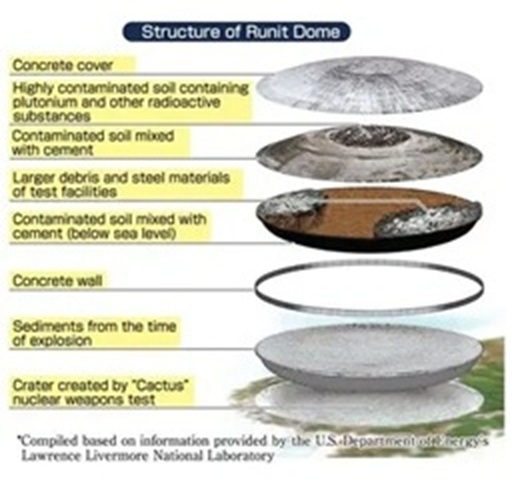
After the blast took place on the Marshall Island’s Runit Island, the military filled it in with contaminated soil and debris, creating a ‘tomb’ of nuclear waste known now as the Runit Dome.
Almost 50 years after the dome’s construction, experts are concerned that cracks in the concrete-capped radioactive landfill indicate just how vulnerable the site is to rising seas encroaching upon the narrow island’s shores.
The 115-meter (377 feet)-wide dome, built between 1977 and 1980 as part of military cleanup efforts, rests above more than 120,000 tons of material that were contaminated by US nuclear testing across Enewetak Atoll, including lethal quantities of plutonium.
The dome was intended as a temporary solution to contain material left behind by the nuclear tests, some of which exceeded the magnitude of Hiroshima and Nagasaki 1,000 times over.
But since its construction, groundwater has penetrated the otherwise-unlined crater, beneath which there lies a bed of porous coral sediment. So far, this is the main source of leaks, but there are concerns that layers of the dome intended to sit above sea level are not going to stay above water much longer.
In 2020, following a major report by the Los Angeles Times, Woods Hole Oceanographic Institute marine radioactivity expert Ken Buesseler pointed out that radioactive leaks from the Runit Dome are, so far, “relatively small,” in an interview for the institute’s journal
“As long as the plutonium stays put under the dome, it won’t be a large new source of radiation to the Pacific Ocean,” Buesseler told journalist Evan Lubofsky at the Los Angeles Times.
“But a lot depends on future sea-level rise and how things like storms and seasonal high tides affect the flow of water in and out of the dome. It’s a small source right now, but we need to monitor it more regularly to understand what’s happening, and get the data directly to the affected communities in the region.”
Columbia University chemist Ivana Nikolic-Hughes has been involved in ongoing research into the persistent contamination of the Marshall Islands following nuclear testing, and recently told journalist Kyle Evans at the Australian Broadcasting Corporation that she saw the dome’s cracks first-hand while taking soil samples on the island back in 2018.
In her research, Nikolic-Hughes has found elevated radiation levels and significant quantities of five radionuclides in soil samples from the island, outside the dome.
This could be evidence of the nuclear tomb leaking – though it may also be the result of the haphazard nature of the cleanup efforts, which also resulted in much waste being dumped into the lagoon.
Either way, the presence of plutonium-239, a component of nuclear weapons that remains dangerous for more than 24,000 years, warrants grave concerns about its vulnerability to rising sea levels and climate change.
“Given that sea levels are rising and there’s indications storms are intensifying, we worry the integrity of the dome could be in jeopardy,” Nikolic-Hughes told Evans.
“Runit is about 20 miles from where people live and they use the lagoon, so the implications are potentially devastating.”
In 2024, the US Department of Energy’s Pacific Northwest National Laboratory conducted an investigation into the potential impacts of climate change on the Runit Dome site, finding that storm surges and gradual sea level rise would indeed be the biggest factor in spreading radionuclides through the atoll.
Most of Runit Island sits just 2 meters (6.5 feet) above sea level.
Viewed from above, it is easy to imagine what an impact just 1 meter of extra water could do to the atoll and Runit Island’s crumbling nuclear tomb. That is the amount of sea level rise climate scientists predict for the Marshall Islands by 2100.
Related: Parts of The Marshall Islands Are Now More Radioactive Than Chernobyl, Study Finds
Nikolic-Hughes and her fellow researcher Hart Rapaport have previously urged the United States to take responsibility for proper cleanup of nuclear waste on the islands, as one part of ensuring a safe future for Marshallese residents.
As United Nations special rapporteur Paula Gaviria Betancur said back in 2024: “Legacies of nuclear testing and military land requisitions by a foreign power have displaced hundreds of Marshallese for generations, while the adverse effects of climate change threaten to displace thousands more.”
The Nightmare of Fukushima 15 Years Later

SCHEERPOST, By Joshua Frank, March 20, 2026
“…………………………………………………………………………………… The Fukushima Daiichi nuclear plant, built by General Electric (GE) in the mid-1960s, was designed to withstand natural disasters, but its creators never foresaw an earthquake like that. When the plant’s sensors detected the quake, its reactors automatically shut down. That emergency shutdown (or scram) halted its fission process, triggering backup power to keep cold seawater flowing through the reactors and spent-fuel containers to prevent overheating. Things at Fukushima were going according to plan until that massive tsunami battered the plant, washing away transmission towers and damaging electrical systems. There were backup generators in the basement, but those, too, had been inundated by waves of seawater, and an already bad situation was about to get far worse.
A power outage at a nuclear power plant is known as a “station blackout.” As you might imagine, it’s one of the worst scenarios any nuclear facility could possibly experience. If all electricity is lost, that means water is no longer being pumped into the reactor’s scalding-hot core to cool it down. And if that core isn’t constantly being cooled, one thing is certain: disaster will ensue. The fission process itself may be complicated, but that’s basic physics. To make matters worse, there were three operating reactors at Fukushima Daiichi. Luckily, three others had already been shut down for maintenance. If power wasn’t restored in short order, that would mean that all three of Fukushima’s reactors were in very big trouble.
We would later learn that no one — not at TEPCO, GE, or among Japanese regulators — had ever considered the possibility that all the reactors might lose electricity at once. They had only drawn up plans for one reactor to go down, in which case the others could keep the plant running. But all of them offline, and every generator out of commission? There was no precedent or playbook for that.
The nuclear industry has a reasonably polite name for a disaster like the one that was rocking Fukushima. They refer to it as a “beyond design-basis accident” because no single nuclear plant design can account for every possible problem it might encounter in its lifetime. The fact that there’s a term for this should make you anxious.
Meltdowns and Fallout
Over the next several days, the emergency at Fukushima Daiichi only worsened. Every effort to restore power to its reactors hit a dead end. On-site radiation-detection equipment, which would have triggered warnings and guided evacuation efforts for those in danger, was no longer functioning. Plans to pump water into the reactors to cool them had faltered. Their cores kept overheating, and the boiling pools of spent fuel were at risk of drying out, potentially triggering a massive fire that would release extreme amounts of radiation.
Within three days, following a series of fires, hydrogen explosions, and panic among those aware of what was happening, Fukushima’s Units 1, 2, and 3 experienced full-scale core meltdowns. Over 150,000 people within an 18-mile radius had already been forced to evacuate, and radiation plumes would take two weeks to spread across the northern hemisphere, although the Japanese government wouldn’t admit publicly that any meltdown had occurred until June 2011, three months later.
The only good news for the 13 million people living 150 miles south in Tokyo was that, during and immediately after the meltdowns, prevailing winds carried much of Fukushima’s radioactive material away from the smoldering reactors and out to sea. It’s estimated that 80% of the fallout from Fukushima ended up in the ocean, meaning most of it headed east rather than toward population centers to the south and west. The other fortunate news was that the spent fuel containers had somehow survived it all. If their water levels in the pools had been drained, far more radiation would have been released.
But Tokyo wasn’t completely spared. After years of research, scientists discovered that cesium-rich microparticles had blanketed the greater Tokyo area, an unpopular discovery that drew backlash and threats of academic censorship. Areas around the Fukushima exclusion zones recorded the highest radiation levels. Japanese government officials continually downplayed the dangers of the accident and were reluctant to even classify the event as a Level 7 nuclear disaster, the highest rating on the International Nuclear Event Scale, which would have placed it on a par with the 1986 Chernobyl nuclear disaster. Japanese officials have also failed to conduct long-term epidemiological studies that would include baseline measurements of cancer rates, which has cast doubt on thyroid screenings that found troubling incidents of cancer far higher than researchers expected.
Radioactive Fish
Prior to the earthquake, the ocean’s cesium-137 levels near Fukushima were 2 Becquerels (a unit of radioactivity) per cubic meter, well below the recommended drinking water threshold of 10,000 Becquerels. Just after March 11, 2011, cesium-137 levels there spiked to fifty million before decreasing as sea currents dispersed the radioactive particles away from the coast. The ocean, however, had been poisoned.
In the years that followed the Fukushima nuclear disaster, researchers documented a frightening, yet predictable trend. Radioactive isotopes in seawater were taken up by marine plants (phytoplankton), which then moved up the food chain into tiny marine animals (zooplankton) and, eventually, to fish.
Cesium-137 consumed by fish can reside in their bodies for months, while Strontium-90 remains in their bones for years. If humans then eat such fish, they will also be exposed to those radioactive particles. The more contaminated fish they eat, the greater the radioactive buildup will be.
In 2023, over a decade after the incident, radiation levels remained sky-high in black rockfish caught off the Fukushima coast. Other bottom-dwelling species have been found to be laden with radioactivity, too, including eel and rock trout. Further concerns have been raised about the treated radioactive water that TEPCO continued to release into the ocean, prompting China to suspend seafood imports from Japan. Aside from those findings, there have been very few studies examining the effects of Fukushima’s radiation on ecosystems or on the people of Japan.
“Japan has clamped down on scientific efforts to study the nuclear catastrophe,” claims pediatrician Alex Rosen of International Physicians for the Prevention of Nuclear War. “There is hardly any literature, any publicized research, on the health effects on humans, and those that are published come from a small group of researchers at Fukushima Medical University.”
Recognizing such levels of radiation, even if confined to the waters near Fukushima, would cast the country’s nuclear industry as a significant threat — not only to Japan but globally. Any admission that Fukushima’s radiation is linked to increased cancer rates would raise broader concerns about nuclear power’s future viability. Radiation exposure is cumulative and, although Fukushima didn’t immediately cause mass casualties, it wasn’t a benign accident either. It took decades before it was accepted that Chernobyl had caused tens of thousands of excess cancer deaths. It may take even longer to completely understand Fukushima’s full effects. In the meantime, the still ongoing cleanup of the burned-out facilities may cost as much as 80 trillion yen ($500 billion).
It’s been 15 years since Fukushima’s reactors experienced those meltdowns and we still don’t fully understand their long-term repercussions. Nuclear power advocates will argue that Fukushima wasn’t a serious incident and that nuclear technology is still safe. They’ll minimize radiation threats, remain optimistic that new reactor designs will never falter, dismiss the fact that there’s simply no permanent solution for radioactive waste, and overlook the inseparable connection between nuclear power and atomic weapons. After all, among other things, we’ll undoubtedly need nuclear energy to help power the artificial intelligence craze, right?………………………………………………………………………………………………………………………………………………………………………. With nine nuclear-armed nations and roughly 12,000 nuclear warheads on this planet, worries about nuclear war are unavoidable. However, the danger of a nuclear disaster at a seemingly “peaceful” nuclear facility is often ignored. The future of atomic energy remains uncertain, but it is our duty to eliminate this hazardous energy source before another Fukushima triggers a war-like catastrophe all its own.mhttps://scheerpost.com/2026/03/20/searching-for-solace-in-a-nuclearized-world/
Joshua Frank, a TomDispatch regular, is co-editor of CounterPunch and co-host of CounterPunch Radio. He is the author of Atomic Days: The Untold Story of the Most Toxic Place in America, and the forthcoming Bad Energy: AI Hucksters, Rogue Lithium Extractors, and Wind Industrialists Who are Selling Off Our Future, both with Haymarket Books.
Trump is the most dangerous man in the world
By Mark Beeson | 21 March 2026, https://independentaustralia.net/politics/politics-display/trump-is-the-most-dangerous-man-in-the-world,20838
Trump’s Iran war raises fears of global conflict — while allies stay silent and diplomacy collapses, writes Mark Beeson.
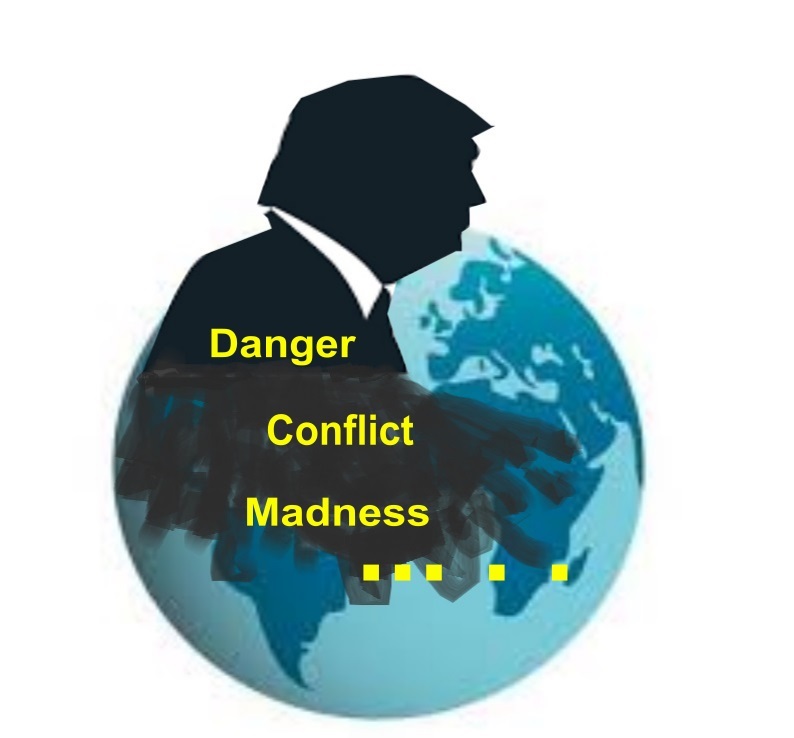
U.S. PRESIDENT DONALD TRUMP is the most dangerous man in the world. Why are we supporting him?
Many people were concerned about what a second Trump presidency might look like, but it’s uncontroversial to claim that it’s much worse than even the gloomiest pessimists feared.
It has been plain for a long time that Trump has little regard for the truth and is determined to silence independent media. But the one thing his supporters and the world in general might have hoped for was that he wouldn’t have gone back on his promise to not start unnecessary, ill-conceived wars, especially in the Middle East.
And yet, not only has Trump launched an illegal war with Iran, which has already resulted in the deaths of thousands, including innocent schoolgirls, but he is also displaying a psychopathic delight in using America’s overwhelming military might ‘just for fun’.
Given that the assault on Iran is being conducted with – or even on behalf of – Israel there is a breathtaking irony in the fact that Trump is displaying the same sort of indifference to human suffering that allowed individual Nazis to take part in the ‘final solution’ and the murder of six million Jews.
It is, of course, entirely possible that Trump doesn’t really know what’s going on given his increasingly obvious cognitive decline, but he has never exhibited much human empathy and is a compulsive liar and confabulator. These qualities arguably made him unfit to be a property developer, much less the most powerful man on Earth.
Given his famously child-like need for attention and adulation, which his courtiers and cronies are only too willing to provide, there is absolutely no chance of him changing. On the contrary, his belief that God is proud of him ought to alarm ought to alarm friend and foe alike.
After all, this is a man with the capacity to blunder into World War 3 without having any idea what he’s doing. The complete absence of any plan or exit strategy in the escalating conflict with Iran demonstrates that even the most apocalyptic of unforeseen consequences cannot be ruled out.
While an international economic crisis may not be the worst thing that could happen, for those of us fortunate enough to live in peaceful Australia it really ought to demonstrate that Trump is a threat to supposed friends and allies, as well as the innocent Iranians he promised to help.
If nothing else, Trump’s behaviour should make the danger and folly of relying on someone quite so delusional and self-obsessed clear to even our most unthinking policymakers. Trump will be satisfied with nothing less than the complete support and cooperation of allies, no matter how misguided or inhuman his policies may be.
Given the decades of uncritical fealty Australia’s leaders have displayed to the United States, it is no surprise that there has generally been an uncomfortable silence about ‘our’ response to the latest American-led fiasco.
Penny Wong wrote:
‘We (sic) support the United States acting to prevent Iran from obtaining a nuclear weapon and to prevent Iran continuing to threaten international peace and security.’
It’s worth remembering that Iran was attacked while trying to negotiate a new agreement to replace the one Trump tore up, a tactic that may have allowed the U.S. to decapitate Iran’s leadership but won’t making resolving the conflict any easier. Truth, diplomacy and trustworthiness are clearly for losers. Might clearly does make right in Trump-world. This reality may help to explain why the Albanese government is keeping its collective head down.
Other leaders have not been quite so supine and gutless, however. German Chancellor Friedrich Merz, after fruitless attempts at ingratiating himself with Trump, unambiguously stated that the “government will not participate in this war”. Moreover, Merz pointed out that Trump’s war had nothing to do with NATO, which was a defensive alliance, not one designed for wars of aggression.
Trump responded in his usual fashion with threats and bluster, suggesting a failure to support his ill-conceived war would be ‘very bad’ for NATO. Although we have learned not expect truth or consistency when dealing with Trump, suggesting that the foundation of the Western alliance may be in jeopardy is hardly a minor threat. Trump’s great friend Vladimir Putin must be delighted.
If our leaders are too unimaginative and cowardly to speak up in defence of international law, or to criticise unilateralism and the intensification of great power politics, civil society must do what it can. The absence of the sort of activism and protests that characterised opposition to the equally ill-conceived and pointless Vietnam War is disappointing and revealing, however. Perhaps it takes 500 actual combat deaths and the prospect of being called-up to bring home the reality of war to Australians.
Or perhaps rising interest rates, the cost of filling up a monstrous SUV, or re-routing your European holiday might do the trick. Either way, it’s reassuring to know that President Trump thinks the war with Iran is going so well that he gives if 15 out of 10. Nothing for our leaders to worry about after all.
Macron slams ‘unacceptable’ Israeli attacks on Lebanon
The French president stressed that the Jewish state’s military operation violates international law and will not enhance its security.
20 Mar, 2026, https://www.rt.com/news/635660-macron-condemns-israel-lebanon-attacks/
Israel’s ongoing military operation in Lebanon violates international law, French President Emmanuel Macron has said.
Speaking at a European Council press conference in Brussels on Thursday, Macron also criticized the attacks on Israel being carried out by Lebanese-based militant movement Hezbollah, which has vowed to avenge the US-Israeli killing of Iranian Supreme Leader Ali Khamenei.
Macron rejected the notion that a third party could resolve the conflict with the Iran-linked group through force, emphasizing that only Lebanese authorities have the legitimacy to address the issue.
“We don’t think that the fight against Hezbollah and the removal of its weapons can be carried out by a third power,” Macron told reporters. “We believe that Israel’s ground military operation and bombardments are inappropriate and even unacceptable in terms of international law and the interests of both the Lebanese and Israel’s long-term security.”
Macron also pointed out that Israel has conducted similar operations in Lebanon for years without ever producing the “expected results.”
The French leader’s comments come as Israel has expanded its military campaign against Hezbollah following the US-Israeli strikes on Iran that began late last month. The Israel Defense Forces announced “limited and targeted ground operations against key Hezbollah strongholds” earlier this week, escalating cross-border hostilities that have already claimed hundreds of lives.
Lebanese authorities report that Israeli strikes have killed over 880 people over the past two weeks, with more than 2,000 injured and over 1 million displaced. The strikes have targeted residential districts, a UN peacekeeping position, and a Russian cultural center in the southern city of Nabatieh.
On Thursday, RT correspondent Steve Sweeney and his cameraman Ali Rida Sbeity were also injured in what appeared to be a deliberate Israeli airstrike on their filming position, despite them wearing clearly labeled press uniforms.
Moscow has condemned Israel over the strike, with Russian Foreign Ministry spokeswoman Maria Zakharova stressing that the attack on journalists wearing press markings “cannot be called accidental given the killing of two hundred journalists in Gaza.”
Iran’s Retaliation Reignites Discontent With US Military Bases in Middle East
The US spent decades building an empire of military bases throughout the Middle East. Now they’re under attack.
By Shireen Akram-Boshar , Truthout, March 20, 2026
n Thursday, March 19, Saudi Arabia’s foreign minister Prince Faisal warned Iran that tolerance for its regional attacks was running short — and that the Saudi regime has “the right to take military actions if deemed necessary.” He elaborated that Saudi Arabia and other Gulf states have “very significant capacities and capabilities that they could bring to bear” if the attacks continue. This came a day after Iranian attacks on Gulf energy sites in Saudi Arabia, Qatar, and the United Arab Emirates, which Iran said was in retaliation for an Israeli strike on an Iranian gas field.
Over the past three weeks of the U.S.-Israeli war on Iran, Iran has increasingly targeted sites across the Gulf, further regionalizing the war. Among its prime targets are U.S. military bases in the region: Iran has targeted, and damaged, at least 17 U.S. sites in the region, 11 of which are military bases. The two largest bases, Al Udeid Air Base in Qatar and the U.S. Navy’s Fifth Fleet in Bahrain, host 10,000 and 9,000 U.S. military personnel, respectively — of an estimated 50,000 U.S. military personnel across the region.
The existence of these military bases should alert us to a larger problem — that the U.S. has come to dominate the region militarily, building relationships with local regimes that further encourage repression and domination. Now, Iranian retaliation against these bases spurred by U.S.-Israeli attacks is reigniting a divide between Gulf leaders and their populations……………………………………………………………………………………………………………………………………………..
But the real expansion of U.S. military bases across the Middle East began in the early 1990s during and after the Gulf War, with the establishment of permanent U.S. bases in Kuwait, Qatar, and Bahrain, as well as sites in Saudi Arabia that the U.S. would use for long stretches. Though many expected U.S. global military presence to decrease after the collapse of the Soviet Union, the 1990 Gulf War saw a seismic expansion of U.S. troops in the Middle East along with the start of a unipolar world order dominated by the U.S. With the fall of the Soviet Union, the U.S. was now the world’s sole superpower, and the Middle East would experience its military might.
Following the 1990-’91 Gulf War, Kuwait, Bahrain, Qatar, and the UAE all signed public, formal defense agreements with the U.S., granting the U.S. access to each country’s bases and other facilities. With the exception of Saudi Arabia, U.S. military presence was now well-known rather than discreet. And soon after the U.S.-led campaign ended Iraq’s occupation of Kuwait, the U.S. played a role in bringing the Palestinian First Intifada to an end, pushing for first the Madrid Conference and then the Oslo Accords to contain and end the uprising that challenged Israel’s brutal status quo.
In the wake of the Oslo Accords, the U.S. also facilitated neoliberal transitions throughout the Middle East, accelerating privatization, deregulation, and the selling off of state assets — thereby reversing the nationalization policies of earlier decades and aligning the region with U.S. political and economic interests through a set of reforms and interventions commonly called the Washington Consensus. Thus, in the few years after the fall of the USSR, the U.S. managed to restructure the Middle East according to its designs; its military bases represented one pillar of its dominance and control over the region.
An Empire of Bases and Local Authoritarian Regimes
In 2001, the U.S. expanded its military bases even further, creating an “empire of bases” in the region as it launched its endless “war on terror.” During its wars on Afghanistan and Iraq, the U.S. held more than 1,000 installations in those two countries alone. New bases were established and old ones expanded in Qatar, the UAE, Kuwait, Iraq, and Jordan.
Though international and regional dynamics have changed over the past two-and-a-half decades, U.S. bases still dominate the region. The presence of these bases has also further encouraged U.S. support for authoritarian regimes capable of suppressing popular opposition to U.S. imperialism and support for the Palestinian cause. This is particularly obvious in the case of Bahrain, which hosts the U.S. Navy’s Fifth Fleet and some 9,000 U.S. troops — the second largest base in the region after Qatar’s Al Udeid Air Base — and is thus seen as a crucial base in the region…………………………………………………………………………………………………..
The US-Israeli war on Iran and the regionalization of the war highlight both the U.S.’s historic domination of the region, and the extent to which the region’s regimes have normalized relations with the U.S — straying far from the anti-imperialist sentiments that dominated the region in the 1950s and ‘60s. Instead, it is a reactionary status quo that is entrenched across the Middle East. While Bahraini people dare to protest against their regime, the U.S., and Israel, the Gulf states’ ruling regimes double down in their reliance on U.S. military support, making their alignment clear. Qatar in particular has used its military base to cozy up to Trump.
And yet it is this U.S. military presence itself that has pulled them into the increasingly regionalized war. Still, the large U.S. military presence remains in tension with the wishes of the vast majority of the population in most countries in the region, and it remains to be seen if the current U.S.-Israeli war on Iran, and Iran’s widespread retaliation against this network of bases, will once again reshape the U.S. military presence in the Middle East. https://truthout.org/articles/irans-retaliation-reignites-discontent-with-us-military-bases-in-middle-east/?utm_source=Truthout&utm_campaign=accdbb6382-EMAIL_CAMPAIGN_2026_03_20_06_50_COPY_01&utm_medium=email&utm_term=0_bbb541a1db-1f909890d7-650192793
A MAN and woman have been arrested after attempting to enter Faslane naval base.
20th March, https://www.thenational.scot/news/25954299.man-woman-arrested-attempting-enter-faslane-naval-base/
The incident, which took place at around 5pm on Thursday, saw the pair reportedly ask if they could enter.
They were refused permission and were then arrested shortly after. It is understood the pair did not try to force their way into the base.
According to the PA news agency, the man is understood to be Iranian.
The Faslane naval base, also known as HM Naval Base Clyde, is located on the eastern shore of Gare Loch in Argyll and Bute.
It is home to the core of the UK’s submarine fleet and the Trident nuclear deterrent.
A Police Scotland spokesman said: “Around 5pm on Thursday, 19 March, 2026, we were made aware of two people attempting to enter HM Naval Base Clyde.
“A 34-year-old man and 31-year-old woman have been arrested in connection and enquiries are ongoing.”
A Navy spokesperson said: “Police Scotland have arrested two people who unsuccessfully attempted to enter HM Naval Base Clyde on Thursday 19 March.
“As the matter is subject to an ongoing investigation, we will not comment further.”
Why US likely losing war on Iran
Walt Zlotow West Suburban Peace Coalition Glen Ellyn IL 21 March 26
Iran has destroyed 10 advanced US radar systems that are crucial for identifying and destroying incoming Iranian missiles and drones. Three major bases lost their radar to Iranian missiles as well as radar protecting the US embassy in Baghdad. So desperate is the US for critical radar, they’ve scooped up high tech radars from South Korea to fill the breach. South Korea is not happy. Without sufficient radar, US bases, Gulf States oil facilities, US ships, and especially Israel become blind to thousands of Iranian missiles and drones.
US bases have been hit at least 25 times, but US censorship of damage hides this this unfolding disaster from the US public.
Knowledgeable observers believe the US will run out of missiles and drone interceptors before Iran runs out of offensive weaponry. They also believe the US likely has less than month of weaponry to continue round the clock bombing. US bases, Gulf States oil facilities and Israeli military and civilian infrastructure all geographically compact making them easily accessible to attack. Iran smartly spread their tens of thousands of missiles and drones thruout Iran’s 676,000 square miles, forcing Trump and Netanyahu to play ‘Whack a Mole.’
Trump’s colossal failure to collapse the Iranian regime shouldn’t surprise since Trump’s single victory plan was for the Iranian people to overthrow their Islamic regime within a few days after Trump assassinated supreme leader the Ayatollah Ali Khamenei. That was stupid on steroids. Iran’s 90 million beleaguered souls rallied round their government determined to fight to the death rather than surrender to monstrous attackers US and Israel.
Bombing alone almost never wins a war, something true thruout the century long history of aerial bombing. Now Trump cannot tolerate a long war of attrition because he’s put the world into a possible economic death spiral by near totally disrupting flow of precious Middle East oil. That’s why he’s secretly seeking an off ramp from military, economic and political catastrophe. Having insulted and disparaged nearly every country on earth, he finds himself without an ally except his partner in criminal war Israeli Prime Minister Benjamin Netanyahu.
Of course, Trump could miraculously pull out victory from the jaws of defeat closing in on him. But with Iranian missiles and drones raining down on mostly defenseless US bases and oil infrastructure in the Gulf States, and giving Israel a taste of the massive destruction they visited on Gaza…the smart money is on Iran.
The Warmongers Will Never Admit They Were Wrong And Will Never Learn From Their Mistakes
Cait;in Johnstone, 20 Mar 26, https://mail.google.com/mail/u/0/?tab=rm&ogbl#inbox/WhctKLcDqcPgHJwXCXxhJgcDpJZFXpkgKlZRLMBbTfNgLndgLLjFjSMrWXffFBwHrWcdXkb
| Trump’s former national security advisor John Bolton has a tweet that’s got me absolutely fuming right now.“In 2018–2019, I made the case for regime change in Iran as often as I could. Voices in Trump’s orbit often cited Iran’s capacity to close the Strait of Hormuz as a reason against regime change. Trump has been fully aware this is a possibility, and yet did not prepare,” Bolton posted. |
Can you believe this shit? Dude’s like “Hey, Trump should have known this war would be hard because people tried to warn him not to listen to me!”
Motherfucker THIS WAS YOUR WAR. You were THE “bomb Iran” guy! You made it your entire personality for DECADES. Over the years I’ve used your name God knows how many times whenever I needed an example of a Beltway swamp monster who’s got a throbbing hard-on for war with Iran. Now you’ve finally got it and it’s going exactly as badly as everyone said it would, and you’re like “Yeah well he should’ve known better, people tried to warn him about the Strait of Hormuz”? Fuck you.
These professional warmongers never, ever learn from their errors. Many years after the Iraq invasion turned out to be a disaster, John Bolton was still out there telling the media he believed it was a “resounding success,” conceding only “mistakes that were made subsequently” to the ousting of Saddam Hussein.
They never admit they were wrong. They never admit that their war was a bad idea. They only ever acknowledge that it didn’t happen in exactly the way they imagined it happening in their minds. They live in this fantasy world where all their war agendas would unfold beautifully so long as they could personally control every molecule of matter involved in how it happens, completely ignoring that this is impossible and any war is always going to have an unfathomable number of moving parts you can’t control.
In their eyes the wars are never wrong, they’re only ever executed incorrectly. US military interventionism can never fail, it can only be failed.
Bolton doesn’t even seem to have any idea what Trump could have done differently to stop Iran from closing the Strait of Hormuz. I listened to an NPR interview the other day where he slammed Trump for not having “done the planning in advance” to prevent the Iranian blockade, but he never at any time outlined what Trump could have done to accomplish this. He just said there was “a huge hole in the planning” and that “they apparently didn’t take as seriously as they should have the potential to mine the Strait of Hormuz,” without ever saying what they could have done.
These are the kinds of minds they have spearheading the US empire’s wars.
All the worst people are getting exactly what they want, and it turns out they don’t even want it, like Elon Musk tweeting “Whoever said ‘money can’t buy happiness’ really knew what they were talking about” last month. They’re getting everything they asked for and it’s making everyone miserable, and it’s not even making THEM happy.
The imperial status quo elevates the worst among us. The least wise. The least insightful. The least compassionate. The least deserving. The least qualified.
We need drastic revolutionary change, and we need it now.e doesn’t know. He himself, Mister Iran War, had no plan for how to carry out this war without disastrous consequences for the US and its allies. He’s spent his entire blood-soaked career pushing for a war he never had any idea how to actually carry out.
Conscientious objector and human rights defender Yurii Sheliazhenko detained

The undersigned organisations are shocked by the detention and deprivation of liberty of human rights defender Yurii Sheliazhenko, today March 19th, by the Ukrainian authorities in Kyiv. This is just weeks after a joint call to the authorities to withdraw from such persecutions of conscientious objectors and withdraw their ongoing persecution of Mr. Sheliazhenko.1
According to the information available, Mr. Sheliazhenko was apprehended by officers of the Pechersk District Police in Kyiv without a proper legal basis and without compliance with the procedural safeguards required by Ukrainian law. In particular, there are indications that:
– no detention protocol was drawn up;
– no clear legal grounds for the deprivation of liberty were provided;
– access to legal counsel was obstructed;
– contact with the Ukrainian State Bureau of Investigation was obstructed;
– he was transferred, or intended to be transferred, to a Territorial Centre of Recruitment and Social Support (TCC) without due legal procedure.
We note that any involvement of the TCC does not exclude the responsibility of law enforcement officers for the initial deprivation of liberty. These actions may constitute violations of the Constitution of Ukraine and the European Convention on Human Rights, in particular Article 5 (right to liberty and security), and Article 9 of the International Covenant on Civil and Political Rights (ICCPR).
Yurii Sheliazhenko is a well-known conscientious objector, publicly declared since 1998, a pacifist and a human rights defender. He is also an academic, the executive secretary of the Ukrainian Pacifist Movement (member organisation of War Resisters International), Director of the Institute of Peace and Law in Ukraine, and a Board member of the European Bureau for Conscientious Objection and of World Beyond War.
Tragically, he has previously reported on the cruel practices of “busification”, forced conscription and compulsory military registration occurring in Ukraine, which in some cases have even led to tortures and deaths in military recruitment centers.2
We strongly condemn all these actions as grave human rights violations that have no place in democratic countries.
We urge the Ukrainian authorities to immediately release Yurii Sheliazhenko and cease all procedures of forced conscription.
We remind that his case has been previously included in a Communication by the Mandates of the Special Rapporteur on the rights to freedom of peaceful assembly and of association; the Special Rapporteur on minority issues and the Special Rapporteur on freedom of religion or belief.3 The case of Mr. Sheliazhenko, the communication of the Special Rapporteurs and the response of the Ukrainian authorities were highlighted also by the OHCHR, in its report concerning Conscientious objection to military service, and particularly in the chapter titled “Refrain from unduly restricting the human rights of those representing or advocating for the rights of conscientious objectors”.4 His case has been highlighted also in Amnesty International’s Annual Report 2023/2024.5
We repeat our call to the international community to exercise all proper actions to ensure that human rights defenders and peace activists are not criminalised for their actions for peace and nonviolence; moreover, that the right to conscientious objection is fully implemented in line with international standards and that conscientious objectors are provided with the necessary protection against persecution in their country of origin, also with asylum.
Connection e.V.
European Bureau for Conscientious Objection
International Fellowship of Reconciliation
War Resisters’ International
- https://ebco-beoc.org/press-release/2026-01-23-yurii-sheliazhenko-conscientious-objector-to-military-service-and-human-rights-defender-under-immediate-threat ↩︎
- https://ebco-beoc.org/ukraine/2024 ↩︎
- AL UKR 1/2023, 8 November 2023, p. 5-6. https://spcommreports.ohchr.org/TMResultsBase/DownLoadPublicCommunicationFile?gId=28562 ↩︎
- A/HRC/56/30, 23 April 2024, para. 45. https://docs.un.org/en/A/HRC/56/30↩︎
- https://www.amnesty.org/en/documents/pol10/7200/2024/en/ p. 385↩︎
What a recent court win reveals about the Trump administration’s unlawful attacks on climate science

Bulletin, By Rachel Cleetus | Opinion | March 18, 2026
The second Trump administration is taking its hostility to climate science to new levels. In addition to its rhetoric dismissing climate change as a con or scam, recently released government documents show how the administration is seeking to replace scientific facts with propaganda and disinformation.
The Environmental Defense Fund and the Union of Concerned Scientists recently won a court case against the administration which forced it to release of a trove of government documents related to a secretive “Climate Working Group” illegally convened by Energy Secretary Chris Wright. These documents show that the Trump administration secretly enlisted a handpicked group of climate contrarians to write a biased climate report specifically designed to undermine the EPA’s Endangerment Finding. This science-based finding establishes the known harms to human health and well-being from global warming pollution, facts that were clear in 2009 and even more so today, as affirmed by a recent National Academies report……………………………………………………………………………………………………………………………..
Propaganda and disinformation about climate science are now the official position of the US government. Meanwhile, scientists confirm that the world is on the verge of overshooting 1.5 degrees Celsius of global warming within the next few years. Costly and deadly climate impacts—extreme heatwaves, record-breaking floods, intensified storms, catastrophic wildfires—are worsening, and the risks of irreversible, multi-century harms are growing. And yet this deeply anti-science administration continues to prop up fossil fuel interests rather than protecting people’s safety and the health of the planet.
The successful Federal Advisory Committee Act lawsuit has resulted in some crucial wins, including shining a light on the Trump administration’s deceptive tactics to undermine climate science. . And the administration’s harmful actions will continue to be challenged in court. The Union of Concerned Scientists and the Environmental Defense Fund, together with many other groups, have recently joined a lawsuit challenging the unlawful repeal of the endangerment finding. Try as it might, this administration cannot bury the evidence of climate harms so readily apparent to communities across the nation. The American people deserve genuine solutions to the climate crisis, not more self-serving lies.https://thebulletin.org/2026/03/what-a-recent-court-win-reveals-about-the-trump-administrations-unlawful-attacks-on-climate-science/
1 This Month



Tell the Ukrainian Government to Drop Prosecution of Peace Activist Yurii Sheliazhenko

Petition to revoke the licensing of the Near Surface Nuclear Disposal Facility (NSDF) at Chalk River. https://www.ourcommons.ca/petitions/en/Petition/Details?Petition=e-7247


of the week – STOP SMALL MODULAR REACTORS IN CANADA
To see nuclear-related stories in greater depth and intensity – go to https://nuclearinformation.wordpress.com
-
Archives
- March 2026 (222)
- February 2026 (268)
- January 2026 (308)
- December 2025 (358)
- November 2025 (359)
- October 2025 (376)
- September 2025 (258)
- August 2025 (319)
- July 2025 (230)
- June 2025 (348)
- May 2025 (261)
- April 2025 (305)
-
Categories
- 1
- 1 NUCLEAR ISSUES
- business and costs
- climate change
- culture and arts
- ENERGY
- environment
- health
- history
- indigenous issues
- Legal
- marketing of nuclear
- media
- opposition to nuclear
- PERSONAL STORIES
- politics
- politics international
- Religion and ethics
- safety
- secrets,lies and civil liberties
- spinbuster
- technology
- Uranium
- wastes
- weapons and war
- Women
- 2 WORLD
- ACTION
- AFRICA
- Atrocities
- AUSTRALIA
- Christina's notes
- Christina's themes
- culture and arts
- Events
- Fuk 2022
- Fuk 2023
- Fukushima 2017
- Fukushima 2018
- fukushima 2019
- Fukushima 2020
- Fukushima 2021
- general
- global warming
- Humour (God we need it)
- Nuclear
- RARE EARTHS
- Reference
- resources – print
- Resources -audiovicual
- Weekly Newsletter
- World
- World Nuclear
- YouTube
-
RSS
Entries RSS
Comments RSS
 nuclear-news