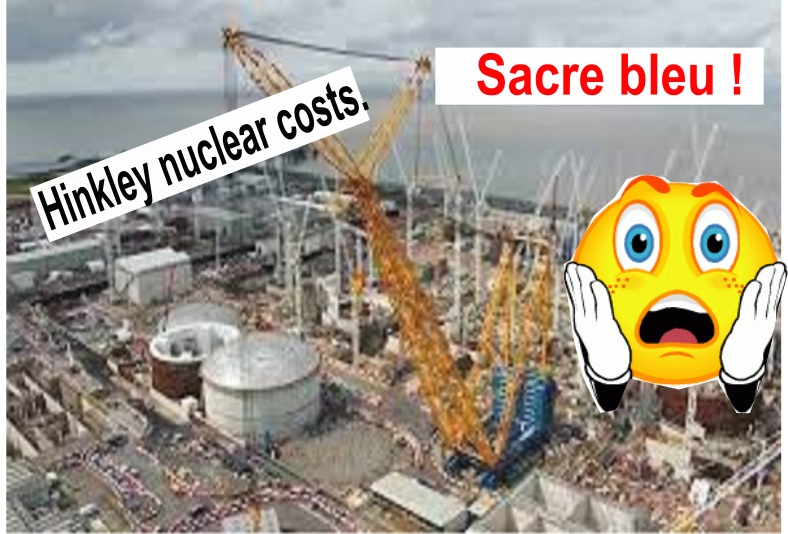
Several days after announcing the new cost hikes at Hinkley, news broke about similarly soaring electricity prices predicted for the Sizewell C nuclear power plant, another French twin EPR plant targeted for the steadily eroding and submerging UK Suffolk coast.
Electricity prices from new nuclear plants will be sky high with more delays to completion while jobs don’t materialize.
If you wanted to sum up the most compelling reasons not to build new nuclear power plants, Hinkley Point C, the two-reactor project under construction in Somerset in the UK, encapsulates almost all of them.
When the UK government, still miraculously led by the clinging-by-his-fingernails beleaguered Labour prime minister, Keir Starmer, announced its Golden Age of nuclear last September, obediently gliding in Trump’s gilded wake, it claimed that the new nuclear power plants planned for Britain “will drive down household bills in the long run.” Nothing could be further from the truth.
Far from driving down consumer costs, the Hinkley Point C project, consisting of two 1,630 MW French Evolutionary Power Reactors (EPR), could see the original agreed strike price of $123.50 per megawatt — already considerably higher than the price Britons were paying at the time it was set in 2012 — soar even higher by the time the plant is finished, since prices are designed to increase annually in line with the Consumer Price Index.
The original estimated cost of $24 billion for the two Hinkley C EPRs has now almost tripled, having sky-rocketed to almost $67 billion as announced last week, along with new delays.
In 2007, when EDF first proposed its Hinkley Point C scheme, an officer with the company predicted locals would be cooking their turkeys using electricity from Hinkley C by Christmas 2017. That’s the same year — in March — that construction eventually began.
The Hinkley C completion date has now been pushed to at least 2030, another deadline extension it probably won’t meet. If the plant does show up in 2030, it will have taken 22 years, 13 longer than planned.
That’s a long time to wait for those new jobs the UK government’s ‘Golden Age’ promised. “Working people will benefit from jobs and growth as companies in the UK and United States sign major new deals that will turbocharge the build-out of new nuclear power stations in both countries,” said that September announcement, embracing yet more hyperbolic rhetoric.
Several days after announcing the new cost hikes at Hinkley, news broke about similarly soaring electricity prices predicted for the Sizewell C nuclear power plant, another French twin EPR plant targeted for the steadily eroding and submerging UK Suffolk coast.
The Sizewell C project was first proposed in 2010 but there are still no shovels in the ground for the plant itself, only site preparation (for that, read tearing up countryside and precious habitat.)
As revealed in an article in the Daily Telegraph, electricity generated from Sizewell C is likely to cost “almost double today’s prices”. The prediction is a staggering $160 per megawatt hour, and that’s according to the government’s own new report.
Incredibly, despite the track record at Hinkley C, with identical reactor designs to Sizewell, this same government report “assumed no escalation in costs” for the Suffolk project. Such an outcome is, to put it mildly, highly unlikely.
In an recent analysis for OilPrice.com, Leonard S. Hyman, an economist and financial analyst, and William I. Tilles, a senior industry advisor and speaker on energy and finance, predicted that “the prospects for new nuclear (both big and small) are deader than the proverbial doornail.”
They viewed the outlook for the so-called small modular reactors that the UK government is poised to green light as even bleaker. (At around 490MW the favored design from Rolls-Royce isn’t actually that small.) Small reactors will have “projected costs that are much higher than gigawatt-scale reactors, making them even less relevant economically,” they wrote.
And yet, the Starmer and Trump governments each press on with their false and fantastical nuclear fantasy plans regardless.
Linda Pentz Gunter is the founder of Beyond Nuclear and serves as its international specialist. Her book, No To Nuclear. Why Nuclear Power Destroys Lives, Derails Climate Progress and Provokes War, can be pre-ordered now from Pluto Press. (Use the scroll menu at the top of the page to select dollars or pounds for payment.)
When a hypothesis is at odds with data, you don’t discard the data – you modify the hypothesis.
Medical data trump hypothetical estimates of “radiation doses” that are disconnected from reality, not measured nor even measurable.
Internal exposures to alpha emitters like plutonium and pure beta emitters like tritium and carbon-14 are notoriously difficult to measure, especially when it comes to pregnant women and their developing fetuses.Too often, medical data have been mistrusted or even discarded because the estimated radiation doses were “too low” to account for the harmful effects recorded
This happened in the aftermath of the TMI nuclear accident, for example, and following the German KiKK study that found significantly increased leukaemia in children under 5 within 5 kilometres of any one of Germany’s then-operating 17 nuclear power reactors.All 17 reactors are now shut down, as Germany has completely phased out of nuclear power.
——————————————————————————–
‘Robust and consistent’ signal: Cancer mortality rates higher near nuclear power plants
By Mark Leiser, Fact checked by Heather Bile, Healio, March 16, 2026
[from Hematology/Oncology News Today]
Key Takeaways
An analysis of every U.S. county showed higher cancer mortality rates in those located closer to nuclear power plants.
The findings cannot prove causality but warrant further investigation, researchers concluded.
U.S. counties located closer to nuclear power plants have higher cancer mortality rates than those located farther away, results of a national analysis showed.
The study — which accounted for environmental, socioeconomic and other factors — yielded results that remained consistent through multiple sensitivity analyses.
During the 19 year study period, researchers estimated that 115,586 cancer deaths nationwide could be attributed to nuclear power plant proximity.
Data derived from Alwadi A, et al. Nat Commun. 2026;doi:10.1038/s41467-026-69285-4.
In light of increased attention on nuclear power as a low-carbon energy alternative, more research into its potential effects on public health is warranted, according to Yazan Alwadi, PhD, postdoctoral research fellow in the department of environmental health at Harvard T.H. Chan School of Public Health.
“We want to be very clear that we cannot prove causality. However, the signal we observed is very robust and consistent, and it is surprising it has not been shown before,” Alwadi told Healio. “In my opinion, we have all the evidence we need to justify going to the next level of investigation.”
Impact of ‘normal operation’
A majority of studies that examined the effects of routine operation assessed cancer incidence or mortality in a specific region located near one or two plants. The limited setting reduces the statistical power to detect effects, he said.
Alwadi and colleagues launched their study after local public health officials in Plymouth County, Massachusetts — where the now-closed Pilgrim Nuclear Power Station is located — asked them to evaluate what they considered concerning cancer patterns in the region.
“Rather than focusing on a single county, we felt it was scientifically stronger to conduct a national analysis,” Alwadi said.
The researchers used U.S. Energy Information Administration records to identify the locations and operational dates of all nuclear power plants located within 200 km — about 124 miles — from the center of any U.S. county. They obtained county-level cancer mortality data from the CDC, focusing on the period between 2000 and 2018.
Alwadi and colleagues employed what they described as a “spatially resolved, inverse distance-weighted proximity metric.”
They used statistical modeling to calculate cumulative effects of multiple nearby nuclear power plants on people aged 35 years or older, controlling for potential confounders — such as BMI, smoking prevalence, household income and educational attainment — in each county.
A positive association
The results revealed a positive association between proximity to nuclear power plants and cancer mortality.
Investigators estimated 115,586 cancer deaths (95% CI, 56,964-173,326) during the 19-year study period — or approximately 6,400 per year across the country — could be attributed to nuclear power plant proximity.
For men and women in most age groups, results showed considerably higher relative risks when equivalent plant distance was 50 km or less, with risk curves beginning to plateau with greater distance.
Relative risk estimates were lowest among the 35-to-44 age group for both women and men, then began to increase with age.
Investigators estimated 115,586 cancer deaths (95% CI, 56,964-173,326) during the 19-year study period — or approximately 6,400 per year across the country — could be attributed to nuclear power plant proximity.
For men and women in most age groups, results showed considerably higher relative risks when equivalent plant distance was 50 km or less, with risk curves beginning to plateau with greater distance.
Relative risk estimates were lowest among the 35-to-44 age group for both women and men, then began to increase with age.
Among women, those aged 55 to 64 years exhibited the highest relative risk (RR = 1.19), with 2.1% (95% CI, 1.3%-2.9%) of cancer deaths in that age group attributable to nuclear power plant proximity.
Among men, those aged 65 to 74 years had the highest relative risk (RR = 1.2), with an estimated 2% (95% CI, 1.2%-2.7%) of cancer deaths in that age group attributable to nuclear power plant proximity.
Overall results showed the highest attributable cancer mortality burden among individuals aged 65 to 84 years. Researchers estimated 4,266 deaths (95% CI, 3,000-9,112) per year among those aged 65 or older to be attributable to proximity to nuclear power plants.
Among women, those aged 55 to 64 years exhibited the highest relative risk (RR = 1.19), with 2.1% (95% CI, 1.3%-2.9%) of cancer deaths in that age group attributable to nuclear power plant proximity.
Among men, those aged 65 to 74 years had the highest relative risk (RR = 1.2), with an estimated 2% (95% CI, 1.2%-2.7%) of cancer deaths in that age group attributable to nuclear power plant proximity.
Overall results showed the highest attributable cancer mortality burden among individuals aged 65 to 84 years. Researchers estimated 4,266 deaths (95% CI, 3,000-9,112) per year among those aged 65 or older to be attributable to proximity to nuclear power plants.
The associations between proximity and cancer mortality persisted in multiple sensitivity analyses, Alwadi said. In one, researchers adjusted the distance from nuclear power plants to county centers, changing by increments of 10 km until it reached a 100-km radius. In another, investigators varied the average proximity window across five intervals, ranging from 2 years to 20 years.
The consistency of the results demonstrate that they “are not driven by arbitrary choices in model variables or parameters,” the researchers wrote.
The investigators acknowledged study limitations.
The analysis assumed equal impact of all nuclear power plants rather than incorporating direct radiation measurements, and it assessed all malignancies combined even though radiation sensitivities and latency periods vary by cancer type.
Also, the standard formula investigators used to calculate attributable fraction assumes a causal relationship between the outcome and exposure without accounting for potential exposure misclassification or residual confounding.
‘We need to dig deeper’
The study is the first to the authors’ knowledge that uses a continuous proximity metric to examine nuclear power plant proximity and cancer mortality on a national level.
The use of 19 years of national cancer mortality data and a 10-year average nuclear power plant proximity window allowed for a “robust temporal assessment” of proximity’s long-term effects, the researchers wrote.
However, the findings have been the subject of some public criticism.
The Breakthrough Institute — a California-based research center that seeks to identify technological solutions to environmental challenges — published a post on its website challenging the accuracy of the paper, as well as another that Alwadi’s research group previously published that showed an association between residential proximity to nuclear power plants and elevated cancer incidence among people in Massachusetts.
The Breakthrough Institute — a California-based research center that seeks to identify technological solutions to environmental challenges — published a post on its website challenging the accuracy of the paper, as well as another that Alwadi’s research group previously published that showed an association between residential proximity to nuclear power plants and elevated cancer incidence among people in Massachusetts.
“The two papers make the fundamental mistake of confusing correlation with causation,” the online post reads.
The post authors point to the lack of a control group in the Massachusetts state-level analysis and use of “an improperly sampled group” in the national study. Distance from a nuclear plant is not a substitute measure of radiation dose, they argued, noting factors such as wind direction, shielding or monitored emissions had not been taken into account. Researchers also could not demonstrate that people who live nearby receive “any incremental dose beyond natural background radiation,” they added.
Consequently, the research is “fundamentally dangerous” and increases public health risks by “fueling efforts” to close existing nuclear plants and prevent new ones from coming online, the post authors wrote, suggesting this would compound the health risks associated with fossil-fueled electricity generation.
Alwadi said he is aware of the criticisms but believes many of them result from “lack of knowledge of statistics or epidemiology.”
Many of the concerns expressed in the online post already have been acknowledged by researchers in the manuscript as study limitations or addressed in sensitivity analyses performed to answer questions raised by peer reviewers prior to publication, Alwadi said. The methodology “has been put through the wringer and checked step by step,” he added.
“Anyone can write what they want on their own website,” Alwadi said. “If they have a legitimate criticism, they can submit it to the journal. If the editors determine it is valid, we would have to respond to it. We haven’t received anything like that.
“We have, however, received emails from so many people asking to collaborate with us or to investigate this more closely in specific regions,” Alwadi added. “People are very interested in this. They want to know if there is an effect. We want to know, too.”
Alwadi and colleagues are continuing to analyze additional datasets and perform cohort analyses. They have hypotheses that they hope will serve as the foundation for exposure pathway-specific analyses. Alwadi also emphasized the need for additional research into latency effects and impacts on risks for specific malignancies.
“The best data we get comes from randomized clinical trials, but that design is not applicable to the study of environmental exposures,” Alwadi said.
“Epidemiological studies progress in stages. If you find a signal, you keep going. We certainly did not want to see an effect, but we observed a systematic association that is robust to sensitivity analyses and observed across multiple datasets and geographic aggregations.
“We acknowledge that does not establish causality,” he added. “But what if you lived in a town and noticed that everybody who drank from a specific well got sick? If you didn’t know the exact mechanism, would you still drink from that well or would you investigate it? That’s all we’re saying. We need to dig deeper.”
Defense Secretary Pete Hegseth appears to be in the midst of two conflicts, one…in Iran, and the other with the American free press over its coverage of the widening Middle East war. —MS NOW‘s Sydney Carruth (3/13/26)
Last fall, nearly the entire Pentagon press corps was banned from the Pentagon after refusing to sign Pete Hegseth’s loyalty oath, which would have bound them to only report information “authorized” by the government (FAIR.org, 9/23/25). They were quickly replaced by pundits from Hegseth-approved outlets like One America News, Gateway Pundit and Lindell TV, which is “Pillow Guy” Mike Lindell’s pet project.
But once the Iran War got underway, it dawned on Hegseth that a Defense secretary needs to communicate with the whole country, not just the narrow slice of it reached by his favorite right-wing pundits. So Hegseth reversed course, asking the major networks to bring their cameras back to the Pentagon. They agreed, but on one condition: Some of their reporters had to be allowed to return to the press briefing room, too.
So back they came, albeit now at the back of the room. Few of these reporters—who represent outlets you’ve actually heard of, like ABC, NBC and the New York Times—are called on. Hegseth, a former Fox News weekend host, instead fields questions almost exclusively from handpicked media personalities seated in the front rows. (I’d call them reporters, but if they signed Hegseth’s 2025 oath, as most did, they’re anything but.)
‘Typical gotcha-type question’
When Hegseth stepped to the podium for his first Iran War press briefing on March 2, there was a lot on the line. A skeptical American public wanted to know why President Trump had just launched another regime-change war, the very thing he’d railed against on the campaign trail. But Hegseth had little to offer, aside from “lots of chest-thumping,” a Pentagon reporter toldCNN.
For the Q&A, Hegseth “only answered questions from his chosen outlets,” reported CNN’s Brian Stelter (3/4/26), until a journalist in the back lobbed a question about Trump’s changing timeline for the war’s duration. Hegseth initially ignored the interruption, but his anger got the best of him, and he returned to the matter.
“I heard the question about ‘four weeks,’” Hegseth sneered. “It’s the typical NBC sort of gotcha-type question.”
Having veered away from his friendly questioners, Hegseth was off script and had to think on his feet, not exactly a strength.
“President Trump has all the latitude in the world to talk about how long it may or may not take—four weeks, two weeks, six weeks. It could move up, it could move back,” Hegseth said at the opening of a rant that somehow included the word “aperture” and the observation that, “well, I mean, Joe Biden didn’t even know what he was doing.”
‘Only favorable images’
After face-planting at his first Iran War press briefing, Hegseth knew change was needed—only not by him, but with his enemies in the press.
If Hegseth couldn’t kick out any more reporters, who could he get rid of? Scanning the room, he fixed on the photographers.
The Pentagon’s stated reason for banning press photographers after the March 2 briefing was because of space restrictions. But the real reason, the Washington Post (3/11/26) reported, was they took “unflattering” photos of Hegseth.
Now only Pentagon photographers are allowed into briefings, and they are happy to provide the media with approved photos of their boss. Alex Garcia, president of the National Press Photographers Association, told the Post:
Excluding photographers from Pentagon briefings because officials did not like how published images portrayed them shows an astonishingly poor sense of priorities in the midst of a war and is, for a public servant, not a good look…. A free press cannot function if government officials decide that only favorable images of public officials may be created or distributed.
In Hegseth’s March 4 press briefing—without those pesky photographers—he stuck again to his preferred outlets, like the Daily Caller, Daily Wire, Lindell TV and the Washington Times. He also took one question from a mainstream journalist, Tom Bateman of the BBC, who pressed Hegseth on the US bombing of an elementary school in Minab. “We’re investigating it,” Hegseth replied curtly.
‘A snowflake behind a military shield’
Among the many reporters who didn’t get called on was the Atlantic’s Nancy Youssef, although in her case it was because she wasn’t allowed in. “I, along with print photographers, have been denied entry to cover today’s Pentagon briefing,” Youssef wrote on X. “All other media were allowed in.”
By Hegseth’s next briefing, March 19, his banned list had expanded again. “The Pentagon’s own publication, Stars and Stripes, was disinvited from Defense Secretary Pete Hegseth’s latest Iran War press conference—as he continues to clamp down on press coverage,” the Independent (3/19/26) reported.
This came less than two weeks after the Pentagon announced it was taking greater control of Stars and Stripes, a paper Hegseth previously claimed had gone “woke” (Daily Beast, 3/19/26). As former Stars and Stripes reporter Kevin Baron (X, 3/19/26) pointed out, the paper’s
employees are US Army civilians. Their editorial independence is protected by Congress specifically to prevent political leaders from feeding troops propaganda.
“Hegseth spent years on a comfortable Fox News couch building a brand around contempt for the thin-skinned and the easily offended,” wrote Status’s Jon Passantino (3/14/26). “But in office, Hegseth has revealed himself to be exactly that—a snowflake behind a military shield.”
‘An actual patriotic press’
As the US and Israel’s war on Iran continues to worsen, Hegseth’s attacks on the media have also escalated. At his March 13 briefing, Hegseth insisted that “an actual patriotic press” wouldn’t write headlines stating the war is expanding, even as the war has sprawled from an initial three countries—Israel, the US and Iran—to over a dozen.
“Allow me to make a few suggestions,” Hegseth offered. “People look up at the TV and they see banners, they see headlines [like]… ‘Mideast War Intensifies,’” he said. “What should the banner read instead? How about, ‘Iran Increasingly Desperate.’”
Hegseth also singled out a CNN story (3/13/26), headlined “Trump Administration Underestimated Iran War’s Impact on Strait of Hormuz.” That story is “patently ridiculous, of course,” Hegseth said, blithely dismissing the strait’s closure, saying we “don’t need to worry about it.”
Hegseth’s worries were directed elsewhere—at CNN. “The sooner David Ellison takes over that network, the better,” Hegseth said.
Ellison is the 43-year-old nepo baby of billionaire Larry Ellison, a close Trump ally. Having already purchased Paramount, and with it CBS, Ellison is on the verge of closing a $110 billion deal for Warner Bros. Discovery, which owns, among other media and film properties, CNN.
Hegseth’s comments about Ellison taking over CNN “should be a major scandal,” wrote Craig Aaron (Pressing Issues, 3/17/26), co-CEO of Free Press (the media advocacy group, not the right-wing, Ellison-owned outlet of the same name). “But in the chaos of the Trump administration, he’s just a warm-up act.”
‘Sick and demented people’
Indeed, as Trump’s historically unpopular war continues to sour, he’s sought to place blame on a familiar target: news media. Outlets critically covering the war, Trump posted on Truth Social (3/14/26), “are truly sick and demented people that have no idea the damage they cause the United States of America.” The next day (3/15/26), he declared they “should be brought up on Charges for TREASON for the dissemination of false information!” Treason is punishable by death.
Trump’s censorious FCC chair, Brendan Carr, backed up his boss: “The law is clear,” he tweeted (3/14/26). “Broadcasters must operate in the public interest, and they will lose their licenses if they do not.”
Hegseth succinctly outlined what “operating in the public interest” looks like at his March 19 briefing. The press need only say “one thing to President Trump,” he said. “Thank you.”
TOKYO (AP) – A video taken by tiny drones sent into one of three damaged reactors at the Fukushima Daiichi nuclear power plant showed a gaping hole in the thick-walled steel container of the core, with lumps of likely melted fuel debris hanging from it, in a first sighting of a pressure vessel bottom since the meltdown 15 years ago.
The rare footage was taken by micro-drones – measuring 12 by 13 centimeters (4.7 by 5.1 inches) and weighing only 95 grams (3.3 ounces) each – deployed for a two-week mission to collect visual, radiation and other data from inside the Unit 3 reactor. It was released late Thursday.
The March 11, 2011 massive quake and tsunami destroyed cooling systems at the Fukushima Daiichi plant, causing meltdowns at reactors No. 1, 2 and 3.
The three reactors contain at least 880 tons of melted fuel debris with radiation levels still dangerously high. Tokyo Electric Power Company Holdings, which manages the plant, successfully took tiny melted fuel samples from the Unit 2 reactor last year, but internal details remain little known.
TEPCO plans more remote-controlled probes and sampling to analyze melted fuel and to develop robots for future fuel debris removal that experts say could take decades more.
Sending drones as close as possible to the pressure vessel’s bottom was an important goal of the latest probe, according to the plant operator, Tokyo Electric Power Company Holdings……………………………..
TEPCO spokesperson Masaki Kuwajima said officials confirmed there was a hole at the bottom of the vessel and that those hanging objects, lumps and deposits are believed to be melted fuel debris…….
The accelerating pace of coastal erosion after a damaging winter on the UK’s east coast has raised fresh questions over protection for a new £40bn nuclear plant under construction.
Sizewell C is being built on the Suffolk coast, near the site of two previous nuclear power plants, with an operational and decomissioning timeline stretching for more than 100 years.
But a bruising winter along the coast, which has seen dozens of homes demolished before they fall into the sea, has led to concerns about the wisdom of building the plant on one of the fastest-eroding coastlines in Europe.
Sizewell C said the plant would be built on a “more stable section of the coast between two hard points” and an offshore bank of sediment known as the the Sizewell-Dunwich Bank.
Prof Sir David King, chair of the Climate Crisis Advisory Group, said a secure future for Sizewell lay in adaptable and robust defences.
“The question is no longer should it be built there, because it is being built; but rather ‘How do we protect it?’”, he said.
“I would be constructing a wall around Sizewell B and Sizewell C, and I would see the foundations for this wall going in quite soon.
“Build the foundations now so that in later years, as sea levels rise, we can build them all up to defend appropriately,” he advised.
The plans are for Sizewell C to be built on a platform approximately 7m above today’s sea level.
It will be protected by a sea defence structure more than 14m above today’s sea level, which will take the form of temporary sheet-pile sea defences during construction and will be replaced by permanent structures throughout the plant’s operational lifetime and decommissioning until 2140.
Sizewell C said the plant would be built on a stretch of coastline which had been shown by data to be “comparatively stable”, while the beach will also be enlarged and maintained to form a soft coastal defence.
It adds that it will all be adaptable, meaning if sea levels rise beyond predictions, so too can the defences.
But communities along the coast complain there is an inequality of defence.
While millions are being pumped into defences at Sizewell, others living elsewhere along the coast are being left to fend for themselves and there is a big debate on whether what happens at Sizewell will have an impact on neighbouring areas further down the line.
The campaign group Together Against Sizewell C believes planning approval should not have been granted without Sizewell C demonstrating it had a viable plan to protect the site from an extreme climate change scenario.
Chris Wilson from the group said: “Why was the modelling for flood-risk in the [development consent order] restricted to a site lifetime of 2140 when it was clearly evident that spent fuel would be on site beyond that date?”
“And why was it allowed to be based on an unchanging coastal geomorphology assuming that the protective sand bars… would remain intact throughout the full lifetime of the project?”
There have also been concerns raised about how the defence work to protect Sizewell C will impact further down the coast.
Local resident Jenny Kirtley said erosion had escalated in the past year “far more than anybody thought it would”.
“A worry will be when they start the work out at sea,” she said.
“There will be two jetties built and huge intake and outfall tunnels built under the seabed. We know what’s happened to Thorpeness already. Is this going to make to make it more difficult for Thorpeness? Will these sea defences cause more problems?”
The answers are inconclusive.
Robert Nicholls, professor of coastal adaptation at the University of East Anglia, has studied the coastline for many years.
“The effects of Sizewell become significant if we are forced to protect it”, he said.
“At the current time, Sizewell doesn’t need much protection. So probably I would argue it’s not having a huge effect on its neighbouring coasts, if it suddenly began to erode and you had to protect it, then it might start to have a big effect both on the coast to the north and the south.”
At the village of Thorpeness, 11 families have already lost their clifftop homes to erosion in the last few months.
Residents have been given permission to take matters into their own hands and are raising hundreds of thousands of pounds to place rock bags at the bottom of what is left of the sandy cliff.
But with millions being pumped into defences for Sizewell C, residents want support from the project to help secure their future too.
Dennis Skinner from the Thorpeness Community Interest Company said: “The scientists can do all the studies but, as we’ve seen in the last two months with the amount of erosion here in Thorpeness, I don’t think anyone can be certain about what impact different things are having up and down the coastline
“Sizewell C have got a budget in excess of £50bn, so contributing to Thorpeness will just be a rounding sort of figure.”
A spokesperson from Sizewell C told ITV News Anglia it was monitoring local coastal processes and the situation at Thorpeness.
“We’ve performed thousands of hours of flood risk modelling using the highest plausible estimates for sea level rise and therefore have the highest level of confidence that Sizewell C is in the right location,” they said.
“It’s located on a more stable section of the coast and […] drones are regularly producing 3D maps of changes, coastal erosion, and accretion […] If there are any unexpected developments, we will take action to address them.
“Our assessments show that the power station will be built to withstand a 1-in-10,000-year storm and 1-in-100,000-year surge”.
Roger Hawkins is desperately trying to save his house at Thorpeness from the inevitable erosion.
“We recognise that it’s impossible to defend the whole coast, and there are some areas where you’ve got areas of dense population like towns and docks and infrastructure like Sizewell C, where you can obviously need to have a hard defence.
“But at what point do you stop providing the hard defence?”
HANOI, Vietnam (AP) – The war in Iran is exposing the world´s reliance on fragile fossil fuel routes, lending urgency to calls for hastening the shift to renewable energy.
Asia, where most of the oil was headed, has been hit hardest, but the disruptions also are a strain for Europe, where policymakers are looking for ways to cut energy demand, and for Africa, which is bracing for rising fuel costs and inflation.
Unlike during previous oil shocks, renewable power is now competitive with fossil fuels in many places. More than 90% of new renewable power projects worldwide in 2024 were cheaper than fossil-fuel alternatives, according to the International Renewable Energy Agency.
Oil is used in many industries beyond generating electricity, such as fertilizer and plastics production. So most countries are feeling the impact, while those with more renewable power are more insulated since renewables rely on domestic resources like sun and wind, not imported fuels.
China and India, the world´s two most populous countries, face the same challenge of generating enough electricity to power growth for over a billion people. Both have expanded renewable energy, but China did so on a far larger scale despite its continued reliance on coal-fired power.
Today China leads the world in renewables. About one in 10 cars in China are electric, found the International Energy Agency. It’s still the world´s largest importer of crude oil and the biggest buyer of Iranian oil. But electrifying parts of its economy with renewables has reduced its reliance on imports.
Without that shift, China would be “far more vulnerable to supply and price shocks,” said Lauri Myllyvirta of the Centre for Research on Energy and Clean Air. China also can rely on reserves built when prices were low and shift between using coal and oil as fuel in factories, he said.
UK government announces multibillion-pound science investments — but what impact will this have on the global race in these fields?
Britain is making an ambitious technological bet. It is investing £2 billion (US$2.66 billion) in quantum-computing development and £2.5 billion in nuclear-fusion energy in a bid to secure technological and energy independence and nurture homegrown scientific talent.
The changes — announced on 16 March as part of an ongoing national science and technology strategy — have been broadly welcomed by the research community. And officials say that the money and increased strategic focus will help to push the United Kingdom to the forefront of both fields globally.
However, some point out that long-term commitments and more money will be needed if Britain is to push past its competitors. Others lament that the funding is not so much a mark of heightened ambition as necessary merely to maintain aspects of the nation’s current scientific capabilities given the disruptive effects Brexit had on its science funding and access to joint European projects.
For example, the United Kingdom withdrew from ITER, a long-running international effort to build an experimental fusion reactor in France.
“You have to go back to Brexit to understand what’s going on now,” says Tony Roulstone, a nuclear-power researcher at the University of Cambridge, UK.
Boost to quantum computing
Officials say that the quantum investment will lay the foundations for the United Kingdom to become the first country to roll out the large-scale use of quantum computers and be the fastest to adopt artificial intelligence in the G7 group of nations.
The £2-billion quantum package aims to support research, infrastructure, skills and commercialization, including funding for hardware and software development, expanded facilities and support for start-ups and industry partnerships.
The government has also pledged to buy and use successful systems as they emerge — echoing the procurement mechanisms used by the United States to promote the development of satellite navigation systems and stealth aircraft.
But Britain faces stiff competition globally. Large-scale quantum computing — systems that offer consistent, practical advantages across multiple sectors — is not yet possible.
Word’s first fusion?
The £2.5-billion fusion investment is similarly ambitious — although how it will compete on a global stage is also unclear. The funds include plans to build a prototype fusion-energy plant called Spherical Tokamak for Energy Production (STEP) on the site of a former coal-fired power station in the centre of the United Kingdom. They also include £45 million for building the nation’s first AI supercomputer dedicated to accelerating fusion-energy research.
Researchers say that STEP is a ‘moonshot’ project, a high-risk initiative that might not prove successful but could still spark scientific breakthroughs. Its aim of producing significantly more power output than the total input — a key requirement for fusion energy — is extremely ambitious.
“It will build a lot of capacity in material science, in magnet engineering, all sorts of things,” says Richard Jones, an experimental physicist who retired last year from the University of Manchester, UK……………………………………………….. https://www.nature.com/articles/d41586-026-00877-2










 nuclear-news