Iran signals a ‘fight to the end’ with choice of new ayatollah

Tyler Durden, ZeroHedge, Mon, 09 Mar 2026
Meanwhile, the US struggles to define Israeli-coordinated endgame
Summary:
- Lebanon wants direct peace talks with Israel to end fighting but Israeli rejects it, also amid US skepticism: Axios.
- Trump says too soon to talk about seizing Iran’s oil but does not rule it out, tells NBC.
- Analyst consensus on question of potentially protracted conflict: Iran Signals a Fight to the End With Appointment of Khamenei’s Son
- Senator Graham: “The American Embassy is being evacuated in Riyadh because of sustained attacks by Iran against the Kingdom of Saudi Arabia.”
- Timeline to end Iran war? Trump signals decision will be only after ‘mutual’ decision with Netanyahu.
- Trump Truth Social post calls for Australia to give Iran National Woman’s Soccer team Asylum, but it remains unclear if the whole team is actually requesting it, or if individuals are.
- Iranian official to Al Jazeera: “we are able to continue the war for a long time and there is no room for diplomacy now.”
- G7 ‘closely monitoring’ energy markets, ‘ready’ to take necessary measures, including possible oil stockpile release.
- Younger, reportedly more ‘hardline’ Ayatollah takes command as regime stability continues: Military and political elites have pledged allegiance to Mojtaba Khamenei, who replaces his slain father as supreme leader and is viewed as a figure favored by the IRGC.
- Offramp, or more global shock & pain ahead? Trump after seeing oil prices: Short term oil prices, which will drop rapidly when the destruction of the Iran nuclear threat is over, is a very small price to pay for U.S.A., and World, ONLY FOOLS WOULD THINK DIFFERENTLY!
- Threat of whole regional war ongoing: Turkey says second Iranian ballistic missile shot down by NATO defenses in airspace, but then NATO quickly contradicts – saying no 2nd missile was intercepted.
- Nation-building, nation-smashing, divergent US-Israeli aims? More from Trump”…will work tirelessly to bring Iran back from the brink of destruction, making it economically bigger, better, and stronger than ever before.” But US officials distance themselves from big weekend attacks on Iranian oil.
Iran shuts door on ceasefire talk possibility, accuses US of seeking ‘partition’: as several countries have begun mediation efforts; however Foreign Ministry says: “While military aggression continues, there is little room to talk about anything other than a decisive response.”- CENTCOM confirms 8th US troop death; More Iranian missile/drone hits on Gulf sites, IDF ground operations expand inside Lebanon
Update(1240ET): Iran on Monday is seeking to showcase its continuity and ‘stability’ of government after a week of heavy US-Israeli bombardment failed to produce regime change. Instead, Tehran is vowing to fight back, saying it can keep the war going for as long as needed. Analysts have pointed out Iran needs to inflict a cost on the US and Israel, fearing it will just be attacked again somewhere down the line, even if years from now.
And yet, Trump admin officials have been signaling the American public there won’t be a protracted war. But on this big looming question, The Wall Street Journal is out Monday with the following ominous headline suggesting a lengthy conflict ahead:
Iran Signals a Fight to the End With Appointment of Khamenei’s Son…
The elevation of Mojtaba Khamenei, a conservative long close to Iran’s Islamic Revolutionary Guard Corps, shows that Trump’s efforts so far to cow the regime into surrender have failed. It also appears to have put hard-liners in firm control of the country, with moderate and reformist factions long marginalized. The 56-year old Khamenei is expected to take a confrontational stance toward the West.
His appointment also shows that Iran won’t acquiesce to Trump’s demand that he approve the country’s new top cleric. Trump told Axios last week that “Khamenei’s son is unacceptable to me.”
The younger Khamenei’s ascendance “suggests the continuation of the same old strategy: repression at home and resistance internationally,” said Sanam Vakil, director of the Middle East and North Africa program at Chatham House.
There remains the question of if US and Israeli goals and objectives are truly aligned on the Iran war. Some of Trump’s latest remarks are cause for concern, and highlight the aforementioned question: “Iran was going to destroy Israel and everything else around it. We’ve worked together. We’ve destroyed a country that wanted to destroy Israel,” Trump asserted.
The President indicated that he would keep the ultimate prerogative but while consulting directly with Netanyahu.
“I think it’s mutual, a little bit. We’ve been talking. I’ll make a decision at the right time, but everything’s going to be taken into account.”
Some admin officials are likely looking for a quick exit ramp, which would probably involve a politically expedient moment to declare ‘victory’ and get out. But will the Israelis cooperate when/if that moment comes?……………………………………………………………………………………………………………………………………………………………………………………………………………………………………………………..
As for ‘what’s next’ – escalation or offramp… the following from Bloomberg suggests there could be a gateway to ground troops if things take an escalatory war path: “Trump is weighing the option of deploying special forces on the ground to seize Iran’s near bomb-grade uranium, according to diplomats. He told the Times of Israel that a decision on when to end the war will also involve Benjamin Netanyahu,” Bloomberg reviews of prior weekend reporting.
This as there are claims that Washington and Tel Aviv don’t see eye to eye on ultimate war aims and strategy: “Israel’s strikes on 30 Iranian fuel depots Saturday went far beyond what the U.S. expected when Israel notified it in advance, sparking the first significant disagreement between the allies since the war began eight days ago, according to a U.S. official, Israeli official and a source with knowledge.” But all of this fresh reporting of ‘distance’ between the close allies who are executing Trump’s Operation Epic Fury could by design be meant to create artificial distance between the president and what might prove to be an unpopular war. https://www.sott.net/article/505074-Iran-signals-a-fight-to-the-end-with-choice-of-new-ayatolla
Bill Gates’ TerraPower Finally Has a Permit for a Nuclear Reactor, but No Reliable Way to Fuel It.

“HALEU is not currently available from domestic suppliers, and gaps in supply could delay the deployment of advanced reactors,” the HALEU Availability Program website says. Filling the gap will involve “downblending”—or converting highly concentrated weapons-grade uranium into relatively low-concentration HALEU. This literally means dismantling warheads, melting the uranium, and rejiggering the concentration of the crucial fissile isotope.
Gizmodo, By Mike Pearl, 5th March 2026
By unanimous vote, TerraPower, a Nuclear Power company founded and chaired by Bill Gates, just reached a major milestone by receiving the most important federal permit: clearance to build a commercial nuclear reactor in Kemmerer, Wyoming, scheduled to start operating in 2031. This places TerraPower at the front of the pack when it comes to small, cutting-edge nuclear reactors for generating power in the U.S.
Unfortunately, there’s currently no way to fuel this reactor.
The plant has already been under-construction since 2024, and a spokesman for TerraPower named Andy Hallmark confirmed to me that only the “nonnuclear sections of the plant” were being built at the time.
But while TerraPower’s Natrium sodium-cooled fast reactor can now at least be constructed, it won’t put power into the Wyoming energy grid without high-assay, low-enriched uranium (HALEU), which is only made in commercial quantities by a company called Techsnabexport, which is a subsidiary of another company called Rosatom, which is owned by the Russian state.
This has been presenting a problem ever since 2022 when Russia invaded mainland Ukraine. At that point, “it became very clear, for a whole set of reasons — moral reasons as well as commercial reasons — that using Russian fuel is no longer an option for us,” TerraPower spokesman Jeff Navin told WyoFile.
But Hallmark told me in 2024 that alternative suppliers “are expected to develop similar capacity as demand grows,” and that Terrapower believes a solution will materialize in time for the project to stay on track.
The US government has been prioritizing and cheerleading this project (along with similar projects), and has an alternative plan, which the Department of Energy calls the HALEU Availability Program.
“HALEU is not currently available from domestic suppliers, and gaps in supply could delay the deployment of advanced reactors,” the HALEU Availability Program website says. Filling the gap will involve “downblending”—or converting highly concentrated weapons-grade uranium into relatively low-concentration HALEU. This literally means dismantling warheads, melting the uranium, and rejiggering the concentration of the crucial fissile isotope.
It is, of course, unsustainable for commercial power plants to be fueled by the guts of the aging U.S. nuclear stockpile, and a real supply chain for HALEU has to exist if TerraPower’s plant is actually going to operate.
In the short term, TerraPower needs enough fuel from early sources like downblending to load its reactor for the first time, and then it can focus on staying online. One report says it needs about 150 metric tons of the fuel to run from 2028 through 2037—roughly 15 metric tons per year on average.
But according to Reuters, there’s only one U.S. company actually attempting to make HALEU by enriching uranium rather than downblending: Ohio’s Centrus Energy. But Centrus was projecting 900 kilograms per year in 2024—by my rough math that’s about 6% of what Terrapower’s Kemmerer plant will need per year. To stay Centrus needs to ramp-up quickly is an understatement.
Needless to say, Terrapower is racing to find alternatives, which include companies like South Africa’s ASP Isotopes, Inc. with whom it launched a “strategic agreement” in 2024. As of last month, ASP was hoping to build a HALEU plant soon.
At any rate, TerraPower’s Kemmerer plant can be built now, and that construction can now include its reactor. There’s not enough fuel for that reactor—unless of course the war in Ukraine ends, and Russia-U.S. relations get patched up in a hurry—but there are still five years between now and then, and a whole lot is riding on this. Generating nuclear fuel has always forced people to move mountains. Why should this plant be any different?
Gizmodo reached out to TerraPower for a statement, or additional information about any as-yet unreported sources of HALEU. We will update if we hear back.
00
.00
While Hinkley Nuclear Was Being Built, The UK Grid Decarbonized
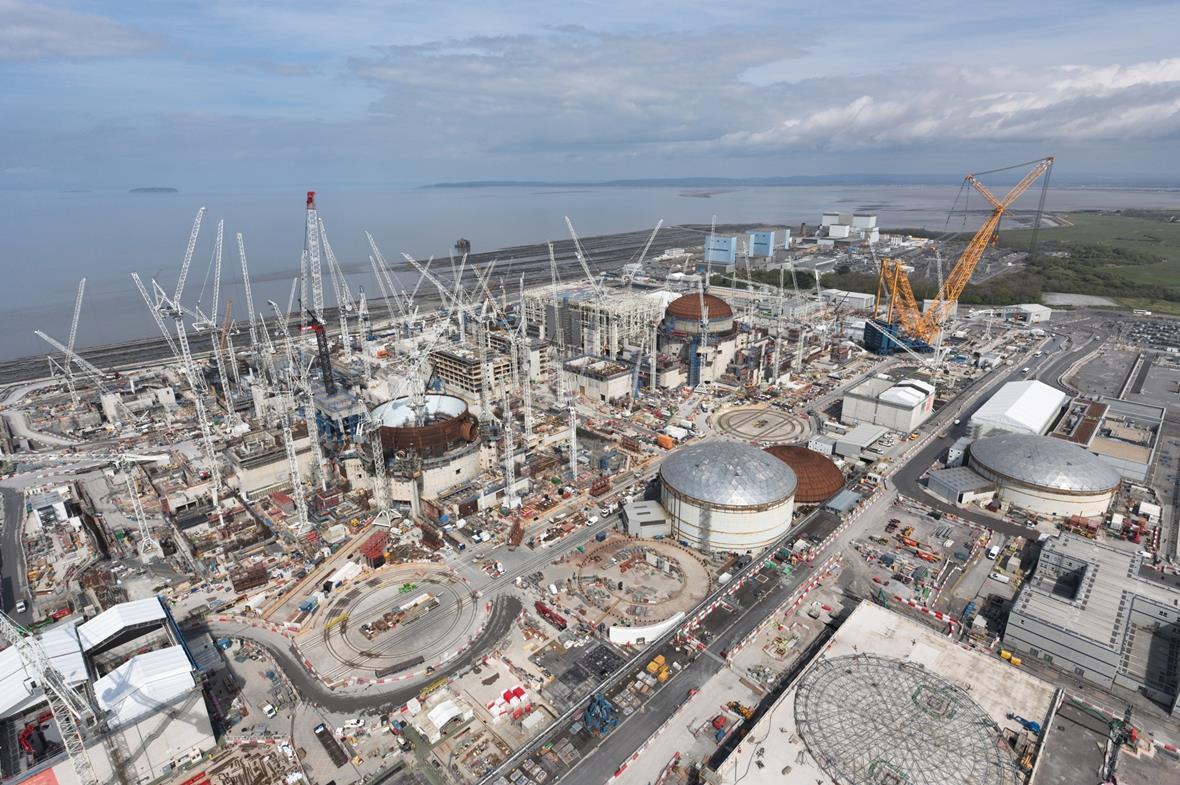
Clean Technica, Michael Barnard, 6th March 2026
The latest announcement about Hinkley Point C was predictable. The first reactor at the plant in Somerset is now expected to begin generating electricity in 2030. The cost estimate has climbed again, now reaching roughly £35B in 2015 pounds or about £49B in current money according to Electricité de France. When the project received final approval in 2016, the expected construction cost was £18B and the first reactor was expected to begin operating in 2025. In the span of a decade, the expected capital cost nearly doubled while the schedule slipped by five years. The project illustrates the pattern described by Oxford megaproject scholar Bent Flyvbjerg. Large infrastructure projects tend to run over budget, over schedule, and deliver fewer benefits than originally promised. Hinkley Point C appears to be achieving the full trifecta.
To understand how the project arrived at this point it is necessary to revisit the electricity system that existed when Hinkley was first proposed……………………………Policymakers faced a looming capacity gap as aging coal plants approached retirement under European pollution rules and older nuclear reactors approached the end of their operating lives. Large baseload nuclear plants seemed like a logical replacement for retiring coal and nuclear capacity while maintaining system reliability and reducing emissions.
EDF entered the picture in 2008 when it acquired British Energy for about £12.4B. This acquisition gave the French utility access to several UK nuclear sites including Hinkley Point in Somerset……………………… T.he UK government supported the project through a Contract for Difference that guaranteed a strike price of £92.50 per MWh in 2012 pounds for 35 years. Adjusted for inflation that price is now roughly £120 to £130 per MWh in current money.
The timeline of the project reflects the slow progress typical of large nuclear builds……………………………………………………….. The most recent revision places the cost at about £35B in 2015 pounds with startup expected in 2030. If the schedule slips to 2031, EDF estimates another £1B in additional cost..
Hinkley is not an isolated example. The reactor design used at the site is the European Pressurized Reactor. Other projects using this design have experienced similar difficulties. Olkiluoto 3 in Finland began construction in 2005 and entered commercial operation in 2023. The project took roughly 18 years from start to finish and cost about €11B compared with an original estimate of about €3B. Flamanville 3 in France began construction in 2007 and only began producing electricity in 2024 after more than a decade of delays and cost escalation. These projects demonstrate that modern nuclear construction faces structural challenges including complex regulatory oversight, large supply chains, and one-off engineering work.
While Hinkley Point C progressed slowly, the electricity system around it began to change rapidly. UK grid carbon intensity fell from about 520 gCO2 per kWh in 2006 to roughly 120 gCO2 per kWh in 2025 according to National Grid data. That represents a reduction of about 77%. Coal generation collapsed during the same period. In 2012 coal still produced about 40% of UK electricity. By 2024 the last coal plant closed and coal generation fell to zero. Gas generation initially increased as coal declined, providing a bridge fuel that cut emissions roughly in half per kWh compared with coal. At the same time renewable energy expanded quickly.
Wind power became the largest contributor to this change. ……………………………………………………………………………..
The grid also evolved to accommodate the growing share of renewable energy. Market reforms played a significant role. The Contract for Difference program created long term price stability for renewable developers………………High voltage direct current interconnectors connected the UK to electricity markets in France, Norway, Belgium, and Denmark. These interconnectors allow power to flow between regions and help balance variable generation.
Grid operations also changed to manage a system with lower inertia and higher renewable penetration. Batteries began appearing in grid services markets around 2017. These batteries provide fast frequency response and reserve capacity.
The economic dynamics of electricity generation shifted during the same period. Nuclear plants represent a form of megaproject economics. Each plant is a large custom built facility that takes many years to construct. Learning effects are limited because each plant is unique. Wind turbines and solar panels follow a different model. These technologies are manufactured in large volumes. Production learning and scale economies reduce costs over time. ………………………………………………………………..
The rising cost of Hinkley also raises questions about opportunity cost. The current estimated cost of about £49B in today’s money represents a very large capital investment. Offshore wind projects in Europe commonly cost between £2M and £3M per MW of installed capacity depending on location and turbine size. At £2.5M per MW, £49B could finance roughly 20 GW of offshore wind capacity. With a typical offshore wind capacity factor of about 45%, that capacity would produce around 79 TWh of electricity annually. Hinkley Point C is expected to produce about 25 TWh annually. The comparison is not exact because nuclear provides firm generation while wind is variable. The scale difference is significant.
……………………………………………………………………………………………………………. The next UK nuclear project, Sizewell C in Suffolk, raises obvious questions about what lessons policymakers are drawing from the experience at Hinkley Point C. Sizewell C is planned as a near replica of Hinkley using the same European Pressurized Reactor design and similar capacity of about 3.2 GW. The estimated construction cost is currently around £20B to £30B depending on assumptions about financing and schedule. Unlike Hinkley, the project will be financed through a regulated asset base model that allows developers to collect revenue from electricity consumers during construction. This structure reduces financing risk for investors but shifts more cost exposure onto the public.
The core question is whether the UK energy system in the 2030s and 2040s still requires additional nuclear megaprojects built on decade long timelines when wind, solar, and storage technologies continue expanding on much shorter deployment cycles. A second question concerns opportunity cost. If Sizewell C ultimately approaches the capital intensity seen at Hinkley, the same level of investment could finance tens of gigawatts of renewable capacity or large expansions of grid infrastructure. Policymakers therefore face a strategic choice between continuing the megaproject model for firm low carbon generation or allocating capital toward technologies that can scale incrementally and rapidly across the electricity system.
The broader lesson from the Hinkley experience concerns the pace of technological change in energy systems. Large infrastructure projects require long planning and construction timelines. Energy technologies such as wind turbines, solar panels, and batteries follow faster innovation cycles driven by manufacturing scale and global deployment. Between the time Hinkley Point C was conceived and the time it will enter operation, the UK electricity system transformed itself. Coal disappeared. Wind capacity expanded more than tenfold. Carbon intensity fell by more than three quarters. The project will arrive into a grid that has already undergone much of the transition it was designed to support.
https://cleantechnica.com/2026/03/06/while-hinkley-nuclear-was-being-built-the-uk-grid-decarbonized/
US Argues ‘Emergency’ of Iran War Means Israel Needs 20,000+ More Bombs Without Congressional Approval

This is the first time that the second Trump administration has formally declared an emergency, allowed under the Arms Export Control Act, to bypass Congress to sell arms to Israel. The administration has bypassed the informal approval process in Congress three times to sell arms or send weapons aid to Israel, but previously has not declared an emergency
‘Who cares about Israel’s genocide, apartheid, and aggression?” asked one human rights expert.
Jon Queally, Mar 07, 2026, https://www.commondreams.org/news/us-bombs-for-israel-iran-lebanon
The US State Department is hiding behind the war against Iran that was started by US President Donald Trump last week to justify an emergency order to ship more than 20,000 bombs—estimated at a value of $660 million—to Israel, skirting a pending approval process for the sale by Congress.
In a statement issued quietly on Friday night, the State Department said 12,000 BLU-110A/B general purpose, 1,000-pound bombs had been determined for approval, noting that Secretary of State Marco Rubio has “provided detailed justification that an emergency exists that requires the immediate sale to the Government of Israel of the above defense articles and defense services is in the national security interests of the United States, thereby waiving the Congressional review requirements under Section 36(b) of the Arms Export Control Act.”
Not included in the statement, according to the New York Times, were additional parts of the sale that “include 10,000 bombs of 500 pounds each and 5,000 small-diameter bombs.”
“This is an emergency of the Trump administration’s own creation.” —Rep. Gregory Meeks (D-N.Y.)
According to the Times:
The State Department did not mention these details in the announcement, but two current US officials and a former, Josh Paul, who worked on weapons transfers at the State Department, said they were part of the emergency sale. The current officials spoke on the condition of anonymity to discuss sensitive arms transactions.
This is the first time that the second Trump administration has formally declared an emergency, allowed under the Arms Export Control Act, to bypass Congress to sell arms to Israel. The administration has bypassed the informal approval process in Congress three times to sell arms or send weapons aid to Israel, but previously has not declared an emergency.
The push for the “emergency” arms sale comes as Israel pummels Lebanon with airstrikes, forcing an estimate 500,000 people or more in southern regions outside of Beirut to flee their homes. It also coincides with Israeli forces hitting targets in Iran alongside the US in what experts say is a wholly illegal attack on that country.
Rep. Gregory W. Meeks (D-N.Y.), ranking member of the House Foreign Affairs Committee, denounced the move by the Rubio in a Friday statement.
“Today’s invocation of the Arms Export Control Act’s emergency authority to bypass congressional review for two munitions cases to Israel exposes a stark contradiction at the heart of this administration’s case for war,” said Meeks. “The Trump administration has repeatedly insisted it was fully prepared for this war. Rushing to invoke emergency authority to circumvent Congress tells a different story. This is an emergency of the Trump administration’s own creation.”
Others also questioned the emergency sale, especially given Israel’s record of genocide in Gaza over the last two years and its pivotal role in pushing the Trump administration toward a war of choice with Iran.
Meeks, in his statement, argued that key questions about Trump’s war in Iran remain unanswered.
“What is the endgame? What preparations have been made to protect American citizens in the region? And how much will this war cost the American people?” asked Meeks. “The administration has provided no credible answers. The American people deserve answers, and Congress must demand them.”
A chilling reminder of the deceit & violence of Iraq war
March 09, 2026, by Bruce K. Gagnon
This film ‘Official Secrets’ is a true story. It’s now airing on Netflix and I urge folks to watch it.
‘Official Secrets,’ which opened in 2019, is the best movie ever made about how the Iraq War happened. It’s startlingly accurate, and because of that, it’s equally inspiring, demoralizing, hopeful, and enraging.
It’s been mostly forgotten now, but the Iraq War and its abominable consequences — the hundreds of thousands of deaths, the rise of ISIS terrorism, the nightmare oozing into Syria, arguably the presidency of Donald Trump — almost didn’t happen.
In 2003, as politicians in Britain and the US scheme to invade Iraq, GCHQ translator Katharine Gun leaks a classified e-mail that urges spying on members of the UN Security Council to force through the resolution to go to war.
Charged with breaking the Official Secrets Act, and facing imprisonment, Katharine and her lawyers set out to defend her actions. With her life, liberty and marriage threatened, she must stand up for what she believes in…
During this present Iran war – packed with lies, distortions and evil boasts of killing by the US and Israel – this 2019 film reveals the kind of ugly twists and turns that are regularly used to pull the wool over the public’s eyes.
Now and then a principled person stands against the dark wall of endless war.
Marco spills the beans…’Bibi made us do it’

Walt Zlotow, Mar 04, 2026, Walt Zlotow West Suburban Peace Coalition Glen Ellyn IL, https://substack.com/home/post/p-189862460
In 4 days of immoral, criminal war on Iran, the Trump administration changes the rationale every day, indeed almost every hour.
The most preposterous comes from supreme American warmonger Marco Rubio who masquerades as Secretary of State while every fiber of his damaged soul plots endless war.
“It was abundantly clear that if Iran came under attack by anyone, the United States, Israel, or anyone, they were going to respond and respond against the United States. If we stood and waited for that attack to come first, before we hit them, we would have suffered much higher casualties. And so the president made the very wise decision. We knew that there was going to be an Israeli action, we knew that that would precipitate an attack against American forces,”
Rubio could not have been more disingenuous. He’s pretending we’re a neutral observer that will be involved if Israel attacks and must attack first to avoid US casualties. . He knows full well the US and Israel have been plotting together to destroy Iran for decades. He’s spent the last year as Secretary of State involved in that war plotting. The US wants to extend its dominance over the entire Middle East while Israel wants to eliminate its only hegemonic rival in the region. Together the US, Israeli tag team seeks to accomplish both imperialistic goals.
The combined attack February 28 was a replay on steroids of the smaller combined preemptive attack last June. Since it didn’t accomplish regime change and Iran’s destruction, Netanyahu and Trump decided to launch an all out war to the death. This time Americans are dying along with Israelis, and the shutdown of oil production and transit may send America spiraling into a major recession.
Since few Americans are buying into this madness, rejecting one Trump justification after another, Rubio came to the rescue. ‘I’ve got it’ he proclaimed. ‘We’ll tell the public that we had to attack because it was the only way to save American lives after Israel attacks Iran. We’re simply playing defense.’
Rubio’s logic would be hilarious if not for the fact that it guarantees US body bags coming home as a result of Rubio’s self-licking ice cream cone.
Cardinals McElroy and Cupich denounce Iran war: ‘War now has become a spectator sport.’
“Our government is treating the suffering of the Iranian people as a backdrop for our own entertainment,”
by Edward DesciakMarch 9, 2026, https://www.americamagazine.org/politics-society/dispatches/2026/03/09/cardinal-mcelroy-cupich-iran-war/?utm_source=ActiveCampaign&utm_medium=email&utm_content=Cardinals%20McElroy%20and%20Cupich%20denounce%20Iran%20war%3A%20%20War%20now%20has%20become%20a%20spectator%20sport&utm_campaign=Daily%203%209%2026
Following the United States and Israel’s overnight missile barrage of Iran on Feb. 28 and the widening war across the Middle East, a number of U.S. bishops have spoken out in opposition to the war.
They underscored an urgent need for peace and a return to diplomacy, denounced as unjust American and Israeli military aggression and expressed deep concern for the millions in the region affected by the armed conflict.
“At this present moment, the U.S. decision to go to war against Iran fails to meet the just war threshold for a morally legitimate war,” Cardinal Robert McElroy of the Archdiocese of Washington, D.C., said.
In an interview with the Catholic Standard on March 9, he explained that the U.S. offensive operations failed to meet at least three criteria of just war theory—the Catholic framework for evaluating the morality of military action—including the requirements for just cause, right intention and clarity that “the benefits of this war will outweigh the harm which will be done,” made impossible by the unpredictability of the region
Cardinal McElroy said: “Almost everyone rightly believes that the Khamenei regime has been for decades a brutal and repressive government that has spread terrorism throughout the world and should be replaced. But there is immense concern that this war will spiral out of control and embroil the United States in ever greater depth.”
The cardinal, who has also voiced opposition to the Trump administration’s mass deportation policy, mentioned particular concern for the military families he has spoken with who are worried about their loved ones’ safety.
“We must all work together to forbid this expansionism to lead us into an ongoing morass in Iran,” he said, expressing his “deepest concern” for the “deterioration of moral norms” in the United States and the world, signified by the growing willingness to turn to preventative war over diplomacy as a legitimate means of foreign policy.
Cardinal McElroy’s responses echoed comments from Cardinal Blase Cupich of the Archdiocese of Chicago, who criticized the war and the Trump administration’s mix of militarism and entertainment in a statement on March 7.
Cardinal Cupich cited a post from the official White House X account captioned “JUSTICE THE AMERICAN WAY” that spliced clips from popular action movies, cartoons and TV shows “with actual strike footage from their war on Iran.”
It was one of many edits the White House has posted over the last few days in which the account has similarly spliced together video footage of the war with NFL and MLB highlights and video game references.
“A real war with real death and real suffering being treated like it’s a video game—it’s sickening,” Cardinal Cupich said. “This horrifying portrayal demonstrates that we now live in an era when the distance between the battlefield and the living room has been drastically reduced.”
He noted that the social media post dishonored the six U.S. soldiers who had been killed at that point during the war (the death of another service member was confirmed on March 8) as well as the hundreds of others who have died across the Middle East, “including the scores of children who made the fatal mistake of going to school” the day a U.S. missile struck a naval base next to an elementary school in Iran, killing 175 people.
“The moral crisis we are facing is not just a matter of the war itself, but also how we the observers, view violence, for war now has become a spectator sport or strategy game,” Cardinal Cupich wrote, referencing a particularly macabre scandal involving the popular prediction market site Kalshi, where Americans can now gamble on matters of life and death. The company is the respondent in a $54 million class action lawsuit after it declined to pay out wagers on whether Iran’s Supreme Leader Ali Khamenei would be ousted by March 1, citing a “death carveout.”
Cardinal Cupich also urged the American people not to “become addicted to the ‘spectacle’ of explosions.”
“Our government is treating the suffering of the Iranian people as a backdrop for our own entertainment,” he wrote, “as if it’s just another piece of content to be swiped through while we’re waiting in line at the grocery store.”
“I know that the American people are better than this. We have the good sense to know that what is happening is not entertainment but war, and that Iran is a nation of people, not a video game others play to entertain us,” he concluded.
The cardinals joined the president of the U.S. Conference of Catholic Bishops, Archbishop Paul Coakley, who followed Pope Leo XIV’s lead and released a statement on March 1 condemning the hostilities: “We ask for a halt to the spiral of violence, and a return to multilateral diplomatic engagement that seeks to uphold the ‘well-being of peoples, who yearn for peaceful existence founded on justice.’”
Archbishop Coakley added: “I invite Catholics and all people of goodwill to continue our ardent prayers for peace in the Middle East, for the safety of our troops and the innocent, that leaders may seek dialogue over destruction, and pursue the common good over the tragedy of war.”
The Archdiocese of New York’s new archbishop, Ronald Hicks, also commented on the Iran crisis in a brief interview for 1010 WINS on March 5, calling for prayers and diplomacy. “We have to give some special prayers for our men and women in uniform and pray for their protection, too, and everyone involved,” he said. “It is absolutely heartbreaking.”
As proposals for nuclear stations proliferate across Canada, ‘fleet-based’ reactor deployment remains elusive.

The Ontario government announced last summer a body called the New Nuclear Technology Panel, composed of senior executives from OPG, Bruce Power and the government, and instructed it to co-ordinate a technology selection decision. But the panel has not been established, and there is no timeline for doing so.
among those few proponents that have publicly committed to specific models, at least three have already wavered on their decisions. The situation underlines how tentative plans for nuclear expansion in Canada remain
Matthew McClearn, 9 March 26, https://www.theglobeandmail.com/business/article-nuclear-stations-canada-fleet-based-reactor-deployment-remains-elusive/
In the nuclear industry it is practically gospel: Canada isn’t populous or wealthy enough to purchase a smorgasbord of different nuclear reactors. Yet after years of lukewarm efforts by Canadian utilities and governments to reach a consensus on which ones to buy, there are few indications that one is emerging.
In January, Saskatchewan’s government announced it had begun evaluating large nuclear reactors for potential deployment. Jeremy Harrison, a minister whose responsibilities include the Crown-owned SaskPower, said the utility will study the readiness of reactors to be built, vendors’ ability to support licensing and construction, and their track record of executing previous projects.
Ontario’s utilities have been asking similar questions for several years. In 2023 Bruce Power began hunting for a reactor for Bruce C, a proposed four-unit station at its facility near Tiverton, Ont. Ontario Power Generation recently began its own search for a huge plant dubbed Wesleyville, planned in Port Hope, Ont.
Observers have long warned that given Canada’s population and economy, utilities, private developers and provinces must co-ordinate procurement of reactors – an approach sometimes dubbed “fleet-based deployment.” But it hasn’t arrived yet.
Indeed, among those few proponents that have publicly committed to specific models, at least three have already wavered on their decisions. The situation underlines how tentative plans for nuclear expansion in Canada remain, even as governments forecast spiking demand for electricity in the immediate future and consider their options for generating that power.
All 25 reactors built in Canada during the 1960s through the 1990s featured Canada deuterium uranium (Candu) technology developed by Atomic Energy of Canada Ltd., a Crown corporation. One benefit was that later Candus, such as those at the Bruce B and Darlington stations, proved significantly more reliable than earlier ones in that they suffered fewer outages. Similar dynamics applied when those stations required midlife overhauls. Another advantage was that utilities could share operational experience through the Candu Owners Group (now known as Conexus Nuclear).
By the time the federal government began promoting small modular reactors (SMRs), though, the Candu’s monopoly seemed precarious, and international vendors arrived promoting early-stage designs. In 2018 the government published a “roadmap” for SMRs, recommending stakeholders settle on a small number of finalized designs.
Jeremy Whitlock, a nuclear consultant and adjunct professor at McMaster University, wrote in an e-mailed response to questions that fleet-based deployment is vital for nuclear. “There is simply not enough infrastructure, resources, and (currently at least) work force to support multiple lines of technology,” he wrote.
A report released in February by Clean Prosperity, a Toronto-based energy and climate policy think tank, asserted that one necessary precondition for nuclear expansion is that all proponents converge on three designs at most: one “large” design with a capacity of 1,000 megawatts or more (enough to power a large city), one “small” reactor with an output around 300 megawatts, and one “micro” reactor putting out less than 20 megawatts.
Brendan Frank, Clean Prosperity’s head of policy development, said a first-of-a-kind reactor is far too expensive; the industry needs to learn how to build subsequent units more cheaply to compete with other generation options. “Your chances of doing that are significantly higher if you build the same reactor design over and over and over again,” he said.
The BWRX-300 from U.S.-based GE Vernova Hitachi Nuclear Energy has seemingly emerged as the lone contender among the larger SMRs. Yet only OPG has committed to build one.
As for large and micro-reactors, no firm orders have been placed in Canada. However attractive fleet-based deployment might seem, it might be difficult to achieve. Selecting a model has numerous implications, from securing a fuel supply to managing the resulting waste; what’s best for Ontario mightn’t seem so for Saskatchewan or New Brunswick.
Nuclear power is among the few generation options that has grown more expensive, and eliminating pricing competition by sourcing from a single reactor vendor won’t help
Options are limited. AtkinsRéalis Group Inc.
ATRL-T -1.07%decrease, the company which purchased Atomic Energy of Canada’s reactor business more than a decade ago, is developing an updated 1,000-megawatt Candu dubbed the Monark. Its most significant home-court advantage is that utilities and their workers are already familiar with operating and maintaining Candus. Moreover, its supply chain is on Canadian soil, an appealing feature amid surging economic nationalism. Its greatest vulnerability might be its readiness: The Canadian Nuclear Safety Commission says it has not yet begun a preliminary assessment of the Monark, known as a vendor design review.
The CNSC reviewed the Monark’s most obvious competitor more than a decade ago. It concluded there were “no fundamental barriers” to licensing Westinghouse Electric Co.’s AP1000. Although AP1000s have been built in China and the U.S., the American projects suffered disastrous setbacks during construction. Souring Canada-U.S. relations further diminish the AP1000’s appeal.
GE Vernova Hitachi, which designed the BWRX-300, faces similar obstacles in marketing its larger Advanced Boiling Water Reactor. Dark horses include the European Pressurized Reactor, a French design, and the South Korean APR-1400.
If fleet-based deployment is to succeed in Canada, Ontario appears to be the most credible co-ordinator. Between Bruce C and Wesleyville, it might purchase up to 14 large reactors.
Neither OPG nor Bruce Power specified reactors in their regulatory applications, which are intended to encompass a variety of options. Bruce Power’s chief operating officer, James Scongack, said since late 2023 his company has sought information from reactor vendors, a process intended to ascertain which reactors are ready to be constructed and at what cost. The process “was really designed to look at what are all the technologies available for new nuclear, assess them, review them, narrow them down,” he said.
Citing confidentiality agreements, Mr. Scongack declined to discuss which ones had emerged as front-runners. But “we’re now very focused on options that would not be a surprise to you.”
The Ontario government announced last summer a body called the New Nuclear Technology Panel, composed of senior executives from OPG, Bruce Power and the government, and instructed it to co-ordinate a technology selection decision. But the panel has not been established, and there is no timeline for doing so.
Lately, Ontario Energy Minister Stephen Lecce has spoken emphatically about the importance of promoting Canadian technology and supply chains – comments suggesting strong support for Candus.
“My first preoccupation is: What is going to advance the national interest of Canada in a post-Trump world,” he told The Globe in late January.
“We need to be fiercely protective of our intellectual property, of Canadian technology for Candu, a large-scale [reactor] that is made in Canada, stored in this country, a supply chain that is Canadian, a work force that is mature and Canadian.”
But a different champion could emerge in Saskatchewan. As far back as 2022, SaskPower selected the BWRX-300. Yet just two years later, SaskPower announced it had signed an agreement with Westinghouse to evaluate other models including its AP300, a direct competitor.
That sudden interest in Westinghouse didn’t come out of nowhere. The uranium giant Cameco Corp. CCO-T +5.86%increase, based in Saskatoon, is one of the province’s most influential companies. In 2023 it purchased a 49-per-cent stake in Westinghouse.
Mr. Harrison said the AP300 is no longer under consideration, and SaskPower confirms it’s planning to announce a proposed site for building BWRX-300s later this year. But SaskPower won’t make a final investment decision until at least 2029, leaving plenty of time to pivot again.
And that’s one reason Saskatchewan’s decision to explore large reactors could be highly significant. Mr. Harrison said the province is prepared to go its own way. And while SaskPower will consider candidate reactors on their merits, he added that local companies’ interests are an important consideration.
“We are really very, very proud of Cameco, a great Saskatchewan company,” Mr. Harrison said. “To be a 49-per-cent owner of this iconic American company, Westinghouse Electric, is really a quite an amazing story for a company that began life as a Crown corporation.”
He added: “Without question, benefits to the supply chain in Saskatchewan is a part of the consideration. We’ve been very upfront about that.”
Energy Alberta, a nascent developer with a long-standing proposal to build a four-reactor plant in Peace River, Alta., offers perhaps the most striking example of indecision. It had selected the Monark, but late last year announced it was considering Westinghouse’s AP1000s instead.
New Brunswick selected two reactors for construction at its Point Lepreau station nearly a decade ago. But neither the ARC-100 nor the SSR-W appear to be nearing a completed design; their vendors (ARC Clean Technology and Moltex Energy Canada, respectively) have few employees and have struggled to raise capital.
NB Power’s chief executive officer, Lori Clark, said her utility remains committed to building reactors. But it has come around to fleet-based thinking: it no longer wants to build a first-of-a-kind, or one-of-a-kind, reactor, because they are inevitably costlier. Provincial officials have expressed interest in a variety of different reactors over the past year, including the BWRX-300, AP1000 and Candu.
“We want to watch what’s happening in Ontario, because they are much bigger player in the nuclear field than we are.”
Hungary detains Ukrainians transporting tens of millions in cash and gold
Hungarian authorities have launched an investigation into potential money laundering, but Ukraine insists those facilitating the transfer were state-owned bank employees carrying out their job

Thomas Brooke, ReMix News, 2026-03-06, https://rmx.news/article/hungary-detains-ukrainians-transporting-tens-of-millions-in-cash-and-gold/
Hungarian authorities have detained seven Ukrainian citizens and seized tens of millions of dollars, euros, and gold that were being transported through the country in armored vehicles, triggering the latest diplomatic dispute between Budapest and Kyiv.
Hungary’s National Tax and Customs Administration (NAV) confirmed on Friday that criminal proceedings had been launched on suspicion of money laundering following an operation carried out on March 5. Authorities intercepted two armored cash-transport vehicles traveling through Hungary from Austria toward Ukraine.
According to the Hungarian authorities, the vehicles were carrying approximately $40 million, €35 million in cash, and 9 kilograms of gold.
Hungarian Foreign Minister Péter Szijjártó said the case raised serious questions about the movement of large quantities of physical cash through the country.
“Since January, a total of $900 million and €420 million in cash has been transported through Hungary, and 146 kilograms of gold bars have also been transported through the country,” he said, as cited by Magyar Hírlap.
“We have a number of serious questions about this. First of all, this is a huge amount of cash, and we wonder why Ukrainians need to transport such a large amount of cash. If it is true that this is a transaction between banks, then the question rightly arises as to why the banks do not settle this between themselves by bank transfer, why it is necessary to transport such a large amount of cash, and why it has to be transported through Hungary,” Szijjártó added.
“These questions arise mainly because these cash shipments are accompanied by people who have clear ties to Ukrainian secret services.”
Hungarian Prime Minister Viktor Orbán’s political director, Balázs Orbán, also commented on the case, raising concerns about the purpose of the funds.
“Hundreds of millions in cash and gold moving through Hungary toward Ukraine — escorted by people linked to Ukrainian intelligence. Armored vehicles, suitcases full of money, staggering sums,” he wrote on X……………………………………………………………………………………….. https://rmx.news/article/hungary-detains-ukrainians-transporting-tens-of-millions-in-cash-and-gold/
Long-term safety forecasting for nuclear waste repositories needed

Simon Schmitt Kommunikation und Medien
Helmholtz-Zentrum Dresden-Rossendorf 24/2 /2026
The Federal Ministry for the Environment, Climate Protection, Nature Conservation and Nuclear Safety (BMUKN) supports applied basic research that is helpful for the site selection of a deep geological repository for high-level radioactive waste. Approximately 1.7 million euros have been allocated to the MALEK project. MALEK aims to develop a portfolio of methods to support the safety assessment of a nuclear waste repository. This includes developing methods that make it possible to model transport and reaction processes in crystalline host rock over a period of one million years. The project is coordinated by the Institute of Resource Ecology at Helmholtz-Zentrum Dresden-Rossendorf (HZDR).
The disposal of high-level radioactive waste presents a major technical and societal challenge. Safety is a key factor in evaluating potential sites for deep geological repositories. With this funding initiative, the Ministry seeks to address existing knowledge gaps: new research and development projects are intended to establish and further advance the scientific foundations needed to assess the safe disposal of radioactive waste.
Designed to run for 36 months, the MALEK project (Machine Learning for Complex Hydrological-Geochemical Processes in Crystalline Rock Repositories) is investigating how models should be designed to be able to predict worst case scenarios for radionuclide retention within a repository. Predictions are needed that span spatial scales from millimeters to kilometers and timescales of up to one million years. In this context, conventional numerical models and simulation methods reach their computational limits.
MALEK therefore pursues an approach that systematically augments physics-based models of radionuclide transport with machine learning methods. The key advantage is a substantial acceleration of complex simulations without disregarding the underlying physical and chemical processes. A central tool in this context is the use of so-called surrogate models: machine-learning models trained on data generated by computationally intensive simulations. Once trained, these models can replace the original simulations. Although the results are approximations, the fact that they are available much faster than those of detailed simulations is crucial.
“Surrogate models will be deployed at multiple stages throughout the overall project,” explains project coordinator Prof. Vinzenz Brendler, head of the “Thermodynamics of Actinides” department at HZDR’s Institute of Resource Ecology. “One example is sorption—how strongly radionuclides attach to rocks or minerals. This depends heavily on the surrounding chemical conditions. The stronger the binding, the more slowly radionuclides can migrate through the subsurface. Another planned surrogate model addresses reactive transport through the rock matrix. This process depends not only on sorption, but also on diffusion processes, rock properties, and chemical reactions.”
Focus on accurate, robust, and transparent methods
“MALEK will lead to understandable, verifiable, and reproducible modeling approaches, thereby making an important contribution to more robust safety assessments,” says Dr. Attila Cangi, head of the “Machine Learning for Materials Design” department at CASUS. “Our goal is to transfer the expertise we have developed in machine-learning models for the microscopic description of materials to this application, since the underlying methodological challenges are closely related.” Prof. Michael Hecht, head of the CASUS Young Investigator Group “Mathematical Foundations of Complex Systems Science”, emphasizes the planned systematic evaluation of the developed modules: “From individual surrogate models to their combinations and ultimately to different versions of an integrated assessment model, the central question is which solutions are best suited in terms of accuracy, robustness, and transparency.” To this end, extensive benchmarking and uncertainty analyses will be conducted, incorporating experience from underground research laboratories such as Äspö in Sweden and Grimsel in Switzerland.
MALEK focuses on crystalline host rock, one of the host rock types under consideration in Germany for a deep geological repository. Because the rock itself is usually very dense, fractures and fault zones play a decisive role: they control groundwater flow and thus the transport of dissolved substances such as radionuclides. These complex structural features make crystalline rock particularly challenging from a scientific perspective, and the project is therefore expected to deliver especially valuable insights.
The project, which started in early 2026, will benefit from the partners’ complementary expertise. Prof. Brendler and his team contribute experience in geochemistry, reactive transport modeling, and the development of data-driven methods. Dr. Cangi and Prof. Hecht provide expertise in machine learning and mathematical surrogate modeling. Prof. Thomas Nagel from TU Bergakademie Freiberg is an expert in issues related to fractured porous geomaterials as well as geotechnical simulations and verifications. Prof. Denise Degen from TU Darmstadt contributes expertise in uncertainty analysis in the geosciences, which helps simplify complex computational models based on physical laws.
Additional information:
Prof. Vinzenz Brendler | Head of Thermodynamics of Actinides
Institute of Resource Ecology at HZDR
phone: +49 351 260 2430 | email: v.brendler@hzdr.de
Media contact:
Dr. Martin Laqua | Officer Communications, Press and Public Relations
Center for Advanced Systems Understanding (CASUS) at HZDR
cell phone: +49 1512 807 6932 | email: m.laqua@hzdr.de
1 This Month
10 March A LIVE WEBINAR THE REAL EFFECTS OF NUCLEAR POWER
What the Industry Isn’t Telling Us
1:00 PM Mountain, 2 pm Central, 3 pm Eastern. Live on the Keepers of the Water Facebook page



18 March Webinar @ 1 PM EST: An Assessment of SMR Projects: The Case of Canada
register for the zoom:
https://us02web.zoom.us/webinar/register/WN_o8BIIOUvQ2ONJR1nta65DQ#/registration


of the week – STOP SMALL MODULAR REACTORS IN CANADA
To see nuclear-related stories in greater depth and intensity – go to https://nuclearinformation.wordpress.com
-
Archives
- March 2026 (129)
- February 2026 (268)
- January 2026 (308)
- December 2025 (358)
- November 2025 (359)
- October 2025 (376)
- September 2025 (258)
- August 2025 (319)
- July 2025 (230)
- June 2025 (348)
- May 2025 (261)
- April 2025 (305)
-
Categories
- 1
- 1 NUCLEAR ISSUES
- business and costs
- climate change
- culture and arts
- ENERGY
- environment
- health
- history
- indigenous issues
- Legal
- marketing of nuclear
- media
- opposition to nuclear
- PERSONAL STORIES
- politics
- politics international
- Religion and ethics
- safety
- secrets,lies and civil liberties
- spinbuster
- technology
- Uranium
- wastes
- weapons and war
- Women
- 2 WORLD
- ACTION
- AFRICA
- Atrocities
- AUSTRALIA
- Christina's notes
- Christina's themes
- culture and arts
- Events
- Fuk 2022
- Fuk 2023
- Fukushima 2017
- Fukushima 2018
- fukushima 2019
- Fukushima 2020
- Fukushima 2021
- general
- global warming
- Humour (God we need it)
- Nuclear
- RARE EARTHS
- Reference
- resources – print
- Resources -audiovicual
- Weekly Newsletter
- World
- World Nuclear
- YouTube
-
RSS
Entries RSS
Comments RSS
 nuclear-news