An attendee told The Grayzone that oil industry heavyweights were less excited about Trump’s Venezuela policy, privately complaining about the President’s aggressive push to restart their operations.
When the American Petroleum Institute (API) gathered oil industry leaders and lobbyists for a “State of American Energy” summit on January 16, 2026, the geopolitical landscape seemed to be shifting dramatically in their favor. However, an attendee of the resource extraction cartel’s most important annual lobbying conference told The Grayzone that participants privately grumbled about President Donald Trump’s heavy-handed attempts to steer their agenda, particularly in Venezuela, where he has demanded they immediately restart operations.
Two weeks before the API summit, the US military kidnapped Venezuelan President Nicolas Maduro in a violent raid, enabling the Trump administration to commandeer the country’s oil reserves. Meanwhile, foreign-backed riots left thousands dead in oil-rich Iran on January 8 and 9, generating enough instability to excite Western governments about the prospects of regime change.
From the stage at Washington DC’s Anthem theater, veteran industry consultant Bob McNally of the Rapidan Energy Group could not contain his excitement over the prospect of toppling the Islamic Republic of Iran.
“Iran holds the biggest promise as well, though they’re the biggest risk, but the biggest opportunity,” McNally proclaimed. “If you can imagine the United States opening an embassy in Tehran, the regime in Tehran reflecting its people – the most pro American population outside of Israel in the Middle East, culturally, commercially adept – historic. If you can imagine our industry going back there, we would get a lot more oil, a lot sooner than we will out of Venezuela.”
According to McNally, who formerly advised President George W. Bush on energy policy, a US regime change war on Iran would be a “terrible day for Moscow, [a] wonderful day for the Iranians, the United States, the oil industry and world peace.”
However, like many industry titans at the API summit, McNally saw Venezuela as a high-risk, low-return investment, even after the de facto US takeover of its resources. “Since the President’s decision to apprehend Nicolas Maduro, I think we’ve seen, you know, private conversations, the meeting at the White House, the administration has had to learn, you don’t go into Venezuela, turn a tap and 3 million barrels a day flow. It doesn’t happen like that,” he commented.
McNally went on to suggest the oil industry was pushing back on Trump’s demands that it immediately reinvest in Venezuela: “The prize in Venezuela is getting back from below a million barrels a day to between three and four million barrels a day, and that we will measure in many years and many decades. And that’s the truth. And the industry is speaking that truth to the administration.”………………………………………………………………………………………………………………………………………………..
The oil lobby sponsors a TV show to glorify itself
The API “State of American Energy” summit’s program closed with a session which demonstrated the power of America’s oil lobby to influence Hollywood content.
On stage beside actor Andy Garcia, a star of a new Paramount+ show, Landman, API President Mike Sommers boasted about his role in sponsoring a dramatic series which glorifies a heavily maligned industry on a Trump-aligned network.
According to Axios, API provided Landman with “a seven figure ad campaign,” ensuring the show’s viability on Paramount+, a network purchased in 2025 by the pro-Trump, ultra-Zionist billionaire heir David Ellison.
Landman’s plotlines sell viewers on the image of America’s extraction industry as a vital force that is entitled to bend the rules and make crooked deals in order to keep the oil flowing. In one episode, the roguish “landman” protagonist Tommy Norris, played by Billy Bob Thornton, finds himself involved in a turf war with a Mexican narco-cartel which controls a valuable plot of land. To increase his leverage over the cartel, Tommy threatens to trigger Drug Enforcement Agency (DEA) involvement unless they stand down. Ultimately, the cartel agrees to co-exist with Tommy’s company, M-Tex Oil, ensuring secure drilling and lucrative profits.
It’s a plot that could have been ripped from actual headlines about the US oil industry’s secret dealings with Mexican cartels and designated terrorist groups. And just months after the Trump administration initiated a legally dubious anti-drug operation off Venezuela’s coast to increase pressure on Maduro, who now languishes in a federal prison cell as Washington dictates energy policy to Caracas, the API-sponsored Landman feels increasingly like predictive programming. https://thegrayzone.com/2026/02/13/iran-war-opportunity-oil-lobbys/
The unexplained illnesses and deaths of animals, a desert veterinary clinic run by a uranium mining corporation, and its attempts to ignore the troubling facts are perplexing.
Orano has set a stark precedent, demonstrating that even lenient mining laws are no real constraint. According to activists, the company simply ignored the required environmental impact assessment for some of its ISL mining projects in Dornogobi Aimag. Coincidentally, Orano was also bribing officials to secure mining licenses during this same period.
Environmentalists square off against a French mining company.
On a warm April 1st day last year, Budee Khekhee, head of local non-profit The Power of Unity for the Sake of Our Homeland, led a team into the Gobi Desert to investigate reports of a mysterious illness causing the death of wild and domestic animals, which he obtained from the local herders. A former resident who’d assisted his father’s veterinary work, Budee knew the terrain and knew authorities had ignored previous alarms.
In Zamyn Ud, they spotted numerous white-tailed gazelles lying on the ground, unable to get up, and twitching their legs convulsively. The activists livestreamed their discovery. “My heart was overwhelmed with despair,” Budee later testified. “I realized I couldn’t just abandon them here to die.”
Suspecting that the epidemic was caused by French uranium company Orano’s in-situ leach operations, he loaded four gazelles aboard a truck and drove to the corporation’s clinic gate, broadcasting on Facebook. Orano had built and was operating a veterinary clinic in the mining area. Budee didn’t trust them a lot, but he hoped that the staff would assist in rescuing the animals. Those hopes were dashed when, after two hours of standing outside the locked clinic doors, no one appeared, and the animals died. Left with little choice, the activists dissected the gazelles’ bodies and took tissue samples for independent analysis. They livestreamed their actions to Facebook.
For many Mongolian herders, resource neocolonialism is not an abstract concept. They have resulted in tangible losses, illness, and deaths. Descendants of the Mongol Empire now face uranium mining invaders. After the Soviets departed—leaving behind a legacy of toxic mining—the “clean” French uranium industry arrived, reproducing similar patterns of corruption while poisoning the land. At the same time, these colonialists have participated in the persecution of environmental activists.
Should they be held accountable before domestic and international communities?
The Revenge
In official reports, human rights defenders often refer to the persecution of activists as “unjust” or “disproportional punishment.” However, what happened in the case of the Mongolian herders was closer to pure revenge. Unidentified individuals made police reports accusing Khekhee of illegal hunting. He was subjected to repeated questioning for several months after the criminal investigation began.
The local prosecutor’s office then reclassified the matter as an administrative offense. The state’s Environmental Protection Office determined that Khekhee illegally pursued and killed four gazelles. They penalized him $1,200, a substantial sum for an average Mongolian. His July appeal was denied in full in September, but the court of first instance postponed the sentence for three months, thereby conceding that the case lacked merit.
Neither the investigation nor the court determined why Budee Khekhee allegedly needed to kill the gazelles. However, a local journalist discovered the “motive,” writing in August 2025 that it was done “to mislead the public about the consequences of uranium mining by the joint Mongolian-French enterprise ‘Badrakh Energy’ LLC.”
Prosecution for Independent Dosimetry
The unexplained illnesses and deaths of animals, a desert veterinary clinic run by a uranium mining corporation, and its attempts to ignore the troubling facts are perplexing. Especially when combined with the absurd accusation of poaching directed at an environmental activist whose action was widely livestreamed. When connected to other similar events, a pattern emerges.
In mid-August 2025, the same non-profit invited Russian nuclear physicist Andrey Ozharovskiy to conduct dosimetry measurements. Their focus on radioactive pollution was encouraged by groundwater assessments, which had revealed high uranium and arsenic levels in the area. Ozharovskiy, who had extensive experience in identifying radioactive sources, agreed to come. He entered Mongolia legally with his dosimetry and spectrometry equipment for “business purposes.”
On August 15–17, activists drove him along dirt roads in the Gobi Desert to Orano’s pilot ISL uranium extraction wells, where locals reported trucks carrying pregnant solution or liquid waste. It didn’t take the Russian expert long to discover three dried-up puddles emitting gamma radiation 20-50 times above background levels. Spectrometry identified uranium decay products—radium-226, bismuth-214, and lead-214, which, according to Ozharovskiy, was consistent with mining spills rather than natural radiation. The activists published their finding on social media, and this is how the Mongolian authorities learned about the expedition.
The group later traveled across Mongolia along similar dirt roads to Maradai. On August 19, while measuring radiation near abandoned Soviet mining sites, the group was detained by a border officer and some people in plain clothes. According to the activists, the authorities used drones to spot them in the desert. After spending a day or two in several offices, Ozharovskiy was transferred to the Main Intelligence Directorate in Ulaanbaatar. There, after being questioned, he was told that he was suspected of espionage and immigration violations.
Although the authorities released Ozharovskiy, they took his passport so that he couldn’t leave the country. A few days later he was taken again, forced to admit administrative violations, including using unregistered dosimetry devices, and to pay a fine. Then they brought him to the border with Russia and expelled him without his belongings but with a 10-year entry ban. The local activists, meanwhile, have spoken of intimidation, police reporting requirements, smartphone searches, and non-disclosure agreements.
In the same days the Mongolian Nuclear Regulatory Commission issued a formal statement, where accused Ozharovskiy of spreading false information about radiation background. Some media labeled the activists foreign agents undermining Franco-Mongolian projects in Russia’s interest.
A System That Favors Abuse and Distrust
Mongolian law prohibits radiation measurements using devices that haven’t been registered with the country’s Nuclear Regulatory Commission. After his first detention, Ozharovskiy donated some of his measuring devices to the non-profit. Activists brought them to the NRC but were denied certification with no clear explanation. The only reason provided, though invalid, was that the devices belonged to a Russian citizen.
The activists explained why they hadn’t registered the devices beforehand: they didn’t want authorities to know about their survey in advance. “If they knew about the devices, they wouldn’t let us measure anyway,” one activist said. “We don’t trust them,” Khekhee added.
This distrust is entirely justified given the broader context documented by prominent human rights organizations. Mongolia has earned a reputation for cracking down on critics and human rights defenders, particularly those challenging the mining industry. Amnesty International’s 2024 report documents that criticism of authorities and mining corporations has become effectively criminalized. According to the report Our Land, these corporations commit massive environmental violations, causing significant environmental pollution and deterioration of public health, and undermining traditional Mongolian livelihoods. To attract investors, Mongolian mining lobbyists even managed to pass corporate-friendly legislation. According to Our Land, in 2006 and again in 2013–2015 they weakened environmental safeguards, reducing water protection zones and allowing mining on private and even protected lands.
While the new multi-year energy program favors nuclear power, our investigation reveals that the final bill for the EPR2 reactor program could reach nearly 250 billion euros.
“EDF presents its provisional estimate for the EPR2 program at 72.8 billion euros,” read a press release from the group on December 18 .
The final cost estimate for the construction of the first series of six French -made nuclear reactors at the Penly (Seine-Maritime), Gravelines (Nord), and Bugey (Ain) sites, of the EPR2 type (approximately 1,650 megawatts of power), is expected this spring. EDF and its shareholder, the French State, hope for a final investment decision by the end of the year.
German Chancellor Friedrich Merz has initiated talks with France on strengthening Europe’s nuclear deterrent as he urged the continent to bolster its defences and “repair” strained relations with the US. The discussions, centred on the possibility of Germany joining France’s nuclear umbrella, underline mounting anxiety in Europe over an expected reduction in the US military presence on the continent, as Russia’s full-scale war on Ukraine enters its fifth year.
Matt Ridley: Donald Trump has revoked the official doctrine that carbon dioxide is a danger to human health. This removes the justification for the federal government treating it as a pollutant. An anti-scientific lurch that will kill people – or a welcome return to common sense? What does the science actually say?
The most sinister revelation from the article is that NATO’s Secretary-General maintains a “highly classified” contingency plan which allows giving the NATO Supreme Allied Commander broad emergency authority to unilaterally move forces around without a vote of the members:
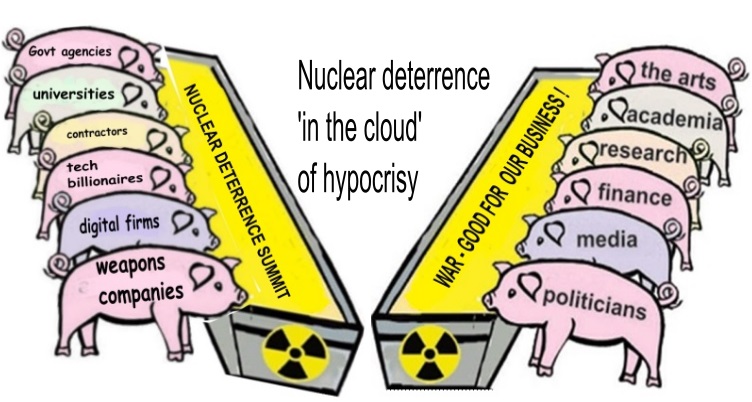
The Munich Security Conference has kicked off, and not surprisingly the Brussels nomenklatura and its attendant apparatchiks and media flacks are pushing war hysteria. The purpose of this is to make the Ukrainian conflict feel existential to Europeans to jawbone them into parting with their dwindling eurobucks for the sake of bleeding Russia as much as possible.
BRUSSELS — Western countries increasingly believe the world is heading toward a global war, according to results from The POLITICO Poll that detail mounting public alarm about the risk and cost of a new era of conflict.
But while Politico smugly celebrates the convection toward war, the rag laments the unwillingness of the drowning masses to destroy what remains of their serfhood for the sake of funding these cabal-provoked wars:
But The POLITICO Poll also revealed limited willingness among the Western public to make sacrifices to pay for more military spending. While there is widespread support for increasing defense budgets in principle across the U.K., France, Germany and Canada, that support fell sharply when people learned it might mean taking on more government debt, cutting other services or raising taxes.
This leaves European leaders “in a bind”:
So European leaders are left in a bind — unable to rely on the U.S., unable to use that as a reason to invest domestically, and under higher pressure to urgently solve this for a world where conflict feels closer than before.”
Well, the conflict “feels” closer than before only because the European sock-puppet leaders are pushing it there themselves, every day, more and more aggressively.
Most concerning for the elites is that support for militarization is on a down-trend heading out of 2025:
The elites are in panic over how to convince their populaces to fan the flames of war ever higher. They are distraught that the peons are overly concerned with selfish pursuits like self-preservation, sustenance, taking care of their families, paying their mortgages, etc. Conclaves like the Munich Conference are meant to stoke debate over precisely how to more effectively connive the masses sell the necessity of war to the public; the going concensus seems to be to just pile on more hysteria, fake lies about the Russian threat, etc. It’s a reliable standby.
This was supported by fiery calls-to-arms from Ukrainian frontliners:
“You [Europe] need to prepare yourselves before war comes to you. And in this, we Ukrainians are your best partners, because we already live in the future of war” – Oleksandr Falshtynskyi, Chief of Medical Service of the 7th Rapid Response Corps of the Ukrainian Air Assault Forces, during Ukraine House at the Munich Security Conference.
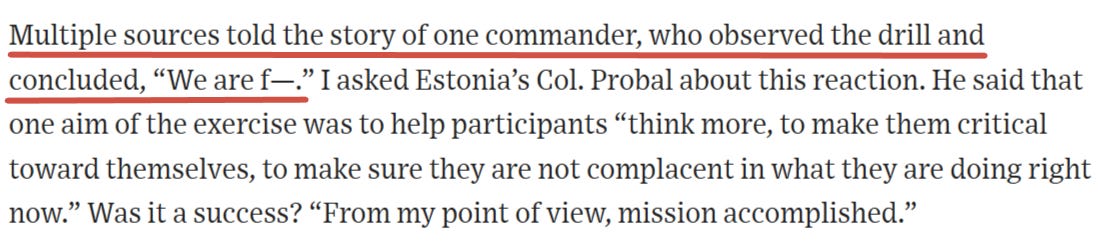
He warns Europe to be ready for the coming war—but is Europe ready? Two recent simulations have shown that to woefully not be the case.
In the first, WSJ reports a single Ukrainian team of 10 drone operators was able to eliminate “two NATO battalions” in a single day without any losses:
Overall, the results were “horrible” for NATO forces, says Mr. Hanniotti, who now works in the private sector as an unmanned systems expert. The adversary forces were “able to eliminate two battalions in a day,” so that “in an exercise sense, basically, they were not able to fight anymore after that.” The NATO side “didn’t even get our drone teams.”
Multiple concurrent Wall Street Journal articles push war hysteria—it must be good for stock prices!
In the article, Germany’s “top military officer” General Carsten Breuer states explicitly that Russia will be ready to wage war on Europe in three years:
Breuer is racing to prepare Germany’s armed forces for war. And for the 61-year-old veteran of conflicts from Kosovo to Afghanistan, the clock is ticking.
Germany’s military-intelligence agency estimates that within the next three years, Russia, whose armies poured into Ukraine in 2022, will have amassed enough weaponry and trained enough troops to be able to start a wider war across Europe. Breuer says a smaller attack could come at any time.
“We have to be ready,” he says.
Besides the obvious fear-mongering, this does appear to indirectly confirm our thesis that Russia is building a large rear reserve force if NATO ‘intelligence’ continues to surmise that Russia “will have amassed enough weaponry and trained […] troops” for WWIII in three years’ time. Clearly, there is a surplus of force regeneration, which flies in the face of the contradictory narrative we’re fed daily that Russia’s losses are now vastly outpacing its recruitment. If that was the case, how could Russia possibly be building a force capable of tackling Europe so soon?
This quote from the article is just rich:
To that end, Breuer has been waging a multi-front campaign to rally Germany’s politicians, business people, soldiers and the general public behind efforts to speed the nation’s rearmament and persuade them that they must be prepared to fight Russia to preserve their democratic freedoms.
So, stoking WWIII to destroy Russia now retreads the same old phony and fatuous “freedums and liburty” ignis fatuus used by neocons time and again since the Iraq war days. Funny, given that it’s Germany now suffering from totalitarian restrictions on their so-called freedoms.
But while the article boasts of Germany raising its commitment level to provoke WWIII by stationing troops in Lithuania, the reality seems to be a bit different. Spiegel reports that Germany is in fact struggling to even find enough recruits to fill the brigade meant for the task:
On 13 February 1960, France detonated a nuclear weapon over the deserts of Algeria. It was the first of what were eventually 17 nuclear detonations across two sites. Four of these took place while Algeria’s fight for independence was still raging. To this day, communities harmed by the development of France’s nuclear weapons arsenal are seeking recognition, compensation and redress.
ICAN joins other organisations in a joint statement on the anniversary of France’s first nuclear detonations in Algeria, “66 Years Since the First French Nuclear Explosion in Algeria … No Truth Without Transparency, No Justice Without Reparation”
The statement recognises efforts to address the legacy of harm from French nuclear testing through parliamentary debates in both Algeria and France. The explosions exposed nearby communities, soldiers and workers to dangerous levels of radiation and left a long-lasting toxic legacy in the environment.
In France, steps are being taken to revise the compensation framework in order to make it fairer for victims of the tests in Algeria and French Polynesia, alongside calls to strengthen transparency and accountability.
In Algeria, the People’s National Assembly addressed this issue for the first time in February 2025 through a parliamentary session that resulted in 13 recommendations calling for enhanced transparency, justice for nuclear victims, the transmission of memory, and the development of research on health and environmental impacts. ICAN France, the Observatoire des armaments and the Heinroch Böll stiftung published The Waste From French Nuclear Tests in Algeria: Radioactivity Under the Sand to provide more information on the environmental legacy of French testing in the region.
The statement further calls on the French government to provide sustained technical and financial support for health monitoring and environmental remediation programs. It calls on the Algerian government to protect public health in affected areas through a national program of monitoring, early screening, and medical care, and to ensure that populations receive accurate information in national and local languages, with particular attention to vulnerable groups. Today, people in Algeria are still living with cancers, contaminated lands, and intergenerational health problems linked to those tests.
France is urged to sign and both countries are encouraged to ratify the Treaty on the Prohibition of Nuclear Weapons (TPNW).
ICAN’s dedicated nuclear testing impacts website hosts stories of those who worked near the test sites in Algeria, as well as more detailed information on the tests carried out by France.
By Bill Gertz – The Washington Times – Wednesday, February 11, 2026
The U.S. Space Force is accelerating the deployment of counterspace weapons under a new Trump administration policy aimed at reasserting and ensuring American dominance over China and Russia in any potential orbital conflict.
The force is deploying three electronic satellite jammers and racing to match the more advanced space forces of China and Russia, which include arsenals of anti-satellite weapons.
Space Force Gen. B. Chance Saltzman, chief of space operations, said Defense Secretary Pete Hegseth recently set the goal for the U.S. military to dominate in space.
“And the Space Force was created to do just that,” Gen. Saltzman told The Washington Times. “The service has and will continue to invest in a full range of counterspace capabilities to deter conflict in space and to win decisively if called upon.
“Continuing to train and equip combat-credible Guardians is essential to maintaining our warfighting readiness,” he said.
Mr. Hegseth said in a speech to workers at the space company Blue Origin last week that the $25 billion being spent on the Golden Dome national missile and drone defense system would produce “cutting-edge, space-based capabilities which we are going to need.”……………….
“That is how we will establish total orbital supremacy,” he said.
Golden Dome systems are expected to support Space Force counterspace arms.
A Space Force spokeswoman declined to provide details on Gen. Saltzman’s plans for counterspace weapons, but at this point, the newest branch of the American military — the force was founded in 2019 under the first Trump administration — has only limited capabilities with counterspace systems. The force will be challenged to match enemy systems…………………….
Funding for counterspace weapons in the recently passed $890.6 billion defense authorization bill is relatively meager and does not appear to support a space dominance policy.
Procurement for counterspace weapons in the current fiscal year is $2 million, and the research, development, testing and evaluation budget for counterspace systems spending is $31.2 million, according to a funding chart in the defense authorization act.
Developing space weapons is a priority for the Pentagon because U.S. space systems, including high-altitude Global Positioning System satellites — used for GPS targeting and navigation in military operations, missile warning satellites and key imagery and communications systems — were not designed for conflict in space…………..
A Pentagon official said a presidential directive requires U.S. space superiority and therefore “American leadership in space is nonnegotiable.”…………………………..
“The Department of War has and will continue to invest in a full range of capabilities — kinetic, non-kinetic, reversible and irreversible — to restore deterrence and, if necessary, prevail in conflict.”………………………………………………
Charles Galbreath, a retired Space Force colonel, said Mr. Hegseth’s comments on space power dominance are “probably some of the most aggressive language I’ve heard ever, openly, about conflict in the space domain.”………………………………………………………..
The orbital playbook
Space Force plans for waging warfare in space are outlined in a March 2025 report, “United States Space Force Space Warfighting: A Framework for Planners.”
The report defined three main types of counterspace operations as control of space using both offensive and defensive action.
“Counterspace operations are conducted across the orbital, link and terrestrial segments of the space architecture,” the report said, creating effects aimed at “space superiority.”……………………
The combat will include “orbital warfare” using fires, movement and maneuver to control space.
Also used will be electromagnetic warfare to defeat enemy space and counterspace threats.
Cyberwarfare will be a major part of space combat, with strikes and other actions aimed at gaining control of space.
Offensive space combat will include orbital strike operations, pursuit and escort of satellites, standoff attacks, interdicting space communications links, and maneuvering killer satellites that can grab and crush enemy systems.
Orbital attacks will use “pursuit operations” with an attacking system maneuvering to an enemy spacecraft before firing weapons. Alternatively, the Space Force will use standoff operations — space-based or ground long-range missiles that attack without a nearby orbital rendezvous.
Space link interdiction will use electromagnetic or cybernetwork attacks……………………………………………
For electronic attacks, high-powered lasers and microwave weapons are being built, and some reports indicate that electromagnetic pulse arms could be used to damage satellite electronics without causing debris.
Emil Michael, undersecretary of defense for research and engineering, stated in a X post that the Pentagon has directed energy weapons………………………………………………………………………………..
Navy drone warship, undersea robot weapon unveiled
By Bill Gertz – The Washington Times – Wednesday, February 11, 2026
U.S. Navy efforts to deploy large numbers of drone weapons advanced this week with the disclosure of a coming autonomous warship and a new undersea drone.
Blue Water Autonomy, a shipbuilding startup, announced the first autonomous warship called the Liberty that the company says will provide advanced warfare capabilities for the Navy as soon as later this year.
The Boston-based technology firm and shipbuilder said construction of its first 190-foot Liberty drone ship will begin next month with the goal of delivering the first vessel to the Navy in 2026.
The ship will be 190-feet long with a range of over 10,000 nautical miles and can carry more than 150 tons of payload capacity, Blue Water said in a press release.
“As the U.S. Navy drives to expand fleet capacity, accelerating the deployment of unmanned systems that complement traditional crewed ships has become a critical effort,” the company said……..
Separately, defense contractor Lockheed Martin this week disclosed its development of a new class of smart, stealthy, multimission autonomous undersea drone.
The Lockheed vessel, called the Lamprey, is capable of launching drone aircraft from the surface and is described by the company as a “do-it-all” submersible, “built to disrupt and deny enemy forces at sea.”
The undersea drone will be used to detect, disrupt, decoy and target enemy forces in support of sea denial missions and “subsea seabed warfare,” Lockheed said on its website.
The Lamprey can be hitched to submarines or warships, will launch aerial drones for surveillance or attacks, and can conduct electronic warfare to disrupt underwater enemy sensors.
Both drone warfare platforms are likely to become part of what the commander of the U.S. Indo-Pacific Command, Adm. Sam Paparo, has called a “hellscape” strategy to deter China.
The strategy, which remains mostly secret, calls for deploying thousands of low-cost armed drones as a deterrent and counter to any potential future Chinese attack on Taiwan or other locations in the region. The “hellscape” could also influence Chinese commanders’ decision-making on whether such attacks could be successful……………………………………….
“The Liberty class reflects our focus on building autonomous ships that are designed from the start for long-duration operations and repeat production,” said Rylan Hamilton, Blue Water Autonomy chief executive. “By adapting a proven hull and reengineering it for unmanned operations, we’re delivering a vessel that can operate for extended periods without crew while being produced at a pace the Navy urgently needs. This is a modern take on an old idea: building capable ships quickly and at scale.”
The drone warship will use artificial intelligence for its automated controls with limited human intervention for months-long deployments.
It was developed entirely with private capital without defense funding as part of push by Navy and Pentagon leaders on defense contractors to privately develop key military technology outside of a problematic procurement process.
Command and control of nuclear weapons is a delicate and complicated system, designed to prevent error while ensuring reliability under high-pressure conditions. In environments where vast amounts of data shape high-stakes outcomes, artificial intelligence has become a natural consideration.
The integration of a rapidly evolving technology raises fundamental questions about responsibility, data quality, and system reliability. When a single error could have irreversible consequences, how can confidence be built around the integration of machine learning into systems that have long relied on human judgment and oversight? What guardrails should be maintained? Where are there opportunities for international collaboration and consensus?
Join the Bulletin of the Atomic Scientists and the Outrider Foundation as a group of experts examine the current state of AI in nuclear command and control, identify where the greatest risks reside, and explore the policies that must be considered now to govern this technology in the years ahead.
The MAHA Commission 2025 report unfotunately ignored radioactivity as a possible cause of rising cancer and chronic illness. But even leaving aside nuclear accidents, studies show living near nuclear plants elevates cancer risk. Nuclear reactors generate radioactive waste and ionizing radiation, which get into the environment, contaminating air, water, soil and food.
Harmful isotopes like Cesium-137 aren’t natural; they’re made only in reactors, but persist in the environment and food for centuries. Decades after Chernobyl, for instance, researchers found Cesium-137 in meat from domestic and game animals in Poland, and in food and children’s bodies in Belarus, which caused pediatric cardiovascular disease.
Cesium-137 has a 30-year half-life but remains dangerous for 300 years, especially when ingested or inhaled. It lodges in soft tissues inside the body, irradiating cells and increasing cancer risk, according to the Centers for Disease Control and Prevention. Even very low doses have been shown to cause cancer, renal pathology and other damage.
This summer, the Food and Drug Administration issued multiple health hazard warnings about Cesium-137 detected in imported Indonesian shrimp, triggering massive recalls and worried coverage in mainstream outlets like “Martha Stewart Living.” Consumer Reports found evidence a wide swath of Indonesia’s land may be contaminated.
U.S. Sens. Bill Cassidy (R-L.) and John Kennedy (R-La.) then launched an inquiry, asking grocery chains how they will keep radioactive shrimp off their shelves. Kennedy said that eating Cesium-137-laced shrimp “will kill you. Even if doesn’t turn you into the alien from ‘Alien,’ I guarantee you’ll grow another ear.” Rep. Clay Higgins (R-La.) wrote to President Trump, calling radioactive shrimp a “significant public health threat” and asking him to pause all shrimp imports.
“Alien” shrimp penetrated public consciousness, but the radioactivity problem is much bigger. The FDA recently found radioactive cloves, and Malta customs officials found radioactive clothing, both contaminated with Cesium-137. The World Customs Organization launched “Operation Stingray” to intercept nuclear and radioactive materials, seizing 51 shipments in just three weeks.
Such action is overdue. Long before so-called “forever chemicals” or microplastics were recognized as health threats, watchdog groups were flagging the threat of radioactivity in food, especially after the 2011 Fukushima disaster. A 2013 FDA Citizen Petition demanded tighter regulation and lower allowable radioactivity levels. My organization has collected 1,600 comments and thousands of companion signatures.
Health advocacy groups recently pointed this out in a joint letter, exhorting Kennedy and federal officials to “finally address the impact of radiation contamination of U.S. food on the trajectory of cancer and chronic illness by setting and enforcing much safer levels for Americans.” In its reply FDA demurred, calling it “unlikely that a fish exposed to significant levels of radionuclides near the [Fukushima] reactor could travel to U.S. waters and be caught and harvested.”
Yet we see evidence of consumer goods contaminated with radioactivity all around us. Instead of downplaying the problem, the FDA should tighten and enforce protective standards.
The Indonesian shrimp flagged as a health hazard had 68 becquerels of Cesium-137. The FDA’s “derived intervention level” — more of a guideline than an enforceable standard — is about 20 times higher, at 1,200 becquerels.
No level of Cesium-137 or other harmful radioactive isotopes is safe, yet Trump’s recent executive orders raise exposure limits and depart from the longstanding linear no-threshold model of radiation safety. Advocates warned the public health consequences would be severe, with women, children and fetuses worst impacted.
The standard should be, if Cesium-137 or other isotopes of concern are detectable in food items, they ought to be pulled off shelves, or at the very least labeled with warnings so consumers can make an informed decision. Unfortunately, that’s not the system we have. The importance of humility and transparency are among the lessons of Chernobyl and Fukushima, but the Trump administration is ignoring them in an explosion of hubris.
That’s nothing new; it’s deep in the nuclear culture. That 2011 International Commission on Radiological Protection report states, “There may be situations where a sustainable agricultural economy is not possible without placing contaminated food on the market. As such foods will be subject to market forces, this will necessitate an effective communication strategy to overcome the negative reactions from consumers outside the contaminated areas.”
But a communications strategy designed to soft-pedal radioactive contamination of food won’t make America healthy. Only setting and enforcing science-based standards will.
Kimberly Roberson is director of the Fukushima Fallout Awareness Network, a project of the National Institute for Science, Law and Public Policy.
The Department of Energy’s Office of Environmental Management said crews at the Hanford Site near Richland, Wash., have started retrieving radioactive waste from Tank A-106, a 1-million-gallon underground storage tank built in the 1950s.
Tank A-106 will be the 24th single-shell tank that crews have cleaned out at Hanford, which is home to 177 underground waste storage tanks: 149 single-shell tanks and 28 double-shell tanks. Ranging from 55,000 gallons to more than 1 million gallons in capacity, the tanks hold around 56 million gallons of chemical and radioactive waste resulting from plutonium production at the site.
According to the Washington Department of Ecology, at least 68 of Hanford’s tanks are assumed to have leaked in the past, and three are currently leaking.
The transfer: Tank A-106 contains about 80,000 gallons of solid waste, which now are being transferred to one of the newer, double-shell tanks for continued safe storage. A-106 is one of two tanks currently undergoing retrieval operations by the Hanford Field Office and its tank operations contractor, Hanford Tank Waste Operations and Closure (H2C). In March 2025, H2C began retrieving waste from Tank A-102, a 1-million-gallon tank holding about 41,000 gallons of solid waste……………………………
Hanford’s waste tanks are organized into 18 different groups, called tank farms. The A Tank Farm, which contains six tanks, each with a million-gallon capacity, is the third farm to undergo retrieval at the site. Retrieval field operations on the farm’s first tank and Hanford’s 22nd single-shell tank, A-101, were completed last September……………………………… https://www.ans.org/news/2026-02-11/article-7751/hanford-begins-removing-waste-from-24th-singleshell-tank/
New START treaty expired, no binding constraints on arsenals
Russia commits to treaty limits as long as US does
Russia wary of costly arms race amid Ukraine conflict
MOSCOW, Feb 11 (Reuters) – Russia will keep observing the missile and warhead limits in the expired New START nuclear treaty with the United States as long as Washington continues to do the same, Foreign Minister Sergei Lavrov said on Wednesday.
The 2010 treaty ran out on February 5, leaving the world’s two biggest nuclear-armed powers with no binding constraints on their strategic arsenals for the first time in more than half a century.
U.S. President Donald Trump rejected an offer from Russian President Vladimir Putin to voluntarily abide by the New START limits for another year, saying he wanted a “new, improved and modernized” treaty rather than an extension of the old one.
“Our position is that this moratorium on our side that was declared by the president is still in place, but only as long as the United States doesn’t exceed the said limits,” Lavrov told the State Duma, Russia’s lower house of parliament.
“We have reason to believe that the United States is in no hurry to deviate from these indicators, and for the foreseeable future these indicators will be observed,” he said, without explaining the basis for that assumption
Lavrov reiterated that Russia wanted to start a “strategic dialogue” with the U.S., saying it was “long overdue”.
By Bill Gertz – The Washington Times – Thursday, February 12, 2026
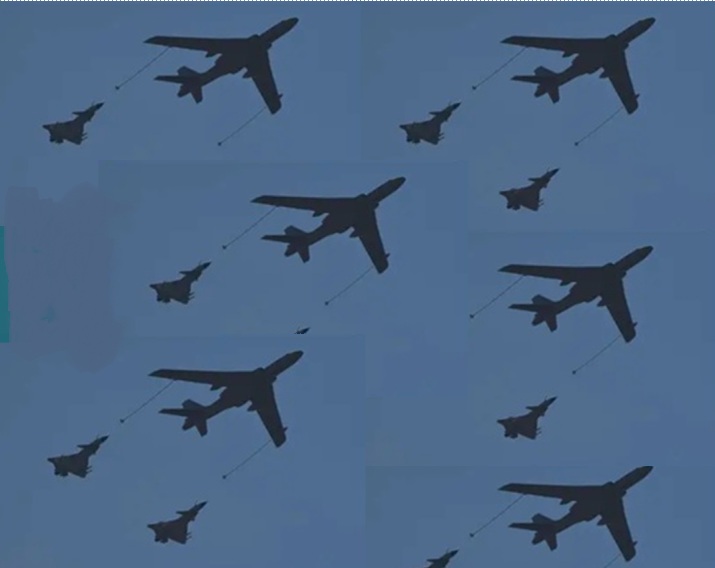
Current plans for U.S. bomber forces are inadequate for winning a future conflict with China and the Air Force needs 200 new B-21 bombers to bolster the strategic bomber shortfall, according to a new report by a think tank that supports the Air Force.
The larger bomber force is needed to attack Chinese inland sanctuaries should a war break out between the U.S. and China over Taiwan or other regional allies, the report by the Mitchell Institute for Aerospace Studies stated.
The U.S. military today lacks the post-Cold War combat aircraft power for conducting Air Force strikes deep inside enemy lines and denying operational sanctuary to enemies like China and its People’s Liberation Army………………………………………………
“A strong offense is the best defense, and a war-winning U.S. campaign must include strategic attacks against China’s military leadership, command and control, and long-range combat forces that now threaten the U.S. military’s ability to operate effectively in the Western Pacific,” the report said………………………………
“B-21s in sufficient numbers are necessary to seize the operational advantage in a conflict with China,” the report said.
Additionally, the Pentagon should build at least 300 of the new, sixth-generation F-47 jets.
The Department of War (DoW) and the Department of Energy (DoE) are partnering to mark a historic milestone in advancing America’s nuclear energy landscape and strengthening national security.
This groundbreaking collaboration with Valar Atomics is directly aligned with President Trump’s Executive Order to reshape and modernize America’s nuclear energy landscape.
On Sunday, February 15, 2026, a next-generation nuclear reactor will be transported via C-17 from March Air Reserve Base in California to Hill Air Force Base in Utah. The reactor will then be transported to Utah San Rafael Energy Lab (USREL) in Orangeville, Utah, for testing and evaluation…………………………………………












 nuclear-news