National analysis of cancer mortality and proximity to nuclear power plants in the United States
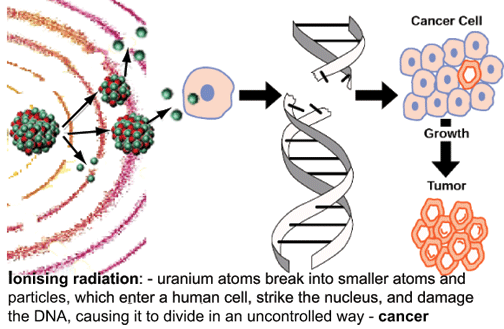
Nature Communications volume 17, Article number: 1560 (2026) , 23 February 2026 [Excellent graphics and tables]
Abstract
Understanding the potential health implications of living near nuclear power plants is important given the renewed interest in nuclear energy as a low-carbon power source. Here we show that U.S. counties located closer to operational nuclear power plants have higher cancer mortality rates than those farther away.
Using nationwide mortality data from 2000-2018, we assess long-term spatial patterns of cancer mortality in relation to proximity to nuclear facilities while accounting for socioeconomic, demographic, behavioral, environmental, and healthcare factors. Cancer mortality is higher across multiple age groups in both males and females, with the strongest associations among older adults, males aged 65–74 and females aged 55–64. While our findings cannot establish causality, they highlight the need for further research into potential exposure pathways, latency effects, and cancer-specific risks, emphasizing the importance of addressing these potentially substantial but overlooked risks to public health.
…………………………………………………………….Nuclear power plants emit radioactive pollutants that can disperse into the surrounding environment, leading to potential human exposure through inhalation, ingestion, and direct contact. These pollutants can be transported through air, water, and soil, contributing to long-term environmental contamination1. Populations residing near nuclear power plants may experience low-level chronic exposure to ionizing radiation via environmental release pathways. While our study does not include dosimetry, ionizing radiation is a well-established carcinogen2,3,4,5,6,7 and thus motivates investigation into proximity-based exposure patterns.
………………………Despite the importance and prevalence of nuclear power plants in the U.S., epidemiologic research regarding their health impacts remains rare. Most U.S. studies have focused on individual plants or limited regions, with only a few national assessments to date – many of which relied on fixed distance cutoffs to classify exposed populations8,9,11,12,19,21,22,23,24,25. These studies often focus on a single facility and its surrounding communities, which restricts their statistical power to detect effects and ability to capture broader exposure patterns. Furthermore, differences in study design, exposure assessment methods, and geographic scope make it difficult to draw generalizable conclusions.
In this work, we assess the association between county-level proximity to nuclear power plants and cancer mortality across the United States from 2000 to 2018. We find that counties located closer to operational nuclear power plants have higher cancer mortality rates, with stronger associations observed among older adults. These associations remain consistent across multiple sensitivity analyses and proximity definitions. The results highlight spatial patterns of cancer risk in relation to nuclear power generation and emphasize the importance of evaluating potential long-term health implications of nuclear energy infrastructure in population-scale studies…………………………………………………………………………………………………………………………………………………………………. https://www.nature.com/articles/s41467-026-69285-4
Sizewell C power to cost almost double today’s prices
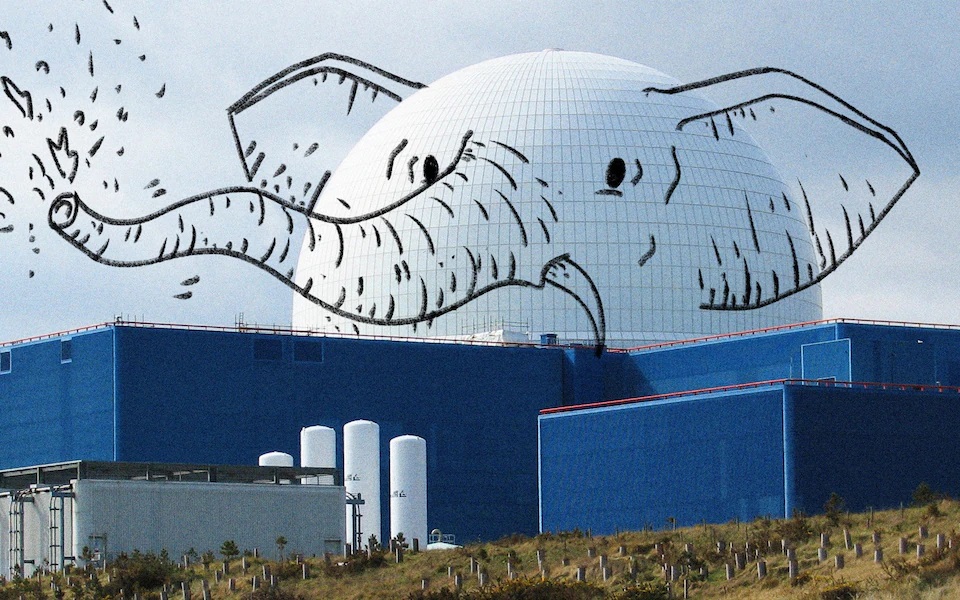
Nuclear plant is an ‘appalling waste of electricity consumers’ and taxpayers’ money’, experts claim
Electricity generated by the Sizewell C nuclear power station will
cost roughly double the normal price of power, according to a new
Government report.
Estimates suggest that the power Sizewell C produces
will cost £120 per megawatt hour (MWh) in today’s prices, compared with the
current wholesale price of about £60 to £70. The extra costs will be added
to energy bills.
The disclosure was made in a review of the business case
for Sizewell C published by the Department for Energy Security and Net
Zero. It is understood to be the first time Sizewell C’s power output has
been costed. It refers to the so-called “strike price”, which is likely
to be awarded to the nuclear power station under the contracts for
difference system. This is where generators get a guaranteed minimum price
for electricity, whatever the market value.
The cost is then covered by a
levy on consumer bills, meaning it effectively acts as an energy subsidy.
Nuclear supporters, including Ed Miliband, the Energy Secretary, have
argued that nuclear power is worth the extra money because it acts as a
secure energy source for decades – potentially a century in the case of
Sizewell C.
However, critics have raised concerns that prices for nuclear
will continue to rise, arguing that early estimates for constructing power
stations are always significant underestimates. They have pointed to
Sizewell C’s predecessor, Hinkley Point C, where original costs of £18bn
have soared to £50bn – a figure announced last week – with start-up delayed
from 2026 to 2031.
The Government report for Sizewell C said estimates
assumed no escalation in costs, which would be a first for UK nuclear
construction projects. The report also warned that consumers were likely to
be charged more than the £120 per MWh rate because the strike price was
calculated net of all the tax, business rates and other payments to the
Government.
Prof Stephen Thomas, the editor-in-chief of Energy Policy, an
academic journal, said: “Sizewell is an appalling waste of electricity
consumers’ and taxpayers’ money. If you want to justify a premium price for
nuclear, you have to estimate the costs of achieving the same factors –
energy security and reliability.
“Of course, nuclear power plants aren’t
always reliable and the most insecure power source is the one that isn’t
built yet. Without the assumptions behind these cost guesses [of £120 per
MWh], they are worthless and far from transparent.” Alison Downes, of
Stop Sizewell C, a local campaign group, said: “Hinkley’s cost has soared
to £50bn with completion dates slipping and five years still to go.
Sizewell C’s costs will rise higher still when it inevitably overruns its
£40bn construction budget.”
Telegraph 25th Feb 2026, https://www.telegraph.co.uk/business/2026/02/25/sizewell-c-power-to-cost-almost-double-todays-prices/
The Innate and Inseparable Ties Between Nuclear Weapons and Energy

Why are these statements significant? Because there is a long track record of attempts by the nuclear industry and advocates for nuclear power to erase or at least camouflage the connection between the technologies used to develop nuclear energy and the capacity to build nuclear weapons.
Understanding these connections between nuclear weapons and nuclear energy helps explain why governments around the world continue to support nuclear power despite the multiple problems associated with nuclear power. On top of huge amounts of funding, ultimately from the public, that is made available to nuclear enterprises, the linkage with nuclear weapons is also used to control information flows and exclude outsiders from policy discussions, thus weakening democracy
M.V. Ramana, February 24, 2026, https://www.counterpunch.org/2026/02/24/the-innate-and-inseparable-ties-between-nuclear-weapons-and-energy/
What do Canada’s retired general Wayne Eyre and Saudi Prince Mohammed Bin Salman share in common? Answer: In their own ways, both have inadvertently warned the public about the deep relationship between nuclear weapons and nuclear energy.
The former’s warning came earlier this month, when the retired general told a conference in Ottawa that when it came to acquiring nuclear weapons, Canada should keep its “options open,” pointing out that Canada had “a good nuclear enterprise” including “the civilian infrastructure” and “the scientists.” Eyre, who served as Canada’s chief of the Defence Staff from 2021 to 2024, argued, “Let’s just have the conditions in place so that if we decide to go that way, we can do it in shorter order than some other countries who have no nuclear enterprise. It’s all about hedging\.” Part of the strategy he recommended was to invest in aerospace and missile technology.
Canadian government officials were quick to state that the country remained opposed to acquiring nuclear weapons, and others pointed out that such acquisition wouldn’t be so simple. But Eyre was pointing to a deep truth—Canada’s nuclear energy program would facilitate the building of nuclear weapons, should the country decide to do so. Indeed, the Globe and Mail, Canada’s leading newspaper, highlighted this fact in its editorial (“The strong civilian nuclear industry could provide a springboard if ever Ottawa chose to go that way”) even as it argued against Canada building nuclear weapons.
This fact is equally applicable to all countries that acquire the technology to generate nuclear power: they would be closer to having the capacity to make nuclear weapons than if they had not built nuclear plants.
The last time this connection was so prominently broadcast was back in March 2018, when Saudi Prince Mohammed bin Salman told CBS News about Saudi Arabia’s equivalent hedging strategy. Earlier, the country had announced that it was interested in deploying nuclear power plants for “peaceful purposes,” but during the interview, MBS pointed to the possibility that Iran might develop a nuclear bomb, and declared that Saudi Arabia “will follow suit as soon as possible.”
Effacement Efforts
Why are these statements significant? Because there is a long track record of attempts by the nuclear industry and advocates for nuclear power to erase or at least camouflage the connection between the technologies used to develop nuclear energy and the capacity to build nuclear weapons. An early example of the attempt to make the two pursuits seem unrelated was President Dwight Eisenhower’s Atoms for Peace program, which the President announced at the United Nations General Assembly in December 1953 with the stated aim of hastening “the day when fear of the atom will begin to disappear from the minds of the people and the governments of the East and West.”
The Atoms for Peace speech came just seven years after the 1946 Report on the International Control of Atomic Energy that explicitly warned that “the development of atomic energy for peaceful purposes and the development of atomic energy for bombs are in much of their course interchangeable and interdependent.” The intervening years witnessed a dramatic shift in the policy of the United States to build a larger and more destructive nuclear arsenal, including hydrogen bombs, and, simultaneously, a growing movement for nuclear disarmament and peace. The US government was also involved in an effort to induce private companies to build nuclear plants, in part to advance military capabilities. Eisenhower’s speech is an attempt to paper over the contradiction between a claimed interest in peace while developing nuclear capabilities.
In subsequent decades, the nuclear industry and its supporters have resorted to simply denying any connection between nuclear power and weapons. For example, Ted Nordhaus, who recently praised Trump’s policies to promote nuclear energy in the Washington Post, exhorted people to “stop confusing nuclear weapons with nuclear power.”
Overlaps
There are five overlaps between nuclear energy and nuclear weapons: technical, historical, geographical, personnel and institutional.
Let us start with the technical. The greatest challenge to developing a nuclear arsenal is obtaining the necessary fissile materials, namely highly enriched uranium or plutonium. These materials are “the key ingredients in nuclear weapons.” Neither is found in nature.
Uranium occurs naturally in two main varieties, called isotopes, the heavier uranium-238 and the lighter uranium-235.The latter is the one that can sustain a chain reaction, which is the basis of both nuclear power plants and nuclear bombs. But the concentration of uranium-235 in nature is usually too low for such a chain reaction to occur. Whether it is to make nuclear weapons or to use as nuclear fuel in most common nuclear power plants, the uranium-235 concentration must be “enriched,” from 0.7 percent to 3 to 5 percent for most nuclear power plants and ideally around 90 percent for nuclear weapons. One technical overlap between the processes used to produce nuclear weapons and generate energy is that the facilities used to produce low-enriched uranium fueling nuclear power plants can be modified to produce weapons-useable highly enriched uranium, a technical detail that is at the heart of the dispute over Iran’s nuclear program.
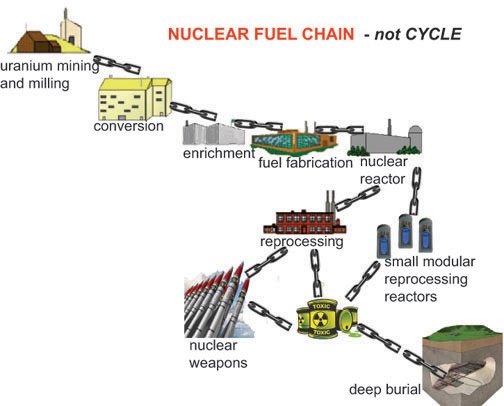
Plutonium, too, is not found in nature but is produced when uranium fuel is irradiated in a nuclear reactor. In order for this plutonium to be used either as nuclear reactor fuel or in nuclear weapons, it must first be separated from uranium and other chemicals in the irradiated fuel through a chemical process called reprocessing.
Historically, many countries built their first nuclear reactors to produce plutonium for use in nuclear weapons. The United States, for example, built reactors in Hanford to produce plutonium, and the first uses for the plutonium thus produced were the nuclear weapon tested in New Mexico in July 1945 and the bomb dropped over Nagasaki.
There are some countries, such as Israel, that only operate nuclear reactors to produce plutonium for nuclear weapons. That is rare. Which points to the geographical connection between nuclear weapons and energy: a significant overlap between the countries that have built nuclear power plants and those that have nuclear weapons. If one looks at the 413 nuclear reactors listed as operational by the International Atomic Energy Agency as of February 2026, 279 of them are in countries with nuclear weapons. If one adds countries that are part of military alliances with nuclear-weapon states, such as members of the NATO alliance, then the overlap is overwhelming.
There is also an overlap in the training needed to have personnel who can design and operate nuclear power plants and who can produce fisile material for nuclear weapons. Examples include Pakistan and Iran, both of which received training for scientists and engineers from the United States.
Munir Ahmed Khan, who was responsible for launching Pakistan’s nuclear weapons program, explained it thus:
“The Pakistani higher education system is so poor, I have no place from which to draw talented scientists and engineers to work in our nuclear establishment. We don’t have [a] training system for the kind of cadre we need. But, if we can get France or somebody else to come and create a broad nuclear infrastructure, and build these plants and these laboratories, I will train hundreds of my people in ways that otherwise they would never be able to be trained. And with that training, and with the blueprints and the other things that we’d get along the way, then we could set up separate plants that would not be under safeguards, that would not be built with direct foreign assistance, but I would now have the people who could do that. If I don’t get the cooperation, I can’t train the people to run a weapons program.”
Finally, there is a deep connection between institutions that oversee nuclear energy and weapons programs, as exemplified in the United States by the Department of Energy (DOE). The National Nuclear Security Administration (NNSA) is a semi-autonomous agency within DOE that is responsible for maintaining the stockpile of nuclear weapons in the United States and for “modernizing” it (namely, to make new weapons). The DOE also promotes nuclear energy through multiple funding mechanisms. There is also a significant overlap between the private corporations involved in building nuclear power plants and servicing the nuclear weapons industry.
Significance
Understanding these connections between nuclear weapons and nuclear energy helps explain why governments around the world continue to support nuclear power despite the multiple problems associated with nuclear power. On top of huge amounts of funding, ultimately from the public, that is made available to nuclear enterprises, the linkage with nuclear weapons is also used to control information flows and exclude outsiders from policy discussions, thus weakening democracy.
The expansion of nuclear energy also thwarts efforts toward a world free of nuclear weapons. It will not be possible to eliminate nuclear weapons without policies and resource-allocation decisions that are grounded in the reality that nuclear energy cannot be separated from nuclear weapons.
M. V. Ramana is the Simons Chair in Disarmament, Global and Human Security at the School of Public Policy and Global Affairs, University of British Columbia and the author of The Power of Promise: Examining Nuclear Energy in India.
Israeli troops fired 900+ rounds at Gaza medics – report

24 Feb, 2026, https://www.rt.com/news/632982-israel-gaza-medics-killing/
Hundreds of rounds were fired at aid workers during a March 2025 massacre at Tal as-Sultan, an independent investigation says
Israeli soldiers fired over 900 rounds at a convoy of clearly marked emergency vehicles in Rafah in 2025, killing 15 Palestinian aid workers, some of them shot at close range, an independent investigation has found.
The attack took place on March 18, 2025 in the Tal as-Sultan area of southern Gaza, where local responders had been dispatched to collect wounded civilians. Fifteen Palestinian aid workers were killed, including medics from the Palestine Red Crescent Society and members of the Civil Defense.
The victims were traveling in five ambulances and one fire truck, all clearly marked and operating with emergency lights, when they came under sustained gunfire, according to a report released on Monday by independent research agency Forensic Architecture and audio investigation group Earshot.
Investigators reconstructed the incident using audio recordings, satellite imagery, video footage, and witness testimony. Some of the victims were reportedly “shot ‘execution-style’ from close range.”
Investigators analyzed footage recovered from the phone of one of the slain paramedics and identified at least 910 gunshots during the attack, with 844 bullets fired over five and a half minutes. “During this time, at least five shooters fired simultaneously, and witness testimonies suggest as many as thirty soldiers were present in the area,” according to the report.
The report said Israeli forces later crushed the vehicles with heavy machinery and tried to bury them along with the bodies. The victims, all wearing identifying uniforms or volunteer vests, were recovered from a mass grave nearby, the researchers said.
One of the two survivors was abducted by Israeli forces, and were held without charge for 37 days at the Israeli Sde Teiman detention facility and released in poor health. He testified that soldiers confiscated and buried his phone. The other was used as a “human tool” at an Israeli military checkpoint near the site, the report added.
The Israel Defense Forces said the area was an active combat zone and that troops believed they were facing security risks. They later claimed that one vehicle may have been linked to Hamas, which was disputed by the survivors and humanitarian organizations. An internal Israeli inquiry launched in April 2025 cited “professional failures” but rejected allegations of deliberate killings or criminal conduct and recommended no criminal action against the units involved.
The UN, Red Cross, and a number of human rights groups condemned the killings.
Hundreds of medical and emergency personnel have been killed or injured since October 2023, when the IDF began its campaign in the enclave in response to a Hamas incursion into Israel that left at least 1,200 people dead and 250 taken hostage. According to the Palestinian Health Ministry, more than 72,000 people have been killed since the war began.
Nuclear waste leaks show the need for focus on renewables
Letter from Tor Justad. Nuclear Waste Leaks show need for focus on
renewables. The NDA says the Dounreay decommissioning programme will
continue until the 2070s during which time some £7.9billion will be spent.
The cost of decommissioning has risen dramatically while the risk of
accidents continues. After the recent leak Dounreay says there may be other
unrevealed hazards waiting to reveal themselves.
The National 21st Feb 2026, https://www.pressreader.com/uk/the-national-scotland/20260221/textview?popupArticleId=281951729285676
EDF pledges new £15bn UK investment as falling energy prices hit profits

The energy firm reported a 12 per cent decrease in nuclear output
Anna Wise, Independent UK, Monday 23 February 2026
French energy giant EDF saw its UK profits decline last year, attributed to a combination of falling energy prices and a significant outage at one of its nuclear power stations.
Despite this setback, the company has announced plans for a substantial £15 billion investment in the country over the next three years.
The energy firm reported a 12 per cent decrease in nuclear output from its five operational power stations during the period.
While its Sizewell B facility in Suffolk and Torness in Scotland performed strongly, the overall output was significantly impacted by an extended outage at the Hartlepool power station.
The Teesside-based station, which began generating power 43 years ago and supplies electricity to approximately two million homes, experienced a prolonged shutdown.
Despite these operational challenges, Hartlepool recently secured a one-year extension to its operational lifespan, now expected to generate electricity until March 2028.
This extended downtime, primarily due to issues affecting one of its two reactor systems, was identified as the main driver for EDF‘s overall decline in nuclear generation last year.
Furthermore, a decline in earnings was also down to the prices it charges for nuclear power being lower than in 2024.
It is understood that average prices were down by approximately 20 per cent.
Energy prices in the UK have been gradually coming down after spiking in the aftermath of Russia’s invasion of Ukraine in 2022.
EDF said that in its UK business, earnings before
interest, tax, depreciation and amortisation (EBITDA) were £1.9 billion for 2025, down about a third from £2.9 billion in 2024……………………………………………………….. https://www.independent.co.uk/news/business/edf-hinkley-point-energy-prices-profits-b2925974.html
1 This Month

Petition to revoke the licensing of the Near Surface Nuclear Disposal Facility (NSDF) at Chalk River. https://www.ourcommons.ca/petitions/en/Petition/Details?Petition=e-7247


of the week – STOP SMALL MODULAR REACTORS IN CANADA
To see nuclear-related stories in greater depth and intensity – go to https://nuclearinformation.wordpress.com
-
Archives
- March 2026 (153)
- February 2026 (268)
- January 2026 (308)
- December 2025 (358)
- November 2025 (359)
- October 2025 (376)
- September 2025 (258)
- August 2025 (319)
- July 2025 (230)
- June 2025 (348)
- May 2025 (261)
- April 2025 (305)
-
Categories
- 1
- 1 NUCLEAR ISSUES
- business and costs
- climate change
- culture and arts
- ENERGY
- environment
- health
- history
- indigenous issues
- Legal
- marketing of nuclear
- media
- opposition to nuclear
- PERSONAL STORIES
- politics
- politics international
- Religion and ethics
- safety
- secrets,lies and civil liberties
- spinbuster
- technology
- Uranium
- wastes
- weapons and war
- Women
- 2 WORLD
- ACTION
- AFRICA
- Atrocities
- AUSTRALIA
- Christina's notes
- Christina's themes
- culture and arts
- Events
- Fuk 2022
- Fuk 2023
- Fukushima 2017
- Fukushima 2018
- fukushima 2019
- Fukushima 2020
- Fukushima 2021
- general
- global warming
- Humour (God we need it)
- Nuclear
- RARE EARTHS
- Reference
- resources – print
- Resources -audiovicual
- Weekly Newsletter
- World
- World Nuclear
- YouTube
-
RSS
Entries RSS
Comments RSS
 nuclear-news