Middle-aged women ‘most at risk of cancer’ from nuclear power plants
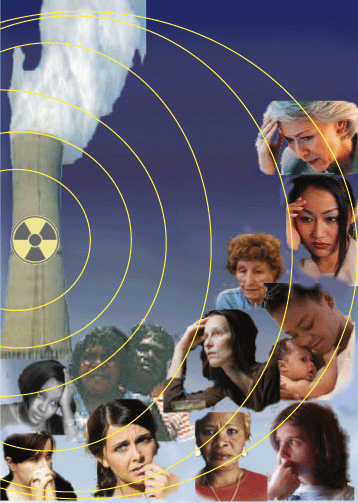
2.1 per cent of cancers in women aged 55-64 attributable to living near a plant, research shows
Sarah Knapton,Telegraph, Science Editor, 23 February 2026
Middle-aged women are the most at risk from living near power plants, a study suggests.
Researchers at Harvard University found that US counties closer to nuclear plants had higher cancer death rates than those farther away, even after accounting for socioeconomic, environmental and health factors.
The team estimated that 2.1 per cent of cancers in women aged 55-64 were “attributable” to living near a plant, the highest of all age groups and genders.
Similarly, 2 per cent of cancers in men aged 65-74 were linked to nuclear plants, the highest age range for males.
Younger people aged 35-44 had the lowest risk, with proximity to nuclear plants accounting for 0.4 per cent of cancers in females and 0.6 per cent in males.
Radiation fears
“Our study suggests that living near a nuclear power plant may carry a measurable cancer risk – one that lessens with distance,” said Dr Petros Koutrakis, the senior author and professor of environmental health and human habitation at Harvard TH Chan School of Public Health.
“We recommend that more studies be done that address the issue of nuclear power plants and health impacts, particularly at a time when nuclear power is being promoted as a clean solution to climate change.”
Last year, Harvard discovered that people living near the Mallinckrodt Chemical Works in Missouri, which processed uranium for the first atomic bomb, had a far higher chance of developing most cancers than those living farther away.
There have been ongoing fears that radiation from power stations can cause cancer, with some evidence showing clusters of leukaemia and non-Hodgkin lymphoma near Sellafield in Cumbria, and Dounreay, on the north coast of Scotland.
The Committee on Medical Aspects of Radiation in the Environment was set up in 1985 to investigate.
Although it confirmed the raised rates, it also found that other nearby villages did not show similar increases as might be expected if the plants were to blame.
Investigators theorised that an influx of workers moving to Seascale and Thurso to work in the nuclear industry might have exposed residents to new infections, causing a rise in childhood cancer rates…………………………………………………………… https://www.telegraph.co.uk/news/2026/02/23/middle-aged-women-most-at-risk-of-cancer-from-nuclear-power/
No comments yet.
1 This Month

of the week – Shut Down Drone Warfare!


Tell the Ukrainian Government to Drop Prosecution of Peace Activist Yurii Sheliazhenko

Petition to revoke the licensing of the Near Surface Nuclear Disposal Facility (NSDF) at Chalk River. https://www.ourcommons.ca/petitions/en/Petition/Details?Petition=e-7247
To see nuclear-related stories in greater depth and intensity – go to https://nuclearinformation.wordpress.com
-
Archives
- April 2026 (7)
- March 2026 (251)
- February 2026 (268)
- January 2026 (308)
- December 2025 (358)
- November 2025 (359)
- October 2025 (376)
- September 2025 (257)
- August 2025 (319)
- July 2025 (230)
- June 2025 (348)
- May 2025 (261)
-
Categories
- 1
- 1 NUCLEAR ISSUES
- business and costs
- climate change
- culture and arts
- ENERGY
- environment
- health
- history
- indigenous issues
- Legal
- marketing of nuclear
- media
- opposition to nuclear
- PERSONAL STORIES
- politics
- politics international
- Religion and ethics
- safety
- secrets,lies and civil liberties
- spinbuster
- technology
- Uranium
- wastes
- weapons and war
- Women
- 2 WORLD
- ACTION
- AFRICA
- Atrocities
- AUSTRALIA
- Christina's notes
- Christina's themes
- culture and arts
- Events
- Fuk 2022
- Fuk 2023
- Fukushima 2017
- Fukushima 2018
- fukushima 2019
- Fukushima 2020
- Fukushima 2021
- general
- global warming
- Humour (God we need it)
- Nuclear
- RARE EARTHS
- Reference
- resources – print
- Resources -audiovicual
- Weekly Newsletter
- World
- World Nuclear
- YouTube
-
RSS
Entries RSS
Comments RSS
 nuclear-news
Leave a comment