Radiation Protection -worker and public health protection standards at risk.
The Military Connection.
For Australian workers and the public, the situation is complicated by and made more
urgent as a result of the Australia, UK, USA (AUKUS) agreement regarding the building and
stationing of nuclear-powered submarines in Australia. We have already seen the creation
of a separate Australian Naval Nuclear Power Standards Regulator (ANNPSR) that will be
responsible for all standards in the construction, operation, maintenance, decommissioning,
and radioactive waste management from the submarines built or stationed here. We can
expect pressure from the USA to have these standards align with those in the USA. As such
the ANNPSR could become a back door for pressuring the current standards agency
ARPANSA to revise and weaken rather than tighten protection standards across the full
range of other occupational and public radiation health risks.
Radiation Protection Standards
For most of the past century national and international standards agencies have regulated
radiation protection based on three fundamental principles.
1 A ”Linear No Threshold ‘ (LNT) model based on scientific evidence that indicates
there is no safe level of exposure. Any dose however small can be the one which can
cause cancer – sometimes taking years to develop – or genetic damage affecting
future generations.
2 That, therefore, all exposures should be kept ‘As Low As Reasonably Achievable’ –
known as the ALARA principle
3 And that exposures to workers and the public should be kept below specified annual limits.
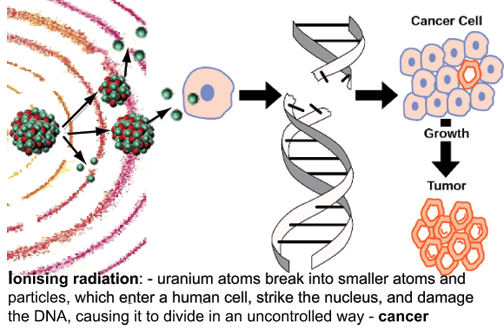
The science behind this protection regime is based on the capacity of ionising radiation to
cause damage at the cellular level in the human body. Radiation striking a cell can either
cause no damage or it may kill the cell outright – in which case, unless too many cells are
killed at once, the body will eliminate the dead cells and function healthily. The problem
comes when the cell is merely damaged, and the natural process of repair is imperfect,
leaving the cell to replicate in this damaged form – which may in some cases lead to the kind
of growth we call a cancer, other long term health or genetic damage. The level of this kind
of damage (known as stochastic) is a hit-and-miss affair – a low level of radiation exposure
doesn’t determine a health effect but as the level of exposure increases, it increases the
probability of the damage.
Current Standards Need Tightening
The limits on exposure have been progressively tightened over the years as estimates of the
cancer risks, mainly drawn from the Life-Span Studies (LSS) of Japanese survivors of the
Hiroshima and Nagasaki atomic bomb blasts in 1945, showed progressively higher rates of
this stochastic health damage. Recent evidence from studies of workers in the Nuclear
Industries in France the UK and USA (The INWORKS studies) suggest the worker-exposure
limits need to again be revised – and significantly tightened. In addition, studies on health of
populations living close to nuclear power plants in Europe and the USA show significantly
elevated rates of cancer in both children and the elderly directly related to living distance
from these facilities.
United States Proposals Would Weaken Current Standards
Unfortunately, it appears that the USA is headed in the opposite direction and given the
recent behaviour of the current President, may soon pressure other countries to follow suit.
In May 2025 US President Donald Trump issued a Directive (EO 14300) Instructing the US
Nuclear Regulatory Commission (NRC) to revise all its regulations – in particular, to revise
those relating to radiation health and safety. He instructed the NRC to abandon the LNT
and ALARA principles and re-set limits on worker and public exposures based on ‘deterministic’ rather than ‘probabilistic’/’stochastic ‘ health outcomes – potentially allowing
much higher levels of exposure.
Exactly how the NRC will respond to these directives is unclear. To comply with the
president’s orders would put the USA in conflict with national and international agencies
such as the International Commission of Radiological Protection (ICRP), the United Nations
Scientific Committee on Atomic Radiation (UNSCEAR), the US National Academy of
Science’s. Committee on the Biological Effects of Ionising Radiation (the BEIR committee)
and other countries’ national agencies including the Australian Radiation Protection and
Nuclear Standards Agency (ARPANSA) – all of which have recently reaffirmed commitment
to the LN and ARPANSA principles and the current annual limits on worker and public
exposure.
TThe draft of the revised NRC regulations on radiation protection is expected on 30 April
2026 with a 30-day period for comments before the final comprehensive revision of all NRC
regulations is published in November 2026.
An international Campaign
These US proposals have stimulated the beginnings of an international campaign bringing
together trade unions, environment and public health groups and communities concerned
about current and future exposures from mining, industrial, medical, and nuclear radiation
sources. The objectives of this campaign are two-fold:
1 To pressure national and international agencies with responsibility for radiation
protection to publicly repudiate any US regulations that align with the Trump
Directive and resist any pressures from the US to similarly weaken existing national
standards.
2. To build pressure on these national and international agencies to revise and tighten
the standards in line with the best available scientific evidence that the health risks
are greater than those used to set current standards.
The Military Connection
For Australian workers and the public, the situation is complicated by and made more
urgent as a result of the Australia, UK, USA (AUKUS) agreement regarding the building and
stationing of nuclear-powered submarines in Australia. We have already seen the creation
of a separate Australian Naval Nuclear Power Standards Regulator (ANNPSR) that will be
responsible for all standards in the construction, operation, maintenance, decommissioning,
and radioactive waste management from the submarines built or stationed here. We can
expect pressure from the USA to have these standards align with those in the USA. As such
the ANNPSR could become a back door for pressuring the current standards agency
ARPANSA to revise and weaken rather than tighten protection standards across the full
range of other occupational and public radiation health risks.
For further information
For references to the scientific evidence and to be kept informed of developments as this
campaign evolves contact:
Dr Tony Webb,
E-mail: webbt45@icloud.com,
No comments yet.
1 This Month

of the week – Shut Down Drone Warfare!


Tell the Ukrainian Government to Drop Prosecution of Peace Activist Yurii Sheliazhenko

Petition to revoke the licensing of the Near Surface Nuclear Disposal Facility (NSDF) at Chalk River. https://www.ourcommons.ca/petitions/en/Petition/Details?Petition=e-7247
To see nuclear-related stories in greater depth and intensity – go to https://nuclearinformation.wordpress.com
-
Archives
- April 2026 (7)
- March 2026 (251)
- February 2026 (268)
- January 2026 (308)
- December 2025 (358)
- November 2025 (359)
- October 2025 (376)
- September 2025 (257)
- August 2025 (319)
- July 2025 (230)
- June 2025 (348)
- May 2025 (261)
-
Categories
- 1
- 1 NUCLEAR ISSUES
- business and costs
- climate change
- culture and arts
- ENERGY
- environment
- health
- history
- indigenous issues
- Legal
- marketing of nuclear
- media
- opposition to nuclear
- PERSONAL STORIES
- politics
- politics international
- Religion and ethics
- safety
- secrets,lies and civil liberties
- spinbuster
- technology
- Uranium
- wastes
- weapons and war
- Women
- 2 WORLD
- ACTION
- AFRICA
- Atrocities
- AUSTRALIA
- Christina's notes
- Christina's themes
- culture and arts
- Events
- Fuk 2022
- Fuk 2023
- Fukushima 2017
- Fukushima 2018
- fukushima 2019
- Fukushima 2020
- Fukushima 2021
- general
- global warming
- Humour (God we need it)
- Nuclear
- RARE EARTHS
- Reference
- resources – print
- Resources -audiovicual
- Weekly Newsletter
- World
- World Nuclear
- YouTube
-
RSS
Entries RSS
Comments RSS
 nuclear-news
Leave a comment