Trump nixes nukes from environmental reviews
February 5, 2026, https://beyondnuclear.org/trump-nixes-nukes-from-environmental-review/
White House Executive Order & DOE set rule for “categorical exclusion” of new reactors from NEPA environmental impact statements
On February 2, 2026, the American Nuclear Society’s NuclearNewsWire headlined the US Department of Energy (DOE) announcement for the exclusion of experimental advanced nuclear reactors (ANR) from environmental reviews under the National Environmental Policy Act (NEPA). The February 2, 2026 Federal Register notice states that the Trump White House by Executive Order (E.O.) 14301, “Reforming Nuclear Reactor Testing at the Department of Energy” (May 23, 2025), Section 6, Streamlining Environmental Reviews directs U.S. Secretary of Energy Chris Wright to create “categorical exclusions as appropriate for reactors within certain parameters.” The categorical exclusion was made effective immediately on February 2, 2026.
Beyond Nuclear encourages you to submit your comment on the new categorical exclusion rule up until March 4, 2026, using the Federal eRulemaking Portal: www.regulations.gov. Public comments must include the agency name (“Department of Energy,”) and docket number, (DOE-HQ-2025-0405) and labeled “DOE categorical exclusion for Advanced Nuclear Reactors (ANR).”
The new DOE categorical exclusion rule establishes some specific conditions allegedly before the nuclear industry can proceed through licensing for mass production, construction and operation its ANR projects unfettered by any environmental assessment or environmental impact statement as otherwise required under NEPA law.
Beyond Nuclear’s first examination of the DOE’s qualifying conditions for claiming categorical exclusion eligibility to apply finds them contradicting facts and without meeting the legal standard of “reasonable assurance”.
Here are a few samples of prepared comments that Beyond Nuclear will be submitting to the DOE on these bogus conditions of eligibility:
Inherent/Passive Safety Features: The new reactor design must employ “inherent safety” features and systems.
Based on available information of currently funded nuclear power startup companies in the United States, none of the known startups, or any of the established nuclear power corporations like Westinghouse Electric have formally declared they will refuse US government limited liability protection from a catastrophic nuclear power accident under the Price-Anderson Act. In fact, as quietly tacked onto to “An Act: To authorize appropriations for the United States Fire Administration and firefighter assistance grant programs, to advance the benefits of nuclear energy, and for other purposes,” the Accelerating Deployment of Versatile, Advanced Nuclear for Clean Energy (ADVANCE) Act of 2024—without a single public hearing—Congress extended the industry’s limited liability protection beyond the scheduled expiration of Price-Anderson on December 31, 2025 with a 40-year extension to December 31, 2065. The original Price-Anderson Act of 1957 has long been and remains essential for the nuclear industry to secure what meager private investment it can still attract by maintaining its federally limited liability and indemnification from catastrophic radiological contamination by nuclear accidents and malevolent acts. It is highly improbable that any nuclear power startup or current operational nuclear companies will voluntarily forgo the federal government’s limited liability nuclear accident financial shelter, given developing advanced reactors still face unacceptable uncertainty from severe nuclear accident risks and bad actors. This demonstrated lack of industry confidence contradicts its own claims of “inherent safety” from a well established and acknowledged “inherently dangerous” nuclear power technology.
Advanced Fuel and Coolant Systems: The reactor must utilize well-established fuel, coolant, and structural materials that support a, low-risk safety design basis.
Many of the emerging US advanced reactor designs will rely upon an advanced nuclear fuel identified as High Assay Low Enriched Uranium (HALEU) nuclear fuel. HALEU fuel is not “well-established” in the US market. HALEU is fissionable uranium-235 enriched to just under 20% U-235. (Conventional nuclear fuel is enriched to 3-5% U-235). The only commercial-grade HALEU fuel available globally today is state-owned and controlled by Russian oligarchy. Even the US current operating fleet of commercial reactors only resources roughly 1% or less of low enriched U-235 domestically to fuel its existing fleet. It is heavily reliant upon foreign uranium. According to the US Energy Information Administration, Russia and the Russia-influenced countries of Kazakhstan and Uzbekistan provide approximately 48% of the total US domestic reactor nuclear fuel purchases.
What’s more, at just under an upper limit near 20% enriched U-235, HALEU fuel significantly reduces the effort needed to produce nuclear weapons-grade material under the guise of advanced reactor deployment and fuel development. This results in an increased threat to global safety and security with accelerated nuclear weapons proliferation that would likely result with the commercial trafficking and expansion of advance reactor technology and the higher enriched uranium nuclear fuel.
The number of advanced reactor design coolant systems that plan to use highly reactive and “hazardous” liquid metal and liquid salt combined with nuclear power operations warrant the NEPA requirement for “reasonable assurance” analysis and public interrogation by environmental impact statements. In the context of advanced nuclear coolants, this refers to materials that are chemically reactive in air and water (sodium) or highly corrosive (molten salts) both of which are balanced with safety tradeoff benefits that come with low-pressure operation. However, historical accounts demonstrate numerous and recurring of reactor coolant leaks and fires in different countries involving sodium coolant do not provide the “reasonable assurance” for the blanket categorical exclusion of environmental reviews for these advanced reactors.
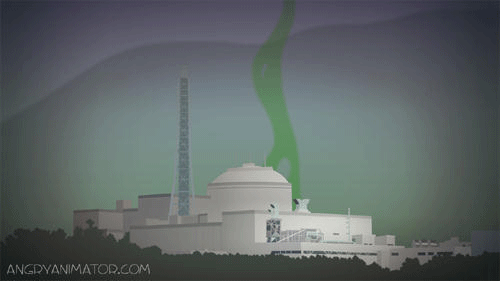
Japan’s Monju sodium cooled reactor had numerous and significant leaks and fires over its operational history including one major accident and widely reported sodium leak and fire accident in 1995. The accident dominated Monju’s operational history associated with forced shutdown for nearly 15 years and its eventual abandonment of operation. This 1995 accident was compounded by a scandal where the operator (JAEA) attempted to hide the extent of the damage, leading to a significant loss of Japan’s public confidence in nuclear power. Monju was permanently closed in 2016 and decommissioned. This operational history in Japan does not demonstrate “reasonable assurance” in the technology to warrant a blanket categorical exclusion of NEPA’s required environmental impact statement on the risks and consequences also associated with a catastrophic nuclear accident.
Another example documented by historical operating data comes from France’s sodium-cooled fast breeder reactor (FBR) program, specifically the Phénix (multiple sodium-air and recurring sodium-water reactive events in its steam generators). Additionally, France’s Superphénix reactors experienced a major sodium reactive event that shut down the reactor for four years. These combined incidents and accidents were frequent and costly enough to lead to major, long-term shutdowns and France’s eventual abandonment of the technology altogether in the late 1990s. Again, the operational history in France does not provide “reasonable assurance” for the DOE to grant a categorical exclusion of NEPA’s required environmental impacts statement on the resumption of yet another experimental reactor coolant failure, significant fire and/or explosion that could precipitate significant radiological releases.
Safe Waste Management: The project must demonstrate that any hazardous waste, radioactive waste, or spent nuclear fuel can be managed in accordance with applicable requirements.

The Proceedings of the National Academy of Sciences (PNAS), a peer reviewed journal of the National Academy of Sciences (NAS) published a report “Nuclear waste from small modular reactors,” on May 31, 2022. The significance of this study authored by finds “few studies have assessed the implications of SMRs (Small Modular Reactors) for the back end of the nuclear fuel cycle. The low-, intermediate-, and high-level waste stream characterization presented here reveals that SMRs will produce more voluminous and chemically/physically reactive waste than LWRs (the US conventional large Light Water Reactor fleet), which will impact options for the management and disposal of this waste.”
“‘Our results show that most small modular reactor designs will actually increase the volume of nuclear waste in need of management and disposal, by factors of 2 to 30 for the reactors in our case study,’ said study lead author Lindsay Krall, a former MacArthur Postdoctoral Fellow at Stanford University’s Center for International Security and Cooperation (CISAC). ‘These findings stand in sharp contrast to the cost and waste reduction benefits that advocates have claimed for advanced nuclear technologies.’”
Study Conclusions
“This analysis of three distinct SMR designs shows that, relative to a gigawatt-scale PWR, these reactors will increase the energy-equivalent volumes of SNF (spent nuclear fuel), long-lived LILW (low and intermediate level radioactive waste), and short-lived LILW by factors of up to 5.5, 30, and 35, respectively. These findings stand in contrast to the waste reduction benefits that advocates have claimed for advanced nuclear technologies. More importantly, SMR waste streams will bear significant (radio-) chemical differences from those of existing reactors. Molten salt– and sodium-cooled SMRs will use highly corrosive and pyrophoric fuels and coolants that, following irradiation, will become highly radioactive. Relatively high concentrations of 239Pu (plutonium) and 235U in low–burnup SMR SNF will render recriticality a significant risk for these chemically unstable waste streams.”
These few excerpts from scientific findings by the peer reviewed journal of the National Academy of Sciences do not provide “reasonable assurance” to meet a legal standard for the DOE to grant a categorical exclusion of NEPA’s required environmental impacts statement.
Additional samples of the critical comments already submitted to the DOE:
“DOE-HQ-2025-0405 is illegal, absurd, arbitrary, and capricious.
Per NEPA: § 4336e. Definitions. In this subchapter: (1) Categorical exclusion. The term ‘categorical exclusion’ means a category of actions that a Federal agency has determined normally does not significantly affect the quality of the human environment within the meaning of section 4332(2)(C) of this title. Obviously, nuclear reactors significantly affect the quality of the human environment when they fail (e.g. Three-Mile Island, Fukishima, and Chernobyl). DOEHQ-2025-0405 excludes experimental nuclear technologies from review without any analysis. DOE-HQ-2025-0405 briefly mentions that these experimental technologies will ‘limit adverse consequences from releases of radioactive or hazardous material from construction, operation, and decommissioning.’ This statement implies that there will be ‘releases of radioactive or hazardous material,’ and ‘adverse consequences’ from those releases, but that the unproven technologies will somehow ‘limit’ those adverse consequences. To be clear, releases of radioactive and hazardous materials significantly affect the quality of the human environment.”
“The new policy of waiving regulatory hurdles is INSANITY! Whole communities, town and cities are at risk for nuclear contamination. Surely you’ve documented our history of radiation contamination not only in our country but around the globe. Trump’s administration acts before thinking, studying, and reasoning. If there is anything to be done in advance of nuclear projects going online please for the sake of humanity stop this nonsense.”
“Department of Energy DOE-HQ-2025-0405. Given the controversial nature of nuclear power generation and disposal of associated waste, as well as earlier reactor disasters around the world compliance with NEPA requires the completion of an EIS not a CX. The long term environmental impacts and alternatives require a more complete and scientically informed analysis before a decision can be made.”
No comments yet.
1 This Month

of the week – Shut Down Drone Warfare!


Tell the Ukrainian Government to Drop Prosecution of Peace Activist Yurii Sheliazhenko

Petition to revoke the licensing of the Near Surface Nuclear Disposal Facility (NSDF) at Chalk River. https://www.ourcommons.ca/petitions/en/Petition/Details?Petition=e-7247
To see nuclear-related stories in greater depth and intensity – go to https://nuclearinformation.wordpress.com
-
Archives
- April 2026 (7)
- March 2026 (251)
- February 2026 (268)
- January 2026 (308)
- December 2025 (358)
- November 2025 (359)
- October 2025 (376)
- September 2025 (257)
- August 2025 (319)
- July 2025 (230)
- June 2025 (348)
- May 2025 (261)
-
Categories
- 1
- 1 NUCLEAR ISSUES
- business and costs
- climate change
- culture and arts
- ENERGY
- environment
- health
- history
- indigenous issues
- Legal
- marketing of nuclear
- media
- opposition to nuclear
- PERSONAL STORIES
- politics
- politics international
- Religion and ethics
- safety
- secrets,lies and civil liberties
- spinbuster
- technology
- Uranium
- wastes
- weapons and war
- Women
- 2 WORLD
- ACTION
- AFRICA
- Atrocities
- AUSTRALIA
- Christina's notes
- Christina's themes
- culture and arts
- Events
- Fuk 2022
- Fuk 2023
- Fukushima 2017
- Fukushima 2018
- fukushima 2019
- Fukushima 2020
- Fukushima 2021
- general
- global warming
- Humour (God we need it)
- Nuclear
- RARE EARTHS
- Reference
- resources – print
- Resources -audiovicual
- Weekly Newsletter
- World
- World Nuclear
- YouTube
-
RSS
Entries RSS
Comments RSS
 nuclear-news
Leave a comment