12 February – Webinar The Big Push: New Nuclear Projects in Canada
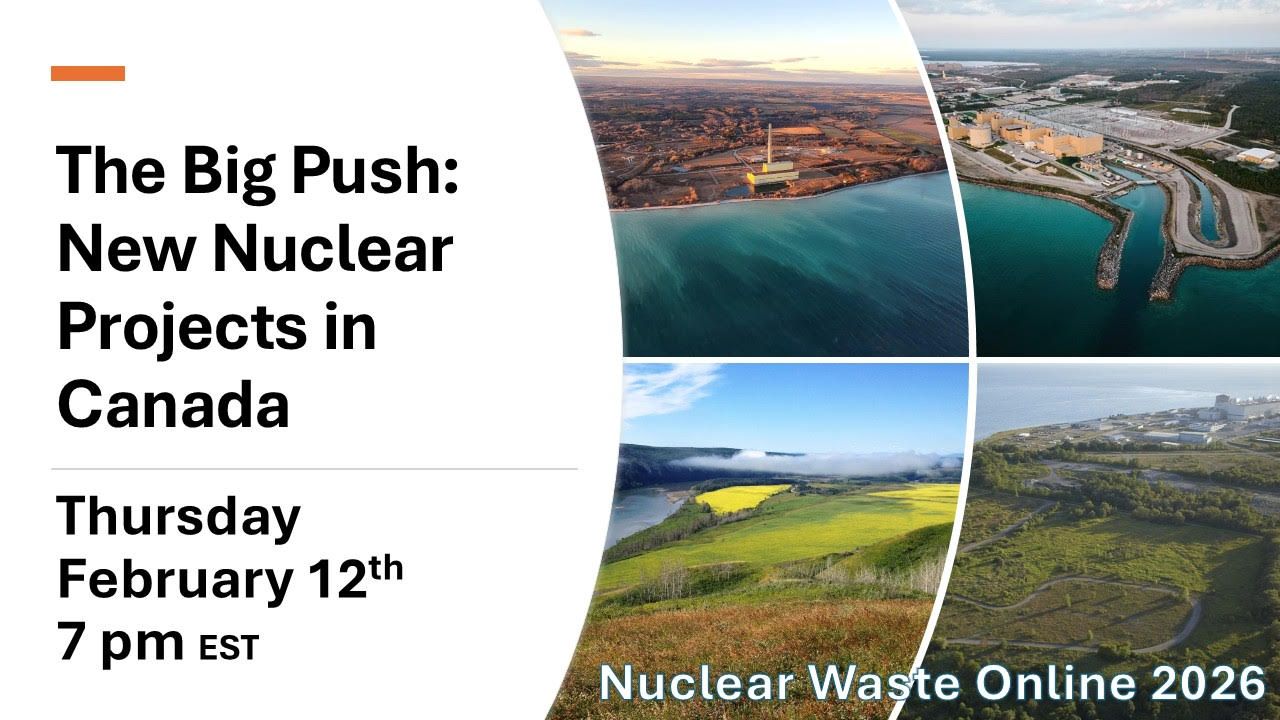
Thursday, February 12, 7 pm Eastern | 2nd of 4 sessions in the 2026 Nuclear Waste Online webinar series
Join a webinar on the push for new nuclear generation in Canada. Go to Northwatch.org to register or use the registration link https://us02web.zoom.us/webinar/register/WN_ZfWOf1GITqSRIZX8CB-A9w
From construction underway for not-so-small “Small Modular Reactors” at the Darlington site to plans for new mega-reactors at the Bruce Nuclear Generating Station, Peace River and now Wesleyville, the nuclear industry is running a seeming juggernaut nuclear expansion campaign and governments are on nuclear spending sprees. Join this session to hear about nuclear expansion plans in Canada, from New Brunswick to Alberta.
This is the second in a four part webinar series.Join every Thursday in February. Go to Northwatch.org to register and for details of all four sessions.
A Nuclear Renaissance for Scotland?

“They of course don’t want to talk about the European Power Reactor (EPR) configuration being installed at astronomical cost at Hinkley C. This project is forecast to cost around £45 billion when it finally comes online sometime next decade.”
They misleadingly present them as cheap, clean and ‘green’ – yet this is as far from the truth as it was 70 years ago when it was promised that nuclear energy would be ‘too cheap to meter’
By Mike Small, 5th February 2026, https://bellacaledonia.org.uk/2026/02/05/a-nuclear-renaissance-for-scotland/
At an exciting launch in Glasgow tonight where Sam Richards (CEO Britain Remade. Ex No10) will lay out his plans for new nuclear power in Scotland:
“Looking forward to speaking at the launch of this later. A nuclear renaissance is taking place across the world and Scotland shouldn’t be left behind.”
Tonight will see the launch of something called ‘Scotland for Nuclear Energy’ with support from groups like ‘Nuclear for Scotland‘, which has no information about itself on its own website, and Home | Minerva Health Physics Ltd which ‘are a dedicated team of experts in radiation protection and radioactive waste management’, and the North Highland Chamber of Commerce. Home – Caithness Chamber of Commerce
The launch was nicely timed in the week when it was revealed that the UK Govt has buried “almost 200 containers” of radioactive material underground in Scotland.
*
Today Britain Remade announced: “Today we’re part of the launch of Scotland For Nuclear Energy – a coalition of communities, businesses and campaigners calling on the Scottish Government to lift the ban on new nuclear power in Scotland.”
It’s not clear exactly who the ‘communities’ are, but maybe that will become clearer at the launch.
According to ‘Britain Remade’: “We are not affiliated with, or part of, any political party.”
But Sam Richards is the Director of the network of conservative environmentalists and caucus of green Conservative MPs, and was the Special Advisor to the PM on Energy & Environment (2019-2022). He’s a Boris SPAD. And Jeremy Driver (Head of Campaigns), is a former Lloyds Banker and Parliamentary Assistant to Ann Soubry. Sam Dumitriu is Head of Policy at Britain Remade who formerly worked at the Adam Smith Institute. Jason Brown is Head of Communications for Britain Remade, a former No. 10 media Special Adviser and Ben Houchen’s comms Adviser.
These are Tory SPADS working on their own campaign to support new nuclear in Scotland: Lift The Ban On New Scottish Nuclear Power.
Jeremy and Sam are a bit shy about the costs of nuclear power, and so they should be. Anas Sarwar and Labour energy minister Michael Shanks are enthusiastic. But, as John Proctor has pointed out, they too aren’t very up front about costs.
Proctor writes [I spent decades in energy. Here are the problems with UK nuclear plans]:
“They of course don’t want to talk about the European Power Reactor (EPR) configuration being installed at astronomical cost at Hinkley C. This project is forecast to cost around £45 billion when it finally comes online sometime next decade.”
“It is not easy to get a proper sense of this sum, but it might surprise people to realise that this is the equivalent of paying £1 million every single day for 120 years – and this is just the construction cost. We have not even started talking about operational costs, asset management and asset decommissioning.”
Remake Britain, or Scotland for Nuclear Energy (it’s not entirely clear if they are one and the same thing) are great at PR, managing to create this fantastic puff piece by Paris Gourtsoyannis on the BBC ‘News’ channel: The nuclear power station at the centre of the political divide in Scotland.
They’ve also managed to somehow try and re-create the ‘Nuclear Power No Thanks’ badge from the 1970s with a super-cringey ‘Nuclear Power Aye Cheers’ slogan.
SCRAM (Scottish Campaign to Resist the Atomic Menace) have issued a rebuttal to all this astroturfing.
Pete Roche, spokesperson for SCRAM said: “As renewable energy-rich Scotland heads towards an election, it is all too predictable that nuclear lobbyists are again arguing that Scotland needs new nuclear power stations. They misleadingly present them as cheap, clean and ‘green’ – yet this is as far from the truth as it was 70 years ago when it was promised that nuclear energy would be ‘too cheap to meter’
“An energy system built around renewables is already happening. Meeting all our needs this way is not just possible, but it’s quicker and cheaper without the costly distraction of new nuclear. Low-cost renewable energy combined with storage, flexible power to balance the grid and smart local energy systems will make the best use of our incredible renewable resources and engineering know-how. Why dilute that by backing eye-wateringly expensive nuclear power stations?”
“The highly skilled nuclear workforce will be kept busy for decades in decommissioning the sites at Torness, Hunterston, Chapelcross and Dounreay – and completing a sustainable renewable energy system is already bringing huge demand for skilled energy professionals. The renewables sector is the future, and where the focus for skills must remain.”
”A 100% renewable-based energy system will be cheaper, better for jobs and energy security, and be truly green and sustainable. We hope the information we have provided will be useful to all political parties and voters, and help to balance out the misleading propaganda of the nuclear PR machine.”
One of the other myths that SCRAM is keen to dispel is the notion that new nuclear power is a solution to climate change. They state:
“Nuclear power stations are not resilient to climate change. They are usually on the coast where sea levels are rising and storm surges could threaten installations. They require large quantities of water to keep cool and avert meltdowns. [see Nuclear Energy isn’t a Safe Bet in a Warming World – Here’s Why, by Paul Dorfman, The Conversation https://theconversation.com/nuclear-energy-isnt-a-safe-bet-in-a-warming-world-heres-why-163371 ]
“Using nuclear plants to address climate change involves unacceptable risks. Risks include the possibility of serious accidents; an unsolved radioactive waste problem; the environmental damage caused by uranium mining, yet another nuclear target for terrorists or in armed conflict and increased nuclear weapons proliferation. Renewable energy risks none of these.”
“Tackling climate change is urgent, so requires the fastest and cheapest solutions. We must spend our limited resources as effectively, quickly and fairly as possible. Amory B. Lovins, adjunct professor of civil and environmental engineering at Stanford University, explains that saving the most carbon per pound, as quickly as possible, requires not just energy generation that doesn’t burn fossil fuels, but also generation that is deployable with the least cost and time. That rules out nuclear energy as an answer to climate change. In fact, nuclear worsens climate change by spending valuable resources on a solution which is much too slow and too costly.” [see Why Nuclear Power Is Bad for Your Wallet and the Climate].
There is no case for new nuclear in Scotland.
These front groups and astroturf projects are attempting to paper over the cracks about Britain’s ageing and decrepit nuclear programme [Revealed: 585 cracks in Torness nuclear reactor ]. They are a costly clandestine distraction which threatens to undermine the urgent need to shift to clean energy and decarbonise the economy.
Sorrowful day for peace largely ignored thruout America

Walt Zlotow West Suburban Peace Coalition Glen Ellyn IL, 7 Feb 26
The New Start Treaty between Russia and US expires today and America largely yawned. Big story on mainstream news? Faggedaboudit. Ask the person on the street about New Start and he might mutter something about giving disadvantaged kids free comprehensive early childhood education. Wait, wait…that’s Head Start.
Nope, New Start is the 16 year old treaty Obama signed with Russian President Dmitry Medvedev on February 8, 2010. It caps the number of nuclear warheads each side can deploy at 1,550 and limits the number of deployed and non-deployed strategic launchers to 800. Still enough for either side to incinerate us all, but prevents a senseless arms race and symbolic of the critical need to reduce nuclear tensions.
But limited US Russian nuclear arsenals go back 54 years as 2010 Russian New Start signer Medvedev reminded us yesterday. “That’s it. For the first time since 1972, Russia (the former USSR) and the US have no treaty limiting strategic nuclear forces. SALT 1, SALT 2, START I, START II, SORT, New START – All in the past, winter is coming.”
President Trump rebuffed Russian President Putin’s offer to extend the limits for another year for sensible diplomacy to negotiate a new treaty.
Secretary of State Marco Rubio used the lame excuse that any new treaty must include China. But with a nuclear arsenal a pittance of the two nuclear giants, China demurred saying any treaty involving China must include US Russian nuclear stockpiles reduced to China’s level. Rubio knew his requirement was a poison pill deal breaker for any new extension of New Start.
Dumping nuclear agreements is nothing new for Trump. He left office in January 20, 2021 ignoring New Start’s eminent expiration. Successor Biden promptly renewed New Start for 5 years, exactly 5 years ago today. This time Trump has succeeded in letting it expire on his watch.
This gives Trump a trifecta in dumping critically needed nuclear agreements. In August 2019 Trump withdrew from the Intermediate Range Nuclear Forces (INF) Treaty that banned all land-based missiles with ranges between 500 and 5,500 km. . In November 2020, just before leaving office, Trump withdrew from the 2002 Open Skies Treaty which allowed the US and Russia to conduct short-notice, unarmed reconnaissance flights over each other’s territory to monitor military activities.
The only positive glimmer to put on Trump’s refusal to extend New Start, even for a measly year to negotiate a long term agreement? Trump has no more nuclear agreements to withdraw from in the last sorrowful 3 years of his second term.
This January the Bulletin of Atomic Scientists moved the Doomsday Clock, symbolic of approaching global catastrophe, to 85 seconds to Midnight, the closest in its 79 year history. With Trump president, the Bulletin might want to quickly reconvene for another gander at our march toward world annihilation. Next January, none of us might around to hear the 2027 announcement.
The US Keeps Openly Admitting It Deliberately Caused The Iran Protests
Caitlin Johnstone, Feb 06, 2026, https://www.caitlinjohnst.one/p/the-us-keeps-openly-admitting-it?utm_source=post-email-title&publication_id=82124&post_id=187080859&utm_campaign=email-post-title&isFreemail=true&r=1ise1&triedRedirect=true&utm_medium=email
Speaking before the Senate Banking Committee on Thursday, US Treasury Secretary Scott Bessent explicitly stated that the US deliberately caused a financial crisis in Iran with the goal of fomenting civil unrest in the country.
Asked by Senator Katie Britt what more the US can be doing to place pressure on the Ayatollah and Iran, Bessent explained that the Treasury Department has implemented a “strategy” designed to undermine the Iranian currency which crashed the economy and sparked the violent protests we’ve seen throughout the country.
“One thing we could do at Treasury, and what we have done, is created a dollar shortage in the country,” Bessent said. “At a speech at the Economic Club in March I outlined the strategy. It came to a swift and I would say grand culmination in December when one of the largest banks in Iran went under. There was a run on the bank, the central bank had to print money, the Iranian currency went into free fall, inflation exploded, and hence we have seen the Iranian people out on the street.”
This is not the first time Bessent has made these admissions. Speaking at the World Economic Forum in Davos last month, the treasury secretary said the following:
“President Trump ordered Treasury and our OFAC division, Office of Foreign Asset Control, to put maximum pressure on Iran. And it’s worked, because in December, their economy collapsed. We saw a major bank go under; the central bank has started to print money. There is dollar shortage. They are not able to get imports, and this is why the people took to the street. So, this is economic statecraft, no shots fired, and things are moving in a very positive way here.”
Following these remarks, Jeffrey Sachs and Sybil Farres wrote the following for Common Dreams:
“What Secretary Bessent describes is of course not ‘economic statecraft’ in a traditional sense. It is war conducted by economic means, all designed to produce an economic crisis and social unrest leading to a fall of the government. This is proudly hailed as ‘economic statecraft.’
“The human suffering caused by outright war and crushing economic sanctions is not so different as one might think. Economic collapse produces shortages of food, medicine, and fuel, while also destroying savings, pensions, wages, and public services. Deliberate economic collapse drives people into poverty, malnutrition, and premature death, just as outright war does.”
Bessent laid out these plans in advance at the Economic Club of New York back in March of last year, saying the following:
“Last month, the White House announced its maximum pressure campaign on Iran designed to collapse its already buckling economy. The Iranian economy is in disarray; 35% official inflation, has a currency that has depreciated 60% in the last 12 months, and an ongoing energy crisis. I know a few things about currency devaluations, and if I were an Iranian, I would get all of my money out of the Rial now.
“This precarious state exists before our Maximum Pressure campaign, designed to collapse Iranian oil exports from the current 1.5–1.6, million barrels per day, back to the trickle they were when President Trump left office.
“Iran has developed a complex shadow network of financial facilitators and black-market oil shippers via a ghost fleet to sell oil, petrochemical and other commodities to finance its exports and generate hard currency.
“As such, we have elevated a sanctions campaign against this export infrastructure, targeting all stages of Iran’s oil supply chain. We have coupled this with vigorous government engagement and private sector outreach.
“We will close off Iran’s access to the international financial system by targeting regional parties that facilitate the transfer of its revenues. Treasury is prepared to engage in frank discussions with these countries. We are going to shut down Iran’s oil sector and drone manufacturing capabilities.
“We have predetermined benchmarks and timelines. Making Iran Broke Again will mark the beginning of our updated sanctions policy. Watch this space.”
The US has been orchestrating plans to foment unrest in Iran by causing economic strife for years. In 2019 Trump’s previous secretary of state Mike Pompeo openly acknowledged that the goal of Washington’s economic warfare against Iran was to make the population so miserable that they “change the government”, cheerfully citing the “economic distress” the nation had been placed under by US sanctions.
As unrest tore through Iran last month, Trump egged protesters on and encouraged them to escalate, saying “To all Iranian patriots, keep protesting, take over your institutions, if possible, and save the name of the killers and the abusers that are abusing you,” adding, “all I say to them is help is on its way.”
Deliberately trying to ignite a civil war in a country by immiserating its population so severely that they start attacking their own government out of sheer desperation is one of the most evil things you can possibly imagine. But under the western empire it’s just another day. They’re doing it in Iran, and they’ve also aggressively ramped up efforts to do it in Cuba, where the government has just announced it will be rationing oil as the US moves to strangle the island nation into regime change.
A lot of attention is going into the Epstein files right now, and understandably so. But it’s worth noting that nothing in them is as depraved and abusive as what our rulers are doing right out in the open.
Comments on the Deep Geological Repository (DGR) for Canada’s Used Nuclear Fuel Project December 2025 APM-REP-05000-0211.
D. M. LeNeveu, Feb. 4 2026
The project scope of the DRG at the Revell site is for disposal of up to 5.9 million used fuel bundles to cover the expected inventory from Canada’s reactors by the end of 2026. However used fuel from ongoing reactor operation in Canada into the far future can be deposited in the DGR pending approval from host communities and applicable regulators. The Project is expected to last over 160 years. It is recognized that a viable disposal method for all nuclear wastes from reactors is necessary for the continuation of the use of nuclear energy in Canada. Thus the disposal of used fuel from Canada’s reactors in the DGR into the far future is almost certain.
What is grossly missing is a comprehensive analysis of the continuation of nuclear energy in comparison to other energy sources particularly the potentially much less costly options of renewable energy. A comprehensive long term lifecycle cost benefit analysis is required for all potential power sources. All life cycle costs for nuclear energy must be comprehensively determined including the cost of new reactor builds, existing reactor refurbishment, all waste management costs into the far future including all existing and future high, intermediate and low level waste management costs plus reactor decommissioning costs. This analysis must include all legacy waste and decommissioning costs such as from Chalk River, Whiteshell, Point Lepreau, and Gentilly as these are embedded costs of the nuclear industry. All past and continuing costs for nuclear research such as at AECL, CNL and any other government funded nuclear research for nuclear power must be included. The cost of operating the DGR for 160 years must be included. These reactor and renewable costs should be expressed in a cost per GW-hour per year. As well, the overall past and future costs including legacy costs must be quantified.
Renewable energy is often dismissed based on intermittency of wind or solar. It is essential that any cost comparison include a nation wide power grid that can be used to transfer renewable power over large enough distances to secure continuous renewable sources that would diminish the intermittency issue. Large distance transfers of hydro power used as reliable back up should be included in the cost estimates.
- Such a cost benefit analysis must be done by an independent qualified agency and certainly not OPG or advocates of nuclear power. Such a comprehensive study of all costs associated with nuclear power in Canada will almost assuredly demonstrate that nuclear power is not viable in terms of cost comparison to renewable energy. As such the planned DGR must then be restricted only to current nuclear waste and wastes following from closure of all current reactors. Implicit is the required shut down of nuclear energy in Canada.
An extensive national energy cost benefit analysis is not planned but absolutely essential to determine the scope of the DGR. All plans for the DGR should be suspended until such an analysis is done.
- For the Seaborn Panel assessment of the disposal of high level nuclear waste in Canada circa 1998, a comprehensive probabilistic risk assessment was completed entailing years of dedicated research and data gathering and computational analysis. Vault, geosphere, and biosphere models were developed based on years of research to quantify the probabilistic dose consequence risk of a generic DGR. No such comprehensive probabilistic risk has been required for the Revell site DRG.
For the Seaborn assessment, extensive borehole, seismic and geological data and analysis was used to develop a three dimensional geosphere model including all fracture zones for an example site at the underground research laboratory at the Whiteshell research Centre. The groundwater flow in the example geosphere model including the fracture zones and surface discharge was evaluated using detailed computational finite element analysis. Such an analysis is not documented in the description of the Revell site assessment.
Research is required on the mineralization present and the geochemical conditions at the Revell site to determine site specific data required for radionuclide sorption on fracture surfaces and radionuclide solubility.
Extensive site specific data is required for an updated biosphere model for the Revell site. - Detailed research and modeling was done to determine corrosion, pitting and initial defects in for the copper coated waste container design for the Seaborn assessment. The geometry and thickness of the containers has changed for the Revell site requiring an updated container defect analysis. Detailed computational modeling was done for the Seaborn assessment to determine the required vault design to ensure the temperature around the waste containers would not exceed 100 C, the limit for no damage to the clay based buffer around the containers. Changes in container geometry and vault design for the Revell site necessitates new thermal analysis. The copper coating for the Revell design is significantly thinner than for the Seaborn assessment. Comprehensive new research must be documented to determine modes of Revell DRG container failure including size, number, and timing of pinhole defects from failure mechanisms including initial defects. This information must be incorporated into an updated vault model.
- No comprehensive detailed data gathering and analysis requiring years of dedicated research comparable to the Seaborn assessment has been done for the Revell site. Why should detailed analysis have been required for a generic analysis but not for an actual site that will be implemented? It is likely that the cost and time frame for a comprehensive probabilistic risk assessment of radionuclide dose consequence would be beyond the level the government and industry is willing to expend. Instead mainly generic arguments will be used which are basically expert-opinion and hand-waving without the comprehensive site specific expensive time consuming data and analysis required to do a meaningful impact assessment. A multi-year detailed comprehensive data gathering, model development and probabilistic risk assessment similar to the Seaborn assessment is required for a meaningful impact assessment of the Revell site. Instead the Revell site development has degenerated into mainly an engineering and design exercise with vague, poorly supported claims and tables about minimal effects to the environment.
- A neglected issue is neutron activation in used fuel nuclear waste containers. The OPG reactor site used fuel containers are helium filled preventing neutron activation of nitrogen in air to carbon 14. However activation of chlorine in structural components would create highly mobile and difficult to detect long lived chlorine 36. Other radionuclides such as cobalt 60 would also be neutron activated.
- Used fuel waste containers in concrete silos such as at Whiteshell are air filled. Thus carbon 14 would be activated from neutron radiation emanating from used fuel in such storage containers.
Neutron activation both from short lived spontaneous fission of curium isotopes and long term alpha-n reactions must be considered.
Carbon 14, chlorine 36 and other activation products would be transferred from waste storage and transport containers to the DRG waste containers.
The long term DGR waste container would be air filled. Significant amounts of carbon 14, chlorine 36 and other activation products would accumulate in these containers over thousands of years in the DGR despite the gradual decrease in the long term alpha-n neutron radiation from used fuel. Activation products would be rapidly released following DGR container failure. This potential risk from neutron activation has been neglected and must be adequately quantified and reported. - Transfer of used fuel from transportation containers to the DGR container in hot cells at Used Fuel Packaging Plant at the DGR site could result in significant surface contamination of the DRG container assemblage. The DRG container assemblage is to include an exterior clay based buffer layer that would be impossible to decontaminate. Surface contamination of carbon 14, tritium, and other volatile radionuclides such as cesium 137 and iodine 129 present in large amounts in used fuel are known to occur from off gassing deposition. Both airborne and surface contamination is liable to spread to DGR container assemblages and throughout the DGR during the required remote transport of the container assemblages.
Carbon 14, tritium, and iodine 129 are difficult to detect beta emitters. There is no documented contamination measurement and control measures in the documentation for the DGR.
Measurements have been made of significant amounts of airborne tritium and carbon 14 of gassing in low and intermediate level waste storage buildings at OPG reactor sites. Ventilation stack measurements at NPD and Whiteshell detect significant emissions of carbon 14, tritium and beta/gamma particulate long after reactor shutdown and removal of used fuel. Such measurements establish that extensive surface contamination and off gassing from used fuel occur, and would be expected at the DGR.
Ventilation stack measurements from the DGR hot cells and general areas are liable to record stack releases. Such stack releases are usually neglected as being far below derived release limits based on very large environmental air dilution of the stack releases. It must be realized that such stack releases of radionuclides are measures of widespread significant contamination throughout all ventilated areas.
The operational hazard from such widespread contamination that could endanger DGR workers has been neglected. Contamination would continually accumulate over impossible to clean DRG surfaces over the 160 or more operational lifetime. Contamination of the buffer material and exterior of DGR containers would lead to direct unquantified release of radionuclides outside the copper coated containers upon emplacement. Operational measures to adequately control and measure such airborne and surface contamination in the DGR may not be possible rendering the entire DGR operation unfeasible.
The waste container assemblage within the DGR will require remote handling and emplacement due to the high radiation fields around the containers. Any failure of the remote emplacement system would likely require manual intervention exposing workers to potentially unacceptably high radiation dose.
A realistic full scale hot cell transfer and contamination measurement is required to quantify operational hazard and determine adequate contamination control measures if at all feasible. This test must be made over many container transfers to measure accumulation of contamination.
Decontamination of the interior of hot cells following each transport container transfer is not possible for the millions of used fuel bundles that must be transferred. This consideration alone indicates that widespread contamination spread throughout the DGR is unavoidable. Determination must be made for radiation protection during recovery from failed remote emplacement. The full scale test should include a mock up of recovery from failed waste container emplacement in a disposal environment with actual dose exposure measurements.
A comprehensive operational test including testing of feasibility of recovery from failed remote disposal and determination of accumulation of surface and airborne contamination must be done before any site approval and further site development and characterization.
Will soaring electricity rates kill Ontario’s nuclear expansion?
At $20.9-billion, the Darlington SMRs are expected to cost nearly as much as larger reactors that would have generated far more power. The government is betting that the economic benefits will be worth it: by building the first-ever BWRX-300 reactor, it hopes to win export opportunities for Ontario-based nuclear suppliers.
Future plans include what would be two of the largest nuclear plants on Earth, which will cost hundreds of billions of dollars. And while the IESO holds competitive procurements for other forms of generation including natural gas, wind and solar, nuclear plants are exempted from that requirement………… “There’s no real competition and there’s no real incentive for them to deliver that power at the cheapest cost “
Matthew McClearn, The Globe and Mail, Feb 5, 2026
The Ontario government’s plans to more than double the capacity of the province’s fleet of nuclear power reactors is sprawling in its ambition – and has a price tag to match.
Last May, Energy Minister Stephen Lecce stood alongside Premier Doug Ford to announce that the government would spend $20.9-billion to build four new small modular reactors in Clarington, Ont. In November, they approved a $26.8-billion overhaul of four old reactors at Ontario Power Generation’s Pickering Nuclear Generating Station, just east of Toronto.
Ontario’s electricity rates shot up 29 per cent in November, driven in part by rising nuclear generation costs. Further hikes are virtually certain: Ontario Power Generation (OPG) recently filed a rate application before the Ontario Energy Board, which it says will lay the foundation for the province’s energy supply over the next quarter century. The utility seeks roughly a doubling of the payments it receives for the electricity generated by its nuclear power plants. If granted, monthly bills would increase by an average of $3.50 each year for the next five years.
What comes next, though, promises to be even more expensive.
The Ford government asserts that Ontario will need roughly 18,000 additional megawatts of nuclear capacity by mid-century. (Ontario’s existing Darlington, Bruce and Pickering stations represent about 12,000 megawatts.) They’re ready to embark on what they describe as “the largest expansion of nuclear energy on the continent,” which includes plans for two of the largest nuclear plants on Earth. They could easily cost hundreds of billions of dollars.
This aspect of Ontario’s nuclear ambitions – the cost, and how residents and businesses will pay – is rarely discussed by provincial officials, and then only in vague terms. But the Ford government has long insisted that it can do it all while keeping electricity costs down. Critics – particularly those favoring renewable generation – have warned for years that this nuclear-focused approach would eventually lead to steep rate hikes.
“Ontario is on a track to more expensive energy in the future,” said David Pickup, manager of electricity at the Pembina Institute, an energy thinktank.
In a presentation in late January, Jack Gibbons, chair of the Ontario Clean Air Alliance, said Mr. Ford’s plans would see 75 per cent of Ontario’s electricity produced by nuclear power by 2050.
“If his nuclear projects proceed, our electricity rates will rise dramatically,” he predicted.
The Ford government came to power in 2018 riding a wave of dissatisfaction with the energy policies of its Liberal predecessors, which also led to surging power bills. Have Mr. Lecce and Mr. Ford similarly miscalculated?
Surging rates
Ontario’s Nov. 1 rate hike of 29 per cent was likely the largest on the continent last year. In the past year, Maine and New Jersey experienced increases of 25.5 per cent and 21 per cent, respectively, according to data published by the U.S. Energy Information Administration. The U.S. national average was just 6.6 per cent.
OEB spokesperson Tom Miller attributed Ontario’s rate increase partly to unexpectedly high nuclear generation last year, including from a refurbished reactor at Darlington that returned to service five months earlier than expected.
The November hike was almost entirely offset by an accompanying increase in the Ontario Energy Rebate, a provincial subsidy the government uses to lower residential electricity bills. But those subsidies will cost taxpayers billions of dollars each year, competing with other priorities.
For now, Ontarians’ rates still compare favorably to some provinces, including Nova Scotia, and also U.S. states around the Great Lakes. But the higher payments sought by OPG, if approved, would endure for years.
Traditionally, OPG recovered its costs for projects once they began generating electricity – a common practice worldwide. But nuclear plants can take a decade or two to construct and therefore tend to rack up sizeable interest charges, adding to their final tab.
Last year the government amended the Ontario Energy Board Act to allow OPG to immediately begin recouping some costs associated with building the small modular reactors (SMRs) and refurbishing Pickering.
“The intended effect is to smooth out the cost over time, rather than massive jumps from one year to the next,” explained Brendan Frank, who heads policy development and analysis at Clean Prosperity, a clean energy thinktank.
The Association of Major Power Consumers of Ontario, which represents major industrial electricity users, accepts the charges.
“It’s a legitimate ask from the generators,” said Brad Duguid, the organization’s president. “They have preliminary costs that they’re incurring, and they need to have a way to pay for that.”
Nonetheless, similar regulatory changes elsewhere in North America led to misfortune. In the U.S., a practice known as Construction Work in Progress was introduced in South Carolina and Georgia, which obligated ratepayers in those states to pay up front for the only new nuclear plants built in the U.S. since the 1980s. The South Carolina plant was never finished, and the Georgia plant came in well over budget and many years late, contributing to major rate increases in both states.
Another factor driving up rates in Ontario are refurbished reactors returning to service. Including Pickering, Ontario has decided to refurbish 14 reactors, at a cost of several billions of dollars each. OPG is wrapping up an overhaul of its Darlington plant while Bruce Power’s is scheduled to run until 2033.
Refurbishments enjoy broad political support. One reason is that Ontario’s nuclear industry employs tens of thousands of people. At a press conference held in November to announce the Pickering refurbishment, Finance Minister Peter Bethlenfalvy turned to the unionized workers behind him and assured them: “You folks are gonna be working for a long time. By the way, you’ve got job security…I can guarantee you that we’ll have the nuclear industry’s back all the way through for the next 50 years.”
Local economic benefits are central to Mr. Lecce’s enthusiasm for nuclear, as is energy security.
“The alternative is either a dirty source of power,” he said, “or it is leveraging procurements or materials that are often made in China.
“When I think about President Trump’s attack on the country and his ongoing antagonistic approach to allies and historic friends of the U.S. like Canada, it only reaffirms to me that we are on the right path.”
An expensive future
How much of a premium are Ontarians prepared to pay?
At $20.9-billion, the Darlington SMRs are expected to cost nearly as much as larger reactors that would have generated far more power. The government is betting that the economic benefits will be worth it: by building the first-ever BWRX-300 reactor, it hopes to win export opportunities for Ontario-based nuclear suppliers.
Nuclear plants worldwide have routinely suffered serious delays and cost overruns during construction, and one in nine is never completed. Mr. Lecce exudes confidence that OPG can repeat its performance with the Darlington refurbishment.
Mr. Lecce emphasized that his government is pursuing an “all-of-the-above” approach. The province’s Independent Electricity System Operator (IESO) has awarded contracts to natural gas and battery storage projects, which are to come online in 2028. But the slogan obscures the fact that the government’s plans would see Ontario lean even more heavily on reactors than it has in the past.
And while the IESO holds competitive procurements for other forms of generation including natural gas, wind and solar, nuclear plants are exempted from that requirement.
Said Mr. Pickup: “There’s no real competition and there’s no real incentive for them to deliver that power at the cheapest cost – unlike these competitive procurements, where if they don’t come in at low cost, they won’t win and they won’t get built.”
The Ford government supports Bruce Power’s proposal to build four large new reactors at its plant in Kincardine, Ont., adding up to 4,800 megawatts to what is often described as the world’s largest nuclear power plant. Known as Bruce C, it could be Canada’s first large-scale nuclear build in more than 30 years. The government has agreed to pay for most of the impact assessment, a benefit few other private power producers enjoy.
Simultaneously, OPG has begun planning an even larger plant at Wesleyville, the site of a partly-constructed oil-fired facility near Port Hope. Wesleyville’s capacity could be as high as 10,000 megawatts, enough to seize the Bruce’s crown as the world’s largest nuclear plant.
Nuclear plants take at least a decade, often two or more, to plan and build. This long lead time, accompanied by their huge output of electricity, requires governments to make big bets about future demand.
Mr. Lecce has placed his. He expects 21 million people will live in Ontario by mid-century, up from 16 million currently. He anticipates mass-adoption of electric vehicles, new data centres and massive investment in Ontario’s industry, including electrification of steel mills.
“We need 65 per cent more power at least, 90 per cent at the high,” Mr. Lecce said. “The province is going to be investing in energy generation, one way or another.”
But many EV projects announced in the past few years have stalled or been cancelled outright. U.S. President Donald Trump’s efforts to curtail automotive imports into his country has led automakers to lower production in Ontario, and the future of other power-intensive industries such as steel are similarly unclear.
The path not taken
The Ford government’s nuclear expansion plots the opposite course to that taken by most other jurisdictions globally.
According to the International Energy Agency, renewables (particularly solar) are growing faster than any other major energy source, and will continue to do so in all scenarios it has presented – even accounting for continuing hostility from the Trump administration.
“Renewables and storage have come down massively” in cost over the last 15 years, Mr. Pickup said. “Cost reductions have been 80 to 90 per cent, so renewables aren’t just competitive, they’re much cheaper.”
Mr. Ford resolutely opposed wind generation when he first assumed office; his government sought to halt construction of two partly-constructed wind farms, much as Mr. Trump now attacks offshore wind projects.
Mr. Ford’s antipathy toward renewables appears to have softened since then. Nonetheless, the IESO expects renewables will supply roughly the same proportion of Ontario’s electricity 25 years from now as they do today.
Mr. Pickup said the Pembina Institute doesn’t think Ontario should throw out its nuclear plans entirely, only that it should moderate its ambitions considerably in favor of alternatives, particularly renewables and energy storage.
“Nuclear comes in as expensive today,” he said. “It’s going to be relatively more expensive tomorrow.”
Mr. Gibbons, of the Ontario Clean Air Alliance, asserted that the cost of new nuclear capacity is between two and eight times more expensive than wind and solar generation.
“If we build new nuclear stations, our electricity rates will rise. If we actually want to lower our electricity bills, we need to invest in the lower cost options.”
But renewables have their own shortcomings and hidden costs. Unlike nuclear plants, wind and solar facilities provide electricity only intermittently, the amount of which is largely determined by environmental conditions like wind speed and daylight. And they require additional transmission infrastructure to connect to the grid, not to mention lots of land.
Europe feels the impact of weeks of wet weather and freezing cold.

Hundreds of thousands of people have been evacuated in Spain, Portugal and
Morocco after Storm Leonardo caused widespread flooding. Emergency services
and the military have been helping rescue people from their homes with
residents who remain warned to leave immediately. The Portuguese government
have extended a state of emergency due to what it describes as the
“devastating crisis” caused by a wave of storms. Saturday will see the
arrival of Storm Marta which will bring more rain to the region.
BBC 6th Feb 2026, https://www.bbc.co.uk/weather/articles/cwy8450qkwwo
Ontario’s Nuclear Rate Shock Reveals a Deeper Affordability Problem

Michael Barnard, Clean Technica, 4 Feb 26
Ontario Power Generation (OPG) has asked the Ontario Energy Board to approve a sharp increase in regulated nuclear payment amounts, including a year over year jump of more than 40% in 2027. The weighted average regulated payment amount rises from about $78/MWh in 2026 to roughly $110/MWh in 2027, driven by the nuclear payment amount increasing from around $111/MWh to about $207/MWh, almost doubling. For a typical household, this does not mean a 40% increase in the electricity bill. OPG’s own consumer impact analysis shows an increase of roughly $8 per month on a typical bill of about $142, or around 5.6%, mostly because a lot fewer MWh are being delivered at the much higher price. The difference between those two figures is the starting point for understanding what is happening and why it matters for affordability and system design.
An electricity bill is a bundle of charges layered together. Generation is only one part of what households pay. Transmission, local distribution, system operations, and regulatory charges make up a large share of the total. Nuclear sits inside the generation portion, and OPG’s regulated nuclear sits inside nuclear. When the regulated payment amount for OPG’s nuclear fleet rises sharply, the overall bill moves much less because the other layers do not change at the same rate. This does not make the nuclear increase less real. It means the effect is diluted across a broader bill structure.
Importantly, the more Ontario is electrified with good demand management and batteries smoothing peaks, the more that the additional costs of transmission, local distribution, system operations, and regulatory charges are spread across more units of electricity, lowering their portion of the final bill. Expensive nuclear begins to dominate bills in that scenario causing higher rates than necessary, just as inexpensive renewables would lower rates.
Ontario’s nuclear system also has an important institutional split that needs to be clear early.
There are two major nuclear operators. OPG is publicly owned and regulated on a cost of
service basis. The other, Bruce Power, is privately owned and operates under a long term
contractual structure with more exposure to performance and market discipline. The current
rate application applies only to the public operator’s regulated nuclear fleet. System wide
visuals and energy flows, however, reflect the combined output of both operators. Keeping that
distinction clear avoids confusion when comparing rate case numbers to province wide
generation totals.
What is increasing in this application is not spending that OPG failed to anticipate. It is the
amount the regulator allows OPG to recover in a given year under cost of service regulation.
The revenue requirement includes operating and maintenance costs, depreciation of capital
already spent, return of capital, return on capital, taxes, and nuclear liability accruals. These
costs were planned, forecast, and approved years ago. The regulatory question is not whether
OPG expected them, but how and when they are recovered from ratepayers. A large increase in
a payment amount can occur even when nothing unexpected has happened on the ground.
The key mechanical driver of the 2027 spike is a drop in output from OPG’s nuclear fleet, not a
sudden surge in total nuclear spending. OPG’s filing shows production from its regulated
nuclear facilities falling to roughly 18.7TWh in 2027, compared with values in the high 20s or
low 30s TWh in surrounding years. This reflects planned refurbishment outages at Darlington
combined with conservative assumptions about Pickering availability as those units operate
under life extension conditions. Nuclear plants are expensive to own and relatively inexpensive
to operate, while still having costs of operations above the cost of new wind and solar. When
nuclear reactors are offline, most costs continue while output falls. Fixed costs are spread over
fewer kWh under the regulatory structure, and the $/MWh figure rises quickly.
This is why outages matter so much in a nuclear heavy system. A large portion of Ontario’s
electricity comes from a small number of very large units. When one or more of those units is
offline, there are limited alternatives ready to scale up at the same cost. Gas generation can fill
gaps, but that introduces fuel price exposure and emissions. Imports can help at the margin,
but intertie capacity is finite. The result is that nuclear outages show up as price volatility even
when total system costs remain within expected ranges…………………………………………………………………………………………………………………………………………………………………………………………………………………………………………
The decision to pursue small modular reactors adds another layer to this picture. The SMRs at
Darlington are being developed by the publicly owned utility, OPG, under a cost of service
framework. Development and early construction costs are already flowing into the nuclear
revenue requirement, even though the units won’t be producing electricity for years, likely
many more years than the current schedule projection. Ratepayers are paying financing and
development costs today, with much larger construction and depreciation costs to come later
in the decade.
The contrast with the private nuclear operator, Bruce Power, is instructive. The private
operator has chosen to focus on refurbishing existing large reactors rather than building SMRs.
That choice reflects exposure to cost, schedule, and performance risk. First of a kind nuclear
projects have long lead times, uncertain costs, and limited flexibility. In addition to first of a
kind risks, the SMR reactor designs, operations and fuel cycle are completely unfamiliar to
Ontario’s nuclear operators. Ontario has no nuclear reactor construction experience left, as the
last reactor was turned on a generation ago, so there are no master builders and experienced
teams. Ontario knows how to run existing nuclear and occasionally refurbish the CANDU fleet,
but that’s it. Without guaranteed cost recovery, private capital won’t proceed under those
realities. In Ontario, the reason SMRs are moving forward is that risk can be socialized to
Ontarians through regulation and the current Administration refuses to accept the global
lessons on renewables, not that SMRs are the lowest cost or most flexible option.
This distinction matters for rates. When SMR costs rise above current projections, and they will,
those overruns will flow into rate base if deemed “prudent” by the regulators. That increases
depreciation, return of capital, and return on capital for decades, and Ontario ratepayers or
taxpayers will be paying those costs. Overruns also raise financing costs during construction,
which affects rates before any electricity is delivered. If delays accompany overruns, fixed costs
are spread over fewer kWh for longer, worsening the same denominator problem seen in the
2027 refurbishment year, but stretched across many years.
It’s worth pointing out that Ontario still carries the legacy financial burden of the massive
nuclear build-out undertaken by Ontario Hydro in the 1970s and 1980s, and that burden has
persisted for decades. When Ontario Hydro was reorganized in 1999, its assets were valued at
roughly $39.6 billion while its long-term debt was about $26.2 billion, with a large portion of
that debt tied directly to nuclear construction, cost overruns, and related liabilities.
Much of that stranded debt was transferred to the Ontario Electrical Financial Corporation to
manage and service, rather than being absorbed by investors, and it has been paid down only
gradually over the years. As of 2024, that successor entity still carried about $12.1 billion in
debt originally associated with the old nuclear program, and it was paying roughly $626 million
in interest charges in that year alone. That debt does not mature until 2050, which means
Ontario taxpayers and ratepayers will continue servicing obligations from past nuclear build
projects well into the middle of this century. Current discussions about new, expensive and
untried SMRs should be occurring in context of that still very high debt that Ontario taxpayers
and ratepayers are funding.
It is also important to separate refurbishment from new nuclear. Refurbishment creates short
term price volatility because of outages, but the assets already exist and return to service,
assuming refurbishment goes well. New nuclear creates long term cost commitments. In OPG’s
own filings, the Darlington New Nuclear Program already accounts for hundreds of millions of
dollars per year in revenue requirement. By the end of the decade, new nuclear is likely to
represent roughly one quarter to one third of the incremental increase in nuclear costs. These
commitments are locked in early and recovered over decades. Extending the life of nuclear
reactors instead of more aggressively ramping up wind and solar is a trade off, and at present
Ontario is making the decision to refurbish very old reactors, with the intent of running them to
ages no nuclear reactor in the world has ever seen. This doesn’t mean geriatric nuclear reactors
will necessarily be unsafe, but they get increasingly expensive to maintain, operate and
refurbish………………………………………………………………https://cleantechnica.com/2026/02/02/ontarios-nuclear-rate-shock-reveals-a-deeper-affordability-problem/#google_vignette
Decommissioning of Gentilly 1
Ken Collier, 7 Feb 26
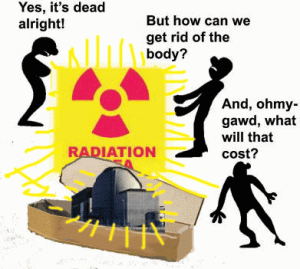
As in many industrial projects, many of the hazards come to be known only after the project is well under way or, very often, completed and discontinued. Gentilly 1 is one of those projects. Like others, the Gentilly 1 detritus presents grave dangers to living things as the building, equipment and supplies are taken apart. Complete public review of the decommissioning of Gentilly 1 is required, in my view. It should not be skipped or sidestepped in any way.
Notice of the project was posted on the website of the federal impact assessment agency, but it bears scant resemblance to formal and complete impact assessments, and the public is instructed to send comments to the private consortium, rather than to the federal authorities responsible for making the decision.
To cite Dr. Gordon Edwards, president of the Canadian Coalition for Nuclear Responsibility (CCNR): “Heavily contaminated radioactive concrete and steel would be trucked over public roads and bridges, through many Quebec and Ontario communities, to the Chalk River site just across the Ottawa River from Quebec.”
How Flexibility, Not Nuclear, Can Secure Ontario’s Electricity Future
Michael Barnard, Clean Technica, 6 Feb 26
Ontario is moving forward with planning for an entirely new nuclear generation site in Port Hope, 100 km east of Toronto, at a moment when its electricity system is already one of the most nuclear-heavy in the world. Nuclear power today provides roughly 55% of Ontario’s electricity, with hydro adding another 25%. Wind, solar, batteries, and demand-side resources together account for a much smaller share, having been cut off at the knees in 2018 when the provincial conservative party took power and summarily cut 758 contracts for renewable generation. Advancing a new site signals how the province understands its future electricity challenge. It reflects an expectation that Ontario will require another large block of firm, always-available capacity to remain reliable as demand grows, particularly during the most constrained hours of the year.
Ontario’s electricity planners, primarily through the Independent Electricity System Operator, frame the case for new nuclear around long-term reliability rather than annual energy supply. Their planning outlook projects electricity demand rising by about 65–75% by 2050—a low energy value not aligned with actual climate or competitiveness goals—with a projected winter peak reaching roughly 36–37 GW. Summer peaks are also expected to rise, but they remain slightly lower, in the range of about 35–36 GW by mid-century. The winter peak, not the summer peak, is treated as the binding constraint, and it is that single cold, dark evening hour that underpins the justification for new nuclear capacity.
This framing matters because of how nuclear is treated in planning models. Nuclear plants supply energy year-round, but the decision to build new nuclear capacity is driven mainly by how much firm capacity planners believe is needed to meet future peak demand. Nuclear units are counted as fully available during peak hours, even though they operate continuously, do not follow demand and are not available when down for maintenance, refueling or refurbishment for months or years. From a reliability perspective, this approach is understandable. System operators are rewarded for avoiding shortages and penalized heavily for blackouts, while overbuilding capacity carries fewer immediate consequences………………………….
The distinction between energy growth and peak growth is critical here. Energy demand, measured in TWh, reflects how much electricity the system produces over a year. Peak demand, measured in GW, reflects the single hardest hour the system must meet. Nuclear plants are not built to follow peaks, but they are sized to peaks. If peaks remain sharp and high, nuclear looks attractive in planning models. If peaks flatten or decline due to significant system component flexiblity, the value of adding large, inflexible, always-on generation falls quickly, even if total energy demand continues to rise.
Electrification without flexibility is genuinely concerning, and planners are right to worry about it……………………………………………………………………………………………………………………………………………………………………………………………………………………………………………………..
Ontario does not lack clean electricity. It lacks a planning framework that fully reflects how electricity systems are changing, why winter peaks appear hard only under outdated assumptions, and how firm capacity is actually used in a flexible, digitized grid. The choice facing the province is not between reliability and decarbonization, but between building infrastructure sized for a winter peak that no longer needs to exist and building a system designed to avoid creating that peak in the first place. https://cleantechnica.com/2026/02/06/how-flexibility-not-nuclear-can-secure-ontarios-electricity-future/
1 This Month


Petition to revoke the licensing of the Near Surface Nuclear Disposal Facility (NSDF) at Chalk River. https://www.ourcommons.ca/petitions/en/Petition/Details?Petition=e-7247


of the week – STOP SMALL MODULAR REACTORS IN CANADA
To see nuclear-related stories in greater depth and intensity – go to https://nuclearinformation.wordpress.com
-
Archives
- March 2026 (163)
- February 2026 (268)
- January 2026 (308)
- December 2025 (358)
- November 2025 (359)
- October 2025 (376)
- September 2025 (258)
- August 2025 (319)
- July 2025 (230)
- June 2025 (348)
- May 2025 (261)
- April 2025 (305)
-
Categories
- 1
- 1 NUCLEAR ISSUES
- business and costs
- climate change
- culture and arts
- ENERGY
- environment
- health
- history
- indigenous issues
- Legal
- marketing of nuclear
- media
- opposition to nuclear
- PERSONAL STORIES
- politics
- politics international
- Religion and ethics
- safety
- secrets,lies and civil liberties
- spinbuster
- technology
- Uranium
- wastes
- weapons and war
- Women
- 2 WORLD
- ACTION
- AFRICA
- Atrocities
- AUSTRALIA
- Christina's notes
- Christina's themes
- culture and arts
- Events
- Fuk 2022
- Fuk 2023
- Fukushima 2017
- Fukushima 2018
- fukushima 2019
- Fukushima 2020
- Fukushima 2021
- general
- global warming
- Humour (God we need it)
- Nuclear
- RARE EARTHS
- Reference
- resources – print
- Resources -audiovicual
- Weekly Newsletter
- World
- World Nuclear
- YouTube
-
RSS
Entries RSS
Comments RSS
 nuclear-news