Britain courts private cash to fund ‘golden age’ of nuclear-powered AI.

SMR trials are on the horizon, but commercial viability is not expected until the 2030s.
Things get a little hazy over the question of any financial support.
Framework aims to lure investors into powering the compute boom
Dan Robinson, Thu 5 Feb 2026,
https://www.theregister.com/2026/02/05/uk_private_finance_smr/
The British government today launched the Advanced Nuclear Framework to attract private investment in next-generation nuclear technology for factories and datacenters.
The framework aims to accelerate development of advanced modular reactors to power the AI infrastructure boom and provide [?]clean energy for economic growth.
The Department for Energy Security and Net Zero (DESNZ) will create a “pipeline” of projects meeting readiness criteria, offering a “concierge-style” service to help the developers navigate UK planning, regulations, and secure private investment.
DESNZ says emerging nuclear technologies like small modular reactors (SMRs) can be prefabricated in factories, enabling faster, cheaper assembly using skilled jobs across multiple regions. These reactors can provide [?] clean energy to the grid or directly to industrial users, it claims. SMRs, as Reg readers likely know, are newfangled designs with a power capacity of up to about 300 MW per unit, about a third of the generating capacity of traditional atomic reactors.
However, the novelty of these designs means they probably won’t be pumping out the megawatts any time soon. As Omdia principal analyst Alan Howard told us last year, SMR trials are on the horizon, but commercial viability is not expected until the 2030s.
Howard was commenting on the announcement of the UK’s first SMR plant last November, which being built at Wylfa on Anglesey, an island off the coast of Wales.
DESNZ also points to plans for X-Energy and Centrica to build 12 advanced modular reactors in Hartlepool, while Holtec, EDF, and Tritax aim to build SMRs at a former coal-fired power station site at Cottam in Nottinghamshire.
Lord Patrick Vallance, Minister for Science, Innovation, Research and Nuclear, claimed advanced nuclear technology could revolutionize the power and AI datacenter industries, delivering [?]clean energy and more jobs.
“We are seizing the opportunity to become a frontrunner in this space as part of our golden age of nuclear, creating the conditions for the industry to flourish,” he said.
The British government today launched the Advanced Nuclear Framework to attract private investment in next-generation nuclear technology for factories and datacenters.
The framework aims to accelerate development of advanced modular reactors to power the AI infrastructure boom and provide clean energy for economic growth.
The Department for Energy Security and Net Zero (DESNZ) will create a “pipeline” of projects meeting readiness criteria, offering a “concierge-style” service to help the developers navigate UK planning, regulations, and secure private investment.
DESNZ says emerging nuclear technologies like small modular reactors (SMRs) can be prefabricated in factories, enabling faster, cheaper assembly using skilled jobs across multiple regions. These reactors can provide clean energy to the grid or directly to industrial users, it claims.
SMRs, as Reg readers likely know, are newfangled designs with a power capacity of up to about 300 MW per unit, about a third of the generating capacity of traditional atomic reactors.
However, the novelty of these designs means they probably won’t be pumping out the megawatts any time soon. As Omdia principal analyst Alan Howard told us last year, SMR trials are on the horizon, but commercial viability is not expected until the 2030s.
Howard was commenting on the announcement of the UK’s first SMR plant last November, which being built at Wylfa on Anglesey, an island off the coast of Wales.
DESNZ also points to plans for X-Energy and Centrica to build 12 advanced modular reactors in Hartlepool, while Holtec, EDF, and Tritax aim to build SMRs at a former coal-fired power station site at Cottam in Nottinghamshire.
Lord Patrick Vallance, Minister for Science, Innovation, Research and Nuclear, claimed advanced nuclear technology could revolutionize the power and AI datacenter industries, delivering [?]clean energy and more jobs.
“We are seizing the opportunity to become a frontrunner in this space as part of our golden age of nuclear, creating the conditions for the industry to flourish,” he said.
The AI datacenter focus reflects the government’s ambitions for UK AI leadership. It is encouraging a rash of datacenter projects to house AI infrastructure, which is notoriously hot and hungry. One of many reports published last year estimated that global datacenter electricity use is set to more than double by 2030 thanks to AI.
Interested parties will be able to use the Advanced Nuclear Framework to submit proposals to join the pipeline from March. These will then be assessed by Great British Energy-Nuclear, the government-owned atomic energy company.
Things get a little hazy over the question of any financial support. Successful applicants get government endorsement “in principle,” and while they will be expected to secure private finance, the government says it is open to discussions on what may be needed to help get projects off the ground.
Developers will also be able to approach the National Wealth Fund, which can act as a “catalytic investor” for projects that meet their criteria.
The UK isn’t alone in looking to revitalize nuclear power. The US is also encouraging new builds and the development of advanced technologies, and it appears the Trump administration is prepared to overlook safety precautions to speed things along.
US and Russia negotiating New START deal – Axios.

The issue was reportedly discussed on the sidelines of the Ukraine peace talks in Abu Dhabi
5 Feb, 2026 , https://www.rt.com/news/632065-us-russia-negotiate-new-start/
Moscow and Washington are working on a deal to continue the New START nuclear reduction treaty, Axios reported on Thursday, citing three sources familiar with the issue. The strategic arms control agreement officially expired on February 5.
Signed in 2010, the treaty put caps on the number of strategic nuclear warheads and launchers that can be deployed and establishes monitoring mechanisms for both Russian and American arsenals. It was initially set to expire in 2021 but was extended for five years at the time.
According to Axios, President Donald Trump’s son-in-law Jared Kushner and special envoy Steve Witkoff discussed the issue with the Russian delegation on the sidelines of the Ukraine peace talks in Abu Dhabi. “We agreed with Russia to operate in good faith and to start a discussion about ways it could be updated,” a US official told the media outlet. Another source claimed that the sides had agreed to observe the treaty’s terms for at least six months as the talks on a potential new deal would be ongoing.
Earlier on Thursday, Kremlin spokesman Dmitry Peskov said that Moscow suggested sticking to the treaty’s provisions for another year but its initiative “remained unanswered.” Russia will “keep its responsible attentive approach in the field of strategic stability [and] nuclear weapons” but will be always “primarily guided by its national interests,” he said.
The UN also called the treaty expiration “a grave moment for international peace and security.” Secretary-General Antonio Guterres warned that “the risk of a nuclear weapon being used is the highest in decades” as he urged Moscow and Washington to negotiate a successor framework.
Russian President Vladimir Putin had earlier proposed to his US counterpart Donald Trump a one-year extension of the treaty but the American president said that he wanted a “better” agreement that includes China.
On Thursday, Peskov said that China considers joining the talks on a new treaty “pointless” since its nuclear arsenal is incompatible with that of Russia and the US. “We respect this position,” the Kremlin spokesman said.
Looking to Blame Anyone But Israel for Youth’s Anti-Israel Turn
Ari Paul, February 5, 2026, https://fair.org/home/looking-to-blame-anyone-but-israel-for-youths-anti-israel-turn/
Younger Americans are turning against Israel. “On both the left and the right, young Americans are growing more skeptical of offering unconditional US support to Israel,” Politico (9/29/25) reported. Brookings (8/6/25) ran the headline “Support for Israel Continues to Deteriorate, Especially Among Democrats and Young People.” According to the Forward (11/21/25), “Younger Jews are more than twice as likely to identify as anti-Zionist than the overall population.
Pro-Israel media are looking for blame. It’s often easy to paint youth opinion that is out of sync with official state policy as emotionally driven social justice warriorism, the result of hearts not yet hardened by life’s cold realities. The Zionist media narrative is looking for the culprits who have apparently miseducated our youth, turning them not just into Israel critics, but Jew haters.
‘Panicked’ by young people
At the Atlantic (12/15/25), Yair Rosenberg wrote a piece headlined “The More I’m Around Young People, the More Panicked I Am,’” with the subhead, “Anti-Jewish prejudice isn’t a partisan divide—it’s a generational one.” To his credit, Rosenberg starts off reporting on very real instances of antisemitism, but then watch carefully what he does in the middle:
Young people also tend to be more critical of Israel than their elders, leading a minority to excuse or even perpetuate anti-Jewish acts in America in the name of Palestine. These critics are likely to consume anti-Israel content on their social-media apps of choice. The platforms then funnel some of those users toward antisemitic material—a sort of algorithmic escalator that ends up radicalizing a percentage of them.
In the first sentence, the only evidence Rosenberg cites is a link to his own article (Atlantic, 5/22/25) about how “Elias Rodriguez allegedly shot and killed two people as they were exiting an event at the Capital Jewish Museum,” with the headline “A Dangerous Disguise for Antisemitism.” Rosenberg said the “assailant used the Palestinian struggle as a pretext to harm Jews.”
But as I have previously written (FAIR.org, 5/29/25), much of the media framed this attack as antisemitic without any factual basis. While there was plenty of evidence that the act was political, with Rodiguez’s manifesto denouncing Israel as a “genocidal apartheid state,” there wasn’t any evidence that the attacker held antisemitic views, or targeted the event because of the faith of the victims. If someone obsessed with Saudi Arabia’s aggression in Yemen killed two Muslim workers at the Saudi embassy, that would certainly be anti-Saudi political violence, but not necessarily anti-Muslim terror.
‘Sewer of filth and lies’
Rosenberg doesn’t quite say that today’s young critics of Israel are necessarily antisemites, but argues that by putting anti-Israel content on social media, they’re helping to drive traffic to actual antisemitism. This is a framing that lets Elon Musk—who famously gave a Nazi salute at Donald Trump’s second inauguration—off the hook for overseeing the rise of this antisemitic content on X (CNN, 9/29/25).
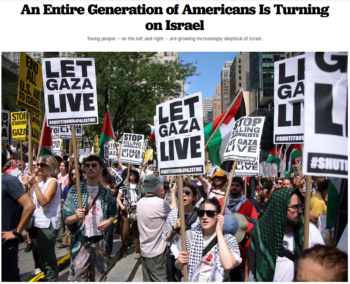
Politico (9/29/25) cites Israel’s “latest moves to launch a ground offensive in Gaza City…and deny evidence of widespread famine” as reasons for the country’s loss of support among young people.
Younger Americans are turning against Israel. “On both the left and the right, young Americans are growing more skeptical of offering unconditional US support to Israel,” Politico (9/29/25) reported. Brookings (8/6/25) ran the headline “Support for Israel Continues to Deteriorate, Especially Among Democrats and Young People.” According to the Forward (11/21/25), “Younger Jews are more than twice as likely to identify as anti-Zionist than the overall population.”
Pro-Israel media are looking for blame. It’s often easy to paint youth opinion that is out of sync with official state policy as emotionally driven social justice warriorism, the result of hearts not yet hardened by life’s cold realities. The Zionist media narrative is looking for the culprits who have apparently miseducated our youth, turning them not just into Israel critics, but Jew haters.
‘Panicked’ by young people
“Younger Americans…are likely to trust and get their news from lightly moderated social-media platforms,” writes Yair Rosenberg (Atlantic, 12/15/25), “which often advantage the extreme opinions, conspiracy theories, and conflict-stoking content that drive engagement.”
At the Atlantic (12/15/25), Yair Rosenberg wrote a piece headlined “The More I’m Around Young People, the More Panicked I Am,’” with the subhead, “Anti-Jewish prejudice isn’t a partisan divide—it’s a generational one.” To his credit, Rosenberg starts off reporting on very real instances of antisemitism, but then watch carefully what he does in the middle:
Young people also tend to be more critical of Israel than their elders, leading a minority to excuse or even perpetuate anti-Jewish acts in America in the name of Palestine. These critics are likely to consume anti-Israel content on their social-media apps of choice. The platforms then funnel some of those users toward antisemitic material—a sort of algorithmic escalator that ends up radicalizing a percentage of them.
In the first sentence, the only evidence Rosenberg cites is a link to his own article (Atlantic, 5/22/25) about how “Elias Rodriguez allegedly shot and killed two people as they were exiting an event at the Capital Jewish Museum,” with the headline “A Dangerous Disguise for Antisemitism.” Rosenberg said the “assailant used the Palestinian struggle as a pretext to harm Jews.”
But as I have previously written (FAIR.org, 5/29/25), much of the media framed this attack as antisemitic without any factual basis. While there was plenty of evidence that the act was political, with Rodiguez’s manifesto denouncing Israel as a “genocidal apartheid state,” there wasn’t any evidence that the attacker held antisemitic views, or targeted the event because of the faith of the victims. If someone obsessed with Saudi Arabia’s aggression in Yemen killed two Muslim workers at the Saudi embassy, that would certainly be anti-Saudi political violence, but not necessarily anti-Muslim terror.
‘Sewer of filth and lies’

The root of the antisemitism problem at X is not criticism of Israeli war crimes (FAIR.org, 1/23/25).
Rosenberg doesn’t quite say that today’s young critics of Israel are necessarily antisemites, but argues that by putting anti-Israel content on social media, they’re helping to drive traffic to actual antisemitism. This is a framing that lets Elon Musk—who famously gave a Nazi salute at Donald Trump’s second inauguration—off the hook for overseeing the rise of this antisemitic content on X (CNN, 9/29/25).
Nor does he recognize that Meta is aggressively policing against criticism of Israel, even as it ends efforts to proactively screen out hate speech like antisemitism (Washington Post, 2/25/25). Last year, Meta announced “that it will expand its policies to classify the misuse of the term ‘Zionist’ as a proxy for ‘Jews’ as antisemitic and Tier 1 hate speech” (World Jewish Congress, 6/9/24). Al Jazeera (10/24/24) also reported on “testimonies of routine deletion of Palestine-related posts and a deep-seated pro-Israel bias” at Meta.
Rosenberg is rightly concerned that there are too many far-right extremists promoting white nationalism and antisemitism on social media networks (Wired, 5/2/24; PBS, 8/13/24), and these corporate regimes are too tolerant of such activity on their sites. But Rosenberg manages to twist this into an argument that young people need to shut up about Gaza.
Of course, many people are upset about anti-Israel content on social media not because it leads to antisemitism, but because it’s anti-Israel: The reason for the shift in youth opinion isn’t Israel’s behavior, the argument goes, but social media’s influence. Hillary Clinton blames youth criticism of Israel on TikTok (Hollywood Reporter, 12/2/25). The Australian (12/12/25) wrote: “Young people live now on social media. And social media is an unregulated sewer of lies and filth.” The Israeli government has reportedly recruited social media personalities and public relations firms to tell its version of the story (Jerusalem Post, 10/3/25; Al Jazeera, 10/30/25).
‘Brainwashed’ into opposing sex pests
The issue of this generational divide is the center of a piece at Free Press (12/17/25) by Olivia Reingold, called “The Jewish Parents Who Raised Mamdani Voters.” For the unacquainted, Free Press was bought by Paramount (10/6/25), now controlled by oligarch David Ellison, thus turning the once-marginal publication into the closest thing the right has to the New Yorker. (The acquisition also elevated Free Press co-founder Bari Weiss, noted right-wing pundit, to CBS News editor-in-chief.)
Free Press quoted one parent in particular, Sagra Maceira de Rosen, whose bio describes her as “chair of SIO Global, an investment and advisory firm working with private equity and investment.” She said she was “horrified” that Mamdani won the election. What’s worse for her was that her grown child campaigned for him. “I fear that kids I care for—my children—are brainwashed.”
Parents looked for answers. Reingold reported:
They wondered if they should have parented differently. Did their children get enough Jewish education? Were they brainwashed by their elite private schools? Where did they go wrong?
“Maybe I failed in the sense that the kids didn’t go to Israel enough,” a 63-year-old physician in Greenpoint, Brooklyn, told me. He said his daughter, a civil rights attorney, holds anti-Zionist views and refused to vote for former New York Gov. Andrew Cuomo due to his alleged sexual harassment. “It would’ve been better if they went more, just to see the lies they’re being told.”
It’s not clear if the doctor or Reingold knows what they’re saying here. Jewish kids need to 1) go to Israel to get indoctrinated and 2) stop being appalled by sexual harassment. These issues are more connected than one might think, as a Jewish Currents (4/18/18) investigation by Lilith executive editor Sarah Seltzer found widespread problems of sexual violence within Birthright, the program offering young Jews free guided trips to Israel.
Lacking ‘a capacity for critical thinking’
Another parent, Lisa Fields Lewis, lamented that her grown children liked Mamdani:
Lewis was raised by an Israeli mother; her father survived Bergen-Belsen concentration camp. She said the rise of Mamdani awakened a “generational trauma” in her. Now, she can’t shake the feeling that history is repeating itself. And kids don’t seem to realize just how dangerous Mamdani’s views are, Lewis said.
With Mamdani set to be sworn in just after midnight on January 1, Lewis doesn’t know if their relationship can return to normal any time soon. “I feel sad,” Lewis said. “I feel envious of my friends whose kids are proud Zionists, or at least have the capacity for critical thinking.”
It’s not FAIR’s job to comment on others’ parenting skills, but Lewis just told the world she thinks her children don’t have a “capacity for critical thinking”; the tension in this household might have to do with a lack of respect, rather than just differing politics. What’s really dangerous here is that the author doesn’t challenge the absurd suggestion that “Mamdani’s promise of providing free buses and righting the city’s widening income gap” is the first step in sending the Jews to the camps.
By what measure does the Free Press think Mamdani is dangerous for Jews? It pointed out that he “has consistently denied Israel’s right to exist as a Jewish state,” saying instead that “Israel should exist ‘with equal rights for all’—a bar the nation already meets.”
Reingold can’t decide what she wants here: a Jewish state or a state that doesn’t discriminate. Maintaining the former requires preventing the latter, as Palestinians that have been under Israeli control for nearly 60 years need to be denied the right to vote in Israeli elections. Jews from anywhere in the world have a “right to return” to Israel, but non-Jewish refugees from pre-1948 Palestine do not. A number of human rights groups, including an Israeli one, have found that the legal separation of peoples in Israel proper and the Occupied Territories amounts to apartheid (B’Tselem, 1/12/21; Human Rights Watch, 4/27/21).
Reingold went on, “More recently, the mayor-elect has caught flack for his controversial appointments to his transition committees, which include fringe anti-Zionist rabbis.” Again, there’s nothing here that represents antisemitism–instead, there’s inclusion of Jews. The problem is that Mamdani is close to clergy whose politics don’t align with the Weiss editorial regime. To put things into perspective, Mamdani won a third of the city’s Jewish vote (Jewish Telegraphic Agency, 11/5/25)—not a majority, but not exactly a “fringe” either.
‘A problem of disobedient children’
These pieces spend a lot of ink displaying anxiety for this generational divide, but never really ask why it exists. If they did that, they might find out that while many in the older generation could indulge the fantasy that a pre-Netanyahu Israel was engaged in a peace process, when mainstream Israeli leaders paid lip service to the idea of a two-state solution, younger Jews only know a place of extreme bellicosity.
Any voter in their 20s doesn’t remember the Oslo Accords or Yitzhak Rabin shaking hands with Yasser Arafat (Conversation, 9/12/23). Instead, what they know is a country that has mostly been under the control of the right-wing Likud party and its extremist allies, an anti-democratic slide into authoritarianism (Haaretz, 10/30/25; Committee to Protect Journalists, 12/11/25), government corruption (New York Times, 11/30/25), settlement expansion (UN News, 9/29/25), alliances with the European far right (CNN, 3/26/25; Foreign Policy, 5/9/25) and several lopsided wars against Gaza.
But neither the Atlantic nor the Free Press can say this. The answer can’t be that Israel’s actions against Palestinians and its decaying political system are turning people off. No, the problem is that young people are led astray by social media and distance from real education.
“While Israel’s actions have always been structured by apartheid and ethnic cleansing, the scale and the visibility of its structural violence has been placed at the center of American political discourse,” said Benjamin Balthaser, author of Citizens of the Whole World: Anti-Zionism and the Cultures of the American Jewish Left. “Americans, not just Jews, are compelled to respond.”
He added, “That the Free Press sees this as a problem of disobedient children or a lack of Torah school is not unlike Hillary Clinton blaming outrage at Israel on TikTok videos and social media.
ISIS vs IDF. Selective justice and the fall of Australian law
by Andrew Brown | Feb 4, 2026, https://michaelwest.com.au/isis-vs-idf-selective-justice-and-the-collapse-of-australian-law/
Australians who went to fight for ISIS were prosecuted, their families vilified, while former IDF soldiers fighting for Israel walk freely among us. Andrew Brown reports on the double standards.
Australians like to believe our justice system is governed by principle, and crimes judged by what was done, not by who did them. We like a comforting story about ourselves. That justice is served, and accountability painful but even-handed. We tell it often. We believe it when it suits us.
That story collapses the moment it is tested.
After the Brereton Report, Australia demonstrated what accountability looks like when it chooses to take law seriously. Entire Australian Defence Force platoons were investigated. Whole units placed under suspicion. Soldiers interrogated repeatedly. Careers frozen. Medals questioned. Command structures dismantled. Hundreds of millions of public dollars spent. One soldier charged. Many others left suspended indefinitely, their lives stalled in legal limbo.
This pursuit of accountability was not timid or symbolic. It did not flinch at rank, reputation, or heroism. Australia went after its returning heroes, including Victoria Cross recipients, and some of the most decorated units in its military history. It did so publicly and without fear or favour.
“No medal or mythology placed anyone beyond scrutiny.”
Australia wanted the world to see that it would investigate its own forces, not just individuals but units and chains of command, even when it was humiliating and politically costly.
Soldiers going overseas
When Australians travelled to join ISIS, the response was faster and harsher. Passports cancelled. Homes raided. Surveillance expanded. Citizenship stripping powers deployed. Wives treated as accomplices. Children framed as future threats. Suspicion alone was often enough to trigger punishment. Due process became optional.
If Australians fought for Russia against Ukraine, arrests would follow. Prosecutions under foreign incursion and war crimes laws. Media outrage before the luggage carousel stopped turning. The word traitor would appear instantly.
That is the standard Australia claims to uphold.
Gaza
Now consider Gaza. What is occurring is not chaotic warfare. It is a civilian catastrophe with a measurable pattern. Credible casualty analyses based on hospital records, death registries, and independent verification show that approximately 84% of those killed are civilians and around 33% are children. Not combatants miscounted. Not teenagers caught in crossfire. Children.
By comparison, in Ukraine, children account for around 0.3% of casualties. That is a difference of more than one hundredfold.This is not incidental harm. It is demographic concentration.
The destruction follows the same logic. Entire residential districts have been levelled. Homes, schools, universities, bakeries, water infrastructure, and sewage systems have been systematically destroyed. This is not damage caused by fighting around civilians.
“It is the removal of the conditions required for civilian life to continue.”
Hospitals have been a central target. Gaza’s major medical complexes were besieged, raided, and rendered inoperable. Electricity was cut. Fuel was denied. Oxygen supplies ran out. Patients died untreated on floors. Premature infants were left in incubators without power. Medical staff were detained directly from wards and operating theatres, taken without charge, many remaining in detention months later.
This is not collateral damage. It is the dismantling of a healthcare system in real time.
Human rights atrocity
Mass detention has accompanied the physical destruction. Thousands of Palestinians have been taken without charge or access to legal counsel. Human rights organisations have documented beatings, starvation, stress positions, and sexual abuse in detention. Medical professionals and journalists were not spared. They were targeted.
Journalists have been killed at a rate unmatched in any modern conflict. Aid workers have been killed despite operating in clearly marked vehicles and facilities. Among them was Australian humanitarian Zomi Frankcom, killed during a coordinated strike on an aid convoy.
And then there is Hind Rajab.
A six-year-old girl was trapped in a car after her family was shot dead. She called emergency services. Her voice was recorded. An ambulance was dispatched to rescue her. The ambulance was destroyed. Hind was later found dead alongside the paramedics sent to save her.
There was no firefight. No exchange of fire. No ambiguity.
Doctors from Australia, the United States, and Canada who worked in Gaza later testified publicly to treating repeated waves of children with gunshot wounds consistent with sniper fire. Identical entry wounds to heads and chests. These were not anecdotes.
They were clinical observations recorded by trained professionals.
The crime scene
This is why the language of genocide is no longer rhetorical. It is legal. The International Court of Justice has found a plausible risk of genocide and ordered provisional measures. The International Criminal Court is pursuing accountability for war crimes and crimes against humanity arising from Israeli actions.
What is unfolding in Gaza is not a tragedy without authorship.
It is a crime scene.
Australia has chosen silence.
That silence is no longer ignorance. At the National Press Club, senior human rights lawyer Chris Sidoti warned that Australians who served in Gaza may face criminal liability if genocide or war crimes are established. He was explicit. Genocide does not require pulling a trigger. Assistance, facilitation, or knowing contribution can be enough.
“The government did not contest the law. It did nothing.”
The government did not contest the law. It did nothing.
No Australian Federal Police task force. No examination of units or command chains. No transparency. No framework for investigating potential complicity in genocide or war crimes under Australian law.
Instead, indulgence.
An estimated 1,000 former or current Israeli Defence Force soldiers now live freely in Australia. They stroll through Caulfield, Bondi, Dover Heights, and Double Bay. They drink lattes in Sydney cafes. They enjoy suburban normality without scrutiny, while Gaza remains a ledger of rubble, amputations, mass graves, and dead children.And the indulgence does not stop at inaction. It now edges toward empowerment.
NSW Premier Chris Minns has publicly canvassed expanding armed community protection roles, including the involvement of current or former Israeli soldiers in guarding Jewish institutions in Australia. The stated aim is protection against antisemitism. That aim is legitimate. The implications are not.
Policing and the authorised use of force are public functions. They exist because weapons in civilian life require training, oversight, accountability, and law. When governments contemplate arming individuals with recent service in a foreign military now under investigation for genocide, the issue becomes immediate and domestic.
Run the test honestly.
ISIS vs IDF
If ISIS returnees sought to bear arms in public under the guise of community protection, the state would answer with handcuffs and prison, not consent. The request itself would be treated as evidence of danger.
That this proposal can be entertained for one category of foreign fighter while unthinkable for another exposes the fiction at the heart of Australia’s claim to equal justice. The law has not changed. Only who it is prepared to protect has.
“This is not neutrality. It’s policy.”
Australia destroyed careers investigating its own soldiers. It went after its most decorated units without fear or favour. It acted ruthlessly against ISIS recruits. It would move instantly if Australians fought for Russia.
When Australians fight in Gaza under the Israeli flag, amid credible allegations of genocide now before international courts, the state looks away.
“That is not restraint, but complicity.”
History will remember this as the moment Australia blinded its own law, allowing returning IDF soldiers to pass unexamined and exposing fairness before the law as a deliberate lie.
Impact Assessment of the Planned Dismantling of the Core of the Gentilly-1 reactor.
To: The Honourable Julie Aviva Dabrusin, Minister of Environment and Climate Change
From: The Canadian Coalition for Nuclear Responsibility (CCNR)
Re: Impact assessment of the final dismantling of the Gentilly-1 nuclear reactor
Date: July 5 2026
Reference Number 90092
Cc Impact Assessment Agency of Canada
Atomic Energy of Canada Limited
Canadian Nuclear Laboratories \
Canadian Nuclear Safety Commission
The final dismantling of the most radioactive portions of the Gentilly-1 nuclear reactor, proposed by the licensee Canadian Nuclear Laboratories (CNL), will mark the first time that a CANDU power reactor has ever been fully decommissioned – that is, demolished.
This project is not designated for a full panel review under the Impact Assessment Act (IAA) but you, Minister Dabrusin, have the power to so designate it under the terms of the Act.
The Canadian Coalition for Nuclear Responsibility urges you to do so for the reasons stated below.
(1) When it comes to post-fission radioactivity (human made), the long-lived radioactive decommissioning waste from the core area of a nuclear reactor is second only in radiotoxicity and longevity to the high-level radioactive waste (irradiated nuclear fuel) that has already been designated for a full panel review under IAA at the initiative of NWMO, the Nuclear Waste Management Organization. The deadline for initial comments on the NWMO Deep Geological Repository project (DGR) for used nuclear fuel was yesterday, February 4, 2026. [Our comments: www.ccnr.org/GE_IAAC_NWMO_comments_2026.pdf ]
(2) Fully dismantling a nuclear reactor core is a demanding and hazardous undertaking, resulting in voluminous intermediate level radioactive wastes. The highly radioactive steel and concrete structures – fuel channels, calandria tubes, tube sheet, thermal shield, calandria vessel, biological shield, reactor vault, and more – need to be carefully disassembled, using robotic equipment and perhaps underwater cutting techniques with plasma torches. Such methods are described in a 1984 article published by the Canadian Nuclear Society and linked below, on the detailed advanced methods required for dismantling Gentilly-1.
Gentilly-1 Reactor Dismantling Proposal, by Hubert S. Vogt
Reactor and Fuel Handling Engineering Department
Atomic Energy of Canada Limited – CANDU Operation
Published by the Canadian Nuclear Society in the
Proceedings of the 5th Annual Congress
(3) Dismantling the reactor core will create large amounts of radioactive dust and debris some of which will almost certainly be disseminated into the atmosphere, or flushed into the nearby St. Lawrence River, or added to the existing contamination of the soil and subsoil (including groundwater) at the Gentilly site. It is worth noting that, during the Bruce refurbishment operations in 2009, over 500 workers – local tradesmen, mainly – suffered bodily contamination by inhaling radioactive airborne dust containing plutonium and other alpha emitters (i.e. americium) for a period of more than two weeks. The workers were told that respirators were not required. The radioactivity in the air went undetected for two and a half weeks because neither Bruce managers nor CNSC officers on site took the precaution to have the air sampled and tested.
(4) Once disassembled, the bulky and highly radioactive structural components of Gentilly-1 will have to be reduced in volume by cutting, grinding or blasting. Radioactive dust control and radioactive runoff prevention may be only partially effective. Then the multitudinous radioactive fragments must be packaged, and either (a) stored on site or (b) removed and transported over public roads and bridges, probably to Chalk River. The Chalk River site is already overburdened with high-level, intermediate-level, and low-level radioactive wastes of almost all imaginable varieties. Toxic waste dumping at Chalk River is contrary to the United Nations Declaration on the Rights of Indigenous Peoples (UNDRIP) and the federal government’s “duty to consult”, since Keboawek First Nation and other Indigenous rights-holders in the area have not given their free, prior, informed consent to either the storage or disposal of these toxic wastes on their unceded territory. A panel review could weigh the options of temporary on-site storage versus immediate relocation. Since there is as yet no final destination for intermediate level wastes, moving those wastes two or three times rather than once (when a final destination exists) will be costlier and riskier. Hence on-site storage is attractive.
(5) The decommissioning waste must be isolated from the environment of living things for thousands of years. The metallic fragments contain such long-lived radioactive species as nickel-59, with a 76,000 year half-life, and niobium-94, with a 20,000 year half-life. The concrete fragments also contain long-lived radioactive species like chlorine-36, with a 301,000 year half-life. Such radioactive waste materials are created during the fission process; they were never found in nature before 1940. NWMO has recommended that such intermediate-level decommissioning waste requires a Deep Underground Repository (DGR) not unlike that proposed for used nuclear fuel. CCNR believes that it is only logical and entirely responsible to call for a panel review of this, the first full decommissioning project for a nuclear power reactor in Canada. The lessons learned will have important ramifications for all of Canada’s power reactors as they will all have to be dismantled at some time. This is not “business as usual”.
Read more: Impact Assessment of the Planned Dismantling of the Core of the Gentilly-1 reactor.(6) Demolition of buildings is often a messy business, but demolition of a nuclear reactor core is further complicated by the fact that everything is so highly radioactive, therefore posing a long-term threat to the health and safety of humans and the environment. A panel review by the Assessment Agency is surely the least we can do in the pubic interest.
(7) To the best of our understanding, Canadian Nuclear Laboratories (CNL) is a private contractor managed by an American-led consortium of multinational corporations, whose work is paid for by Canadian taxpayers through the transfer of billions of dollars to CNL from Atomic Energy of Canada Limited, a crown corporation wholly owned by the Canadian government. As CNL is a contractor, paid to do a job by AECL, CCNR does not feel assured that the best interests of Quebec or of Canada will automatically be fully served by CNL, as it is not accountable to the electorate. When the job involves demolishing, segmenting, fragmenting, packaging and transporting dangerous radioactive materials, involving persistent radiological toxins, we feel that a thorough public review by means of a comprehensive impact assessment, coupled with the involvement and oversight of accountable federal and provincial public agencies is required to ensure that the radioactive inventory is verified and documented, that no corners are cut and no presumptions go unchallenged. The International Atomic Energy Agency strongly advises that before any reactor decommissioning work is done, there has to be a very precise and accurate characterisation of the radioactive inventory –
all radionuclides accounted for, all becquerel counts recorded, and all relevant physical/chemical/biological properties carefully noted. We have seen no such documentation, but we believe it is essential to make such documentation publicly available before final decommissioning work begins, and to preserve such records for future generations so that they can inform themselves about the radioactive legacy we are leaving them. A panel review could help to ensure that we do not bequeath a radioactive legacy that is devoid of useful information, a perfect recipe for amnesia.
(8) The Canadian Coalition for Nuclear Responsibility (CCNR) is federally incorporated as a not-for-profit organization, whose official name in French is le Regroupement pour la surveillance du nucléaire (RSN). CCNR/RSN is a member of le Regroupement des organismes environnementaux en énergie (ROEÉ). The ROEÈ has also filed comments on this dossier, linked below, with 10 recommendations. We endorse the ROEÉ submission and all of its recommendations. The ROEÉ submission is en français www.ccnr.org/IAAC_ROEE_G1_2026.pdf and here is a link to an English translation
www.ccnr.org/IAAC_ROEE_G1_e_2026.pdf .
Yours very truly,
Gordon Edwards, Ph.D., President,
Canadian Coalition for Nuclear Responsibility
‘Significant’ fire risks at nuclear plant site
Maisie Lillywhite, West of England, 4 Feb 26, https://www.bbc.com/news/articles/cgqexej138jo
‘Significant’ fire risks have been uncovered at the first nuclear plant to be built in Britain for 30 years, including flammable materials left on emergency exit stairs.
Inspectors from the Office for Nuclear Regulation (ONR) said they found significant fire safety shortfalls at Hinkley Point C, EDF’s twin-reactor nuclear power station in Somerset.
The ONR has served enforcement action notices on five organisations which are overseeing mechanical, electrical and heating (MEH) and ventilation and air conditioning work (HVAC) at the site.
Bosses of the five organisations will need to address the shortfalls ahead of the next inspection.
A spokesperson for Hinkley Point C said they are working closely with contract partners to ensure that the appropriate enhancements are made.
“Safety is our overriding priority, and we are already acting to oversee improvements,” they added.
Mahtab Khan, ONR’s head of regulation, said fire safety is not optional and it is a legal requirement that protects lives.
“We will not hesitate to take enforcement action where safety standards fall short, and we expect all dutyholders to treat fire safety with the urgency it demands.
“Working alongside the principal contractor and MEH alliance, we have made good progress in understanding the root causes of these shortfalls to ensure they are addressed,” Khan added.
The Hinkley Point C contractors given fire enforcement notices are Altrad Babcock, Altrad Services, Balfour Beatty Kilpatrick Ltd, Cavendish Nuclear, and NG Bailey.
The combustible material, found during an inspection in December, was discovered in the staircase and was waste typical of construction activities, the ONR said.
It added although the waste did not block the fire exit, it could have compromised access to the building in the event of a fire.
Inspectors found the construction site did not have an adequate fire risk assessment.
There were also insufficient means of escape exits for the number of people working in the building.
The ONR said the shortfalls had no direct impact on the likelihood of a fire, but that the enforcement means adequate routes should be available to workers in the event of a fire.
It comes after inspectors found there was a “risk of serious injury” due to “inadequate fire controls” being used by civil engineering firm Bylor JV, which is run by both Laing O’Rourke and Bouygues Travaux Publics.
In December, the company was served with a fire safety notice and was told it had until June to implement changes.
The estimated cost of Hinkley Point C has risen to £46bn from the £18bn predicted in 2017, and it is expected to open in 2031.
Trump’s $1.5 Trillion “Dream Military”
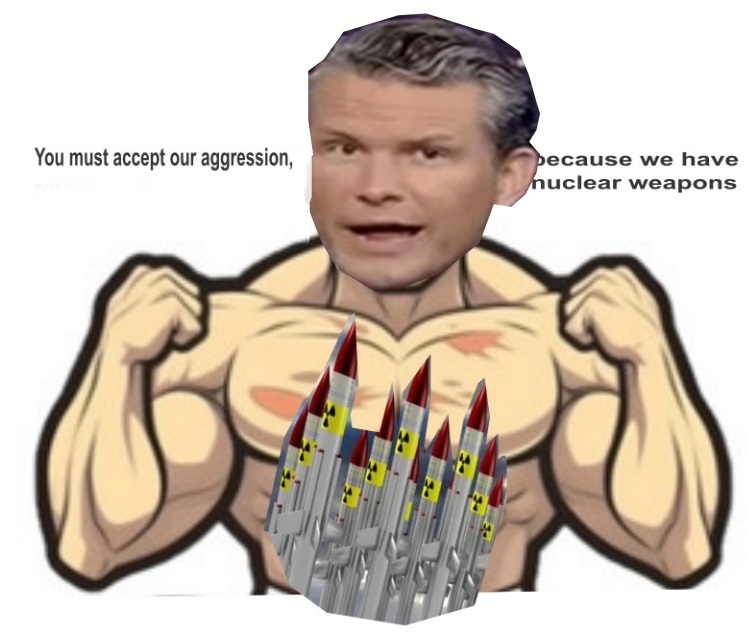
Or What National Nightmares Are Made Of
By William J. Astore. Tomgram, February 5, 2026
What constitutes national security and how is it best achieved? Does massive military spending really make a country more secure, and what perils to democracy and liberty are posed by vast military establishments? Questions like those are rarely addressed in honest ways these days in America. Instead, the Trump administration favors preparations for war and more war, fueled by potentially enormous increases in military spending that are dishonestly framed as “recapitalizations” of America’s security and safety.
Such framing makes Pete Hegseth, America’s self-styled “secretary of war,” seem almost refreshing in his embrace of a warrior ethos. Republican Senator Lindsey Graham is another “warrior” who cheers for conflict, whether with Venezuela, Iran, or even — yes! — Russia. Such macho men revel in what they believe is this country’s divine mission to dominate the world. Tragically, at the moment, unapologetic warmongers like Hegseth and Graham are winning the political and cultural battle here in America.
Of course, U.S. warmongering is anything but new, as is a belief in global dominance through high military spending. Way back in 1983, as a college student, I worked on a project that critiqued President Ronald Reagan’s “defense” buildup and his embrace of pie-in-the-sky concepts like the Strategic Defense Initiative (SDI), better known as “Star Wars.” Never did I imagine that, more than 40 years later, another Republican president would again come to embrace SDI (freshly rebranded as “Golden Dome”) and ever-more massive military spending, especially since the Soviet Union, America’s superpower rival in Reagan’s time, ceased to exist 35 years ago. Amazingly, Trump even wants to bring back naval battleships, as Reagan briefly did (though he didn’t have the temerity to call for a new class of ships to be named after himself). It’ll be a “golden fleet,” says Trump. What gives?………………………………………………
In America, nothing — and I mean nothing! — seems capable of reversing massive military spending and incessant warfare. President Ronald Reagan, readers of a certain (advanced) age may recall, was nicknamed the “Teflon president” because scandals just didn’t seem to stick to him (at least until the Iran-Contra affair proved tough to shed). Yet history’s best candidate for Teflon “no-stick” status was never Reagan or any other president. It was and remains the U.S. warfare state, headquartered on the Potomac River in Washington, D.C. And give the sclerotic bureaucracy of that warfare state full credit. Even as the Pentagon has moved from failure to failure in warfighting, its war budgets have continued to soar and then soar some more………………………………….
The Shameless Embrace of Forever War and Its Spoils
………………………………………….In case you’ve forgotten them (or never read them), here are Ike’s words from that televised address in January 1961, when he put the phrase “the military-industrial complex” in our language:
“This conjunction of an immense military establishment and a large arms industry is new in the American experience. The total influence — economic, political, even spiritual — is felt in every city, every state house, every office of the Federal government. We recognize the imperative need for this development. Yet we must not fail to comprehend its grave implications. Our toil, resources, and livelihood are all involved; so is the very structure of our society.
“In the councils of government, we must guard against the acquisition of unwarranted influence, whether sought or unsought, by the military-industrial complex. The potential for the disastrous rise of misplaced power exists and will persist.”…………………………..
Those were the prescient words of the most senior military man of his era, a true citizen-soldier and president, and more than six decades later, we should and must act on them if we have any hope left of preserving “our liberties and democratic processes.”
………………………………..More, More, More!
Not only is such colossal military spending bad for this country, but it’s also bad for the military itself, which, after all, didn’t ask for Trump’s proposed $500 billion raise. America’s prodigal son was relatively content with a trillion dollars in yearly spending. In fact, the president’s suggested increase in the Pentagon budget isn’t just reckless; it may well wreck not just what’s left of our democracy, but the military, too………………………………………………………………………………………………………………………………………………………………….
Americans, we must act to cut the war budget, shrink the empire, embrace diplomacy, and work for peace. Sadly, however, the blob has seemingly become our master, a well-nigh unstoppable force. Aren’t you tired yet of being its slave?
On the 250th anniversary of America’s founding, which was predicated on resistance to empire and military rule, it should be considered deeply tragic that this country has met the enemy — and he is indeed us. Here the words of Ike provide another teachable moment. Only Americans can truly hurt America, he once said. To which I’d add this corollary: Only Americans can truly save America.
As we celebrate our nation’s birthday this July 4th, wouldn’t it be wonderful if we could save this deeply disturbed country by putting war and empire firmly in the rearview mirror? A tall task for sure, but so, too, was declaring independence from the mighty British Empire in 1776. https://tomdispatch.com/trumps-1-5-trillion-dream-military/
1 This Month
Chernobyl: The Lost Tapes – A good documentary on Chernobyl on SBS available On Demand for the next 3 weeks– https://www.sbs.com.au/ondemand/tv-program/chernobyl-the-lost-tapes/2352741955560

of the week–London Campaign for Nuclear Disarmament

Tell the Ukrainian Government to Drop Prosecution of Peace Activist Yurii Sheliazhenko
To see nuclear-related stories in greater depth and intensity – go to https://nuclearinformation.wordpress.com
-
Archives
- April 2026 (139)
- March 2026 (251)
- February 2026 (268)
- January 2026 (308)
- December 2025 (358)
- November 2025 (359)
- October 2025 (376)
- September 2025 (257)
- August 2025 (319)
- July 2025 (230)
- June 2025 (348)
- May 2025 (261)
-
Categories
- 1
- 1 NUCLEAR ISSUES
- business and costs
- climate change
- culture and arts
- ENERGY
- environment
- health
- history
- indigenous issues
- Legal
- marketing of nuclear
- media
- opposition to nuclear
- PERSONAL STORIES
- politics
- politics international
- Religion and ethics
- safety
- secrets,lies and civil liberties
- spinbuster
- technology
- Uranium
- wastes
- weapons and war
- Women
- 2 WORLD
- ACTION
- AFRICA
- Atrocities
- AUSTRALIA
- Christina's notes
- Christina's themes
- culture and arts
- Events
- Fuk 2022
- Fuk 2023
- Fukushima 2017
- Fukushima 2018
- fukushima 2019
- Fukushima 2020
- Fukushima 2021
- general
- global warming
- Humour (God we need it)
- Nuclear
- RARE EARTHS
- Reference
- resources – print
- Resources -audiovicual
- Weekly Newsletter
- World
- World Nuclear
- YouTube
-
RSS
Entries RSS
Comments RSS
 nuclear-news