Beware these dangerous writers in the world of journalism
Noel Wauchope, 3 Feb 26
I had in mind to look at Australia’s dangerous writers, in no particular hurry. But that’s changed. You see, the Australian Prime Minister, in his wisdom, decided to invite Isaac Herzog, the President of our great ally, Israel, on a state visit to Australia. After all, Herzog is not the real leader, not the Prime Minister of Israel. A United Nations commission of inquiry found Israel guilty of genocide. The International Criminal Court found Prime Minister Netanyahu guilty of war crimes. But even if you do take any notice of those radical organisations, probably President Isaac Herzog didn’t know anything about the alleged atrocities in Gaza.
Fortunately, the Australian press takes a moderate view of all this. P.M. Albanese’s invitation to Herzog is intended to unite Australians, and give comfort after the massacre of Jews at Bondi Beach. (What? The invitation was sent long before that massacre? There is no need to bring logic into this.)
Note .I wrote that the invitation had come before the Bondi massacre, and I was wrong in this. Nevertheless, it’s a tragic truth that the Bondi massacre has allowed the media to obscure the fact that the Australian government has been under continual pressure from the Zionist lobby.
In the circumstances, it’s important to avoid a trouble-making bunch of Australian writers who are likely to stir up criticism of Isaac Herzog, and let’s all be friends.
Now, you already know that Australia’s Cailtin Johnstone is an evil witch (and terribly rude, too). But there are plenty of other equally dangerous writers. I know, because even some of my family and friends have warned me about them, as have other very “reputable” people. There are so many evil ones like her. I don’t know where to begin.
A new threat is Michael West, and his string of collaborators:
Australians have been pretty well protected. The Adelaide Festival Board cancelled Dr Randa Abdel-Fattah‘s talk, planned for the Adelaide Writers Festival in March. Quite rightly and properly, as Dr Abdel-Fattah, though born in Australia, is of Palestinian heritage, and her books take an extremely pro-Muslim view, and advocate for Palestinian rights and identity.
Indeed, our government is pretty good at saving us from evil writers. And dedicated pressure groups can have a good influence on our media. So, for example, we have been protected from the wicked influence of Chris Hedges. The chief executive of Australia’s National Press Club, Maurice Reilly, cancelled Hedges’ scheduled talk on the Betrayal of Palestinian Journalists. The U.S. Press Club banned him, too. All very proper, as Hedges was insulting our friends, the Israeli government. But that’s not all. Chris Hedges is just so gloomy about everything – especially corporate coup, death of the liberal class, and the rise of fascism. We really should not tolerate such extreme bias and negativity. Why, Hedges even condemns the happiness industries. He’s so awful – hates everything that Western culture holds dear.
Rex Patrick is another Australian writer to be avoided, obviously unpatriotic as he trashes the idea of AUKUS submarines.
Australia’s boast is that “we are young and free”? Well, not exactly free, when it comes to press freedom, as we have no constitutional or explicit legal protection for press freedom. But that’s all to the good – keeping us focussed on our most respected traditional interests – sport, entertainment, celebrities, and food.On the international scene, there’s a spate of writing by extremists.You know straight away to avoid people like Jeffrey Sachs, with his wide-ranging way out views. Ralph Nader – a long time pest, obstructing progress. Eva Bartlett is particularly suspect, as she criticises both Israel and Ukraine. Juan Cole has extremist views on the Middle East. Craig Mokhiber is a complete ratbag, waffling on about human rights. Les Leopold is a ratbag on economics and workers’ rights. Koohan Paik-Mander is exceptionally dangerous, too, being Asian, and female.
Look, there’s lots more of them. I’ve barely scraped the surface. But my advice to you (especially right now, with the imminent arrival of our friend Isaac Herzog), is to be calm, be complacent, stick to the mainstream media, and avoid those awful journalists whose only aim is to upset you.
I spent decades in energy -Here are the problems with UK nuclear plans.
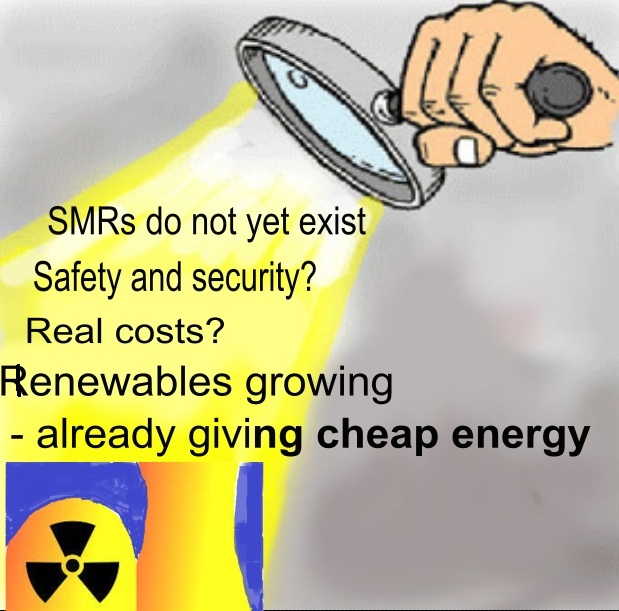
IT is clear that the issue of Scotland’s moratorium on new nuclear power
will be a key battle line in May’s Scottish Parliament election. Anas
Sarwar has joined the Labour energy minister Michael Shanks in the call for
building more nuclear power in Scotland – and the electricity cables to
take the generated electricity to energy-hungry England. MP Shanks
continues to declare that he would be relaxed about having a small
modularised reactor (SMR) erected in his constituency.
I am not sure how
the good people of Rutherglen feel about this. What I find mystifying is
the lack of proper scrutiny being applied to the claims made by those
members of the Nuclear Energy All-Party Parliamentary Group and its
well-funded nuclear lobbyists. It does not surprise me that they are unable
to set out what configuration they favour, as the reactors which they claim
will produce 400 MWs do not exist. They have not been manufactured, tested,
or installed – anywhere! As an engineer, I would be keen to ask the
politicians if they have thought about some of the basic elements of a
power plant. Do they have any ideas what the thermal capacity of the
proposed reactors are? Have they understood what the cooling requirements
might be? How about the status of the “core catcher”, the system
designed to prevent a Chernobyl-type event?
Be under no illusion, Shanks,
Sarwar and the nuclear lobby are building a Potemkin village, a deceptive,
impressive facade. They of course don’t want to talk about the European
Power Reactor (EPR) configuration being installed at astronomical cost at
Hinkley C. This project is forecast to cost around £45 billion when it
finally comes online sometime next decade. It is not easy to get a proper
sense of this sum but it might surprise people to realise that this is the
equivalent of paying £1 million every single day for 120 years – and this
is just the construction cost.
We have not even started talking about
operational costs, asset management and asset decommissioning. When Julia
Pyke, the managing director of Sizewell C, was asked by the BBC how the
project was going, she answered airily that it is “on schedule and within
budget”. I waited eagerly for the obvious follow-up question – what is
the budget and schedule? – but that never came. If the Sizewell C
construction consortium defies recent construction trends and achieve a 10%
saving relative to Hinkley C, that would still indicate a £40bn project
cost – which is enough to build 130 hospitals similar to, for example,
Forth Valley Royal Hospital.
The supporters of nuclear energy tell us that
we need these plants for baseload capacity. They fail to acknowledge that
in Scotland we already generate more capacity from renewables than we
consume – and this surplus is only going to grow as we continue to see more
investment in wind, solar, tidal and energy storage.
“What about
intermittency and the lack of system inertia?” is the nuclear advocates’
stock question when discussing the growth of renewables. This is a
legitimate question but the answer is beautifully simple – we will continue
to do what we do now, rely on combined-cycle gas turbines (CCGTs). Which is
reassuring as there will be no nuclear plant coming on stream anytime soon.
“But what about net zero?” might be the next question. Thankfully,
there are a raft of solutions to this currently available and more coming
on stream every week. For example, gas turbine manufacturers are building
on 50 years of experience of burning hydrogen and will be ready to burn
hydrogen or blended hydrogen/methane as quickly as the hydrogen market can
come on stream. My prediction is that the hydrogen market will come on
stream faster than any SMRs can be built – and if UK politicians had a
strategic bone in their bodies, they would be trying to beat our friends in
Europe to win the hydrogen race.
The National 31st Jan 2026, https://www.thenational.scot/news/25813385.spent-decades-energy-problems-uk-nuclear-plans/
The U.S. occupation of Gaza has begun
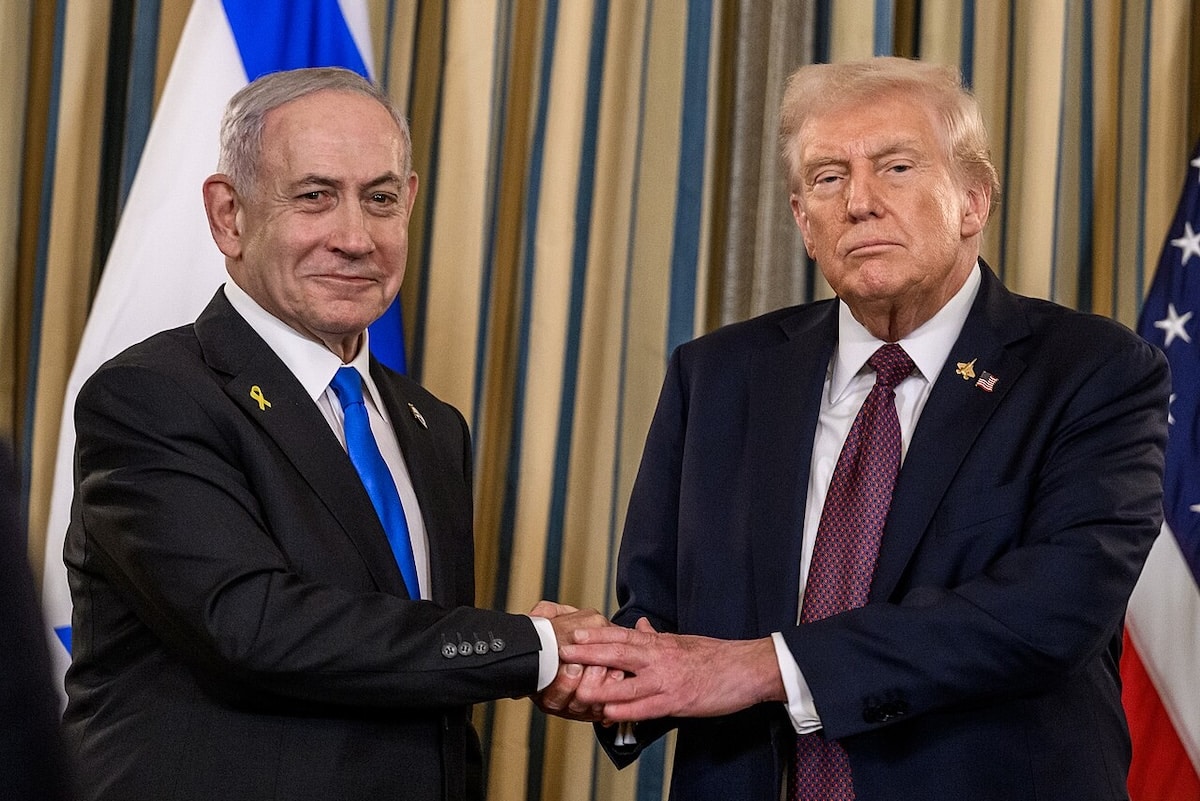
The plans for Donald Trump’s “Board of Peace” show that the goal is not just to make Gaza a playground for the wealthy, but to put it under permanent American occupation.
Mondoweiss, By Mitchell Plitnick January 30, 2026
This week, Drop Site News revealed a draft resolution from Trump’s newly christened “Board of Peace.” The resolution outlines what is, in essence, Phase Two of Trump’s unrealistic peace plan that ushered in a new phase of horror in Gaza under the guise of a ceasefire.
The actions outlined in the resolution ignore realities on the ground and paint a very grim picture of what the United States is planning for Gaza. Far from abandoning the ludicrous and offensive imagery Trump shared in that AI video from last year of himself and Elon Musk on a beach in an unrecognizable Gaza, this resolution is the battle plan to turn Gaza into the playground for the wealthy that Jared Kushner presented to the World Economic Forum at Davos last week. It’s a Gaza where the only Palestinians remaining are those chosen to be the servants in the new regime.
It’s a Gaza under permanent American occupation.
The “Executive Board” that would control Gaza
The Board of Peace (BoP) itself has drawn the most attention, but it is not the focal point for Gaza. The BoP is being set up as an international force to challenge the United Nations. It is currently populated entirely by far-right and autocratic figures, and will likely stay that way.
The BoP will be headed by Donald Trump and his role as Board Chair is personal, disconnected from his role as President of the United States. He has full power over the Board’s composition and full veto power over all of its actions. Trump will remain in control of the BoP until he decides to leave or he dies, and he has the sole authority to name his successor. You couldn’t build a clearer autocracy.
The BoP can delegate its authority as it wishes, and that is what it has done regarding Gaza. The “Executive Board” (EB) is the body that will govern Gaza. The EB itself will also have other areas within its portfolio, so it, too, has delegated its power to yet another group, dubbed the Gaza Executive Board (GEB). There is considerable overlap between the members of the EB and GEB.
The members of the GEB include some very familiar names like Steve Witkoff, Trump’s lead negotiator; Susan Wiles, his Chief of Staff; Jared Kushner, his son-in-law; and Tony Blair the former PM of the UK and a war criminal in the 2003 invasion of Iraq.
The rest of the names may be less familiar, but they are all important and, together, they draw a very worrisome picture of how this Board will behave ………………………………………………………………………………………………………………………………………………………………………………………………………………………………………………………..
Palestinians not included in planning Gaza’s future
While there are no Israelis on the Executive Board, it is stacked with extreme supporters of the Israeli right and of Netanyahu. This makes the vague mandate of the entire enterprise much more concerning.
The proposal published by Drop Site states that “the reconstruction and rehabilitation activities of the Board shall be dedicated solely to those who regard Gaza as their home and place of residence.”
But the proposal offers no opportunity for the people of Gaza to have any say at all in their present situation, let alone their future. The EB governs all of the laws. An American-led International Stabilization Force (ISF) controls all security.
The ISF is to be under the command of American Major General Jasper Jeffers. Trump, and Trump alone, has the power to remove the commander of the ISF and must personally approve any nominee to replace him.
The plan further states that “only those persons who support and act consistently [with Trump’s Comprehensive Plan for Gaza] will be eligible to participate in governance, reconstruction, economic development, or humanitarian assistance activities in Gaza.”
In other words, Palestinians who wish to be part of Gaza in any way must meet Trump’s litmus test of support for the external American control of the Gaza Strip. The same will be true for any business, NGO, or even individual who wants to participate in any way in rebuilding Gaza, physically, politically, or economically.

Ideally, for Trump and Jared Kushner, Gaza would be transformed into a giant “company town.” Most of the coastline would be dedicated to tourism. The bulk of Gaza’s eastern border with Israel would be dedicated to industrial zones and huge data centers, doubtless reflecting the massive investments Trump and his Emirati friends are making in AI.
In between would be residential areas separated by parks, agricultural, and sporting sites. In the West Bank, such parks and agricultural areas are frequently declared closed military zones and used for other purposes by the occupying force.
As has been apparent from the beginning, the only role currently envisioned for Palestinians is in the administration of the Executive Board’s decisions. In other words, Palestinian technocrats, laborers, and office workers would be “permitted” to carry out the decisions made for them by others.
The U.S. occupation of Gaza
This resolution provides only a bit more substance to the half-baked ideas Trump has been putting forward since October. And it continues to envision a near-future where Hamas has voluntarily disarmed, Israel has pulled out of Gaza, and the ISF has assumed security control that is welcomed by whatever Palestinians remain in Gaza.
All of that remains fully in the realm of fantasy.
Hamas has repeatedly made it clear that it is willing to discuss decommissioning its weapons, but would not disarm. Given that Israel is, once again, funding rogue Palestinian gangs in Gaza, complete disarmament is suicide for many members of Hamas, Islamic Jihad, and other factions.
The United States is discussing offering amnesty and even a buy-back program for the weapons, but these offers are hardly useful if the lives of Hamas members are put at grave risk by disarmament, even if we assume that the U.S. keeps to its word and that Israel does not itself hunt these fighters down.
Moreover, Israel is bristling at this entire plan. They prefer to bring the hammer down again on Gaza, especially now that there are no hostages, dead or alive, to be concerned with.
Netanyahu is openly stating that Israel will allow no rebuilding in Gaza—where it is killing people, including infants, not only with its weapons but by denying Palestinians the materials to shelter from the winter elements—until Hamas is “disarmed.”
…………………………Israel has already reportedly drawn up a plan for a major military operation, a return to the full-blown genocide of last year, which it plans to launch in March unless the U.S. refuses to allow it to do so.
…………………..What is taking shape in Gaza is a new kind of foreign occupation. This time, the U.S. would be the leading force on the ground unless it allows Israel to renew its aggression, something Trump doesn’t want.
………………………….An American occupation of Gaza on Israel’s behalf will be just as unwelcome by Palestinians as an Israeli one backed by the United States. It may take some time for the people of Gaza to regroup from the past two and a half years to organize impactful resistance, but it will come, as it always has.
The solution is simple: allow Palestinians their freedom and their rights. But that solution is beyond the imagination of Washington and Tel Aviv. So, meet the new occupation. It will be no more pleasant than the old one. https://mondoweiss.net/2026/01/the-u-s-occupation-of-gaza-has-begun/
Israel’s War on Iran: The Overkill No One Calls War
| urbanwronski on February 3, 2026, https://urbanwronski.com/2026/02/03/israels-war-on-iran-the-overkill-no-one-calls-war/ |
Tehran, June 13, 2025, 4:17 a.m. The first explosions light up the sky over Natanz. Israeli F-35s, invisible to radar, drop JDAMs on Iran’s largest uranium enrichment plant. Within minutes, no fewer than five car bombs detonate across Tehran, next to government buildings and the homes of nuclear scientists. The IDF, ever the courteous occupier, issues a warning to Iranian civilians: evacuate the areas around weapons factories and military bases in Shiraz. Or else.
By dawn, Israel has struck over 100 targets. Not just nuclear sites, but missile depots, air defences, and the homes of Iran’s top military brass. General Hossein Salami, commander of the Revolutionary Guards, is dead. So is Chief of Staff Mohammad Bagheri. So are nuclear scientists Fereydoon Abbasi and Mohammad Mehdi Tehranchi.
The Mossad, meanwhile, has spent years smuggling precision weapons into Iran, setting up covert drone bases near Tehran, and recruiting Iranian dissidents to sabotage air defences from within. This is not a flare-up. This is not a crisis. This is war, waged by Israel, enabled by the US, and dressed up as something else entirely.
The US Joins the Party On June 22, the Americans arrive. Twelve B-2 stealth bombers, escorted by 125 aircraft, drop 30,000 pound “bunker buster” bombs on Fordow, Natanz, and Isfahan. The GBU-57s, each capable of burrowing 200 feet underground before detonating, are the only weapons on Earth that can destroy Iran’s fortified nuclear sites. Trump calls it “Operation Midnight Hammer.” The Pentagon calls it “degrading Iran’s nuclear capabilities.” The rest of the world calls it what it is: the US and Israel bombing a country that, by all independent accounts, is not building a nuclear weapon. Nor intends to.
The Body Count By June 28, the numbers are in. Iranian health officials report 1,190 dead, including 435 military personnel and 436 civilians. Another 4,000 are wounded. Israel loses 28. The US? Zero. Iran fires back with missiles at Tel Aviv, drones at Haifa, a barrage at a US base in Qatar, but the Iron Dome and Patriot batteries swat most of them away. The Iranian air force, such as it is, never gets off the ground. Its fleet of MiG-29s and F-14s, some half a century old, are no match for Israel’s F-35s and the US’s B-2s. Iran has no air force to speak of. It has missiles, proxies, and little else.
The Mossad’s Shadow War This is not just a war of bombs. It’s a war of knives in the dark. The Mossad doesn’t just strike from the air, it strikes from within. In the months leading up to June 2025, Mossad operatives and recruited Iranian dissidents disable air defences, plant explosives, and assassinate scientists. They infiltrate government databases, steal passport data, and turn Iranian software against itself. When the war “ends,” the Mossad stays.
“We will be there,” Mossad Director David Barnea promises, “like we have always been there.”
The Next Round And there will be a next round. The US and Israel have already authorised fresh strikes. The CIA and Mossad are busy preparing the ground with cyberattacks, sabotage, the occasional hanging of an accused spy in Tehran’s Evin Prison. Iran, for its part, threatens to close the Strait of Hormuz, block oil shipments, and unleash its proxies across the region. But the pattern is set: Israel strikes, the US backs it up, and the world calls it anything but war.
The Language of Impunity Why does this matter? Because language is the first casualty. When Israel and the US bomb Iran, it’s a “campaign.” When Iran fires back, it’s “escalation.” When 1,190 Iranians die, it’s “collateral damage.” When the Mossad assassinates a scientist, it’s “targeted killing.” When the US drops bunker busters, it’s “degrading capabilities.” This is not neutral phrasing. It’s a lie by omission, a way to wage war without consequence, to turn atrocity into policy.
The Spectacle of Overkill Israel has 345 combat aircraft. Iran has 312, most of them museum pieces. Israel spends 5.6% of its GDP on defence. Iran spends 2.6%. Israel has the Iron Dome, David’s Sling, and the full backing of the US military. Iran has the S-300, a system so outdated that Israeli drones fly right through it. This is not a war. It’s a slaughter, dressed up as self defence.
What Comes Next The ceasefire is a pause, not an end. The Mossad is still in Tehran. The CIA is still running ops. The US with Donald Trump’s “beautiful Armada” is still offshore, waiting for the next excuse. And Iran? Iran is still standing, still defiant, still a target. Because for Israel and its American backer, the war never ends. It just gets rebadged.
Name it now. Or live with it forever.
Labour backbenchers revolt over Starmer’s nuclear plans

Ministers accused of scapegoating protected species for construction failures
Matt Oliver, 02 February 2026
Sir Keir Starmer’s plan for a nuclear renaissance faces a rearguard action
from Labour MPs and wildlife charities over claims it will be a
“catastrophe” for nature. As many as 40 backbenchers are rallying
against the Prime Minister’s proposal to overhaul environmental regulations
after an independent review said red tape was frustrating the construction
of new power stations.
The MPs and a coalition of environmental charities
including the Wildlife Trusts, the RSPB, the National Trust and the
Woodland Trust have accused ministers of scapegoating protected species
such as bats and newts for planning failures.
It comes ahead of a plan
expected to be published by ministers this month, setting out how they will
implement the review’s recommendations and whether they will adopt them in
full. Labour is also under pressure from an opposing group of pro-nuclear
campaigners, businesses and think tanks who argue reform is “essential if
we want to create jobs, tackle climate change, and cut energy bills”.
Britain is currently the most expensive place in the world to build nuclear
reactors, with critics blaming nature rules that have added hundreds of
millions of pounds of extra costs to construction. The review of nuclear
regulations, led by the economist John Fingleton, criticised regulators
such as the Office for Nuclear Regulation, the Environment Agency and
Natural England for presiding over a confusing and “duplicative” system
that prioritised “process over outcomes”.
A briefing circulated in
Parliament by the Wildlife Trusts claims that the review’s proposed changes
to habitat regulations “will do little to speed up planning decisions
but, instead, will turn the nature crisis into a catastrophe.” It argues
that the suggestion of a nature fund may be suitable in some cases but not
in the case of “irreplaceable habitats or species that cannot
re-establish elsewhere easily.”
The briefing adds: “The Government must
reject the nuclear regulatory review recommendations on environmental
regulations and end its confected war on nature as a barrier to
planning.” Chris Hinchcliffe, the Labour MP for North East Hertfordshire
who is coordinating the rebellion, said “a good number of colleagues”
shared the concerns. He said: “There is very clear polling on the
importance of nature to the British public and their desire to seek
stronger, not weaker, protections for nature. “Getting this wrong is a
real vote-loser, and is a misstep that the Government cannot afford.”
Responding to the findings in November, ministers vowed to present “a
full implementation plan” by late February and to push through the
changes within two years. On Monday, the campaign group Britain Remade
published a letter signed by businesses and think tanks urging ministers to
press ahead. The letter said: “If the Government is serious about growing
the economy, reducing bills, and delivering a new golden age of nuclear
energy, its implementation plan must back the Fingleton reforms in full.
“Nuclear energy is the most land-efficient zero-carbon technology we
possess. A single power station can power millions of homes. “If we are
serious about halting climate-driven nature loss, then nuclear energy must
expand in a safe, secure and sustainable way. “We cannot afford for the
Government to U-turn.”
Telegraph 2nd Feb 2026 https://www.telegraph.co.uk/business/2026/02/02/labour-backbenchers-revolt-over-starmer-nuclear-plans/
Germany: Ministry of the Environment: Mini‑reactors [SMNRs] not an option

Berlin (energate) – The gap between the hype and industrial reality surrounding nuclear energy is widening. This applies in particular to the smaller nuclear reactors, Small Modular Reactors (SMR). This is the conclusion of the World Nuclear Industry Status Report, which was commissioned by the Heinrich Böll Foundation, the Federal Office for the Safety of Nuclear Waste Management (BASE) and the Friedrich Ebert Foundation, among others.
by Leonie Wolf, energate, 22 January 2026
According to the study, nuclear energy remains “irrelevant” on the global market, as the 5.4
GW increase in nuclear capacity is offset by 100 times the combined new capacity of over 565
GW of wind and solar energy. Wind and solar plants
worldwide currently generate 70 per cent more electricity than nuclear reactors.
According to the report, there is still no market-ready product for Small Module Reactors (SMR), only a design certification and an approved standard design. Both come from the US company NuScale. The US Nuclear Regulatory Commission has already approved a total of three of the company’s models, but previous contracts with potential customers have been cancelled due to increased costs.
A first mini-reactor was cancelled in 2023.

According to the study, the two largest European start-ups Newcleo and Naarea are in financial difficulties; the French start-up Naarea has already filed for insolvency. The start-up is now to be taken over by the Polish-Luxembourgish group Eneris.
The Netherlands and France continue to rely on nuclear power
Despite these failures, other countries are sticking with nuclear energy. In the Netherlands, a debate on the use of SMR, which is seen as a measure to achieve the 2030 climate targets, has been ongoing for several years. In addition, the Dutch company Mammoet signed a memorandum of understanding with Electricité de France (EDF) at the end of 2025, which provides for the construction of nuclear plants in the Netherlands. Two nuclear power plants were already planned for 2022 and two more are still in operation.
Debate continues in Germany
Although Germany has withdrawn from nuclear energy, the debate about its benefits continues. Parliamentary State Secretary Rita Schwarzelühr-Sutter also spoke at the presentation of the World Nuclear Industry Status Report. When asked by energate, a spokesperson for the Federal Ministry for the Environment explained that Germany had “good reasons” for withdrawing from the use of nuclear power. The risks of nuclear energy and also of the use of SMRs remain “ultimately unmanageable”. In addition, the development and construction of smaller reactors raises many other unresolved issues.
There is also no reliable evidence to date for the safety promises. As a result, the disadvantages of nuclear energy would be transferred from a few large plants to many small ones. Ultimately, “the individual plants may become smaller, but the problems as a whole tend to become bigger”.
The spokesperson also referred to a study by the Federal Office for the Safety of Nuclear Waste Management, which energate has already reported on. According to the report, the advantages of mass production of SMRs would only outweigh their fundamental cost disadvantages compared to large reactors with a production volume of around 3,000 units.
The CDU/CSU (Christian Democrats) parliamentary group takes a different view. At the end of 2024, the CDU and CSU published a position paper in which they advocated research and development of nuclear power plants, including SMRs. CSUChairman Markus Söder also spoke out in favour of the use of SMRs in an interview with Die Welt at the end of 2025.
A total of 127 different designs worldwide
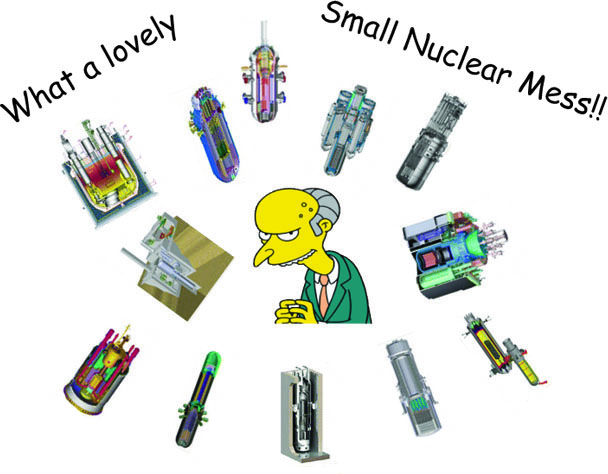
The report states that it is above all the continuous financial and political support for SMRs that keeps faith in them alive. In particular, private capital injections are playing an increasingly important role in driving research and development forward. There are 127 different SMR designs, so the funding amounts are widely spread. This means that most designs do not have sufficient financial resources to drive development forward
. According to the report, even the US start-up NuScale is still years away from building the first Small Module Reactor, although several designs have already been approved.
Let’s stop pretending AUKUS makes us safer

Margaret Beavis, February 2, 2026 —https://www.theage.com.au/national/let-s-stop-pretending-aukus-makes-us-safer-20260202-p5nysl.html
A couple of weeks ago, Canadian Prime Minister Mark Carney highlighted the need for
“naming reality”. Accordingly, we have to “name” the wishful thinking that is AUKUS. While it
is clear Australia needs a credible submarine capability, the AUKUS plan is neither credible
nor capable of meeting Australia’s defence needs. The Australian Defence Force has
correctly described this as a high-risk project – with no Plan B.
It is highly questionable whether a few nuclear-powered submarines (SSNs) will be effective
in defending Australia: too big for our northern waters, too few, difficult to man, unreliable
and potentially obsolete by 2050, if not before. But not to worry – they will probably never
come.
It is very unlikely, under the AUKUS Pillar I agreement, that the US will sell us three to five
Virginia-class nuclear-powered submarines, given US legislation, ongoing US shipyard
sustainment difficulties and major build delays.
The US legislation is very clear. The AUKUS Submarine Transfer Authorization Act, Code
10431, says that the transfer of Virginia-class submarines to Australia “will not degrade the
United States undersea capabilities”.
To meet its own needs, the US must build two Virginia-class SSNs per year. To supply
Australia, it must build at a rate of 2.33 annually; the current rate is 1.13 and has proved very
resistant to increasing, despite major increases in funding (by $US9 billion since 2018).
Australia’s $US3.3 billion contribution is not enough. In addition, the US is now prioritising
construction of the much larger Columbia submarines, making increased production rates of
Virginia-class submarines even less likely.
Operational availability is also a problem, though seldom mentioned. Rear Admiral Jonathan
Rucker, the program executive officer for Attack submarines, noted that with the “Virginia-
class of Attack submarines suffering from maintenance woes and low operational availability,
the US Navy is working to ensure its next Attack submarine is easier to sustain”. This makes
it even less likely the US can spare submarines. Even if they do – how available will they
be? Indeed, during a conflict, would we even get spare parts if US subs needed them too?
How many times does Australia need to be told this a very long shot? Last year, the US
Navy’s Chief of Operations Admiral Daryl Caudle testified that there are “no magic beans” to
boosting the US’ shipbuilding capacity. UK submarine building is even more behind, but that
is another story.
Elbridge Colby, the US under-secretary of defence for policy, said in 2024 that “it would be
crazy for the United States to give away its single most important asset for a conflict with
China over Taiwan when it doesn’t have enough already … money is not the only issue – it’s
also time, limits on our workforce, so both sides of this vitally important alliance need to look
reality in the face.”
From our partners
Late last year, his Pentagon review of AUKUS was reportedly significantly modified by the
president’s office before Trump declared AUKUS was “full steam ahead”.
The US Congressional Research Service in October 2024 proposed that Australia did not
receive any US SSNs but focused on other defence capabilities. It noted that “there is little
indication that, prior to announcing the AUKUS Pillar I project … an analysis of alternatives
or equivalent rigorous comparative analysis was conducted to examine whether Pillar I
would be a more cost-effective way to spend defence resources”.
So why is the US keen to go ahead with this? The benefits for it are obvious. Much more
important than the (non-refundable) billions of dollars is having a new base at Garden Island
and a new maintenance shipyard at Henderson in WA. Even better, the AUKUS agreement
locks us into US war-fighting plans for the next 40 years. Decisions when Australia goes to
war will be made in DC, not in Canberra.
Current US missile and warhead developments mean Virginia-class subs (in reality US-
operated subs) will probably carry nuclear missiles by the early 2030s. The initial assurance
that they would not be nuclear-armed has vanished, just as the initial assurance we would
not end up with the weapons-grade nuclear waste has vanished.
Fuel for these subs requires serious enrichment technology, significantly weakening nuclear
non-proliferation norms. Japan, South Korea, Iran and Turkey are now interested in this
technology. Also, which lucky community will host the high-level nuclear waste?
‘High probability of failure’: Former top official’s dire AUKUS warning
By hosting these submarines (and nuclear-capable B-52 bombers in the Northern Territory),
we not only lose sovereignty but also become a target ourselves. These submarines are too
big to defend Australia’s northern waters, and there will be too few of them – if any – toprovide meaningful defence. Advances in underwater detection technology will probably render them obsolete by 2050, if not before.
Finally, the massive cost of these submarines will cannibalise spending on other more
effective defence weaponry. It will also limit funds available for health, education and other
critical social needs. Austerity in the UK has severely damaged the NHS, once a source of
national pride. Don’t think it can’t happen here.
AUKUS Pillar II and the UK submarines are also extremely problematic, but that needs
another article.
We must have a public independent review of AUKUS. We need to consider alternatives that
are more cost-effective and in our national interest. Sovereignty matters.
Defence secrecy is no excuse, and wishful thinking is very poor strategy. It is time to stop
gaslighting the public.
Dr Margaret Beavis is the vice president of the Medical Association for Prevention of
War.
Hedonism’s Dance: How the Governing Classes Fell for Jeffrey Epstein
2 February 2026 Dr Binoy Kampmark , https://theaimn.net/hedonisms-dance-how-the-governing-classes-fell-for-jeffrey-epstein/
How did he generate so much paperwork, traffic and comment? New York financier, mountebank, all purposes conman and dedicated rake that he was, Jeffrey Epstein continues to nag living figures from beyond the grave and place them in a tight spot of bother. His correspondence with these individuals runs into the millions, a figure suggesting his only work in life was being a pimp for pleasure and valet to the rotten.
The press vultures have been feeding most excitedly on the latest carrion released by the US Department of Justice on January 30 in response to the Epstein Files Transparency Act, comprising some 3.5 million pages with more than 180,000 images and 2,000 videos. “Today’s release marks the end of a very comprehensive document identification and review process to ensure transparency to the American people and compliance,” stated Deputy Attorney General Todd Blanche.
Leaving aside Blanche’s perky claim to thoroughbred compliance, those found corresponding or engaging with Epstein have had to qualify any engagement with the late financier as utterly innocent and certainly unconnected to the sexual trafficking arm he operated with the incarcerated Ghislaine Maxwell, herself the daughter of that mighty confidence trickster, serial litigant and press mogul, Robert Maxwell. What did not seem to bother Epstein’s vast network of correspondents, foolish confidants and dissolute playmates was a conviction for soliciting sex from a 14-year-old girl in 2008. The sinner always knows best.
The list of the dishonourable is long and impossible to enumerate without expectorating. A handful of rummy specimens will suffice. We have the morally stunted tech brat billionaire Elon Musk discussing travel to Epstein’s properties for reasons of entertainment. “What day/night will be the wildest party on your island?”, he asks in one yearning inquiry. Musk continued to press the financier for information of any planned parties, claiming that he needed to “let loose”. “I’ve been working to the edge of sanity this year and so, once my kids head home after Christmas, I really want to hit the party scene in St Barts or elsewhere and let loose.”
In 2009, despite Epstein serving a prison sentence at the time, the emails reveal the financial provision of a loan to Lord Peter Mandelson’s husband Reinaldo Avila da Silva regarding an osteopathy course. Mandelson, the Mr Fixit of Britain’s New Labour, had his tenure as UK ambassador to Washington terminated once the cloacal gatherings of his association with Epstein proved too hard to ignore.
We find Britain’s founder of Virgin Group, Richard Branson, expressing his pleasure at meeting Epstein before adding “Any time you’re in the area would love to see you. As long as you bring your harem!” (The company hurriedly tried to dispel any needless assumptions of prurience: “harem” in this case was a reference to three adult members of the Epstein team.)
As is already known, royalty is not exempt from the turd lined trough. Recently deprived of his status as prince for scouring Epstein’s fleshpots with rutting glee, Andrew Mountbatten-Windsor, known as “The Duke” in the correspondence, is most accommodating to Epstein in emails sent in September 2010. “We could have dinner at Buckingham Palace and lots of privacy,” suggests Epstein. The reply: “Delighted for you to come here to BP [Buckingham Palace]. Come with whomever and I’ll be here free from 1600ish.”
The matter gets even more squalid with Mountbatten-Windsor’s former wife, Sarah Ferguson, calling Epstein the “brother” she “had always wished for.” (The provision of £15,000 to pay off her debts probably helped.) Showing how liberal his house arrest conditions were, Ferguson implies that the pair had lunch. An August 2009 exchange points to a meeting between Epstein and her daughters, Prince Beatrice and Princess Eugenie. “I have never been more touched by a friends [sic] kindness than your compliment to me in front of my girls.”
Showing that the royals of other countries also slid into the honeypot, Norway’s Crown Princess Mette-Marit had extensive contact with Epstein between 2011 and 2014. From what can be gleaned from the correspondence, the financier had made quite an impression, being “soft hearted” and “such a sweetheart.” In one message dated November 1, 2012, the crown princess responds to a message of sheer gibberish discussing the protective facilities of nature and the problems of unnatural products. “You always make me smile,” she reflects. “Because you tickle my brain.”
The timing was most unfortunate for Mette-Marit, as her son, Marius Borg Høiby, is facing 38 criminal charges, including allegations of rape of four women including assault and drug offences. “I showed poor judgment and I deeply regret having had any contact with Epstein,” she said in a statement, conjuring up contrition. “It is simply embarrassing.”
Figures from the world of sports are not exempt. “We had a brief association where we exchanged emails about adult women, and in addition we discussed movies, philanthropy and investments,” claimed New York Giants co-owner Steve Tisch, mentioned over 400 times in the files. “I did not take him up on any of his invitations and never went to his island. As we all know, he was a terrible person and someone I deeply regret associating with.”
To keep Tisch in sporting company is chairman of the Los Angeles 2028 Olympic Games, Casey Wasserman. In his case, it was an enduring infatuation with Epstein’s collaborator in vice, Ghislaine. “I think of you all the time,” he says in a charged exchange in 2003. “So what do I have to do to see you in a tight leather outfit?” A statement from Wasserman on the matter expressed “regret” for correspondence “which took place over two decades ago, long before her horrific crimes came to light.”
A generous assessment of these files would suggest the sense of sheer beguilement shown by Epstein’s correspondents, who seemed to be playing fools during much of their acquaintanceships. But the cosmic expansiveness of it all at the highest social and political level points to the ethically desiccated nature of the governing classes and their willingness to be depraved and blinded. Operating in the realm of power and influence, these figures have shown themselves to be dunces and cavorters before hedonism’s dance, utterly indifferent to the prospect that they would, eventually, be found out.
Dissecting The Belief That The US Should Forcibly Remove Tyrannical Governments
Caitlin Johnstone, Feb 02, 2026, https://www.caitlinjohnst.one/p/dissecting-the-belief-that-the-us?utm_source=post-email-title&publication_id=82124&post_id=186562873&utm_campaign=email-post-title&isFreemail=true&r=1ise1&triedRedirect=true&utm_medium=email
“Government X does bad things” and “therefore the US should forcibly overthrow Government X” are two completely different claims. Propagandists keep acting like they’re the same claim and like the second claim naturally follows the first, and I’m seeing far too many people accepting this manipulation without question.
They are not the same claim. They’re entirely unrelated. It should not be necessary to explain this to grown adults, but here we are.
Even if we accept as fact all the claims about how badly the US-targeted government is behaving, and even if we ignore the obvious fact that unilateral US regime change wars are against international law, there is still no valid reason to accept that a government doing bad things justifies US regime change interventionism.
Just because a foreign government has done bad things does not mean it would be good if another government took military action to overthrow them. This is uniquely true of the United States, who is quantifiably the single most tyrannical government on earth, and whose regime change interventionism reliably causes more death, suffering and abuse than its proponents claimed they were trying to stop.
The United States is the very last government on earth who has any business engaging in humanitarian interventionism. Literally dead last. No other government has been responsible for more catastrophic military actions justified under humanitarian pretenses than Washington and its network of allies and proxies.
Most of the violence, chaos and instability we’ve seen in the middle east in recent decades has been the fallout from prior western interventionism under the leadership of the United States. Dropping a Jewish ethnostate on top of a pre-existing civilization, installing puppet regimes, setting up military bases, invading Iraq, backing the Saudi genocide in Yemen, deliberately fomenting violent uprisings in Libya and Syria, and countless other interventions have kept the middle east from following the rest of humanity into a state of relative peace and stability after the second world war.
“Therefore the US should forcibly overthrow Government X” also doesn’t naturally follow from “Government X does bad things” because the US generally doesn’t overthrow governments who do bad things. A majority of the world’s dictatorships are armed and supported by the United States.
There are many, many tyrannical governments in our world whose abuses you hardly ever hear about, because they are not enemies of the US empire. You don’t hear western media and western governments constantly shrieking about the mass atrocities of Saudi Arabia, the UAE and other tyrannical Gulf state monarchies, for example, because they are aligned with the global interests of the US hegemon.
This shows that the US never actually attacks countries to stop their governments from doing bad things. That might be the excuse, but it’s never the reason. The governments targeted by the United States do tend to be more authoritarian than the western liberal ideal because if they weren’t controlling their country with an iron fist they would have already folded to US efforts to absorb them into the imperial power umbrella a long time ago, but that’s never the real reason for targeting them.
The real reason is global hegemony. The US never attacks foreign governments because they are doing bad things, it only ever attacks them for being disobedient and failing to kiss the imperial ring.
It is therefore crazy and stupid to pretend “Government X does bad things” should naturally give rise to the expectation that the US should forcibly overthrow that government. The US never deposes foreign governments for doing bad things, and when it does depose them it reliably leads to far more chaos, suffering and destruction than if it had just minded its own affairs.
Propagandists rely on repetition, echo chambers, information dominance and narrative distortion to manipulate our minds. But they also rely on our own lack of basic critical thinking skills. A little robust examination of our underlying assumptions goes a long way.
Without START, everything could end

With a major nuclear exchange there would be many detonations, killing billions of people. As the fallout spreads, billions more would sicken and die a slower death from radiation poisoning. The soot and smoke would block out sunlight, causing a “nuclear winter”, a fall in temperature that would destroy most food-producing agriculture. The electromagnetic field on which the internet and much of modern technology depends would be disrupted
All of these effects would multiply each other in unforeseeable ways. Civilizations would collapse. And radiation hangs around for millions of years. It disrupts DNA, so the long-term biological effects, assuming there are still life forms around, would be devastating.
Ignoring this last nuclear treaty comes at great peril, writes Carol Wolman
A key nuclear treaty, the START (Strategic Arms Reduction Treaty) expires on Feb 4th 2026. This bilateral treaty between the US and Russia caps the number of nuclear weapons each side may legally possess. It also mandates bilateral inspections to ensure the treaty is respected on both sides.
Originally signed in 1991 by then Soviet premier Mikhail Gorbachev and US President H. W. Bush, it successfully reduced the nuclear weapons stockpiles on each side by 80%. This essentially put an end to the nuclear arms race between the US and the Soviet Union, which broke up later that year.
In 2010, a revised New START treaty was negotiated by US President Clinton and Russian President Medvedev. This further reduced stockpiles to about 2000 nuclear warheads apiece. Ratified by both sides in 2011, it had a ten-year term and was renewed for another 5 years in 2021 under President Biden.
Russia’s President Putin has offered to extend the treaty for another year, if the US reciprocates. President Trump said on January 8, 2026: “If it expires, it expires”. Expiration of New START would remove all constraints on expansion of nuclear stockpiles and delivery systems, as well as abolishing bilateral inspections
By way of background: the first nuclear weapons were used on August 6th and 9th 1945, when the US dropped atomic bombs on the Japanese cities of Hiroshima and Nagasaki. Over the next 20 years, Russia, England, France and China also developed these weapons of mass destruction.
The Cuban Missile Crisis of 1962 frightened everyone. Soviet leader Nikita Khrushchev placed nuclear armed missiles on the island of Cuba, 90 miles from Florida, and President Kennedy threatened various sorts of retaliation, including nuclear. For 13 days, we didn’t know if we would wake up the next morning.
This alarm set in motion a series of treaties designed to prevent nuclear war. A hotline was installed between the White House and the Kremlin. Atmospheric nuclear testing was banned in 1963 through the Partial Test Ban Treaty. Some underground tests were banned two years later, but it was not until 1996 when all nuclear explosions, including underground, were finally banned through the Comprehensive Test Ban Treaty (CTBT), although it has never come into force. However, Russia officially withdrew its ratification of the CTBT in November 2023.
The key nuclear Nonproliferation Treaty, which entered into force in 1970, was designed to stop the spread of nuclear weapons to countries that did not have them, although four more countries have since joined the “club” — India, Pakistan, North Korea and Israel, none of which are signatures to the treaty (North Korea originally joined the treaty but withdrew once it developed nuclear weapons).
As of 2026, Russia, China and the US are all increasing their nuclear budgets exponentially. Global tensions are rising because of many factors: global warming, natural disasters, increases in the demand for energy, and scarcity of essential resources like water and rare minerals, to name a few. The risk of all-out nuclear war goes up dramatically without New START.
An all-out nuclear war might well be suicidal for humanity; indeed, for most life forms. Scientists tell us that a number of factors would ensure widespread lethality.
With a major nuclear exchange there would be many detonations, killing billions of people. As the fallout spreads, billions more would sicken and die a slower death from radiation poisoning. The soot and smoke would block out sunlight, causing a “nuclear winter”, a fall in temperature that would destroy most food-producing agriculture. The electromagnetic field on which the internet and much of modern technology depends would be disrupted.
All of these effects would multiply each other in unforeseeable ways. Civilizations would collapse. And radiation hangs around for millions of years. It disrupts DNA, so the long-term biological effects, assuming there are still life forms around, would be devastating.
We have lived with nuclear weapons for 80 years, since the A-bombs were dropped on Hiroshima and Nagasaki. Horrendous as those were, they were small compared to the hydrogen bombs, 5-40 times more powerful, which are now routine in nuclear stockpiles……………………………………………………………………………………………………………..
A new treaty, the UN Treaty on the Prohibition Nuclear Weapons (TPNW), became international law five years ago. Seventy-four nations have ratified it. Most of them are in the Southern Hemisphere; none of them have nuclear weapons.
There is a resolution in the US House of Representatives, HR 77, which supports the tenets of the TPNW. It currently has 44 cosponsors. Is your Representative one of them?
It will take a concerted effort to get rid of nuclear weapons. The International Campaign to Abolish Nuclear Weapons has many tools for individuals and groups to use. A good start would be to write to periodicals and demand that they run articles about the looming demise of the New START treaty.
Abolishing nuclear weapons begins with paying attention. https://beyondnuclearinternational.org/2026/02/01/without-start-everything-could-end/
As Trump Threatens Weekend Strike on Iran, Albanese Pretends Pine Gap Isn’t Complicit

1 February 2026 David Tyler AIM Extra
Albanese’s Iran Illusion: How Australia Sleepwalks into Someone Else’s War
While our federal government waffles on about rules based order, Iran is rewriting the rules of modern warfare. Trump is threatening regime-change. The Strait of Hormuz has become a kill box where $13 billion aircraft carriers play sitting duck to lethal, glorified speedboats, where cyberattacks double as deterrence, and where Australia, ever the loyal deputy, pretends it’s all someone else’s problem. Labor’s silence isn’t prudence. It’s complicity in a US strategy that’s already unravelling, and we’ve got the scars to prove it.
Trump already bombed Iran once. In June 2025, Operation Midnight Hammer saw seven B-2 stealth bombers drop bunker-busters on three nuclear facilities while Pine Gap provided the targeting data. Iran’s face-saving response, a telegraphed missile strike on Al Udeid Air Base in Qatar, fooled no one. But it burned through 25% of America’s total THAAD interceptor stockpiles, missiles the US produces at a rate of roughly one per month. Now Trump’s threatening round two, this time with explicit regime-change goals, and Albanese still won’t acknowledge that Australia’s uncritical alignment has painted a target on our own facilities.
The real damage? Washington’s isolation campaign isn’t weakening Tehran. It’s shoving Iran into Beijing and Moscow’s arms, locking in an anti-Western axis that thrives on American blunders, while teaching every threshold nuclear state that compliance buys nothing but bombs. Why won’t Labor admit the scale of the mess? Because doing so would mean confessing its own role in a policy already fraying at the seams.
Iran’s Budget Warfare: Turning American Strength into Liability
Iran isn’t trying to match the US ship for ship. The Islamic Revolutionary Guard Corps has crafted a playbook that turns American firepower into dead weight: coastal swarms, cyber harassment, proxy deterrence. The goal isn’t winning a war. It’s making escalation so unpredictable, expensive, and politically toxic that the US thinks twice before starting one.
In the cramped waters of the Strait, even Iran’s modest fleet of fast-attack craft becomes a force multiplier. The IRGC doesn’t need a knockout punch, just enough chaos to trap US commanders in a no-win scenario. Push ahead and risk humiliation. Retreat and signal weakness. Dither in the middle while morale drains away. So far, the Pentagon has mostly chosen door number three, proving you can outspend your opponent by billions and still lose the initiative to speedboats and audacity.
The Strait of Hormuz: Where Geography Beats Firepower
The USS Abraham Lincoln isn’t just another, elderly ship in the Strait. It’s a floating monument to American overreach, now redeployed for what Trump calls an “armada larger than Venezuela,” the latest regime-change operation on his scorecard. Iran’s swarm tactics don’t need to sink a nuclear-powered carrier to succeed. They just need to make every transit a gamble, every patrol a potential disaster.

The IRGC’s speedboats may look like dinghies, but in these confined waters where 20% of the world’s oil flows, they’re a constant reminder: geography, not firepower, decides who blinks first. Tehran isn’t trying to win a shootout. It’s turning the Strait into a quagmire where the US loses whether it escalates or backs down, and every crisis burns through irreplaceable defensive systems while China takes notes.
Cyber Jihad: How Iran Turned Hacking into Deterrence
Iran may not match Russia or China’s cyber prowess, but it doesn’t need to. Its campaigns against US, Israeli, and Gulf targets aren’t about knockout blows. They’re about raising costs, sowing doubt, ensuring any strike on Iranian soil comes with a digital counterpunch. From disrupting Saudi oil facilities to probing Israeli water systems, Tehran’s message is simple: hit us, and we hit back, not just with missiles, but with chaos in your backyard.
At home, the regime has weaponised the internet itself, using imported surveillance tech and homegrown censorship to crush dissent. Since January 8, Iran’s internet connectivity has been throttled to 1% of normal levels, a digital blackout designed to hide what appears to be one of the bloodiest crackdowns in modern Iranian history. It’s crude, effective, and one more layer of deterrence the Pentagon now factors into every war plan.
The Massacres Under the Blackout: What Trump’s “Humanitarian” Intervention Ignores
Here’s what Trump won’t mention when he frames the next strike as protecting Iranian protesters: his administration is planning regime change in a country already reeling from mass killings. Since late December, Iran has experienced its largest uprising since 1979, sparked by currency collapse and spreading nationwide. The regime’s response has been catastrophic…………………………………………………………………………………………………………………………………………………………………………………….
The Pine Gap Paradox: Australia’s Uncritical Complicity
Australia isn’t a neutral observer. Through Pine Gap, we provided the intelligence backbone enabling the June 2025 strikes on Iranian nuclear facilities, operations now drawing genocide allegations at the ICJ given the broader context of US-Israeli coordination. That makes us complicit, and Tehran has noticed.
Iranian Brigadier General Mohammad Akraminia was explicit in his warning: if the US strikes again, “the scope of war will certainly extend across the entire region… From the Zionist regime to countries that host American military bases, all will be within range of our missiles and drones.” That’s not bluster. That’s a direct threat to Australian facilities, delivered after we’d already enabled one round of strikes.
The Herzog visit crystallises Labor’s paralysis. Albanese frames it as “solidarity” with Jewish Australians, but the timing, amid ICJ hearings, domestic protests, and credible reports of an “imminent” second US strike aimed at regime change, screams political theatre. Hosting an Israeli president while Pine Gap’s data flows unrestricted into contested operations isn’t tone-deaf. It’s a neon sign for Iranian retaliation: cyberattacks, grey-zone harassment, or worse.
Yet Albanese won’t acknowledge the risks, because doing so would mean admitting our uncritical alignment with Washington has made us a target. So we get silence, deflection, empty platitudes about “shared values,” while senior US military officials tell Middle Eastern allies that Trump may strike Iran “as soon as this weekend.”
Greg Moriarty, our ambassador in Washington, saw this coming. His warnings about blowback from sanctions and military-first strategies should be shaping the debate. Instead, they’ve been sidelined, because realism doesn’t win elections, and admitting the Pine Gap Paradox would require honesty this government doesn’t possess.
The Nuclear Cascade: What Comes After Trump Bombs Iran Again
If Trump follows through, the consequences extend far beyond the Middle East. Every regional power watching this crisis is recalculating. Saudi Arabia has made no secret of its nuclear ambitions, with Crown Prince Mohammed bin Salman publicly declaring the kingdom would pursue weapons if Iran did. Riyadh’s deepening defence cooperation with nuclear-armed Pakistan isn’t coincidence. It’s a hedge against American unreliability and regional instability……………………….
Crossroads: The Choice Albanese Won’t Make
Australia still has options, but the window is closing fast. We can deepen our operational integration with the US, provide targeting for regime-change strikes, and hope Iran decides we’re more trouble than we’re worth. Or we can use our position inside the American security ecosystem to argue for de-escalation, regional guarantees, diplomacy over another roll of the dice with irreplaceable defensive systems and global proliferation architecture.
The second path means telling a distracted superpower our support has limits, that we won’t sign a blank cheque for a strategy multiplying our exposure while delivering only drift. It means acknowledging publicly that Pine Gap’s role in the June strikes has already made Australia complicit, and that a second round aimed at regime change crosses a line we should never have approached.
But if Albanese won’t level with the public about the stakes, we risk sleepwalking into a conflict shaped by other people’s decisions, on other people’s timelines, with Australian facilities providing the targeting data that helps trigger a regional war and global nuclear cascade.
Drop Site News reports the strike could come “as soon as this weekend.” Common Dreams notes 56% of Americans already believe Trump has gone too far with military interventions. Even many Iranian protesters warn the US will exploit their struggle rather than support it. The pieces are in place for a catastrophic escalation, one that makes the June strikes look like a warning shot.
The question isn’t whether Australia can afford to speak plainly about these risks. It’s whether we can afford not to, and whether Albanese has the courage to admit that our “shared values” with Washington don’t extend to enabling regime-change operations that will make us targets while accelerating nuclear proliferation across the Middle East.
The silence from Canberra isn’t prudence. It’s complicity. And if Trump pulls the trigger this weekend, Albanese’s refusal to acknowledge our role will look less like diplomacy and more like dereliction.
This article was originally published on URBAN WRONSKI WRITES, https://theaimn.net/as-trump-threatens-weekend-strike-on-iran-albanese-pretends-pine-gap-isnt-complicit/
1 This Month


Petition to revoke the licensing of the Near Surface Nuclear Disposal Facility (NSDF) at Chalk River. https://www.ourcommons.ca/petitions/en/Petition/Details?Petition=e-7247


of the week – STOP SMALL MODULAR REACTORS IN CANADA
To see nuclear-related stories in greater depth and intensity – go to https://nuclearinformation.wordpress.com
-
Archives
- March 2026 (163)
- February 2026 (268)
- January 2026 (308)
- December 2025 (358)
- November 2025 (359)
- October 2025 (376)
- September 2025 (258)
- August 2025 (319)
- July 2025 (230)
- June 2025 (348)
- May 2025 (261)
- April 2025 (305)
-
Categories
- 1
- 1 NUCLEAR ISSUES
- business and costs
- climate change
- culture and arts
- ENERGY
- environment
- health
- history
- indigenous issues
- Legal
- marketing of nuclear
- media
- opposition to nuclear
- PERSONAL STORIES
- politics
- politics international
- Religion and ethics
- safety
- secrets,lies and civil liberties
- spinbuster
- technology
- Uranium
- wastes
- weapons and war
- Women
- 2 WORLD
- ACTION
- AFRICA
- Atrocities
- AUSTRALIA
- Christina's notes
- Christina's themes
- culture and arts
- Events
- Fuk 2022
- Fuk 2023
- Fukushima 2017
- Fukushima 2018
- fukushima 2019
- Fukushima 2020
- Fukushima 2021
- general
- global warming
- Humour (God we need it)
- Nuclear
- RARE EARTHS
- Reference
- resources – print
- Resources -audiovicual
- Weekly Newsletter
- World
- World Nuclear
- YouTube
-
RSS
Entries RSS
Comments RSS
 nuclear-news