Betrayed: How Liberals Supported Islamic Revolution in Iran in 1979 and Turned Against the Progressive Shah.

COMMENT. This is a terrific article, much needed, and the original is richly illustrated.
It does set the record straight on the Shah, who basically ran a pretty decent system, and liberated women.
One thing to mention. The USA helped with manipulation to put the Shah into power, but later decided he wasn’t compliant enough. When he wanted to get nuclear power, that was the last straw, and the USA helped manipulate him out again
The Left’s Lethal Miscalculation Still Goes On!
SL Kanthan, Jan 19, 2026, https://slkanthan.substack.com/p/betrayed-how-liberals-supported-islamic?utm_source=post-email-title&publication_id=844398&post_id=184864947&utm_campaign=email-post-title&isFreemail=true&r=1ise1&triedRedirect=true&utm_medium=email
History repeats itself and rhymes in uncanny ways. And there are profound contradictions in political ideologies. The partnership of liberals and right-wing fundamentalist Islam is one of those phenomenon that would leave any objective thinker immensely confused.
Let’s look at the Islamic Revolution in Iran in 1979, where liberals and communists joined forces with religious leader Khomeini to overthrow the progressive but authoritarian Shah, under whom Iran made astonishing progress in terms of economy, modernization and social justice. Of course, immediately after coming to power, Ayatollah Khomeini crushed the Marxists and anyone remotely considered liberal.
Fast forward to 2026, Western liberals are generally very pro-Iran, and many of them are staunchly supporting the current theocratic government that is putting down the nationwide protests with brute force. Khamenei has admitted that “thousands” of protesters have been killed, but he blames the victims for sedition.
The photos and videos of body bags of dead Iranian protesters left to rot on the ground have not changed the opinion of liberal social media influencers.
Western liberals now are driven by the same motive as the Iranian liberals in the 1970s — that is, anti-imperialism and anti-Americanism. Anti-Zionism is also a major factor now.
However, such blind ideology leads to a situation where the cure is much worse than the disease. Let’s dive in.
Shah, the Progressive Leader
The Shah of Iran – Mohammad Reza Pahlavi – would be considered a leftist role model these days!
He did things that would make Mao Zedong cheer — for example, the Shah ended feudalism, took lands away from the landlord, and distributed the land to 1.5 million farmers. That helped about 9 million Iranians, a third of the population.
The Shah of Iran emancipated girls and women and did admirable things. Consider these:
- By 1979, 33% of the university students in Iran were women. That’s an astonishing number in the Middle East.
- There were 22 female ministers in the Iranian parliament.
- Iranian women were doctors, judges, professors and so on.
- How did the Shah achieve it? It was not easy. Here’s how he did it:
- The Shah made education free and compulsory for all Iranian girls (and boys) — up to the age of 14. Also, poor children were provided a free meal in schools.
- Reza Pahlavi built thousands of schools all over Iran, especially in rural areas.
- He abolished child marriage and raised the age to 18.
- He gave Iranian women the right to vote in 1963 — eight years ahead of Switzerland!
- Reza Pahlavi cracked down on Sharia law that limited women’s potential. His father, the first Shah, had already banned chador, the Iranian version of burqa.
- He gave Iranian women equal rights in marriage, divorce and custody. The Islamic laws were quite misogynistic.
In 1962, the Shah of Iran came to the US with his wife and met with President JFK.
The two really clicked, and the Shah was impressed by Kennedy’s Peace Corps. So, the Shah went back home and created a Literacy Corps and Health Corps to have young well-educated Iranians volunteer as teachers and doctors in rural Iran. It was also a bit like Mao’s “barefoot doctors,” but more modern and sophisticated.
Modernization of Iran Under Pahlavi Dynasty — “White Revolution”
Under the Shah and his father (the first king of the Pahlavi Dynasty), Iran made astonishing progress.
- Iran’s GDP grew a stunning 700-fold between 1925 and 1975! The per-capita income grew 200 times!
- Between 1960 and 1976, the real GDP — adjusted for inflation — grew an astonishing 5-fold.
- Between 1948 and 1978, the constant PPP GDP-per-capita grew from $250 to nearly $10,000.
Iran used to be a poor and an illiterate country divided by ethnic and religious identities. In 1925, a quarter of the population was nomadic. Infrastructure was terrible, manufacturing was negligible (except for artisans like those making Persian rugs) and there was no real military.
Under the two visionary Shahs (1925-1941 and 1941-1978), Iran underwent massive modernization. Initially, the private sector did not have enough money or the rich Iranians were not interested in factories, since they could make easy money from imports. Thus, Reza Pahlavi’s government encouraged public-private partnerships, co-invested in numerous factories, raised tariffs on imports, and made Iran self-sufficient in many areas.
Father and the son Shahs electrified villages and built massive infrastructure to connect various parts of Iran — like the Trans-Iranian railway, which is still an engineering marvel in some regions. The Shah helped create joint ventures for auto manufacturing and Iranian cars (like “Paykan”) for the first time. Iran Air was flying (often non-stop) to global hot spots like New York, London, Paris, and Tokyo!
- Under the Shah, a vast majority (60%) of the oil revenue was spent on improving Iran’s transportation, infrastructure and industrialization.
- Iran had no military before the Pahlavi Dynasty. However, by the 1970s, Iran had the most powerful military in the Middle East.
Iran under the Shah also had smart and pragmatic foreign policy. The Shah was greatly liked by the US and the West. Yes, it was geopolitics of the Cold War, but Iranians benefited from the US-Iran relations.
In 1962, the Shah of Iran visited the US and had an amazing ticker-tape parade on Broadway Street in Manhattan, New York City.
“CIA Puppet and SAVAK”
Two of the criticisms about the Shah are that “he was installed by the CIA after the 1953 coup” and that his secret intelligence group SAVAK was brutal and cruel. Let’s explore:
- The CIA coup in 1953 did NOT install the Shah, who came to power in 1941. Yes, his father went into exile when the Brits and the Russians invaded Iran; and he was placed on the throne at the age of 21.
- Fast forward to 1953, Iranian Prime Minister Mossadegh — who had become too powerful — had nationalized the oil sector two years earlier. Powerful Western oil interests and deep state (MI6/CIA) colluded to get rid of Mossadegh. The Shah had fled the country for only 3-4 days.
- This is just a matter of survival in politics and geopolitics. It was a partnership of shared values, although the US definitely and obviously was the more powerful one in the relationship. The Shah eventually became so independent that the US/West secretly supported Khomeini. Recently declassified US diplomatic cables show that the Carter administration had extensive contacts with Khomeini, and basically told the Iranian military to stand down.
- As for SAVAK, it was created in 1957 by the Shah with the help of the British and American intelligence to prevent further coups or the rise of extremists like communists and religious terrorist groups. Remember that the USSR was meddling a lot in the Iranian affairs. And SAVAK did operate outside the law, engaged in spying, arrests, torture etc.
- But guess what happened after the Islamic Revolution? SAVAK was not dismantled, but simply renamed as SAVAMA! In fact, the deputy chief of SAVAK – General Hossein Fardoust – became the head of SAVAMA. All the infrastructure, files, intelligence, torture methods, along with most intel agents continued under Khomeini.
So What Underpinned the 1979 Revolution?
If the Shah was so great, as I have argued, why did was he overthrown in the 1979 revolution?
Well, a whole slew of incompatible radicals and disgruntled groups got together in a strange alliance. The common excuse is that the Shah was authoritarian. However, if the Shah had been as tyrannical as the current government, he would have survived. But let’s take a look at the opposition:
- Islamic clergy — The mullahs were the #1 instigator, since they had lost a lot of their power and wealth in a secular society. Their hatred for the Shah and his father was intense. Some of the Shiite extremist groups like Fadayan-e Islam even assassinated Iranian Prime Ministers (four, to be precise!)
Socialists and Communists — The leftists were a small group in Iran since the 1920s. But when the USSR and the British joined to attack and defeat Iran in 1941, communism spread quickly. A communist political party known as Tudeh was founded in 1941. (Ironically, it was crushed by Khomeini! More on that later). The Soviet Union secretly funded the communists; and openly spread anti-Shah propaganda through newspapers and radio stations (operated out of Azerbaijan). Tudeh had a vast following, especially in trade unions; and quite a few military officers secretly belonged to the party. The communists kept demanding higher wages, even though the Shah passed laws for industrial workers to get 20% of corporate profits. These extremists wanted a communist Iran, and nothing else would satisfy them.
College Students — Khomeini really hated them! These spoiled kids were the clueless and idealistic group, which dreamed of democracy and freedom from imperialism, although they were very Westernized. Not much different from the current liberals, who live in the US but spend all day demonizing the US.
All these people had underestimated the religious fundamentalists. Some naively thought a religious person would never lie! And they all thought the religious poor were too harmless or incompetent to take over the leadership. In the desperation to beat the Shah, none of these groups used their brain. They missed all the red flags and projected their fantasy into Khomeini, who despised them.
How Ayatollah Khomeini Back-stabbed Communists, Liberals & Women
Consider the timeline:
Jan 16: The Shah of Iran leaves Iran, unwilling to push the country into a civil war.
Feb 1: Khomeini comes to Iran after exile. He had spent the last few weeks in France
Feb 11: Khomeini becomes the new leader of Iran.
March 7: Mandatory hijab law gets passed.
March 8: Liberal women stage a massive protest, but their new “friend” turned out to be far more totalitarian than the Shah.
What did Khomeini do to women?
- He systematically reversed much of the Shah’s contribution to women’s liberation.
- Khomeini introduced Sharia laws, made hijab mandatory, segregated public places (men v. women), reduced marriage for girls from 18 to 9 (!), banned women from being judges and other key roles, banned women from sports stadiums, banned women from singing or dancing and so on.
- Remember how the Shah raised marriage of girls to 18? The “Supreme Leader” of Iran reduced the age to 9. Nine!
Khomeini and his followers were brutal in enforcement. Women who did not wear a hijab or “dress modestly” were beaten, stoned, and sometimes attacked with acid that would disfigure their face. The Iranian parliament passed a law that women without hijab could face 72 lashes.
The obsession with hijab still goes on, although in the last 3-4 years, the government has relaxed a bit in Tehran. In 2016, Iran’s top chess player – Dorsa Derakhshani – left Iran because she was banned from the national team for not wearing a hijab or wearing “tight jeans.” There have also been many cases of men throwing acid on women’s faces for not dressing properly — like Marziyeh Ebrahimi in the photo below [on original]
Khamenei’s morality police have harassed, beaten up and arrested countless women for not dressing properly. Young Iranians are arrested for singing or dancing on Instagram or other social media. Last year, a woman (Parastoo Ahmadi) was arrested for live streaming her singing. It was a beautiful and classy performance but women cannot sing in public under Islamic laws! See below: [on original]
How did Khomeini attack the students?
Khomeini shut down the universities for nearly three years, starting from 1980! He fired or arrested all the leftist professors and student leaders. Some were even executed. All the leftist newspapers on campuses were shut down — by brute violence. The entire college curriculum was rewritten to be Islamic. Courses in music and other topics were banned. Soon, Western movies were banned and movie theaters were closed. Alcohol was banned, needless to say.
How did Khomeini attack the communists?
Tudeh, the communist party, had survived 38 years under Shah, even though he was harsh on them, since they were more pro-Soviet than pro-Iran. However, the party did not even last five years under the Islamic Republic. In 1984, the leader of the communist party – Noureddin Kianouri – was tortured and forced into confession, broadcast on TV.
Another Marxist-Leninist group was the OIPFG, a violent underground guerrilla organization that worked against the Shah and supported the Islamic revolution. These clowns were also ruthlessly crushed by Khomeini.
Khomeini eliminated all opposition groups, including the National Front, which was founded by Mossadegh, the man who nationalized the Iranian oil industry in 1951 and is still idolized by Western liberals.
The regimes of Khomeini and Khamenei have continued to be unrepentantly repressive for 47 years.
In 1988, for example, up to 30,000 political prisoners — all of whom once helped overthrow the Shah — were executed over a period of three months. These belonged to the MEK, Tudeh and Fedayeen, who were all deemed to be guilty of “crimes against Allah.”
End of the Shah
The Shah left Iran on Jan 16, 1978, partly because he was already sick with cancer, and partly because he didn’t want to plunge the nation into a bitter civil war. The US didn’t even the decency to let him at first. So, he went to Morocco, Panama, the Bahamas etc. Eventually, he was admitted into a hospital at Cornell in late 1978. A few months later, he died in exile in Egypt.
Hostile and Irrational Foreign Policy of the Islamic Republic
There is a golden mean between being a total puppet of the USA and being an uncompromising enemy of the USA. However, the rabid religious in Iran lack such a nuanced approach that arises out of geopolitical maturity.
In 1979, the Shah went to the US for cancer treatment. Rather than focusing on governance of the new nation, the Islamists wanted to kill the Shah, and demanded the US to send him back to Iran. When the US refused this barbaric demand, Khomeini’s radical students stormed the US embassy in Tehran and took 52 American civilians hostage for 444 days. During this time, the Americans were tortured and humiliated in shocking ways.
This needless and uncivilized action by Khomeini set the US and Iran on a collision path. Obviously, the country that has suffered more in this conflict is Iran.
Furthermore, the delusional Ayatollahs wanted to spread their “revolution” and expand their sphere of influence. Thus, they armed and funded Hezbollah in Lebanon, Hamas in Gaza, Houthis in Yemen, Shiite militias in Iraq etc. Then, the Iranian government cries about US interference or attempts to do a regime change in Iran.
Conclusion
History is written by winners… and sometimes by losers. In Iran’s case, the US didn’t want to admit that it made a mistake, so Mohammad Reza Pahlavi Shah was demonized. “We let the bad guy fall, so don’t feel too bad.”
And Western liberals have a strange affinity for right-wing Islamic fundamentalism. Perhaps it comes out of guilt about imperialism, colonialism, Zionism, and endless wars in the Middle East. Not to mention political correctness, which disrupts critical thinking.
90 million Iranians are suffering because of the religious hardliners, for whom compromise is a dirty word. Even after the death of thousands of protesters over the last decade, the government has not agreed to change one policy. The people don’t have many basic political, economic, social or personal freedoms.
One of the Shah’s son hopes to be return to Iran and restore the old glory along with democracy. It really depends on the US/EU since the Iranian people themselves cannot fight back or change the status quo.
Anyways, hope you found this article useful and interesting. There are no simple truths in geopolitics, but it’s good to have different perspectives .
Trump Lashes Out At Norway Over Nobel Peace Prize In Latest Push To Annex Greenland.

“I no longer feel an obligation to think purely of peace.”
blueapples, Jan 20, 2026, https://ddgeopolitics.substack.com/p/trump-lashes-out-at-norway-over-nobel?utm_source=post-email-title&publication_id=1769298&post_id=185048801&utm_campaign=email-post-title&isFreemail=true&r=1ise1&triedRedirect=true&utm_medium=email
Although the integrity of the Nobel Peace Prize had fallen into tatters long before President Donald J. Trump’s recent quest to have it awarded to him, a bizarre letter he penned to Norwegian Prime Minister Jonas Gahr Støre has taken the mockery of the prize to new heights. Trump declared he “no longer feels an obligation to think purely of peace” in the letter to Norway’s head of state, raising tensions even higher over the U.S.’ continued quest to annex Greenland after several NATO member states deployed troops to the Danish territory.
Trump reaffirmed his administration’s position that U.S. control of Greenland is necessary to secure the Western Hemisphere from the threat of Russian and Chinese infiltration. Trump’s claim that Denmark cannot protect Greenland from Russia or China is contravened by the fact that the Danish territory is covered by NATO’s collective security pact. By virtue of being a territory of Denmark, one of NATO’s founding member states, Greenland is protected by Article 5 of the North Atlantic Treaty. This means that any attack on Greenland by a nation such as Russia or China would constitute an attack against all member states, providing as much protection to Greenland as is provided to the U.S., Canada, or any European nation belonging to NATO.
The letter written by Trump to Støre was leaked after being forwarded to several European ambassadors in Washington, D.C., and reads as follows:
“Dear Jonas: Considering your country decided not to give me the Nobel Peace Prize for having stopped 8 wars PLUS, I no longer feel an obligation to think purely of peace, although it will always be predominant, but can now think about what is good and proper for the United States of America. Denmark cannot protect that land from Russia or China, and why do they have a “right of ownership” anyway? There are no written documents; it’s only that a boat landed there hundreds of years ago, but we had boats landing there also. I have done more for NATO than any other person since its founding, and now, NATO should do something for the United States. The world is not secure unless we have complete and total control of Greenland. Thank you! President DJT”
Although Trump alleges that the country of Norway decided not to award him the Nobel Peace Prize, the Norwegian government plays no role in determining its recipient. The prize is awarded by the Norwegian Nobel Committee, a five-member body elected by the Norwegian Parliament in accordance with the will of the late eponymous founder of the award, Alfred Nobel. The Nobel Peace Prize is the only award determined by the committee. The other five Nobel Prizes in physics, chemistry, medicine, literature, and economics are awarded by respective Swedish bodies, including the Royal Swedish Academy of Sciences, the Karolinska Institutet, and the Swedish Academy. Although the Norwegian Parliament does elect the members of the Norwegian Nobel Committee, it has no authority in determining who they vote to recognize as the laureate of the Nobel Peace Prize.
The Norwegian Nobel Committee voted to award the 2025 Nobel Peace Prize to María Corina Machado despite Trump and other world leaders, such as Israeli Prime Minister Benjamin Netanyahu, lobbying to have him selected as its laureate. Machado, the longtime opponent of the Venezuelan governments led by presidents Hugo Chávez and Nicolás Maduro, was awarded the prize on October 10th, 2025 for what the committee praised as her setting “one of the most extraordinary examples of civilian courage in Latin America in recent times.”
Despite that acclaim, Machado is seen by much of the world as a puppet of the West being used to expand its control over South America. Just weeks after the U.S. deposed Venezuelan President Nicolás Maduro by executing Operation Absolute Resolve in the early morning hours of January 3rd, Machado visited the White House to hand over the 2025 Nobel Peace Prize to Trump. Machado’s decision to give Trump the prize came as the U.S. continues to determine its vision for the future of the governance of Venezuela in the wake of overthrowing Maduro. Despite being propped up to replace Maduro, the Trump administration has not endorsed Machado as his successor just yet, though her decision to give Trump the award appears designed to curry his favor by influencing that decision.
While Trump characterized Machado’s decision as a “wonderful gesture of mutual respect,” the gesture was a performative one, as the prize is non-transferable. In a statement released following Trump and Machado’s meeting, the Norwegian Nobel Committee stated, “The medal and the diploma are the physical symbols confirming that an individual or organization has been awarded the Nobel Peace Prize. The prize itself—the honor and recognition—remains inseparably linked to the person or organization designated as the laureate by the Norwegian Nobel Committee.” Trump’s decision to accept the award is ironic, considering how he and his MAGA acolytes have mocked participation trophies as symbols of the declining American culture they stand against. By choosing to accept the Nobel Peace Prize from Machado, Trump has effectively received his very own participation trophy.
Despite now having the 2025 Nobel Peace Prize firmly in his grasp, the letter Trump wrote to Norwegian Prime Minister Jonas Gahr Støre shows that being passed over for its actual awarding continues to leave a sour taste in his mouth. The letter also conveys the vindictiveness Trump has over the snub, which ostensibly is influencing his foreign policymaking as he uses it to continue to justify the U.S.’ territorial claim to Greenland.
As the Trump administration continues to escalate the pressure it places on the rest of the world in its quest to annex Greenland, most recently by vowing to implement tariffs on nations that oppose the U.S. acquiring the territory, the Nobel Peace Prize isn’t the only thing this saga has brought the fallacy of to light. The conflict also reveals the fallacy of NATO, which has deployed troops to protect itself against what it deems as a threat against it from its leading member state. That internal strife makes NATO appear to be an antiquated and entangled web of alliances, reminiscent of the pre-World War I world order. The disorder caused by those alliances ultimately erupted into a global conflict following the assassination of Austrian Archduke Franz Ferdinand. With NATO continuing to wage a proxy war against Russia in Ukraine, the internal conflict it finds itself in over the U.S.’ claim to Greenland may be the catalyst leading to the facade of its alliance crumbling, which the aftermath of risks leading to that history repeating itself all over again.
A Cruel Truce: Israel’s Ongoing Demolition of Gaza
15 January 2026 Dr Binoy Kampmark, https://theaimn.net/a-cruel-truce-israels-ongoing-demolition-of-gaza/
What matters peace if it permits killing, maiming and destroying the infrastructure of a society supposedly once at war? This is the situation facing Gaza as the occupying Israeli forces go about their business making the Strip even more uninhabitable for the Palestinian residents, ensuring that that land will be vacated, either through force or massaged consent, to enable its eventual seizure.
In a January 12 report, The New York Times found that Israel had razed over 2,500 buildings in the Strip since the ceasefire with Hamas commenced on October 10, 2025. These have been initiated on the Israeli side of the demarcated side known as the Yellow Line. The report, however, also notes the demolition of buildings on the side controlled by Hamas. “The scale of ongoing destruction is stark. Across eastern Gaza, in areas under Israeli control, satellite imagery reveals that entire blocks have been erased since the cease-fire, as well as swaths of farmland and agricultural greenhouses.”
The NYT quoted the grave words of Gaza-based political analyst Mohammed Al-Astal: “The Israeli military is destroying everything in front of it – homes, schools, factories and streets. There’s no security justification for what it’s doing.” A former Israeli official did not disagree. “This is absolute destruction,” assessed Shaul Arieli, commander of Israeli forces in Gaza in the 1990s. “It’s not selective, it’s everything.”
Under the thin covering of a cruel truce, Israel’s demolition campaign, according to the Palestinian National Initiative Movement, is intended to “deepen the humanitarian catastrophe and impose forced displacement and collective punishment on the people of Gaza.”
Justifications provided to the NYT were not reassuring, relying on that part of President Donald Trump’s 20-point peace plan affirming that, “All military, terror, and offensive infrastructure, including tunnels and weapons production facilities, will be destroyed and not rebuilt.” An Israeli military official denied a lack of discrimination in the destruction. At times, buildings collapsed because of the IDF’s detonation of explosives in tunnels underneath them. The air force had also been striking structures deemed a threat to Israeli soldiers, some of them being adjacent to the Yellow Line. It was also conceded that demolitions were taking place on both sides of the Yellow Line, though Israeli forces had not crossed the line in doing so.
This pattern is not a newly discovered one. The BBC took note of this in November last year when it revealed that “entire neighbourhoods controlled by the Israeli Defense Forces (IDF) have been levelled in less than a month, apparently through demolitions.” The broadcaster’s Verify unit had analysed satellite imagery showing “that the destruction of buildings in Gaza by the Israeli military has been continuing on a huge scale.” Many of the buildings destroyed showed no indication of being damaged prior to their razing, notably in such areas as eastern Khan Younis, around Abasan al-Kabira. Gardens, trees and a number of small orchards were also pulverised in the exercise.
Such actions should have been considered blatant violations of the ceasefire terms. Israeli officials, current and former, were having none of it. Ex-head of the National Security Doctrine Department, Eitan Shamir, suggested that the IDF had acted in accordance with the terms, seeing as they did not apply to areas of the Strip behind the Yellow Line. This gorgeous casuistry also found form in the cold language of an IDF spokesperson who explained that, in accordance with the agreement, “all terror infrastructure, including tunnels, is to be dismantled throughout Gaza. Israel is acting in response to threats, violations, and terror infrastructure.” The level of destruction permitted relies on the beholder’s definition of the threat posed.
In December, it was the turn of Al Jazeera’s Sanad fact-checking agency, which found much the same thing. “Satellite images showed the latest demolitions took place between November 5 and December 13, with most concentrated in the Shujayea and the Tuffah neighbourhood.” The images also revealed demolitions in the southern city of Rafah and the levelling of agricultural facilities east of Deir el-Balah in central Gaza.
The Fourth Geneva Convention prohibits the destruction by an occupying power of real or personal property belonging either individually or collectively to private persons, or to a State, public authorities, or social or co-operative organisations, except in circumstances where it is absolutely necessary as part of military operations (Article 53).
In an email to Al Jazeera in December, Adil Haque of Rutgers Law School was sceptical that the systematically destructive activities of the IDF had complied with the provisions of the Convention. “With a general ceasefire in place, and only a few sporadic exchanges of fire, it is not plausible that such significant destruction of civilian property has been rendered absolutely necessary by military operations.” Absolute necessity, he explained, had to “arise from military operations, that is, from combat or direct preparations for combat.”
In responding to the NYT report, Francesca Albanese, UN Special Rapporteur on the situation of human rights in the Palestinian Territory occupied since 1967, summed up the grim state of affairs with characteristic sharpness. “The so called peace plan,” she fumed on social media, “is allowing Israel to ‘finish the job’: 450 killed; 2,500 structures destroyed; lifesaving aid blocked.” Less a peace plan, it would seem, than a state of ongoing, permitted violence falling just short of war.
The end of sovereign immunity: America’s new doctrine of capture.
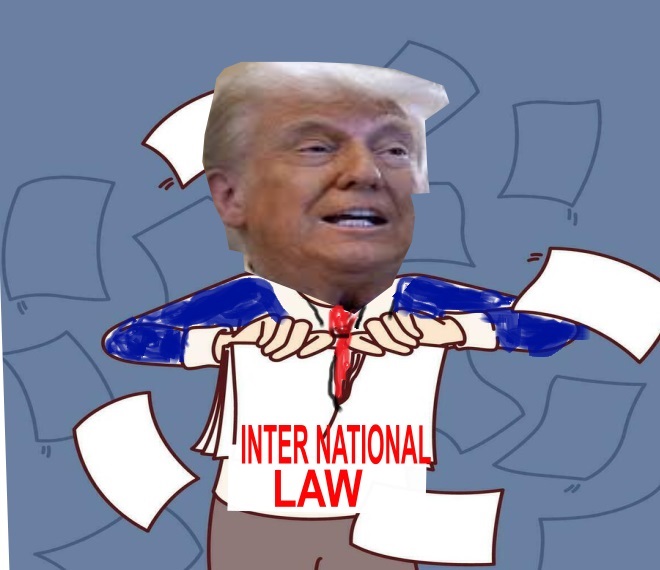
the United States will act as judge, jury and gaoler.
We are entering a “Legal Wild West”.
By Imran Khalid | 19 January 2026, https://independentaustralia.net/politics/politics-display/the-end-of-sovereign-immunity-americas-new-doctrine-of-capture,20584
By seizing a sitting head of state, Washington has replaced international law with a doctrine of unilateral reach, writes Imran Khalid.
FOR NEARLY FOUR centuries, the global order has rested on the foundation of Westphalian sovereignty: the idea that a state has exclusive authority over its territory and that a head of state is shielded from the jurisdiction of foreign courts.
Recently, that principle was not merely challenged; it was dismantled. The capture of Nicolás Maduro and his wife, Cilia Flores, by U.S. special forces in Caracas and their transfer to U.S. custody – initially aboard the USS Iwo Jima before being flown to New York – marks the birth of what we might call the “Decapitation Doctrine”. It is a shift that moves the world away from universal law and toward a system where geography determines your level of immunity.
The Trump Administration’s rationale for “Operation Absolute Resolve” is framed as a law enforcement action rather than an act of war. By relying on a narco-terrorism indictment filed in the Southern District of New York, Washington has bypassed the United Nations and the traditional mechanisms of international conflict.
The message is as clear as it is jarring: the United States no longer views the recognition of a foreign leader as a barrier to domestic prosecution. If a leader is deemed a criminal by the Department of Justice, they are subject to the same reach as any common cartel boss.
This development is a logical, if extreme, conclusion to a decade of eroding global norms. We have seen the steady decline of multilateral institutions and the rise of transactional diplomacy. But by “running” Venezuela – as President Trump promised on 3 January – the United States is doing more than pursuing a fugitive. It is declaring a new Monroe Doctrine for the 21st Century.
This updated version suggests that within its own hemisphere, the United States will act as judge, jury and gaoler. It is a return to a “sphere of influence” model where the rules of the road are written by the regional hegemon.
To understand the gravity of this moment, one must look at the history of sovereign immunity. Since the mid-17th Century, the international system has functioned on the “fiction” of equal sovereignty. Whether a nation was a global empire or a tiny principality, its leader was considered the personification of the state and thus beyond the reach of foreign domestic law.
This was not a moral judgment, but a practical one designed to prevent a cycle of endless retributive litigation between nations. By breaking this seal, the United States has effectively signalled that sovereignty is no longer an absolute right, but a privilege granted by the powerful to the compliant.
The legal community is understandably alarmed. If the U.S. can arrest Maduro based on a domestic indictment, what stops other powers from doing the same? We are entering a “Legal Wild West”.
Imagine a future where a court in Tehran issues an arrest warrant for a European defense minister, or a tribunal in Moscow indicts a Baltic leader for “crimes against the Russian state”. By removing the shield of sovereign immunity, the United States has introduced a level of personal vulnerability for world leaders that will inevitably lead to a more paranoid and defensive international climate.
This concern is already manifesting in UN Security Council debates over the operation’s legality, with Russia expelling U.S. diplomats in retaliation and China halting debt talks with Venezuela.
This “judicialisation” of foreign policy also creates a dangerous precedent for domestic politics. When foreign policy is conducted through the lens of criminal law, it becomes harder to engage in the necessary compromises of diplomacy. You cannot negotiate a peace treaty with someone you have labelled a common felon.
In the past, the United States often used “golden bridges” to allow dictators to leave power gracefully — think of Ferdinand Marcos or Jean-Claude Duvalier. By opting for a New York courtroom instead of a quiet exile, the U.S. may find that future dictators will choose to fight to the bitter end rather than risk a life sentence in a Brooklyn cell.
Indeed, on 5 January, Maduro and Flores pleaded not guilty in Manhattan’s federal court, with Maduro declaring himself “kidnapped” and a “prisoner of war” while his wife appeared with visible injuries from the raid — a gash over her eye and a forehead welt.
Furthermore, the transitional oversight of Venezuela by American officials – backed by the initial presence of the USS Iwo Jima – creates a political vacuum that may be impossible to fill legitimately.
While Vice President Delcy Rodríguez has been named acting president by the Venezuelan Supreme Court and has received “unconditional support” from Maduro’s son even as she extends an olive branch to Trump, the reality on the ground is one of American leverage. Any successor to Maduro will now face the “proxy problem”.
In an era of intense nationalism, a leader who is seen as being installed or protected by Washington will struggle to gain the internal legitimacy required to govern. This is compounded by Cuba’s report of 32 officers killed in the raid, Venezuela’s nationwide manhunt for Maduro supporters and Switzerland’s freeze on Maduro-linked assets.
We are witnessing the transition from a world of rules to a world of reach. The United States has demonstrated that its reach is unrivalled, but the long-term stability of the international system depends on more than just the ability to snatch a dictator from his bedroom. It depends on a shared understanding of where one state’s power ends and another’s begins.
By blurring that line in Caracas, Washington may have achieved a tactical masterstroke, but it has left the global order in a state of profound and dangerous uncertainty, with oil markets surging and protests rippling across U.S. cities in response.
TEPCO postpones 1st reactor restart since Fukushima due to alarm trouble.
January 19, 2026 (Mainichi Japan), https://mainichi.jp/english/articles/20260119/p2g/00m/0bu/023000c
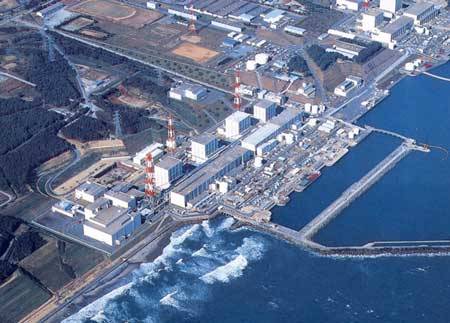
TOKYO (Kyodo) — Tokyo Electric Power Company Holdings Inc. said Monday it will postpone until an unspecified date the restart of its nuclear reactor northwest of Tokyo — its first since the 2011 Fukushima disaster — due to a control-rod alarm failure.
The Kashiwazaki-Kariwa nuclear complex in Niigata Prefecture was initially set to restart on Tuesday, but an alarm designed to sound when two non-paired control rods are withdrawn from the reactor fuel core failed to trigger during a test Saturday, the utility said at a press conference.
The company said it will announce a new date for restarting the No. 6 unit of the nuclear power complex.
After the latest incident, which was deemed a deviation from operational limits stipulated in the plant’s safety regulations, TEPCO returned all control rods to the fully inserted position.
The cause of the error was determined to be an incorrect control rod pairing that had persisted since the No. 6 unit began commercial operation in November 1996.
According to TEPCO, investigations since Saturday revealed that 88 of approximately 20,000 control rod pairs had configuration errors. The incorrect pairings had not been discovered until now because alarm tests are conducted at random.
Yutaka Kikukawa, unit director at the Kashiwazaki-Kariwa plant, denied that any mistakes were made by operational staff, saying, “We will do what needs to be done to correct the error discovered by chance.”
The configuration errors have since been corrected, and the plant was returned to its pre-deviation state Sunday night, TEPCO said.
The rescheduling came as it will take several days for the operator to conduct verification checks on each of the 205 control rods at the No. 6 reactor and examine the fission reaction of the fuel assemblies.
The reactors at the seven-unit complex have been offline since the No. 6 unit entered regular inspection in March 2012.
Who Needs CO2 to Heat the Planet When You Have Nuclear?

Letter in Westmorland Gazette January 15th 2026, https://lakesagainstnucleardump.com/2026/01/19/who-needs-co2-to-heat-the-planet-when-you-have-nuclear/?page_id=1745
Dear Editor
EDF is brazenly heralding the new year with their hype about how much CO2 Heysham’s dodgy old reactors have “saved.’ What they don’t say is that Heysham’s old reactors with their cracked graphite cores have used a vanishingly small amount of the vicious ongoing heat they have produced.
A vicious radioactive heat that will continue to be produced for thousands of years with the proposal to use the Lake District geology as a giant heat sink for this nuclear heat which cannot be turned off. Who needs CO2 to heat the planet when the nuclear industry is heating it up directly at great expense to the public in every way.
Yours sincerely,
Marianne Birkby
Lakes Against Nuclear Dump (a Radiation Free Lakeland campaign)
The Regime Change Machine Is Turning on Iran Again
the strategy shifts from direct confrontation to destabilization from within, through sabotage, information warfare, and regime-change pressure. That is why unrest inside Iran is being treated as an opening to exploit. That has been the official US and Israeli strategy for decades. And Israeli officials are already framing this like a Syria scenario.
This is all built to shape diaspora perception — and then feed Western headlines. Israel and the United States aren’t operating separately; they operate as an ecosystem. Israel drives the information war: narrative shaping, psychological operations, and online influence. The U.S. provides the infrastructure layer: funding pipelines, Persian-language media influence, pro-democracy NGO networks, and diaspora-facing institutions that convert narrative momentum into political pressure.
Even if Iranians overthrew their government today, that does not mean Iran’s future would suddenly be decided freely. Because the moment a state collapses, a vacuum opens. Washington and Tel Aviv will fill that vacuum. They will intervene politically, economically, and through media and proxy networks to shape the outcome.
January 16th, 2026, Mnar Adley, https://www.mintpressnews.com/us-israel-iran-protests-regime-change/290644/
Make no mistake: the U.S. and Israel are ready to seize this moment in Iran’s mass protests to drive a regime change operation. And it’s not even subtle.
Trump has openly threatened airstrikes against Iran — and he’s told protesters to keep going, promising: “Help is on the way.”
And Israeli security analysts are already gaming out a collapse scenario — suggesting the Israeli military could hit Iran’s strategic infrastructure and government targets if the state begins to crumble — to weaken the Islamic government and shape the outcome towards regime change with a plan to install Reza Pahlavi, the son of the brutal dictator, Mohammad Reza Pahlavi.
And the timing matters. Iran sits at the heart of the Axis of Resistance, and Israel has been hit with many political and regional losses from resistance in Gaza, Lebanon, and Yemen. With its global reputation destroyed after the genocide in Gaza and stalled normalization plans with Saudi Arabia and Turkey, Israel’s default issue is to attack Iran, as the Islamic Republic is the number one target of the apartheid state.
This is why Israel is seizing this moment now. Its own intelligence agency posted on its Farsi-language account urging Iranians to join the protests, even claiming that Mossad was with them “in the field.”
What began as legitimate protests over the collapsing rial, rising prices, economic hardship and calls for real political reforms is now bwwwwwweing hijacked by pro-monarchy rioters waving Shah-era flags, openly calling on Israel and the United States to help overthrow the government.
Reports indicate these rioters who are openly backed by Israel have burned down over 30 mosques, and committed attacks and killings against civilians and pro-government demonstrators, using military-style weapons, hunting rifles, knives, axes, and blades, while targeting police and state institutions.
MintPress has documented how Israeli intelligence covertly transfer weapons into Iran through its eastern border and often times through Israeli-tied Cargo Ships that travel past Yemen through the Red Sea. A MintPress investigation revealed that Zodiac Maritime, operator of the Mercer Street, has deep ties to the IDF and Mossad — using commercial ships to move arms and operatives for covert operations, including assassination missions inside Iran.
Phony Human Rights Groups
Despite these facts, Western corporate media are pushing out bogus casualty and mass arrest numbers that are being shared by diaspora Iranians in the push for regime change. But we at MintPress News traced these numbers back to one source: the Human Rights Activist News Agency – an arm of the Human Rights Agency in Iran (HRAI).
A new MintPress investigation found that this agency and its news arm are funded by the National Endowment for Democracy (NED), a CIA cutout organization.
They’ve become the go-to source for some of the most inflammatory claims and shockingly high casualty figures reported in the press. In the past week alone, their numbers have been repeated across outlets like CNN, The Wall Street Journal, NPR, ABC News, Sky News, and The New York Post, among others.
Even mainstream liberal commentators repeat these claims as settled fact. One example of this is Owen Jones, who wrote in The Guardian that Human Rights Iran is a “respected” group, and that their death toll claims are “probably significant underestimates.”
But what these reports almost never disclose is the funding pipeline connecting it directly to the CIA. Human Rights Activists in Iran presents itself as independent, but it’s based in Fairfax, Virginia — right inside the Washington intelligence ecosystem of the CIA. On its website, it describes itself as “non-political,” and even claims it does not accept financial aid from political groups or governments. Yet in the same paragraph, it admits its major donor is from the National Endowment for Democracy, a group created by the CIA to covertly do what the CIA once did openly.
And Human Rights Iran isn’t the only “human rights” NGO being signal-boosted into Western headlines. Another organization widely cited in coverage of Iran is the Abdorrahman Boroumand Center for Human Rights in Iran, led by Roya Boroumand — cited by outlets including The Washington Post, PBS, and ABC News.
And again, the proximity to the U.S. foreign policy apparatus is rarely mentioned.
Although the Boroumand Center does not prominently advertise it in its funding disclaimer, it has been supported by the National Endowment for Democracy. A 2024 NED press release described the center as a “partner” organization — and the NED awarded Boroumand its 2024 Goler T. Butcher medal for democracy promotion.

At that ceremony, NED officials openly praised the Boroumand Center’s work as an “indispensable resource” and said the NED was “proud to support” their advocacy toward what it called a “democratic future for Iran.”
And sitting on the center’s board is Francis Fukuyama — a former NED board member, and an editor of the NED’s own publication, the Journal of Democracy.
So when Western corporate media presents these organizations as neutral, independent referees while using them to justify escalations, sanctions narratives, and regime change pressure, understand what’s happening.
Propaganda Onslaught
These messages are being reinforced digitally on social media through coordinated media messaging, diaspora amplification, and bot-driven campaigns traced back to hubs including Tel Aviv, Virginia and LA, boosting hashtags calling for the downfall of the Islamic government.
Of course, Iranians have the right to self-determination But what is happening now is unfolding inside a long-standing U.S.-Israeli framework built around sanctions, information warfare, and “democracy promotion” pipelines, including CIA-linked front structures like the National Endowment for Democracy, designed to steer unrest and manipulate Iranian diaspora toward regime change.
We have to remember: Israel has spent decades pushing the nuclear red-herring — the claim Iran is always “months away” from an atom bomb — to justify sanctions, sabotage, and escalation.
This summer, Israel and its allies tried to pull the U.S. into direct strikes on Iranian nuclear facilities. But instead of a clean victory, Israel took a major blow when Iran retaliated, hitting military targets and causing damage reportedly worth billions, including in and around Tel Aviv.
Israel can’t win a full-scale war with Iran on its own.
So the strategy shifts from direct confrontation to destabilization from within, through sabotage, information warfare, and regime-change pressure. That is why unrest inside Iran is being treated as an opening to exploit. That has been the official US and Israeli strategy for decades. And Israeli officials are already framing this like a Syria scenario.
In the last year alone, Israel has been deploying an AI enabled operation on X targeting Iranians in the diaspora — using fake bot accounts, AI-generated personas, fabricated crisis content, and synchronized posting to push regime change messaging — pushing the idea that Iran must be de-Islamicized, that the Islamic Republic must fall, and that the “solution” is a secular, Western-aligned order. Ironic, of course, considering it is being pushed by an ethnic-Jewish state.
And when they say “de-Islamicize Iran,” Israel means destroy its revolutionary spirit from its roots. Iran’s 1979 Islamic Revolution that overthrew a US and British backed Monarchy is rooted in Islamic history and stories of Imam Hussain and Karbala, standing against a tyrannical system of exploitation, class warfare and oppression no matter the cost even if it means to stand alone.
That story is the moral backbone of Iran’s resistance identity, including why it backs Palestinian liberation, working class movements, independence and rejects U.S. and Israeli imperialism in the region and is part of a resistance movement for liberation.
Therefore, weakening that Islamic identity weakens resistance, targeting not just Iran, but Hezbollah, Yemen, and Gaza. That is why secularization is being sold as “liberation,” even though Iran is a majority-Muslim country.
This AI signal boosting promoting secularism, the monarchy, and regime change to the diaspora is not new. During previous unrest, hashtags like #WomenLifeFreedom and #IraniansDetestSoleimani were aggressively signal-boosted by bot networks — with MintPress analyses showing major traffic patterns tied not to Iran, but to hubs in Los Angeles and Tel Aviv, and even MAGA-linked account clusters pushing the messaging. In some cases, over 80% of the traffic tied to these hashtags was coming from outside of Iran, according to X activity patterns and Google Analytics.
Read more: The Regime Change Machine Is Turning on Iran AgainThis is all built to shape diaspora perception — and then feed Western headlines. Israel and the United States aren’t operating separately; they operate as an ecosystem. Israel drives the information war: narrative shaping, psychological operations, and online influence. The U.S. provides the infrastructure layer: funding pipelines, Persian-language media influence, pro-democracy NGO networks, and diaspora-facing institutions that convert narrative momentum into political pressure.
Modern regime change against Iran doesn’t start with tanks. It starts with civil society capture — shaping what people believe, what they protest for, and what outcome they’re pushed toward through “pro-democracy NGOs” that are CIA cutouts. The stated goal and policy is to covertly do what the CIA once did openly.
That pipeline runs through a network of “democracy promotion” groups tied into U.S. foreign policy that can be traced back to the CIA’s National Endowment for Democracy, and organizations in its wider orbit like Foundation for Democracy in Iran, United for Iran, Tavaana, NUFDI, the Iran Human Rights Documentation Center, and Farashgard. Different branding — same function: media narratives, activist training, diaspora pressure campaigns, and political steering toward one destination: regime change.
One of the pressure points repeatedly weaponized is culture, especially women and the hijab, framing Islamic governance as backward, while selling “freedom” as secularization and Western capitalism as the future of freedom.
Now here’s the part most people never hear: it’s an influence architecture, where Washington-linked NGOs generate the numbers, Western outlets repeat them as fact, and the funding networks behind them stay off-screen and are represented as “independent.”
In Washington, Iran policy runs through institutions that are funded by weapons manufactures like Raytheon and Lockheed Martin and pro-Israel billionaires with board members that read like a war criminal roster.
The pressure campaign is sustained by think tanks like the Foundation for Defense of Democracies, American Enterprise Institute, the Washington Institute for Near East Policy, and the Atlantic Council, pushing maximum pressure, sanctions escalation, and regime change year after year.
These institutions are fueled by donor networks tied to hardline pro-Israel politics — billionaire megadonors like Miriam Adelson, Paul Singer, and Haim Saban — who bankroll the ecosystem that keeps Iran framed as the permanent enemy and regime change as the permanent solution.
Imperial Games
And of course, Iran sits inside a broader U.S. Cold War framework targeting Russia, China, and Iran as the core adversarial bloc. Iran’s “crime” is refusing to submit — standing independent, backing resistance, and defying U.S. and Israeli power.
So the policy becomes familiar: isolate, sanction, destabilize. And if that fails, destroy.
Israel’s strategic doctrine has long treated the region’s strongest adversarial states – Iraq, Syria, Lebanon, and Iran – as targets for destabilization, because these states and alliances block Israeli dominance.
Its plan to weaken these states is documented in its Yinon Plan — the argument that Israel’s long-term security is strengthened when major states are broken into smaller sectarian and ethnic entities.
In 1996, a strategy paper written for Netanyahu’s circle called “A Clean Break” argued for reshaping Israel’s environment by weakening hostile states and rolling back adversaries. Meanwhile, in the U.S., the Brookings Institute published “Which Path to Persia?” treating regime change in Iran as a standing policy option, while outlining methods from pressure campaigns to covert destabilization.
If regime change doesn’t deliver a compliant Iran, partition becomes the fallback. The plan is to carve out a Sunni statelet across western Iraq and eastern Syria — specifically to cut the land corridor that connects Iran to its allies. That corridor runs Iran → Iraq → Syria → Lebanon — the route that links Tehran to the Mediterranean and to Hezbollah. And if you break that corridor, you isolate Iran, weaken the Axis of Resistance, and sever the regional link that makes Iran such a strategic problem for Israel.
The plan has already been partially executed with the U.S. and Israel’s proxy war in Syria, the new HTS leadership, the arming of Kurdish separatists, and breaking off Kurdistan into its own state in Iraq. This is called the Sunnistan plan inked by neocon war hawk John Bolton, and it is being put into action through policy by the Foundation for Defense of Democracies, AEI, and the Washington Institute.
This has been the official plan for Iran and the region to target any resistance to U.S. and Israeli imperialism. So when bystanders call for regime change under the guise of humanitarianism, they do not realize they are falling into the trap of imperialist propaganda and war planning that is fueled by a very sophisticated messaging system.
Even if Iranians overthrew their government today, that does not mean Iran’s future would suddenly be decided freely. Because the moment a state collapses, a vacuum opens. Washington and Tel Aviv will fill that vacuum. They will intervene politically, economically, and through media and proxy networks to shape the outcome.
And that’s why the replacement is being preloaded right now. If the Islamic Republic falls, the preferred answer is ready: Reza Pahlavi, a secular figurehead. A pro-West, pro-normalization with Israel, reversing the Islamic Revolution’s economic independence, and reopening Iran’s strategic industries — oil, gas, infrastructure — to Western capital and privatization. That’s the sad truth.
Iran is not a chessboard. It is 90 million human beings, with a civilization, culture, and identity far deeper than any foreign policy narrative. This is a people shaped by deep history and resilience, not a caricature in a policy playbook. And if the world truly believes in self-determination, then Iran’s future cannot be decided by think tanks in Washington or intelligence agencies in Tel Aviv.
Yet Western governments — where police state repression is increasingly the norm at home — are acting like they have the moral authority to tell Iranians to overthrow their own government.
In the United States, Trump has unleashed ICE in ways that have involved grave abuses, all while that same government lectures the world about human rights and “freedom.”
And history shows us this clearly: when the empire intervenes, it’s ordinary people who bleed first. Iran’s future belongs only to Iranians.
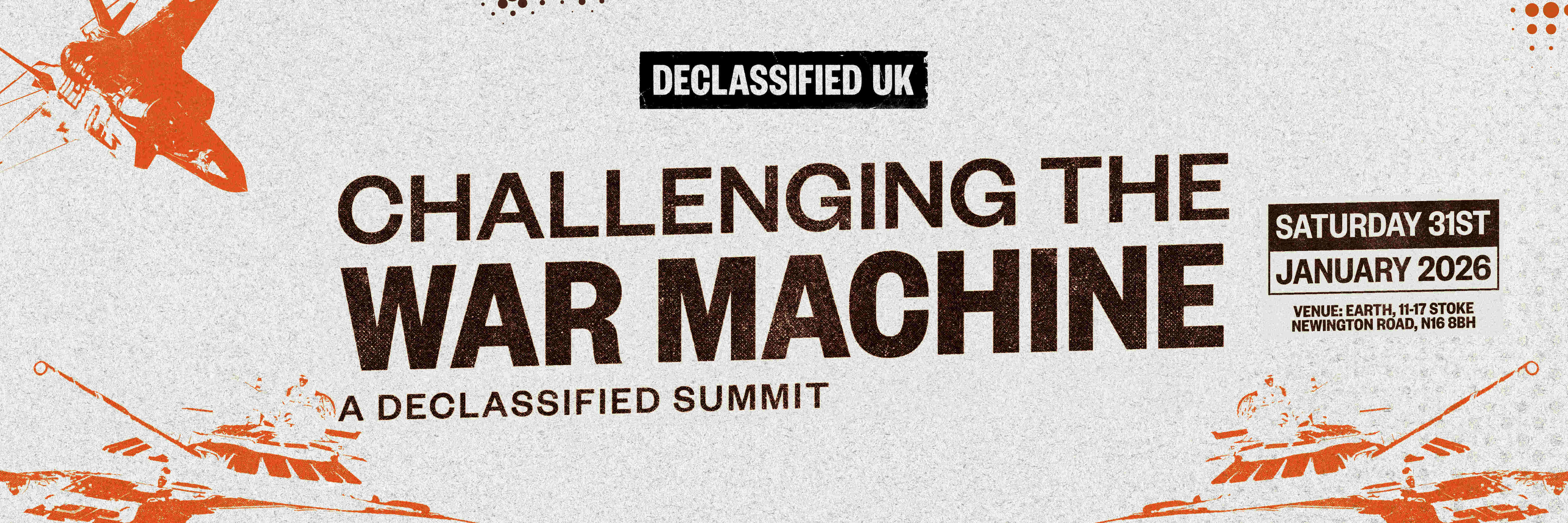
31st January – Challenging the War Machine – a DECLASSIFIED SUMMIT
DECLASSIFIED SUMMIT – https://secure.declassifieduk.org/page/180663/event/1?ea.tracking.id=496tbt7d&ea.url.id=8990610
Declassified UK will host its first ever summit, Challenging the War Machine, on Saturday 31 January 2026 at EartH in Dalston, London.
The one-day summit will bring together journalists, activists, academics, campaigners and members of the public to examine how the UK’s war machine operates and, crucially, how we challenge it.
Challenging the War Machine is open to anyone interested in understanding the structures and systems that underpin the drive to war, and how we challenge it. We will firstly assess the crisis we are in and thereafter we’ll be answering questions such as –
How do we challenge the drive to war? How do we challenge the propaganda machines of the legacy media & cultivate independent media? How do we challenge UK support for Israel? How do we build an active majority against war and militarism?
Challenging the War Machine marks a major milestone for Declassified UK, bringing its reporting off the page and into a shared physical space for dialogue.
The summit will feature Declassified UK journalists and contributors alongside a wide range of independent media organisations and movement groups, including:
Organisations – Action on Armed Violence, Alborada, CAAT – Campaign Against the Arms Trade, CND – Campaign for Nuclear Disarmament, Code Pink, Demilitarise Education, Drone Wars, Forces Watch, IMA – Independent Media Association, Irish Pages Press, Media Revolution, New Internationalist, PYM – Palestinian Youth Movement, Red Pepper Magazine, Shadow World Investigations, Stop The War, The Bristol Cable, The Canary.
Speakers – Ahmed Alnaouq, Alex Gordon, Andrew Feinstein, Anna Stavrianakis, Chris Kunzler, Dan Lambert, Des Freedman, Hamza Yusuf, Inès Khoury, Jason Hussein, Kate Hudson, Laura Webster, Lindsay German, Lowkey, Pablo Navarrete, Peter Oborne, Shahd Abusalama, Sophie Bolt.
The Declassified UK team – Mark Curtis, Laura Pidcock, Vicki Thomas, Phil Miller, John McEvoy, Dania Akkad, Martin Williams, Alex Morris and Hanna-Johara Dokal.
Join us – 9.15am-6pm | 31 January 2026 | EartH, Stoke Newington Rd, London N16 8BH
Low Cost
Unwaged/Low wage
£10
General Admission
Standard ticket price
£25
Solidarity
Pay for your ticket, plus help us provide a low cost ticket too
£35
Everyone Wants Peace Until They Get Hit With The War Propaganda.
Caitlin Johnstone, Jan 15, 2026, https://www.caitlinjohnst.one/p/everyone-wants-peace-until-they-get?utm_source=post-email-title&publication_id=82124&post_id=184610045&utm_campaign=email-post-title&isFreemail=true&r=1ise1&triedRedirect=true&utm_medium=email
Everyone’s anti-war until the war propaganda starts.
Every normal person will tell you they want peace and abhor mass-scale violence. Then the mass media start doing what they always do and churning out stories about atrocities in an empire-targeted nation, and all of a sudden people find themselves supporting airstrikes on that nation’s capital, and believing they came to that position all on their own.
This happens because most people are unaware that the western news media do not exist to report the news. They exist to administer propaganda on behalf of the western empire.
Our news outlets. Our search engines. Our social media algorithms. Our most prominent online information resources. Our mainstream podcasts and Youtube pundits. Our AI chatbots. They’re all rigged by the rich and powerful to manipulate our understanding of the world. And most of us have no idea this is even occurring.
Propaganda is very effective if you don’t know it’s happening to you. That’s why westerners are far more propagandized than the populations of nations with overtly authoritarian governments. In a nation with strict speech laws and press regulation people know the state media they’re being fed is government propaganda, whereas westerners are so propagandized they don’t even KNOW they’re propagandized.
There’s an old joke that goes like this:
A Soviet and an American are on an airplane seated next to each other.
“Why are you flying to the US?” asks the American.
“To study American propaganda,” replies the Soviet.
“What American propaganda?” asks the American.
“Exactly,” the Soviet replies.
The mass-scale psychological manipulation worms its way into western minds without their having any idea that it’s happening. Then all of a sudden you’ve got Trump supporters who just spent ten years proudly proclaiming that their man is going to end all the wars and bring about world peace enthusiastically cheerleading for decapitation strikes in Tehran. They think they came up with the idea all on their own, but in reality they were skillfully manipulated into that position by the most powerful people in the world.
You see it over and over again. People’s natural, healthy impulse to support peace and oppose mass murder gets hacked and reversed by the mass-scale psychological manipulation of the most sophisticated propaganda machine that has ever existed. From cradle to grave they are attacking our innate goodness and working to twist us toward evil and abusiveness.
We think we live in a free society, but in reality we live in a mind-controlled dystopia where people are systematically psychologically conditioned to support the world’s ugliest agendas driven by the most powerful and depraved individuals on our planet. The more you think about it, the creepier it gets.
But, again, propaganda only works if you don’t know it’s happening to you. The more people understand that our view of world events is being aggressively manipulated by our rulers, the less effective these propaganda operations will become. All we have to do is help our fellow citizens and netizens wake up to the fact that that’s what’s going on. Once they lose the ability to manipulate the way we think, speak, act and vote, the possibility of a free and healthy world is just a click away.
Australia’s Opposition Leader, Sussan Ley , tries to rewrite history
19 January 2026 AIMN Editorial, Palestine Action Group, https://theaimn.net/sussan-ley-tries-to-rewrite-history/
Today has witnessed a new low in the sickening attempt by some politicians to exploit the horrific massacre at Bondi in order to attack the mass protest movement in which hundreds of thousands of people have marched against the genocide in Gaza.
Opposition leader Sussan Ley, in particular, made a speech filled with obscene misinformation and outright lies. The complete abandonment of any commitment to the truth is a deeply worrying lurch toward the kind of politics Donald Trump has unleashed in the US.
Any suggestion that the Bondi massacre can be blamed on the millions of Australians who have opposed Israel’s genocide in Gaza is baseless, preposterous, hate-filled and hypocritical. There is no evidence of any link whatsoever. ISIS does not support the Palestinian cause, and all available evidence points to the killers being radicalised several years before 2023 or the Harbour Bridge March for Humanity.
The Palestine solidarity movement has always stood firmly and explicitly against antisemitism, and has since the very beginning been organised alongside Jewish people, who have marched in their thousands against the Israeli regime. In Sydney, almost every protest we have held for the past two years has been co-sponsored by Jews Against the Occupation ‘48, and featured Jewish speakers and MCs.
Antisemitism did not march on our streets, bridges and landmarks, nor did it camp in our university quadrangles, and not a shred of real evidence has ever been produced for such claims. On the incredibly rare occasions when genuine antisemites have tried to participate in our movement, they have been unanimously denounced and excluded. The same certainly cannot be said of the Liberal Party, or the Murdoch and other press outlets pushing these claims, who have often supported far right movements led by actual neo-Nazis.
Sussan Ley despicably ties the mass anti-genocide movement to firebombings of places of worship – attacks which the NSW Police and AFP have detailed were carried out by criminal elements, perhaps coordinated by someone in Iran. In other words, nothing to do with the protest movement!
Like others making such blatantly dishonest claims, Sussan Ley has supported the worst possible act of racist violence: genocide. Ley gives the impression she would like it to be a criminal offence to oppose the crimes of the state of Israel. She also seeks to weaponise one form of racism, antisemitism, to whip up another: Islamophobia. This is despicable politics and must be rejected by all who want to uphold universal principles of anti-racism, let alone a basic commitment to factual and rational debate.
Outside the Canberra bubble dominated by politicians, lobbyists and media executives, the fact that Israel has committed a genocide in Gaza is now an incontrovertible fact, confirmed by all human rights organisations and experts. Well over 100,000 Palestinians are estimated to have been massacred and starved to death since October 2023. This is why millions have marched, not because they hate Jews, but because they are against possibly the biggest racist atrocity of the 21st century, carried out by the state of Israel. And this is why they will continue to march, as Israel’s occupation and genocide of Gaza continues.
Study reveals ‘persistent danger’ from Israel’s white phosphorus strikes in southern Lebanon
Middle East
An investigation mapping out 248 strikes highlights Israel’s use of white phosphorus during the recent conflict in southern Lebanon between October 2023 and November 2024. Open-source researcher Ahmad Baydoun, who conducted the study, emphasises the serious and ongoing concerns regarding the substance’s impact on health, agriculture and the environment.
The FRANCE 24 Observers/ Djamel BELAYACHI, 03/12/2025, https://www.france24.com/en/middle-east/20251203-study-reveals-persistent-danger-israeli-white-phosphorus-strikes-southern-lebanon
Burnt olive groves, devastated fields and toxic fragments buried underground – in southern Lebanon, Israel‘s use of white phosphorus during the conflict with Hezbollah from October 2023 to November 2024 left a lasting mark.
Although not explicitly prohibited by international law, the use of white phosphorus is regulated as an incendiary weapon. Its use against civilians or in populated areas is prohibited. In June 2024, the Israeli army claimed that it did not use white phosphorus shells to target or set fires, adding that “Israel Defence Forces procedures require that such shells are not used in densely populated areas, subject to certain exceptions”.
‘91% of white phosphorus strikes took place before Israeli forces entered southern Lebanon’
Ahmad Baydoun is an open source intelligence (OSINT) researcher at Delft University of Technology in the Netherlands. According to data from the study he led, presented in an interactive map published in October 2025, a significant proportion of white phosphorus strikes in southern Lebanon hit civilian and agricultural areas.
Collecting this data involved combining digital tools, verification of images posted on social media (particularly Facebook and Instagram), and testimonies from residents on the ground. Baydoun explains:
“Israel justifies the use of white phosphorus as a smoke screen to protect the movements of its troops or to mark targets. But according to my research, 91 percent of white phosphorus strikes took place before Israeli forces entered southern Lebanon in October 2024, which contradicts the official Israeli version. Furthermore, 39 percent of all phosphorus strikes we documented took place over civilian areas, 16 percent over agricultural land, and only 44 percent in uninhabited areas or areas far from residents.”
NGOs such as Human Rights Watch and Amnesty International have documented the use of white phosphorus in or near residential areas, contradicting official Israeli statements.
‘A persistent danger to human life and livestock’
White phosphorus was used only with artillery during the last war, according to Baydoun. The munition explodes, scattering incandescent fragments over a wide area, reaching temperatures of up to 800°C.
Baydoun told our team:
“The munitions explode in the air and produce 115 small fragments that sink into the ground and continue to emit this toxic substance for ten to fifteen minutes. Fragments can remain active in the ground. They can remain dormant until they are exposed to oxygen again. Then they reactivate and produce smoke.
We had a farmer in southern Lebanon who, a year after the initial strike, hit a fragment with a stick, and the fragment started emitting toxic smoke again, demonstrating the ongoing danger to people’s lives and livestock.”
The study lists nearly 28,700 fragments scattered throughout the region, which are considered very difficult to extract.
“It is very difficult to extract them from the ground. If someone has livestock and that livestock eats one of these fragments, it dies immediately, and if a human consumes the meat from that livestock, they also die.”
Among the villages in southern Lebanon most affected by white phosphorus strikes are Al-Khiam (30 incidents), Meiss El-Jabal (28 strikes), Kfar Kila (26 strikes), Yaroun (24 strikes) and Rmaysh (17 strikes).
Fear of consuming local products
Thanks to the geolocation of hundreds of photos and videos, Baydoun’s project has precisely documented 248 strikes. Residents can check whether their land or homes have been affected.
Many residents express fear of consuming local products, particularly olive oil and vegetables, over concerns of invisible contamination. In February 2025, analyses conducted by the Lebanese Ministries of Agriculture and Environment did not detect traces of phosphorus in olive samples. However, high concentrations were found in some soils, posing a potential risk to future harvests.
According to the United Nations FAO, nearly 2,100 hectares of orchards were burned, 2.3 million livestock were killed, and agricultural losses in the south of the country and the Bekaa Valley (in eastern Lebanon) exceeded 704 million dollars between October 2023 and November 2024.
Iran & Israel Secretly Agreed Not To Attack Each Other Through Russian Backchannel
by Tyler Durden, Jan 15, 2026, https://www.zerohedge.com/geopolitical/iran-israel-secretly-agreed-not-attack-each-other-through-russian-backchannel-wapo
There may have been some back-channel dealmaking and a ‘mutual understanding’ reached between Iran and Israel far behind the scenes as protests unfolded on Iran’s streets, and as President Trump began to make threats about striking Tehran.
At a moment Trump seems to have climbed down (at least for now) from the threatened drive to intervene militarily, The Washington Post has issued a Wednesday report saying Israel and Iran have been in indirect diplomatic contact via Russia as a mediator.
“Days before protests erupted in Iran in late December, Israeli officials notified the Iranian leadership via Russia that they would not launch strikes against Iran if Israel were not attacked first,” WaPo writes. “Iran responded through the Russian channel that it would also refrain from a preemptive attack, diplomats and regional officials with knowledge of the exchange said.”
Could this be because of the Iranian missiles that rained down on Tel Aviv back in June? If so, it seems the Islamic Republic has finally established deterrence.
The timeline of what was communicated when remains unclear. But this backchannel had already been revealed in Middle East media reports, for example in the following prior reporting:
Israel and Iran have recently exchanged secret, indirect messages through Russia in the midst of heightened regional tensions, according to a new report by Amwaj.media today. The exchanges were described as an effort to prevent further military escalation rather than to establish any form of ceasefire or diplomatic framework.
According to the report, the messages were conveyed through Russian President Vladimir Putin after Israel sought to pass along a signal that it was not interested in escalating military conflict at this stage. Iranian officials acknowledged the message but emphasized that their reply carried no commitment, no coordination, and no obligation on Iran’s part. An Iranian political source quoted in the report said bluntly that “there is no commitment, no coordination, and no ceasefire agreement.” The source emphasized that the contact should not be interpreted as a step toward broader understandings between the two countries, which remain bitter adversaries with no direct diplomatic ties.
The exchanges were reportedly limited in scope and intent. No guarantees were offered, no timelines were discussed, and no monitoring or enforcement mechanisms were established. One source described the communication as “a mutual announcement to a mutual friend on no new strikes,” meaning that the goal was simply to manage tensions at a specific moment rather than to lock in any lasting arrangement.
A senior Iranian political source confirmed that indirect communication with Israel had indeed taken place, identifying Russia, and specifically Putin, as the intermediary. The source reiterated that there was “no ceasefire agreement” and that the messages amounted only to parallel notifications of intent, rather than a shared understanding or deal.
The report says the Iranian side of the exchanges was handled not by the foreign ministry but by Ali Larijani, secretary of Iran’s Supreme National Security Council.
It’s possible that this served as important background to Trump’s apparent decision to not strike Iran at this point. Israel is usually the country yelling loudest to hit Iran, but this time the Netanyahu government was somewhat muted.
By all accounts, Iran’s streets have pretty much gone quiet by now, after a crescendo of violence this week left hundreds dead, including many police and security personnel.
US Evacuating Some Troops From Middle East Bases as It Considers Attacking Iran
One of the bases the US is pulling troops from is the Al Udeid Air Base in Qatar, which Iran previously attacked in retaliation for the US bombing its nuclear facilities
NEWS.ANTIWAR.COM, by Dave DeCamp | January 14, 2026
The US is pulling some troops from several of its bases in the Middle East, as European officials told Reuters on Wednesday evening that a US attack on Iran could come within the next 24 hours. The US pulled forces from bases in the region before the start of the 12-day US-Israeli war against Iran in June 2025.
One of the bases the US is pulling troops from is the Al Udeid Air Base in Qatar, which Iran attacked in June in retaliation for the US bombing its nuclear facilities. Iran gave the US advanced warning ahead of the attack, giving the US military time to evacuate its forces and prepare to intercept the missiles.
Iranian officials have been warning they will strike US bases and ships in the region in response to any attack, and it’s likely this time they won’t give advanced notice……………………………………………………………………………………… https://news.antiwar.com/2026/01/14/us-evacuating-some-troops-from-middle-east-bases-as-it-considers-attacking-iran/
Celebrating Five Years of the Nuclear Weapons Ban Treaty.
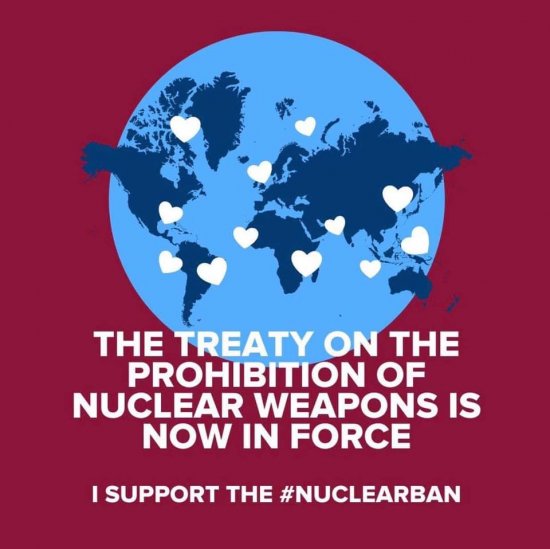
On Thursday, January 22th, the world and New Mexicans will mark five years since the Treaty on the Prohibition of Nuclear Weapons became international law. Nuclear weapons are now illegal. https://disarmament.unoda.org/en/our-work/weapons-mass-destruction/nuclear-weapons/treaty-prohibition-nuclear-weapons
In Santa Fe, on Thursday and Friday, January 22nd and 23rd from noon to 1 pm, we’ll be gathering on the corners of West Alameda and Sandoval to peacefully commemorate the fifth year of the Treaty. Join us!
In 2017, the Nobel Peace Prize was awarded to the International Campaign to Abolish Nuclear Weapons, or ICAN, for its work to bring the Treaty to fruition. https://www.icanw.org/nobel_prize
ICAN continues its work. Currently most countries support the nuclear weapons ban treaty because they understand that any use of nuclear weapons carries extreme risks – by design, miscalculation or accident – causing catastrophic humanitarian consequences. We must continue to demand policy reform to debunk the myths of nuclear deterrence and defund the costs of continuing down that road.
In 2026, ICAN will work closely with states parties to the Treaty to make sure that diplomatic efforts reduce the risks of nuclear weapons and build towards nuclear disarmament. https://www.icanw.org/
Did you know about some of the changes have happened since the Treaty went into effect? In the last five years over $4.7 trillion dollars have been divested from nuclear weapons and the majority of the world refuses to accept doomsday as our destiny. https://www.icanw.org/take_action_now
All the president’s yes-men?
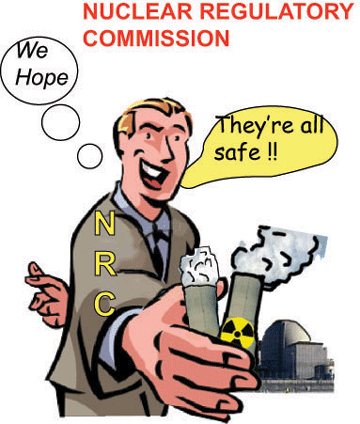
The NRC commission looks poised to rubber-stamp “Cowboy Chernobyl”, write Paul Gunter and Linda Pentz Gunter
Donald Trump loves a yes-man. What we are now waiting to learn is just how many of those yes-men are sitting on the US Nuclear Regulatory Commission (NRC).
The agency was ordered late last year by the then White House and Elon Musk-created US Department of Government Efficiency, to effectively accelerate and “rubber stamp” reactor license approvals in order to fulfill the White House’s reckless directive, contained in four executive orders issued last May, to license new reactors at lighting speed.
On December 1, the NRC proudly announced that its staff had completed their final safety evaluation for the Bill Gates company TerraPower’s small modular reactor design in record time, in keeping with the make haste mandate from the White House. The NRC staff had concluded that “there are no safety aspects that would preclude issuing the construction permit.”
NRC commissioner David Wright was abruptly and surprisingly demoted from his position as chairman after serving in that capacity for less than one year.
Jeremy Groom, acting director of the NRC’s Office of Nuclear Reactor Regulation, even bragged how the NRC staff “finished our technical work on the Kemmerer review a month ahead of our already accelerated schedule, as we aim to make licensing decisions for new, advanced reactors in no more than 18 months.”
What we are now waiting to find out, likely sometime this month, is whether the five NRC commissioners will indeed grant a construction license to a patently dangerous reactor design (we are using the term “dangerous” here under their own definition since all of us already know that every nuclear reactor design is inherently dangerous and the so-called new ones haven’t changed that reality.)
Who will be calling those shots, however, has now been significantly reshuffled by the Trump administration.
Sitting NRC commissioner and Republican David Wright had been appointed commission chair immediately after Trump’s January 2025 inauguration, bumping the Biden administration’s appointed chair, Democrat Christopher Hanson, to commissioner.
By June, the White House had unceremoniously fired Hanson from the commission “without cause” in a move widely viewed as illegal based on US Supreme Court precedent case law that went unchallenged. By August, Republican commissioner Annie Caputo had resigned, a surprise move explained by the need to “spend more time with family,” invariable a convenient cover story. This left two vacant seats on the commission.
These have now been filled by two Republicans nominated by the White House — Douglas Weaver (straight from industry) and Ho Nieh, who has been spinning through industry-regulator revolving doors for much of his career.
Nieh has been an NRC employee for 23 years, reaching senior management level. He was confirmed to the commission by the US Senate on November 19, 2025 and sworn in on December 4, 2025.
Then, in yet another surprise move, on January 8, 2026, Trump named Ho Nieh the new NRC commission chairman, effective immediately, bumping David Wright back to commissioner. Caputo’s vacant seat was filled by Weaver.
This was a strategic political maneuver to set up a 3-2 Republican majority on the commission, with the Democrats — Bradley Crowell (term expiring June 30, 2027) and Matthew Marzano (term expiring June 30, 2028 — now pushed to the minority………………………………………………………………………………………………………………………………………………………………………………………………………
The witnesses for the House hearing — tellingly called “American Energy Dominance: Dawn of the New Nuclear Era” — came exclusively from the industry, with representatives from the Nuclear Energy Institute — the nuclear industry’s paid propaganda arm — and from Southern Company, the Nuclear Innovation Alliance and the Idaho National Laboratory.
Entirely missing were any contrary, independent, objective and scientifically knowledgeable voices. Did they invite Lyman or M.V. Ramana, or Arjun Makhijani, physicists who actually understand how precisely dangerous these new reactor schemes are?
Did they invite Amory Lovins to blow the lid off the extreme costs or Mark Jacobson to educate them on how they could achieve their same goals with renewables instead?
And did they invite anyone from the targeted communities to see if they actually wanted these things in their neighborhoods or had even been consulted?
Even the right wing British daily newspaper, the Daily Mail, ran a headline that screamed “Tiny city of just 2,000 residents are fearful as Bill Gates-backed nuclear plant dubbed ‘Cowboy Chernobyl is built on their doorstep,” borrowing the moniker Lyman had used for the Natrium plan.
“I don’t think there are, at least from our perspective, many communities that are out there raising their hands saying, ‘Yes. We want a nuclear project in our community with an expedited safety and environmental review,’” John Burrows, Wyoming Outdoor Council’s energy and climate policy director told his local NPR station. “It’s just not something that any community wants to see, especially for a pilot or demonstration project.”
At least 60 percent of Americans now say they want more nuclear power according to a recent Pew Research Center poll. Of course they do, because they, like members of Congress, are only listening to the endless propaganda drumbeat from the nuclear industry, blasted non-stop across mainstream media and almost always without challenge.
Lyman’s “Cowboy Chernobyl” quip is actually a deep serious warning. It’s time we drove those nuclear cowboys off into the sunset, not in glory but in disgrace.
Paul Gunter is the Director of the Reactor Oversight Project at Beyond Nuclear. Linda Pentz Gunter is the founder of Beyond Nuclear and serves as its international specialist. Her book, No To Nuclear. Why Nuclear Power Destroys Lives, Derails Climate Progress and Provokes War, can be pre-ordered now from Pluto Press. https://beyondnuclearinternational.org/2026/01/15/all-the-presidents-yes-men/
1 This Month

of the week – Shut Down Drone Warfare!


Tell the Ukrainian Government to Drop Prosecution of Peace Activist Yurii Sheliazhenko

Petition to revoke the licensing of the Near Surface Nuclear Disposal Facility (NSDF) at Chalk River. https://www.ourcommons.ca/petitions/en/Petition/Details?Petition=e-7247
To see nuclear-related stories in greater depth and intensity – go to https://nuclearinformation.wordpress.com
-
Archives
- March 2026 (244)
- February 2026 (268)
- January 2026 (308)
- December 2025 (358)
- November 2025 (359)
- October 2025 (376)
- September 2025 (257)
- August 2025 (319)
- July 2025 (230)
- June 2025 (348)
- May 2025 (261)
- April 2025 (305)
-
Categories
- 1
- 1 NUCLEAR ISSUES
- business and costs
- climate change
- culture and arts
- ENERGY
- environment
- health
- history
- indigenous issues
- Legal
- marketing of nuclear
- media
- opposition to nuclear
- PERSONAL STORIES
- politics
- politics international
- Religion and ethics
- safety
- secrets,lies and civil liberties
- spinbuster
- technology
- Uranium
- wastes
- weapons and war
- Women
- 2 WORLD
- ACTION
- AFRICA
- Atrocities
- AUSTRALIA
- Christina's notes
- Christina's themes
- culture and arts
- Events
- Fuk 2022
- Fuk 2023
- Fukushima 2017
- Fukushima 2018
- fukushima 2019
- Fukushima 2020
- Fukushima 2021
- general
- global warming
- Humour (God we need it)
- Nuclear
- RARE EARTHS
- Reference
- resources – print
- Resources -audiovicual
- Weekly Newsletter
- World
- World Nuclear
- YouTube
-
RSS
Entries RSS
Comments RSS
 nuclear-news