Trump Abandonment of Global Treaties, Including Landmark Climate Deal, ‘Threatens All Life on Earth’

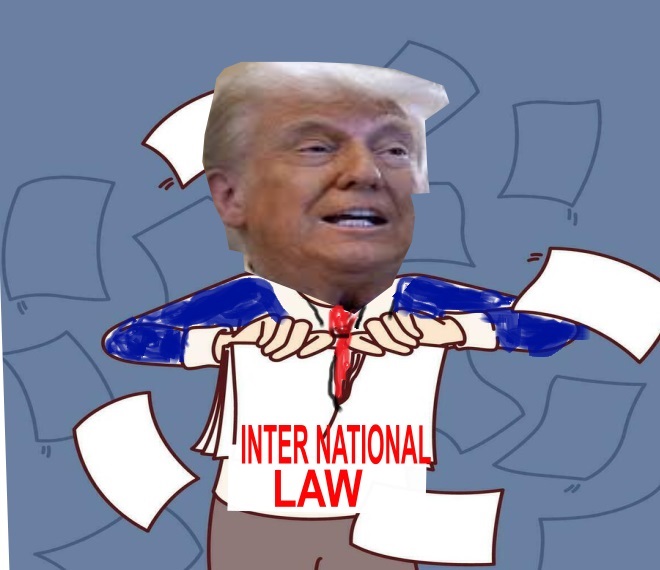
“Trump cutting ties with the world’s oldest climate treaty is another despicable effort to let corporate fossil fuel interests run our government.”
Jake Johnson, Jan 08, 2026, https://www.commondreams.org/news/trump-withdraws-global-treaties
President Donald Trump on Wednesday withdrew the United States from dozens of international treaties and organizations aimed at promoting cooperation on the world’s most pressing issues, including human rights and the worsening climate emergency.
Among the treaties Trump ditched via a legally dubious executive order was the United Nations Framework Convention on Climate Change (UNFCCC), making the US—the world’s largest historical emitter of planet-warming greenhouse gases—the first country to abandon the landmark agreement.
President Donald Trump on Wednesday withdrew the United States from dozens of international treaties and organizations aimed at promoting cooperation on the world’s most pressing issues, including human rights and the worsening climate emergency.
Among the treaties Trump ditched via a legally dubious executive order was the United Nations Framework Convention on Climate Change (UNFCCC), making the US—the world’s largest historical emitter of planet-warming greenhouse gases—the first country to abandon the landmark agreement.
The US Senate ratified the convention in 1992 by unanimous consent, but lawmakers have repeatedly failed to assert their constitutional authority to stop presidents from unilaterally withdrawing from global treaties.
Jean Su, energy justice director at the Center for Biological Diversity, said in a statement that “Trump cutting ties with the world’s oldest climate treaty is another despicable effort to let corporate fossil fuel interests run our government.”
“Given deeply polarized US politics, it’s going to be nearly impossible for the U.S. to rejoin the UNFCCC with a two-thirds majority vote. Letting this lawless move stand could shut the US out of climate diplomacy forever,” Su warned. “Withdrawing from the world’s leading climate, biodiversity, and scientific institutions threatens all life on Earth.”
Trump also pulled the US out of the International Institute for Justice and the Rule of Law, the International Union for Conservation of Nature, the UN International Law Commission, the UN Democracy Fund, UN Oceans, and dozens of other global bodies, deeming them “contrary to the interests of the United States.”
The president’s move came as he continued to steamroll domestic and international law with an illegal assault on Venezuela and threats to seize Greenland with military force, among other grave abuses.
Below is the full list of international organizations that Trump abandoned with the stroke of a pen:
(a) Non-United Nations Organizations:
(i) 24/7 Carbon-Free Energy Compact;
(ii) Colombo Plan Council;
(iii) Commission for Environmental Cooperation;
(iv) Education Cannot Wait;
(v) European Centre of Excellence for Countering
Hybrid Threats;
(vi) Forum of European National Highway Research Laboratories;
(vii) Freedom Online Coalition;
(viii) Global Community Engagement and Resilience Fund;
(ix) Global Counterterrorism Forum;
(x) Global Forum on Cyber Expertise;
(xi) Global Forum on Migration and Development;
(xii) Inter-American Institute for Global Change Research;
(xiii) Intergovernmental Forum onMining, Minerals, Metals, and Sustainable Development;
(xiv) Intergovernmental Panel on Climate Change;
(xv) Intergovernmental Science-Policy Platform on Biodiversity and Ecosystem Services;
(xvi) International Centre for the Study of the Preservation and Restoration of Cultural Property;
(xvii) International Cotton Advisory Committee;
(xviii) International Development Law Organization;
(xix) International Energy Forum;
(xx) International Federation of Arts Councils and Culture Agencies;
(xxi) International Institute for Democracy and Electoral Assistance;
(xxii) International Institute for Justice and the Rule of Law;
(xxiii) International Lead and Zinc Study Group;
(xxiv) InternationalRenewable Energy Agency;
(xxv) International Solar Alliance;
(xxvi) International Tropical Timber Organization;
(xxvii) International Union for Conservation of Nature;
(xxviii) Pan American Institute of Geography and History;
(xxix) Partnership for Atlantic Cooperation;
(xxx) Regional Cooperation Agreement on Combatting Piracy and Armed Robbery against Ships in Asia;
(xxxi) Regional Cooperation Council;
(xxxii) Renewable Energy Policy Network for the 21st Century;
(xxxiii)Science and Technology Center in Ukraine;
(xxxiv) Secretariat of the Pacific Regional Environment Programme; and
(xxxv) Venice Commission of the Council of Europe.
(b) United Nations (UN) Organizations:
(i) Department of Economic and Social Affairs;
(ii) UN Economic and Social Council (ECOSOC) — Economic Commission forAfrica;
(iii) ECOSOC — Economic Commission forLatin America and the Caribbean;
(iv) ECOSOC — Economic and Social Commission for Asia and the Pacific;
(v) ECOSOC — Economic and Social Commission for Western Asia;
(vi) International Law Commission;
(vii) International Residual Mechanism for Criminal Tribunals;
(viii) InternationalTrade Centre;
(ix) Office of the Special Adviser on Africa;
(x) Office of the Special Representative of the Secretary General forChildren in Armed Conflict;
(xi) Office of the Special Representative of the Secretary-General on Sexual Violence in Conflict;
(xii) Office of the Special Representative of the Secretary-General on Violence Against Children;
(xiii) Peacebuilding Commission;
(xiv) Peacebuilding Fund;
(xv) Permanent Forum on People of African Descent;
(xvi) UN Alliance of Civilizations;
(xvii) UN Collaborative Programme on Reducing Emissions fromDeforestation and Forest Degradation in Developing Countries;
(xviii) UN Conference on Trade and Development;
(xix) UN Democracy Fund;
(xx) UN Energy;
(xxi) UN Entity for Gender Equality and the Empowerment of Women;
(xxii) UN Framework Convention on Climate Change;
(xxiii) UN Human Settlements Programme;
(xxiv) UN Institute for Training and Research;
(xxv) UN Oceans;
(xxvi) UN Population Fund;
(xxvii) UN Register of Conventional Arms;
(xxviii) UN System Chief Executives Board for Coordination;
(xxix) UN System Staff College;
(xxx) UNWater; and
(xxxi) UN University.
Rachel Cleetus, policy director and lead economist for the Climate and Energy Program at the Union of Concerned Scientists, said Trump’s withdrawal from the world’s bedrock climate treaty marks “a new low and yet another sign that this authoritarian, anti-science administration is determined to sacrifice people’s well-being and destabilize global cooperation.”
“Withdrawal from the global climate convention will only serve to further isolate the United States and diminish its standing in the world following a spate of deplorable actions that have already sent our nation’s credibility plummeting, jeopardized ties with some of our closest historical allies, and made the world far more unsafe,” said Cleetus. “This administration remains cruelly indifferent to the unassailable facts on climate while pandering to fossil fuel polluters.”
‘Year of bloodshed’: West Bank authorities record nearly 24,000 army, settler attacks on Palestinians in 2025
Around 35,000 trees have been uprooted or destroyed by illegal settlers this year, while 14 Palestinian citizens have been killed
News Desk, JAN 6, 2026, https://thecradle.co/articles-id/35236
Head of Palestine’s Colonization and Wall Resistance Commission (CWRC), Minister Muayyad Shaaban, said in a new report that over 23,000 attacks have been carried out on Palestinians by settlers and the Israeli army in the occupied West Bank this year.
According to the CWRC report, 2025 saw Israeli troops and illegal settlers commit 23,827 attacks across the territory.
“The attacks were categorized as follows: 1,382 targeted land and trees, 16,664 attacks targeted individuals, while 5,398 attacks targeted property,” the report reads.
“The Israeli army was responsible for 18,384 attacks, while colonizers carried out 4,723 attacks, and both parties together were involved in an additional 720 attacks,” Shaaban is quoted as saying during a press conference at CWRC headquarters in Ramallah.
The minister said 2025 was “a year marked by bloodshed.”
“The occupying power did not simply expand colonies; it aimed to redefine the very concept of control. That is, domination is no longer limited to physical land, but rather, it extends to reshaping geography, symbolism, and the entire existence of the Palestinian people,” he added.
As a result of this year’s violence in the occupied West Bank, 14 Palestinian citizens have been killed.
Shaaban went on to say that 35,000 trees have been destroyed this year, and that settlers have caused 434 fires, which impacted Palestinian property and agriculture.
Meanwhile, land confiscation and settlement expansion are surging.
“Israeli occupation authorities effectively control approximately 41 percent of the West Bank, maintain a tight grip on nearly 70 percent of Area C, and control over 90 percent of the Jordan Valley through a comprehensive system of military orders and expropriation measures,” according to CWRC.
The 1993 US-sponsored Oslo Accords established the Palestinian Authority (PA) and its security forces, and gave the Palestinians limited autonomy in some parts of the occupied West Bank. This was said to be in preparation for the eventual establishment of a Palestinian state.
However, the accords did not end Israel’s military occupation and gave the Israeli government time to confiscate more Palestinian land and continue illegally expanding West Bank settlements.
The agreement resulted in the splitting of the West Bank into areas A, B, and C. Area A gave the PA authority over civil and security matters, while Area B gave it control only over civil matters. In Area C, Israel was granted full control.
Since then, illegal settlements have continued to expand, including in Areas A and B.
Since the start of 2025, Israel has been occupying multiple West Bank refugee camps and has been carrying out a systematic campaign of destruction and displacement.
Tens of thousands of Palestinians have been uprooted from their homes in the occupied West Bank since the start of the year, mainly in Jenin, Tulkarem, and Tubas.
As army and settler violence surges, the government also continues to advance plans for illegally annexing the territory.
Bezalel Smotrich, Israel’s finance minister and staunch backer of the illegal settler movement, said on 30 December that Washington has given Tel Aviv “full support” to expand settlements in the occupied West Bank.
Analysts Warn Venezuela Invasion Could Empower Trump to Take Actions Elsewhere.
“The invasion of Venezuela is a blatant violation of international law,” “It is a prelude, potentially, to a long and violent conflict within Venezuela. And it’s a throwback to other times when leaders who had broken democracy, who had exploited their peoples in Haiti in 1915 or in Panama in 1989, became the fodder for further U.S. invasions and occupation.”
“We’re ready to go again if we have to,” Trump said in a press conference after the invasion. And not just against Venezuela. Trump has threatened military action in Colombia, Cuba, and Mexico.
The US’s first unilateral invasion in South America is Trump’s testing ground for military supremacy in the region.
By Michael Fox , Truthout, January 6, 2026
The bombs fell in the early hours of January 3. They cascaded over the city, one and then another. The bright orange explosions rocked Venezuela’s capital, Caracas, shaking people awake.
“The bombs lasted a while,” Caracas resident and community organizer Yanahir Reyes told Truthout. “And you could hear the helicopters, the planes. It was terrifying.”
The U.S. forces rained down fire — focused on the military barracks in the capital and nearby states, but also hitting surrounding neighborhoods.
Videos of the invading forces spiraled quickly onto social media. Countless videos of the bombs falling, people screaming, trying to make sense of it all, while the explosions shook buildings and destroyed homes. And the sound of the arrival of the U.S. forces echoed across the city.
Shock. Fear. Confusion………………………………………
This was the invasion that Donald Trump had vowed for months. An invasion that U.S. administrations had threatened for years and decades, going all the way back to President George W. Bush.
And it marked the U.S. once again deploying direct military action in other countries in the region. A return to President Theodore Roosevelt’s gunboat diplomacy, where the United States pushes its agenda and its interests by force. The Monroe Doctrine on steroids, or what Trump has called it his own “Donroe Doctrine” — Donald plus Monroe.
It is a terrifying precedent. It is the first time the United States has taken unilateral military action against a nation in Latin America in more than 35 years. Many analysts and Latin Americans had hoped this bellicose foreign policy and direct U.S. aggression had been relegated to the history books.
But those playbooks have been dusted off and are being used again, echoing the December 20, 1989, U.S. invasion of Panama. And it was a copy and paste job — give or take some minor alterations.
“The invasion of Venezuela is a blatant violation of international law,” John Lindsay-Poland told Truthout. He’s the author of the book Emperors in the Jungle, about the history of U.S. intervention in Panama and the 1989 invasion. “It is a prelude, potentially, to a long and violent conflict within Venezuela. And it’s a throwback to other times when leaders who had broken democracy, who had exploited their peoples in Haiti in 1915 or in Panama in 1989, became the fodder for further U.S. invasions and occupation.”
As the 1989 invasion of Panama would be considered a training exercise for the ensuing U.S. wars in the Middle East, the Venezuelan invasion on January 3 was Trump’s testing ground for military supremacy in the region.
“We’re ready to go again if we have to,” Trump said in a press conference after the invasion. And not just against Venezuela. Trump has threatened military action in Colombia, Cuba, and Mexico.
“We should be concerned,” says Steve Ellner, an associate managing editor of the journal Latin American Perspectives, who taught for decades at the Universidad de Oriente in Venezuela. “And we should be concerned because this is meant to send a message way beyond Venezuela, not only way beyond Venezuela in the region, but worldwide.”
1989 Panama Invasion
On December 20, 1989, U.S. President George H.W. Bush ordered the U.S. invasion of Panama. Twenty-six thousand U.S. troops invaded the country. They rained down fire and bombs — attacking the barracks of the Panama Defense Forces in the capital of Panama City and other areas.
The U.S.’s goal was to capture President Manuel Noriega on drug trafficking charges.
Neighborhoods like Panama City’s El Chorrillo went up in smoke. Twenty-thousand homes burned. U.S. forces killed hundreds of people. They dumped bodies into mass graves.
When I visited El Chorrillo in late 2023 to report for the episode of my podcast Under the Shadow about the U.S. invasion, I saw the open wounds that still remain. The bullet holes left by U.S. troops. The pain in people’s voices as they remember that night and the subsequent U.S. occupation.
“So many innocent people died,” said resident Omar Gonzalez, who was only 12 at the time and watched fires engulf homes. “Friends of ours. Children we knew. People. Men and women. Some people who were sleeping at that moment. Elderly people who couldn’t stand up or run away because they lived close to the barracks. And this is the history. It’s painful, more than anything else.”
U.S. forces killed more than 500 people. Victims and their families are still demanding justice. Large murals cover walls, like one depicting a U.S. helicopter flying over rubble engulfed in flames. It reads: “Never forget. Never forgive.”
The Panama invasion marked a new era for U.S. foreign policy in the region in a number of ways………………………………………………………………………………………………………………………………………………. https://truthout.org/articles/analysts-warn-venezuela-invasion-could-empower-trump-to-take-actions-elsewhere/?utm_source=Truthout&utm_campaign=7f1612e76d-EMAIL_CAMPAIGN_2026_01_06_10_12&utm_medium=email&utm_term=0_bbb541a1db-7f1612e76d-650192793
Revealed: Australia’s secret Anti-Protest Force for US Department of War

“public order management operations. “
the Government is boosting its capability to deal with anticipated political protest activities against a much expanded US military and intelligence presence in Australia.
“AUKUS costs in total secrecy.”
by Rex Patrick | Jan 5, 2026 , https://michaelwest.com.au/australias-anti-protest-force-for-us-department-of-war/
As public concerns over the AUKUS alliance rise – with expanding US bases in Australia and Donald Trump’s belligerent conduct, FOI documents reveal the Government is secretly expanding its ‘US Department of War Protest’ Force. Rex Patrick reports.
Most people won’t be aware that the Australian Federal Police (AFP) has established a new command.
Headed by Commissioner Krissy Barrett, our national police force is made up of five regional commands (Northern, Eastern, Central, Southern and Western) and a number of functional commanders dealing variously with crime, fraud and corruption, cyber operations, counter-terrorism and special investigations, and protective security. No surprises there – the AFP structure is well established and pretty much what you would expect.
But now there’s a new AFP “AUKUS Command”, established with little fanfare and headed by AFP Assistant Commissioner Sandra Booth.
AFP Assistant Commissioner for AUKUS Sandra Booth at a US naval station. Image: AFP
AUKUS Command’s roles are centred on security for the AUKUS nuclear submarine project and interestingly include ‘Public Order Management’, but its mandate is much broader than protecting nuclear submarines.
MWM’s Freedom of Information (FOI) request to the AFP, amongst other things, sought access to documents that show the terms of reference, functions and responsibilities of AUKUS Command and Documents held by AUKUS Command that relate to potential political opposition and/or protest activity relating to the AUKUS nuclear-powered submarine project.
The AFP’s FOI response came in late and was covered with large swaths of black ink redacting most of the information, but enough has been revealed to show that the Government is boosting its capability to deal with anticipated political protest activities against a much expanded US military and intelligence presence in Australia.
AUKUS Protection
AUKUS Command starts with a “permanent AFP horizontal security overlay” set up at HMAS Stirling (near Perth) to “support the Australian nuclear submarine program under the AUKUS initiative”
The set-up in some part replicates the US Department of Energy’s Nuclear Protective Forces and the UK’s Ministry of Defence Special Escort Group.
The AFP AUKUS Command will initially conduct AUKUS protective security work, including waterborne and remotely piloted aircraft escorting of US Navy, Royal Navy and (eventually, maybe) Royal Australian Navy submarines in and out of waters around the base.
Submarines berthing at HMAS Stirling have to do a lengthy and protest-vulnerable surfaced transit through Gage Roads to get to/from the deep water north-west of Rottnest Island.
The AUKUS Command has established a rapid response capability and is prepared for
“public order management operations. “
Officers in the AUKUS Command are trained in rapid appraisal, coxswaining, jet ski operation, remote piloting of aircraft and countering remotely piloted aircraft, protestor negotiation techniques, protestor removal techniques and “public order management munitions delivery”.
Initially, at least, the Command will comprise four teams, a ready reaction team and a canine unit.
Nuclear protestors not tolerated
Although anti-nuclear protests focused on visiting US Navy nuclear powered submarines have so far been small in scale, the AFP has likely been alerted to the possibilities of larger scale water-borne protest by the “Rising Tide” environmental actions at Australia’s largest coal export terminal at Newcastle.
Protest groups involved in those activities have already been subject to close scrutiny by the AFP and New South Wales Police.
In any case, it’s clear that the Australian Government and the AFP are determined to demonstrate to the United States and the United Kingdom that there will be no tolerating protest activity that might impede or delay the movement of American and British submarines stationed at HMAS Stirling as part of the AUKUS Submarine Rotational Force – West.
But wait, there’s more, much more
But it turns out that protecting nuclear submarines is only part of the AUKUS Command’s responsibilities.
The first giveaway as to the much broader purpose of the Command is the fact that a July 25, 2025, Memorandum of Understanding signed by Assistant Commissioner Booth was between the AFP and, not the Australian Submarine Agency, but the Department of Defence.
The previously secret AFP documents released under FOI show that the AFP AUKUS Command will have strategic responsibility for delivery of protective security services to “specified Defence bases) under the Defence MOU, with a significant focus on building and supporting a future-ready Protective Security Officer workforce.
Pine Gap
The documents do not reveal which Defence bases, but the FOI request did capture emails between Assistant Commissioner Booth and other AFP officers dealing with a protest that took place last year at Joint Defence Facility Pine Gap, the top-secret signals intelligence facility near Alice Springs that’s operated by the US National Security Agency, the US National Reconnaissance Office and the Australian Signals Directorate.
Major upgrades are taking place at a number of other Australian Defence Force facilities to accommodate an expanded US military presence in Northern and Western Australia.
Significant works have also been underway at Australian intelligence facilities, including a major perimeter security upgrade and installation of new satellite dishes at the ASD’s Shoal Bay Receiving Station, nineteen kilometres north-east of Darwin.
As the US defence and intelligence footprint expands, it’s likely that the AUKUS Command’s security and “public order management” responsibilities will be quite wide-ranging.
More protests coming, and costs
As public concerns rise over nuclear issues, it’s very likely the arrival of the US submarine rotational force at HMAS Stirling, the increasing disposition of US forces around Australia and the abandoning by the US of a ‘rules-based order’ will lead to more protests.
The Mid-Year Fiscal and Economic Outlook (MYEFO) handed down in December showed an allocation to the AFP AUKUS Command of $73.8 million in this financial year and $125.2 million in the next.
The expenditure publication was unusual, given that the Government thinks it is entirely appropriate to wrap
“AUKUS costs in total secrecy.”
Indeed, even in this release, cost information in the MOU was redacted.
A lack of transparency
It is accepted that some things around nuclear submarines are properly confidential. But the Australian Government has been wrapping a thick secrecy blanket over everything to do with AUKUS; absolutely everything.
As an FOI related transparency fight goes on in background, including in the Federal Court where this writer is trying to get access to documents that advise the government on how to select a high-level radioactive waste site, the Government has (in contrast to the US and UK) refused to allow for an inquiry into this bankrupting Defence capability.
Instead of bringing the Australian public along with them, instead of generating social licence for the project, instead of being up front about the integration of the Australian Defence Force into the US Armed Forces at a time when Australians are struggling with confidence in the US, opaqueness is the order of the day for the Government.
And now, for good measure, there’s a whole new AFP command to keep a lid on the secrets and to crack down on public protests.
Labor’s Bondi Backflip: When Fear Trumps Justice
7 January 2026 David Tyler, Australian Independent Media
Anthony Albanese didn’t choose a Royal Commission into the Bondi massacre, but he was bullied into it. The real scandal isn’t his surrender, but the cynical machinery that left him no other option. When political extortion replaces policy, nobody wins.
The Hostage Prime Minister: How Albanese Was Cornered
Anthony Albanese is said to be on the cusp of a belated acceptance of a Royal Commission into the Bondi massacre, “senior sources” tell the Sydney Morning Herald, as the political costs of his refusal become too big to bear. Similarly, the ABC reports that he’s “not ruling it out.”
This isn’t a back-flip, it’s a capitulation. The PM, who sensibly resisted the demand as redundant, divisive, and politically-driven, is now forced to yield by a Coalition campaign so relentless it beggars belief. This isn’t about truth-seeking; it’s about hostage-taking and cynical opportunism, made possible by Advance backing, where the ransom is Labor’s credibility and the cost is the weaponisation of grief.
The trap was sprung from the moment key figures persuaded Sydney’s Jewish community leaders to exclude the PM from memorial services to the Bondi shootings. Did Albo have to suffer this public snub? No. A bolder, less conflict-avoidance craving type of leader might have stood his ground and insisted on his right to be there to grieve publicly as the nation’s leading public figure. Paul Keating would have seen off the ploy. It remains a calculated and unprecedented slight, from which Albo may not recover.
Our PM was effectively denied the role of national mourner after the Bondi massacre, with organisers excluding him from key memorial services; a move described as an “extraordinary personal censure”
The Coalition, scenting blood after an orchestrated booing at Bondi’s memorial and an open letter from over twenty former Labor MPs, including Mike Kelly and Michael Danby, is turning dissent, discord and grief into a media blitzkrieg. Business elites, judges, and commentators pile on, framing resistance as indifference to Jewish safety. (As if a Royal Commission ever confers protection.)
The message is clear: Comply, or be branded weak on terror. Albanese, boxed in, is folding; not out of conviction, but because the alternative could be political suicide. Already, Sydney shock jocks, Ben Fordham and Ray Hadley, charge the PM with having helped cause the tragedy. He “ignored the warnings.” His government’s focus on Gaza meant it was “distracting from domestic hate.”
The Sydney Morning Herald reports that government insiders confirm Albanese now doubts Dennis Richardson’s rapid review suffices; but the review was never the issue. The issue was who controlled the narrative. The Coalition, having spent years demonising Muslims, migrants, and “African gangs,” suddenly discovered a conscience on anti-Semitism. The hypocritical opportunism isn’t just thick; it’s Trumpian.
The Royal Commission Racket: Justice as a Political Weapon
Royal Commissions in Australia are less about truth than theatre, as Albanese knows all too well. From the Trade Union Royal Commission ($46 million, zero convictions) to the Aboriginal Deaths in Custody inquiry (339 recommendations, Indigenous incarceration doubled), the pattern is clear: damning headlines, negligible reform. These inquiries are designed to paralyse governments, not fix problems.
The Coalition’s demand for a Bondi Royal Commission fits this play book perfectly.
It’s not about answers; it’s about amplifying division, tying Labor in knots over Israel-Palestine, and ensuring the issue dominates headlines until the next election. As historian Judith Brett notes, inquiries are the opposition’s nuclear option when arguments fail. Opposition leader Sussan Ley, whose predecessors won elections on stopping the boats, babies overboard, and other migrant scapegoating, now postures as the guardian of social cohesion.
The audacity would be laughable if the stakes weren’t so grim.
Sussan Ley’s Selective Outrage
Sussan Ley’s claim that “antisemitism has no place” in Australia would carry more weight if her party hadn’t spent decades monetising bigotry and moral panic……………………………………………………………………………………………………………….. https://theaimn.net/labors-bondi-backflip-when-fear-trumps-justice/
‘No more annexation fantasies’ Greenland PM responding to Trump’s threats
The Cradle News Desk, JAN 5, 2026, https://thecradle.co/articles/no-more-annexation-fantasies-greenland-pm-responding-to-trumps-threats
US imperial ambitions directed at an EU member were met with coordinated diplomatic pushback and explicit warnings against altering borders by force.
Denmark’s Prime Minister Mette Frederiksen, on 5 January, publicly rejected renewed threats by US President Donald Trump calling for US annexation of Greenland, warning Washington to “stop the threats against a historically close ally.”
“It makes absolutely no sense to talk about the US needing to take over Greenland,” Frederiksen said, stressing that “the US has no right to annex any of the three countries in the Danish Kingdom.”
The Danish PM noted that Denmark, “and thus Greenland,” is a NATO member and protected by the alliance’s collective security guarantees.
Greenland’s Prime Minister Jens-Frederik Nielsen also responded on the same day through social media, issuing a blunt warning.
“That’s enough now,” he wrote, followed by a firmer rejection saying “No more pressure. No more insinuations. No more fantasies of annexation.”
Nielsen emphasized that Greenland remains open to engagement but set clear limits, saying “We are open to dialogue. We are open to discussions,” adding that any talks must take place “through the proper channels and with respect for international law.”
The dispute centers on Trump’s repeated claims that Greenland should become part of the US, a position he reiterated while speaking to reporters aboard Air Force One and in a separate interview with The Atlantic.
Trump framed his remarks around security concerns, saying, “We need Greenland from the standpoint of national security,” and asserting that Denmark “is not going to be able to do it.”
He also suggested the issue could be revisited soon, stating, “We’ll worry about Greenland in about two months … let’s talk about Greenland in 20 days.”
The timing of Trump’s remarks heightened concern in Europe, with his comments following US military action in Venezuela and the the abduction of President Nicolas Maduro and his wife, and transferring them to US soil for “trial”, events that, according to reports, raised fears that similar logic could be applied elsewhere.
Additional backlash followed a social media post by Katie Miller, a former Trump aide, who shared an image of Greenland colored like the US flag with the caption “SOON.”
Nielsen called the post “disrespectful,” writing that “our country is not for sale, and our future is not decided by social media posts.”
European leaders, including those of Finland, Sweden, and Norway, voiced support for Denmark, while France’s Foreign Ministry warned that “borders cannot be changed by force.”
France said that it stands in solidarity with Denmark and Greenland and rejects any attempt to alter borders by force, reaffirming that Greenland’s future is for its people and Denmark to decide.
Academic Freedom on Life Support: Trump’s War on Knowledge Exposed
January 6, 2026 https://scheerpost.com/2026/01/06/academic-freedom-on-life-support-trumps-war-on-knowledge-exposed/
In this episode of Scheer Intelligence, Robert Scheer speaks with Professor Steve Macek about what he calls an unprecedented assault on academic freedom in the United States. From federal investigations into Columbia and UCLA to state‑level crackdowns in Florida and Texas, Macek argues that the country is witnessing a new form of political interference — one that targets universities, scholars, and even entire fields of study.
Scheer and Macek trace the historical lineage from McCarthyism to the present, examining how both major political parties have contributed to a climate of fear, surveillance, and self‑censorship on campus. They discuss the weaponization of antisemitism accusations, the precariousness of adjunct faculty, the chilling effect on student activism, and the broader erosion of institutions that produce knowledge.
This conversation is essential for anyone concerned about free inquiry, democratic debate, and the future of higher education.
Japan’s ‘most dangerous’ nuclear power plant admits to manipulating earthquake safety data

Regulator halts review to restart Hamaoka power plant after 14 years
Shweta Sharma, Tuesday 06 January 2026, https://www.independent.co.uk/asia/japan/japan-nuclear-plant-data-manipulation-earthquake-b2895086.html
A Japanese power plant operator has admitted to cherry-picking critical safety data to pass the screening process of the nuclear safety regulator to restart two of its offline reactors.
Chubu Electric said on Monday that it had set up an independent panel of experts to investigate possible misconduct in compiling data as part of a process to restart two reactors at the Hamaoka nuclear power plant.
The plant originally had five reactors but two were permanently shut down in 2009. The remaining three reactors were taken offline in the wake of the 2011 Fukushima disaster.
Concerns about data manipulation mean the power plant is unlikely to restart anytime soon. It’s also a likely setback for Japan’s efforts to shift back to nuclear power to boost energy security and cut greenhouse gas emissions.
Chubu told regulators it had selected an earthquake wave model closest to the average of 20 possible patterns to calculate the Hamaoka plant’s “standard seismic motion”, the maximum shaking the reactors could withstand. However, the company admitted, employees in charge could have deliberately chosen that model to make the plant appear safer and speed up the screening process.
We sincerely apologise for the incident,” Chubu Electric president Kingo Hayashi told a press conference. “The actions could potentially shake the foundations of the nuclear power business.”
The regulator learned about the misconduct last February after it was contacted by a whistleblower.
A senior agency executive called the matter “unbelievable” saying it broke trust in the operator and would make the people question its eligibility.
The industry ministry has now ordered Chubu Electric to submit a detailed report by 6 April explaining the cause of the misconduct and outlining measures to prevent it from happening again.
The Hamaoka power plant, 200km south-west of Tokyo, has been described as the “world’s most dangerous” nuclear power facility by some seismologists and anti‑nuclear campaigners. Government forecasts have predicted an 87 per cent chance of a powerful quake in the area, which sits on two major subterranean faults. A major accident would be likely to force the evacuation of Greater Tokyo, home to 28 million people.
Professor Katsuhiko Ishibashi, a seismologist and a former member of a Japanese government panel on nuclear reactor safety, said in 2003 that Hamaoka was “the most dangerous nuclear power station” in Japan because of the potential for an earthquake to trigger a nuclear disaster.
He assessed at the time that such an incident would devastate a broad area between Tokyo and Nagoya, destroying more than 200,000 buildings and resulting in a huge tsunami.
The plant was ordered to shut down reactors 4 and 5 and cancel the planned restart of reactor 3 following the Fukushima disaster, when a magnitude 9 earthquake triggered tsunami waves up to 15m high. Hamaoka was built to withstand only an 8.5-magnitude quake and an 8m tsunami.
Chubu applied for a review to restart the Hamaoka reactors between 2014 and 2015, and it was approved for standard seismic motion in September 2023.
Shares of Chubu Electric dropped 8.2 per cent, its steepest fall since April 2025, after the latest revelations.
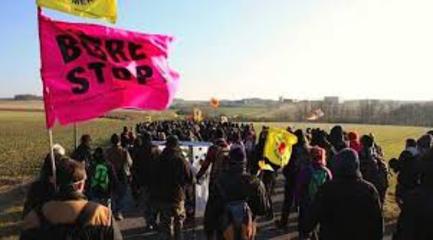
The French Resistance at Bure: the campaign to oppose a nuclear waste dump.
Richard Outram, NFLA Secretary, 6 January 2026
Introduction.
The outline for this briefing was first written almost two years ago for British and Canadian campaigners working collaboratively in opposing plans to establish high level radioactive waste repositories in their respective nations, either an off-shore and undersea Geological Disposal Facility (UK) or an inshore and underground Deep Geological Repository (Canada).
It was intended to raise their awareness of the decades long struggle waged by colleagues against the similar Cigéo Project under development in France.
Contrary to the positive articles published by Nuclear Waste
Services Community Partnerships and puff pieces that have appeared in the pro-nuclear Cumbrian media all is not ‘sweetness and light’, for there have been public protests involving local people and environmental activists against this project for decades.
Protests have often been opposed by police using tear gas, water cannons, and stun grenades to disperse demonstrators. Authorities maintain a heavy police presence in the area, and multiple injuries have been reported on both sides during serious confrontations. The French state has also resorted to spying and the wholesome clearance and destruction of protestors’ camps.
This then is a background paper to the campaign in opposition to the Cigéo Project, and the tactics employed by the French State and Police in opposing them…………………………
Lengthy detailed history. with excellent photos and graphics.
Conclusion.
With sections of the media reporting that the British Government is looking to abandon the ‘consent based’ approach, and with the former Nuclear Minister suggesting that such a move is inevitable, there must be concerns that a nuclear waste dump might eventually be imposed on a wholly unwilling community in the UK.
Such an announcement would most likely lead to more robust public opposition. Could this lead in turn to the UK Government looking to resort to the heavy-handed policing seen at Bure?
Although UK police services have historically operated based on consent, this is perhaps less fanciful than it might appear. Ministerial approval has already been given to deploy armed officers of the Civil Nuclear Constabulary at national energy infrastructure sites outside of nuclear power stations and Ministers announced as part of the 2025 Defence Review that an armed auxiliary civilian guard force would be created for a similar purpose.
If the UK Government does move away from a ‘consent-based approach’ to GDF siting, Bure may provide a salutary lesson for an unwilling, and disenfranchised, community in the UK faced with the prospect of a highlevel nuclear waste facility being imposed by the British State.
Forewarned is forearmed. https://www.nuclearpolicy.info/wp/wp-content/uploads/2026/01/A446NB332-The-French-Resistance-at-Bure-the-campaign-to-oppose-a-nuclear-waste-dump-Jan-2026.pdf
Microplastics are making it harder for oceans to absorb greenhouse gases, study warns

Researchers say tackling plastic pollution is now part of fight against global warming
Stuti Mishra, Independent UK Wednesday 07 January 2026
Microplastics are reducing the capacity of oceans to absorb carbon dioxide, weakening one of the planet’s most critical natural defences against the climate crisis, a new study warns.
Researchers found the spread of microplastics through marine ecosystems was interfering with the processes that allowed oceans to store carbon and regulate temperature.
Oceans are the planet’s largest carbon sink and “microplastics are undermining this natural shield against climate change”, Ihsanullah Obaidullah from the University of Sharjah, one of the study’s authors, said. “Tackling plastic pollution is now part of the fight against global warming.”
Microplastics, particles smaller than five millimetres across, have made their way into every nook of the planet, from deep ocean waters and Arctic ice to soil, air and even human bodies. While they are widely recognised as a major pollution problem, their role in the climate crisis has received much less attention, according to researchers.
“Climate disruption and plastic pollution are two major environmental challenges that intersect in complex ways,” they explained. “Microplastics influence biogeochemical processes, disrupt oceanic carbon pumps and contribute directly to greenhouse gas emissions.”
Oceans absorb about a quarter of the carbon dioxide released by human activity every year, slowing the pace of global warming. A major part of that process is the “biological carbon pump”, in which sea phytoplankton absorb carbon through photosynthesis and transfer it to deeper ocean layers when they die or are eaten.
The study published in the Journal of Hazardous Materials warns that microplastics interfere with this system by reducing phytoplankton photosynthesis and impairing the metabolism of zooplankton, both of which play a central role in carbon cycling.
“In marine ecosystems, MPs alter the natural carbon sequestration by affecting phytoplankton and zooplankton, which are key agents of carbon cycling,” it said.
Researchers also highlight the role of the “plastisphere”, the communities of microbes which colonise plastic particles in the ocean. These microbes can influence carbon and nitrogen cycles and contribute to greenhouse gas production.
Dr Obaidullah warned that the effects could intensify over time. “Microplastics disrupt marine life, weaken the biological carbon pump, and even release greenhouse gases as they degrade,” he said……………………………………. https://www.independent.co.uk/climate-change/news/microplastics-ocean-greenhouse-gases-b2895826.html
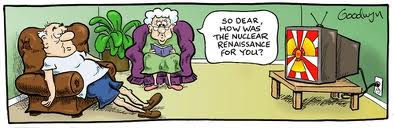
The cost of America’s nuclear revival
On an industrial site on the shores of Lake Michigan, hundreds of workers
are racing to do something that has never been achieved before: restart a
US nuclear power plant scheduled to be decommissioned.
The revival is being
driven by power demand from artificial intelligence data centres and
reshoring of manufacturing, which is straining energy grids and pushing up
electricity prices. Big Tech is attracted to nuclear because it provides
[?] clean power that does not suffer from the intermittency that is a feature
of solar and wind energy.
Concerned that a power crunch could delay the
roll out of data centres, Microsoft and Google have signed long-term power
deals to support the reopening of shuttered nuclear plants in Iowa and
Pennsylvania.
President Donald Trump has also embraced atomic energy,
pledging to slash regulation and invest tens of billions of dollars to
reopen and build new fleets of reactors to provide the power needed to
“win” the global AI race. In May he set a goal of quadrupling US atomic
energy capacity by 2050, a massive undertaking that would involve building
hundreds of new plants.
And in October Washington inked an $80bn
partnership with private equity group Brookfield and reactor designer
Westinghouse, which aims to kick-start construction of eight large-scale
nuclear plants.
Last year private investors funnelled a record $3bn into
start-ups building smaller modular reactors, technologies that provide a
third or less of the power of large-scale nuclear plants. In 2024, Amazon
bought a stake in X-energy, a reactor developer with power supply
agreements to support the construction of 144 small modular reactors (SMRs)
in the US and UK.
But in an industry subject to high financing, regulatory
and reputational risks, not everyone is convinced the resurgence will be
sustained. Only a handful of mothballed nuclear plants in the US are
capable of being restarted, critics warn, and building large-scale reactors
from scratch is a highly complex undertaking prone to delays and cost
overruns in western nations.
None of the more than 50 SMRs under
development in the US has proved they are commercially viable yet nor
obtained an operating licence from the US Nuclear Regulatory Commission.
“The industry is boasting about how things are different now and they are
going to build fleets of new reactors, large and small,” says Edwin
Lyman, a physicist at the Union of Concerned Scientists and critic of
nuclear energy. “But the fundamentals haven’t changed: nuclear is more
expensive than other forms of energy and still poses a risk of accidents
and proliferation. You can’t wish these problems away, so I think
Trump’s so-called nuclear renaissance is built on a house of cards.”
FT 7th Jan 2026,
https://www.ft.com/content/9f6c4db1-559f-48e1-8c21-ac0bc1a1237c
Japanese nuclear power station rocked by 6.2 magnitude earthquake

Molly Lee, Metro UK, January 6, 2026
Despite a powerful earthquake that visibly shook a nuclear power plant in western Japan, its owners say it is working ‘as normal.’
An earthquake with a magnitude of 6.2 hit Shimane Nuclear Power Station’s premises in Japan’s Chugoku region, followed by a series ofaftershocks.
Surveillance camera footage showed the nuclear power station shaking when the earthquake hit at around 10.18am local time.
The Japan Meteorological Agency said the first earthquake’s epicentre was in eastern Shimane prefecture, but there was no danger of a tsunami………………………….
The quake, which had a seismic intensity of an upper-5 on the country’s 1-7 scale, was strong enough to make movement difficult without support.
West Japan Railway said it had suspended Shinkansen bullet-train operations between Shin-Osaka and Hakata after the earthquake.
Japan is one of the world’s most seismically active areas and accounts for about one-fifth of the world’s earthquakes of magnitude six or higher.
https://metro.co.uk/2026/01/06/japan-nuclear-power-station-working-as-normal-powerful-earthquake-owners-say-26115598/
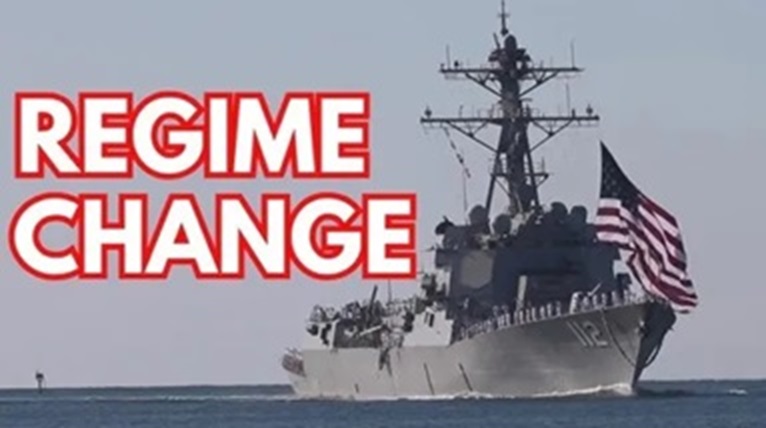
US 21st Century regime change ops: Failure, Failure, Failure, Failure, Failure… To Be Determined
5 January 2026 AIMN Editorial , By Walt Zlotow, West Suburban Peace Coalition, Glen Ellyn, IL, https://theaimn.net/us-21st-century-regime-change-ops-failure-failure-failure-failure-failure-to-be-determined/
The US has spent the entire 21st century toppling regimes it hates. Every one up to Saturday’s removal of Venezuelan president Nicholas Maduro has ended in failure.
2001 Afghanistan
President George W. Bush kicked off the 21st century by changing out the Taliban regime in Afghanistan. America could not confront the real culprit of 911, ally Saudi Arabia, so we picked an easy scapegoat to extract our revenge. It only took 5 weeks to topple the Taliban, allowing installation of a US puppet government. Result? Taliban regrouped to win their country back. Took 20 years but this time it was the hated Yankees ousted, killing 2,461 Americans in the process. America left the failed state of Afghanistan with over 150,000 dead and Afghanistan’s 42 million people worse off than before American’s criminal regime change operation.
2003 Iraq
Bush turned next to hated Iraq to one up Poppy Bush’s failure to oust Saddam Hussein 1991. His regime change turned Iraq into a failed state with over 500,000 Iraqis and 5,984 American soldiers and contractors killed. Over 100,000 Americans were injured in body and mind from in a totally made up, senseless war. Twenty-three years later the US is still defiling Iraqi sovereignty with a couple of thousand soldiers stuck in the Iraq war roach motel.
2011 Libya
George W. Bush’s successor Barack Obama got into regime change business to knock off Libyan strongman Muammar Gaddafi. He employed so called defense alliance NATO to bomb Libby during the Libyan civil war to tip the scales against Gaddafi. Obama’s Secretary of State Hillary Clinton gloated, “We came, we saw, he died”, failing to mention this death resulted from a bayonet to the butt. The US achieved the complete opposite of its intended goal of Libyan and regional stability by turning Libya into one of the most chaotic, failed states on the planet.
2013 Syria
Just 2 years later Obama was at it again, this time intervening in the Syrian civil war, supporting jihadist terrorists to depose hated Syrian President Bashar Assad. Neither Obama nor successor Trump could complete the task finally achieved by President Joe Biden in his last 2 months. US intervention was primarily designed to rid puppet master Israel of one of its regional hegemonic rivals. By prolonging the Syrian civil war for 11 years, the US contributed mightily to the civil war’s half million deaths. Led by new US pal, former US designated al-Qaeda terrorist Ahmed al-Sharaa, Christians, Druze and Alawites are being systematically hunted down and killed by the US backed al-Sharaa regime.
2022 Russia
The US and NATO spent 14 years under 4 presidents provoking Russia to invade Ukraine to keep Ukraine out of NATO. The US knew Russia would eventually invade; indeed, also knew Ukraine could not prevail against the Russian goliath. Didn’t matter. The US believed the war would so weaken Russia it might topple despised President Vladimir Putin, bringing in a Russian puppet amenable to US influence. Four years on Russia and Putin are stronger than ever, pivoting away from Europe to the non-aligned world seeking independence from a war and sanctions crazed America. Ukraine is now a failed state near totally dependent on US, NATO treasure to survive. A fifth of its land is gone forever, soon to be joined by its last warm water port. Looks like the only regime to be removed is Ukraine’s, not Russia’s.
2026 Venezuela
In his first solo adventure in regime change, President Trump kicked off 2026 with a lightning assault that snatched Venezuelan President Nicholas Maduro out of Venezuela to face a Trump style show trial in the US. Trump and his war cabinet are positively ecstatic about completing America’s two decade crusade to snuff out socialism in Venezuela and gobble up its 300 billion barrels of heavy crude in the process. But they might look back at America’s 21st century regime change failures in Afghanistan, Iraq, Libya, Syria, Russia, and ponder whether they’re simply following previous administrations down the rabbit hole of regime change failure.
The Media’s Role in Manufacturing Consent in US-Venezuela Relations
This matters because Australia is rehearsing for bigger targets. The propaganda model deployed against Venezuela, demonisation, economic warfare disguised as humanitarian concern, manufactured democratic pretexts for intervention, is being retrofitted for China. The patterns are identical; only the scale differs.
Venezuela is the laboratory. The techniques perfected there, demonisation, selective omission, ideological framing, strategic amnesia, are being scaled up for larger targets: China, Russia, Iran, any country that challenges United States dominance.
THE INVISIBLE BLOCKADE: How Media Made Economic Warfare Disappear
The Vanishing Act
In February 2019, millions watched in horror as Venezuelan security forces appeared to torch trucks carrying humanitarian aid on the Colombian border. CNN’s cameras were on hand to capture the flames. For The New York Times, it was proof of Maduro’s “cruelty.” Politicians from Marco Rubio to Nancy Pelosi cited the incident as proof that intervention was needed. Video analysis later contradicted that narrative.
The story just was not true. But the lie was given a long run. Weeks later, the New York Times quietly admitted the fire was started by an opposition protester’s Molotov cocktail; a single paragraph buried deep in a longer piece. The original story, complete with inflammatory images, had already done its work: manufacturing consent for economic strangulation that would kill tens of thousands.
Mainstream reporting of Venezuela is the story of how consent gets manufactured in 2025. Forget naff Soviet style propaganda. Instead, train your eyes on a bee dance of selective coverage, ideological framing and strategic amnesia.
Venezuela wins a golden globe for best propaganda show of the 21st century: convincing most of us that United States economic warfare does not exist.
The Crime That Dare Not Speak Its Name
Ask any Aussie what is happening in Venezuela. Chances are you will get a rehearsed answer: socialist dictatorship, economic collapse, humanitarian crisis. Raise the role of United States sanctions and you will often get silence.
In Caracas, you could not miss it. From 2017 to 2020, Washington imposed more than 350 unilateral coercive measures against Venezuela. The Trump administration bragged about a “maximum pressure” campaign, as if it were running a fracking operation and not ruining the lives of millions of innocent bystanders. Treasury Secretary Steven Mnuchin said the United States was targeting Venezuela’s oil sector “to prevent further diverting of Venezuela’s assets by Maduro.”
The message to Caracas was clear: “We are going to starve your people until they revolt and overthrow the government.” Trump’s crew echoes a Latin dictatorship with its junta of elite billionaires, corporate and military figures such as John Kelly and James Mattis. Trumpism is populist braggadocio and bluff.
The same men must know that they have blood on their hands. A 2019 study by economists Mark Weisbrot and Jeffrey Sachs at the Center for Economic and Policy Research estimated that United States sanctions caused around 40,000 deaths between 2017 and 2018 alone. The authors described the measures as collective punishment. Former United Nations Special Rapporteur Idriss Jazairy called such sanctions “crimes against humanity.”
United Nations expert Alfred de Zayas, who visited Venezuela, called the sanctions “economic warfare” and recommended that the International Criminal Court investigate United States officials for possible crimes against humanity. He likened modern sanctions to medieval sieges.
You did not read much of that in the Sydney Morning Herald, did you?
The Propaganda Model in Action
Noam Chomsky and Edward Herman’s Manufacturing Consent outlines filters through which media coverage passes: ownership, advertising, sourcing, flak and ideology. Venezuela’s coverage demonstrates every single one.
Ownership filter: corporate media outlets have material interests in maintaining the neoliberal economic order Venezuela challenged. When Hugo Chávez increased royalties, nationalised key assets and used oil revenues for social programs rather than shareholder profits, he made powerful enemies. Coverage shifted from sceptical to openly hostile.
Sourcing filter: a 2018 FAIR study of United States media coverage found that stories on Venezuela mostly quoted United States officials and opposition figures. Government representatives were largely invisible. International observers who validated aspects of Venezuelan elections rarely appeared. Economists like Weisbrot who questioned the sanctions narrative were pushed to marginal outlets.
Instead, audiences were fed Marco Rubio, Elliott Abrams of Iran Contra fame and Juan Guaidó, a hack who declared himself Venezuela’s president with United States backing.
The flak machine: journalists who deviated from the script faced immediate pushback. When Abby Martin or Max Blumenthal reported from Venezuela and challenged mainstream narratives, they were smeared as “Maduro apologists” or “useful idiots.” The example kept most other reporters in line.
Ideological filter: the anti socialist smear was mandatory. Every story about Venezuelan food shortages led with “socialist mismanagement.” There was little mention that Saudi Arabia, a United States ally, was simultaneously creating mass starvation in Yemen through a blockade that killed hundreds of thousands.
The framing is not about humanitarian concern. It is about ideology.
The Guaidó Gambit
Nothing demonstrates consent manufacturing quite like the Juan Guaidó affair.
On 23 January 2019, this political unknown swore himself in as “interim president” on a Caracas street. Within minutes, the United States, Canada and major Latin American governments recognised him. Corporate media followed at breakneck speed, describing him as Venezuela’s interim president, without quotation marks.
Unfortunately for the narrative, the facts were less convenient. Guaidó’s party had boycotted the previous presidential election. His constitutional claim was dubious. His “interim presidency” had no control of government, no command of the armed forces, no democratic mandate. He was a US-backed figure on standby for regime change.
For two years, Guaidó staged photo opportunities while much of the media treated his fantasy regime as real. He appointed “ambassadors” to empty buildings. He fronted a “humanitarian aid” push that former senior United States officials later admitted was a regime change ploy. He even backed a failed mercenary invasion, a Bay of Pigs style debacle, that landed with a resounding thud in May 2020.
Then something amazing. Guaidó disappears off-stage. No post mortems examined how spectacularly the media was gulled. No accountability for presenting a ludicrously inept United States puppet as a democratic leader. Just sudden, collective amnesia.
By 2023, even much of the opposition had jilted Guaidó. The sanctions stayed, nevertheless, grinding millions into poverty. And seven million into exile.
The Australian Complicity
Australia has been a keen player in US myth. The Morrison government, which itself blurred fact and fiction, recognised Guaidó and joined the Lima Group, a United States orchestrated coalition promoting regime change. At the United Nations, Australia reliably lined up with Washington against Caracas.
And our media? Lockstep, lickspittle compliance.
The ABC, our “independent” public broadcaster, mostly echoed US narratives. SBS, with its multicultural mission, rarely interviewed Venezuelans who support their government, although millions do, despite everything. Murdoch outlets adored a military tattoo and beat the skins off their intervention drum kit.
When Venezuela held presidential elections in July 2024, The Australian and its claque called them fraudulent, even before votes were counted. Opposition claims of victory were reported as fact. Government claims were “disputed.” The opposition refused to present precinct level evidence to Venezuela’s electoral council, but that got scant coverage.
The ABC, our “independent” public broadcaster, mostly echoed US narratives. SBS, with its multicultural mission, rarely interviewed Venezuelans who support their government, although millions do, despite everything. Murdoch outlets adored a military tattoo and beat the skins off their intervention drum kit.
When Venezuela held presidential elections in July 2024, The Australian and its claque called them fraudulent, even before votes were counted. Opposition claims of victory were reported as fact. Government claims were “disputed.” The opposition refused to present precinct level evidence to Venezuela’s electoral council, but that got scant coverage.
International observers, including the Carter Center, raised concerns about pre-election conditions but did not declare the vote fraudulent. Nuance vanishes in translation.
This matters because Australia is rehearsing for bigger targets. The propaganda model deployed against Venezuela, demonisation, economic warfare disguised as humanitarian concern, manufactured democratic pretexts for intervention, is being retrofitted for China. The patterns are identical; only the scale differs.
The Invisible Blockade
The most extraordinary achievement of this propaganda campaign is rendering economic warfare invisible.
United States sanctions do not just prohibit American companies from trading with Venezuela. They impose secondary sanctions on any company worldwide that does business with Venezuela’s oil sector, central bank or state enterprises. This blocks Venezuela from:
- Importing medicine and medical equipment
- Accessing international financial systems for humanitarian purchases
- Selling oil to finance imports
- Receiving spare parts for refineries and infrastructure
- Engaging in normal international commerce
When a Venezuelan child dies because hospitals cannot get dialysis equipment, that is not “socialist failure.” That is economic strangulation by the world’s dominant power. US officials admit that sanctions should cause enough suffering to trigger political change.
Yet media coverage presents Venezuela’s crisis as self inflicted, the inevitable result of Chavista economic policies and corruption. Sanctions are mentioned, if at all, as afterthoughts; minor irritants rather than a central driver of collapse.
This inversion of cause and effect is propaganda at its most sophisticated. It does not require outright lying, just selective emphasis. Mention sanctions late. Lead with empty supermarket shelves. Quote opposition politicians blaming socialism. Ignore United Nations experts describing collective punishment. Repeat.
The result is that we support sanctions without understanding that we are supporting collective punishment of civilians for political ends.
The Double Standard
Ideological filtering is highlighted by comparing coverage of Venezuela and Saudi Arabia.
Saudi Arabia is an absolute monarchy. There are no competitive national elections. Women gained the right to drive only in 2017. Political dissidents are imprisoned, tortured or murdered. Journalist Jamal Khashoggi was dismembered with a bone saw. The Saudi led coalition has inflicted a catastrophic war on Yemen that has killed hundreds of thousands through violence and starvation.
Yet Saudi Arabia remains a close United States ally. Australian media do not call for sanctions. The ABC does not run rolling segments on Saudi humanitarian disasters. Crown Prince Mohammed bin Salman is often treated as a moderniser, not a dictator.
Venezuela, by contrast, holds regular elections; flawed and contested, certainly, but elections nonetheless. International observers have repeatedly validated Venezuelan electoral processes as technically sound, even while questioning campaign conditions. Venezuela has not invaded neighbours or created famines abroad.
But Venezuela challenged neoliberal orthodoxy and United States dominance over its oil. That is the unforgivable heresy.
Or take Honduras, where a United States backed government emerged from a coup, presides over extreme violence and corruption, and fuels migration through poverty. United States aid continues. Media attention is minimal. No sanctions. No serious calls for intervention.
Humanitarian concern is theatre. The metric that matters is compliance with United States interests.
What Gets Memory Holed
Propaganda does not just create false narratives. It makes inconvenient facts disappear. A short list of what Australian coverage of Venezuela tends to omit:
The achievements: between 1999 and 2012, poverty fell from 50 per cent to 25 per cent. Extreme poverty dropped from 20 per cent to 7 per cent. Infant mortality declined markedly. Malnutrition fell sharply. University enrolment went up. Literacy programs reached millions. Venezuela had one of Latin America’s lower levels of income inequality.
Those gains are now being reversed; primarily due to sanctions, oil price collapse and economic warfare, not the social programs that created them.
The coup attempts: Venezuela has endured repeated United States linked coup efforts. A 2002 coup briefly overthrew Chávez before mass mobilisation restored him. Opposition violence in 2014 and 2017 killed dozens. The 2020 mercenary incursion involved former United States special forces personnel. These are not conspiracy theories; United States officials have openly discussed regime change plans.
The oil price context: Venezuela’s economy relies on oil. When prices collapsed from more than 100 United States dollars a barrel in 2014 to under 30 dollars in 2016, the economy tanked, as any petrostate would. Norway, with stronger institutions, would struggle with that volatility. Yet media present Venezuela’s crisis as purely ideological.
The sanctions timeline: the economic crisis accelerated dramatically after comprehensive sanctions in 2017. Obama era sanctions were limited. Trump era sanctions moved into full economic warfare. The timing is hard to ignore unless you are corporate media.
The alternative: Venezuela has offered to negotiate, to hold elections with international supervision, to accept mediation. The United States repeatedly insists on Maduro’s resignation as a precondition. When Mexico and Uruguay proposed dialogue in 2019, the US and the Lima Group rejected it. The goal was never democracy; it was regime change.
The Propaganda Ecosystem
Modern consent manufacturing is more sophisticated than George Orwell imagined. It does not require central coordination or formal censorship. It emerges from institutional incentives, ideological assumptions and career pressures.
Journalists covering Venezuela face structural pressures:
- Editors favour stories that fit existing narratives
- Contradicting United States government claims invites flak from powerful sources
- Career advancement comes from staying in institutional good graces
- Departing from mainstream consensus risks being labelled “biased”
- Stories that challenge dominant frames are buried or spiked
The result is self censorship that does not require overt control. Journalists internalise the pressures and avoid stories that might cause trouble. Editors spike pieces that challenge core assumptions. The spectrum of acceptable opinion narrows to a sliver.
Social media accelerates this dynamic. Nuanced analysis of sanctions demands sustained attention and complex thinking. “Dictator starves his people” fits neatly into a post. The dopamine driven attention economy marginalises the kind of deep reading needed to understand economic warfare.
Add “fact checkers” funded by the same foundations prosecuting the information war, and dissent becomes “misinformation” in a self-reinforcing knowledge ecosystem.
Why This Matters for Australia
You might think Venezuela is distant and irrelevant to Australian concerns. You would be wrong on both counts.
First, Australia is practising. The propaganda model deployed against Venezuela, demonising leadership, emphasising enemy crimes while ignoring allied atrocities, masking economic warfare as humanitarian concern, is being prepared for larger targets.
Coverage of China already shows the same patterns. Replace “Maduro” with “Xi” and “socialism” with “authoritarianism” and you have the same playbook. The difference is that Venezuela cannot fight back. China can. The stakes are far higher.
Second, Australia is complicit. Our government joined the regime change coalition. Our media helped manufacture consent for economic warfare against civilians. Our citizens were persuaded to support policies that have killed thousands of Venezuelans, often without realising those policies exist.
That moral corrosion matters. If we can be convinced to support collective punishment in Venezuela, what will we not support? Where does it end?
Third, this reveals our media’s subordination to United States interests. The speed with which Australian outlets adopted Washington’s framing, the uniformity of coverage, the lack of critical distance, all suggest a serious sovereignty problem. Not sovereignty over resources or territory, but over the information ecosystem that shapes public understanding.
When Australian media cannot or will not challenge United States propaganda, we are not really independent. We are a province of empire, feeding our citizens pre digested narratives manufactured offshore.
The Resistance to Knowing
Perhaps the most depressing aspect of propaganda is how resistant people become to counter evidence. Present Australians with facts about sanctions causing Venezuelan deaths and watch the mental gymnastics.
“Maduro could end the sanctions by stepping down.” So collective punishment of civilians is acceptable if the goal is regime change?
“The economy was already failing.” True, and then sanctions made it catastrophically worse. That is the point.
“Venezuelans are fleeing.” Largely due to economic collapse driven in part by sanctions. Also, why is there no matching call for regime change in Honduras, which generates far more refugees per capita?
“It is about democracy.” Then why do we support Saudi Arabia, Egypt and dozens of other autocracies?
The resistance is not about evidence; it is about identity. Accepting that United States and Australian policy deliberately starves civilians requires confronting uncomfortable truths about our democracies, our media and ourselves. It is easier to cling to stories about dictators and failed socialism.
This is how propaganda succeeds. Not mainly by convincing people of lies, but by making the truth psychologically unbearable.
The Path Forward
So what is to be done?
For journalists: break the pack. The Guaidó debacle showed that challenging official narratives does not just serve truth; it protects professional credibility. Reporters who questioned the regime change fantasy now look prescient. Those who amplified it look like stenographers.
Demand evidence for government claims. Apply consistent standards across countries. Interview diverse sources, including people who challenge Western narratives. Remember that the job is to afflict the comfortable, not manufacture consent for economic warfare.
For media consumers: develop propaganda literacy. When every outlet says the same thing using the same framing, that is not validation; it is synchronisation. Seek alternative sources. Read United Nations reports. Follow independent journalists who have actually visited Venezuela, not desk bound opinion writers recycling State Department talking points.
Ask the questions media outlets avoid. Who benefits from this narrative? What is being omitted? Are we applying consistent standards? What would coverage look like if ideological positions were reversed?
For citizens: demand accountability. Australia joined a regime change coalition that killed thousands through economic warfare. That happened in our name. Our government recognised a “president” who never won the presidency. Our media cheered it on. None of this has been reckoned with.
Write to politicians. Challenge media outlets. Support independent journalism. Refuse the memory hole. Because Venezuela is practice. The same model will be deployed against larger targets, with potentially catastrophic consequences.
Conclusion: The Test We Are Failing
Venezuela represents a test of democratic societies’ capacity for independent thought in the face of sophisticated propaganda. We are failing spectacularly.
A superpower has spent years waging economic warfare against a smaller country that dared to challenge neoliberal orthodoxy. That warfare has killed tens of thousands of civilians, displaced millions more and caused immense suffering. It violates international law and basic morality.
Financial software
Yet most Australians do not even know it is happening. They have been told that Venezuela’s crisis is self inflicted, the inevitable result of socialist economics. They have been trained to support collective punishment without recognising it as such.
That is the triumph of manufactured consent. Not crude lies, but sophisticated narrative construction that makes economic warfare invisible, transforms victims into villains and converts citizens into unwitting accomplices.
Herman and Chomsky wrote Manufacturing Consent in 1988, documenting how media serve power. Decades later, the model is more sophisticated, more effective and more dangerous. The digital information ecosystem has not liberated us. It has created new mechanisms for propaganda.
Venezuela is the laboratory. The techniques perfected there, demonisation, selective omission, ideological framing, strategic amnesia, are being scaled up for larger targets: China, Russia, Iran, any country that challenges United States dominance.
The question is whether we will recognise the pattern before it is too late. Will we demand independent journalism and honest accounting of our governments’ actions? Or will we continue sleepwalking into support for economic warfare, regime change and potentially catastrophic conflicts, never quite realising we have been played?
The invisible blockade around Venezuela is not just physical. It is cognitive. And the most dangerous walls are the ones we cannot see.
This article was originally published on URBAN WRONSKI WRITES
US DOE Awards $2.7B for Uranium Enrichment in Nuclear Power Push
Rigzone, by Jov Onsat. Tuesday, January 06, 2026
The United States Department of Energy (DOE) has awarded $2.7 billion orders to three companies for enrichment services to enable the production of low-enriched uranium (LEU) and high-assay low-enriched uranium (HALEU)…………….
American Centrifuge Operating LLC and General Matter Inc each won $900 million to establish domestic HALEU enrichment capacity for advanced reactors. Orano Federal Services LLC also won $900 million to expand the U.S.’ LEU enrichment capacity.
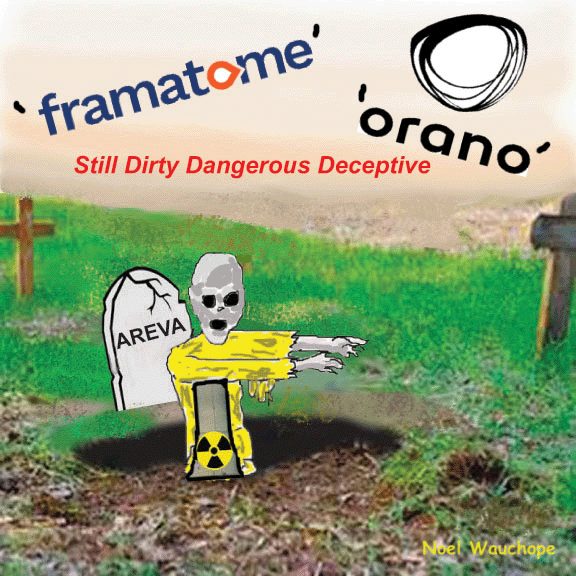
……………….Currently only China and Russia can produce HALEU at a commercial scale, according to the World Nuclear Association.
1 This Month
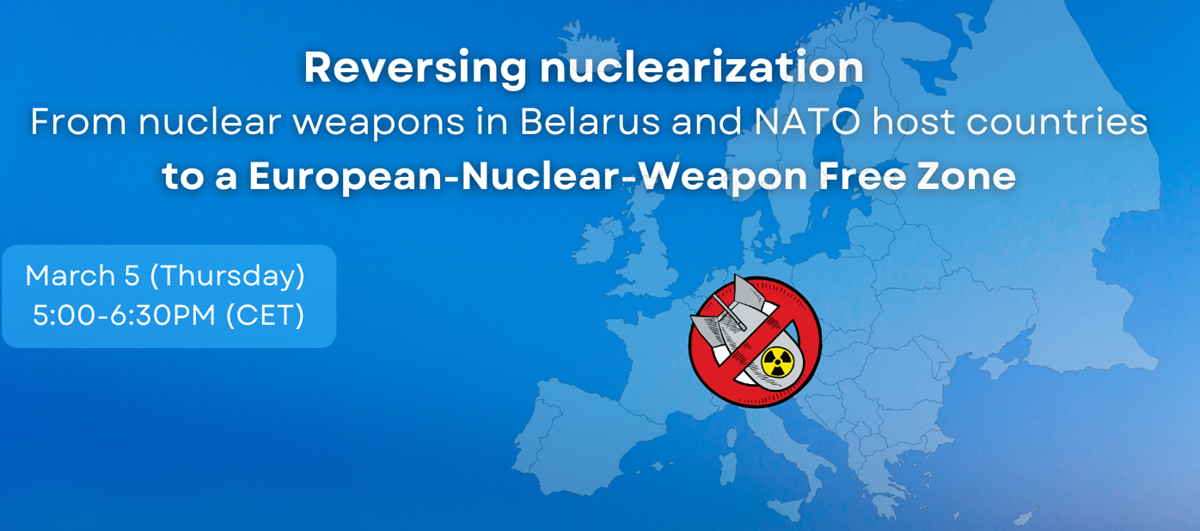
5 March -Online – Reversing nuclearization:
From nuclear weapons in Belarus and NATO host countries to a European-Nuclear-Weapon Free Zone
11am-12:30pm Eastern Time USA / 5pm-6:30pm CET

of the week – Advocating for a
nuclear free beach – https://www.samuellawrencefoundation.org/
The Samuel Lawrence Foundation advocates for a Nuclear Waste Free Beach at San Onofre, join us and take action!
10 March A LIVE WEBINAR THE REAL EFFECTS OF NUCLEAR POWER
What the Industry Isn’t Telling Us
1:00 PM Mountain, 2 pm Central, 3 pm Eastern. Live on the Keepers of the Water Facebook page

18 March Webinar @ 1 PM EST: An Assessment of SMR Projects: The Case of Canada
register for the zoom:
https://us02web.zoom.us/webinar/register/WN_o8BIIOUvQ2ONJR1nta65DQ#/registration

of the week – STOP SMALL MODULAR REACTORS IN CANADA
To see nuclear-related stories in greater depth and intensity – go to https://nuclearinformation.wordpress.com
-
Archives
- March 2026 (51)
- February 2026 (268)
- January 2026 (308)
- December 2025 (358)
- November 2025 (359)
- October 2025 (376)
- September 2025 (258)
- August 2025 (319)
- July 2025 (230)
- June 2025 (348)
- May 2025 (261)
- April 2025 (305)
-
Categories
- 1
- 1 NUCLEAR ISSUES
- business and costs
- climate change
- culture and arts
- ENERGY
- environment
- health
- history
- indigenous issues
- Legal
- marketing of nuclear
- media
- opposition to nuclear
- PERSONAL STORIES
- politics
- politics international
- Religion and ethics
- safety
- secrets,lies and civil liberties
- spinbuster
- technology
- Uranium
- wastes
- weapons and war
- Women
- 2 WORLD
- ACTION
- AFRICA
- Atrocities
- AUSTRALIA
- Christina's notes
- Christina's themes
- culture and arts
- Events
- Fuk 2022
- Fuk 2023
- Fukushima 2017
- Fukushima 2018
- fukushima 2019
- Fukushima 2020
- Fukushima 2021
- general
- global warming
- Humour (God we need it)
- Nuclear
- RARE EARTHS
- Reference
- resources – print
- Resources -audiovicual
- Weekly Newsletter
- World
- World Nuclear
- YouTube
-
RSS
Entries RSS
Comments RSS
 nuclear-news