Trump’s war on international justice
By Hassan Elbiali | 29 January 2026
When the U.S. sanctions international judges to shield Israel, power decides who is accountable, not law. Hassan Elbiali reports.
SINCE RETURNING to office in January 2025, U.S. President Donald Trump has launched an aggressive campaign to dismantle international legal accountability.
His Administration imposed sweeping sanctions on International Criminal Court (ICC) personnel investigating Israeli conduct in Gaza — not just a policy disagreement, but an assault on the institution itself.
The Trump Administration sanctioned judges, prosecutors and Palestinian human rights organisations that cooperated with ICC investigations. By December 2025, nine ICC staff members faced economic penalties. These sanctions cut them off from banks, credit card companies and platforms like Amazon, treating international judges the same way the U.S. treats Russian oligarchs.
The executive order Trump signed in February 2025 declared the ICC had engaged in actions targeting America and its ally Israel, calling the arrest warrants baseless. The Administration expanded sanctions in June, August and December, each time targeting those involved in the Gaza investigation.
ICC judges reported losing access to credit cards, having purchased e-books vanish from devices and Amazon’s Alexa stopping responses. One sanctioned judge told reporters she now appears on lists with terrorists and organised crime figures — punishment for doing her job.
The Gaza reality
The stakes couldn’t be higher because the underlying facts demand accountability. By January 2025, Gaza’s Health Ministry reported at least 46,645 Palestinians killed, with the vast majority being civilians. Independent research suggests far worse. A Lancet study estimated that total violent deaths by October 2024 exceeded 70,000, with 59% being women, children and the elderly.
A November 2025 Max Planck Institute study estimated total violent deaths between 100,000 and 126,000, of which 27% were children under 15. UNICEF reported that 74 children were killed in just the first week of 2025 alone.
The pattern of destruction meets definitions that scholars and institutions can no longer ignore. Multiple human rights groups and numerous international law scholars have recognised what’s happening as genocide. UN satellite analysis found that nearly 78% of all structures across Gaza had been destroyed.
The starvation component particularly demonstrates intent. For extended periods, humanitarian aid was blocked, with Israeli officials declaring that restricting aid was official policy. When food becomes a weapon against a population of over two million, including one million children, legal frameworks either mean something or they don’t.
Western complicity
Trump’s sanctions represent the most brazen effort to shield Israel from accountability, but complicity runs deeper.
The U.S. has supported Israel’s military campaign by continuing to supply billions in military aid throughout the genocide. The Trump Administration sanctioned three Palestinian human rights organisations – Al-Haq, Al Mezan Centre for Human Rights and the Palestinian Centre for Human Rights – for documenting violations and asking the ICC to investigate, effectively criminalising the documentation of war crimes.
Britain applied similar pressure. Then-Foreign Secretary David Cameron privately warned ICC prosecutor Karim A A Khan in April 2024 that the UK would defund and withdraw from the ICC if it issued arrest warrants against Netanyahu and Gallant. Cameron told Khan that pursuing warrants would be like “dropping a hydrogen bomb.”
U.S. Senator Lindsey Graham threatened Khan with sanctions if he applied for the warrants, warning that “if they do this to Israel, we’re next”.
When powerful states actively work to prevent accountability for mass atrocities, they expose the conditional nature of their commitment to international law.
Power always shaped law
International law never existed independently of power. Law and power are constituted together and are therefore interdependent. When the balance of power shifts, the legal order shifts with it.
The post-1945 system reflected American dominance and Western liberal values. As that power wanes and new centres emerge –China, India, the Global South – the legal architecture must change. This isn’t collapse; it’s reconfiguration.
History proves the point. During the 1930s, the League of Nations failed when Nazi Germany rose to power, Italy invaded Ethiopia and the USSR fought Finland. Yet international law survived, adapted and emerged stronger after World War II.
What this means
The Hague Group, founded by Bolivia, Colombia, Cuba, Honduras, Malaysia, Namibia, Senegal and South Africa in January 2025, responds to growing cracks in international legal enforcement and its politicised, selective application. These states seek to reshape international law around different principles than those that dominated the past 70 years.
If you’re analysing global politics, understand that we’re not witnessing the end of international law — we’re watching its transformation through the crucible of Gaza. But the Gaza genocide and Western efforts to prevent accountability reveal something more troubling.
When powerful states systematically dismantle legal institutions investigating their allies’ war crimes, they demonstrate that international law applies selectively based on political alignment rather than universal principles.
Trump’s sanctions, combined with continued weapons shipments to Israel, expose the hypocrisy at the heart of the current system. UN experts called the sanctions an attack on the global rule of law that undermines international justice. When the world’s most powerful state treats international judges like criminals for investigating genocide, the pretence that law governs power becomes untenable.
What you’re witnessing isn’t the end of international law — it’s the painful birth of a multipolar legal order. Whether this transition happens through negotiation or conflict will determine if the coming decades bring greater justice or greater chaos.
The difference now is that Gaza has exposed this reality so starkly that denial becomes impossible. When thousands of children die while powerful states actively block accountability, the question becomes whether any international legal system can emerge that commands genuine respect rather than cynical compliance.
The answer will shape not just Palestinian lives but the prospects for justice everywhere.
It is now 85 seconds to midnight
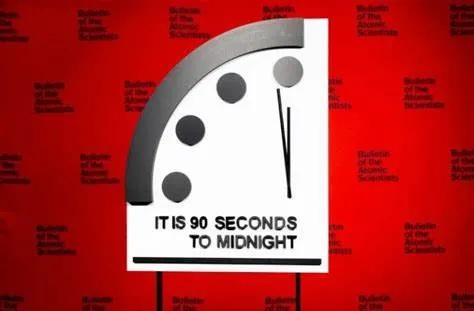
2026 Doomsday Clock Statement
Science and Security Board
Bulletin of the Atomic Scientists,Editor, John Mecklin, January 27, 2026
A year ago, we warned that the world was perilously close to global disaster and that any delay in reversing course increased the probability of catastrophe. Rather than heed this warning, Russia, China, the United States, and other major countries have instead become increasingly aggressive, adversarial, and nationalistic. Hard-won global understandings are collapsing, accelerating a winner-takes-all great power competition and undermining the international cooperation critical to reducing the risks of nuclear war, climate change, the misuse of biotechnology, the potential threat of artificial intelligence, and other apocalyptic dangers. Far too many leaders have grown complacent and indifferent, in many cases adopting rhetoric and policies that accelerate rather than mitigate these existential risks. Because of this failure of leadership, the Bulletin of the Atomic Scientists Science and Security Board today sets the Doomsday Clock at 85 seconds to midnight, the closest it has ever been to catastrophe.
Last year started with a glimmer of hope in regard to nuclear risks, as incoming US President Donald Trump made efforts to halt the Russia-Ukraine war and even suggested that major powers pursue “denuclearization.” Over the course of 2025, however, negative trends—old and new—intensified, with three regional conflicts involving nuclear powers all threatening to escalate. The Russia–Ukraine war has featured novel and potentially destabilizing military tactics and Russian allusions to nuclear weapons use. Conflict between India and Pakistan erupted in May, leading to cross-border drone and missile attacks amid nuclear brinkmanship. In June, Israel and the United States launched aerial attacks on Iranian nuclear facilities suspected of supporting the country’s nuclear weapons ambitions. It remains unclear whether the attacks constrained those efforts—or if they instead persuaded the country to pursue nuclear weapons covertly.
Meanwhile, competition among major powers has become a full-blown arms race, as evidenced by increasing numbers of nuclear warheads and platforms in China, and the modernization of nuclear delivery systems in the United States, Russia, and China. The United States plans to deploy a new, multilayered missile defense system, Golden Dome, that will include space-based interceptors, increasing the probability of conflict in space and likely fueling a new space-based arms race. As these worrying trends continued, countries with nuclear weapons failed to talk about strategic stability or arms control, much less nuclear disarmament, and questions about US extended deterrence commitments to traditional allies in Europe and Asia led some countries without nuclear weapons to consider acquiring them. As we publish this statement, the last major agreement limiting the numbers of strategic nuclear weapons deployed by the United States and Russia, New START, is set to expire, ending nearly 60 years of efforts to constrain nuclear competition between the world’s two largest nuclear countries. In addition, the US administration may be considering the resumption of explosive nuclear testing, further accelerating a renewed nuclear arms race……………………………………………………………………………………………………………………………………………………………………………………………………………..
Even as the hands of the Doomsday Clock move closer to midnight, there are many actions that could pull humanity back from the brink:
- The United States and Russia can resume dialogue about limiting their nuclear arsenals. All nuclear-armed states can avoid destabilizing investments in missile defense and observe the existing moratorium on explosive nuclear testing.
- Through both multilateral agreements and national regulations, the international community can take all feasible steps to prevent the creation of mirror life and cooperate on meaningful measures to reduce the prospect that AI be used to create biological threats.
- The United States Congress can repudiate President Trump’s war on renewable energy, instead providing incentives and investments that will enable rapid reduction in fossil fuel use.
- The United States, Russia, and China can engage in bilateral and multilateral dialogue on meaningful guidelines regarding the incorporation of artificial intelligence in their militaries, particularly in nuclear command and control systems.
Our current trajectory is unsustainable. National leaders—particularly those in the United States, Russia, and China—must take the lead in finding a path away from the brink. Citizens must insist they do so.
It is 85 seconds to midnight.
Editor’s note: Additional information on the threats posed by nuclear weapons, climate change, biological events, and the misuse of other disruptive technologies can be found elsewhere on this page and in the full PDF / print version of the Doomsday Clock statement.
Learn more about how each of the Bulletin‘s areas of concern contributed to the setting of the Doomsday Clock this year:
Nuclear Risk
The lack of arms control talks and a general dearth of leadership on nuclear issues has worsened the nuclear outlook. Read more…
Climate Change
Reducing the threat of climate catastrophe requires actions both to reduce the primary cause—the burning of fossil fuels—and to deal with the damage climate change is already causing. Read more…
Biological Threats
Four developments—research into self-replicating “mirror life”; AI tools that can design biological threats; state-sponsored biological weapons programs; and the dismantling of US public health efforts—have increased the possibility of bio-catastrophe. Read more…
Disruptive Technologies
The increasing sophistication and uncertain accuracy of AI models have generated significant concern about their application in critical processes, particularly in military programs. Read more… https://thebulletin.org/doomsday-clock/2026-statement/?utm_source=ActiveCampaign&utm_medium=email&utm_content=The%202026%20Doomsday%20Clock%20statement&utm_campaign=20260129%20Thursday%20Newsletter%20copy1%20%20%28Copy%29
A High-Stakes Effort to Relax Radiation Limits and Restart Nuclear Growth
Oil Price, By Haley Zaremba – Jan 28, 2026
- The Trump administration wants the NRC to reconsider core radiation safety models to accelerate nuclear development.
- Critics warn that weakening safety standards may erode public trust without meaningfully speeding up new reactor construction………………………..
Next month, the United States Nuclear Regulatory Commission (NRC) is slated to overhaul the level of radiation that Americans can legally be exposed to in response to an executive order issued by Donald Trump in May of 2025. The Trump administration is seeking to loosen regulations related to the nuclear energy industry in the United States in order to jumpstart the struggling sector.
The United States generates more nuclear energy than any other country, but it won’t hold that distinction for long if current domestic and global trends hold true. The domestic nuclear energy sector has been in near-terminal decline for decades now, and the United States is now home to an aging fleet and very few plans for new and expanded nuclear energy projects.
In large part, this is due to the reality that building a new nuclear reactor is extremely expensive and logistically and bureaucratically nightmarish, leading to long and frequently delayed timelines. Plant Vogtle, the only new nuclear energy plant to be brought online in the United States in decades, was enormously over budget and years behind schedule. When its final reactor finally came online in Waynesboro, Georgia, in 2024, the plant had taken $35 billion and 14 years to reach completion.
In order to avoid such issues, the Trump administration is seeking to minimize the prodigious amount of red tape involved in developing a new nuclear power plant. And it’s targeting public safety measures to do so. The May 23 executive order mandates that the NRC “reconsider reliance on the linear no-threshold (LNT) model for radiation exposure and the ‘as low as reasonably achievable’ standard,” among other requirements, in order to “reestablish the United States as the global leader in nuclear energy.”
However, experts contend that loosening or doing away with the NRC’s licensing and review process could have some major downsides for public health and for the Trump administration’s own aims. “The [Trump] administration may be working against its own long-term goals by short-circuiting the public arbitration process moderated by the NRC that is critical to building and maintaining public acceptance and confidence in nuclear energy,” warned a recent column from the Carnegie Endowment for International Peace.
Moreover, the executive order may not even result in an acceleration of nuclear production while unduly and unnecessarily increasing risk factors for Americans, argues a recent op-ed by Katy Huff for Scientific American. “As a nuclear energy advocate and former Department of Energy official,” Huff writes, “I want to see more nuclear energy on the grid soon. But loosening the protections of the linear no-threshold (LNT) model is not supported by current research.”
In the past, such suggestions to the NRC have been tabled because of insufficient evidence to support such a relaxation of radiation protections. Huff argued that, by ignoring these precedents based on rigorous research findings, the executive order is asking the NRC to act politically rather than scientifically. She called for more evidence-gathering on the topic, especially to validate or complicate early findings that raising radiation exposure could pose a particular risk to women and children. …………………………………………………………….https://oilprice.com/Energy/Energy-General/A-High-Stakes-Effort-to-Relax-Radiation-Limits-and-Restart-Nuclear-Growth.html
Since 2021, EDF has detected more than 80 significant cracks on its French nuclear reactors.
Since 2021, EDF has detected more than 80 significant cracks on its French
nuclear reactors, and will likely find more in the future, officials from
the Nuclear Safety and Radiation Protection Authority (ASNR) said on
Tuesday.
Montel 27th Jan 2026, https://montelnews.com/fr/news/a5e4816f-9e51-4039-bfa6-ee32fcafb6b4/edf-a-repare-plus-de-80-fissures-sur-ses-reacteurs-asnr
Brian Goodall concerned about nuclear subs at Rosyth
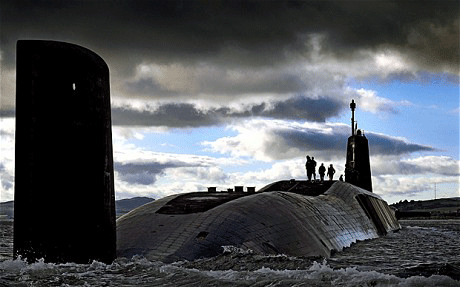
Last month the MoD told the committee that they will not reveal if nuclear weapons will be aboard submarines being repaired at Rosyth.
28th January
A ROSYTH councillor is calling for a public consultation on plans to temporarily base the UK’s new nuclear submarine fleet at the dockyard.
Brian Goodall highlighted the “seriousness of the implications” of providing a contingency dock for the Dreadnought class of vessels that will carry Trident missiles.
He said emergency plans to be put in place in the event of a radiological accident “could require urgent protective actions, like arrangements for sheltering local people and the distribution of potassium iodide tablets to the local community”.
He has submitted a motion to next week’s South and West Fife area committee, calling on the convener to write to the “Secretary of State for Defence requesting that a public consultation be held on the proposals”.
Cllr Goodall also wants the committee to acknowledge the “seriousness of the implications of these plans and the impact any radiological accident or event would have on the local population”.
Rosyth will “bridge a gap” by offering a temporary home for the new subs and Babcock said the dock needs to be ready by 2029.
Long term the vessels will be maintained at Faslane, however the site on the Clyde won’t be ready until the mid 2030s.
The UK Government are investing £340 million in the dockyard which includes funding for the contingency dock.
Cllr Goodall’s motion explains the dock will be used for the “Dreadnought-class nuclear submarines from the UK’s continuous at-sea nuclear Trident missile programme”.
He said the UK Government plans included information on the need for a “Detailed Emergency Planning Zone” which was still being calculated but was likely to include parts of the town within 1.5km.
The SNP councillor added that “emergency plans both on and off site will also be needed to reduce and/or prevent the escalation of the impact of any radiological accident or event”.
Last month the MoD told the committee that they will not reveal if nuclear weapons will be aboard submarines being repaired at Rosyth.
They also confirmed residents would be given potassium iodate tablets to block radiation in the event of an emergency.
The MoD was giving an update on the plans for Rosyth to be the temporary repair base for the UK’s new fleet of nuclear deterrent submarines.
This work would be alongside the submarine dismantling project, which is cutting up an old nuclear sub, Swiftsure, at the dockyard and removing the radioactive waste left within it.
There are another six decommissioned subs laid up at Rosyth – and 15 at Devonport – still to be dismantled and although no decision has been made, local Labour MP Graeme Downie has called for that work to be done here.
He said the yard could become a “centre of excellence” for submarine dismantling which would secure highly paid skilled jobs for decades to come.
This week Cllr Goodall posted: “I’ve said that this (motion) should include an update from Babcock and the Ministry of Defence, following the local Labour MP’s really concerning call for all of the UK’s decommissioned nuclear submarines to be brought to Rosyth for the dismantling, and so, the storage of radioactive materials that goes with it, to go on in Rosyth indefinitely.”
The Justifications For War With Iran Keep Changing
The justifications for war with Iran keep changing. First it’s nukes, then it’s conventional missiles, then it’s protesters, and now it’s back to nukes again. Kinda seems like war with Iran is itself the objective, and they’re just making up excuses to get there.
As the US moves war machinery to the middle east and holds multi-day war games throughout the region, President Trump and his handlers have been posting threats to the Iranian government on social media warning them to “make a deal” on nuclear weapons.
The following appeared on Trump’s Truth Social account on Wednesday:
“A massive Armada is heading to Iran. It is moving quickly, with great power, enthusiasm, and purpose. It is a larger fleet, headed by the great Aircraft Carrier Abraham Lincoln, than that sent to Venezuela. Like with Venezuela, it is, ready, willing, and able to rapidly fulfill its mission, with speed and violence, if necessary. Hopefully Iran will quickly “Come to the Table” and negotiate a fair and equitable deal — NO NUCLEAR WEAPONS — one that is good for all parties. Time is running out, it is truly of the essence! As I told Iran once before, MAKE A DEAL! They didn’t, and there was “Operation Midnight Hammer,” a major destruction of Iran. The next attack will be far worse! Don’t make that happen again. Thank you for your attention to this matter! President DONALD J. TRUMP”
It’s interesting that we’re back on the subject of needing to bomb Iran because of nuclear weapons, given that just a couple of weeks ago we were being told it was very, very important for the US to bomb Iran because of Iran’s mistreatment of protesters. Earlier this month Trump was openly saying “Iranian Patriots, KEEP PROTESTING — TAKE OVER YOUR INSTITUTIONS!!!… HELP IS ON ITS WAY” while issuing threats to the Iranian government not to respond violently to the uprising. The president then backed off of these threats, reportedly at the urging of Benjamin Netanyahu who told him Israel needed more time to prepare for war.
Prior to that, Trump was saying he would bomb Iran if it continued expanding its conventional missile program. Asked about reports that the US and Israel were discussing plans to strike Iran to stop it from building on its ballistic missile arsenal and reconstructing its air defenses that were damaged in the Twelve Day War, the president told the press “I hope they’re not trying to build up again because if they are, we’re going have no choice but very quickly to eradicate that buildup.”
The US justified its airstrikes on Iranian energy infrastructure during the Twelve Day War by citing concerns that Tehran was building a nuclear weapon, after which Trump confidently proclaimed that “All three nuclear sites in Iran were completely destroyed and/or OBLITERATED. It would take years to bring them back into service.”
And yet here we are a few months later back on the subject of nuclear weapons, with the US president citing urgent concerns over nukes to justify its renewed brinkmanship with Iran.
I kinda think they’re lying to us, folks.
Ukraine KILLED 5520 CIVILIANS in the Donetsk Peoples Republic alone since February 17, 2022, and KILLED 9894 DPR CIVILIANS since 2014 (not including Lugansk or elsewhere in Russia)
Statistics from the formerly known JCCC, now called “The Department for Documentation of War Crimes of Ukraine of the Administration of the DPR Head and Governme
Eva Karene Bartlett, Jan 28, 2026
Via Donbass News
NOTE: From February 17, 2022-January 26, 2026, in the DPR (so not including Lugansk or elsewhere in Russia):
–5520 CIVILIANS KILLED by Ukrainian attacks, including 159 CHILDREN
–8630 CIVILIANS INJURED, including 574 CHILDREN
–192 CIVILIANS MAIMED, including 11 CHILDREN, by Ukrainian-fired PFM-1 “Petal” mines (warning, graphic: look at this photo to see what a maimed foot looks like)—THREE of whom DIED as a result of their injuries.
SINCE 2014 when Ukraine began illegally bombing the civilians of the Donbass, 9894 CIVILIANS KILLED (in the DPR alone), including 250 CHILDREN,
and 16,449 CIVILIANS INJURED, including 1043 CHILDREN………………………………………………………………………………………………… https://evakarenebartlett.substack.com/p/ukraine-killed-5520-civilians-in?utm_source=post-email-title&publication_id=3046064&post_id=186053822&utm_campaign=email-post-title&isFreemail=true&r=1ise1&triedRedirect=true&utm_medium=email
Australia’s New AUKUS Protest Police, and the Quiet Redefinition of Dissent
28 January 2026 AIMN Editorial, By Denis Hay
AUKUS protest police: FOI documents reveal the AFP’s Orcus Command and how protest is being treated as a national security issue in Australia.
Introduction
Public discussion of AUKUS has focused on submarine delivery dates, strategic alignment, and cost blowouts. Far less attention has been given to how the Australian government is preparing for domestic opposition to the agreement.
Freedom of Information documents obtained by transparency advocate Rex Patrick and reported by Michael West Media reveal that the Australian Federal Police has quietly established a new unit, Orcus Command, dedicated to protecting AUKUS-related defence facilities. The documents show this unit is also planning for public order management, including protest and political dissent connected to Australia’s growing role in US and UK military operations.
This matters because protest is a cornerstone of democratic accountability. When dissent is framed primarily as a security risk, the balance between public order and civil liberties shifts in ways that deserve close public scrutiny.
What has received far less attention is how the government is preparing to manage Australians who oppose it.
Internal link: “Australia’s AUKUS agreement”.
Editor’s note:
This analysis is based on Freedom of Information documents obtained by transparency advocate Rex Patrick and reporting by Michael West Media. All claims in this article are drawn from released documents, budget papers, and publicly available statements. Care has been taken to distinguish between documented facts, lawful policing powers, and broader democratic implications.
What Is Orcus Command
Orcus Command is a specialised AFP unit created to provide protective security for the AUKUS nuclear-powered submarine program, particularly at strategically significant defence bases such as HMAS Stirling in Western Australia.
FOI documents show that:
- The unit was created with minimal public disclosure.
- It has a mandate extending beyond physical asset protection.
- It is embedded within the Department of Defence, not a civilian oversight body.
- Its planning includes public order and protest activity.
This institutional placement is significant. By situating Orcus Command within Defence rather than a civilian agency, protest management around AUKUS is treated as a national security issue rather than a matter of routine democratic policing.
Internal link: “Defence influence in Australia”.
Protest and Dissent as a Security Issue
Internal AFP documents explicitly reference the monitoring and response to political opposition and protest activity linked to AUKUS and the expanding US military presence in Australia.
This reflects a broader shift in Australian governance. Over recent years, most states have introduced or strengthened laws restricting protest, increasing police powers, and imposing harsher penalties for disruption.
Rather than being framed as a democratic expression to be facilitated and protected, protest is increasingly framed as a risk to continuity and order.
The Orcus Command documents indicate:
- Planning for escalation scenarios
- Proactive monitoring of protest groups
- Coordination with state police
- Anticipation of increased protest intensity
Internal link: “right to protest in Australia”
Why is Protest Being Framed as a National Security Issue Under AUKUS?
The documents state that Orcus Command has Commonwealth responsibility for protecting the nuclear submarine program under existing legislative powers.
This places protest activity in the same conceptual space as counterterrorism and critical infrastructure protection. While such powers are lawful, their application to political dissent raises difficult questions.
When a protest is absorbed into a national security framework:
- Thresholds for intervention are lowered.
- Decision-making becomes less transparent.
- Oversight mechanisms are weakened.
- Civil liberties are more easily subordinated to strategic objectives.
This does not mean that protest is automatically criminalised. It does mean that the lens through which protest is viewed has changed.
Internal link: “national security frameworks”.
One of the most sensitive revelations in the AFP briefing material is the inclusion of lethal force within Orcus Command’s armed protection planning.
Lethal force authorisations are standard in many armed federal policing and counter-terrorism contexts. Their inclusion alone is not unlawful or unusual. However, the context matters.
These provisions appear within documents that also discuss protest and public order management. This signals that scenarios involving political dissent are being contemplated within a framework that allows for the highest level of force available to federal police.
This does not suggest protesters will routinely face lethal force. It does show that dissent around AUKUS is being planned for within a security paradigm where extreme outcomes are legally contemplated.
That distinction is important, but it should not be dismissed.
Reassuring Allies, Managing Citizens
FOI emails reveal that Australian authorities are keen to show to the United States and the United Kingdom that protest activity will not disrupt or delay AUKUS operations.
This highlights a core tension: Australian policing resources are being used not only to keep domestic order, but also to reassure foreign military partners.
The documents emphasise:
- Proactive responses to identified protest risks.
- The importance of continuity for allied operations
- Minimising disruption to US and UK interests
Internal link: “Foreign policy dependence“.
Budget Allocations Signal Long-Term Expansion
Funding figures reinforce the seriousness of the operation.
- $73.8 million allocated to Orcus Command in late 2025.
- Funding rising to $125.2 million in 2026.
This near doubling suggests the government expects expanded responsibilities and sustained operations, rather than a short-term security task.
Budgets reflect priorities. In this case, substantial public funds are being committed to a policing unit designed to manage both infrastructure security and anticipated dissent.
Internal link: “public money priorities”.
Secrecy, FOI, and Democratic Oversight
AUKUS is one of the most secretive projects in Australia’s modern history. While some confidentiality around defence capabilities is legitimate, secrecy has expanded far beyond technical details.
The government has:
- Refused a comprehensive public inquiry.
- Limited parliamentary scrutiny
- Relied heavily on national security exemptions
- Restricted public access to key information
Without FOI requests and investigative journalism, the existence and scope of Orcus Command would remain unknown.
The Broader Democratic Context
The creation of Orcus Command does not occur in isolation. It sits alongside:
- Tightened protest laws across states
- Expanded police powers.
- Increasing surveillance of activists
- Reduced tolerance for disruption
Taken together, these trends suggest a gradual rebalancing of the state’s relationship with citizens, particularly where dissent intersects with powerful economic or strategic interests.
Why This Matters for Democracy……………………………………………………………………………………. https://theaimn.net/australias-new-aukus-protest-police-and-the-quiet-redefinition-of-dissent/
1 This Month

of the week – Shut Down Drone Warfare!


Tell the Ukrainian Government to Drop Prosecution of Peace Activist Yurii Sheliazhenko

Petition to revoke the licensing of the Near Surface Nuclear Disposal Facility (NSDF) at Chalk River. https://www.ourcommons.ca/petitions/en/Petition/Details?Petition=e-7247
To see nuclear-related stories in greater depth and intensity – go to https://nuclearinformation.wordpress.com
-
Archives
- April 2026 (7)
- March 2026 (251)
- February 2026 (268)
- January 2026 (308)
- December 2025 (358)
- November 2025 (359)
- October 2025 (376)
- September 2025 (257)
- August 2025 (319)
- July 2025 (230)
- June 2025 (348)
- May 2025 (261)
-
Categories
- 1
- 1 NUCLEAR ISSUES
- business and costs
- climate change
- culture and arts
- ENERGY
- environment
- health
- history
- indigenous issues
- Legal
- marketing of nuclear
- media
- opposition to nuclear
- PERSONAL STORIES
- politics
- politics international
- Religion and ethics
- safety
- secrets,lies and civil liberties
- spinbuster
- technology
- Uranium
- wastes
- weapons and war
- Women
- 2 WORLD
- ACTION
- AFRICA
- Atrocities
- AUSTRALIA
- Christina's notes
- Christina's themes
- culture and arts
- Events
- Fuk 2022
- Fuk 2023
- Fukushima 2017
- Fukushima 2018
- fukushima 2019
- Fukushima 2020
- Fukushima 2021
- general
- global warming
- Humour (God we need it)
- Nuclear
- RARE EARTHS
- Reference
- resources – print
- Resources -audiovicual
- Weekly Newsletter
- World
- World Nuclear
- YouTube
-
RSS
Entries RSS
Comments RSS
 nuclear-news