The ‘Peace President’ Who Bombed 10 Countries and Wants $1.5 Trillion for War
SCHEERPOST, Joshua Scheer,
Donald Trump keeps insisting he’s a “peace president.” The record shows something closer to a global arsonist with better PR. In just one year of his second term, he bombed seven countries—adding to a list that now reaches ten, more than any president in U.S. history—while demanding a $1.5 trillion Pentagon budget that would eclipse the military spending of nearly the entire planet combined.
This video dissects the chasm between Trump’s self‑mythology and the reality of an empire that has only expanded its reach, its violence, and its appetite for public money. It also exposes the bipartisan machinery behind it: Democrats and Republicans alike feeding the military‑industrial complex while slashing social programs at home and calling it “efficiency.”
As Ben Norton lays out, the U.S. isn’t just waging endless wars abroad—it’s waging a class war at home, shifting wealth upward while telling working people to tighten their belts. Trump’s rhetoric may promise peace, prosperity, and fiscal responsibility, but the policies tell a very different story: more bombs, more debt, more suffering, and more power for the same billionaire class that bankrolls Washington.
This is the reality behind the branding. And it’s why journalism that cuts through the mythology is more essential than ever.
Some facts to consider
Trump repeatedly brands himself a “peacemaker” and “peace president,” despite overseeing more bombings than any president in U.S. history.
In 2025 alone, he bombed seven countries; across both terms, the total reaches ten
The countries bombed so far include Afghanistan, Pakistan, Yemen, Somalia, Libya, Syria, Iraq, Nigeria, Iran, and Venezuela—on top of ongoing U.S. military actions and blockades throughout Latin America. And now Washington is posturing against Mexico as well.
In the last few days, a Cuban diplomat accused the United States of “international piracy” as Washington continues blocking Venezuelan oil shipments to the island in the aftermath of the U.S. attack on Venezuela and the abduction of President Nicolás Maduro. Carlos de Céspedes, Cuba’s ambassador to Colombia, told Al Jazeera that the U.S. is effectively imposing a “marine siege.”
Trump, meanwhile, is bragging that “Cuba is ready to fall.” On January 5 he declared, “Cuba now has no income. They got all of their income from Venezuela, from the Venezuelan oil. They’re not getting any of it. Cuba literally is ready to fall.”
All of this sits atop a much longer record: Brown University researchers estimate that U.S. wars since 2001 have caused at least 4.5 million deaths and displaced 38 million people worldwide.
This is certainly not a peace president or a peaceful country. And for anyone who still needs to understand how U.S. policy devastates other nations through coercive measures that overwhelmingly harm children, an October study published in The Lancet found that sanctions imposed by the United States and its Western allies from 1971 to 2021 caused more than 550,000 deaths every year—a toll comparable to the annual global deaths from war, both military and civilian, over the same period.
For more on his campaigns, remember that “Little Marco” and his own State Department were hailing Trump as the “Peacemaker‑in‑Chief” as recently as August—a whiplash‑inducing reversal given today’s situations globally.
For more stories about these issues:……………………………………………………………………………………………………………………………………………………………………………………………………….. https://scheerpost.com/2026/01/26/the-peace-president-who-bombed-10-countries-and-wants-1-5-trillion-for-war/
US military moves Navy, Air Force assets to the Middle East: What to know
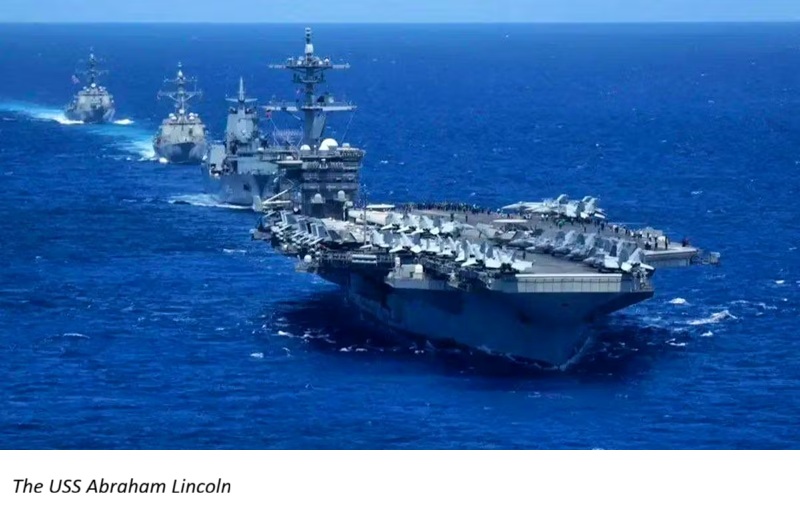
Trump says US ‘armada’ is heading towards the Gulf, raising fears of a military escalation in the region.
Aljazeera, By Yashraj Sharma, 25 Jan 2026
A United States aircraft carrier strike group is heading towards the Gulf as tensions build with Iran.
The US military last staged a major build-up in the Middle East in June – days before striking three Iranian nuclear sites during Israel’s 12-day war with Tehran.
This month, US President Donald Trump backed antigovernment protesters in Iran. “Help is on its way,” he told them as the government cracked down. But last week, he dialled down the military rhetoric. The protests have since been quashed.
So what are the US military assets moving to the Gulf? And is the US preparing to strike Iran again?
Why is the US moving warships?
Trump said on Thursday that a US “armada” is heading towards the Gulf region with Iran being its focus.
US officials said an aircraft carrier strike group and other assets are to arrive in the Middle East in the coming days.
“We’re watching Iran. We have a big force going towards Iran,” Trump said.
“And maybe we won’t have to use it. … We have a lot of ships going that direction. Just in case, we have a big flotilla going in that direction, and we’ll see what happens,” he added.
The aircraft carrier Abraham Lincoln changed its path from the South China Sea more than a week ago towards the Middle East. Its carrier strike group includes Arleigh Burke-class destroyers equipped with Tomahawk cruise missiles capable of striking targets deep inside Iran.
The US military vessels en route to the Middle East are also equipped with the Aegis combat system, which provides air and missile defence against ballistic and cruise missiles and other aerial threats.
When Washington hit Iran’s nuclear sites, US forces reportedly launched 30 Tomahawk missiles from submarines and carried out strikes with B-2 bombers.
When asked on Thursday if he wanted Iranian Supreme Leader Ali Khamenei to step down, Trump replied: “I don’t want to get into that, but they know what we want. There is a lot of killing.”
He also reiterated claims that his threats to use force stopped authorities in Iran from executing more than 800 people who had taken part in the protests, a claim denied by Iranian officials.
An unnamed US official told the Reuters news agency that additional air defence systems were being considered for the Middle East, which could be critical to guard against an Iranian strike on US bases in the region.
Iranian state media said the protests killed 3,117 people, including 2,427 civilians and members of the security forces.
How widespread is the US military presence in the Middle East?
The US has operated military bases in the Middle East for decades and has 40,000 to 50,000 soldiers stationed there.
According to the Council on Foreign Relations, the US operates a broad network of military sites, both permanent and temporary, at at least 19 locations in the region.
Of these, eight are permanent bases, located in Bahrain, Egypt, Iraq, Jordan, Kuwait, Qatar, Saudi Arabia and the United Arab Emirates.
The first US deployment of soldiers in the Middle East was in July 1958 when combat troops were sent to Beirut. At its height, almost 15,000 Marines and Army soldiers were in Lebanon.
The US naval movement towards Iran was ordered despite a new National Defense Strategy being released on Friday. The document is drawn up every four years by the Department of Defense, and the latest security blueprint outlines a pullback of US forces in other parts of the world to prioritise security in the Western Hemisphere.
How has Iran responded?
Ali Abdollahi Aliabadi, who heads coordination between Iran’s army and its Islamic Revolutionary Guard Corps, warned on Thursday that any military strike on Iran would turn all US bases in the region into “legitimate targets”.
General Mohammad Pakpour, the commander of the Revolutionary Guard, said two days later that Iran is “more ready than ever, finger on the trigger”.
He warned Washington and Israel “to avoid any miscalculation”……………………………………………………………………………………………. https://www.aljazeera.com/news/2026/1/25/us-military-moves-navy-air-force-assets-to-the-middle-east-what-to-know
The Global Billionaire Steal: Wealth, Authoritarianism and Media

26 January 2026 Dr Binoy Kampmark AIM Extra , https://theaimn.net/the-global-billionaire-steal-wealth-authoritarianism-and-media/
It’s official. This tormented, heated, traumatised planet is now home to over 3,000 billionaires. (That number was reached last year.) In October 2025, Elon Musk became the first man to have wealth exceeding half a trillion dollars. These developments could still take alongside the fact that one in four people across the globe face hunger.
Oxfam’s Resisting the Rule of the Rich has, as its subtitle, “defending freedom against billionaire power.” It’s an important link, as money, rather than knowledge, tends to be the indicator of raw power. In her foreword to the report, the Secretary General of Amnesty International, Agnès Callamard, links the stirrings of authoritarianism with the pains of inequality. They were neither “separate problems” nor “distinct dilemmas.” They were “entwined, as governments across the world side with the powerful, not the people, and choose repression, not redistribution.” Reading such words commands an echo from US Supreme Court Justice Louis Brandeis, who observed in 1941 that, “We can have a democratic society or we can have the concentration of great wealth in the hands of a few. We cannot have both.” (The Oxfam authors also cite the same quote, though not its questionable provenance.)
The charity accepts that the rich influencing and moulding politics is hardly new. That scale of influence, however, has burgeoned. What took place in the US last year, with the victory of a billionaire president, supported and sponsored by billionaires, running a cabinet with billionaires, made this “viscerally clear: in country after country, the super-rich have not only accumulated more wealth than could ever be spent, but have also used this wealth to secure the political power to shape the rules that define our economies and govern our nations.”
Considering data from 136 countries, the authors confirm the thesis that the unequal distribution of economic resources correlates with unequal political power. “This leads to policy outcomes that reflect the preferences of upper-income groups more than those in lower-income groups.” Those in the highest income bracket have, by means of this fact, secured influence in purchasing political representatives, seeking to legitimise elite power, and secure direct access to institutions.
News coverage and commentary have also been infiltrated by the billionaire class, with over half of the stable of global media companies owned by it. Of the 10 top social media companies, nine are in the hands of six billionaires. A chilling nexus with artificial intelligence has also developed, with its inexorable shaping of the information environment, given that 8 of the top 10 AI companies are steered by billionaires. These are individuals who are not only affecting the nature of wealth distribution but the nature of how knowledge and understanding is sought.
The authors do not throw their hands up in despair at these dire developments. They suggest measures of amelioration. One idea, and unlikely to take off, is the proposal of “limitarianism” advocated by philosopher Ingrid Robeyns. Just as societies define a poverty line, they should just as well define an “Extreme Wealth Line”. (Robeyns puts this limit at US$10 million, an amount bound to make the tech tyrants goggle.)
More feasible is the construction of a “strong firewall between wealth and politics.” Governments can tax the wealthiest – a thorny point given the threatening influence they exert both within and outside representative chambers. Lobbying and the revolving door phenomenon between public and private interest should be regulated. Modest measures include transparent budgetary processes, reforming regulations, establishing mandatory public lobby registries and enforcing rules on conflicts of interest.
Addressing the hoary old chestnut of concentrated media ownership is another suggestion, be it through rules limiting individuals and corporations to secure a lion’s share of the market, encouraging alternative public and independent media outlets, compelling media companies to be transparent about how they use algorithms and rein in the distribution of harmful content. “Oversight and enforcement should be led by a state-funded, governmental body independent of billionaire influence.” The authors fail to appreciate that such supposedly independent bodies can come with their own problems, becoming censors in chief and paternalistic killjoys, a point aptly illustrated by the Australian eSafety Commissioner’s guerilla campaign against the Internet.
The very nature of political campaigning is also targeted by the charity’s recommendations. Political financing by the wealthy should be subject to accountability and transparency guidelines. Those running for office would have to make commitments to reduce their reliance on private donations, have such donations capped, with political parties having to abide by transparency rules regarding funding and electoral campaign financing.
While all these measures point to the drafters, regulators and lawmakers, Oxfam insists on “political power of the many” as a noble, necessary agenda, with governments needing to “guarantee an enabling civic space, in line with international legal frameworks, standards and guidance.” This would involve promoting freedom of expression, lawful assembly and association and enforcing such standards “through regular reporting and scrutiny by both state and non-state actors.”
The Oxfam report will be dismissed by the aspirational and the moneyed as the rantings of the envious and the airings of the lazy. The obscenely wealthy often assume that a mixture of hard work, prudence and basic genetics will get you the loot. In the end, it remains loot, protected by the systems that encourage it, and officials who remain complicit in weakening any mechanism that seeks redistribution and levelling.
U.S. Department of Energy signs additional OTAs to accelerate nuclear reactor pilot projects

Energies Media, by Warren, January 24, 2026
The U.S. is aiming to lead the surge in new nuclear energy developments across the international market

Since taking office for his second term, Donald Trump has shaken the U.S. energy market to its core. Trump signed several executive orders aimed at increasing the oil and gas production in the U.S., and has actively been approving the nuclear buildout as part of the government’s efforts to increase nuclear energy output in the United States.
The U.S. DOE has now finalized two new Other Transaction Agreements with Terrestrial Energy and Oklo. The new OTAs form part of the U.S. Reactor Pilot Program, which has outlined a target of fast-tracking the deployment of the reactors by July 4 of this year.
The context behind the new nuclear development in the U.S.
In August of 2025, the U.S. DOE formally selected ten companies as part of the Reactor Pilot Program, a new path for nuclear energy developers to leverage the accelerated DOE approval instead of the standard Nuclear Regulatory Commission licensing process. Initially, the U.S. was targeting to get up to three reactors online within a year, but that target was amended by Energy Secretary Chris Wright at the 2025 ANS Winter Conference & Expo.
Other notable selections by the Department as part of the Reactor Pilot Program include:
- Aalo Atomics
- Deep Fission
- Last Energy
- Natura Resources
- Standard Nuclear
Oklo and Terrestrial Energy will boost the U.S. nuclear energy output capacity
Oklo is as unique as it gets within the framework of the Reactor Pilot Program, as it has three distinct nuclear energy projects in the United States, namely the Aurora Powerhouse development, the Pluto reactor, and a third reactor being developed by the company’s subsidiary, Atomic Alchemy…….
Terrestrial Energy, on the other hand, follows a more conventional OTA process. The company’s Project Tetra has been slowly developing over the past few months and has now been added to the Reactor Pilot Program by the U.S. authority………………………. https://energiesmedia.com/us-department-of-energy-signs-additional-otas/
Over 2 Million Ukrainians Are Dodging The Draft
Andrew Korybko, Jan 23, 2026
The 2.2 million men that are currently on the run amounts to 6.8% of the Ukrainian population and is slightly larger than the percentage of Asians in the US.
New Ukrainian Defense Minister Mikhail Fedorov shockingly revealed that 200,000 men have already deserted thus far and ten times more (2 million) are actively dodging the draft, which are probably an underestimate but are in any case still very large numbers. To put that into context, Ukraine claimed in early 2025 to have had a population of 32 million, likely an overestimate, so the 2.2 million men who either deserted or dodged the draft amounts to at least 6.8% of the population currently on the run.
Rada Deputy Dmitry Razumkov claimed during a parliamentary session last month that his country had already lost half a million troops by then with an equal number wounded, possibly also an underestimate, while Ukraine is thought to currently field around 900,000 active troops. All of this data enables observers to better understand the significance of these “voluntary losses” since it should be clear by now that 2.2 million more troops would have certainly made a major difference for Ukraine.
That’s not to imply that it would have been able to reverse the military-strategic dynamics of the conflict that have trended in Russia’s favor since the epic failure of Ukraine’s NATO-backed counteroffensive in summer 2023, but perhaps it might have been able to decelerate the pace of its losses afterwards. Ukraine could have thus also been in a comparatively better diplomatic position too going into Trump 2.0 a year ago and that might have in turn predisposed him to a relatively harder line towards Russia as well.
For that reason, while the scale of its desertions and draft-dodging can’t credibly be described as a game-changer, it can still be considered a significant variable that adversely affected Ukraine’s fortunes. By contrast, this was never a relevant factor for Russia, which hasn’t conscripted anyone unlike Ukraine. On that topic, it’s worthwhile reminding readers about Ukraine’s forcible conscription policy that’s been made infamous by viral videos showing officials snatching young and old men alike off the streets.
This footage and stories that draft-eligible males (25-60 years of age) heard through the grapevine are partly why 2 million of them decided to go on the run and dodge the draft. They’ve also seen drone footage of the conflict zone and are therefore well aware of how likely it is that they’ll be killed shortly after being deployed to the front. These men might sincerely consider themselves to be Ukrainian patriots in their hearts, however they conceptualize it, but they’re not willing to die for nothing.
This segues into the plummeting popularity of the conflict among the populace and increasing support for a quick end thereto per recent Gallup polling. Trump just blamed Zelensky for stalling peace talks, which is in direct opposition to the will of the same people in whose name he still acts despite the expire of his term in May 2024. Other than his authoritarian tendencies, corruption is likely responsible for his obstinance since he’s thought to be profiting from the conflict and might thus fear charges once it ends.
Whenever he’s asked about the conflict, Trump usually says that he wants to end it as soon as possible in order to stop the killing, which it’s now known has spooked at least 2.2 million Ukrainian men into either deserting or dodging the draft. The 6.8% of the population that’s currently on the run is slightly larger than the Asian population in the US (6.7%) per the last census. The sooner that the conflict ends, the sooner that they can re-enter the economy and help rebuild their country, unless they flee abroad first.
Tribunal says Swahili ban at nuclear firm was discrimination
An employment tribunal has ordered the taxpayer owned company tasked with
safely decommissioning the UK’s first-generation nuclear power sites pay
more than £10,800 in compensation to a worker who was banned from speaking
Swahili. The Glasgow tribunal found that Nuclear Restoration Services
Limited (NRS) discriminated against Mr K Ruiza after his line manager
instructed him to only speak English while on site. The judge said the
order left him humiliated, distressed and fearful he would lose his job.
The tribunal ruled the company must pay £9,000 for injury to feelings,
plus £1,875.94 in interest, bringing the total award to £10,875.94.
Herald 26th Jan 2026, https://www.heraldscotland.com/news/25794684.tribunal-says-swahili-ban-nuclear-firm-discrimination/
1 This Month


18 March Webinar @ 1 PM EST: An Assessment of SMR Projects: The Case of Canada
register for the zoom:
https://us02web.zoom.us/webinar/register/WN_o8BIIOUvQ2ONJR1nta65DQ#/registration


of the week – STOP SMALL MODULAR REACTORS IN CANADA
To see nuclear-related stories in greater depth and intensity – go to https://nuclearinformation.wordpress.com
-
Archives
- March 2026 (129)
- February 2026 (268)
- January 2026 (308)
- December 2025 (358)
- November 2025 (359)
- October 2025 (376)
- September 2025 (258)
- August 2025 (319)
- July 2025 (230)
- June 2025 (348)
- May 2025 (261)
- April 2025 (305)
-
Categories
- 1
- 1 NUCLEAR ISSUES
- business and costs
- climate change
- culture and arts
- ENERGY
- environment
- health
- history
- indigenous issues
- Legal
- marketing of nuclear
- media
- opposition to nuclear
- PERSONAL STORIES
- politics
- politics international
- Religion and ethics
- safety
- secrets,lies and civil liberties
- spinbuster
- technology
- Uranium
- wastes
- weapons and war
- Women
- 2 WORLD
- ACTION
- AFRICA
- Atrocities
- AUSTRALIA
- Christina's notes
- Christina's themes
- culture and arts
- Events
- Fuk 2022
- Fuk 2023
- Fukushima 2017
- Fukushima 2018
- fukushima 2019
- Fukushima 2020
- Fukushima 2021
- general
- global warming
- Humour (God we need it)
- Nuclear
- RARE EARTHS
- Reference
- resources – print
- Resources -audiovicual
- Weekly Newsletter
- World
- World Nuclear
- YouTube
-
RSS
Entries RSS
Comments RSS
 nuclear-news