Artificial intelligence will not revive the nuclear industry
by beyondnuclearinternational, https://beyondnuclearinternational.org/2026/01/25/artificial-intelligence-will-not-revive-the-nuclear-industry/
On the contrary, we need renewable energy and natural intelligence, writes Stéphane Lhomme
The current boom in artificial intelligence is accompanied by a massive increase in energy and water consumption, and, according to what we are told, this phenomenon is only just beginning and will grow exponentially.
However, far from taking measures to stop or at least slow down this phenomenon, industrial and political leaders are instead competing with announcements and decisions to support it. As a result, various countries, including France, are trying to attract data centers by promising their owners, mainly the famous GAFAM (Google, Amazon, Facebook, Apple, Microsoft), to provide them with cheap and, above all, “green” electricity.
France is offering its nuclear power because, as everyone knows, nuclear power is “clean”… if we are willing to forget the devastation caused by uranium mines, the massive radioactive, chemical, and thermal discharges from power plants into rivers and oceans, radioactive waste, and the occasional contamination of an entire country or continent (during disasters such as Fukushima and Chernobyl).

During the World Nuclear Energy Exhibition (WNE) held in Paris from November 4 to 6, 2025, the vast majority of the media reported the countless announcements about a supposed “return to favor of nuclear power,” which, however, is just as illusory as the “great return of nuclear power” announced in the early 2000s – already accompanied by much fanfare at the time – by the same media outlets and sometimes the same journalists, who are taking advantage of the general amnesia of our “information” societies.
Despite the efforts of the high priestess of nuclear power at the time, Ms. Lauvergeon, revered by most of the media (always the same ones!) before leading her company Areva into bankruptcy (we are still waiting for the investigations that have been ongoing for 15 years to result in a trial), there was no “great comeback.”
Producing 17.1% of the world’s electricity in 2001, nuclear power has since seen its share steadily decline to below 10% in 2020 and below 9% in 2024 (8.97% to be exact). A veritable collapse as a “return to favor.” But we would have to believe that this time, buoyed by GAFAM and their unlimited checkbooks, the nuclear industry will truly experience a golden age (or rather a plutonium age). Let’s take a look at some of the thunderous announcements made in recent months.
Last June, Google announced that it would be relying on nuclear fusion to power its data centers! Let’s just remember that for 70 years, the major nuclear powers have failed completely in this endeavor, even when they joined forces in the Iter project in Cadarache (Bouches-du-Rhône). If nuclear fusion really is what powers Google, then this search engine is bound to shut down quickly!

In fact, last October, Google fell back on a plan B: restarting the Duane Arnold nuclear power plant in Iowa, which had been shut down since 2020. Never one to be late in relaying the nuclear industry’s announcements, AFP produced a dispatch reminding readers that this was the third project of its kind.
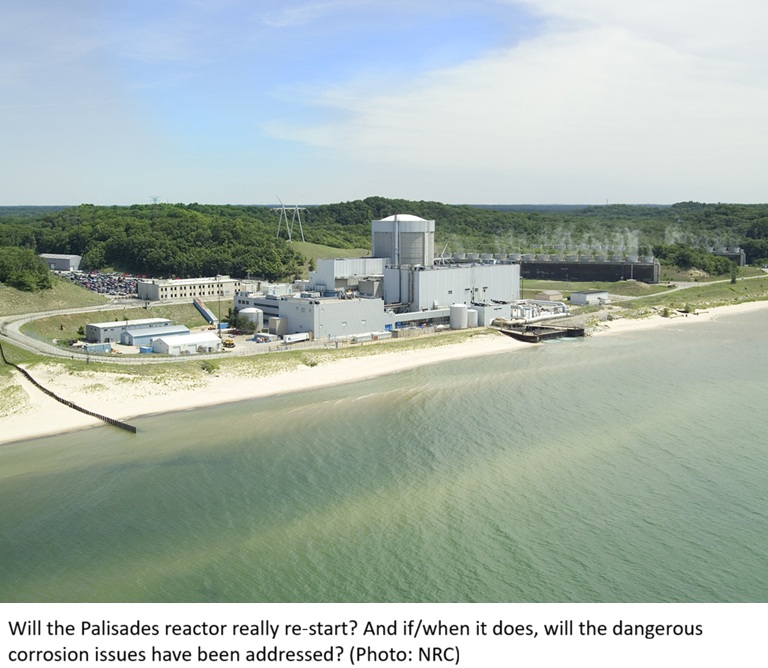
Indeed, the restart of the Palisades nuclear power plant in Michigan has been announced for 2023. But almost no one mentioned the official report of October 2024 revealing that the reactor, which had been shut down for several years, was severely affected by corrosion.
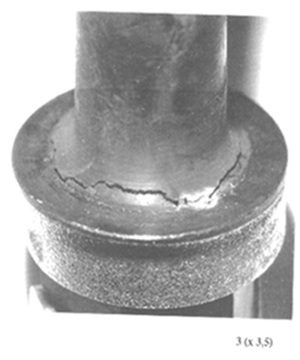
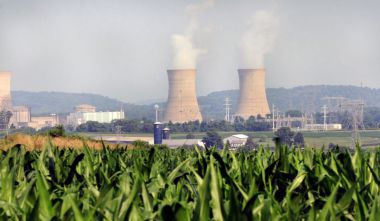
In reality, it is highly likely that this plant will never restart, nor will the Duane Arnold or Three Mile Island plants: in the latter case, the plan is to restart reactor 1, which was shut down in 2019, and not reactor 2 (whose core melted during a serious accident in 1979), as reported by the media, which we will charitably describe as inattentive.
Another avenue for the supposed “return to favor of nuclear power” and its ability to fuel the insane consumption of AI is that of the famous SMRs, small modular reactors, which are of course touted as being “safe, easy to build, and inexpensive.” So all we had to do was think of it.

However, the 127 SMR projects identified worldwide by the OECD’s Nuclear Energy Agency, far from making this idea a reality, show instead a total lack of focus: many start-ups are chasing subsidies generously granted by politicians who are ignorant and, above all, terrified of being seen as dinosaurs who have missed the boat on renewal.
The SMR bubble is about to burst. In France, the main start-ups (Naarea, Newcléo, Jimmy, etc.) are in serious difficulty or have already suspended payments, and EDF’s Nuward project has been postponed indefinitely. In the US, the only project that had made any progress, NuScale, has already closed down.

After initially announcing the construction of new nuclear reactors (large or SMRs), then falling back on restarting shut-down reactors, GAFAM companies are now cautiously turning to existing facilities. In the US, for example, gas-fired power plants are being called upon. In addition, Meta (Facebook) has signed an agreement to purchase the output of the Clinton nuclear power plant (Illinois), a plant that is currently in operation: this is safer than relying on virtual or shut-down plants!
It is already clear that, wherever data centers are built, GAFAM will monopolize electricity production to the detriment of the population. This situation, which one might have thought was the stuff of science fiction, is already a reality in the US, for example in Virginia, Georgia, and Arizona, where the population is deprived of water, which is monopolized for cooling the numerous data centers built in these states, which attracted them by exempting them from taxes (again to the detriment of the population).
The same is true, for example, in Chile and already, or soon, in all countries that have had the bad idea of welcoming these famous data centers. Selfishly, we can only hope that, despite the grandstanding of the showman Macron, France will fail to attract data centers. It will then be the “winners” of this absurd race who will fall victim to GAFAM, and thus there will be electricity and water left for the needs of the French population. It should also be noted that various countries are beginning to take measures to slow down or suspend the installation of data centers.
Unfortunately, it is to be feared that nothing and no one will put a stop to the madness of AI and its senseless consumption of electricity (not to mention the “mining” of bitcoins and other cryptocurrencies, an activity that also consumes a tremendous amount of energy and water).
However, contrary to what is claimed in the numerous articles mentioned above, nuclear power will not be able to meet this demand: as demonstrated by the failures of large reactors—EPR (France) and AP1000 (USA)—as well as SMRs, the construction of nuclear power plants is far too uncertain, slow, and costly.
Moreover, according to the International Energy Agency, since 2020, 90% of new electricity generation capacity worldwide has been renewable, which is much cheaper than nuclear power and, above all, can be brought online very quickly. AI will therefore not save nuclear power; quite the contrary: once they have finished with their absurd announcements, even the GAFAM companies will turn away from it and choose realistic options. That said, while it is of course much better for electricity to be renewable rather than nuclear, one wonders where the progress will be if it is monopolized to power AI rather than meet the needs of the population.
On this subject, there is still time to cancel the senseless EPR reactor projects (even renamed EPR2 to make them seem like an improvement), which EDF is proving incapable of building and operating, and to devote the available money to realistic, decentralized energy efficiency and renewable energy projects that are supported by and for the population: Natural intelligence and renewables rather than artificial “intelligence” and nuclear power.
Stéphane Lhomme is the founder and director of Observatoire du nucléaire. This article was originally published by Observatoire du nucléaire.
No comments yet.
1 This Month


18 March Webinar @ 1 PM EST: An Assessment of SMR Projects: The Case of Canada
register for the zoom:
https://us02web.zoom.us/webinar/register/WN_o8BIIOUvQ2ONJR1nta65DQ#/registration


of the week – STOP SMALL MODULAR REACTORS IN CANADA
To see nuclear-related stories in greater depth and intensity – go to https://nuclearinformation.wordpress.com
-
Archives
- March 2026 (146)
- February 2026 (268)
- January 2026 (308)
- December 2025 (358)
- November 2025 (359)
- October 2025 (376)
- September 2025 (258)
- August 2025 (319)
- July 2025 (230)
- June 2025 (348)
- May 2025 (261)
- April 2025 (305)
-
Categories
- 1
- 1 NUCLEAR ISSUES
- business and costs
- climate change
- culture and arts
- ENERGY
- environment
- health
- history
- indigenous issues
- Legal
- marketing of nuclear
- media
- opposition to nuclear
- PERSONAL STORIES
- politics
- politics international
- Religion and ethics
- safety
- secrets,lies and civil liberties
- spinbuster
- technology
- Uranium
- wastes
- weapons and war
- Women
- 2 WORLD
- ACTION
- AFRICA
- Atrocities
- AUSTRALIA
- Christina's notes
- Christina's themes
- culture and arts
- Events
- Fuk 2022
- Fuk 2023
- Fukushima 2017
- Fukushima 2018
- fukushima 2019
- Fukushima 2020
- Fukushima 2021
- general
- global warming
- Humour (God we need it)
- Nuclear
- RARE EARTHS
- Reference
- resources – print
- Resources -audiovicual
- Weekly Newsletter
- World
- World Nuclear
- YouTube
-
RSS
Entries RSS
Comments RSS
 nuclear-news
Leave a comment