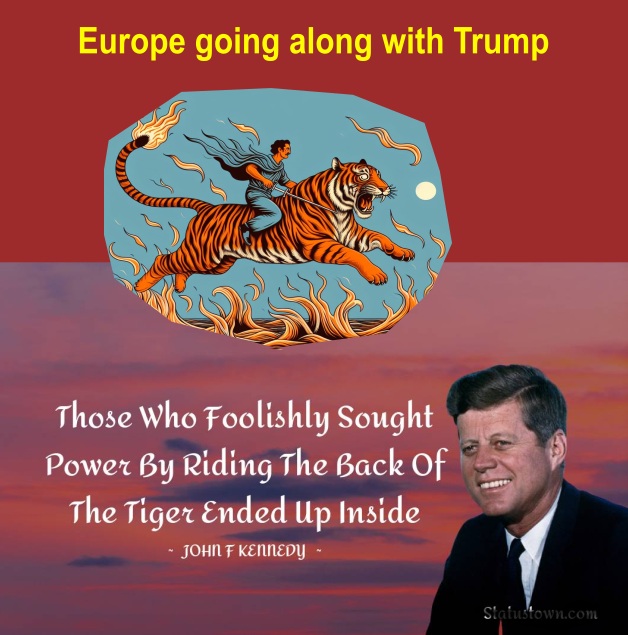
In a sweeping and unsparing conversation with Glenn Diesen, economist and longtime geopolitical analyst Jeffrey Sachs dissects the accelerating rupture between Europe and the United States — a crisis triggered not by Russia or China, but by Washington’s own imperial overreach. Speaking with Glenn, Sachs argues that Europe is finally confronting the consequences of “riding on the back of a predator,” a metaphor he borrows from President Kennedy’s 1961 warning that those who try to ride the tiger often end up inside it.
A Crisis Europe Helped Create
Sachs traces Europe’s current panic — triggered by Trump’s threats toward Greenland and open hostility toward NATO — to decades of European complicity in U.S. militarism. For years, he argues, European leaders “said not a word” as Washington toppled governments, invaded sovereign states, and shredded international law from Iraq to Libya to Syria.
One of Sachs’ most pointed observations captures the hypocrisy now on display:
“When the United States said, ‘We want Greenland,’ suddenly Europe rediscovered international law.”
The same governments that lectured Iran about “restraint” after being bombed, or applauded the kidnapping of Venezuela’s president, now find themselves shocked that the empire they enabled is turning its gaze toward them.
The End of the ‘Rules‑Based Order’
One of the most striking developments Sachs highlights is Canadian Prime Minister Mark Carney’s admission in Davos that the so‑called “rules‑based international order” was never neutral — it was a Western privilege system. With the world shifting toward multipolarity, even U.S. allies are reassessing their dependence on Washington.
Carney’s outreach to China, Sachs notes, signals a geopolitical realignment that Europe has been too timid — or too captured — to attempt.
NATO’s Identity Crisis
The interview exposes a NATO leadership class that continues to praise U.S. power even as Trump openly calls the alliance America’s “enemy from within.” European leaders like Mark Rutte, Sachs argues, have responded with “pathetic” deference, hoping to appease Washington rather than assert independent interests.
Meanwhile, the EU’s political imagination has shrunk to a single unifying principle: Russophobia. Sachs calls this a catastrophic strategic error:
“Europe has no diplomacy with Russia, no diplomacy with the United States — basically no diplomacy at all.”
Germany’s Pivotal Role — and Repeated Failures
Sachs lays particular responsibility at Germany’s feet. From violating its reunification assurances on NATO expansion, to abandoning the 2014 Yanukovych agreement, to failing to enforce the Minsk II settlement, Berlin repeatedly chose alignment with Washington over European stability.
Yet Sachs insists the path to peace still runs through Berlin — joined by France, Italy, and the Central European states already calling for diplomacy.
Economic Warfare as Regime Change
One of the most explosive moments in the interview comes when Sachs quotes U.S. Treasury Secretary Scott Bessant openly bragging about collapsing Iran’s economy:
“This is economic statecraft… their economy collapsed… and this is why the people took to the streets.”
For Sachs, this is not policy — it is gangsterism. And Europe’s silence in the face of such actions has only emboldened Washington.
Despite Sachs bleak assessment, in the end there is room for conditional optimism: Europe could still reclaim sovereignty, pursue diplomacy, and avoid becoming collateral damage in America’s imperial decline. But doing so requires courage — something in short supply among current European elites.
[…] there’s a spate of writing by extremists.You know straight away to avoid people like Jeffrey Sachs, with his wide-ranging way out views. Ralph Nader – a long time pest, obstructing progress. […]




 nuclear-news
[…] there’s a spate of writing by extremists.You know straight away to avoid people like Jeffrey Sachs, with his wide-ranging way out views. Ralph Nader – a long time pest, obstructing progress. […]