The secret nuclear influencer in the heart of Moscow.
Dr Eva Stegen 21st Jan 2026
Nuclear energy does not appear in any of the 19 EU sanctions packages, thanks to a key individual. Former nuclear power executive Henri Proglio has maintained several consulting offices in Moscow, the heart of Putin’s power, for the past 10 years. The former head of the state-owned Électricité de France (EdF) still sits on the international advisory board of Putin’s nuclear power conglomerate Rosatom.
Déjà vu: A wave of outrage swept through Germany when the “family business owners” tested the boundaries by extending an invitation to the AfD. The business lobby group eventually backtracked. The German “corporate families” may have been inspired by French far-right extremists who have been casting their nets into corporate boardrooms for some time. The French trial balloon was launched two years ago, a few months before the elections, and provoked a media frenzy. Marine Le Pen, the presidential candidate of the National Rally (RN), orchestrated a meeting with an extremely polarizing manager: Henri Proglio. He was one of the country’s most powerful business leaders until he was deemed inferior at the nuclear power company Électricité de France (EdF).
Critics consider the self-proclaimed Putin supporter, who calls himself a “killer ,” to be “not as successful as he would have people believe .” They claim he has “developed a system of clans, gangs, and sinecures” that promoted nuclear technology exports to crisis regions. Under his leadership (2009-2014), he forged ties with Chinese rulers, the Libyan dictator Gaddafi , the Saudi Bin Laden Group, and other dubious business partners. His mentor, Nicolas Sarkozy, was imprisoned over the Libya affair. Another key figure in this corrupt clique, the secret protector of Proglio’s career, “Monsieur Alexandre,” also received a prison sentence. Proglio’s enforcer, a former gang leader from the Parisian suburbs , knows prison from the inside. The middleman rose from the underworld to the highest circles of politics and business: “I hold them all by the balls .”……………………………………………………………………………………………………………………………………………
Proglio and the National Rally (RN) are advocating for a “Frexit,” wanting to withdraw from the EU electricity market and give preferential treatment to French companies. These ideas of European division are welcomed by the Kremlin. ………………………………
the fact that “the fuels that power our nuclear power plants largely
come from Russia” amounts to nothing less than import dependency . And this is with a high-risk technology of civil-military relevance.
“Why is the nuclear industry spared?”
Investigate Europe and Tagesspiegel asked back in 2022. Nuclear power does not appear in a single one of the (now 19) EU sanctions packages. In their joint research, they show:
“ The close connection between the French and Russian nuclear industries is exemplified not least by Henri Proglio , the former CEO of the French state-owned electricity supplier EDF, who still sits on the international advisory board of Rosatom ,” the Russian nuclear conglomerate used by Vladimir Putin as a geopolitical instrument to expand his influence in Europe.
No nuclear sanctions – thanks to import dependency and a key personnel decision
In addition to his position at Rosatom, Proglio has maintained several consulting offices in Moscow for the past ten years, profiting handsomely from Putin’s war in Ukraine and orchestrating shady deals, including in the nuclear sector. This is particularly sensitive because he is privileged to the most closely guarded secrets of France, a civilian-military nuclear power. While he can keep secrets—he even concealed the lucrative activities of companies like ‘Henri Proglio Consulting’ and ‘HP Energy Advisory’ in Moscow from the parliamentary inquiry committee—it is highly questionable whether this is always in the best interests of France or Europe.
……………………….He believes the existing reactors should be allowed to operate until a medium-power reactor (1000 MW) is developed. He himself is responsible for the sale of the intellectual property rights for precisely this technology to China. That was the death knell for the French reactor manufacturer Areva.
ts engineers were stunned when they discovered a Chinese pirated copy of their plans, developed with Japanese colleagues for a 1000 MW reactor. Proglio was behind it:
“We will build Franco-Chinese reactors. And we will also build Franco-Russian reactors.” He himself was present at the clandestine signing of far-reaching contracts , which amounted to a ticket into the heart of France’s highly sensitive nuclear infrastructure. ………………………………………………………………………………………………………………………………………………………………………………………………………..
Rosatom’s geostrategy for global dependence
According to its own statements, “Rosatom is the only company worldwide that possesses all technologies of the nuclear fuel cycle .” The nuclear giant, with its 450 arms, employs around 420,000 people and aims to establish itself as the world market leader in the entire nuclear process chain, from uranium mining through conversion, enrichment, fuel element production, reactor construction, operation, maintenance and decommissioning, to waste management…………………………………………………………………………………….https://www-eva–stegen-de.translate.goog/blog/atom-Influencer-im-herzen-moskaus.html?_x_tr_sl=de&_x_tr_tl=en&_x_tr_hl=de&_x_tr_pto=wapp
Mayors for Peace Joint Appeal
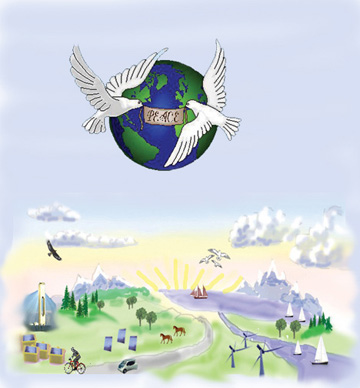
January 20, 2026, https://www.mayorsforpeace.org/wp-content/uploads/2026/file-2601-MfP_Joint-Appeal_January-2026_E.pdf
The milestone year of 2025—marking 80 years since the end of World War II and the atomic
bombings of Hiroshima and Nagasaki, the first use of nuclear weapons in human history—has come
to a close, and a new year, 2026, has begun. Over the past year, Mayors for Peace undertook a wide
range of peace initiatives. In particular, in August, the 11th General Conference of Mayors for Peace
was convened in Nagasaki City, where member cities from around the world engaged in extensive
discussions and renewed their shared determination to achieve a world without nuclear weapons.
Yet today, as power struggles over territory and economic influence initiated by nuclear-armed major
powers intensify, the global situation is growing ever more precarious. Distrust among states is
deepening, regional tensions are worsening in Europe, the Middle East, Latin America, and Asia, and
armed conflicts continue to spread, claiming the lives of countless innocent civilians. Moreover, as
the long-standing taboo against the use of nuclear weapons is being seriously eroded, momentum
toward nuclear disarmament and the abolition of nuclear weapons has stagnated.
Under these circumstances, the New Strategic Arms Reduction Treaty (New START Treaty)—the
only remaining nuclear disarmament and arms control treaty in force between the United States and
the Russian Federation—is set to expire in February 2026. We strongly urge both governments, which
together possess approximately 90 percent of the world’s nuclear warheads, to continue to honor the
limits of the treaty on an agreed basis and to demonstrate commendable leadership by advancing
nuclear disarmament. At the same time, we are gravely concerned that the collapse of this significant
arms control framework between the world’s nuclear superpowers could trigger an intensified global
arms race, including in nuclear weapons.
January 22 of this year marks five years since the Treaty on the Prohibition of Nuclear Weapons
entered into force in 2021. This treaty, a powerful international norm that prohibits the development,
testing, use, and threat of use of nuclear weapons, is a ray of hope amid the present depressing
situation. It was born from the heartfelt appeal of the hibakusha— “No one else should suffer as we
have.” We call upon all states to acknowledge the catastrophic and inhumane consequences of nuclear
weapons and to sign and ratify the treaty without delay.
Comprising local government leaders responsible for protecting the safety and security of their
citizens, Mayors for Peace now includes approximately 8,600 member cities in 166 countries and
regions worldwide and has worked for over 40 years toward the abolition of nuclear weapons. We
urge all policymakers to make every possible diplomatic effort to pursue the peaceful resolution of
conflicts through dialogue and to take concrete steps toward the realization of a peaceful world free from nuclear weapons.
MATSUI Kazumi , Mayor of Hiroshima , President of Mayors for Peace
SUZUKI Shiro
Vice President of Mayors for Peace
Mayor of Nagasaki
Zionism: The Etymological and Ideological Unpacking of a “Political Pathogen”

22 January 2026 Dr Andrew Klein, P https://theaimn.net/zionism-the-etymological-and-ideological-unpacking-of-a-political-pathogen/
The term “Zionism,” the modern political ideology advocating for a Jewish homeland in Palestine, is often analysed through the lenses of history, politics, and conflict. However, to understand its full potency and impact – to see it as a “political pathogen” – we must first dissect the linguistic and cultural DNA from which it was synthesised. This paper posits that Zionism is a European ideological construct, born of a specific historical moment, which instrumentalised ancient religious and cultural symbols to forge a modern nationalist movement. Its power and subsequent global impact stem from this fusion of the ancient and the modern, a fusion that has proven both resilient and, in the view of its critics, deeply destructive.
I. The Etymological Core: From Sacred Hill to Nationalist Ideology
The linguistic root of “Zionism” is the Hebrew word “Zion” (Ṣîyyôn), originally referring to a specific hill in Jerusalem. Over millennia, particularly following the Babylonian Exile, “Zion” transformed from a geographic location into a potent synecdoche and poetic symbol for the entire Land of Israel and the Jewish people’s spiritual yearning for return. This meaning was deeply embedded in Jewish messianic belief, envisioning a future redemption.
The transformation into a modern political “-ism” occurred in late 19th-century Europe. The term “Zionism” (Zionismus) is first credibly attributed to the Austrian Jewish intellectual Nathan Birnbaum in an 1890 article. It was coined in reference to the activities of the Hovevei Zion (“Lovers of Zion”), proto-Zionist groups that promoted Jewish agricultural settlement in Ottoman Palestine. The movement was catapulted onto the world stage by Theodor Herzl, whose 1896 pamphlet Der Judenstaat (The Jewish State) and the subsequent founding of the Zionist Organization in 1897 popularised the term and defined its political objectives. The choice of “Zion” was deliberate: it grafted the new secular nationalist project onto the deep-rooted, sacred longings of Jewish tradition, providing an immediate and powerful historical legitimacy.
II. The European Crucible: Birth of an Ideology
Zionism did not emerge in a vacuum. It was a direct product of, and reaction to, the specific conditions of European society in the 19th century.
The “Jewish Question” in Europe: Zionism arose as one answer to the pervasive “Jewish Question” – the problem of how Jews, perceived as an unassimilable minority, could exist within European nation-states defined by ethnic homogeneity. Faced with persistent antisemitism, from violent pogroms in Eastern Europe to institutional discrimination in the West, thinkers like Herzl concluded that assimilation was impossible and that Jews constituted a distinct nation requiring sovereignty in their own land.
The Influence of European Nationalism: Zionism was fundamentally shaped by the Romantic nationalist movements sweeping Europe, which argued that every “people” or “nation” (Volk) required a state for its full expression. Zionists applied this model to Jews, asserting their right to national self-determination. The movement also internalised contemporary colonial and racial thinking, with early leaders at times explicitly framing a Jewish state in Palestine as a European outpost or “colonial” endeavour that would bring progress to the region.
Internal Jewish Debates: It is critical to note that Zionism was a contested ideology from its inception. Significant Jewish movements, most notably the socialist Bund in Eastern Europe, vehemently opposed it. These anti-Zionists argued that fleeing antisemitism validated the persecutors’ logic, that the diaspora was a legitimate and rich Jewish homeland, and that the future lay in fighting for socialist revolution and equality within Europe.
III. The Ideological Structure: Core Tenets and Internal Divergence
While unified by the core goal of a Jewish homeland, Zionism was never monolithic. Its internal structure comprised several competing strands:
Political Zionism (Herzl): Focused on achieving a Jewish state through high-level diplomacy and international legal charters.
Practical Zionism: Emphasized the “conquest of land” through immediate agricultural settlement in Palestine.
Labor Zionism: Merged socialist principles with nation-building, promoting collective enterprises like the kibbutz and forming the ideological backbone of Israel’s early leadership.
Revisionist Zionism (Jabotinsky): Advocated for a more militant, maximalist approach to establishing a Jewish state on both banks of the Jordan River, emphasizing military strength and capitalist development.
Cultural Zionism (Ahad Ha’am): Prioritised the creation of a new Jewish spiritual and cultural center in Palestine over immediate political sovereignty.
Religious Zionism: Fused Jewish religious messianism with nationalist politics, viewing the Zionist project as the beginning of divine redemption.
Despite these differences, a critical consensus emerged across most Zionist thought: the necessity of establishing a Jewish demographic majority in Palestine. This demographic imperative, confronting the reality of a majority Arab population, led to the conceptualisation of “transfer” – a euphemism for the removal or ethnic cleansing of Palestinians – as a logical, if debated, solution within mainstream Zionist discourse from the movement’s early decades.
IV. The “Pathogen” Metaphor: Mechanisms of Global Impact
Viewing Zionism through the lens of a “political pathogen” requires examining its replication and impact beyond Palestine/Israel. Its global influence operates through several key mechanisms:
The Logic of Domination: Scholar Vincent Lloyd reframes Zionism’s outcome as a transition from a movement seeking liberation from European domination to one that institutes a new structure of domination over Palestinians. This system is maintained through military occupation, legal discrimination, and the systemic denial of Palestinian dignity and political rights.
Christian Zionist Symbiosis: A critical vector for the ideology’s spread is Christian Zionism, particularly within Protestant evangelicalism. This theology supports Jewish return to Israel not out of solidarity with Jews, but as a prerequisite for the Second Coming of Christ, after which non-converted Jews are often envisioned to be destroyed. This creates a powerful, theologically motivated political lobby (especially in the United States) that reinforces Israeli state policy.
Global Export of “Security” Models: Israel has leveraged its experience controlling Palestinian populations to become a leading global exporter of surveillance technology, weapons, and counter-insurgency tactics. This “laboratory” of repression markets its products to other states and regimes, embedding Zionist-derived models of population control into global security infrastructures.
Conflating Critique with Antisemitism: A potent defensive mechanism has been the strategic effort to equate criticism of Zionism or Israeli state policy with antisemitism, as seen in debates over definitions like the IHRA working definition. This conflation seeks to immunise the ideology from political critique by framing opposition as a form of racial or religious hatred.
Conclusion: A Tale That Found a Home
Zionism is indeed “a tale that found a home.” It is a modern European nationalist tale, constructed from the ancient lexicon of Jewish prophecy and the contemporary grammar of 19th-century racial and colonial thought. It found a home through a deliberate and violent process of settlement and state-building, necessitating the displacement and continued subjugation of another people.
Its “pathogenic” quality lies in its resilience and adaptability – its ability to graft itself onto different host ideologies, from socialist pioneering to evangelical Christian millennialism, and to replicate its core logic of ethnic dominance in new contexts. The language that shaped it provided a bridge between deep history and political modernity, creating an ideology of immense persuasive power and tragic consequence. To understand the ongoing conflict and its global resonances, one must first understand this foundational synthesis of word, idea, and power.
References…………………………..
They’re Trying To Sneak Israel’s President Into Australia Without Anti-Genocide Protests
And Other Notes
Caitlin Johnstone, Jan 23, 2026, t.one/p/theyre-trying-to-sneak-israels-president?utm_source=post-email-title&publication_id=82124&post_id=185482225&utm_campaign=email-post-title&isFreemail=true&r=ln98x&triedRedirect=true&utm_medium=email
Israeli president Isaac Herzog is expected to visit Australia at the invitation of the Australian government, with anonymous sources telling the Israeli press that he’s scheduled to arrive on February 7, but so far Canberra itself has been very opaque about the time and nature of the visit. We can surmise from this that they’re currently trying to come up with a strategy for how to sneak the president into the country without the spectacle of him getting confronted by throngs of anti-genocide protesters.
Again: they’re trying to sneak the president into the country for a visit to protect him from anti-genocide protesters. Really think about what that means, and what it says about Australia as a country.
When you are doing things like this, you’re on the wrong side of history.
As soon as the UK listed Palestine Action as a terrorist group it was made clear to the entire western world that there is no limit to how far our governments will go to stomp out speech that is critical of Israel. Literally no limit. Once you’re arresting old ladies in wheelchairs for holding a sign that says “I oppose genocide, I support Palestine Action,” you’re making it clear that there’s nothing you won’t do to bludgeon the populace into line regarding this one particular foreign state.
That was a real turning point for western society, in retrospect. Up until then it’d been horrific genocidal depravity in Gaza and some ugly shenanigans with TikTok and university campuses, but actually proclaiming that an activist group is a terrorist organization and arresting anyone who supports it was a wildly unprecedented escalation. From that point on it’s been clear to every decent person throughout the western world that we’re in the imperial crosshairs now.
They’re coming for us directly. Our rights are on the chopping block. There’s no limit to how dark and dystopian things can get from here.
I’m not trying to be antisemitic or anything but I personally think it should be legal to voice criticisms of the military activities of a foreign state.
❖
One of the many reasons I’m so hostile to authoritarian efforts to stomp out pro-Palestine speech in Australia is because there’s something deep inside me that would find it intolerable for us to be worse than the Brits.
There should be a mandatory six-month “cooling off period” between any mass shooting or act of terrorism and any legislation purportedly put out in response to it, because the emotional immediate aftermath is always when lawmakers try to roll out their most authoritarian agendas.
I’ve said it before and I will say it again: nobody actually believes the Bondi attack had anything to do with Palestinians or pro-Palestine protests. Anyone who claims they believe that is lying. They’re just pretending there’s a connection in order to stomp out pro-Palestine speech and activism in Australia.
International social media has rediscovered video footage of the Sydney Harbour Bridge protest last year, and it is very impressive to revisit. A massive line of hundreds of thousands of people holding umbrellas and Palestinian flags in opposition to their government’s complicity in the holocaust in Gaza.
It must have left a mark, because the Israel lobby has been on the warpath frantically trying to crush our right to protest ever since. People sometimes knock the effectiveness of peaceful demonstrations, but if they didn’t make a difference tyrants wouldn’t hate them so much.
The reason I’ve been talking about the Australian Israel lobby so much lately is because it has made itself my problem. Kwame Ture said “If a white man wants to lynch me, that’s his problem. If he’s got the power to lynch me, that’s my problem.” I find his logic sound.
The Israel lobby in Australia has shown it has the power to successfully pressure governments to advance laws and policies which threaten the speech of people like myself who speak critically of the state of Israel. That makes them my problem.
There are more important and urgent things going on in the world than the lobbying efforts of an apartheid state in a peripheral nation of the imperial core, to be sure. I’d rather be writing about those matters. But the Australian Israel lobby has made itself my problem, so I need to mention its abusive behaviors from time to time.
I know my name has appeared on lists. I know I’ve been the subject of private discussion among people I’d have preferred not to receive attention from. I know I share a country with people who would openly celebrate if I was imprisoned for the things I have said about Israel and Zionism. So I’ve got a vested interest in calling attention to the forces that are working to assault the civil rights of people like myself, and to my government’s inexcusable advancement of those agendas.
And all decent Australians have that same vested interest, to be clear. Every person of conscience who wishes to be able to speak out against their government’s facilitation of mass murder and abuse has a personal stake in this debate. Because we’ve each got a target on our voice box now. We all need to speak out while we still can.
1 This Month

10 March A LIVE WEBINAR THE REAL EFFECTS OF NUCLEAR POWER
What the Industry Isn’t Telling Us
1:00 PM Mountain, 2 pm Central, 3 pm Eastern. Live on the Keepers of the Water Facebook page


18 March Webinar @ 1 PM EST: An Assessment of SMR Projects: The Case of Canada
register for the zoom:
https://us02web.zoom.us/webinar/register/WN_o8BIIOUvQ2ONJR1nta65DQ#/registration


of the week – STOP SMALL MODULAR REACTORS IN CANADA
To see nuclear-related stories in greater depth and intensity – go to https://nuclearinformation.wordpress.com
-
Archives
- March 2026 (76)
- February 2026 (268)
- January 2026 (308)
- December 2025 (358)
- November 2025 (359)
- October 2025 (376)
- September 2025 (258)
- August 2025 (319)
- July 2025 (230)
- June 2025 (348)
- May 2025 (261)
- April 2025 (305)
-
Categories
- 1
- 1 NUCLEAR ISSUES
- business and costs
- climate change
- culture and arts
- ENERGY
- environment
- health
- history
- indigenous issues
- Legal
- marketing of nuclear
- media
- opposition to nuclear
- PERSONAL STORIES
- politics
- politics international
- Religion and ethics
- safety
- secrets,lies and civil liberties
- spinbuster
- technology
- Uranium
- wastes
- weapons and war
- Women
- 2 WORLD
- ACTION
- AFRICA
- Atrocities
- AUSTRALIA
- Christina's notes
- Christina's themes
- culture and arts
- Events
- Fuk 2022
- Fuk 2023
- Fukushima 2017
- Fukushima 2018
- fukushima 2019
- Fukushima 2020
- Fukushima 2021
- general
- global warming
- Humour (God we need it)
- Nuclear
- RARE EARTHS
- Reference
- resources – print
- Resources -audiovicual
- Weekly Newsletter
- World
- World Nuclear
- YouTube
-
RSS
Entries RSS
Comments RSS
 nuclear-news