Nuclear project with locals opposed will get federal review
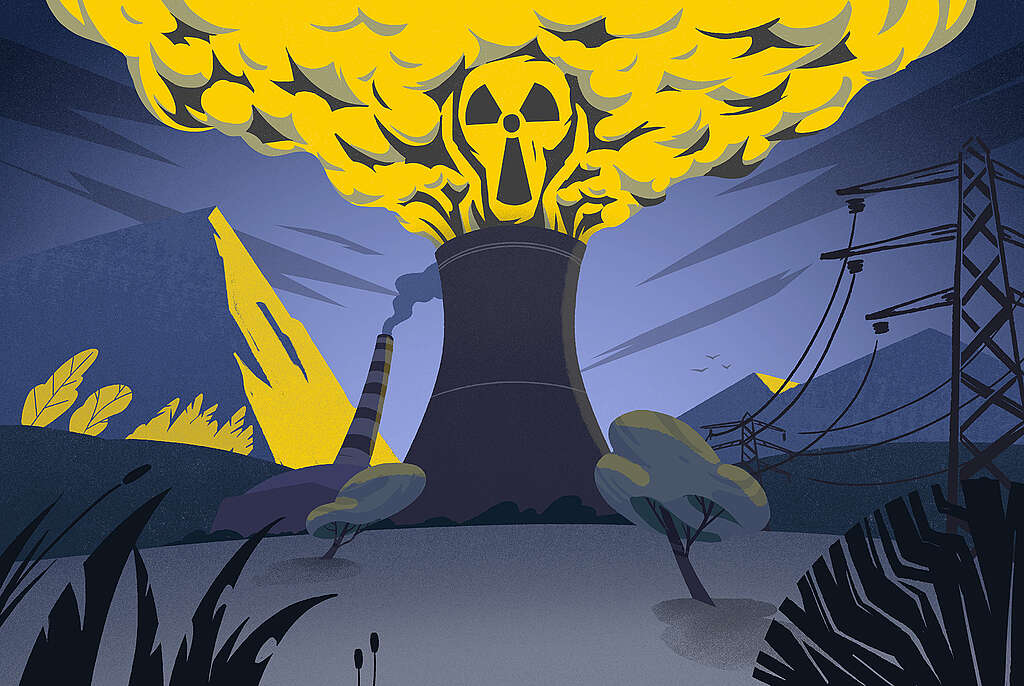
Federal law requires large projects to examine whether there are other feasible ways to meet the same goals with fewer risks.
That opens the door to arguments that renewables, storage and grid upgrades could deliver similar benefits faster, more cheaply and with less environmental harm.
Recent studies from the Ontario Clean Air Alliance suggest alternatives exist and that the province could save up to $19 billion per year by investing in wind, solar and storage instead of pursuing the Wesleyville nuclear megaproject.
Canada’s National Observer, By Abdul Matin Sarfraz, January 22nd 2026
For most of her life, Faye More has lived in the shadow of nuclear waste, grappling with radioactive contamination in her home and her hometown left behind by uranium and radium processing.
She grew up in Port Hope, a lakeside community about 100 kilometres east of Toronto that is still undergoing cleanup of contaminated soil that continues to be removed from neighbourhoods and stored in a huge engineered mound about the size of 70 hockey rinks, visible from Highway 401.
In the 1970s, government investigators found high levels of radon gas at St. Mary’s elementary school in Port Hope, where radioactive mining waste from the town’s uranium mine had been used as fill beneath the building. The school was closed and tests were conducted elsewhere around the town. Investigators uncovered contamination in unexpected places — including backyards and basements.
“I grew up in a contaminated house. I later ended up buying a contaminated property without knowing it and I raised my family there because the locations of radioactive waste were not being disclosed,” More said.
Radon is a colourless, odourless radioactive gas that forms naturally as uranium breaks down in soil and can seep into homes through foundations — it’s naturally occurring in many places but, in Port Hope, levels were significantly higher than normal. Health Canada says radon is the second-leading cause of lung cancer after smoking, linked to about 16 per cent of cases nationwide, or more than 3,000 deaths each year.
Now, More’s community is being asked by the Ford government to shoulder another nuclear burden, one of the largest nuclear projects in the world. This time, she is fighting back, helping lead local residents who say they have already paid the price.
The province last year announced that Ontario Power Generation (OPG) is proposing a new nuclear generating station on its Wesleyville property. The company says the project could eventually host up to 10,000 megawatts of generating capacity, enough to power up to 10 million homes for roughly 78 years.
In its own documents, the Ontario Power Generation says it is not considering alternatives to the Wesleyville project itself. It describes nuclear expansion as a policy decision already made by the province.
The Ford government celebrated the project, claiming more nuclear power is essential to meet rising electricity demand while helping Canada hit its climate targets.
Nuclear energy is frequently cited as a clean, reliable alternative to fossil fuels…………………….
“I was really shocked and appalled,” said More, now chair of the Port Hope Community Health Concerns Committee. “I felt it was very disrespectful to the people, the way it was announced as good news.”
More says the group has more than 100 members and is a volunteer-run non-profit formed in 1995 to address health and environmental risks linked to radioactive contamination in the town.
The group organizes public meetings, shares information online, writes letters to officials and urges residents to take part in public consultations.
Last week, the federal government formally designated the proposed Wesleyville project for a federal environmental impact assessment, opening the door to public consultation.
Unlike most major infrastructure projects, nuclear plants fall largely under federal jurisdiction. The Federal Impact Assessment Act requires a full review for any new nuclear facility larger than 200 megawatts.
The Canadian Nuclear Safety Commission must then decide whether the project meets safety and environmental rules under the Nuclear Safety and Control Act and the Impact Assessment Act before issuing a licence.
More hopes the federal process will stop the project altogether. She says the risks to nearby communities are too great, that safer alternatives exist and that the Ford government ignored Port Hope’s long and painful history with the nuclear industry.
For her, the idea of building one of the world’s largest nuclear plants nearby feels surreal.
“To suddenly hear that in this beautiful rural area they are going to build what could be the largest nuclear plant in the world is really unimaginable,” she said.
More worries about what that would mean for land, water and ecosystems. “It is hard to picture the scope of changes that would happen out there,” she told Canada’s National Observer. “And with that scale comes enormous risks, including emissions to the water, the air and impacts on biodiversity.”
OPG’s filings describe major physical changes that would come with the project. These include shoreline filling, dredging, building docks and large-scale excavation and blasting.
The company also says the plant would rely on cooling water from Lake Ontario. The company acknowledges the site includes wetlands, creeks and fish habitat. It also says parts of the area fall within highly vulnerable aquifer zones.
More says the pace of the project is almost as alarming as its size. She believes people should have veto power, a view not shared by the Ford government, which like the federal government is seeking to build infrastructure more quickly.
“One of the most basic questions in any environmental assessment is: Do we actually need this much energy? And if we do, why does it have to come from here?”
The company says it already owns the property, that it has been intended for electricity generation for decades and that the region has major infrastructure nearby such as transmission corridors, rail access and road that make the site ideal for the expansion plans.
Moving faster than expected
Legal experts note the project is moving at unusual speed.
Theresa McClenaghan, executive director and counsel at the Canadian Environmental Law Association, has followed nuclear projects for decades and says the timeline alone should raise red flags.
“From the very first idea, where the province asked OPG to look at potential new sites, to filing a project description with the federal agency, it’s been something like a year,” she told Canada’s National Observer. “That’s incredibly fast for something of this scale.”
McClenaghan believes OPG is trying to secure approvals while political conditions are favourable.
““They see a friendly Nuclear Safety Commission. They see a supportive provincial government and a supportive federal government,” she said.
“I think they’re thinking: let’s get this licence in our back pocket.”
She points to earlier cases where OPG obtained approvals long before construction began, protecting itself from future political or economic shifts. That strategy matters, she says, because nuclear megaprojects often face soaring costs.
Recent regulatory changes mean many of those costs can now be passed on to ratepayers long before any electricity is produced.
McClenaghan says the federal impact assessment may be the only real opportunity for the public to closely examine the project’s risks, costs and alternatives.
“It’s extremely rare for nuclear projects to be denied,” she said. “But it’s not impossible.”
The review will eventually combine two decisions into one: whether the project’s impacts are acceptable under federal law and whether the Canadian Nuclear Safety Commission should grant OPG a licence.
Under federal rules, the process must look at accident scenarios, long-term environmental effects and whether the project makes sense in its proposed location, including near population centres. In its own documents, OPG says it is not considering alternatives to the Wesleyville project itself. It describes nuclear expansion as a policy decision already made by the province.
McClenaghan says that stance could become a major sticking point. Federal law requires large projects to examine whether there are other feasible ways to meet the same goals with fewer risks.
That opens the door to arguments that renewables, storage and grid upgrades could deliver similar benefits faster, more cheaply and with less environmental harm.
Recent studies from the Ontario Clean Air Alliance suggest alternatives exist and that the province could save up to $19 billion per year by investing in wind, solar and storage instead of pursuing the Wesleyville nuclear megaproject.
Ontario’s big nuclear bet
More than half of Ontario’s electricity currently comes from nuclear power.
Under the province’s long-term planning, that share is projected to rise above 70 per cent by 2050 as electricity demand is expected to increase by about 75 per cent.
Nuclear projects are expensive and complex. The province says it plans to explore new ownership models and equity partnerships to attract private capital.
The government argues nuclear power is more cost-effective and land-efficient than renewables. It says alternatives would require vast amounts of land and major new transmission infrastructure, a claim challenged by energy experts.
For More, the fight has already begun. She is organizing meetings, sharing information online and urging people to take part in the consultation. But she says the timelines are too short for communities to respond in a meaningful way.
She worries that political efforts to “cut red tape” are turning health and environmental protections into barriers to be removed.
“What happens at Wesleyville doesn’t stay at Wesleyville. The reach of a nuclear plant is enormous,” More said. “When a wind turbine fails, it doesn’t contaminate an entire region,” she said. “Nuclear is different.”
More says her community has already paid the price of Canada’s nuclear history once and they are not willing to do it again.
No comments yet.
1 This Month

of the week – Shut Down Drone Warfare!


Tell the Ukrainian Government to Drop Prosecution of Peace Activist Yurii Sheliazhenko

Petition to revoke the licensing of the Near Surface Nuclear Disposal Facility (NSDF) at Chalk River. https://www.ourcommons.ca/petitions/en/Petition/Details?Petition=e-7247
To see nuclear-related stories in greater depth and intensity – go to https://nuclearinformation.wordpress.com
-
Archives
- April 2026 (7)
- March 2026 (251)
- February 2026 (268)
- January 2026 (308)
- December 2025 (358)
- November 2025 (359)
- October 2025 (376)
- September 2025 (257)
- August 2025 (319)
- July 2025 (230)
- June 2025 (348)
- May 2025 (261)
-
Categories
- 1
- 1 NUCLEAR ISSUES
- business and costs
- climate change
- culture and arts
- ENERGY
- environment
- health
- history
- indigenous issues
- Legal
- marketing of nuclear
- media
- opposition to nuclear
- PERSONAL STORIES
- politics
- politics international
- Religion and ethics
- safety
- secrets,lies and civil liberties
- spinbuster
- technology
- Uranium
- wastes
- weapons and war
- Women
- 2 WORLD
- ACTION
- AFRICA
- Atrocities
- AUSTRALIA
- Christina's notes
- Christina's themes
- culture and arts
- Events
- Fuk 2022
- Fuk 2023
- Fukushima 2017
- Fukushima 2018
- fukushima 2019
- Fukushima 2020
- Fukushima 2021
- general
- global warming
- Humour (God we need it)
- Nuclear
- RARE EARTHS
- Reference
- resources – print
- Resources -audiovicual
- Weekly Newsletter
- World
- World Nuclear
- YouTube
-
RSS
Entries RSS
Comments RSS
 nuclear-news
Leave a comment