Nature groups question UK’s Fingleton nuclear review
The Engineer, 21 Jan 2026, https://www.theengineer.co.uk/content/news/nature-groups-question-fingleton-nuclear-review
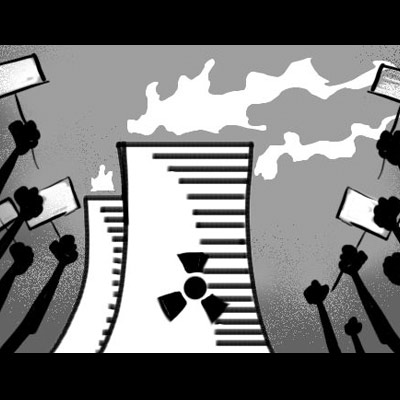
More than a dozen environmental groups and over 60 MPs are questioning the ‘Fingleton recommendations’ set out in the recent Nuclear Regulatory Review.
Led by economist John Fingleton, the Nuclear Regulatory Review made several recommendations designed to ease the path of nuclear development. Among these were proposals to weaken the Habitats Regulations which protect nature sites. But environmental groups, led by The Wildlife Trusts, claim that the review is based on flawed evidence, and that the recommendations could have a catastrophic effect on nature across the UK.
“The dice were loaded from the start – the nuclear review confirms a false narrative that was already being circulated by certain industry lobby groups and think tanks,” said Craig Bennett, chief executive of The Wildlife Trusts.
“The errors in the review form a clear pattern: repeated exaggeration of the costs of preventing harm to nature – and minimisation of the impact to wildlife of nuclear development without those measures. The fact that no environmental experts served on the panel is a disgrace and the resulting distorted picture obscures the value the natural world delivers for economic stability and net zero.”
A new report from The Wildlife Trusts points to specific examples where it believes the nuclear review falls short. It claims that, rather than £700m, Hinkley C’s much-debated fish deterrent system would actually cost £50m. This is against a total project cost of £46bn, up from an original estimate of £18bn.
The Nuclear Regulatory Review also claims that the fish deterrent system would save just 0.08 salmon, 0.02 trout and 6 lamprey per year. However, The Wildlife Trusts cites a report from the Environment Agency that suggests up to 4.6 million adult fish per year could be killed per year if no protective measures are put in place.
“There is limited evidence that environmental protections impose undue costs on infrastructure developers,” said Bennet. “In fact, evidence shows that frequently cited examples of expensive mitigation measures originated from developer mistakes and were unconnected to environmental issues. Blaming nature is unacceptable and a way of avoiding accountability.
“The developers of Hinkley C are trying to blame everyone but themselves for their own failure to think about nature from the outset. When developers think about nature too late in the design process, they end up creating bolt-on engineering solutions for ecological problems, which tend to be more expensive and less effective than committing to make infrastructure nature positive from the very start of the designing process. It’s pretty pathetic that the government is now trying to bail out energy infrastructure developers for this failure of commitment and imagination.”
The Wildlife Trusts’ campaign to save the environmental protections that are threatened by the recommendations of the Nuclear Regulatory Review is supported by 14 other organisations: Wildlife and Countryside Link, Rivers Trust, Campaign for National Parks, Marine Conservation Society, Plantlife, Buglife, Bat Conservation Trust, Amphibian Reptile Conservation, Badger Trust, Beaver Trust, Bumblebee Conservation Trust, Butterfly Conservation, Open Spaces Society, and Client Earth.
No comments yet.
1 This Month

of the week – Shut Down Drone Warfare!


Tell the Ukrainian Government to Drop Prosecution of Peace Activist Yurii Sheliazhenko

Petition to revoke the licensing of the Near Surface Nuclear Disposal Facility (NSDF) at Chalk River. https://www.ourcommons.ca/petitions/en/Petition/Details?Petition=e-7247
To see nuclear-related stories in greater depth and intensity – go to https://nuclearinformation.wordpress.com
-
Archives
- April 2026 (7)
- March 2026 (251)
- February 2026 (268)
- January 2026 (308)
- December 2025 (358)
- November 2025 (359)
- October 2025 (376)
- September 2025 (257)
- August 2025 (319)
- July 2025 (230)
- June 2025 (348)
- May 2025 (261)
-
Categories
- 1
- 1 NUCLEAR ISSUES
- business and costs
- climate change
- culture and arts
- ENERGY
- environment
- health
- history
- indigenous issues
- Legal
- marketing of nuclear
- media
- opposition to nuclear
- PERSONAL STORIES
- politics
- politics international
- Religion and ethics
- safety
- secrets,lies and civil liberties
- spinbuster
- technology
- Uranium
- wastes
- weapons and war
- Women
- 2 WORLD
- ACTION
- AFRICA
- Atrocities
- AUSTRALIA
- Christina's notes
- Christina's themes
- culture and arts
- Events
- Fuk 2022
- Fuk 2023
- Fukushima 2017
- Fukushima 2018
- fukushima 2019
- Fukushima 2020
- Fukushima 2021
- general
- global warming
- Humour (God we need it)
- Nuclear
- RARE EARTHS
- Reference
- resources – print
- Resources -audiovicual
- Weekly Newsletter
- World
- World Nuclear
- YouTube
-
RSS
Entries RSS
Comments RSS
 nuclear-news
Leave a comment