Summary comments on the Deep Geologic Repository (DGR) Project for Canada’s Used Nuclear Fuel
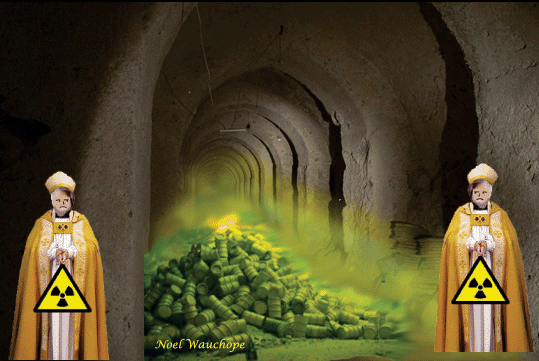
The nuclear waste will be radioactive for, say, a period of time that is close to eternity, whereas the project covers a period of 160 years. The solution is therefore very far from permanent.
We are swimming here in the middle of a pro-nuclear religion.
by Miguel Deschênes, 20 Jan 26
a translation of comments submitted in French to the Impact Assessment Agency of Canada (IAAC) by Miguel Deschêne on this subject.
Seven major objections stand out:
1- Developers are not trustworthy
On page v of the document, it states that “Canada’s nuclear power plants have been providing clean energy for decades,… ». Then, on page vii, it is explained that the project itself “would contain and isolate approximately 5.9 million spent fuel assemblies,” representing approximately 112,750 tonnes of irradiated and highly radioactive heavy metals. This waste contains a wide variety of radioactive substances that are dangerous to living beings. One of the most famous isotopes found in these spent fuel bundles is plutonium-239. Need we remind you that Canadian plutonium was used in the bomb that destroyed the city of Nagasaki in 1945? To say on page v of the document that nuclear energy is clean and to specify on page vii that it will generate 112,750 tonnes of highly radioactive (and potentially destructive) heavy metals in Canada is staggering incoherent.
On page iv of the document, there is a list of twelve specialists and managers who prepared, reviewed, approved and accepted this document, which includes this glaring logical error. This leads to the conclusion that the developers seem willing to present all possible arguments, however incongruous, to defend this project, while concealing the negative aspects that could overshadow it. They therefore have neither the capacity for reflection nor the objectivity required to manage this project, when it would be essential to protect the safety of the public and the environment in complete transparency.
2- The objective(s) are unattainable
The document presents the objective of the project in two places, but they are two different objectives. These objectives look strangely like advertising slogans or the creeds of a pro-nuclear cult. Neither is attainable in practice, but they make it easy to project yourself into a world of unicorns:
a- On page viii, it is stated that: “The objective of the Project is to ensure the safe long-term management of used nuclear fuel so that it does not pose a risk to human health or the environment.”
We are talking about guaranteeing, for 160 years. A great Quebec poet would say “it’s better to laugh than to cry.” A car, which is one of the most advanced technological objects on the planet, is guaranteed for 3 or 5 years. How can we believe that we can guarantee a new landfill technology for a period of 160 years? It’s simply delusional.
In addition, even a simple plastic bottle carries risks to human health or the environment. And they want us to believe that this project will make it possible to store 112,750 tonnes of radioactive nuclear waste so that it does not pose any risk to human health or the environment? What sensible person can believe such a statement?
b- On page 20, it states that: “The objective of the Project is to provide a permanent, safe and environmentally responsible solution for the management of all of Canada’s used nuclear fuel.”
The nuclear waste will be radioactive for, say, a period of time that is close to eternity, whereas the project covers a period of 160 years; The solution is therefore very far from permanent. The solution is also presented as safe and environmentally friendly: based on what? The solution is safe as long as it is sold by convinced developers, but everyone knows that it involves enormous risks. And environmentally friendly? How can we say that burying 112,750 tonnes of radioactive nuclear waste is an environmentally friendly solution? We are swimming here in the middle of a pro-nuclear religion.
Obviously, neither of these two objectives is achievable in practice.
What is the real objective of the project? Indirectly extract as much money as possible from the public treasury and taxpayers? Putting hundreds of highly paid employees to work unnecessarily for decades? Shovel the problem of nuclear waste to our descendants?
The project is therefore, even before it has begun, doomed to failure, since it is impossible for it to achieve its totally utopian objectives. To believe in the success of this project, it is absolutely necessary to be overwhelmed by the pro-nuclear faith.
3- The budget is not presented
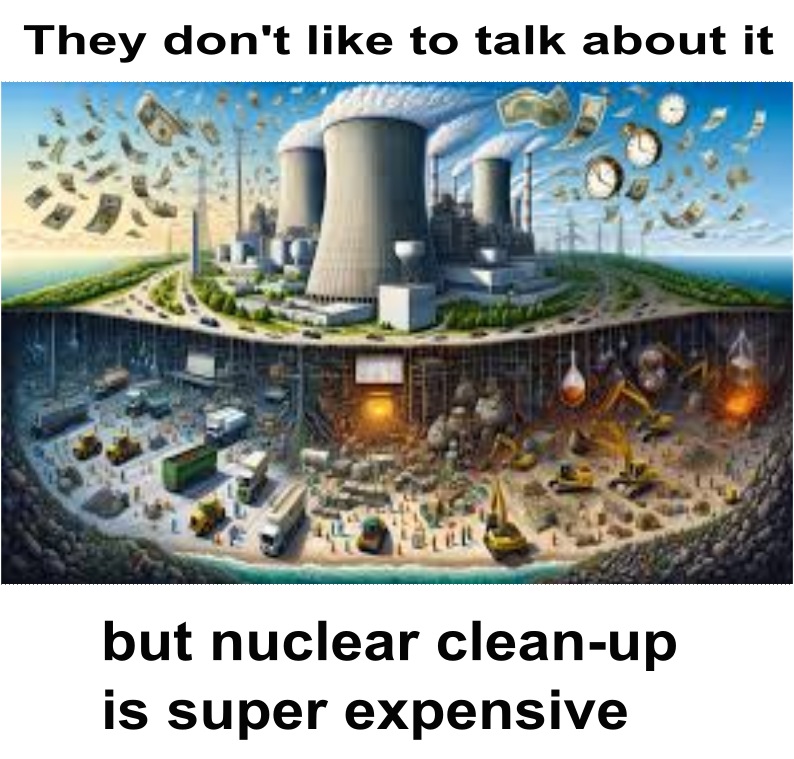
On page 52, it states that “Federal authorities are not providing any financial support to the Project.”
On page 65, it states that: “In addition, although the NWMO is a regulated entity by the CNSC, it is not a federal agency or authority. Rather, it is a question of a not-for-profit organization mandated by the federal government under the NFCA to managing Canada’s nuclear waste. The NWMO is fully funded by industry nuclear power. »
However, the Government of Canada and some provincial governments subsidize and financially encourage the nuclear industry.
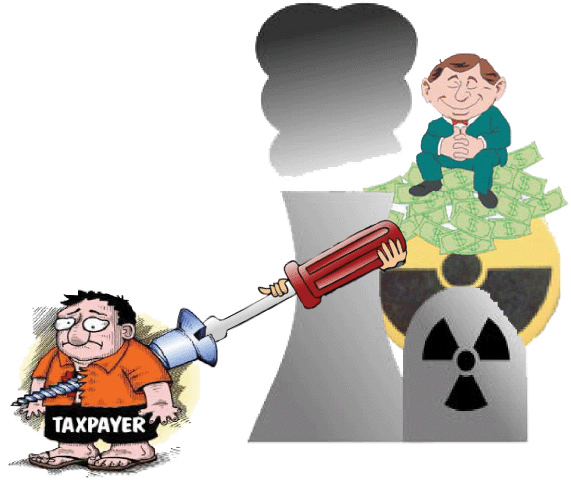
So, in a nutshell, taxpayers are giving money to governments, which in turn subsidizes the nuclear industry, and which in turn funds the NWMO. The present project is therefore indirectly financed by taxpayers and by the federal authorities, which is not revealed by the sentence on page 52. Could we conclude that it is not necessary to call on an accountant if you have a good conjurer?
A detailed budget is one of the essential elements of project planning and monitoring. Where is the budget? How is it cut? And how much will it indirectly cost taxpayers? It would be reasonable to describe the sums required as potentially pharaonic and to require a project plan that includes a complete financial plan.
The absence of a budget in the presentation of a project is an unacceptable shortcoming.
4- The project’s time scale is doubly absurd
On page v, it states that “The Project is expected to span approximately 160 years, including site preparation, construction, operation (approximately 50 years), decommissioning and closure, and post-closure monitoring.”
This duration is both too short and too long:

a- Too short: the half-life of plutonium-239 is about 24,130 years. It is calculated that after a duration of approximately seven times the half-life of an isotope, less than 1% (more precisely, 1/128) of the initial radioactive atoms remain. In the case of plutonium-239, it would therefore be necessary to wait about 168,000 years to reach this target. Obviously, this calculation would have to be done for all the isotopes found in the original waste and for all the isotopes created during subsequent decays in order to properly assess the hazardousness of the waste as a function of time, which is very complex. But we can see right away that the 160-year period is far too short to ensure the safety of the public and the environment.
b- too long: if we go back 160 years in time, we find ourselves in 1866, when the Canadian federation did not even exist. Since that time, humanity has experienced various epidemics (plague, cholera, Spanish flu, covid, etc.), two world wars and a multitude of other wars, major geopolitical reorganizations and major economic crises. It is perfectly utopian to think that a human project that has no other objective than to bury waste will be able to be carried out without hindrance for 160 years. What happens if there is a major epidemic, a world war, a coup d’état by an outsized geographic neighbour, a split in Canada, an unforeseen IT upheaval? How can we seriously believe that all the governments and political parties that will succeed each other will have at heart, for 160 years (if each party remains in power for 4 years, we are talking about 40 different governments), to adequately supervise this project?
In general, the longer a project lasts, the greater the likelihood of not achieving objectives, exceeding costs and exceeding the originally planned schedule. It is therefore quite reasonable and prudent to predict that the 160-year deep geological repository project is likely to be a complete failure: it will not achieve its objectives, while exceeding the planned deadlines and costs.
5- The responsibility for the project in the medium and long term cannot be assumed
What will be the responsibility for the project in the medium and long term, i.e. in 10, 20, 50 or 100 years? What if there is a design problem, a technical problem, a supplier problem, a funding problem, a nuclear incident or whatever? Who will be responsible when most of us are dead? To whom can our descendants turn to ask for accountability and rectification if necessary? No one can imagine or predict it, and it is likely that any assumption today about it will prove wrong tomorrow.
6- The risks associated with transportation are far too high
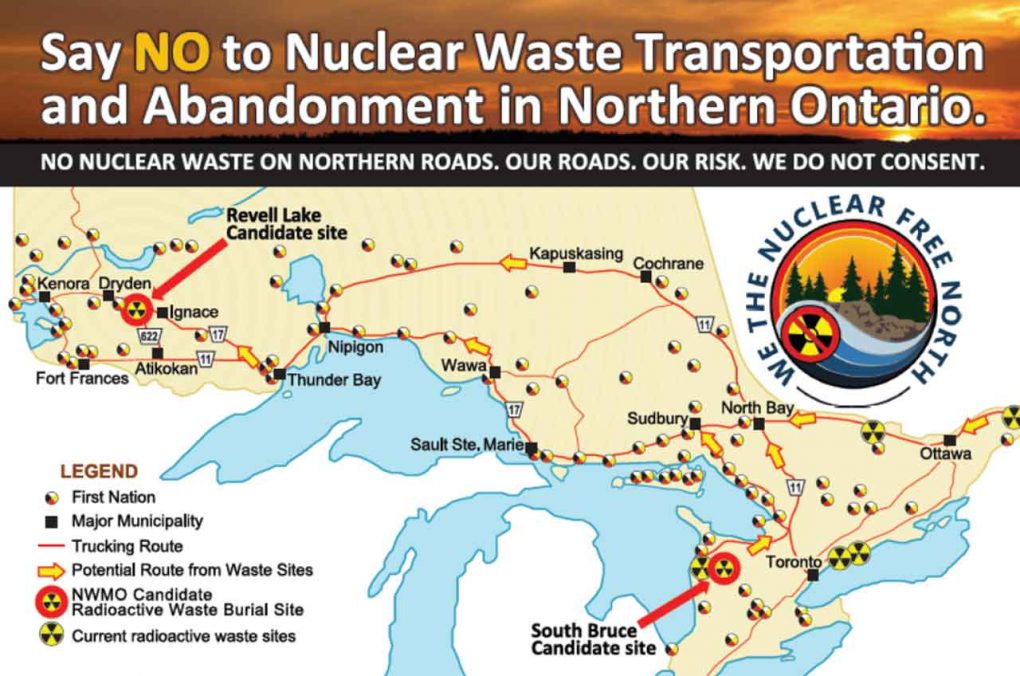
No means of transportation is perfectly safe. Regularly, planes crash, trains derail (the Lac-Mégantic rail accident in 2013 is a sad example) and trucks are involved in pile-ups. Sometimes, a space shuttle explodes in mid-flight.
On page vii, it states that “The Project does not include: the transportation of used fuel from the reactor sites to the Project beyond the primary and secondary access roads to the Project site, as the Project site is regulated separately under CNSC certification and uses existing transportation infrastructure.”
This seems to be, once again, a tactic to make the authorities and citizens swallow the pill of the project. The risks associated with a possible incident during the transportation of 112,750 tonnes of high-level radioactive waste on Canada’s roads, over a period of about fifty years (according to the projected schedule on page 31), are obviously far too high. It is therefore easy to understand why the developer prefers not to include this aspect in his project.
The excessive risk associated with transporting radioactive waste is an argument used by the Nuclear Waste Management Organization itself on its information page about Canada’s used nuclear fuel (https://www.nwmo.ca/fr/Canadas-used-nuclear-fuel): “Related questions: Couldn’t spent nuclear fuel be sent into space? No. In a three-year dialogue with experts and the public on possible long-term management options, the disposal of used nuclear fuel into space was one of the options of limited interest that we eliminated. Space-based evacuation has been ruled out as a solution because it is an unproven concept, not implemented anywhere in the world and not part of any national research and development plan. Concerns about the risk of accidents and the risks to human health and the environment have been amplified in particular by the accidents of the American space shuttles Challenger and Columbia. »
Why should the risk of an accident not be a consistent factor in the Nuclear Waste Management Organization’s reasoning? There have certainly been more train derailments and truck accidents than space shuttle incidents in human history. By what form of logic can we conclude that it is too risky to send used nuclear fuel into space, but that it is safe to transport it by train or truck? The only plausible explanation may be that we must have pro-nuclear faith.
7- Governments do not have a strategy to exit the nuclear industry
On page vii of the document, it states that: “The Project would contain and isolate approximately 5.9 million used fuel assemblies, which is the total anticipated inventory of used nuclear fuel that is expected to be produced in Canada by the current fleet of reactors until the end of their lifetime, as outlined in the NWMO’s 2024 Nuclear Fuel Waste Projections Report (NWMO, 2024). This projection is based on published plans for the refurbishment and life extension of the Darlington and Bruce reactors, as well as the continued operation of the Pickering A (until the end of 2024) and Pickering B (until the end of 2026) reactors, and the assumptions used by the NWMO for planning purposes. »
However, in October 2025, Ottawa and Ontario announced the construction of 4 new nuclear reactors (https://ici.radio-canada.ca/nouvelle/2201625/darlington-nucleaire-reacteur-opg-ontario). What about the waste that will be generated by these plants, which is not part of the inventory considered by the project? And what about those generated by other hypothetical power plants to come? Or those that the government could import from other countries?
Successive governments are constantly creating, recreating and amplifying the problem of nuclear waste, with no intention of ending this mess. The only decision that would limit this ecological disaster would be to abandon the nuclear industry, which would include stopping uranium mining, no longer building new nuclear power plants and never importing nuclear waste from other countries. Unfortunately, no decision-maker seems to have the foresight to move in this direction.
Even before the project begins, we already understand that the planned landfill will not be able to store all of Canada’s nuclear waste. Without a clear direction on the denuclearization of the country, the problem of radioactive waste is far from being solved.
In any case, a deep geological repository will never be a good solution for nuclear waste; This far too risky avenue is really only used to shovel the problems created by today’s decision-makers until a time when they will all be dead and will not have to assume the disastrous consequences.
Conclusion :
In my view, these arguments are more than enough to justify never authorizing the Deep Geologic Repository (DGR) Project for Canada’s used nuclear fuel. It seems that the “original project description” seeks to conceal the real issues related to nuclear waste management, in order to obtain the required authorizations, spend obscure (but potentially staggering) amounts of money, and perpetuate nuclear madness, with no regard for public safety and the environment. Unfortunately, this is a typical project of the nuclear industry, which relies on the blind complacency of the authorities and on daydreams rather than on transparency and objective arguments.
No comments yet.
1 This Month

of the week – Shut Down Drone Warfare!


Tell the Ukrainian Government to Drop Prosecution of Peace Activist Yurii Sheliazhenko

Petition to revoke the licensing of the Near Surface Nuclear Disposal Facility (NSDF) at Chalk River. https://www.ourcommons.ca/petitions/en/Petition/Details?Petition=e-7247
To see nuclear-related stories in greater depth and intensity – go to https://nuclearinformation.wordpress.com
-
Archives
- April 2026 (7)
- March 2026 (251)
- February 2026 (268)
- January 2026 (308)
- December 2025 (358)
- November 2025 (359)
- October 2025 (376)
- September 2025 (257)
- August 2025 (319)
- July 2025 (230)
- June 2025 (348)
- May 2025 (261)
-
Categories
- 1
- 1 NUCLEAR ISSUES
- business and costs
- climate change
- culture and arts
- ENERGY
- environment
- health
- history
- indigenous issues
- Legal
- marketing of nuclear
- media
- opposition to nuclear
- PERSONAL STORIES
- politics
- politics international
- Religion and ethics
- safety
- secrets,lies and civil liberties
- spinbuster
- technology
- Uranium
- wastes
- weapons and war
- Women
- 2 WORLD
- ACTION
- AFRICA
- Atrocities
- AUSTRALIA
- Christina's notes
- Christina's themes
- culture and arts
- Events
- Fuk 2022
- Fuk 2023
- Fukushima 2017
- Fukushima 2018
- fukushima 2019
- Fukushima 2020
- Fukushima 2021
- general
- global warming
- Humour (God we need it)
- Nuclear
- RARE EARTHS
- Reference
- resources – print
- Resources -audiovicual
- Weekly Newsletter
- World
- World Nuclear
- YouTube
-
RSS
Entries RSS
Comments RSS
 nuclear-news
Leave a comment