This Nuclear Renaissance Has a Waste Management Problem

12 Jan, 26, https://energyathaas.wordpress.com/2026/01/12/this-nuclear-renaissance-has-a-waste-management-problem/
Three sobering facts about nuclear waste in the United States.
Americans are getting re-excited about nuclear power. President Trump has signed four executive orders aiming to speed up nuclear reactor licensing and quadruple nuclear capacity by 2050. Big tech firms ( e.g. Google, Amazon, Microsoft, Meta) have signed big contracts with nuclear energy producers to fuel their power-hungry data centers. The federal government has signed a deal with Westinghouse to build at least $80 billion of new reactors across the country. Bill Gates has proclaimed that the “future of energy is sub-atomic”.
It’s easy to see the appeal of nuclear energy. Nuclear reactors generate reliable, 24/7 electricity while generating no greenhouse gas emissions or local air pollution. But these reactors also generate some of the most hazardous substances on earth. In the current excitement around an American nuclear renaissance, the formidable challenges around managing long-lived radioactive waste streams are often not mentioned or framed as a solved problem. This problem is not solved. If we are going to usher in a nuclear renaissance in this country, I hope we can keep three sobering facts top-of-mind.
Fact 1: Nuclear fission generates waste that is radioactive for a very long time.
After 4-6 years of hard work in a commercial fission reactor, nuclear fuel can no longer generate energy efficiently and needs to be replaced. When this “spent” fuel comes out of the reactor it is highly radioactive and intensely hot, so it must be carefully transferred into deep pools where it spends a few years cooling off…
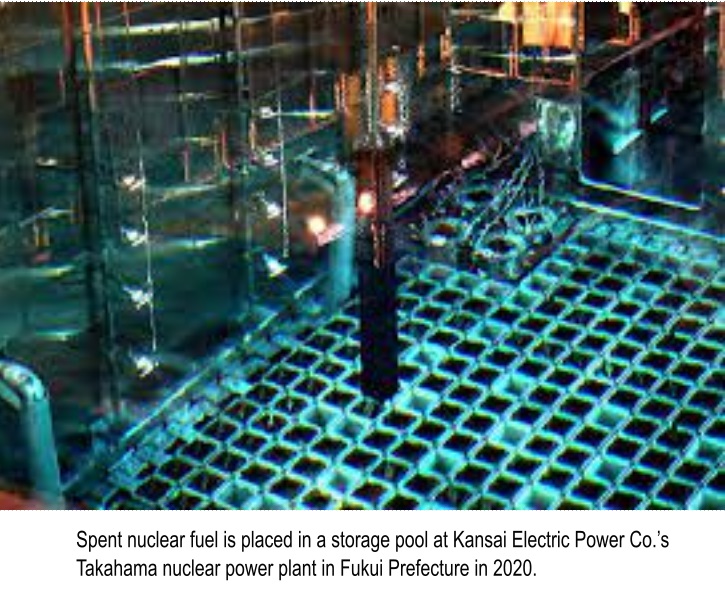
Once cooled, this spent fuel is still not something you want to spend time with because direct exposure is lethal. While most of the radioactivity decays after about 1000 years, some will persist for over a million years. U.S. efforts to site and build a permanent repository for nuclear waste have failed (more on this below). After spending time in the pool, spent fuel is stored on sites of operating or retired reactors in steel canisters or vaults.
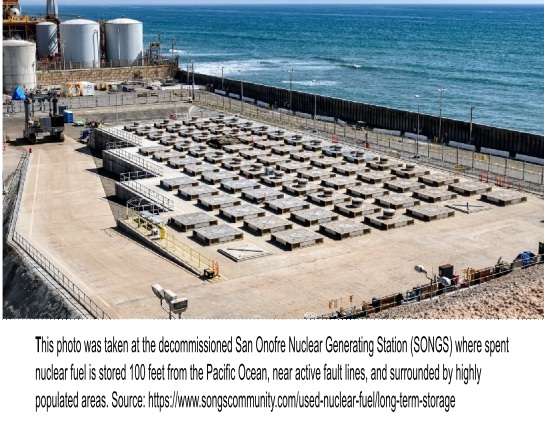
Across the country, more than 90,000 metric tons of radioactive fuel is sitting in pools or dry storage at over 100 sites in 39 states. These sites are licensed by the Nuclear Regulatory Commission (NRC) and regulated by the EPA. They are designed to be safe! But experts agree that this is an unacceptable long-term waste management situation (see, for example, here, here, and here).
Fact 2: The U.S. has no permanent nuclear waste disposal plan
For more than half a century, the United States has tried—and failed—to find a forever-home for its nuclear waste. Early efforts in the 1960s and 1970s went nowhere. In 1982, Congress passed the Nuclear Waste Policy Act which laid out a comparative siting process that was designed to be technically rigorous and politically fair. But this process was slow, expensive, and politically exhausting.
By 1987, Congress lost patience, scrapped its own framework, and tried to force the issue by designating Yucca Mountain in Nevada as the chosen one. Nevada’s resistance was relentless. After roughly $15 billion in spending on site development, the Yucca Mountain proposal was finally withdrawn in 2010. As I understand it, these siting efforts did not fail because the location was declared unsafe. They failed because nuclear waste storage siting was being forced on an unwilling community.
In the years since, Blue Ribbon panels, expert advisory groups, and national research councils have been convened. All have reached the same conclusion. The U.S. needs to break the impasse over a permanent solution for commercial spent nuclear fuel and this will require a fair, transparent, and consent-based process.
You might be thinking that spent fuel reprocessing, which is also enjoying an American renaissance right now, could eliminate the need for a geological repository. It’s true that reprocessing breaks spent fuel down to be used again. But in that process, new types of radioactive wastes are created that need to be managed in deep repositories or specialized landfills. This creates a potentially more (versus less) challenging mess to clean up (reprocessing leaders like France are pursuing costly geological repositories for these wastes).
Fact 3: We are actively undermining public trust in the nuclear waste management process
Convincing a community to host thousands of tons of radioactive waste for thousands of years is not easy. But it’s not impossible. Efforts in Sweden, Finland, France, Switzerland, and Canada are starting to find some success.
All of these international success stories share one important feature: a sustained commitment to building public trust in both nuclear industry regulation and the nuclear waste storage siting process. Alas, here in the United States, we seem to be moving in the opposite direction.
A series of recent developments make it hard to feel hakuna matata about our nuclear waste management protocols:
- In May, an executive order called for a “wholesale revision” of the NRC directing it to accelerate reactor licensing, reconsider radiation standards, and reduce staffing.
- In June, an NRC commissioner was abruptly fired, prompting a letter from concerned career staff .
- The Department of Energy has pledged to “use all available authorities to eliminate or expedite its environmental reviews for authorizations, permits, approvals, leases, and any other activity requested” by nuclear reactor projects under its supervision.
- The Supreme Court recently ruled that Texas lacks legal standing to challenge NRC approval of a privately operated interim nuclear waste facility, raising questions about state’s abilities to challenge nuclear waste siting decisions.
These developments may ultimately succeed in accelerating nuclear deployment across the United States. But they also undermine the public trust and independent governance that are essential inputs into the building of a long-term nuclear waste management strategy.
Weighing our nuclear options
Taking a step back, it is worth asking why nuclear energy is enjoying such a resurgence in this country right now. The growing availability of low-cost renewables and storage, together with an increasingly flexible demand-side, complicates the claim that nuclear power is some kind of moral climate necessity. There are cheaper ways to decarbonize the grid.
The renewed push for nuclear energy is not really about climate necessity. It seems to be driven by anxiety about reliability in a strained power system, industrial policy aimed at rebuilding domestic manufacturing capacity, and the commercial interests of firms chasing revenue streams tied to data centers and federal support. This nuclear revival trades off today’s politically urgent reliability concerns for a long-term obligation to manage radioactive waste (along with some low-probability risk of catastrophic failure). If that’s the trade off we want to make, we should understand that a nuclear renaissance without a viable long-term waste management plan saddles future generations with the messy consequences of our policy choices.
No comments yet.
1 This Month

of the week – Shut Down Drone Warfare!


Tell the Ukrainian Government to Drop Prosecution of Peace Activist Yurii Sheliazhenko

Petition to revoke the licensing of the Near Surface Nuclear Disposal Facility (NSDF) at Chalk River. https://www.ourcommons.ca/petitions/en/Petition/Details?Petition=e-7247
To see nuclear-related stories in greater depth and intensity – go to https://nuclearinformation.wordpress.com
-
Archives
- April 2026 (7)
- March 2026 (251)
- February 2026 (268)
- January 2026 (308)
- December 2025 (358)
- November 2025 (359)
- October 2025 (376)
- September 2025 (257)
- August 2025 (319)
- July 2025 (230)
- June 2025 (348)
- May 2025 (261)
-
Categories
- 1
- 1 NUCLEAR ISSUES
- business and costs
- climate change
- culture and arts
- ENERGY
- environment
- health
- history
- indigenous issues
- Legal
- marketing of nuclear
- media
- opposition to nuclear
- PERSONAL STORIES
- politics
- politics international
- Religion and ethics
- safety
- secrets,lies and civil liberties
- spinbuster
- technology
- Uranium
- wastes
- weapons and war
- Women
- 2 WORLD
- ACTION
- AFRICA
- Atrocities
- AUSTRALIA
- Christina's notes
- Christina's themes
- culture and arts
- Events
- Fuk 2022
- Fuk 2023
- Fukushima 2017
- Fukushima 2018
- fukushima 2019
- Fukushima 2020
- Fukushima 2021
- general
- global warming
- Humour (God we need it)
- Nuclear
- RARE EARTHS
- Reference
- resources – print
- Resources -audiovicual
- Weekly Newsletter
- World
- World Nuclear
- YouTube
-
RSS
Entries RSS
Comments RSS
 nuclear-news
Leave a comment