Report: Military Tells Trump It Needs More Time to Prepare for War With Iran.

Military commanders in the Middle East want more time to prepare for Iranian counterattacks
by Kyle Anzalone | January 11, 2026 , https://news.antiwar.com/2026/01/11/report-military-tells-trump-it-needs-more-time-to-prepare-for-war-with-iran/
Senior Department of War officials have told President Donald Trump they need more time to consolidate American troops deployed to the Middle East before the US launches an attack on Iran.
According to The Telegraph, “Trump has been warned that the US military needs more time to prepare for strikes against Iran.” Military commanders in the Middle East stated they need to “consolidate US military positions and prepare defences” in anticipation of an Iranian retaliatory attack.
Parliament Speaker Mohammad Baqer Qalibaf said that if it attacks Iran, the Islamic Republic will strike Israel and US bases in the Middle East/
Trump has threatened Iran several times in recent weeks. “If Iran [shoots] and violently kills peaceful protesters, which is their custom, the United States of America will come to their rescue. We are locked and loaded and ready to go,” Trump said earlier this month.
Demonstrations began in Iran two weeks ago, and some protests have escalated into riots. Some groups report that 200 people have been killed during the demonstrations, including over 40 members of Iranian security forces.
Iranian authorities have reportedly used live ammunition to break up protests, and Tehran has cut off internet service in an attempt to quell the movement.
Israel Hayom spoke with American officials who said the White House is preparing a range of actions against Iran, including using Starlink to provide protesters with internet access, a cyber attack, new sanctions, and kinetic military action.
The Telegraph reports that potential targets of US strikes include non-military targets in Tehran and Iranian security forces.
At the end of last year, Israeli Prime Minister Benjamin Netanyahu traveled to the US to lobby Trump to restart the war with Iran. In June, Israel launched a surprise attack on Iran that ignited a 12-day war.
During the conflict, Trump ordered American bombers to strike three Iranian nuclear sites. The Islamic Republic responded by striking a US military base in Qatar. The Iranian response was viewed as symbolic, and a ceasefire between the US, Israel, and Iran was reached shortly after.
The plastisphere: a world choked by plastic
13 Jan 26, https://jonathonporritt.com/the-plastisphere-microplastic-crisis/
Inside the microplastic emergency the petrochemical industry doesn’t want us to see
I can sometimes be such a bloody know-all! I’ve been doing all this sustainability stuff for so long that as soon as a particular topic crops up (which I think I’ve got sorted in my own mind), I immediately go into ‘nothing to learn here’ mode, power down the old brain, and wait for what I think I know to be confirmed.
Case in point: microplastics. I’ve been on the case with microplastics for a long time. Working with companies that are responsible for tens of millions of tonnes of plastic waste means that one has to be on the case if one is going to challenge them appropriately. So I keep up with the latest articles, follow the non-technical science, tut-tut vigorously at the continuing failure of politicians to even touch the sides of this vast global problem – and, given half a chance, opine eloquently on what I think ought to happen next.
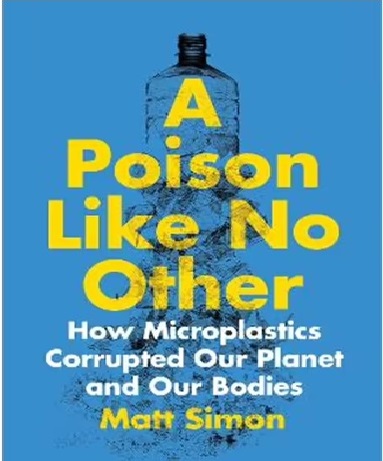
So, I’m not quite sure why I chose to read Matt Simon’s ‘A Poison Like No Other’, dealing with the microplastics crisis. Perhaps it was the subtitle: ‘How Microplastics Corrupted Our Planet and Our Bodies’ – I do like a big bold subtitle. Or it might well have been my intense anger at the all-too-predictable collapse (in August 2025) of negotiations on the Global Plastics Treaty — brutally executed by today’s supremely arrogant petrochemicals industry. Whatever it was, I got myself a copy of ‘A Poison Like No Other’. And it showed me, in short order, that my knowledge about microplastics was wafer thin and that the crisis is so, so much worse than I had ever imagined.
What we talk about most of the time is macroplastics: plastic bags, plastic bottles, plastic packaging, plastic everything, everywhere, in each and every corner of our lives. Matt Simon calls it ‘the plastisphere’. Microplastics are what we end up with when macroplastics break down into little pieces less than 5 mm in size. And when all those teeny-weeny bits of microplastics (and microfibres from our clothes) continue to break down, we end up with unimaginably, unaccountably (as in beyond our ability to count it all) large volumes of nanoplastics. Which, at a millionth of a metre, are not visible to the human eye.
‘A Poison Like No Other’ comprehensively explores the (literal) ubiquity of this source of pollution in the water environment, in the soil, in the atmosphere, and last – but most disturbingly of all – in our own bodies. The sheer scale of the plastisphere is staggering:
“Exactly how much plastic humanity has produced thus far, we will never know. But scientists have taken a swing at an estimate: more than 18 trillion pounds, twice the weight of all the animals living on Earth. Of that, 14 trillion pounds have become waste. Just 9% of that waste has been recycled, and 12% has been incinerated. The rest has been landfilled or released into the environment.”
What scientists have only recently discovered is that as microplastics and microfibres degrade, they split into more and more small pieces, creating an ever-larger surface area on which every conceivable kind of bacteria, viruses, algae, larvae, microbes and infinite varieties of chemical pollutants (including the real baddies like endocrine disruptors and persistent toxics) happily take up residence. And that’s how the food chains that underpin the whole of life on Earth (including our own existence, at the very top of those food chains) have become increasingly contaminated.
Simon argues (convincingly, I believe) that this confronts us with a crisis that is unlike any other. He describes it as “an unprecedented threat to life on the planet”, although he’s very cautious about linking the presence of microplastics in the human body (scientists have detected microplastics in blood, in every part of our digestive systems, in our brains, in mothers’ milk, in placentas in semen – and even in newborns’ first faeces) with any particular uptick in health issues. Respiratory diseases, such as asthma, cognitive problems, and even obesity have all been linked to the vast increase of plastics in the environment – and it’s hard not to imagine that this is rather more than just correlation.
At the heart of this crisis is a classic ‘progress trap’: our modern world simply wouldn’t be possible without a vast range of plastics. We should, of course, be doing much more to reduce the damage caused by that dependency – a tax on virgin plastics, for instance, or specific technological interventions such as mandatory filters in all new washing machines to capture the microfibres before they can escape into the water environment – but we’ll still be caught in the trap.
However, Matt Simon is astonishingly understated in his critique of the petrochemicals industry. That may be because ‘A Poison Like No Other’ was completed well before the industry was finally revealed in all its poisonous glory as it succeeded in crashing negotiations on the Global Plastics Treaty – under the aegis of UNEP (United Nations Environment Programme) – in August 2025.
Talks had been going on since 2022, and although critics of the process (including myself) were deeply sceptical about the industry’s intentions, nobody could have predicted the systematic subversion of the entire process right from the off. Hundreds of corporate lobbyists succeeded in slowing things down, blocking progress at every meeting. Saudi Arabia (the undisputed leader of the bloc of petrochemical countries) somehow got itself onto the coordinating bureau of National Representatives. UNEP itself was subject to intense lobbying, intimidating tactics, and all sorts of ‘inducements’. Its Executive Director, Inger Andersen, has been widely criticised as getting ‘too close to the industry’, not just by NGOs but by independent scientists (whose advice has been consistently ignored by UNEP) and all those other businesses and countries which really did want to see a deal done – including mandatory limits on all future production.
And that remains a crucial objective. From 450 million tonnes today, production is due to triple by 2060. This means that the principal proposal from the industry (that we can recycle our way out of this crisis) is cynically unrealistic. Total recycled volumes have been stuck at around 9% for many years, and even if that doubled, it would still leave untouched the unavoidably vast increases in microplastics and nanoplastics.
No doubt the talks will soon resume. Between now and then, let’s hope that UNEP’s Inger Andersen has had a chance to read A Poison Like No Other. Perish the thought that she should remain as ill-informed as I once was.
Navajo lands at risk

by beyondnuclearinternational, https://beyondnuclearinternational.org/2026/01/11/navajo-lands-at-risk/
New proposal is extraction not remediation, warns the Navajo group, Dooda Disa
More than 500 abandoned uranium mines (AUMs) contaminate the Navajo Nation, and genuine cleanup is urgently needed. But cleanup must be grounded in strict environmental oversight, transparency, and full community consultation. A proposal now being advanced by Navajo Nation EPA (NNEPA) Executive Director Stephen Etsitty, in partnership with DISA Technologies, is being marketed as AUM remediation when DISA’s High-Pressure Slurry Ablation (HPSA) system does not clean up Navajo land—it extracts uranium for commercial sale while leaving radioactive waste behind.
Etsitty told the Albuquerque Journal he was “really excited” that the process could “accelerate the cleanup” and said “the Navajo Nation is investing roughly $3 million” in a commercial-scale test —all of which is misleading. Even calling HPSA “remediation” is whitewashing, because the technology is strictly a uranium-extraction process.
On January 6, 2025, he introduced Resolution ENAC-12-2025-049 at the Eastern Navajo Agency Council (6) that asks the Navajo Nation to enter into a commercial partnership with DISA in order to apply for DOE critical-minerals grants—an extraction initiative, not a cleanup program. It provides no site information, no environmental safeguards, and no cost details, yet seeks approval for a commercial partnership structured around uranium extraction rather than cleanup.
The Truth About DISA and HPSA
In 2023, the EPA commissioned Tetra Tech to test HPSA on waste from three Navajo AUM sites: Old Church Rock Mine (OCRM), Quivira Church Rock-1, and the Cove Transfer Station (CTS-2). Over two weeks, small batches of contaminated waste were run through a pilot-scale HPSA unit. The system blasts rock with high-pressure water to create slurry, then separates it into a coarse fraction and a fines fraction. The fines—about 17% of the material—contain 80–95% of the uranium and radium that DISA intends to ship to the White Mesa Mill and sell to Energy Fuels. The coarse fraction is waste that remains radioactive and may be left onsite, buried, or sent to a disposal site that does not exist.
The results are unequivocal: HPSA did not meet Navajo Nation residential cleanup standards because the coarse waste rock left behind is still too radioactive. At each site, the process removed 80–95% of the uranium and concentrated it into the fines fraction (1), but the remaining coarse material still fails cleanup standards. At OCRM, rock that began at 940 mg/kg uranium—milligrams of uranium per kilogram of soil—was reduced only to 47 mg/kg, still far above the Navajo residential cleanup standard of 3.2 mg/kg. The report notes that meeting Navajo standards would require 99.7% uranium removal, which HPSA never achieved. The study shows that HPSA concentrates uranium for extraction but does not produce coarse waste rock clean enough to meet Navajo residential standards. It documents uranium extraction, not cleanup.
Environmental Review, Licensing, and the FONSI
After the field tests, DISA quickly sought federal licensing. On March 28, 2025, the company applied to the Nuclear Regulatory Commission (NRC) for a multi-site “service provider” license. NRC issued a Draft Environmental Assessment (EA) and Finding of No Significant Impact (FONSI) on August 5, 2025, opened a brief comment period, and finalized both documents by September 25, 2025.
This speed was possible only because Trump-era changes to the National Environmental Policy Act (NEPA) weakened requirements for thorough environmental review. NRC’s FONSI rests on assumptions—not Navajo-specific data—about water use, dust, trucking, and waste left onsite. HPSA has never been tested at commercial scale. NRC ultimately granted DISA a multi-state, non–site-specific generic license requiring only a pilot program and a Pre-Mobilization Notification (PMN) before work at any site. If the assumptions in the FONSI are not met, the PMN could trigger a full Environmental Impact Statement (EIS), but this is unlikely given the current administration’s broad weakening of environmental oversight.
Water Use, Energy, Waste, and Trucks
The Tetra Tech study relied on municipal water from Gallup because no Navajo source was available. A scaled-up 50-ton-per-hour HPSA system would use about 200,000 gallons of water per month; a 100-ton-per-hour system, roughly 384,000 gallons—requiring two to four water trucks per day. Each operating campaign ends with 32,000–54,000 gallons of contaminated process water that must be disposed of or transported to another AUM site.
For every 100 tons processed, HPSA generates about 17 tons of fines—the uranium-rich concentrate DISA intends to ship to White Mesa—and roughly 83 tons of coarse waste rock, which remains on the land or must be hauled to a disposal site that does not exist.
Energy demand is also heavy. A 100-TPH system requires two 500-kilowatt diesel generators running continuously, ensuring constant deliveries of diesel fuel and the need for onsite fuel storage—none of which were meaningfully evaluated in the EA, FONSI, or license.
In practice, the project would rely on three continuous streams of truck traffic: water trucks, diesel fuel trucks, and haul trucks carrying uranium-laden fines through Navajo lands to the White Mesa Mill in Utah—transport that is prohibited under the Diné Natural Resources Protection Act of 2005.
Who Profits—and Who Bears the Risk
Under federal law, all Navajo trust land is held by the United States, which controls the mineral rights. Once uranium is extracted from AUM waste, it becomes “source material” that DISA—not the Navajo Nation—may own, transport, and sell under its NRC license. Uranium recovered from high-grade AUM sites could be worth hundreds of millions of dollars—benefiting DISA and Energy Fuels, not the families who have lived with contamination for generations.
Whatever commercial partnership Etsitty envisions with DISA is not clear. DISA needs the partnership to obtain Navajo consent to access sites and conduct business, but what does the Navajo Nation receive in return? Why should the Nation take on the risk while giving up control over Navajo land? The reality is that DISA, a startup with limited funding, cannot even afford to conduct the required pilot itself. That is why Etsitty is asking the Navajo Nation to finance the pilot for $3 million—so DISA can prove its own extraction technology while keeping the uranium and the long-term profits.
What Happens Next—and What Navajo Nation Can Still Do
The question is not whether AUMs should be cleaned up—they must be. The real question is whether DISA should be entrusted with that work. Should the Navajo Nation pay to enter into a commercial partnership with a high-risk company using an unproven technology under the false banner of “cleanup”? All available evidence—the Tetra Tech study, DISA’s own descriptions of HPSA, and NRC’s licensing structure—shows the same thing: this is a mining project, not a cleanup program.
The bottom line is that the Diné Natural Resources Protection Act of 2005 bans uranium mining and processing on Navajo land. Extracting uranium from AUM waste for commercial sale is mining, whether the feedstock is called “ore” or “waste,” and is therefore prohibited.
Dooda Disa is a community-based grassroots group dedicated to providing accurate information, raising awareness, and protecting Navajo lands and communities from renewed uranium extraction disguised as cleanup.
Chubu Electric’s data fraud ‘undermines’ Japan’s nuclear energy policy
10 Jan 2026 https://www.japantimes.co.jp/news/2026/01/10/japan/chubu-electric-data-fraud/
Chubu Electric Power’s data fraud linked to earthquake risks at its Hamaoka nuclear power plant has splashed cold water on the Japanese government’s energy policy of maximizing nuclear power use.
Shinsuke Yamanaka, chief of the Nuclear Regulation Authority, has said that the NRA’s safety screening of the Nos. 3 and 4 reactors at the plant in Shizuoka Prefecture is expected to “go back to square one.”
A delay in the restart of Hamaoka reactors will deal a blow to Chubu Electric’s earnings and affect the government’s goal of raising the share of nuclear power in the country’s energy mix.
The new basic energy plan of the government, adopted in February 2025, marked a shift from its policy of reducing dependence on nuclear power as much as possible, which was introduced following the March 2011 triple meltdown at Tokyo Electric Power Company Holdings’ tsunami-stricken Fukushima No. 1 nuclear power plant.
The plan instead calls for fully utilizing nuclear energy to meet surging electricity demand in the country. It specifically seeks to raise the share of nuclear power in the energy mix to about 20% by fiscal 2040 from the current level of slightly less than 10%. For this to be achieved, the number of active nuclear power reactors should be increased from the current 14 to more than 30.
Late last year, the process to obtain local consent was completed for the restart of reactors at Tepco’s Kashiwazaki-Kariwa nuclear power station in Niigata Prefecture and Hokkaido Electric Power’s Tomari plant in Hokkaido.
On Jan. 20, the Kashiwazaki-Kariwa plant’s No. 6 reactor is expected to become the first Tepco reactor to be brought back online since the 2011 disaster.
Yamanaka said that the NRA does not plan to investigate nuclear power plants other than the Hamaoka power station for data fraud similar to the irregularities found at the Chubu Electric plant.
If public trust in safety is eroded, however, securing local consent for future reactor restarts would become increasingly difficult.
Chubu Electric’s data fraud case “will greatly undermine public trust in safety,” industry minister Ryosei Akazawa told a news conference Friday. “This should not have happened.” He vowed to “take strict measures” against Chubu Electric based on its upcoming report on preventive steps.
If the safety screening of the Hamaoka reactors restarts from scratch, the power supplier’s earnings will be affected significantly.
The company expects that its profitability will improve by about ¥250 billion a year if the Nos. 3 to 5 reactors at the Hamaoka plant are brought back online. The Nos. 1 and 2 reactors at the plant ended operations in January 2009 and are now being decommissioned.
At a news conference Monday, Chubu Electric President Kingo Hayashi said, “The company’s responsibility for the data fraud is serious.”
On whether he will step down from his post, Hayashi said only that he will consider the matter “comprehensively.”
Hayashi also serves as chairman of the Federation of Electric Power Companies of Japan.
Chubu Electric is also expected to struggle in its decarbonization efforts after the company decided last year to withdraw from a project to construct wind power plants at a total of three locations off the coasts of Akita and Chiba prefectures.
Bill Gates-backed ‘Cowboy Chernobyl’ nuclear reactor races toward approval in Wyoming
For longtime Wyoming resident Steve Helling, the risks outweigh the promises.
“Wyoming is being used as a guinea pig for this nuclear experiment,”
By Samantha Olander, Jan. 10, 2026
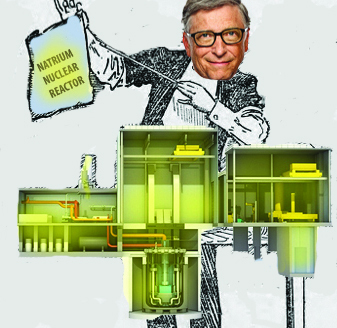
A Bill Gates-backed nuclear reactor dubbed “Cowboy Chernobyl” by critics is barreling toward approval in rural Wyoming, alarming residents and nuclear safety experts as regulators fast-track the project under a Trump-era order.
TerraPower, founded by the Microsoft guru, is seeking federal approval to build the western hemisphere’s first Natrium nuclear reactor in Kemmerer, a coal town of roughly 2,000 people near the Utah border and about two hours north of Salt Lake City.
The plant would use liquid sodium rather than water to cool the reactor, a design pitched as safer and more efficient.
Critics say it introduces new risks while cutting corners on containment.
The United States Nuclear Regulatory Commission completed its final safety evaluation in December, concluding there were no issues that would block issuance of a construction permit.
The five-member commission is expected to vote on the permit later this month. TerraPower still needs a separate operating license before the reactor can run.
Local residents say the fast pace has left them uneasy.
“We’re probably two hours away from that place when it comes to how long it takes the wind to get here,” Patrick Lawien of Casper told the Daily Mail. “Obviously, if anything goes wrong, it’s headed straight for us.”
TerraPower began building the non-nuclear portion of the 44-acre site in June 2024, near the retired Naughton coal plant, which shut down at the end of 2025.
The company says the reactor will generate 345 megawatts of power, with the ability to reach 500 megawatts during peak demand. It aims to have the plant operating by 2030………………………………………
uclear watchdogs say speed is the problem.
The Union of Concerned Scientists, a nonprofit science advocacy group, says TerraPower’s design omits the traditional concrete containment structure used at U.S. nuclear plants.
The company instead proposes “functional containment,” which relies on internal engineered systems to perform containment functions rather than a physical containment building.
“The potential for rapid power excursions and the lack of a real containment make the Kemmerer plant a true ‘Cowboy Chernobyl,’” said Edwin Lyman, the group’s director of nuclear power safety.
Lyman warned that if containment proves inadequate later, it would be nearly impossible to add a traditional containment structure once construction begins.
He also criticized the sodium cooling system.
“Its liquid sodium coolant can catch fire, and the reactor has inherent instabilities that could lead to a rapid and uncontrolled increase in power,” Lyman said….
Concerns intensified after the NRC wrapped up its review months ahead of its original schedule.
The accelerated timeline followed an executive order signed by Donald Trump in May directing federal agencies to fast-track advanced nuclear reactor approvals,
TerraPower applied for its construction permit in March 2024 and received preliminary approval in December, well ahead of its initial August 2026 target.
For longtime Wyoming resident Steve Helling, the risks outweigh the promises.
“Wyoming is being used as a guinea pig for this nuclear experiment,” Helling told the Daily Mail. “Wyoming has everything I could want, beauty, clean air, clean water, wildlife, abundant natural resources.”
He said he worries about the long-term cost of disposing of nuclear waste decades down the road, as the U.S. still lacks a permanent storage solution.
Some states, including California and Connecticut, prohibit new nuclear plant construction unless the federal government establishes a long-term solution for radioactive waste storage.
Zelensky makes another move to avoid election.

12 Jan 26, https://www.rt.com/russia/630856-zelensky-election-martial-law/
The Ukrainian leader has submitted a bill to extend martial law, which would allow him to remain in power.
Ukraine’s Vladimir Zelensky has submitted two draft bills to the parliament to extend martial law and general mobilization for another 90 days, effectively postponing elections once again. The move comes despite pressure from US President Donald Trump and the Ukrainian leader earlier saying he was open to holding an election.
One of the draft laws submitted to the Verhovna Rada on Monday would extend martial law from February 3 to early May, which would effectively bar national elections for this period. Martial law has been renewed repeatedly in three-month increments since 2022. The other bill would prolong the controversial forced mobilization campaign on the same timetable.
Zelensky’s presidential term expired in May 2024. The Ukrainian leader refused to hold a new election, citing the conflict with Russia. Moscow subsequently declared him “illegitimate,” arguing that authority now rests with the Ukrainian parliament. Russian officials also noted that Zelensky’s dubious status is a major legal obstacle to signing a peace agreement.
This comes despite pressure from Trump – who labeled Zelensky “a dictator without elections” last year – to hold an election. In December, Zelensky said he was ready to hold an election within months if the West could provide Kiev with robust security guarantees.
A poll in January by Ipsos suggested that former Ukrainian commander-in-chief Valery Zaluzhny – widely viewed as Zelensky’s main rival – is leading potential presidential candidates with around 23% support, while Zelensky trailed at 20%.
If the second bill passes, Ukraine will prolong its mobilization campaign, which has been marred by numerous violent incidents between draft officers and reluctant recruits. Officials in Kiev have acknowledged a decline in enthusiasm to serve, but insisted that drastic measures are required to replenish growing battlefield losses.
Aftermath of the Bondi massacre
14 January 2026 AIMN Editorial By Antony Loewenstein, https://theaimn.net/aftermath-of-the-bondi-massacre/
Welcome to 2026.
The year has started with a US invasion and kidnapping in Venezuela, ongoing Israeli killings in Gaza, surging violence in the West Bank, huge protests in Iran against its repressive regime, ongoing carnage in Sudan and seemingly never-ending attempts to silence Palestinian voices who dare to criticise Israel.
It’s hard not to feel despair at the state of the world and those forces pushing us towards greater division and violence.
After the horrific anti-Semitic terror attack at Bondi Beach in December, Australia witnessed within hours a highly distasteful and co-ordinated attempt to politicise the massacre by many in the mainstream media and pro-Israel lobby.
Apparently it was the fault of the pro-Palestine marches since 7 October 2023 and criticism of the Jewish state’s actions in Gaza and beyond. There was no evidence for this, more a pre-determined vibe that joined dots that didn’t exist.
It was all deeply cynical and must be rejected by sane people everywhere. Anti-Semitism is an ancient disease and will be fought vigorously. Talking about Israeli war crimes and genocide in Palestine is NOT anti-semitic (as much as many want to claim that it is).
(For a reasoned and compelling examination of anti-Semitism, what it is and what it certainly is not, I recently read this fantastic
book on the subject, On Anti-Semitism: A Word in History by historian Mark Mazower).
Now is the time for sober and reasoned conversations about Palestine, free speech and the egregious attempts to shrink the public space for honest debate.
What needs to be repeated ad nauseam: Israeli criminality, live-streamed to our phones for 2+ years, plus the Zionist lobby’s insistence on curtailing free speech is leading to way more anti-Semitism in the wider community. That’s the conversation that’s rarely had.
It’s a period where most in the mainstream media have shown themselves to be utterly unwilling, unable or ignorant of the threat of the far-right, the growing collusionbetween Israel and global fascism and Big Tech oligarchy.
Corporate media won’t save us.
Independent media and voices have never been more important………………………..
Since the Bondi terror attack, I’ve spoken out extensively about the weaponisation of Jewish trauma in the service of draconian and racist policies + ideas.
I recently launched The Antony Loewenstein Podcast, a weekly show with comments and interviews on issues of the day. It’s available on YouTube, Spotify and Apple. I’m also now on TikTok.
Ontario Power Generation seeks rate increase for electricity from nuclear plants
Matthew McClearn, 13 Jan, 26 https://www.theglobeandmail.com/business/article-ontario-power-generation-rate-increase-application-electricity-nuclear
The Pickering Nuclear Generation Station in January, 2020. In November the Ontario government approved the $26.8-billion refurbishment of four aging reactors at the station.
Ontario Power Generation is seeking a near-doubling of payments it receives for electricity produced by its nuclear power plants, a request that could lead to surging power bills.
In a rate application submitted to the Ontario Energy Board in December, OPG requested payments of nearly $207 dollars per megawatt hour produced by its nuclear power stations beginning Jan. 1, 2027, roughly double what it received as recently as last year. It seeks similar amounts for each year through 2031.
OPG spokesperson Neal Kelly said the sought rates would cause a typical residential customer’s payments to rise by roughly 2.4 per cent annually in each of the next five years.
Ontario has generated roughly half of its power in recent years from its Darlington, Pickering and Bruce nuclear stations. (The latter is operated by private power producer Bruce Power and is not part of OPG’s application.) Energy Minister Stephen Lecce is pursuing an aggressive expansion of the reactor fleet to meet an expected surge in demand for electricity between now and mid-century, which includes plans to build large new multi-reactor stations.
Chelsea McGee, a spokesperson for Mr. Lecce, referred an interview request from The Globe and Mail to the OEB and OPG.
The requested payment increases require the board’s approval. OEB spokesperson Tom Miller said it would be inappropriate to comment on OPG’s application because it is before a panel of commissioners. Mr. Miller said it will be adjudicated later this year.
Made in Canada: Inside an urban Toronto facility making uranium fuel for CANDU reactors
OPG is entering a period of intense capital spending. Last year, it began constructing the first of four new small modular reactors at its Darlington station, with an estimated cost of $20.9-billion. OPG said that project accounts for about one-quarter of the sought payment increases.
Far more consequential, at 60 per cent of the payment increase, is the $26.8-billion refurbishment of four aging reactors at Pickering station. The government approved that overhaul in November; it’s expected to wrap up in the mid-2030s.
OPG is also spending to refurbish many of its hydroelectric stations.
“Every investment in the application has been carefully evaluated, planned prudently and designed to provide long-term value to Ontarians,” Mr. Kelly wrote in a statement.
Mark Winfield, a professor at York University’s environmental faculty, said that because OPG’s projects have been approved by the government, the OEB has little room to disallow the payment increases sought by the utility.
“They can’t really say no to OPG,” he said.
“The system runs by political fiat, and all the agencies are basically mandated to fulfill the minister’s will.”
Ontario to spend $1.5-billion on underwater electricity cable from nuclear plant to Toronto
Ontario’s residential electricity rates previously increased 29 per cent on Nov. 1. The OEB attributed those hikes to “higher-than-expected generation costs” as well as increased spending on conservation programs, but it provided few additional details. Those rate hikes were largely offset by a 23.5-per-cent increase in the Ontario Electricity Rebate, a taxpayer-funded instrument the government uses to provide relief on residential power bills.
The Globe twice requested interviews with OEB officials in December to explore the role rising nuclear costs played in the Nov. 1 rate increases. Mr. Miller denied those requests but agreed to answer questions by e-mail. The Globe sent questions to the OEB on Jan. 5, but had not received responses by late Monday.
A report by Power Advisory LLC, a consultancy that performed work for the OEB related to the Nov. 1 rate increases, attributed them partly to “higher-than-expected nuclear generation.” That report noted payments for OPG’s nuclear generation rose to $123.76 per megawatt hour in 2026, as compared with $111.61 per megawatt hour last year.
The current trajectory for power rates has attracted concern from the Association of Major Power Consumers in Ontario, which represents industrial power users including automakers Ford Motor Co. and Toyota Motor Corp., and steel producers Stelco and ArcelorMittal Dofasco.
AMPCO president Brad Duguid said the province has no choice but to overhaul and expand its nuclear fleet – a decision he argued will preserve the provincial grid’s reliability. But he’s concerned that industrial power rates are already “skyrocketing” for AMPCO’s members – increases he mainly attributed to rising natural gas generation as reactors are taken offline for refurbishment.
“Over the next seven to 10 years, we’re seeing significant increases in the market energy rates to make up that difference,” he said.
“We’re talking about increases in the range of 165 per cent for the market rate over the next three years alone. That’s untenable. That’s an absolute threat to the competitiveness of our industrial sector and the hundreds of thousands of jobs it supports.”
Ottawa, Ontario pledge combined $3-billion for new nuclear reactors
Jack Gibbons, chair of the Ontario Clean Air Alliance, attributed the hikes directly to the government’s nuclear expansion and predicted the situation will only worsen.
“It’s just absurd to be investing in high-cost nuclear,” he said.
“It’s going to push up rates, make life less affordable for hard-working families and make Ontario’s businesses less competitive.”
York University’s Mr. Winfield said the government has four options to address the upward pressure on electricity rates. First, it can allow them to rise, but that would undermine affordability and could stall electrification of Ontario’s economy.
The government could also further increase subsidies such as the Ontario Energy Rebate. But at a total annual cost “of $8.5-billion per year, this has to be already at or near the limits of fiscal feasibility,” Mr. Winfield wrote in an e-mail.
Another option is to reconsider the province’s electricity plans to focus on lower-cost options. Finally, the government could conceal the additional costs as debt, a choice previous governments pursued.
Electricity rates are also rising sharply in many other jurisdictions across North America, including ones with little or no nuclear generation. According to the U.S. Energy Information Administration, average residential rates across the United States increased 5 per cent for the year ended Oct. 31, reaching nearly 18 US cents per kilowatt hour.
Iran is forced to choose between the shah and the ayatollah. But we reject both,
As far as we know, there are more protestors in danger on the streets than ever, writes UK-based Iranian filmmaker Elahe Esmaili. This wave of unrest could herald a new revolution for my country – if we can be truly free to create our own future,
I received a video message from a dear friend three days ago at 6:30 p.m. Iran time, just as she had arrived at the protests in her hometown. She was excited to show me the large crowd filling the street, and I was excited too. She is only 20, and this was her first time attending a street protest. Knowing that she was standing up to a government widely documented to have no limits when it comes to violence against its own people unsettled me deeply.
My latest documentary short film, A Move, about the 2022 protest movement called Woman, Life, Freedom and how people with different beliefs are co-existing afterwards, is set in Mashhad, where I am from, though I now live in London. Mashhad is one of the most religious cities in Iran, yet is now witnessing some of the most crowded protests in the country, with demonstrators chanting for an end to the Islamic Republic regime.
Half an hour later, drawing on my own past experiences on the streets, I messaged her: “Be careful. Make some friends and stick together. Don’t move around by yourself.”
But it was too late. The internet was completely cut off, and a familiar pattern was set in motion: a manic, countrywide blackout – one that continues as I write this piece, three days later. I have been trying to reach out to my family and friends, but not a single way has worked out so far. We know that millions are on the street, we know how brutal the armed forces of the regime are, we hear reports saying that the death toll could be around 2000 people with thousands more injured or arrested, and that’s it. We can’t even check in to see if they survived the day’s protests… And this is the story of millions of Iranians in diaspora.
This round of protests began 17 days ago, sparked in grand bazaars – the economic heart of the country – across Iran, amid soaring inflation, a massive drop in the value of the local currency, and an increasingly unstable economic situation. It grew larger every day and evolved into a political movement, reaching the point we see now: millions in the streets, stretching far beyond the capital, from major cities to the smallest villages in my province, where all my family live. Even cities and villages that rarely appear in headlines have joined the protests, chanting and demanding an end to the dictatorship that has ruled our lives for 47 years.In Pahlavi, many Iranians fear the rise of yet another authoritarian figure – one who shows little respect for human rights, Iran’s ethical values as a multicultural society, or freedom
Iran is a deeply diverse country, home to more than seven major ethnic groups and languages, multiple religions, and a wide spectrum of political views. Yet because of its rich human and natural resources, it has remained of strategic interest to many western powers for more than 80 years. As a result, Iranians have rarely been left alone to decide their own future. The country’s first – and last – democratically elected government was overthrown in a 1953 coup backed by the US and the UK. Since then, those powers have repeatedly shaped dictatorships ruling Iran, from the last king of Iran, to the ayatollah’s regime.
Now, in 2026, the exiled US- and Israel-backed crown prince Reza Pahlavi is being promoted as the leader of the movement. A politically far-right figure, and the son of the last shah of Iran, who was overthrown in 1979, Pahlavi is positioning himself to take power, this time with financial and political support from the US and Israel, most visibly associated with Trump and Netanyahu. Many Iranians, both inside and outside the country, fear the rise of yet another authoritarian figure – one who shows little respect for human rights, Iran’s ethical values as a multicultural society, or freedom.
This fear is rooted in lived history: Pahlavi’s family previously ignored the will of the majority, who sought a democratic republican system rather than a monarchy. Despite these concerns, he continues to be advertised internationally as the face of the current protest movement.
There is no doubt that some Iranians admire Pahlavi’s views and want him in power. Their numbers have risen sharply over the past few years – a rise that coincides with sustained, well-funded media campaigns, largely backed by Israel and its allies, presenting him as the only viable alternative to the current regime. This growth must also be understood in the context of widespread desperation, produced by the brutality and chronic dysfunction of the existing regime.
Foreign intervention and the installation of yet another proxy figure is not what we have been fighting for
Meanwhile, nearly all other opposition voices inside Iran have been silenced – imprisoned, killed, forced into exile, or placed under constant surveillance by the Islamic Republic. This systematic erasure has narrowed what the world is allowed to see. Yet millions of protesters remain who reject both the Islamic Republic and a far-right monarchy. They are a central force within this revolution, but are often rendered invisible by international media coverage, which amplifies chants such as “Long live the king!” – one slogan elevated above a far more complex political reality.
Before going out on to the streets, my 20-year-old friend asked me whether she should attend the protest despite the monarchists trying to claim it as their own. I told her yes – protesting is the way forward. Authoritarianism does not disappear by waiting for perfect political conditions. If another group tries to claim the movement, that is a different struggle we must confront. For now, we go out in solidarity for a free Iran. I keep watching her last video message, hoping that she will come back online soon and send me a new video, smiling.
We have been under severe crackdowns before, and have seen a lot of resistance and killings, but this time is different. As far as we know, and based on the few videos that came out before the blackout, and the very few who gained access to the satellite internet Starlink during the past three days and could upload videos, there have been more protesters on the streets than ever, which scares us hugely as that means, also, more death.
This is an extremely fast-changing situation, particularly in light of Donald Trump’s stated intention of military intervention in Iran, in cooperation with a key regional ally, Israel. The US president’s latest claim was that “we’re ready and on our way to helping the Iranian people”. History has taught Iranians to be deeply sceptical of such promises – especially when they come from the genocidal state of Israel and its allies. Despite leftist movements and Iran’s civil society striving for decades to bring about systemic change from within, foreign intervention and the installation of yet another proxy figure is not what we have been fighting for.
Still, we are desperate to rid ourselves of this dictatorship and rebuild our beautiful country. I hope this will happen very soon, peacefully without a new war, with the world’s help during the transition period. Without a deadly or colonial foreign intervention, and in a way that aligns with the progressive movement we began three years ago: Woman, Life, Freedom.
Elahe Esmaili is an Iranian independent filmmaker based in the UK whose films focus on social issues in Iran, and have gained international recognition. Watch her latest short documentary, ‘A Move’, about women’s resistance against mandatory hijab here.
Wind is certainly not the only renewable power source in Scotland
The National 12th Jan 2026, Alexander Potts
I WOULD like to reply to Lyndsey Ward (Letters, Jan 6) to say that it isn’t the SNP that look silly for not wanting nuclear power plants in Scotland, but those who advocate that we build them.
Statistics published last month showed that Scotland produced 115% of electricity by renewables for the previous year (2024/2025). In other words, we produced 15% more than we needed by renewables alone. And yes, we do use other sources to produce electricity when needed. As we export 40% of electricity to England from the above 115% figure, we are certainly way above what our/Scotland’s demands are, so do we actually need more generating capacity?
I of course acknowledge that at times the wind turbines are switched off, but as I have stated, we do have other means to produce electricity. However, I do have to ask Lyndsey why she didn’t mention that we also generate renewable electricity by hydro power, and have been since the 1950s, as well as solar and tidal power? In that respect, Lyndsey has fallen into the same old trap as others in that she assumes we only generate renewables by the one source and that we don’t have back-up facilities.
Lyndsey also forgets to mention one very important fact in Scotland’s renewable project, in that we pump the water back up to the reservoirs at off-peak periods, so the one thing that we aren’t going to run short of is hydro power. In a similar fashion, people assume that solar panels only work in bright light. However, they work when there is a light source available and are producing power from early morning to evening more or less all the time, even in overcast conditions.
Although tidal power is still at the early stages of development, its only drawback is that its doesn’t produce power at slack water periods, which is about two hours per day (two one-hour periods per day). The interesting thing about that, though, is that slack water time is different all around the coast, so the more that potentially come online, the more that minor problem is overcome. As tidal energy production is submerged, then there won’t be visual evidence as with wind turbines………………………………………………………………………. https://www.thenational.scot/business/25756714.wind-certainly-not-renewable-power-source-scotland/
British Ministry of Defense developing ballistic missile for Ukraine to make “deep strikes into Russia”

Steven Starr , 13 Jan 26
The missile is only in the developmental stage. The delusional British imagine that Russia will not strike Britain if they pursue this folly.
The UK has formally launched Project Nightfall, a competition to develop a new ground-launched tactical ballistic missile intended primarily for use by Ukrainian forces, while also shaping future British long-range strike programmes.
The government has moved ahead with Project Nightfall, a competitive effort to rapidly develop a ground-launched ballistic missile designed to give Ukraine a long-range strike capability against Russian forces. The programme builds directly on work first disclosed by the UK Defence Journal in December, when the Ministry of Defence published an initial contract notice outlining the requirement.
While the project is being run by the UK, ministers have been clear that the missile is not intended as a near-term addition to Britain’s own arsenal. Instead, Nightfall is designed around Ukrainian operational use, with British industry acting as the developer and manufacturer and the UK Armed Forces positioned as a future beneficiary of lessons learned rather than the immediate end user.
The December notice, published on 9 December 2025, confirmed that the MOD was seeking industry partners to “procure a future tactical ballistic missile through a short-term development programme”. That followed parliamentary confirmation in November that officials were assessing industry feedback ahead of launching a formal competition.
According to the published requirement, Nightfall is one of the most ambitious missile programmes pursued by the UK in decades. The MOD specified a cost-effective, ground-launched ballistic missile with a range greater than 500 kilometres, capable of operating in high-threat and heavily contested environments, including under intense electronic warfare and degraded or denied satellite navigation.
Mobility and survivability are central to the concept. The system is required to support salvo firing from a single launcher, with multiple missiles launched in quick succession before the crew withdraws rapidly. The MOD specified that launch units must be able to leave the firing area “within 15 minutes of launching all effectors”, with each missile reaching its target within approximately 10 minutes of launch.
Scalability is another key requirement. Subject to future contracts, production must be capable of delivering at least 10 missiles per month, with scope to increase output. Designs are also expected to allow future upgrades to range, accuracy and manoeuvrability, while minimising reliance on foreign export controls.
This week’s announcement adds political weight and funding detail rather than altering the core technical requirement. Under the current plan, the government intends to award up to three competing development contracts, each worth £9 million. Each team would be expected to design, develop and deliver three missiles within 12 months for test firings. Proposals are due by 9 February, with development contracts targeted for award in March.
Defence Secretary John Healey framed the programme as a response to continued Russian attacks, saying the UK was determined to place advanced weapons “into the hands of Ukrainians as they fight back.” In ful, he said:
The missile must be “capable of being safely ground launched from a mobile platform in a high threat tactical environment, navigating to and accurately striking a user-programmed fixed target co-ordinate.” Each effector is expected to carry a conventional high-explosive payload of around 200 kilograms and follow a supersonic ballistic trajectory, with a stated accuracy requirement of striking within 10 metres of a target coordinate for 50 per cent of launches.
Mobility and survivability are central to the concept. The system is required to support salvo firing from a single launcher, with multiple missiles launched in quick succession before the crew withdraws rapidly. The MOD specified that launch units must be able to leave the firing area “within 15 minutes of launching all effectors”, with each missile reaching its target within approximately 10 minutes of launch.
Scalability is another key requirement. Subject to future contracts, production must be capable of delivering at least 10 missiles per month, with scope to increase output. Designs are also expected to allow future upgrades to range, accuracy and manoeuvrability, while minimising reliance on foreign export controls.
This week’s announcement adds political weight and funding detail rather than altering the core technical requirement. Under the current plan, the government intends to award up to three competing development contracts, each worth £9 million. Each team would be expected to design, develop and deliver three missiles within 12 months for test firings. Proposals are due by 9 February, with development contracts targeted for award in March
Defence Secretary John Healey framed the programme as a response to continued Russian attacks, saying the UK was determined to place advanced weapons “into the hands of Ukrainians as they fight back.” In ful, he said:
“The attacks overnight on Thursday just go to show how Putin thinks he can act with impunity, targeting civilian areas with advanced weaponry. Instead of seriously negotiating a peace, he’s seriously escalating his illegal war. We were close enough to hear the air raid sirens around Lviv on our journey to Kyiv, it was a serious moment and a stark reminder of the barrage of drones and missiles hitting Ukrainians in sub-zero conditions. We won’t stand for this, which is why we are determined to put leading edge weapons into the hands of Ukrainians as they fight back.”
Defence Minister Luke Pollard said the missiles would “keep Ukraine in the fight” while also strengthening longer-term European security.
“A secure Europe needs a strong Ukraine. These new long-range British missiles will keep Ukraine in the fight and give Putin another thing to worry about. In 2026, we will continue to stand shoulder to shoulder with Ukraine. Providing equipment to keep them in the fight today, whilst working to secure the peace tomorrow.”
While the formal launch underscores the government’s intent, the substance of Project Nightfall remains closely aligned with the requirement outlined in December. As that original notice made clear, the MOD still reserves the right to amend or cancel the programme at any stage, stating that “the Authority reserves the right not to award any Contract to any supplier at any stage during the procurement.”
For now, Nightfall represents a rare case of the UK pursuing a ground-launched ballistic missile explicitly for a partner nation’s use, while using the programme to accelerate domestic expertise in deep-strike systems that Britain itself currently lacks.
1 This Month


Tell the Ukrainian Government to Drop Prosecution of Peace Activist Yurii Sheliazhenko

Petition to revoke the licensing of the Near Surface Nuclear Disposal Facility (NSDF) at Chalk River. https://www.ourcommons.ca/petitions/en/Petition/Details?Petition=e-7247


of the week – STOP SMALL MODULAR REACTORS IN CANADA
To see nuclear-related stories in greater depth and intensity – go to https://nuclearinformation.wordpress.com
-
Archives
- March 2026 (176)
- February 2026 (268)
- January 2026 (308)
- December 2025 (358)
- November 2025 (359)
- October 2025 (376)
- September 2025 (258)
- August 2025 (319)
- July 2025 (230)
- June 2025 (348)
- May 2025 (261)
- April 2025 (305)
-
Categories
- 1
- 1 NUCLEAR ISSUES
- business and costs
- climate change
- culture and arts
- ENERGY
- environment
- health
- history
- indigenous issues
- Legal
- marketing of nuclear
- media
- opposition to nuclear
- PERSONAL STORIES
- politics
- politics international
- Religion and ethics
- safety
- secrets,lies and civil liberties
- spinbuster
- technology
- Uranium
- wastes
- weapons and war
- Women
- 2 WORLD
- ACTION
- AFRICA
- Atrocities
- AUSTRALIA
- Christina's notes
- Christina's themes
- culture and arts
- Events
- Fuk 2022
- Fuk 2023
- Fukushima 2017
- Fukushima 2018
- fukushima 2019
- Fukushima 2020
- Fukushima 2021
- general
- global warming
- Humour (God we need it)
- Nuclear
- RARE EARTHS
- Reference
- resources – print
- Resources -audiovicual
- Weekly Newsletter
- World
- World Nuclear
- YouTube
-
RSS
Entries RSS
Comments RSS
 nuclear-news