Chris Hedges: Grand Illusion
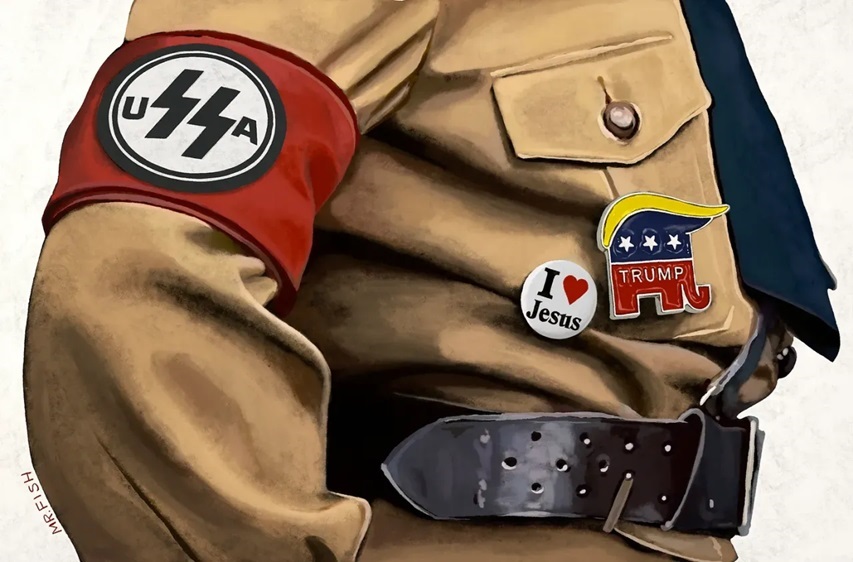
Gangster states have no need of diplomacy. Trump and Rubio, for this reason, have gutted the State Department, along with other forms of “soft” power that achieve influence without resorting to force, including the U.S. role in the United Nations
By Chris Hedges , ScheerPost
“We live in a world in which you can talk all you want about international niceties and everything else, but we live in a world, in the real world, Jake, that is governed by strength, that is governed by force, that is governed by power. These are the iron laws of the world that have existed since the beginning of time.” — Stephen Miller to Jake Tapper on CNN, Jan. 5, 2026.
“He who would live must fight. He who does not wish to fight in this world, where permanent struggle is the law of life, has not the right to exist. Such a saying may sound hard; but, after all, that’s how it is.” — Adolf Hitler in Mein Kampf
“The Fascist State expresses the will to exercise power and to command. Here the Roman tradition is embodied in a conception of strength. Imperial power, as understood by the Fascist doctrine, is not only territorial, or military, or commercial; it is also spiritual and ethical… Fascism sees in the imperialistic spirit — i.e., in the tendency of nations to expand — a manifestation of their vitality.” — Benito Mussolini in The Doctrine of Fascism
ll empires, when they are dying, worship the idol of war. War will save the empire. War will resurrect past glory. War will teach an unruly world to obey. But those who bow down before the idol of war, blinded by hypermasculinity and hubris, are unaware that while idols begin by calling for the sacrifice of others, they end by demanding self-sacrifice. Ekpyrosis, the inevitable conflagration that destroys the world according to the ancient Stoics, is part of the cyclical nature of time. There is no escape. Fortuna. There is a time for individual death. There is a time for collective death. In the end, with weary citizens yearning for extinction, empires light their own funeral pyre.
Our high priests of war, Donald Trump, Marco Rubio, Pete Hegseth, Stephen Miller and the Joint Chiefs of Staff Chairman Gen. Dan “Razin” Caine, are no different from the fools and charlatans who snuffed out empires of the past — the haughty leaders of the Austro-Hungarian Empire, the militarists in imperial Germany and the hapless court of Tsarist Russia in World War I. They were followed by the fascists in Italy under Benito Mussolini, Germany under Adolf Hitler and the military rulers of imperial Japan in World War II.
These political entities committed collective suicide.
They drank the same fatal elixir Miller and those in the Trump White House imbibe. They too tried to use industrial violence to reshape the universe. They too considered themselves to be omnipotent. They too saw themselves in the face of the idol of war. They too demanded to be obeyed and worshiped.
Destruction to them is creation. Dissent is sedition. The world is one-dimensional. The strong versus the weak. Only our nation is great. Other nations, even allies, are dismissed with contempt.
These architects of imperial folly are buffoons and killer clowns. They are ridiculed and hated by those rooted in a reality-based world. They are followed slavishly by the desperate and the disenfranchised. The simplicity of the message is its appeal. A magic incantation will bring back the lost world, the golden age, however mythic. Reality is viewed exclusively through the lens of ultranationalism. The flip side of ultranationalism is racism.
“The nationalist is by definition an ignoramus,” wrote Yugoslav-Serbian novelist Danilo Kiš. “Nationalism is the line of least resistance, the easy way. The nationalist is untroubled, he knows or thinks he knows what his values are, his, that’s to say national, that’s to say the values of the nation he belongs to, ethical and political; he is not interested in others, they are no concern of his, hell — it’s other people (other nations, other tribes). They don’t even need investigating. The nationalist sees other people in his own image — as nationalists.”
These stunted human beings are unable to read others. They threaten. They terrorize. They kill. The art of power politics between nations or individuals is far beyond their tiny imaginations. They lack the intelligence — emotional and intellectual — to cope with the complex, ever-shifting sands of old and new alliances. They cannot see themselves as the world sees them.
Diplomacy is often a dark and deceptive art. It is by its nature manipulative. But it requires an understanding of other cultures and traditions. It requires getting inside the heads of adversaries and allies. For Trump and his minions, this is an impossibility.
Skillful diplomats, such as Prince Klemens von Metternich, the Austrian Empire’s foreign minister who dominated European politics after the defeat of Napoleon, do so by crafting agreements and treaties such as the Concert of Europe and the Congress of Vienna. Metternich, no friend of liberalism, adroitly kept Europe stable until the revolutions of 1848…………………………………………………………………………………………………………….
Gangster states have no need of diplomacy. Trump and Rubio, for this reason, have gutted the State Department, along with other forms of “soft” power that achieve influence without resorting to force, including the U.S. role in the United Nations, the U.S. Agency of International Development, the U.S. Institute for Peace — renamed Donald J. Trump Institute of Peace after most of the board and staff were fired — and Voice of America.
Diplomats in gangster states are reduced to the role of errand boys. Hitler’s Foreign Minister, Joachim von Ribbentrop, whose primary experience in foreign affairs before 1933 was selling fake German champagne in Britain, appointed party hacks from the SA or Brownshirts — the paramilitary wing of the party — to diplomatic posts abroad. Benito Mussolini’s Foreign Minister was his son-in-law, Galeazzo Ciano. Mussolini — who believed that “war is to man what maternity is to woman” — later executed Ciano for disloyalty. Trump’s Special Envoy to the Middle East, Steven Charles Witkoff, is a real estate developer, often accompanied on diplomatic missions by Trump’s feckless son-in-law Jared Kushner.
The Italian philosopher Benedetto Croce quipped that fascism had created a fourth form of government, “onagrocracy,” a government by braying asses, to add to Aristotle’s traditional triumvirate of tyranny, oligarchy and democracy.
Our ruling class, Democrats and Republicans, piece by piece, dismantled democracy. In Germany and Italy, the constitutional state, as well, collapsed long before the arrival of fascism. Trump, who is the symptom, not the disease, inherited the corpse. He is making good use of it. https://scheerpost.com/2026/01/09/chris-hedges-grand-illusion/
Bombshell: A Story of Truth in the Face of Censorship
Elizabeth Smith, NTI 6th Jan 2026 https://www.nti.org/risky-business/bombshell-a-story-of-truth-in-the-face-of-censorship/
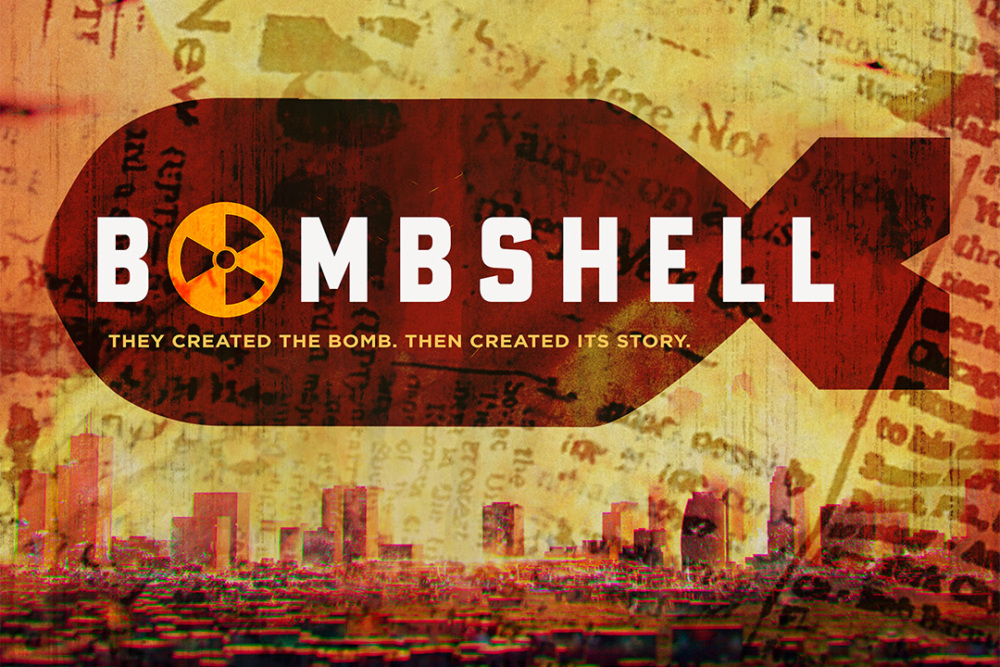
What does it take to reveal truth in the face of censorship? A fascinating new PBS documentary, Bombshell, tells the story of the U.S. government’s efforts to cover up the impact of the 1945 atomic bombings of Hiroshima and Nagasaki, and the journalists who witnessed the devastation and spoke up.
Bombshell provides a detailed account of the U.S. government’s campaign to sanitize the reality of the widespread death and destruction caused by the first use of a nuclear weapon in war, including by constructing a narrative that the bombings allowed for a humane exit from World War II.
Initially, when President Truman announced the Hiroshima bombing to the American people, he reported that the bomb had been dropped on a military target. In fact, the bomb had intentionally targeted the center of the city, not a military base on its outskirts, to maximize the psychological impact on civilians. Tens of thousands of people were killed instantly and by the end of the year, as many more succumbed to radiation poisoning, as many as 140,000 were dead.
In the early months that followed the August bombings of Hiroshima and, three days later, Nagasaki, the U.S. military downplayed the human impact of the bombs with journalists, especially the devastating—and indiscriminate—effects of nuclear radiation.
The racial politics of the time also shaped who was heard, as a small set of journalists attempted to report the truth. In Autumn 1945, when Japanese and Japanese-American journalists like Yoshito Matsushige and Leslie Nakashima tried to describe what they and their families had experienced, U.S. officials labeled their work as propaganda and actively attempted to discredit them. Around the same time, Black intellectuals like Langston Hughes and Zora Neale Hurston were among the first to express outrage at the bombings; they saw Japanese civilians as fellow people of color and sought to humanize their suffering, questioning whether the United States would have committed an atrocity of this scale on a European country. Mainstream news sources sidelined their work.
Eventually, the truth began to take root. Charles Loeb, a well-regarded Black journalist with a medical background, was one of the first American journalists to write about the effects of radiation, drawing on his medical training to understand the abnormalities he had witnessed. Later, The New Yorker asked John Hersey to report on the impact of the bombings. When he decided to shift focus towards the human toll of the bombs, it became clear that one article could not do justice to the lives impacted. The New Yorker ultimately devoted an entire issue to Hersey’s reporting, marking the first coverage of the bombs’ human impacts in mainstream media and resulting in the seminal book titled simply, Hiroshima.
Bombshell lays bare the power of narratives—and counter narratives. It shows, with infuriating and heartbreaking precision, how misinformation about the bombings influenced public opinion.
It also is a testament to the essential role of journalism, the importance of listening to those with different perspectives, and the need to pay attention to those who challenge prevailing narratives. Otherwise, we overlook history’s most crucial lessons.
British and European leaders have shown themselves weak and complicit in the kidnapping of Maduro.
Ian Proud, Jan 08, 2026, https://thepeacemonger.substack.com/p/british-and-european-leaders-have?utm_source=post-email-title&publication_id=3221990&post_id=183823495&utm_campaign=email-post-title&isFreemail=true&r=1ise1&triedRedirect=true&utm_medium=email
The US attack on the Venezuelan capital of Caracas and kidnapping of President Maduro and his wife was illegal under international law. British and European leaders tacitly supporting US actions through silence is weak and will damage further their reputations in the developing world.
The UN Charter was agreed in 1945 to ensure that countries no longer interfered in the sovereign affairs of other countries. Of course, that legal basis was built on shaky foundations, as the outline of post-war borders was complex and in many parts of the world disputed, including in Europe. The Second World War ended at a time when Britain and other European nations were accelerating their departure from colonialism, creating wholly new sovereign states based on former colonial boundaries.
The UN charter didn’t and does not try to rewrite the map of the world. Nor does it seek to impose a template for how countries are governed. The countries of the world continue to be led by a mix of monarchies, democracies and autocracies in many shapes and sizes.
No country has a right to impose its will or preferred mode of governance on another country, however dysfunctional that country may be. In the case of Venezuela, few would argue that it is a democracy in the purest sense, despite the holding of elections. That some countries consider prior Venezuelan elections to have been rigged is immaterial under the UN Charter. No third country can interfere violently in the affairs of another state, even if that state appears a violent dictatorship.
I personally do regard Nicolas Maduro as, at the very least, an authoritarian leader who is predisposed to undemocratic and repressive means to govern his people. But I could say the same about countless other countries, not only in Latin America but in Africa, the middle east and Asia.
Europe itself, while governed by seemingly democratic systems, has stood accused by the US in this past year of being anti-democratic by stifling free speech and choreographing the appearance of democracy with the help of a compliant media. The institutions of Europe are by design anti-democratic, as citizens do not have the opportunity directly to choose any of the six so-called Presidents in charge, nor their unelected aides-de-camp, however they are called.
So, love him or, in many liberal cases, loathe him, western leaders aren’t given a say under international law about whether Nicolas Maduro is the rightful leader of Venezuela.
In the case of the US, that country has justifiable concerns about the flood of drugs channelled through Venezuela that reach its shores and ruin the lives of people addicted to substance misuse. This is undoubtedly a legitimate national security interest for the Americans and gives them the right to act to prevent these hostile acts, including, should they choose, through the use of force. Without getting into the wider debate about US attacks on alleged drug boats, those actions, nevertheless, are still governed by international human rights law.
They do not give the USA the right forcibly to depose a serving President, however unpalatable a character he may be.
That UK and European leaders have tacitly, though their silence of US actions, come out in support of the overthrow of Maduro speaks more of international relations, not international law.
They have set themselves up as judge and jury from affair, on the basis that they agree with the US assessment that Maduro is the wrong sort of leader for Venezuela. For all the pontification about letting Venezuelan people decide, Euro-elites aren’t bright enough to realise that they are aiding and abetting Donald Trump in making a choice on Venezuela’s behalf.
This theatre played out vividly at the UN Security Council on Monday 5 January in which the various European states represented at the table, one by one, refused even to mention the actions of the US in overthrowing Maduro in their statements. Echoing Prime Minister Keir Starmer’s refusal to denounce US actions, the UK’s Representative at the table, James Kariuki, who unfortunately I know of old, stuck to remarking on the undemocratic nature of Nicolas Maduro, the need for a transition to democracy and to abide by international law. And nothing else.
No mention of the fact that US actions were in breach of international law. No mention of the unilateral military attack by the US on Venezuela’s capital nor the kidnapping of Maduro. Simply, Maduro is bad, too bad, let’s find someone new to replace him, of whom, implicitly, we approve.
Every other European state at the table, including Greece, France, Latvia and Denmark, offered a slightly longer-winded version of the same position. The Danes were a little more nuanced, given their not misplaced fear, that they may be next, if America decides to make a move to annex Greenland illegally.
And therein the root cause of the British and European positioning. European foreign policy appears to rest almost entirely on a desire not to offend President Trump.
In London, Riga, Paris and Copenhagen, leaders still cling to the hope that President Trump will, through flattery, still support their efforts to maintain a proxy war in Ukraine.
That if they refuse to denounce him over Venezuela, he might eventually come round again to the idea of regime change in Moscow, through a war in Ukraine that leaders continue to fantasise is winnable when all the evidence suggests otherwise.
So, the requirements of international law have become entirely incidental to the foreign policy imperative of defeating President Putin and, hopefully, perhaps, seeing him, cuffed and blindfolded, whisked off in a US military helicopter to a kangaroo court in New York. Everything else, including the requirements of the UN Charter, is simply inconvenient detail.
Yet, ultimately, Britain and Europe remain weak and unable substantively to influence President Trump’s actions, rendering them weak and as passengers on a runaway US train as it relates to Ukraine policy.
Unfortunately, countries across the developing world – including the Latin American countries at the Security Council who to varying degrees denounced the US move – will have been shocked by the position Britain and Europe has taken. That their leaders are clinging on vicariously to a western hegemon, in which the US acts as global policemen, and they stand back, aghast, while offering obsequious applause.
The main beneficiary of this will, of course, be China and to some extent Russia who have progressively railed against western dominance through alternative global political fora for dialogue and mutually beneficial cooperation. I should think the queue of countries lining up to join BRICS will grow longer after this illegal US attack on Venezuela.
Oil Companies Are Key Partners in Trump’s Imperial Plans for Latin America

Stocks in ExxonMobil, Halliburton, and ConocoPhillips surged the day after Trump’s illegal attack on Venezuela.
By Derek Seidman , Truthout January 8, 2026
or months, U.S. President Donald Trump proclaimed that his pressure campaign against the government of Venezuelan President Nicolás Maduro, backed by dozens of illegal killings through drone strikes, was about fighting drugs and cartels. But at his press conference after the U.S. abduction of Maduro, Trump couldn’t stop talking about oil.
“We’re gonna take back the oil,” Trump brazenly said. “Very large United States oil companies” will “go in” and “spend billions of dollars,” he promised. “We’re gonna be taking out a tremendous amount of wealth out of the ground.”
All told, Trump uttered the word “oil” at least 20 times during the press conference. Oil company stocks — ExxonMobil, Halliburton, ConocoPhillips, Valero, Phillips 66 — surged the following day, with Chevron, the only major U.S. oil corporation with a current foothold in Venezuela, seeing its share value jump more than 5 percent.
Further demonstrating the administration’s drug accusations to be mere propaganda, the Justice Department recently dropped its longstanding claim that Maduro was the head of “Cartel de los Soles,” implicitly conceding that it is indeed not a drug cartel but a slang term referring to political officials who have become corrupted by drug money.
The Trump administration’s barefaced imperial grab for Venezuela’s oil is fraught with challenges, and it’s far too early to predict what will happen. But its abduction of Maduro and effort to gain control over Venezuela’s oil industry aligns with the administration’s openly stated vision of reasserting undisputed political and economic hegemony across the Americas and the Caribbean, including control over natural resources and trade routes, through gunboat diplomacy backed by military threats. In doing so, Trump is looking to corporate allies like Chevron, which could stand to benefit handsomely from his administration’s action — though this is far from guaranteed……………………………………………………………………………………………………………………………………………………https://truthout.org/articles/oil-companies-are-key-partners-in-trumps-imperial-plans-for-latin-america/?utm_source=Truthout&utm_campaign=26a84c82c8-EMAIL_CAMPAIGN_2026_01_08_10_43&utm_medium=email&utm_term=0_bbb541a1db-26a84c82c8-650192793
Oil in Venezuela: Strangulation, Not a Steal
8 January 2026 David Tyler, https://theaimn.net/oil-in-venezuela-strangulation-not-a-steal/
It’s not drill baby drill, after all. Picture a vast, rusting skeletal oil rig off Venezuela’s coast, derricks frozen mid-stroke like the limbs of some colossal fossil. If you’ve heeded Stenographers R Us, the mainstream international media franchise embedded with the rich the powerful and the fabulously ruthless, you’d think Washington’s frenzy over this country boils down to a simple heist. But you’d be wrong.
Put to one side Bull Dust Trump’s buccaneering fantasy, a daring smash and grab raid for the world’s largest proven oil reserves, a tanker-load of cut-price fuel so cheap that every man can run at least one Ram V8 or Ford F-Series truck. And one for the little woman. Above all, it’s the heist that pays for itself. You steal Venezuela’s oil. Take over their country. All free of charge; funded by the plundered oil.
Trump’s lying. Of course. Like his career as a deal-maker, turning Caracas into a McDonald’s hamburger franchise is a fantasy founded on a fiction based on a lie, pure and simple. Behind the headlines, see the levers of power post-Maduro’s Manhattan manacles, muffs and blindfold, the full, Gitmo rig, and a sharper, more sinister pattern swims into view. Not just touring the trophy in a van with the back door open. This isn’t about nicking the black gold. It’s all about the chokehold, a slow but sure squeeze to block off the oil, denying the flow not just to Venezuela, but to anyone who dares defy The Hulk.
The Chokehold Takes Shape
Cast your mind back to the early 2010s. US sanctions began to creep from diplomatic tiffs to industrial strength sabotage. PDVSA, Venezuela’s state oil mammoth, didn’t just falter; it was engineered into failure. Spare parts were embargoed, rigs starved of foreign cash, refineries left to rust in the tropical brine and the sulphur that makes the nation’s heavy, treacle-thick crude, notoriously hard to refine.
Output didn’t dip, it plummeted from three million barrels a day to under 800,000. The Intercept, and Democracy Now! map the blueprint: not haphazard penalties, but a calculated corrosion of the coronary arteries of the economy. And here’s the exquisite irony in the crude itself; that heavy, sour Venezuelan black isn’t some elixir of cheap bounty.
It demands bespoke refineries, the kind that gobble margins unless global prices pitch high, say at the $60-70 per barrel sweet spot for US shale outfits. By idling millions of barrels, Washington doesn’t just punish Caracas; it rigs scarcity, propping up prices for its own patch and Saudi bedfellows.
Why would the planet’s oil glutton sabotage a gusher? Follow the boardroom gaze across the trading floors: scarcity keeps the market taut, volumes crimped, returns plump for the anointed players. The Grayzone and The Real News call it engineered sabotage, with Chevron and Exxon not clamouring for a bargain-bin blowout, but biding time for PDVSA’s orderly dismemberment and disembowelling. It will be privatised, of course, to some asset-stripper, on terms dictated from Foggy Bottom.
The Empire’s Ledger: Workers Foot the Bill
Yet no imperial romp runs on fairy dust, and the tab for this buccaneering lands not in some mythical oil jackpot, but squarely on the brows of ordinary Americans. Imagine the bills: 80 billion dollars a year vanishing into overseas bases, the concrete teeth enforcing sanctions and glowering at rivals across 25 countries since 2001.
Tack on another 62 billion in fossil fuel subsidies; bargain priced pollution, tax loopholes ladled to a coterie of oil titans, as with our gas industry, and the mathematics unmasks itself. The truck driver filling up at dawn, the nurse tallying grocery receipts inflated by freight costs: they’re clobbered doubly, once by the pump’s regressive bite from jacked global crude, again by tax dollars greasing the imperial gears. No plunder’s bounty offsets it; this is a quiet expropriation from wage packets to corner suites.
Now widen the lens to Latin America, where the rogue elephant lumbers, trunk swinging. Step forward Marco Rubio, son of Cuban exiles, his irony bypass a marvel of surgical precision. There he is on ABC’s 7:30 Report, cool as a Miami breeze, labelling Havana a “huge problem” mired in “a lot of trouble” for cradling Maduro; ripe, he implied, for Uncle Sam’s rapture. Rubio has the gall to scorn Cuba’s “senile incompetents” while a demented Donald Trump cheers intervention and why stop with Venezuela?
Trump paints Colombia’s Petro a narco-overlord and Mexico’s Sheinbaum a cartel consort.
Cuba’s original sin harks to 1959, when Fidel Castro’s revolution swept away the neon bordello Washington had bankrolled. Havana wasn’t just a city then; it was an offshore playground for Mafia dons and sugar barons, gangsters and generals carousing amid the roulette wheels while peasants toiled in the cane fields. Paradise Lost. Be not afraid. Trump has the team to turn back the clock.
Socialism didn’t just nationalise assets; Cuba reclaimed dignity, dodging the fate of a permanent Americano brothel. The reprisal? The Bay of Pigs bloodbath, a six-decade embargo tighter than a drum, whispers of invasion perennially on the wind. Rubio’s ire isn’t bungled governance; it’s the gall of autonomy. Now Venezuela’s shell is broken, Havana may well be next; Latin America is no mere backyard, but a type of professional wrestling tournament where Trump shows off US muscle.
China’s Jolt: Crude Hijacked, Chains Rattled
Beijing, too, savours the aftershock. Picture the tankers rerouted: China guzzles 60-90% of Venezuela’s exports, some 470,000 barrels daily. That’s 4-7% of its total crude thirst, a sliver that balloons to strategic heft in a 30-35% import pool menaced by US writ (Iran in the crosshairs too).
Trump’s hijack doesn’t just nick barrels; it disrupts The Panda’s supply lines, spiking costs and forcing frantic diversification. Beijing’s Foreign Ministry thunders condemnation, pledging legal armour for billions in PDVSA loans, but the calculus shifts: no Taiwan gambit while Washington clutches the taps.
Trump: Puppet or Pyromaniac for Neocon Zealots?
Spare us the fairy tale about “transactions”.
Trump isn’t negotiating. He is issuing demands. He is the public face for a crowd that thinks power makes the rules. Stephen Miller says the quiet part out loud: America has “rights” to Greenland, and the military is “always an option”. That is not diplomacy. It is threat.
Greenland is the test case.
If the United States says it can take what it wants from an ally’s territory, then NATO is no longer a defensive pact. It becomes a protection racket. Denmark’s Prime Minister is right to spell out the obvious: if an ally is the aggressor, Article 5 becomes meaningless. The alliance stops. The guarantee dies. The post-war settlement cracks.
Europe can see it. Britain, France, Germany can mouth support for Denmark’s sovereignty, but the damage is already done. You cannot demand unity on Ukraine while leaning on a founding member with a bully’s grin. You cannot preach rules and practise coercion.
This is the return of gunboats.
The language changes first. “Rights” becomes a blank cheque. “Security” becomes a pretext. “Options” becomes a threat. Then the map changes. Resources become the prize: minerals, oil, shipping lanes, bases, ice. Sovereignty becomes conditional. Obedience buys “stability”. Independence buys punishment.
Greenlanders don’t want American rule. Danes are no longer sure America is a safe partner. That is what this behaviour produces: distrust, hedging, rearmament, fragmentation. Not order. Not peace. Not alliance.
And it’s the same playbook in Venezuela.
Venezuela’s mistake was not incompetence alone. It was disobedience. It traded with Russia and China. It tried to keep control of its crude and its policy. For that, it was put in a vise. Sanctions dressed up as morality. Pressure dressed up as rescue. A national oil company turned into a target.
The aim is simple: break the state, break the industry, and decide the terms of recovery. Not to “liberate” Venezuelans, but to control the output, the contracts, and the alignments. To make sure rivals don’t benefit. To make sure the price, and the leverage, stays where Washington wants it.
Call it what it is.
Greenland is not a quirky real estate stunt. Venezuela is not a humanitarian project. They are chapters in the same doctrine: America takes, others comply, and law follows power like a dog behind a ute.
If you keep pretending it’s “dealmaking”, you help the fraud along.
Name the grip. Or live inside it.
This article was originally published on URBAN WRONSKI WRITES
Venezuela today. Greenland tomorrow?
9 Jan 26, https://secure.declassifieduk.org/page/email?mid=8c66e2426c734ac1a627c6af5564d142
During the early hours of Saturday morning, US forces bombed Venezuela and kidnapped its president, Nicolás Maduro.
The objective, according to US president Donald Trump, was to secure access to Venezuela’s massive oil reserves and assert US domination over the hemisphere, pushing out geopolitical rivals like China, Russia, and Iran.
Venezuelan authorities will soon be “turning over between 30 and 50 MILLION Barrels of High Quality Oil… to the United States of America”, Trump wrote on social media.
The Trump administration also told Venezuela’s interim president Delcy Rodriguez that “the country must kick out China, Russia, Iran, and Cuba and sever economic ties”, according to ABC News.
Keir Starmer, a former human rights lawyer, has repeatedly refused to be drawn on whether the kidnapping of a foreign head of state was a violation of international law.
“Are we willing to risk damaging our most important economic and national security partnerships as a result [of condemning Trump]?”, the prime minister reportedly asked colleagues.
Yvette Cooper, Britain’s foreign secretary, could only bring herself to say that she had “raised the importance of complying with international law” with her US counterpart, Marco Rubio.
Yet pressure is mounting on Starmer’s government to respond in concrete terms to the attack, with UN human rights chief Volker Turk now spelling out its brazen illegality.
“It is clear that the operation undermined a fundamental principle of international law – that States must not threaten or use force against the territorial integrity or political independence of any state”, he said in a statement on Wednesday.
With the dust still settling in Caracas, Trump has now turned his imperial gaze to Greenland, a semi-autonomous Arctic territory of the kingdom of Denmark, which is a member of NATO. The White House says it has been discussing “a range of options” to acquire Greenland, including military force, referring to the issue as a “national security priority”. Greenland might seem quite apart from Venezuela in geographical, political, and cultural terms, but the US government has long folded both regions into its designs for hemispheric domination. After the German invasion of Denmark in April 1940, US secretary of state Cordell Hull declared “Greenland is within the area embraced by the Monroe Doctrine”, an 1823 doctrine which has been repeatedly relied upon to assert US hegemony in the Americas During the Cold War, the US army stationed 48 surface-to-air nuclear weapons and air-to-air missiles at Thule air base on Greenland, while a US army research and development facility was established beneath the territory’s icecap. Washington’s current interest in Greenland, however, has more to do with its location for military purposes, the opening of trade routes in the Arctic Ocean (which will increase in importance amid climate change) and the island’s richness in critical minerals like lithium and cobalt. While Starmer reserved judgment on Trump’s illegal attack on Venezuela, he has signed a joint statement alongside France, Germany, Italy, Poland, Spain, and Denmark, affirming “Greenland belongs to its people”. But will Starmer actually take any meaningful action to stand up to Trump? “Nobody’s going to fight the US over the future of Greenland”, said Trump’s aide Stephen Miller on Tuesday. He might just be right. |
Golden Dome changes both NATO and the EU.

Now the wording is changed to: “The United States will deter – and defend its citizens and critical infrastructure – against any airstrike against its territory“. The level of ambition has been raised significantly.
Av Ingolf Kiesow, The Royal Swedish Academy of War Sciences (Kungliga Krigsvetenskapsakademien 22 dec 2025
SIPRI’s 2024 yearbook is titled “Role of nuclear weapons grows as geopolitical relations deteriorate.” The content of that statement has grown in importance in 2025.
Golden Dome
On January 27, 2025, just a few days after taking office for a new term as President of the United States, Donald Trump signed an “Executive Order” to the US Department of Defense – now called the “War Department” – to build a missile defense system, what he later came to call “The Golden Dome”.
According to a statement by the then Department of Defense (now the “Ministry of War”), the Golden Dome will “unify a range of capabilities to create a system of systems to protect the United States from air attack by any aggressor“. Congress approved $24,5 billion for the purpose on September 5.
Donald Trump has said that this grant should be seen as a first installment and that the entire project should be fully operational before his presidential term ends.
He said in May that the total cost could be estimated at $175 billion. The Congressional Budget Office has since estimated that it will cost more than $500 billion. Other observers argue that the need to continuously replace satellites in the system, as Earth’s gravity pulls them out of orbit, means that the cost will exceed a trillion or several trillion dollars before it can be operational.
A first contract under Golden Dome was signed on November 4. Space X will receive $2 billion to build a system of 600 satellites with Lockheed Martin to create an “Air Moving Target Indicator (AMTI).” These low-altitude satellites will detect and track advanced threats from maneuvering glide missiles and stealth aircraft and then feed the data obtained into the US missile defense targeting system.
Congress has pointed out that the US missile defense strategy has so far been formulated as the US striving afterr “to defend against rogue states as well as against unauthorized or accidental missile launches while relying on nuclear weapons to deter China and Russia from striking American territory“.
Now the wording is changed to: “The United States will deter – and defend its citizens and critical infrastructure – against any airstrike against its territory“. The level of ambition has been raised significantly.
The relationship between the White House and Congress on the Golden Dome is marked by suspicion. In a statement, the Congressional Office laments that the administration has failed to provide the public with a detailed account of the project, has not held meetings with representatives of the business community, and has reportedly instructed military officials not to discuss the Golden Dome publicly.
Reactions to the Golden Dome
On May 8, China and Russia issued a joint statement criticizing the project for undermining the link between strategic offensive weapons and strategic defensive weapons, i.e. the very idea of a nuclear balance. Russian press spokesman Peskov said that while a decision on Golden Dome is a sovereign matter for the United States, it is also in the common interest of both countries to create a new legal framework to replace the no longer functioning nuclear arms treaties between the United States and Russia.
However, as of the end of October 2025, no preparations for negotiations on US-Russian arms control have been initiated. Donald Trump is said to have said that it might be a good idea, but without wanting to discuss the matter in more detail. On January 5, 2026, the only Russian-American arms control agreement still in force, the so-called New START agreement, expires.
In addition to China and Russia, there has also been criticism in the West that the US is trying to make the US invulnerable to nuclear attack with Golden Dome and thereby create a strategic advantage. This would damage the balance that has so far rested on the theory of mutual deterrence, a concept that also presupposes a certain degree of mutual vulnerability.
China shows off its weapons
China celebrated the eightieth anniversary of its victory over Japan in World War II with a military parade in Beijing on October 3 of this year. The parade was characterized by three things: coordination with the authoritarian countries of the world, the focus of Chinese defense on preparations for a war with the United States, and the belief that the next war will be fought globally.
Vladimir Putin and Kim Jong Un sat on either side of Xi Jinping during the parade, and among the invited guests were a large majority of presidents and prime ministers from the global south.
The new weapons systems on display included new advanced fighter jets, tanks, hypersonic anti-ship missiles and long-range rocket artillery. Three different groups of missile systems were displayed: five nuclear-capable systems, three cruise missile systems and three hypersonic missile systems.
The direction has been interpreted abroad as a warning to the United States not to try to oppose a possible upcoming attempt to invade Taiwan and to keep the United States away from the waters along China’s coasts in the Pacific Ocean.
FOBS has been a headache for the Pentagon
The presence of a Fractional Orbital Bombardment System (FOBS) in both Russia and China has been a particular concern for Western defense forces in recent times. This is especially true since China conducted a pair of test flights in the summer of 2021, when a launch vehicle was launched into orbit around the Earth and a hypersonic glide missile was released, which re-entered the atmosphere on the other side of the world and hit a designated target. The launch vehicle remained in a relatively low-altitude orbit (around 150 kilometers) and the entire crew moved at hypersonic speed the entire way, making them very difficult – almost impossible – to detect and combat.
Some of the missiles displayed at the military parade may be included in FOBS, which would mean that production and supply to units is ongoing.
After China’s first hypersonic missile flight, it took the United States several years to build a similar system and get the missiles flying, which has been a major concern for the Pentagon. The lack of a US system to defend against FOBS has been explicitly cited by the Defense Intelligence Agency as one of the reasons for introducing Golden Dome.
Truce in the trade war with China, but not peace and no deal………………………………………………………………………………….
……………………………………………………………………. Since NATO is designed to function under American leadership, Europe must now create its own organization in peacetime in order to be able to function without or at least with weakened support in wartime. That is the only conclusion that seems logical to draw in the light of this article. Whether such an adaptation can take place within the framework of NATO or can best be done within the EU or through the creation of an entirely new European defense organization has become a pressing question.
How Europe should dispose of its own nuclear weapons assets to deter Russia from attacking is also an issue that is now demanding attention even in peacetime.
Conclusions for Europe.
In any case, the connection between economic and military strength will play a central role. If the US fails to mobilize the financial resources required for Golden Dome and if the EU fails to find the means to both help Ukraine avoid defeat in the war with Russia and at the same time build up our own defenses, the situation may become difficult to manage.
Since Donald Trump came to power, however, the US has committed serious violations of international law, such as the prohibition of genocide in connection with its support for Israel’s war in Gaza and against the rules on freedom of the seas and human rights in connection with the killing of suspected smugglers from Venezuela and Colombia without prior trial. Being part of NATO and being part of the same alliance as the US is beginning to feel embarrassing to a European.
The nonchalance with the rules of international law also raises uncertainty about how serious the US is about its own membership in NATO and its obligations to help the EU preserve sovereignty over its territory.
Donald Trump’s fickleness and the uncertainty about what the investment in Golden Dome will entail create uncertainty for Europe and the rest of the “West”. For Europe, this means having to walk a balance between the desire not to lose the US as an ally in the long term and, on the other hand, the prospect of perhaps having to face a growing threat from Russia alone. In addition, the US may demand help in its power struggle with China, something that it is not in Europe’s interest to allocate resources to.
Can the EU prepare for a period of reduced American support without irreparably damaging the relationship with the US? Can the EU build a partnership with countries in the global south and even with China that resembles the world trade and payments system that functioned before Xi Jinping and Donald Trump came to power in their respective countries?
Puppet dreams? Yes, maybe, but what choice do we have?
The author is an ambassador and member of KKrVA. https://en.kkrva.se/golden-dome-forandrar-bade-nato-och-eu/
Nuclear Power: Private Sector -Question for UK government
Question for Department for Energy Security and Net Zero
UIN HL13206, tabled on 18 December 2025
Lord Spellar: To ask His Majesty’s Government when they intend to publish a new framework for a private sector route to market for advanced nuclear
technologies.
Lord Vallance: The government will provide a framework that
will set out a pathway for privately led advanced nuclear projects, this framework will be published early this year.
Hansard 6th Jan 2026 https://questions-statements.parliament.uk/written-questions/detail/2025-12-18/HL13206
US will ‘fix’ Cuba and Nicaragua – Republican senator
7 Jan, 2026. https://www.rt.com/news/630708-us-senator-cuba-colombia-nicaragua-to-be-fixed/
Rick Scott issued threats to the socialist countries after American commandos abducted Venezuelan President Nicolas Maduro
Republican US Senator Rick Scott has said that Washington would install a new president in Colombia, as well as “fix” Cuba and Nicaragua.
He made the remarks in an interview with Fox Business, just days after US commandos abducted Venezuelan President Nicolas Maduro and his wife, Cilia Flores, during a raid in Caracas.
US President Donald Trump described the operation as his enforcement of the Monroe Doctrine, designed to ensure Washington’s domination in the Western Hemisphere and said American companies must gain access to Venezuela’s rich oil reserves.
Trump’s actions would “change Latin America,” Scott told Fox on Wednesday. “We’re gonna fix Cuba, Nicaragua will be fixed. Next year, we’ll get a new president in Colombia,” the senator added, declaring that “democracy is coming back to this hemisphere.”
The US first imposed a trade blockade and sanctions on socialist-run Cuba and Nicaragua during the Cold War. Last year, Washington imposed restrictions on Colombia’s left-wing president, Gustavo Petro, whom Trump accused of aiding drug cartels. Petro denied the allegations and has heavily criticized Trump for ordering strikes on alleged narcotics smuggling boats in the Caribbean.
Asked by journalists aboard Air Force One on Sunday whether he was planning to attack Colombia, Trump replied, “It sounds good to me.”
Petro, a former member of a communist guerrilla group, denounced Trump’s threats. “I swore after the 1989 peace agreement never to touch a weapon again, but for the sake of the homeland, I will take up arms once more, even though I do not want to,” he wrote on X earlier this week.
The US Department of Justice indicted Maduro and Flores on drug-trafficking and weapons charges, to which they pleaded not guilty when they were brought before a New York judge on Monday. Venezuela condemned the US operation as a violation of its sovereignty, with Acting President Delcy Rodriguez denying that the country would be ruled by foreign powers.
Delcy Rodríguez swears to uphold sovereignty of the nation as acting president of Venezuela
Rodríguez promised to respect the constitution and uphold national sovereignty following the US attack on Venezuela, which left more than 80 people dead and resulted in the kidnapping of President Nicolás Maduro and his wife.
January 08, 2026 by Pablo Meriguet, https://peoplesdispatch.org/2026/01/08/delcy-rodriguez-swears-to-uphold-sovereignty-of-the-nation-as-acting-president-of-venezuela/
On January 5, Delcy Rodríguez assumed the presidency of Venezuela. The former vice president swore before parliament that she would uphold the constitution and the sovereignty of the nation after the US attack on January 3, in which the US military took President Nicolás Maduro and his wife Cilia Flores prisoner.
The president of the National Assembly, Jorge Rodríguez, urged the president to protect Venezuela “for her honor, for the people of Venezuela, for the example of the Liberators of America to zealously guard our sacred territory.”
Delcy Rodríguez stated that she accepted the task under very difficult circumstances, but that she would not rest until Venezuela was a free, sovereign, and independent nation. “I come with pain for the suffering that has been caused to the Venezuelan people after an illegitimate military aggression against our homeland. [There are] two heroes whom we have as hostages in the United States of America: President Nicolás Maduro and the first combatant of this country, Cilia Flores,” she told Venezuelan parliamentarians.
Rodríguez also promised to ensure an administration that guarantees peace for Venezuelans: “[We will build] a government that provides social happiness, political stability, and political security. [I ask all sectors of Venezuelan society to] move Venezuela forward in these terrible times of threat to the stability and peace of the nation.”
Although Rodríguez initially stated in a Council of Ministers meeting that Venezuela has only one president, Nicolás Maduro, a Supreme Court ruling ordered the vice president to assume the office of president to avoid a power vacuum.
The weight of the most dangerous presidency on the planet
Rodríguez has insisted in her recent speeches that her administration does not imply a break with the Chavista process. In this regard, she has taken every opportunity to demand Maduro’s release and condemn the US military attack. On January 6, Rodríguez declared seven days of national mourning for the death of the “young martyrs” who “gave their lives defending Venezuela and President Nicolás Maduro.”
However, Rodríguez has now inherited an extremely difficult task while in the crosshairs of the most powerful army in the world. Trump himself demanded “full access” to natural resources, while warning of new attacks: “If [the new government] doesn’t behave, we will launch a second attack.”
Trump also stated that major US oil companies will begin operating in Venezuela and that, in addition to making significant profits, they will have to rebuild the South American country’s oil industry.
It is not yet clear what agreements Rodríguez has reached with a US administration that has demonstrated its military power and whose pressure on Caracas has reached levels of violence never before seen against Venezuela.
In this regard, with the threat of more deadly attacks on one hand, a virtually devastated air defense system on the other, and the top leader of Chavismo under arrest, Rodríguez does not have much room for maneuver or negotiation.
Hence, Trump has assured that Venezuela will deliver between 30 and 50 million barrels of oil (worth USD 2.8 billion) in the coming months, and news about the negotiations was confirmed by Venezuelan state oil company PDVSA on Wednesday, January 8.
However, it appears that the Trump administration also recognizes, for the time being, Chavismo as the primary national actor with whom it can negotiate and achieve its geopolitical and economic objectives. Trump has publicly rejected María Corina Machado as the new leader of Venezuela and the idea that elections should be called immediately.
But it is still too early to draw conclusions in a situation that remains unclear amid the dust of missiles, gunfire, and collapsed buildings following the January 3 attack. What is certain is that communication channels have not been closed, nor have the agreements that, it seems, will continue to be made to avoid a new military scenario.
Pope Leo again condemns “zeal for war,” deepening rift with Trump
Axios Jason Lalljee, 10 Jan 26
Pope Leo XIV is continuing to issue indirect critiques about President Trump‘s policies as the U.S. ramps up its intervention in Venezuela.
The big picture: Since becoming pope last May, Leo has made a number of critiques — both subtle and explicit — regarding Trump’s treatment of immigrants as well as his……………………..(Subscribers only) https://www.axios.com/2026/01/09/trump-venezuela-pope-leo
1 This Month

of the week – Shut Down Drone Warfare!


Tell the Ukrainian Government to Drop Prosecution of Peace Activist Yurii Sheliazhenko

Petition to revoke the licensing of the Near Surface Nuclear Disposal Facility (NSDF) at Chalk River. https://www.ourcommons.ca/petitions/en/Petition/Details?Petition=e-7247
To see nuclear-related stories in greater depth and intensity – go to https://nuclearinformation.wordpress.com
-
Archives
- April 2026 (114)
- March 2026 (251)
- February 2026 (268)
- January 2026 (308)
- December 2025 (358)
- November 2025 (359)
- October 2025 (376)
- September 2025 (257)
- August 2025 (319)
- July 2025 (230)
- June 2025 (348)
- May 2025 (261)
-
Categories
- 1
- 1 NUCLEAR ISSUES
- business and costs
- climate change
- culture and arts
- ENERGY
- environment
- health
- history
- indigenous issues
- Legal
- marketing of nuclear
- media
- opposition to nuclear
- PERSONAL STORIES
- politics
- politics international
- Religion and ethics
- safety
- secrets,lies and civil liberties
- spinbuster
- technology
- Uranium
- wastes
- weapons and war
- Women
- 2 WORLD
- ACTION
- AFRICA
- Atrocities
- AUSTRALIA
- Christina's notes
- Christina's themes
- culture and arts
- Events
- Fuk 2022
- Fuk 2023
- Fukushima 2017
- Fukushima 2018
- fukushima 2019
- Fukushima 2020
- Fukushima 2021
- general
- global warming
- Humour (God we need it)
- Nuclear
- RARE EARTHS
- Reference
- resources – print
- Resources -audiovicual
- Weekly Newsletter
- World
- World Nuclear
- YouTube
-
RSS
Entries RSS
Comments RSS
 nuclear-news