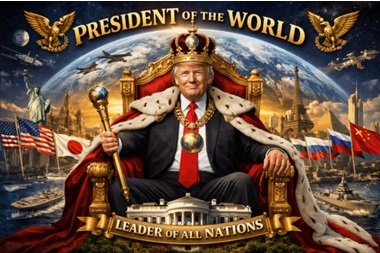
“President of the World” is not a joke – it’s a warning
7 January 2026 Michael Taylor, https://theaimn.net/president-of-the-world-is-not-a-joke-its-a-warning/
Apparently, a Republican has referred to Donald Trump as the “president of the world.” The remark has circulated widely enough to be waved away as hyperbole, trolling, or the sort of rhetorical excess we’ve all learned to mentally file under American political theatre.
That would be a mistake.
Because while the phrase sounds ridiculous – comic-book villain ridiculous – it is also deeply revealing. Not about Trump, who has never been subtle about his view of power, but about how far the language of American politics has drifted from reality, restraint, and even irony.
Calling someone “president of the world” is not just exaggeration. It is an admission. It tells us how power is imagined, how authority is framed, and how limits are quietly discarded.
For most of modern history, even the most dominant empires understood the value of pretense. Rome spoke of provinces, not ownership of the earth. Britain talked of stewardship and civilisation. The United States, at its best, at least gestured toward alliances, multilateralism, and a rules-based order – even when it bent or broke those rules.
What’s new is not American power. It’s the abandonment of embarrassment.
The phrase “president of the world” collapses all the old euphemisms. It dispenses with alliances, sovereignty, and consent. It skips straight to hierarchy. There is a ruler, and there are the ruled. The only remaining question is who gets to pretend otherwise.
Supporters may insist this is just bravado, the rhetorical equivalent of chanting at a rally. But language matters – especially repeated language, and especially when it aligns so neatly with behaviour.
Trump does not speak like the leader of one nation among many. He speaks like an owner. Other countries are not partners; they are assets, dependents, or irritants. Agreements are not commitments; they are deals to be renegotiated or torn up. International law is not a constraint; it is an obstacle.
Seen in that light, “president of the world” is not a joke. It is a job description aspirationally spoken aloud.
What makes this frightening is not that Trump believes it – he has always treated the globe as an extension of his will – but that others are now comfortable saying it without irony. Once, such a phrase would have embarrassed even loyalists. Now it’s floated casually, as though the only thing unusual about global dominance is failing to name it properly.
There is also something revealingly insecure about the claim.
Strong systems don’t need to announce supremacy. They rely on legitimacy, consent, and institutions that outlast individuals. Declaring someone “president of the world” is less a statement of confidence than a confession of longing – for order, for dominance, for a single figure who cuts through complexity with force of will.
It is the language of people tired of democracy’s messiness, who would rather have a boss than a process.
And let’s be clear: no one who believes in democracy, sovereignty, or international law should be comfortable with the idea – even metaphorically. The world is not a corporation. Nations are not subsidiaries. And the office of “global president” does not exist – except in the imaginations of those who resent limits.
The truly unsettling part is how unchallenged this rhetoric has become. There is no widespread recoil, no sharp intake of breath. Just a shrug, a laugh, and a quick pivot to the next outrage. We have normalised language that would once have sounded like satire – or a warning from a dystopian novel.
History suggests that when people start naming emperors before crowning them, the ceremony is already under way.
So yes, calling Trump “president of the world” is absurd. But absurdity does not make it harmless. Sometimes it makes it honest.
And honesty, in this case, is the most alarming part.
Report: Nuclear Power Isn’t Viable In Hawaiʻi

Constitutional issues are the basis for the conclusion of the Nuclear Energy Working Group’s final report for the state energy office.
By Lynda Williams, January 6, 2026 , https://www.civilbeat.org/2026/01/nuclear-power-isnt-viable-in-hawaii/
The Hawaiʻi State Energy Office has released the final report of the Nuclear Energy Working Group created by the Legislature under SCR-136. I served on the working group as a representative of 350 Hawaiʻi.
The report concludes that nuclear power is not viable in Hawaiʻi and that the state should not change its laws or constitution to enable it.
The most fundamental obstacle is legal. Hawaiʻi’s Constitution restricts nuclear fission construction, and nuclear power is excluded from the state’s Renewable Portfolio Standard. These restrictions apply regardless of reactor size, design, fuel type or branding. Small modular reactors and so-called “advanced” reactors are still nuclear fission reactors. Making nuclear power legal in Hawaiʻi would require amending the constitution — a process that requires a two-thirds legislative vote. The working group did not recommend taking this step.
Beyond the law, the technology itself remains unfeasible. No advanced nuclear reactors are operating commercially in the United States, and none are expected to come online in any timeframe relevant to Hawaiʻi’s energy or climate goals. Projects cited by nuclear advocates remain stuck in licensing pipelines, demonstration phases or heavily subsidized pilot programs.
Without commercially operating reactors, reliable cost estimates, construction schedules, or grid-integration analyses do not exist. Nuclear power cannot meaningfully address climate change when it cannot be deployed at scale.
The report also acknowledges that radioactive waste is a decisive and unresolved problem. There is no permanent disposal repository operating anywhere in the United States. Hawaiʻi has no capacity to store or manage spent nuclear fuel, and no federal facility exists to accept it.
The Hawaiʻi Constitution explicitly bars nuclear waste storage and disposal facilities unless approved by a two-thirds vote of both legislative chambers. Any nuclear project would therefore require indefinite on-island storage of radioactive material in direct conflict with the constitution, creating ongoing risks related to containment failure and transport. For an isolated island state, this reality alone makes nuclear power unrealistic.
The Hawaiʻi State Energy Office has released the final report of the Nuclear Energy Working Group created by the Legislature under SCR-136. I served on the working group as a representative of 350 Hawaiʻi.
The report concludes that nuclear power is not viable in Hawaiʻi and that the state should not change its laws or constitution to enable it.
The most fundamental obstacle is legal. Hawaiʻi’s Constitution restricts nuclear fission construction, and nuclear power is excluded from the state’s Renewable Portfolio Standard. These restrictions apply regardless of reactor size, design, fuel type or branding. Small modular reactors and so-called “advanced” reactors are still nuclear fission reactors. Making nuclear power legal in Hawaiʻi would require amending the constitution — a process that requires a two-thirds legislative vote. The working group did not recommend taking this step.
Ideas showcases stories, opinion and analysis about Hawaiʻi, from the state’s sharpest thinkers, to stretch our collective thinking about a problem or an issue. Email news@civilbeat.org to submit an idea or an essay.
Beyond the law, the technology itself remains unfeasible. No advanced nuclear reactors are operating commercially in the United States, and none are expected to come online in any timeframe relevant to Hawaiʻi’s energy or climate goals. Projects cited by nuclear advocates remain stuck in licensing pipelines, demonstration phases or heavily subsidized pilot programs.
Without commercially operating reactors, reliable cost estimates, construction schedules, or grid-integration analyses do not exist. Nuclear power cannot meaningfully address climate change when it cannot be deployed at scale.
The report also acknowledges that radioactive waste is a decisive and unresolved problem. There is no permanent disposal repository operating anywhere in the United States. Hawaiʻi has no capacity to store or manage spent nuclear fuel, and no federal facility exists to accept it.
The Hawaiʻi Constitution explicitly bars nuclear waste storage and disposal facilities unless approved by a two-thirds vote of both legislative chambers. Any nuclear project would therefore require indefinite on-island storage of radioactive material in direct conflict with the constitution, creating ongoing risks related to containment failure and transport. For an isolated island state, this reality alone makes nuclear power unrealistic.
Emergency preparedness and regulatory capacity further reinforce that conclusion. Hawaiʻi does not have a nuclear regulatory agency, a trained nuclear emergency-response workforce, evacuation-planning capacity, or land suitable for exclusion zones. These are not minor administrative gaps. They reflect the absence of the institutional and physical capacity needed to respond to potentially catastrophic nuclear accidents.
The analysis also places nuclear power in the context of Hawaiʻi’s history in the Pacific, including nuclear weapons testing and long-term harm to island and Indigenous communities. Public trust cannot be assumed, and meaningful public evaluation is impossible without concrete information about reactor designs, fuel cycles, waste handling, and accident scenarios — information that does not exist.
Hawaiʻi is not alone in facing industry efforts to dismantle state-level protections. Over the past decade, several states with laws restricting or prohibiting new nuclear plant construction — including Wisconsin, Kentucky, Montana, West Virginia, Connecticut and Illinois — have repealed or weakened those laws to allow so-called advanced nuclear technologies such as small modular reactors, often justified by climate or grid-reliability claims. These rollbacks occurred despite the continued absence of commercially operating advanced reactors, the lack of a permanent nuclear waste repository, and mounting evidence that nuclear power cannot be deployed fast enough to play a meaningful role in addressing climate change.
Now is not the time to weaken Hawaiʻi’s protections against nuclear power. At the federal level, environmental protection and public oversight under the National Environmental Policy Act are being aggressively gutted through executive orders and legislation such as the SPEED Act. These measures are designed to shorten environmental review, eliminate meaningful public participation, restrict judicial oversight, and prevent courts from stopping unlawful projects even when agencies violate the law. As federal safeguards are dismantled, Hawaiʻi’s constitutional and statutory protections against nuclear power become more critical, not less.
The report’s only weak point is its suggestion that the state revisit nuclear power every three to five years. Even under the most optimistic assumptions, advanced nuclear reactors, including SMRs, will not be commercially operating, fully tested, or economically viable within that timeframe. Any nuclear reactor operated in Hawaiʻi would require radioactive waste to remain on island for extended periods to cool before transport, and shifting that waste burden onto other Indigenous lands is not an ethical solution and is inconsistent with the values of aloha ʻāina.
Nuclear power is not viable in Hawaiʻi and never will be; the state should instead focus on renewable energy, storage, efficiency, grid modernization and community-centered planning grounded in reality.
Click here to read the final Nuclear Energy Working Group report. You can read more about the Nuclear Energy Working Group at nuclearfreehawaii.org.
Venal Reactions: US Allies Validate Maduro’s Abduction.
5 January 2026 Dr Binoy Kampmark, https://theaimn.net/venal-reactions-us-allies-validate-maduros-abduction/
On the surface, abducting a Head of State is a piratical act eschewed by States. A Head of State enjoys absolute immunity from foreign criminal jurisdiction, known as ratione personae, at least till the term of office concludes. The International Court of Justice was clear enough about this principle in the 2002 Arrest Warrant Case, holding that high ranked government officials such as a foreign minister are granted immunity under customary international law to enable the effective performance of their functions “on behalf of their respective States.”
That said, international law has been modified on this score by the jurisdiction of theInternational Criminal Court, whose founding Rome Statute stipulates that the official standing of a serving Head of State is no exemption from criminal responsibility. The effectiveness of this principle lies in the cooperation of State parties, something distinctly unforthcoming regarding certain serving leaders. (Israeli Prime Minister Benjamin Netanyahu springs to mind.)
US domestic law puts all of this to side with the highwayman logic of the Ker-Frisbie doctrine. Decided in Ker v Illinois in 1886, the decision overlooks the way, lawful or otherwise, a defendant is apprehended, even if outside the jurisdiction. Once American soil is reached, judicial proceedings can commence without challenge. The US Department of Justice has further attempted to puncture ancient notions of diplomatic immunity by recategorizing (how else?) the standing of a leader – in this case Venezuela’s Nicolás Maduro – as nothing more than a narco-terrorist. Maduro was seized, explains US Secretary of State Marco Rubio, as part of a law enforcement operation.
In addition to being a violation of the leadership immunity principle, the January 3 kidnapping of Maduro and his wife by US forces was an audacious breach of the sovereignty guarantee under Article 2 of the United Nations Charter. Operation Absolute Resolve involved 150 aircraft, strikes on military infrastructure including surface-to-air missile and communication systems, and various depots. The security fantasists from the White House to the State Department treated Venezuela as not merely a dangerous narco-state but one hosting undesirable foreign elements, but it has never posed a military threat to the US homeland.
In the face of such unalloyed aggression – a crime against peace, if you will – the response from Washington’s allies has been feeble and worse. This is made all the more grotesque for their claims to purity when it comes to defending Western civilisation against the perceived ogres and bogeymen of international relations: Russia and China.
From the United Kingdom, Prime Minister Keir Starmer could not have been clearer about his contempt for the processes of international law. “The UK has long supported a transition of power in Venezuela,” he declared in his January 3 statement. “We regarded Maduro as an illegitimate President and we shed no tears about the end of his regime.” Having given a coating of legitimacy to the banditry of the Trump administration, he could still claim to “support” international law. His government would “discuss the evolving situation with US counterparts in the days ahead as we seek a safe and peaceful transition to a legitimate government that reflects the will of the Venezuelan people.” Certainly, judging from this, the will of President Donald Trump.
An official statement from the European Union released by its high representative, Kaja Kallas, was even more mealy-mouthed: “The EU has repeatedly stated that Nicolás Maduro lacks the legitimacy of a democratically elected president and has advocated for a Venezuelan-led peaceful transition to democracy in the country, respectful of its sovereignty.”
The tactic here involves soiling the subject before paying some false respect for such concepts as democracy and sovereignty. We can do without Maduro, and won’t miss him, but make some modest effort to respect some cardinal virtues when disposing of him. All those involved should show “restraint […] to avoid escalation and to ensure a peaceful resolution of the crisis.”
The arrogance of this position is underlined by the concession to diplomacy’s importance and the role of dialogue, when there has been no dialogue or diplomacy to speak of. “We are in close contact with the United States, as well as regional and international partners to support and facilitate dialogue with all parties involved, leading to a negotiated, democratic, inclusive and peaceful resolution to the crisis, led by Venezuelans.”
From the Canadian Minister for Foreign Affairs, Anita Anand, there was not a whisper of Maduro’s abduction, or the US breach of the UN Charter. The phantom conveniently called the Venezuelan People stood as an alibi for lawbreaking, for they had a “desire to live in a peaceful and democratic society.” And there was the familiar call “on all parties to exercise restraint and uphold international law,” marvellous piffle in the face of illegal abductions.
Australian Prime Minister Anthony Albanese did little to improve upon the weak formula in his shabby statement, similarly skipping over the violations of the UN Charter and Maduro’s abduction. “We urge all parties to support dialogue and diplomacy in order to secure regional stability and prevent escalation.” A bland acknowledgement of “the need to respect democratic principles, human rights and fundamental freedoms” is made, along with the risible reference to supporting “international law and a peaceful, democratic transition in Venezuela that reflects the will of the Venezuelan people.”
Who, then, are these idealised people? Presumably these Venezuelans are the vetted ones, sanitised with the seal of approval, untainted by silly notions of revolution and the poverty reduction measures initially implemented by the government of Hugo Chávez. But if EU officials and other states friendly to Washington thought that a Venezuelan appropriately representative of the People’s Will might be the opposition figure and travesty of a Nobel laureate, María Corina Machado, Trump had other ideas. To date the Maduro loyalist Vice President Delcy Rodríguez, has caught his fickle eye. “I think,” he said with blunt machismo, “it would be very tough for [Machado] to be the leader. She doesn’t have the support within or the respect within the country. She’s a very nice woman, but she doesn’t have the respect.” The Venezuelan people’s choice will be, putting democracy and dialogue to one side, the same as Trump’s.
CIA Played Instrumental Role in Maduro Kidnapping.
In reality, while U.S. and British companies were involved in early oil exploration in Venezuela, Venezuela’s oil belongs to Venezuela, pursuant to the international law principle of permanent sovereignty over natural resources.
Venezuela’s socialist government, meanwhile, has used oil revenues to adopt social programs for the poor and to develop Venezuela’s economy, accounting for its electoral successes.
The financial elite the CIA serves is now salivating over the prospects of U.S. corporations retaking control of Venezuela’s oil industry
Jeremy Kuzmarov, Substack, Jan 05, 2026
The Trump administration welcomed the New Year by ordering a brazen Special Forces raid into Venezuela that resulted in the kidnapping of Venezuelan President Nicolás Maduro, who was brought to the U.S. to face charges for alleged drug trafficking.
Called Operation Absolute Resolve, the kidnapping had been preceded by months of terrorist activities that included bombing a Venezuelan oil tanker and fishing vessels, resulting in the deaths of more than 100 civilians.
On January 3, The New York Times reported that a CIA source within the Venezuelan government had monitored Maduro’s location in the days and moments before his capture, tipping off the Special Forces about his whereabouts. The CIA also produced the intelligence that led to Maduro’s capture with a fleet of stealth drones.
According to a person familiar with the agency’s work, the CIA was able to recruit informants in Maduro’s inner circle because of the $50 million bounty placed on Maduro’s head.
Donald Trump watched the Operation Absolute Resolve from Mar-O-Lago with CIA Director John Ratcliffe and Secretary of State Marco Rubio. [Source: yahoo.com]
Beginning in August, the informants worked clandestinely to provide the CIA with information about Maduro’s “pattern of life” and daily movements.
The CIA had Maduro so precisely monitored that even his pets were known to U.S. intelligence agents, according to General Dan Caine, Chairman of the Joint Chiefs of Staff and former CIA associate director for military affairs.
In late December, the CIA used an armed drone to conduct a strike on a dock that U.S. officials claimed was being used by a Venezuelan gang to load drugs onto boats.
These actions fulfilled a promise of CIA Director John Ratcliffe in his confirmation hearing that he would lead a more aggressive CIA willing to conduct large-scale covert operations.
Despite claiming to be doing battle with the “deep state,” President Donald Trump authorized the CIA to take more aggressive action last fall and openly authorized CIA operations in Venezuela when the CIA normally operates covertly.
To the Victor Go the Spoils
The symbiotic relationship between the CIA and the financial elite intent on profiting from regime change are epitomized by the CIA’s former Venezuelan station chief, Enrique de la Torre, who advertised immediately after Maduro’s kidnapping that his lobbying firm, Tower Strategy,[1] was supporting clients intent on “rebuilding Venezuela’s energy sector.”
De la Torre published a blog post in late November entitled “The Case for Ending Maduro’s Rule………………
Venezuela’s Bolivarian Revolution under Hugo Chávez (1998-2013) and then Maduro (2013-present) had in fact been designed to establish Venezuela’s economic sovereignty, empower the poor and Indigenous people, and revitalize the legacy of Latin America’s great liberator, Simón Bolívar.
It was opposed by the U.S. financial elite precisely because it threatened to inspire other Latin American and Third World countries to take control over their own economies and limit the influence of American corporations.
Donald Trump echoed de la Torre in stating after the announcement of Maduro’s capture that “we’re going to have our very large United States oil companies, the biggest anywhere in the world, go in and spend billions of dollars and fix the oil infrastructure—the badly broken oil infrastructure—and start making money for the country.”[2]
Similarly, former CIA Director Mike Pompeo told Fox & Friends last week that, in the event of the overthrow of the Maduro government, “American companies can come in and sell their products — Schlumberger, Halliburton, Chevron — all of our big energy companies can go down to Venezuela and build out an economic capitalist model.”
These latter comments combined with de la Torre’s action make clear the agenda behind Operation Absolute Resolve.
Stephen Miller, a top aide to President Trump, openly proclaimed that Venezuela’s oil belongs to Washington, describing the nationalization of Venezuela’s petroleum industry as “theft.”
According to Miller, “American sweat, ingenuity and toil created the oil industry in Venezuela. Its tyrannical expropriation was the largest recorded theft of American wealth and property. These pillaged assets were then used to fund terrorism and flood our streets with killers, mercenaries and drugs.”
In reality, while U.S. and British companies were involved in early oil exploration in Venezuela, Venezuela’s oil belongs to Venezuela, pursuant to the international law principle of permanent sovereignty over natural resources.
The Venezuelan government never actually denied the U.S. access to its oil and, as late as 2017, remained the U.S.’s third-largest foreign supplier of energy.[3]
Venezuela’s socialist government, meanwhile, has used oil revenues to adopt social programs for the poor and to develop Venezuela’s economy, accounting for its electoral successes.
During his presidency from 1998 to 2013, Hugo Chávez cut poverty by 20% and extreme poverty by 30%.
Literacy rates in this period also increased, child malnutrition rates declined dramatically, millions of hectares of state-owned land were distributed, and Venezuela’s UN Human Development Index, a composite measure of national income (GDP), access to education, and child mortality—rose from seventh in the region to fourth.[4]
Maduro was continuing the same trajectory as Chávez, though Venezuela’s economy was undermined during his presidency by declining world oil prices, internal corruption typical of South and North American countries and harsh U.S. sanctions imposed by the Obama, Trump I and Biden administrations, whose purpose was to set the groundwork for regime change.[5]
Long War Against Venezuela’s Left
In Modernizing Repression: Police Training and Nation-Building in the American Century, I detail how the Kennedy, Johnson and Nixon administrations set the groundwork for today’s foreign policy by providing significant police aid to help prop up centrist governments in Venezuela that carried out a dirty war against left-wing movements.
The latter sought to nationalize Creole Petroleum Company, Venezuela’s largest oil company, which was largely controlled by the Rockefeller-owned Standard Oil empire.
Run under the cover of the United States Agency for International Development (USAID), the CIA-led Office of Public Safety (OPS) provided riot-control gear and other repressive police instruments and assisted Venezuelan police in compiling blacklists of left-wing “subversives.”
The OPS’s support for hard-line police tactics was apparent in its push to eliminate the requirement that a policeman who killed a suspect be arrested, paving the way for death-squad activity.
Showing where their true priorities rested, OPS police advisers met monthly with security officials of Creole Petroleum and the major foreign mining companies in Venezuela to discuss “insurgency problems.”……………………………………………………………………………………………………………………………………………………………………………………… https://jeremykuzmarov.substack.com/p/cia-played-instrumental-role-in-maduro?publication_id=2091638&post_id=183483325&isFreemail=true&r=3alev&triedRedirect=true&utm_source=substack&utm_medium=email
Rubio Says “Not a War” as Trump Threatens Half the Hemisphere
By Joshua Scheer, SCHEEPOST, 5 Jan 26
Welcome to another day in the empire we might as well call 1984. Marco Rubio, who only yesterday said the U.S. didn’t need congressional approval because the situation in Venezuela is not a war but the capture of a fugitive, adding, to the BBC saying “That’s not a war. I mean, we are at war against drug trafficking organizations. That’s not a war against Venezuela,”
But has the narrative really shifted, or is this just good cop/bad cop—or whatever you want to call the times we are living in? Meanwhile, with President Trump threatening both the incoming president of Venezuela and other left-leaning nations, the United States seems to be lurching toward a space where it resembles a new Rome—a power with seemingly no regard for history.
That was made clear in an interview with The Atlantic yesterday, when asked about Iraq and the current intensifying situation, Trump said: “I didn’t do Iraq. That was Bush. You’ll have to ask Bush that question, because we should have never gone into Iraq. That started the Middle East disaster.”
He threatened Venezuela’s new president Delcy Rodríguez, saying that “if she doesn’t do what’s right, she is going to pay a very big price—probably bigger than Maduro,” adding that “she’s essentially willing to do what we think is necessary to make Venezuela great again.” He went on to declare, “The country’s gone to hell. It’s a failed country. It’s a totally failed country. It’s a disaster in every way.”
I wonder why a country that has been subjected to coercive actions by the United States and repeated coup attempts can’t get ahead—especially when, even now, its oil is being seized and treated as if it belongs to the U.S. This is a madman being guided by what I would describe as delusional people. The truly frightening part, however, is that they know exactly what they are doing, and that is what makes it so dangerous.
This was a man when campaigning in 2016 spoke saying “stop racing to topple foreign regimes that we know nothing about.” He had campaigned that year in opposition to “nation building,”
Great—who’s paying attention? Which Trump are we seeing this morning—the 2016 isolationist of the highest order? Reports are emerging of a split within the MAGA camp (Make America Great Again, for those unfamiliar), with the New York Times highlighting tensions among the more isolationist figures from Trump’s first administration. “The lack of framing of the message on a potential occupation has the base bewildered, if not angry,” said Stephen K. Bannon, the pro-Trump podcaster. “While President Trump makes the case for hemispheric defense, Rubio confuses with talk of removing Hamas and Hezbollah.”
At the same time MAGA darling Candice Owens tweeting “Venezuela has been “liberated” like Syria, Afghanistan, and Iraq were “liberated”. The CIA has staged another hostile takeover of a country at the behest of a globalist psychopaths. That’s it. That’s what is happening, always, everywhere. Zionists cheer every regime change. There has never been a single regime change that Zionists have not applauded because it means they get to steal land, oil and other resources.”
In the video below, [on original] in a strange twist, right‑wing superstar Tucker Carlson—of all people—defends Venezuela, apparently because it’s the most Christian nation in Latin America. So there you go.
Of course, this MAGA split—and the difference between Trump in 2016 and now—really shows that the true worm in the drink is Marco “the Neocon” today believes that countries shouldn’t have friends—because the threat is global. Why? Because Venezuela is friends with Iran, Russia, and China… oh my. Of course they are—they certainly aren’t ours.
Here’s “little” Marco discussing why he feels the need to protect the oil because “Why does China need their oil? Russia? Iran? This is the West. This is where we live”Adding, for good measure, that after we take our “fair share,” maybe the people of Venezuela would finally get theirs. That’s entirely on brand for the United States—its free‑market ideology and trickle‑down economic system.
Speaking about China’s reaction, they strongly condemned the U.S. seizure of President Maduro, calling it a violation of international law and an overreach of U.S. power, even as some analysts note Beijing may see the situation as a chance to challenge American global dominance and assert its own influence on the world stage.
Many commentators have draw parallels between Washington’s actions in Venezuela and China’s ambitions toward Taiwan, analysts suggest that China is less concerned with the sovereignty of the self-ruled island. Instead, Beijing sees the U.S. move as an opening to question America’s leadership on the world stage. ……………………………………………………. https://scheerpost.com/2026/01/05/rubio-says-not-a-war-as-trump-threatens-half-the-hemisphere/
Editorial Boards Cheer Trump Doctrine in Venezuela.
Even now we’re still asking: Why? Why is the US taking such drastic military action? Is it to “take back” our oil? To deport Venezuelans en masse? To fight drug trafficking? To send a message to Cuba?
Perhaps this cloud of justifications just conceals the truth—there is no real reason. Trump seems to be doing this because he can.
FAIR, Ari Paul, 6 Jan26
“……………………………. ‘Hemispheric hygiene’
The Wall Street Journal editorial board (1/3/26) called the abductions “an act of hemispheric hygiene,” a dehumanizing comparison of Venezuela’s leaders to germs needing to be cleansed.
For the Journal, the abductions were justified because they weren’t just a blow to Venezuela, but to the rest of America’s official enemies. “The dictator was also part of the axis of US adversaries that includes Russia, China, Cuba and Iran,” it said. It called Maduro’s “capture…a demonstration of Mr. Trump’s declaration to keep America’s enemies from spreading chaos in the Western Hemisphere.” It amplified Trump’s own rhetoric of adding on to the Roosevelt Corollary, saying “It’s the ‘Trump Corollary’ to the Monroe Doctrine” ”—a nod to the long-standing imperial notion that the US more or less owns the Western Hemisphere.
The next day, the Journal editorial board (1/4/26) even seemed upset that the Trump administration didn’t go far enough in Venezuela, worrying that it left the socialist regime in place, whose “new leaders rely so much on aid from Cuba, Russia, China and Iran.” “Despite Mr. Trump’s vow that the US will ‘run the country,’ there is no one on the ground to do so,” the paper complained, thus reducing “the US ability to persuade the regime.”
The Washington Post board (1/3/26) took a similar view to the Journal. “This is a major victory for American interests,” it wrote. “Just hours before, supportive Chinese officials held a chummy meeting with Maduro, who had also been propped up by Russia, Cuba and Iran.”
The Post, which has moved steadily to the right since Trump’s inauguration a year ago, seemed to endorse extreme “might makes right” militarism. “Maduro’s removal sends an important message to tin-pot dictators in Latin America and the world: Trump follows through,” the board wrote. (Really? Did we miss when Trump “followed through” on his promise to end the Ukraine War within 24 hours? Or to take back the Panama Canal? Or make Canada the 51st state?) It belittled Democratic President Joe Biden, who “offered sanctions relief to Venezuela, and Maduro responded to that show of weakness by stealing an election.”
Like the Journal, the Post board (1/4/26) followed up a day later to push Trump to take a more active role in Venezuela’s future. It worried about his decision to leave in place “dyed-in-the-wool Chavista” Delcy Rodriguez and other “hard-liners” in Maduro’s administration.
The Post chided Trump for dismissing the idea of installing opposition leader María Corina Machado, who it deemed a worthy partner in imperial prospects: “She has a strong record of standing for democracy and free markets, and she’s committed to doing lucrative business with the US.” As with the Journal, the assumption that it’s up to the US to choose Venezuela’s leadership went unquestioned.
‘Fueled economic and political disruption’
The New York Times editorial board (1/3/26), on the other hand, condemned the abductions, saying Trump’s attack “represents a dangerous and illegal approach to America’s place in the world.”
But the board only did so after the requisite vilifying, asserting that “few people will feel any sympathy for Mr. Maduro. He is undemocratic and repressive, and has destabilized the Western Hemisphere in recent years.”
You’re writing from the country that has spent the past four months blowing up small craft in the Caribbean, and you think it’s Maduro who has “destabilized the Western Hemisphere”?
Even as CBS News content czar Bari Weiss spiked a 60 Minutes piece about the plight of Venezuelan migrants under the administration’s brutal round-ups, the Times editorial blamed Maduro alone for the humanitarian crisis at hand. “He has fueled economic and political disruption throughout the region by instigating an exodus of nearly 8 million migrants,” the editorial said. As is typical in US commentary on Venezuela (FAIR.org, 2/6/19), the word “sanctions” does not appear in the editorial, though US strictures have fueled an economic collapse three times worse than the Great Depression.
And it comes after the Times opinion page gave space calling for regime change in Venezuela. “Washington should approach dismantling the Maduro regime as we would any criminal enterprise,” wrote Jimmy Story (New York Times, 12/26/25), a former US ambassador to Venezuela. Right-wing Times columnist Bret Stephens wrote a piece simply headlined “The Case for Overthrowing Maduro” (11/17/25).
The Times didn’t mention the recent seizures of ships carrying Venezuelan oil (BBC, 12/21/25; Houston Public Media, 12/22/25)—or the issue of Venezuela’s oil at all, though even the paper’s own news section (1/3/25) admitted that oil was “central” to the kidnapping. “They stole our oil,” Trump dubiously claimed in his public address, bragging that the door to the country was now open to have “very large United States oil companies, the biggest anywhere in the world, go in, spend billions of dollars…and start making money for the country.”
These are glaring oversights by the Times board, even if it ultimately waved its finger at the administration for its military action. Contrast this to the editorial board of the Houston Chronicle (1/3/26), which serves a huge portion of the energy sector:
Even now we’re still asking: Why? Why is the US taking such drastic military action? Is it to “take back” our oil? To deport Venezuelans en masse? To fight drug trafficking? To send a message to Cuba?
Perhaps this cloud of justifications just conceals the truth—there is no real reason. Trump seems to be doing this because he can.
‘Not a guarantee’
Elsewhere in the press, the operation against Maduro won support from editorial boards that also reserved the right to say “I told you so.” “Maduro Had to Be Removed,” said the Dallas Morning News editorial board (1/3/26) in its headline, adding in the subhead, “But the US Cannot ‘Run’ Venezuela.”
And the Miami Herald editorial board (1/3/26), which serves a large anti-socialist Latin American population, said that while Maduro out of power was “obviously cause for enormous joy,” this was “not a guarantee for democracy.” “Is Trump’s true interest to see democracy in Venezuela,” it asked, “or to install a new leader who’s more friendly to the US and its interests in the nation’s oil reserves?”
The Chicago Tribune editorial board (1/5/25) heaped paragraphs of praise on the Maduro mission—”we don’t lament Maduro’s exit for a moment”—and scoffed at “left-wing mayors” who “howled in protest at the weekend actions.” But it saw a moral dilemma:
What moral authority does the US now have if, say, China, removes the Taiwanese leadership, deeming it incompatible with Chinese interests? Not much. And this action surely weakens the moral argument against Vladimir Putin, though Ukrainian President Volodymyr Zelenskyy is now hoping Russia’s leader is the next authoritarian Trump takes out.
The New York Times editorial board (12/21/89) said something similar 36 years ago, when the US invaded Panama. While justifying the invasion, it asked, “What kind of precedent does the invasion set for potential Soviet action in Eastern Europe?”
Perhaps rather than worrying that US behavior will encourage some other country to behave lawlessly, US papers could be more concerned about their own country’s lawlessness. By kidnapping a foreign head of state, the Trump administration is saying that international law doesn’t apply to the United States. That’s a sentiment most American editorialists are all too ready to applaud—despite the danger it poses for Americans, and for the world. https://fair.org/home/editorial-boards-cheer-trump-doctrine-in-venezuela/
Maduro’s kidnapping marks the return of spheres of influence to geopolitics
The UK and Europe will be the biggest losers
Ian Proud, Jan 06, 2026
In my first ever full YouTube video, I spend half an hour talking about the dramatic kidnapping of Nicolas Maduro and his wife at the weekend.
Let’s be clear, this was not about drugs, but about Trump announcing that the USA now decisively controls the western hemisphere.
This was foreshadowed in the new US National Security Strategy.
The Russians may make noise but will accept it, as Putin is more concerned about a bigger strategic reset with the US and finishing the Ukraine war on terms favourable to Russia.
China will see a massive opportunity to gain more influence in the developing world and Trump’s actions will manufacture more consent for a muscular Chinese posture over Taiwan.
But Europe and the UK will be diminished most by this move. Unable to criticise Trump, for fear of losing his support for the Ukraine proxy war, they will appear increasingly duplicitious and mendacious, shattering their geopolitical credibility in the developing world even further.
Buckle up for the return of spheres of influenc
It is not the Earth’s future at stake in the climate crisis – it is ours
Guardian, Mon 5 Jan 2026
As we edge towards an irreversible point, the climate becomes less a challenge to manage and more a hostile environment in which many will struggle to live,
…………………………….The problem is not simply technical or financial; it is profoundly moral. The world is divided into three groups: those in need, who are already suffering and losing homes and livelihoods; those driven by greed, who profit from delay and denial; and those who claim to care, but hide behind endless excuses for inaction. Meanwhile, the clock keeps ticking.
Poorer nations, which did least to create this crisis, are being asked to pay the highest price. Wealthy nations debate costs and political convenience while lives are being lost and futures erased. That is not policy failure; it is injustice.
Adaptation funding is not charity. Emissions cuts are not optional. Honesty, courage and compassion are now survival tools. Anything less is betrayal.
Keith Nicholls
Your leader says “What we can do to minimise, or at least reduce, the risks to life from such events [as violent storms]– as well as more gradual changes – is what climate adaptation experts think about all the time.” Accompanying such storms will be sea level rises, affecting coastal infrastructure.
This raises the question of the efficacy of building new energy plants on vulnerable coastal areas, such as the North Sea coast in Suffolk and the Somerset Levels. The Office for Nuclear Regulation has hosted several roundtable discussions on these dangers in the past year.
The two newest nuclear plants are at Hinkley C, in an area that suffered Britain’s biggest ever flood in 1607; and at Sizewell C, where huge sea walls are having to be constructed to protect the plant from a Fukushima-style inundation from North Sea level rise and increased storms.
It is ironic that nuclear proponents argue such plants are needed to combat climate change.
Dr David Lowry
Senior international research fellow, Institute for Resource and Security Studies……………………………………..https://www.theguardian.com/environment/2026/jan/04/it-is-not-the-earths-future-at-stake-in-the-climate-crisis-it-is-ours
New roads police team for major construction work
Alice Cunningham, BBC 4th Jan 2026, Suffolk
A police force is hiring a road team to escort abnormal loads heading to and from nationally significant infrastructure projects such as Sizewell C nuclear power station.
Suffolk Police said it was recruiting a designated abnormal indivisible loads (AIL) team that would consist of police motorcyclists.
It envisaged the team would work with several projects for several years, and noted that its current project with the new Sizewell C nuclear plant near Leiston was for 12 years.
Chief Constable Rachel Kearton said the “uplift required to support the policing element of the Sizewell C development has been secured through the planning process and paid for by the Sizewell C developer”……………………a “carefully co-ordinated roads policing provision” was in place to ensure safe movement of the abnormal loads to and from Sizewell.
The UK government, which is the largest shareholder in Sizewell C Limited, is building a new two-reactor nuclear power station on the coast next to the Sizewell A and B sites, that could power the equivalent of about six million homes and will generate electricity for 60 years.
Permission for the project was granted in July 2022 before the government gave its final funding approval last year…………………. https://www.bbc.com/news/articles/cddg773172jo
1 This Month

of the week – Shut Down Drone Warfare!


Tell the Ukrainian Government to Drop Prosecution of Peace Activist Yurii Sheliazhenko

Petition to revoke the licensing of the Near Surface Nuclear Disposal Facility (NSDF) at Chalk River. https://www.ourcommons.ca/petitions/en/Petition/Details?Petition=e-7247
To see nuclear-related stories in greater depth and intensity – go to https://nuclearinformation.wordpress.com
-
Archives
- April 2026 (7)
- March 2026 (251)
- February 2026 (268)
- January 2026 (308)
- December 2025 (358)
- November 2025 (359)
- October 2025 (376)
- September 2025 (257)
- August 2025 (319)
- July 2025 (230)
- June 2025 (348)
- May 2025 (261)
-
Categories
- 1
- 1 NUCLEAR ISSUES
- business and costs
- climate change
- culture and arts
- ENERGY
- environment
- health
- history
- indigenous issues
- Legal
- marketing of nuclear
- media
- opposition to nuclear
- PERSONAL STORIES
- politics
- politics international
- Religion and ethics
- safety
- secrets,lies and civil liberties
- spinbuster
- technology
- Uranium
- wastes
- weapons and war
- Women
- 2 WORLD
- ACTION
- AFRICA
- Atrocities
- AUSTRALIA
- Christina's notes
- Christina's themes
- culture and arts
- Events
- Fuk 2022
- Fuk 2023
- Fukushima 2017
- Fukushima 2018
- fukushima 2019
- Fukushima 2020
- Fukushima 2021
- general
- global warming
- Humour (God we need it)
- Nuclear
- RARE EARTHS
- Reference
- resources – print
- Resources -audiovicual
- Weekly Newsletter
- World
- World Nuclear
- YouTube
-
RSS
Entries RSS
Comments RSS
 nuclear-news