Venezuela declares state of emergency, calls for international solidarity
January 4, 2026, https://gpja.org.nz/2026/01/04/venezuela-declares-state-of-emergency-calls-for-international-solidarity/
Editor’s note: The following is the official communiqué issued by the Bolivarian Republic of Venezuela on January 3, 2026, in response to U.S. military strikes on Caracas and surrounding areas. President Trump announced the operation on social media early Saturday morning, claiming the capture of President Nicolás Maduro. International reactions have been swift, with Russia, Iran, China, Cuba, Colombia, Chile, Mexico, Brazil, and Belarus condemning the strikes. UN special rapporteur Ben Saul called it “illegal aggression” and an “illegal abduction.” Venezuela has requested an emergency UN Security Council meeting.
COMMUNIQUÉ
BOLIVARIAN REPUBLIC OF VENEZUELA
The Bolivarian Republic of Venezuela rejects, condemns, and denounces to the international community the grave military aggression perpetrated by the current government of the United States of America against Venezuelan territory and population in civilian and military localities of the city of Caracas, capital of the Republic, and the states of Miranda, Aragua, and La Guaira.
This act constitutes a flagrant violation of the United Nations Charter, particularly its Articles 1 and 2, which enshrine respect for sovereignty, the legal equality of states, and the prohibition of the use of force. Such aggression threatens international peace and stability, specifically in Latin America and the Caribbean, and gravely endangers the lives of millions of people.
The objective of this attack is none other than to seize Venezuela’s strategic resources, in particular its oil and minerals, attempting to forcibly break the political independence of the nation. They shall not succeed. After more than two hundred years of independence, the people and their legitimate government remain steadfast in defense of sovereignty and the inalienable right to decide their own destiny. The attempt to impose a colonial war to destroy the republican form of government and force a “regime change,” in alliance with the fascist oligarchy, will fail as all previous attempts have.
Since 1811, Venezuela has confronted and defeated empires. When in 1902 foreign powers bombarded our coasts, President Cipriano Castro proclaimed: “The insolent foot of the foreigner has profaned the sacred soil of the Homeland.” Today, with the spirit of Bolívar, Miranda, and our liberators, the Venezuelan people rise once again to defend their independence against imperial aggression.
To the Streets, People
The Bolivarian government calls upon all social and political forces of the country to activate mobilization plans and repudiate this imperialist attack. The people of Venezuela and its Bolivarian National Armed Forces, in perfect popular-military-police fusion, are deployed to guarantee sovereignty and peace.
Simultaneously, Bolivarian Peace Diplomacy will submit the corresponding denunciations before the United Nations Security Council, the Secretary-General of said organization, CELAC, and the NAM, demanding condemnation and accountability from the United States government.
President Nicolás Maduro has directed all national defense plans to be implemented at the appropriate time and under appropriate circumstances, in strict adherence to the provisions of the Constitution of the Bolivarian Republic of Venezuela, the Organic Law on States of Exception, and the Organic Law on National Security.
In this regard, President Nicolás Maduro has signed and ordered the implementation of the Decree declaring a State of External Commotion throughout the national territory, to protect the rights of the population, the full functioning of republican institutions, and to immediately transition to armed struggle. The entire country must activate to defeat this imperialist aggression.
Likewise, he has ordered the immediate deployment of the Command for the Comprehensive Defense of the Nation and the Comprehensive Defense Directional Organs in all states and municipalities of the country.
In strict adherence to Article 51 of the United Nations Charter, Venezuela reserves the right to exercise legitimate defense to protect its people, its territory, and its independence. We call upon the peoples and governments of Latin America, the Caribbean, and the world to mobilize in active solidarity against this imperial aggression.
As Supreme Commander Hugo Chávez Frías stated, “In the face of any circumstance of new difficulties, however great they may be, the response of all patriots… is unity, struggle, battle, and victory.”
Caracas, January 3, 2026
WE’LL CONTROL THE OIL! — TRUMP BOASTS AFTER SECRET RAID AS WASHINGTON POST CHEERS ARREST.
“we went from the world cop to the world bully in less than one year. There is no reason for us to be at war with Venezuela.”
January 3, 2026 , By Joshua Scheer, https://scheerpost.com/2026/01/03/well-control-the-oil-trump-boasts-after-secret-raid-as-washington-post-cheers-arrest/
In a reprehensible editorial, The Washington Post praised the capture of Venezuelan President Nicolás Maduro, calling the U.S.-led operation as “Justice in Venezuela” saying it was “one of the boldest moves by a president in recent years” and a tactical success. According to reports, the mission in Caracas involved airstrikes followed by a Delta Force operation that apprehended Maduro and his wife, who have been extradited to the U.S. to face charges including narcoterrorism, weapons violations, and drug crimes—all with no American casualties. The editorial argued that removing Maduro would weaken the influence of authoritarian allies such as Russia, China, Cuba, and Iran in the region and send a strong message to other dictators.
The piece also noted that the next challenge is ensuring stability and a democratic transition in Venezuela, highlighting opposition leader María Corina Machado and her “Freedom Manifesto” as a potential path forward. At the same time, the editorial acknowledged the uncertainty of outcomes, warning that a power vacuum or a new authoritarian leader could emerge if a clear transition plan is not implemented.
Machado was quoted as saying the opposition is “prepared to take power,” though no specifics regarding a transition plan have been released.
Nobel Peace Prize laureate Machado, who has been in hiding since Maduro’s disputed reelection in July 2024, said in a post on X that opposition candidate Edmundo Gonzalez Urrutia, whom the opposition says won the vote, “must immediately assume his constitutional mandate” as president. and that “Venezuelans, the hour of freedom has arrived.”
Not everyone welcomed the operation. Rep. Jim Himes of Connecticut, a Democratic member of the House Intelligence Committee, criticized the attack and said Secretary of State Marco Rubio had “repeatedly denied to Congress” that the administration intended to “force regime change in Venezuela.” Himes added, “Maduro is an illegitimate ruler, but I have seen no evidence that his presidency poses a threat that would justify military action without Congressional authorization, nor have I heard a strategy for the day after and how we will prevent Venezuela from descending into chaos.”
Others highlight the split between the GOP and the Democrats.
“Nicolás Maduro wasn’t just an illegitimate dictator; he also ran a vast drug‑trafficking operation,” tweeted Sen. Tom Cotton, defending the mission and saying he commends Trump and U.S. forces.
The split was evident at first with Utah Senator Mike Lee. Notably, the Republican initially seemed critical of the action being taken without congressional authorization.
“I look forward to learning what, if anything, might constitutionally justify this action in the absence of a declaration of war or authorization for the use of military force,” Lee posted on X.
However, Lee later followed up, saying he had spoken by phone with Rubio and was now comfortable with the administration’s authority to take action. Because the administration is framing this not as a war but as a police action to arrest a fugitive, Lee said he believes it would be permissible under the president’s current authority. I wonder we have heard that term police action before?
From the Democratic side, the sentiment was nearly unanimous.
“Without authorization from Congress … Trump just launched an unjustified, illegal strike on Venezuela,” Democratic Rep. Jim McGovern wrote on social media, highlighting a lack of legislative approval.
“Second unjustified war in my life time,” Arizona Democratic Sen. Ruben Gallego, on X shortly after 3 a.m. Saturday. “This war is illegal, it’s embarrassing that we went from the world cop to the world bully in less than one year. There is no reason for us to be at war with Venezuela.”
Sen Andy Kim writing on X: “Secretaries Rubio and Hegseth looked every Senator in the eye a few weeks ago and said this wasn’t about regime change. I didn’t trust them then and we see now that they blatantly lied to Congress.”
Others Democrats, including Rep. Yvette Clarke and Rep. Rashida Tlaib, called the operation “unconstitutional,” “un‑American,” and a “direct threat to our democracy,” arguing that the administration bypassed Congress.
The president spoke about a great many things, including taking over the country, which again would fall in line with the concept of the historic police action that took place in Southeast Asia. As Gallego said, this may be the second illegal war in our lifetime; it is certainly not the only two that the United States has been involved in.
As Trump said, he’s not afraid of putting boots on the ground.
Trump had the gall to say today that his administration will make the people of Venezuela “rich, independent, and safe.” But he doesn’t mean most people—the poor and working-class citizens whom the socialist government represents. He means the oligarchs: the wealthy and powerful few. Trump is clearly the leader of the oligarchs, so this isn’t surprising—yet it is still deeply sickening.
Of course, this feels a lot like George W. Bush’s horrific war in Iraq, which was more about the pride of a leader whose father couldn’t topple Saddam Hussein. In this case, it seems driven by Rubio’s long-standing fantasy of a life in Cuba, surrounded by the wealth of oligarchs—something his family could have aspired to. Now, he is helping push a new Monroe Doctrine and supporting the rise of right-wing forces in Latin America.
Regarding oil, many in 2003 foolishly claimed that oil profits would cover the costs of the Iraq War. In the lead-up to the invasion, U.S. officials expressed strong confidence that Iraq could finance its own reconstruction, largely through its vast oil reserves and other national assets. Secretary of Defense Donald Rumsfeld emphasized that American taxpayers would not be the primary source of funding, pointing instead to Iraq’s own resources and potential international contributions. Similarly, Deputy Secretary of Defense Paul Wolfowitz assured Congress that Iraq could fund its recovery “relatively soon,” citing the wealth of the Iraqi people. Kenneth Pollack, a former National Security Council official, dismissed the idea of massive U.S. expenditures as “unimaginable,” suggesting that even tens of billions of dollars in spending would be “highly unlikely.” These statements collectively painted a picture of Iraq as a “very wealthy country,” with officials expressing little doubt that it could largely finance the reconstruction of its own nation.
On the parallels between Iraq and Venezuela, I’ll leave this to former Defense Secretary Donald Rumsfeld, as quoted in Ron Suskind’s book about Paul O’Neill. Advocating “going after Saddam” during the January 30 meeting, Rumsfeld said, according to O’Neill:
“Imagine what the region would look like without Saddam and with a regime that’s aligned with U.S. interests. It would change everything in the region and beyond. It would demonstrate what U.S. policy is all about”
Exactly, Donald—the empire was always the goal. The idea of democracy was just a shield to make us seem less evil than those who came before, especially our original colonial parent the English. But now the veil is off: we are brazenly invading countries and claiming what belongs to them as our own. I’ve written before—may the empire end, hopefully peacefully, though most likely it will not.
However, in another display of both war talk and regime change, the president said he’s not afraid of boots on the ground, since they have already been there. So if the people of Venezuela resist, as they have promised, and your justification for a fugitive is now gone, what will you do? Ironically, this is from The Washington Post, but as a member of Congress once told me, you need to read the paper daily to know what the CIA and the policy establishment think.
About oil, the war, and the current situation. As of now Chevron is currently the only global oil company with access to Venezuela’s vast reserves.
As Bloomberg’s Kevin Crowley noted last month, the company occupies a unique position: it has faced criticism in the U.S. for continuing to operate in the country, while some members of Venezuela’s ruling party view it as a symbol of American imperialism. Chevron has been able to maintain its presence thanks to special licenses that allow it to operate despite U.S. sanctions.
Venezuela once played a central role in global oil markets, supplying the U.S. with large volumes of crude and standing as an oil powerhouse. Today, however, it accounts for less than 1% of global oil supplies—less than fellow OPEC member Libya.
However, don’t expect a rapid recovery in Venezuelan oil production—whether or not the U.S. is heavily involved. History shows that violent regime changes rarely encourage inward investment. Fourteen years after Muammar Qaddafi’s removal, Libya’s oil production remains about 25% below its pre-war level. In Iraq, where the U.S. had a major administrative role after toppling Saddam Hussein, it took 12 years for oil production to return to pre-war levels—and much of the new production came from Chinese companies rather than U.S. firms.
Trump said today that “we will control those Venezuelan oil fields.” Let’s see, sir. It’s not nearly as easy as you think. Based on the history of wars that involve oil.
More notes from the presidents speech
Rubio discussed today why Congress was not informed, claiming that this was not a war but rather a Justice Department arrest, and that the individual in question is a fugitive of American justice.
He described the situation as a “president of action,” saying, “I don’t know how we haven’t figured this out. Marco, we have figured it out. The president is a man of action, and he—and this neocon-aligned regime—need to go. Sadly with The Washington Post pushing its editorial agenda, alternative media is essential, because the mainstream press is controlled by you and your oligarch allies. Of course so is social media and almost everything else, I would hope—but not hold my breath—that the same Democrats who are criticizing today’s events would also ensure we have a free and fair media. Yet many in this Congress supported President Biden when he pushed for the forced sale of TikTok to Larry Ellison, so…
Keep hope alive
CIA, with Trump’s blessing, is using Ukrainians to sabotage Russia’s energy infrastructure and oil tankers – NYT
Iona Cleave, The telegraph, Fri, 02 Jan 2026, https://www.sott.net/article/503791-CIA-with-Trumps-blessing-is-using-Ukrainians-to-sabotage-Russias-energy-infrastructure-and-oil-tankers-NYT
Attacks on oil refineries have cost Moscow $75m a day, according to US intelligence
The CIA secretly taught Ukraine how to target crucial components of Russia’s oil refining infrastructure and its sanction-busting shadow fleet, according to officials.
Despite Washington pulling back its support for Kyiv’s war effort under the Trump administration, it has emerged that US intelligence and military officers continued to find new ways to stifle Vladimir Putin’s war machine.
Since June, the CIA, with Donald Trump’s blessing, has been covertly providing specific intelligence to bolster Ukraine’s aerial offensive against oil refineries inside Russia, according to the officials.
The move came amid Mr Trump’s growing frustration with Putin’s unwillingness to negotiate while Russian forces accelerated attacks on Ukrainian cities.
The US has long shared intelligence with Kyiv that helps with attacks on Russian military targets in occupied parts of Ukraine and provides advanced warning of incoming Russian missiles and drones.
Under persuasion by Ukraine sceptics in the White House, led by JD Vance, the vice-president, and his allies, Mr Trump froze military aid in March and intelligence sharing was suspended as a result.
However, The New York Times, citing officials, said the CIA heavily lobbied for the agency to keep sharing intelligence.
Before summer, the impact of the strikes on Russia’s energy infrastructure – which often hit storage depots or structures easily repaired – had been relatively minimal.
Under a new plan, crafted by the CIA and US military, the campaign was concentrated exclusively on oil refineries, targeting a newly found Achilles heel.
A CIA expert had identified a coupler device that is so difficult to replace that it could lead to a facility remaining shut for weeks.
The strikes became so successful that Russian oil refining was reduced by as much as a fifth on certain days, cutting exports and leading to domestic fuel shortages.
It was costing its economy an estimated $75m (£55m) a day, according to US intelligence.
Comment: That’s certainly one way to make your otherwise useless sanctions work: just start blowing up your opponent’s oil business! Uniquely American…
In response, Mr Trump praised the strikes for the leverage and deniability they gave him as Putin continued to stonewall negotiations, according to the sources.
It was first reported in October that Washington was closely involved in the planning of such strikes, but it wasn’t known that the CIA was responsible for the new focus of the campaign and identifying specific weaknesses in its energy infrastructure.
In late November, Ukraine also began a maritime campaign against Moscow’s shadow fleet, a clandestine network of hundreds of vessels carrying sanctioned oil to keep the Russian economy afloat.
Comment: At least we now know how ‘Ukraine’ struck a Russian oil tanker off West Africa.
Kyiv was using its explosive-laden long-range naval drones to blow holes in the ships, opening a new front in the war to cut off Russia’s largest source of funding and strengthen its negotiating position at US-led peace talks.
According to US and Ukrainian officials, the CIA was authorised to assist Kyiv’s military in these efforts, despite the risk of angering Putin’s regime.
It is not clear exactly when such help was approved by the Trump administration.
The New York Times report, citing hundreds of national security officials, military and intelligence officers and US, Ukrainian and European diplomats, charts the unwinding of the US-Ukrainian alliance over the past year.
The officials argued that as Mr Trump attempted to broker peace, factions in the White House and Pentagon pushed the president and his aides to make inconsistent, and at times, erratic decisions that damaged Kyiv’s war effort.
This included how the newly renamed Department of War, led by Pete Hegseth, repeatedly made unannounced decisions to withhold vital munitions from Ukraine that had already been given under the Biden administration, costing lives at the front.
A critical error, according to the officials and diplomats, was Mr Trump overestimating his rapport with Putin and ability to get him to meaningfully engage in negotiations.
Despite repeatedly touting his ability to secure an end to the war in “24 hours”, the Republican was forced to admit on Sunday his lack of a breakthrough after a year of on-off negotiations.
As he hosted Volodymyr Zelensky at Mar-a-Lago, he was forced to admit “it is not a one-day process deal. This is very complicated stuff”.
The officials also revealed that Mr Trump and his Ukrainian counterpart bonded over a love of Ukrainian women.
Following their disastrous meeting in February, Mr Zelensky returned six months later to win back Mr Trump’s support.
Sitting in the Oval Office, Mr Trump said “Ukrainian women are beautiful”, to which Mr Zelensky replied, “I know, I married one.”
In an odd sequence of events, Mr Trump rang up an old friend who had married a former Miss Ukraine who was then put on the phone to speak to Mr Zelensky.
“It humanised Zelensky with Trump,” an official who was there told the New York Times. “You could feel the room change.” The meeting, in which the Ukrainian leader was on the charm offensive, proved crucial for their relationship moving forward.
The officials also revealed that Mr Trump had approved a back channel being opened with Moscow before his inauguration, despite the fact that doing so before his first term prompted claims of conspiracy and became part of a long-running Russian investigation.
The Saudi crown prince, Mohammed bin Salman, reportedly introduced Mr Trump’s special envoy Steve Witkoff to Kirill Dmitriev, who would later emerge as the lead negotiator in peace talks with the US.
That move reportedly came after Joe Biden rejected a request for a secret letter granting Mr Trump and his team permission to begin talks during the transition, for fear the incoming president would sell out Ukraine in a deal.
Comment: So, apparently ‘an edge on the oil markets’ is more important to ‘the peacemaker’ than actual peace.
How are geological repository projects progressing?

COMMENT. This story is from the nuclear industry’s online publication “World Nuclear News”, so important to recognize that there is a bias throughout. And errors. For example, it erroneously describes the Nuclear Waste Management Organization as a government agency.
By Alex Hunt, World Nuclear News, in Vienna, Sunday, 28 December 2025
A growing number of countries are planning a permanent solution to the issue of radioactive waste by burying it deep underground. Schemes take many years to plan, and many more years to build, but progress is being made.
Setting the scene: Why deep geological repository projects matter
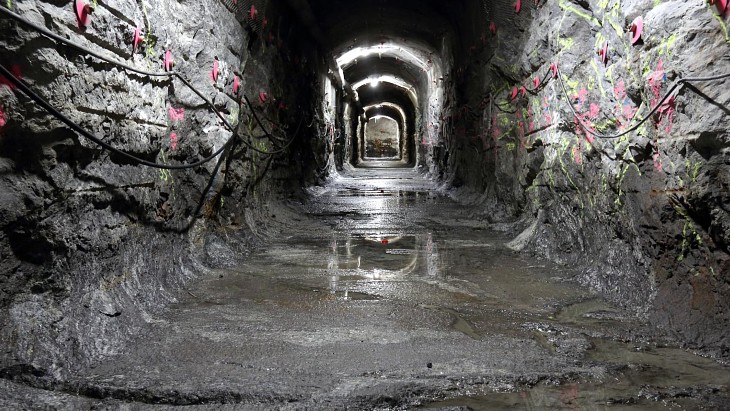
A deep geological repository comprises a network of highly-engineered underground vaults and tunnels built to permanently dispose of higher activity radioactive waste so that no harmful levels of radiation ever reach the surface environment. They need to be located deep enough, and in suitable geological conditions, to ensure they will be safely secured for thousands of centuries.
The disposal of used nuclear fuel and other high-level waste has long been a pressing issue in terms of the perceived sustainability of nuclear energy programmes. For many decades this material has been stored [?]safely in pools or special containers and facilities at surface, or near-surface, locations, often close by nuclear power plants. These are seen as interim storage measures pending a permanent solution.
Hildegarde Vandenhove, Director of the IAEA Division of Radiation Safety, Transport and Waste Safety…………..” developing these facilities is a long and a complex process. It requires rigorous studies and extensive safety demonstrations. These are all first-of-a-kind facilities, and their construction takes time.“
The process of selecting a site, and getting approval for it, takes decades, with Anna Clark, head of the Waste and Environmental Safety Section in the Division of Radiation Transport and Waste Safety at the IAEA, saying that “before operations can begin, there’s a lengthy pre-operational phase with conceptual design, the planning, the surveys, the site investigations, site selection, narrowing down the number of sites, doing detailed characterisation of your preferred site, it’s a long process before you even begin with the licensing of construction. And throughout that period, the safety case evolves and the role of the regulator also evolves, and the regulators have to adapt their expertise and knowledge as they go”.
Canada
Colin Moses, Vice-President, Regulatory Affairs, and Chief Communications Officer at the Canadian Nuclear Safety Commission, outlined the status of the country’s deep geological repository which, he noted, started being discussed in the 1970s. It is being taken forward by the Nuclear Waste Management Organization, a government agency fully funded by the producers of waste with a mandate to determine and find and build and operate a long-term solution for disposal of used fuel in Canada.
Its concept is for a “geosphere which forms a natural barrier of rock to protect the waste from disruptive natural events, water flow and human intrusion”.
The current status is that Wabigoon Lake Ojibway Nation and the Township of Ignace were selected in November 2024 as the host communities for the proposed repository, following a consent-based siting process that had begun some 14 years earlier. Pre-licensing activities, including stakeholder engagement, pre-environmental assessment and technical reviews, have been taking place.
Construction of the facility will only begin once the deep geological repository has successfully completed the federal government’s multi-year regulatory process and the Indigenous-led Regulatory Assessment and Approval Process, a sovereign regulatory process that will be developed and implemented by Wabigoon Lake Ojibway Nation.
The Nuclear Waste Management Organization explored more than 20 different potential locations in Canada looking for local communities to raise their hand and express an interest in potentially hosting the repository, with the last decade spent refining that list down to the one preferred site.
Moses said he was expecting the formal regulatory process to begin this year and “will play out over several years, looking to give an initial decision in 2030. That will allow them to advance construction in 2032, move into operation in 2042 and ultimately to operate that facility for many decades, expecting a current closure date of 2092”.
and ultimately to operate that facility for many decades, expecting a current closure date of 2092″.
“So this is a project that’s playing out over multiple decades and has spent multiple decades getting ready.”
Finland
Progress is furthest advanced with Finland’s Onkalo project. Petteri Tiippana, Director General of the Radiation and Nuclear Safety Authority of Finland (STUK) outlined the concept, which is a repository in crystalline rock with used fuel in copper canisters surrounded by a bentonite buffer at a depth of 400-430 metres.
For Finland, which is currently in the process of commissioning the deep geological repository, the process began in the 1980s with the then government setting a target for operation in the 2020s. Pre-licensing activities started almost immediately, Tiippana said, in terms of research and design and for the concept, with actual licensing steps beginning in the early 2000s with a site selection. A construction licence was issued in 2015.
Currently the encapsulation plant has been commissioned and tested the dummy fuel elements in five canisters and transported them to the underground facility. The next phase will be to “test the underground facility and the final disposal of those five copper cases”. He said that the reviewing of safety documentation is approaching its final stages and the aim is for a decision next year, with operations then starting.
See how Finland’s project will work:
France
France plans to construct the Centre Industriel de Stockage Géologique (Cigéo) repository – an underground system of disposal tunnels – in a natural layer of clay near Bure, to the east of Paris in the Meuse/Haute Marne area. The plan is to dispose of 10,000 cubic metres of high level waste and 75,000 cubic metres of intermediate-level waste.
Jean-Luc Lachaume, Commissioner of the French Authority for Nuclear Safety and Radiation Protection (ASNR), said that, as with other countries, there had been decades of work already on developing the repository, with parliamentary debates about it beginning in the 1980s, before a decision 20 years ago to go ahead with a deep geological repository.
The milestone of the construction licence application being submitted happened in 2023, since when it has been under review. A technical review was completed in June and ASNR issued a favourable opinion on the application earlier this month.
This will be followed by the consultation phase and public inquiry in 2026 and a potential licence granting in 2027 or 2028, with a target first operation of the pilot phase in 2035.
Sweden
A site has been selected at Fosmark, 150 kilometres north of Stockholm. Surface works have been taking place and the application to start underground excavation was submitted in January 2025 and is currently being considered. The concept for Sweden is the repository to be at a depth of 500 metres, in crystalline rock, with copper canisters each surrounded by bentonite clay to keep groundwater away from the canister and to provide a barrier to any potential leakage of radioactive material.
As with all countries, there has been decades of preparation and discussion, with regulatory licensing reviews and court hearings from 2011 to 2018 prior to government approval being issued in 2022……………………………..
Switzerland
Switzerland is in the final stage of the site selection process, which began in 2008, with national and international participation. The plan is for a combined repository for high- low- and Intermediate-level waste, with a general licence application submitted and due to be considered by 2027 with a government decision targeted for 2029.
Marc Kenzelmann, Director General of the Swiss Federal Nuclear Safety Inspectorate, outlined the background to the site selection, noting that Switzerland was a country about 7% the size of Texas, with two thirds of its area covered in mountains, so unusable for a high-level waste repository because the Alps could rise by a kilometre over the next million years, which is “the time frame that we have set for a safe, deep geological repository. So the Alps have an active geology, but what we need is a boring geology”.
This has meant that the location search was focused on the area near to the German border, so “we have involved Germany from the very start of the selection process”. He said that one issue was making sure to take the time and effort to build up stakeholder trust. In their case there have also been some unique differences of public opinion, with “Swiss people generally less concerned than German people” about the issue.
In November 2024 Switzerland’s national radioactive waste disposal cooperative Nagra applied to the Swiss Federal Office of Energy for a general permit for the construction of the planned deep geological repository for radioactive waste at Nördlich Lägern in northern Switzerland, and a used nuclear fuel encapsulation plant at the existing Zwilag interim storage facility in Würenlingen in the canton of Aargau.
According to current planning, the Federal Council will decide on the application in 2029 and Parliament in 2030. A national referendum is expected to take place in 2031.
Once the general authorisation for the repository comes into force, geological studies will be carried out underground in the area of implantation (through the creation of an underground laboratory), with the aim of acquiring more in-depth knowledge with a view to the construction of the repository. The application for a building permit, then later the application for an operating permit, can then be submitted. According to current planning, the repository could come into operation and the first radioactive waste could be stored there from 2050.
The USA
Yucca Mountain has since 1987 been named in the US Nuclear Waste Policy Act as the sole initial repository for disposal of the country’s used nuclear fuel and high-level radioactive wastes. The DOE submitted a construction licence application to the Nuclear Regulatory Commission in 2008, but the Obama Administration subsequently decided to abort the project and there have been various twists and turns since then, with the upshot that it has not been built.
Mike King, Executive Director for Operations at the US Nuclear Regulatory Commission, said the current status of its high-level waste disposal programme is that NRC staff had reviewed the US Department of Energy’s application for a repository at Yucca Mountain and staff completed its Safety Evaluation Report more than a decade ago and concluded it met safety standards “however there were two remaining environmental and programmatic pull points that prevented the final authorisation” and since 2016 funding has been halted and there are no activities taking place on it other than record-keeping, and the licensing process is currently suspended.
The general thrust of the discussion was that there needs to be a clear delineation of responsibilities for the project, with long-term planning and clear public consultation and decision-making processes to ensure there is community trust in the decision making process……………………………………………https://www.world-nuclear-news.org/articles/how-are-geological-repository-projects-progressing
As Israel bans aid orgs in Gaza, notorious mercenary firm seeks “Targeter”
the Israeli government is using the absurdly onerous new registration standards as cover to ban virtually every credible international aid organization from entering Gaza.
Max Blumenthal·December 31, 2025, https://thegrayzone.com/2025/12/31/israel-aid-gaza-mercenary-targeter/
Are Israel and the Trump admin planning to revive the dystopian Gaza Humanitarian Foundation scheme that spawned famine and death under cover of humanitarian aid?
In its bid to continue the genocide in Gaza, Israel has banned 37 international aid organizations from entering the decimated, militarily occupied coastal enclave. This leaves only five humanitarian groups still able to operate inside Gaza.
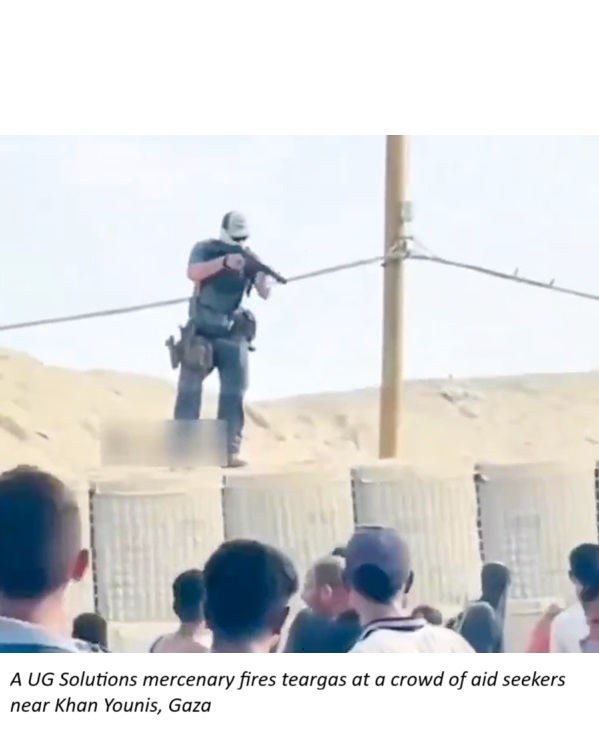
At the same time, one of the US mercenary firms responsible for securing the notorious Gaza Humanitarian Foundation sites which were present during the worst periods of famine in Gaza, when at least 3000 Palestinian civilians were gunned down while seeking aid, has posted an ad soliciting former special forces soldiers for offensive operations.
UG Solutions, the scandal-stained private mercenary firm, announced this December that it was hiring an “experienced Targeter to support intelligence-driven operations through the identification, development, validation, and maintenance of operational targets.” The targeter will be expected to “Develop, validate, and maintain operational target packages in accordance with approved targeting processes.”
Anthony Aguilar, the retired United States Army Lt. Col and former Green Beret who blew the whistle on UG Solutions’ human rights abuses in Gaza, told me he believes that Israel’s ban on the 37 international aid organizations signals the return of UG Solutions as part of a restructured version of the Israeli-controlled Gaza Humanitarian Foundation scheme.
While it’s unclear where the UG Solutions targeter position will be deployed, if they are being hired for upcoming operations in Gaza, Aguilar says “this shows that the US, though paramilitary contractors, is now going to either directly target, or feed target data to the IDF.”
To set the stage for its blanket ban on international aid organizations, Israel’s intel-tied Ministry of Diaspora Affairs has demanded that all staffers of aid NGOs prove they do not support calls to boycott Israel, that they do not support armed struggle or oppose Israel’s existence as an exclusivist Jewish state, and that they do not “actively advance delegitimization activities against the State of Israel.”
Aid staffers must also demonstrate that they have never questioned the established history of the Holocaust or challenged official Israeli narratives about October 7 – including, presumably, that Palestinians committed “mass rape” or beheaded babies.
Israel has also demanded that Doctors Without Borders provide COGAT occupation administrators with the personal data of its staff and donors, an unprecedented move by a belligerent in a conflict which few, if any, aid groups could ever honor.
It seems obvious that the Israeli government is using the absurdly onerous new registration standards as cover to ban virtually every credible international aid organization from entering Gaza. In doing so, the apartheid entity seemingly seeks to deprive Palestinians living inside the yellow occupation line of sustenance, forcing them to leave Gaza, or to move into one of the high-tech, concentration camp-like “smart cities” mapped out in the dystopian new “Project Sunrise” proposal marketed by Trump cronies Steve Witkoff and Jared Kushner.
And it is there that they would be “secured” by a mercenary outfit like UG Solutions – and targeted if they dared to resist.
Below is a list of all the aid orgs banned by Israel from operating in Gaza:
1. Accion contra el Hambre – Action Against Hunger
2. Action Aid
3. Alianza por la Solidaridad
4. Artsen zonder Grenzen (Medecins Sans Frontieres Nederland)
5. Campaign for the Children of Palestine (CCP Japan)
6. CARE
7. DanChurchAid
8. Danish Refugee Council
9. Handicap International – Humanity and Inclusion
10. Japan International Volunteer center
11. Medecins Du Monde (FRANCE)
12. Medecins du Monde Switzerland
13. Medecins Sans Frontières Belgium
14. Medecins Sans Frontieres France
15. Medicos del Mundo (Spain)
16. Mercy Corps
17. MSF Spain – Doctors Without Borders Spain
18. NORWEGIAN REFUGEE COUNCIL
19. Oxfam Novib
20. Premiere Urgence Internationale
21. Terre des hommes Lausanne
22. The International Rescue Committee (IRC)
23. WeWorld-GVC
24. World Vision International
25. Relief International
26. Fondazione AVSI
27. Movement for Peace – MPDL
28. American Friends Service Committee (AFSC)
29. Medico International
30. PSAS – The Palestine Solidarity Association in Sweden
31. Defense for Children International
32. Medical Aid for Palestinians – UK
33. Caritas Internationalis
34. Caritas Jerusalem
35. Near East council churches
36. OXFAM Quebec
37. War Child holland
Three things ICAN is looking forward to in 2026

3 Jan 2026, https://www.icanw.org/2026_3_things_anticipating
As 2026 begins, nuclear risks and the false myths about nuclear deterrence on the rise. ICAN, working with countries and partners across continents, are challenging nuclear weapons and taking our work to the next level. Here are three things we’re looking forward to this year:
Celebrating five years of the nuclear ban treaty
On 22 January, we’ll mark five years since nuclear weapons officially became illegal under international law. That’s not symbolic — it’s transformative.
ICAN and partners around the world will commemorate the moment that nuclear weapons finally became illegal. With celebrations, seminars, screenings, actions and activism across the globe. This anniversary is a chance to reflect on how far we’ve come — and to build momentum for the work ahead. The ban treaty has changed the global conversation. Now we’re making sure it changes reality.
Evidence for action: exposing the myths of nuclear deterrence
Nuclear deterrence is built on theory. Our campaign is built on facts.
Throughout the year, we’ll be working with our partners, scientists, health experts, economists and governments to make one truth unavoidable: any use of nuclear weapons would be catastrophic.
The evidence is clear. Nuclear weapons:
- threaten public health
- destabilise societies
- devastate ecosystems and undermine food systems
- have consequences that would last for decades.
We’ll use this evidence to challenge decision-makers, dismantle dangerous deterrence myths, and demand an end to the billions spent on weapons that put all life on Earth at risk.
Diplomacy that protects people, not power
Real security doesn’t come from weapons of mass destruction. It comes from negotiation and cooperation.
ICAN is working closely with governments that support the Treaty on the Prohibition of Nuclear Weapons (TPNW) to ensure diplomacy in 2026 reduces nuclear risks and advances disarmament. With two major nuclear weapons treaties under review, we’ll seize opportunities to:
- strengthen global norms against nuclear weapons
- hold governments accountable to their commitments
- push disarmament from words into action
Alongside these milestones, we’ll also publish impactful and informative reports, amplify survivor voices, engage media worldwide and support our partners.
The risks around nuclear weapons are growing, making our work to educate, empower and act together more urgent than ever.
WHAT CHAOS WILL TRUMP UNLEASH IN 2026?
The evidence of 2025 suggests a president who is alternately reckless and bored
Seymour Hersh, Jan 03, 2026
One of my favorite anecdotes occurred sometime after 9/11 when Tony Blair, the prime minister of Great Britain, joined in with America’s declaration of war against terrorism. The brilliant playwright Harold Pinter, who would be a bitter and prolific critic of the ensuing war, was invited to respond before the House of Commons. He began his talk with a tale from British history during a wave of terror in Ireland.
“There’s an old story about Oliver Cromwell. After he had taken the town of Drogheda, the citizens were brought to the main square. Cromwell announced to his lieutenants: ‘Right! Kill all the women and rape all the men.’ One of his aides said: ‘Excuse me, General. Isn’t it the other way around?’ A voice from the crowd called out: ‘Mr. Cromwell knows what he is doing!’”
In Pinter’s telling, the voice of support from the crowd was Blair’s. Today it could and would come from the lips of Vance, Bondi, Hegseth, or Noem. Never has a modern American president been surrounded by such self-important sycophants and a Republican-led Congress with little gumption. Trump’s lack of interest in nonmilitary briefing papers and his obsession with social and political gossip has moved from information known by a few to standard operating procedure………………….(Subscribers only) https://seymourhersh.substack.com/p/what-chaos-will-trump-unleash-in?utm_source=post-email-title&publication_id=1377040&post_id=183249150&utm_campaign=email-post-title&isFreemail=true&r=ln98x&triedRedirect=true&utm_medium=email
1 This Month

of the week – Shut Down Drone Warfare!


Tell the Ukrainian Government to Drop Prosecution of Peace Activist Yurii Sheliazhenko

Petition to revoke the licensing of the Near Surface Nuclear Disposal Facility (NSDF) at Chalk River. https://www.ourcommons.ca/petitions/en/Petition/Details?Petition=e-7247
To see nuclear-related stories in greater depth and intensity – go to https://nuclearinformation.wordpress.com
-
Archives
- March 2026 (244)
- February 2026 (268)
- January 2026 (308)
- December 2025 (358)
- November 2025 (359)
- October 2025 (376)
- September 2025 (257)
- August 2025 (319)
- July 2025 (230)
- June 2025 (348)
- May 2025 (261)
- April 2025 (305)
-
Categories
- 1
- 1 NUCLEAR ISSUES
- business and costs
- climate change
- culture and arts
- ENERGY
- environment
- health
- history
- indigenous issues
- Legal
- marketing of nuclear
- media
- opposition to nuclear
- PERSONAL STORIES
- politics
- politics international
- Religion and ethics
- safety
- secrets,lies and civil liberties
- spinbuster
- technology
- Uranium
- wastes
- weapons and war
- Women
- 2 WORLD
- ACTION
- AFRICA
- Atrocities
- AUSTRALIA
- Christina's notes
- Christina's themes
- culture and arts
- Events
- Fuk 2022
- Fuk 2023
- Fukushima 2017
- Fukushima 2018
- fukushima 2019
- Fukushima 2020
- Fukushima 2021
- general
- global warming
- Humour (God we need it)
- Nuclear
- RARE EARTHS
- Reference
- resources – print
- Resources -audiovicual
- Weekly Newsletter
- World
- World Nuclear
- YouTube
-
RSS
Entries RSS
Comments RSS
 nuclear-news