Trump May Launch Strikes on Iran — Regime Change, Not Nukes, Is the Goal.
January 30, 2026, By Joshua Scheer, https://scheerpost.com/2026/01/30/exclusive-trump-may-launch-strikes-on-iran-regime-change-not-nukes-is-the-goal/
A Drop Site News exclusive reports that senior U.S. military officials have informed the leadership of a key Middle Eastern ally that President Donald Trump could authorize direct military strikes on Iran as early as this weekend, with targets potentially extending beyond nuclear and missile facilities to include senior Iranian leadership — a push some strategists say aims at precipitating regime change rather than merely halting Tehran’s military programs. This after new sanctions were placed on Iran by the US treasury department.
With Drop Site reporting “This isn’t about the nukes or the missile program. This is about regime change,” said a former senior U.S. intelligence official who consults for Arab governments and is an informal advisor to the Trump administration on Middle East policy. He told Drop Site that U.S. war planners envision attacks that target nuclear, ballistic, and other military sites around Iran, but will also aim to decapitate the Iranian government, and in particular the leadership and capabilities of the Islamic Revolutionary Guard Corps (IRGC). The IRGC is a branch of the Iranian armed forces created after the country’s 1979 revolution whose leadership now plays a major role in the country’s politics and economy.
Trump not sharing that regime change is part of the plan posted “Hopefully Iran will quickly ‘Come to the Table’ and negotiate a fair and equitable deal – NO NUCLEAR WEAPONS – one that is good for all parties,” Trump wrote on his Truth Social platform. “Time is running out, it is truly of the essence!”
From Senator John Cornyn: in a foregin realtions meeting with Rubio: Cornyn stating: “I know the President is being presented with a range of options. We’ve noticed a lot of movement into the region by our Navy… but what happens if the Supreme Leader is removed in Iran?”
From Marco Rubio: “We have to have enough force and power in the region to defend against the possibility that, at some point, as a result of something, the Iranian regime decides to strike at our troop presence in the region.”
“I hope it doesn’t come to that, but I think what you’re seeing now is the effort to posture assets in the region to defend against what could be an Iranian threat against our personnel.”
This came from Department of War head Pete Hegseth during a recent Cabinet meeting: the Iranians “have all the options to make a deal,” he said. But if the goal is purely regime change, what deal is even possible? Hegseth also claimed that the war in Ukraine and the October 7 massacre “would not have happened” if Trump had been in power.
Iranian officials have made clear that they would respond with a major counterstrike using all means necessary if the U.S. attempts a Venezuela‑style operation or, worse, targets Iranian leadership — a scenario that has regional allies deeply concerned about the risk of a wider war. With Iran’s misison to the UN tweeting…..
While the region waits Iranian Foreign Minister Abbas Araghchi stated in Istanbul saying about the above issue “The Islamic Republic of Iran, just as it is ready for negotiations, it is also ready for war,”
adding:
“Our position is exactly this: Applying diplomacy through military threats cannot be effective or constructive,” Araghchi told journalists Wednesday outside of a Cabinet meeting. “If they want negotiations to take shape, they must abandon threats, excessive demands and the raising of illogical issues.”
Looking at Iran’s past stance versus what could be coming, a recent interview sheds some light with Dr. Foad Izadi, a professor at the University of Tehran, telling Drop Site that in the past:
“a number of high-ranking military officials … made the decision to inform the United States when they were attacking the U.S. bases.”
“The idea was basically trying to ride out the Trump administration, not to confront him in a serious manner, respond to him, but respond in a very limited style so they don’t start a huge war with the United States,” he said. “This was their decision. And they were killed in June,” during the 12-day bombing campaign unleashed against Iran by the U.S. and Israel.”
The report comes amid escalating U.S.–Iran tensions that have woven together diplomatic brinkmanship, regional alliances, and conflicting strategic priorities. While U.S. and Israeli forces previously carried out coordinated strikes on Iranian nuclear sites in 2025 — prompting retaliatory missile barrages and suspending negotiations — the Trump administration has continued to oscillate between threats of further military action and claims it prefers a negotiated settlement over Iran’s nuclear ambitions.
International concern is growing, with Arab states urging restraint to prevent a wider regional conflagration, even as Tehran signals readiness for both talks and defense in the face of mounting pressure.
With at least two nations, Saudi Arabia and the United Arab Emirates, have made it clear they will not allow their airspace to be used for any potential U.S. strike on Iran. Yet the United States has moved the USS Abraham Lincoln and several guided-missile destroyers into the region, assets capable of launching attacks from the sea. Egypt’s Foreign Ministry emphasized diplomacy, with top diplomat Badr Abdelatty engaging both Iranian Foreign Minister Abbas Araghchi and U.S. Mideast envoy Steve Witkoff to “work toward achieving calm, in order to avoid the region slipping into new cycles of instability.”
Meanwhile, Saudi Arabia, Turkey, Oman, and Qatar have all been in contact with Washington and Tehran, warning that any escalation could destabilize the region and disrupt energy markets. Arab and Muslim states fear that even a limited U.S. strike could provoke immediate retaliation from Tehran, potentially targeting regional or American interests and causing collateral damage. Saudi Defense Minister Khalid bin Salman, currently in Washington for high-level talks, reinforced this message, noting on social media that he discussed “efforts to advance regional and global peace and stability” with Secretary of State Marco Rubio, Defense Secretary Pete Hegseth, and other top U.S. officials. With Saudi prince Khalid bin Salman tweeting from the west wing:
This is a developing story, but in Washington, it feels like the only ones pushing it are Trump and his allies. The Saudis are calling for calm, Israel is en route to the capital, and the only thing anyone can predict is that more fuel might soon be thrown on an already blazing fire. Tensions are high: Iran warns it will strike at the heart of Tel Aviv, and whispers of war are spreading across Israel.
The memories of past conflicts remain sharp for Israelis. The latest round of threats between Tehran and Washington has stirred anxiety and put the country on edge. During previous wars, Israel’s air defenses were remarkably effective—but citizens still ran for shelter at the sound of sirens, and the fear of another confrontation has only intensified in recent weeks.
As U.S. warships draw closer, Israeli headlines have been dominated by speculation over a potential American strike on Iran—and the grim expectation that Israel, as the closest U.S. ally in the region, would bear the first wave of retaliation.
Some towns are reopening public bomb shelters. Airlines are canceling flights, hotels are seeing reservations vanish, and citizens are stockpiling food and water. Yet the government and the Home Front Command—Israel’s alert system based on real-time security intelligence—have issued no special guidance.
Without official word, rumors flourish. Both Trump’s and Iran’s statements are heavy on drama, light on specifics, and in Israel, everyone knows “someone who knows something.” Daily chatter revolves around alleged knowledge of a U.S. strike—hours or days away—and debates over whether to cancel travel or postpone events.
In the end, nobody—neither in Tehran nor Tel Aviv—can say for sure what’s coming next.
What we all know is this: war is bad for humans, and our leaders don’t care.
The UN is Being Undermined by the ‘Law of the Jungle’
By Thalif Deen, IPS UN Bureau Report, https://www.ipsnews.net/2026/01/the-un-is-being-undermined-by-the-law-of-the-jungle/?utm_source=email_marketing&utm_admin=146128&utm_medium=email&utm_campaign=The_UN_is_Being_Undermined_by_the_Law_of_the_Jungle_Moving_Towards_Agroecological_Food_Systems_in_So
UNITED NATIONS, Jan 30 2026 (IPS) – UN Secretary-General Antonio Guterres was dead on target when he told the Security Council last week that the rule of law worldwide is being replaced by the law of the jungle.
“We see flagrant violations of international law and brazen disregard for the UN Charter. From Gaza to Ukraine, and around the world, the rule of law is being treated as an à la carte menu,” he pointed out, as mass killings continue.
“The New York Times on January 28 quoted a recent study pointing out the four-year war between Russia and Ukraine has resulted in over “two million killed, wounded or missing”. The study published last week by the Center for Strategic and International Studies in Washington says nearly 1.2 million Russian troops and close to 600,000 Ukrainian troops have been killed, wounded or are missing.
In the war in Gaza, over 70,000 Palestinians, mostly civilians, including women and children, have been killed since October 7, 2023, with figures reaching over 73,600 by early January 2026, according to various reports from the Gaza Health Ministry and human rights organizations.
These killings have also triggered charges of war crimes, genocide and violations of the UN charter, as in the US invasion of Venezuela and the takeover threats against Greenland.
Guterres said in an era crowded with initiatives, the Security Council stands alone in its Charter-mandated authority to act on behalf of all 193 Member States on questions of peace and security. The Security Council alone adopts decisions binding on all.
No other body or ad hoc coalition can legally require all Member States to comply with decisions on peace and security. Only the Security Council can authorize the use of force under international law, as set out in the Charter. Its responsibility is singular. Its obligation is universal, declared Guterres.
Dr Ramzy Baroud, Editor of Palestine Chronicle and former Managing Editor of the London-based Middle East Eye, told IPS the statement by the Secretary-General is long overdue.
Too often, he said, UN officials resort to cautious, euphemistic language when describing egregious violations of international law—especially when those responsible are UN Security Council veto holders, states that have ostensibly sworn to uphold the UN Charter and the core mission of the international system.
Unfortunately, the UN itself has become a reflection of a rapidly shifting world order—one in which those with overwhelming military power sit at the top of the hierarchy, abusing their dominance while steadily hollowing out the very institutions meant to restrain them, he pointed out.
“We must be honest with ourselves and acknowledge that this crisis did not begin with the increasingly authoritarian misuse of law by the Trump administration, nor is it limited to Israel’s absolute disregard for the international community during its two-year-long genocide in Gaza.”
The problem is structural. It is rooted in the way Western powers have long identified—and exploited—loopholes within the international legal system, selectively weaponizing international law to discipline adversaries while shielding allies and advancing their own strategic agendas, he declared.
Responding to a question at the annual press briefing on January 29, Guterres told reporters it is obvious that members of the Security Council are themselves violators of international law –and it doesn’t make life easy for the UN in its efforts.
Unfortunately, he said, there is one thing that we miss. “It’s leverage. It’s the power that others eventually have, to force countries and to force leaders to abide by international law. But not having the power, we have the determination, and we’ll do everything possible with our persuasion, with our good offices, and building alliances to try to create conditions for some of these horrible tragedies we are witnessing. And from Ukraine to Sudan, not to mention what has happened in Gaza, we will be doing everything we can for these tragedies to stop”.
Dr Jim Jennings, President of Conscience International, told IPS the global humanitarian situation described by the Secretary-General is grim but very real. The climate crisis, natural disasters, numerous ongoing and expanding conflicts, and the impact of new technologies, all add to today’s global economic instability and affect every person on earth.
While President Trump continues bombing countries and strutting the world stage with his adolescent dream of US territorial expansion, a major readjustment of the global power balance among China, the US, Europe, and the BRICS nations is underway, he noted.
Stripping life-giving aid away from the poorest countries on earth to benefit those already rich, as his policies guarantee, is a recipe for even more global suffering and violence.
“Clearly one of the most blatant and harmful reasons for the present disastrous situation worldwide is the reduction of funding for UN agencies by the United States, which has traditionally paid a high percentage of their costs”.
With the further curtailment of The Department of State-USAID’s enormous support for people in critical need in almost every country in the world, the Trump administration’s one-two punch has already threatened to make a challenging set of problems unmanageable.
What is to be done? People and governments everywhere must stand up, speak out, and act against the colossal forces now arrayed against some of the world’s most vulnerable populations. How to do that has never been easy, Dr Jennings argued.
Put in the simplest terms, Secretary-General Guterres was merely pointing out the glaring fact of the true global situation and appealing for the critical need UN agencies have for support if their mission is not to fail. The answer is straightforward— more private funding.
Why not raise the level of our individual, corporate, and foundation donations to the UN Agencies and other aid organizations while continuing to advocate for responsible government backing for the irreplaceable United Nations agencies? he asked.
Dr Palitha Kohona, a former Chief of the UN Treaty Section, told IPS international relations, for a very long time, were dependent on the whims of powerful states and empires. Might was right and disputes were settled by using force. Land inhabited for centuries was annexed to empires and native populations were dispossessed or even exterminated.
From such fractured beginnings, an orderly world governed by agreed rules began to emerge gradually, although most of the rules were established by the powerful.
Thousands of treaties were concluded, customary rules were respected and a rudimentary judicial structure began to be established. The world rejoiced in the establishment of the United Nations.
Though lacking in proper enforcement mechanisms and largely dependent on voluntary mutually beneficial compliance, a rule based international order was beginning to emerge.
Dr Palitha Kohona, a former Chief of the UN Treaty Section, told IPS international relations, for a very long time, were dependent on the whims of powerful states and empires. Might was right and disputes were settled by using force. Land inhabited for centuries was annexed to empires and native populations were dispossessed or even exterminated.
From such fractured beginnings, an orderly world governed by agreed rules began to emerge gradually, although most of the rules were established by the powerful.
Thousands of treaties were concluded, customary rules were respected and a rudimentary judicial structure began to be established. The world rejoiced in the establishment of the United Nations.
Though lacking in proper enforcement mechanisms and largely dependent on voluntary mutually beneficial compliance, a rule based international order was beginning to emerge.
Israel’s genocide in Gaza, the war in Ukraine, and the ongoing atrocities in Sudan and elsewhere are not aberrations. They represent the culmination of decades of legal erosion, selective enforcement, and the systematic degradation of the international legal order.
While I agree—and even sympathize—with Canadian Prime Minister Mark Carney’s comments at the World Economic Forum in Davos, in which he expressed criticism of the new power dynamics that have rendered the international political system increasingly defunct, one cannot help but ask why neither he nor other Western leaders are willing to confront their own governments’ historical role in creating this reality.
Without such reckoning, calls to defend international law risk sounding less like principled commitments and more like selective outrage in a system long stripped of credibility.
European powers that are critical of Trump have not raised their voice with the same intensity and vigor against Netanyahu for doing a lot worse than anything that Trump has done or threatened to do.
This also begets the same question about the latest comments by the UN Secretary-General. He should offer more specifics than generalized decrying the collapse of international morality.
“Moreover, we expect a roadmap that will guide us in the process of re-establishing some kind of a sane global system in the face of the growing authoritarianism, dictatorship, and criminality all around”, declared Dr Baroud
‘We are back in the Middle Ages’: How the EU literally starves dissenting experts like Jacques Baud.

No one is safe from the ‘Russian propaganda’ sanctions – even those who never touch Russian sources. Baud is one of nearly 60 public figures under sanctions from the EU
Eva Karene Bartlett, Jan 29, 2026
On December 15, 2025, the European Union slapped sanctions on former Swiss intelligence officer and ex-NATO employee Jacques Baud. No day in court, no charges filed, just abrupt, suffocating, sanctions.
Why did the EU sanction Baud? For “Russian propaganda,” of course, although many of the sources he cites in his reports on the West provoking war with Russia years prior to Russia’s military operation are Western and Ukrainian – including the SBU and Aleksey Arestovich, a former adviser to Vladimir Zelensky.
Welcome to the latest EU insanity.
Widely respected for his deep knowledge and analysis, much of which is based on his own research while working with NATO, Baud has grown increasingly popular over the years, appearing on numerous podcasts and interviews, authoring numerous books and articles as well.
Since Russia began its military operation in Ukraine, Western media have been howling about an “unprovoked invasion.” Baud has written and spoken extensively about realities which counter this claim: facts on the ground prior to February 2022, going back (unlike most legacy media who have developed selective amnesia) to even before the 2014 Maidan coup.
What is interesting about Baud is he does not use Russian sources to back his claims and he has not taken a public position in favor of either Russia or Ukraine.
He has simply analyzed the situation, based on information he had access to. How did he have access to this information? In 2014, when working for NATO in charge of countering proliferation of small arms, he was tasked with investigating accusations of Russia supplying arms to Donbass resistance.
He wrote of this in 2022, noting, “The information we received then came almost entirely from Polish intelligence services and did not ‘fit’ with the information coming from the OSCE – despite rather crude allegations, there were no deliveries of weapons and military equipment from Russia.”
“The rebels were armed thanks to the defection of Russian-speaking Ukrainian units that went over to the rebel side. As Ukrainian failures continued, tank, artillery and anti-aircraft battalions swelled the ranks of the autonomists.”
As a result of his research, he was also able to unequivocally debunk accusations of Russia sending military units into Donbass, by quoting the SBU (Ukrainian security service) itself as well as other Ukrainian sources.
In a September 2024 interview I did with Baud, he spoke of this.
“I can categorically say no, there were no Russian forces in Donbass. The guy you encountered (I had mentioned meeting one sole Russian former soldier when I went to the Donbass in 2019) represents exactly the kind of Russian presence that was at that time, recognized by the SBU and recognized also by the Ukrainian Chief of Staff.
“In a public interview in 2015, just after the signature of the Minsk Agreement 2, the head of the Ukrainian General Staff said publicly that there were no Russian military units fighting in Donbass; that there were only individual soldiers exactly the same case as the one you just mentioned.”
It is clear he is not citing Russian information (or “propaganda”) but Ukrainian and Western sources. An even better illustration of this is what he had to say about the prelude to Russia commencing its Special Military Operation in February 2022.
Referring to a March 2021 decree by Zelensky (to take back Crimea and the south of Ukraine), Baud spoke of an interview two years prior with Zelensky’s former adviser, Arestovich.
“He says in order to join NATO, we had to have a war with Russia. When the interviewer asked him when would this conflict happen, Arestovich says end of 2021 or 2022.” A position, Baud noted, which aligned with a March 2019 300-page document published by the Rand Corporation, “that explains how to defeat and to destabilize Russia.
The EU is almost certainly pissed off that Baud likewise demolished the Western propaganda claims about Russia invading Crimea in 2014. He told me, “The Ukrainian army at that time was a conscript army, meaning that within the Ukrainian army you had both Ukrainian speakers and Russian speakers. When the army was ordered to shoot or to fight against demonstrators, those who were Russian speakers just defected, they just changed side. They just went to support the protesters and they became in fact those the famous ‘little green men’.”
Keep in mind that Baud was working for NATO then. “There was absolutely not the slightest indication that Russia brought new troops to Crimea. Based on the status of force agreement signed between Russia and Ukraine, you had up to 25,000 Russian troops stationed in the Crimean peninsula. At that time they were not even 25,000, there were 22,000. A Ukrainian lawmaker on Ukrainian TV said that out of the 20,000 (sic) Ukrainian soldiers that were deployed in Crimea, 20,000 defected to the Russian-speaking side.”
As for “Russian propaganda,” it is a term bandied about quite easily by legacy media and NATO mouthpieces to taint reputations or lead to censorship of voices. The war backers are upset that their own “Russia started it” propaganda isn’t working
Sanctions prevent Baud from even buying food
Baud lives in Brussels, and now as a result of the sanctions is unable to even buy food for himself. Nor can well-intending people do so on his behalf. In an interview on Dialogue Works at the end of December, 2025, Baud said:
“Yesterday, a friend of mine tried from Switzerland to buy food for me, to be delivered to my home (in Belgium). She could order, but the payment was blocked. Any delivery to my home is prohibited, even if the funds come from Switzerland.”
People who are aware of his unjust situation have been physically bringing him food, to alleviate his inability to purchase it himself.
In a more recent interview on Judging Freedom, Baud highlighted that his case was a foreign policy decision, denying him due process.
“This is not a decision that has been taken by any court. I was not judged by anybody. In fact I was not in front of a jury. I could not present my case. I could not defend my case. This decision was not taken by a court but by the council of the foreign ministers of the European union.”
The most he can do, Baud explained, is, “go to the European Court of Justice and try to make my case saying that the decision was not just, and the court of justice may then study the case and have an assessment on that.” Even if the court concludes the sanctions are not justified, all it can then do is “advise the council of foreign ministers to change their mind.”
Given that the sanctions against Baud are punitive for his not toeing the line, it is unlikely minds will be changed.
A growing list of EU sanctioned voices
Jacques Baud isn’t the first to be sanctioned by the EU. Many journalists and public figures have been sanctioned for their writings or words on the Donbass, Crimea, corruption in Ukraine, and so on…………………………………………………………………………. https://evakarenebartlett.substack.com/p/we-are-back-in-the-middle-ages-how?utm_source=post-email-title&publication_id=3046064&post_id=185812458&utm_campaign=email-post-title&isFreemail=true&r=1ise1&triedRedirect=true&utm_medium=email
Doomsday Clock setting feels more like 8 or 7 seconds to midnight than 87 seconds.

Walt Zlotow, West Suburban Peace Coalition, Glen Ellyn IL, 28 Jan 26
Lived all but the first 4 months of my 81 years under the threat of nuclear annihilation. So every January, I take seriously the annual Bulletin of the Atomic Scientists Doomsday Clock announcement of our countdown to global catastrophe.
The Bulletin of the Atomic Scientists wasfounded in 1945 by Albert Einstein, J. Robert Oppenheimer, and University of Chicago atomic bomb scientists. They created the Doomsday Clock in 1947 to dramatize peoplekind’s threats to existence. Originally focused on nuclear annihilation, the Clock’s setting now includes climate crisis, biological threats, and disruptive AI technologies.
Tuesday’s announcement was disturbing. The Bulletin moved the Clock at 87 seconds to midnight, the closest it’s been in its 79 year countdown. Tho just two seconds closer than its previous worst of 89 seconds last year, the Bulletin sees nary of sign of progress in halting the proliferation of nuclear weapons, unstoppable wars, hostel military entanglements and refusal to address the escalating climate crisis.
The return of President Trump casts gloom over reducing nuclear tensions. In his first term he exited both the Intermediate Range Nuclear Forces Treaty (INF) and the Open Skies Treaty with Russia. He also failed to renew the New Start Treaty which thankfully was extended for 5 years by successor Biden within 2 weeks of taking office. Set to expire again in 7 days, Trump’s refusal to renew it marks the end of all US Russian nuclear agreements. It will quickly accelerate US and Russian development of their nuclear arsenals limited under New Start.
Trump has bombed 7 countries this past year, Iraq, Syria, Iran, Venezuela, Somalia, Nigeria and Yemen. His bombing of Iran’s imagined nuclear program could have triggered a massive Middle East war with the potential of going nuclear. It also likely increases Iran’s perceived need to go nuclear.
Daniel Holz, chair of the group’s science and security board give this stark assessment. “Hard-won global understandings are collapsing, accelerating a winner take all great power competition undermining international cooperation needed to reduce existential risks. If the world splinters into an us v. them, zero-sum approach, it increases the likelihood we all lose,”
The furthest from midnight the Doomsday Clock ticked was 17 minutes (1,020 seconds) in 1991 when the US and Soviet Union signed the Strategic Arms Reduction Treaty (START). Followed by the demise of the Soviet Union, further progress on nuclear disarmament should have a snap. Instead, the US foreign policy elite snapped, ramping up a new Cold War against a weakened Russia. This culminated in the 2022 US proxy war on Russia destroying Ukraine, putting the world at risk of it going nuclear every day it continues.
No wonder the current 87 seconds, for those of us seeking an end to the specter of nuclear annihilation, feels more like 8 or 7 seconds
After Trump Declared Gaza War ‘Over,’ Media Lost Interest

Julie Hollar, January 28, 2026, https://fair.org/home/after-trump-declared-gaza-war-over-media-lost-interest/
Since President Donald Trump declared that “the war in Gaza is over” on October 3, 2025, US news outlets’ interest in the occupied territory has plummeted. In a FAIR search of US-related news sites using Media Cloud, a news media database, coverage of Gaza post-ceasefire agreement averaged just 1.5% of the news hole—significantly less than the level of coverage before the agreement.
From July 2 through October 1, 2025, mentions of Gaza appeared in 2.3% of news stories in Media Cloud’s US–National dataset, which indexes 248 online outlets. Starting October 2, the day before the ceasefire agreement, coverage in the next three weeks jumped to an average of 4.5%. For the following three months (October 23–January 22), that average dropped to 1.5%. That’s less than two-thirds the level of coverage it received prior to the agreement.
It’s also the lowest three-month average at any point since the current crisis began on October 7, 2023.
As FAIR (10/21/25, 12/18/25) has pointed out—along with many others—Israel did not cease firing after signing the ceasefire agreement. It has killed more than 480 Palestinians since then, including more than 100 children. (Israel claims three of its soldiers have been killed since the agreement—Washington Post, 1/8/26.)
And despite the agreement—and multiple binding orders from the International Court of Justice—Israel has kept in place the near-total blockade of Gaza that perpetuates the genocide (Amnesty International, 12/17/25; UNRWA, 1/21/26).
Israel has treated the line it committed to withdraw to in the agreement—the so-called Yellow Line—as a license to kill Palestinians who cross it, thereby ethnically cleansing more than half of Gaza (Al Jazeera, 1/26/26). Israel has begun treating the line as a new permanent border (Drop Site, 1/23/26).
Gaza is at least as newsworthy as it was before the ceasefire deal was signed. The general US media decision to back off covering an ongoing genocide, apparently because Donald Trump declared the conflict over, is both cowardly and complicit.
The War Intervention: AI, Data Centers, and the Environment

the issue of militarism is still left out of climate conversations.
SCHEERPOST, January 28, 2026 By: Aaron Kirshenbaum for Codepink
Early on Saturday, January 3rd, Venezuela was attacked on behalf of oil, mineral, tech, and
weapons profiteers in a regime change operation. Since then, the Trump administration has
threatened Iran, Greenland, Cuba, Colombia, and Mexico. What unites these threats? The
U.S.’s quest for endless resource extraction to power its increasingly deadly global empire. And
it’s not slowing down. These resource wars and “operations” are emerging as the AI drive also
ramps up. In July, Palantir and the Pentagon signed a 10-year, $10 billion agreement. In
April 2025, Palantir won a $30 million contract with ICE — a significant development in their
decade-plus-long partnership that we are now seeing play out in their increasingly militarized,
unrestrained murders and abductions in Minneapolis and around the country. This increasingly
inextricable partnership between AI and the war economy is throwing us into a fast track
of climate and environmental chaos that threatens us all.

In August, I learned about an AI program created by the U.S.-armed Israeli military called
“Where’s Daddy.” The program is designed to track individuals Israel is targeting in order to kill
them at home with their families. In October 2023, the AI war giant Palantir entered into a
contract with the Israeli military. Since 2021, the Israeli Occupation Forces have been working
with tech companies like Google on AI programs such as Project Nimbus, used to surveil and
murder Palestinians. “Where’s Daddy” and other overlapping systems represent the newest
phase of this. The program characterizes the families of these alleged combatants as “collateral
damage” and is often far from accurate, killing entire families without the “intended targets” even
being there. The tech companies developing these programs do not have anyone’s “safety” or
“security” in mind; they are solely motivated by profit. This cruelty is no surprise— these
companies are the same ones building toxic data centers across the U.S., largely in working-
class and Black and Brown communities, in the newest phase of environmental injustice.
We’ve been hearing about AI more and more as it enters the commercial market in increasingly
pervasive ways. In particular, much has been reported about AI data centers entering
communities and the opposition to them. Many of these fights have been taken up by
environmental organizations; it’s estimated that data centers could consume approximately 21%
of global energy by 2030. In order to sustain this energy use, data centers need cooling. Mid-
sized data centers use as much water as a city of 50,000 people. Meta’s Hyperion data center
in Louisiana is projected to use as much water as the entire city of New Orleans. Another
Meta center in Cheyenne, Wyoming, is projected to use more power than the state of
Wyoming itself.
These centers not only increase electricity bills for communities that can’t afford them, but they
also generate significant air, water, and noise pollution. Some centers regularly use diesel
“emergency” generators to meet increased demand. Each generator is the size of a railcar, and
thousands are littered across data center hotspots like Northern Virginia. As a result, toxic
chemicals are seeping into the lungs of residents, causing asthma and long-term illness. Data centers are known to create noise pollution, with constant hums that can lead to hearing loss,
anxiety, cardiovascular stress, and a host of other long-term issues. Furthermore, equipment is
certain to break down and lead to toxic waste and electronic pollution.
“Critical” minerals are required for the operation of these data centers. The process of obtaining
these minerals, supposedly also used for green technology, requires the militarization,
destabilization, and total plunder of mineral-rich regions. These minerals are supposedly
“critical” for energy transitions, and some have advocated more “sustainable” methods for
maintaining data centers through “green” technologies.
The use of these minerals is clear: The Pentagon recently became the largest shareholder in
MP Minerals, one of the largest mining companies in the Western Hemisphere. Why?
Aluminum for fighter jets. Titanium for missiles. And copper, lithium, cobalt, and many others for
data center batteries and semiconductors. The more data centers are built, the more minerals
are needed. This process of extraction has murdered millions in the Congo, destroying the soil,
water, and forest: one of the largest “lungs” of the planet. It has led to the newest phase of
imperialist aggression on Venezuela, a mineral-rich country with the largest oil reserves in the
world (oil, of course, is also essential for data centers). Additionally, it has led to the attempted
subordination of the Philippines to semiconductor production. The U.S. also seeks to use the
archipelago as an “unsinkable aircraft carrier” for the U.S.’s looming war with China, its largest
competitor in the AI and mineral race.
These are the impacts we already know to be devastating. But this is also new technology,
which means there’s a lot we don’t know and a lot that’s being intentionally hidden. Lack of
transparency is the norm in this industry. As data centers rapidly expand and buy up land
around the country, the actual companies behind them hide behind non-disclosure
agreements. This is not dissimilar to the intentional concealment of the military’s role in global
emissions, enacted through U.S. pressure at the third U.N. Climate Change Conference in 1997.
Decades later, the issue of militarism is still left out of climate conversations.
The parallel makes sense, considering how the AI industry has fused with the war machine. The
U.S. military is one of the most environmentally destructive forces on the planet. In its oil
consumption alone, the U.S. military is the world’s largest institutional polluter. The U.S.’s 800+
bases in 80 countries globally are known to regularly leak jet fuel and cancer-causing PFAS
chemicals, along with a toxic cocktail of hundreds of other chemicals. While training exercises
like RIMPAC in the Asia-Pacific region authorize the deaths of thousands of sea creatures, in
environmental sacrifice zones like Camp Lejeune in North Carolina, toxic waste from military
facilities has killed infants hours after birth. In bomb testing sites like Vieques, off the coast of
mainland Puerto Rico, lung cancer and bronchitis rates have been shown to be 200% higher
than on the mainland for men, and 280% for women. And the oil-motivated “war on terror”
emitted 1.2 billion metric tons of carbon dioxide from 2001-2017.
Now we are entering a new era of resource wars that will further destroy the planet as the AI
race with China accelerates. The relationship between AI and the U.S. military goes beyond the Pentagon’s contracts with Palantir, Meta, and Microsoft………………………………………………………………………..
No part of this is sustainable — not the war economy, not unending extraction, regardless of
how much “green tech” it produces, and not an AI-driven speculative economy. We cannot
afford to have splintered conversations either; these AI and tech companies are war profiteers.
The new Cold War on China drives this. The genocide in Palestine drives this. The war on
Venezuela, Latin America, and the Caribbean drives this. And so our organizing must be unified
against the impacts, mechanisms, and causes. Against data centers and the wars that drive
them.We need to stop the blood. But we can’t lose sight of why and how the bullets are
fired. https://scheerpost.com/2026/01/28/the-war-intervention-ai-data-centers-and-the-environment/
As Trump’s ‘Board of Peace’ presses forward, Palestinians in Gaza fear what lies ahead.
“I’m afraid that this committee will be the thing that enforces Trump’s plan on Gaza to turn our homeland into a place that’s not for us,
Mondoweiss spoke with Gazans after the announcement of the Palestinian technocratic committee that will oversee Gaza under Trump’s ‘Board of Peace’. While some hope for change, many fear the committee will ultimately serve U.S. and Israeli interests.
Mondoweiss, By Tareq S. Hajjaj January 27, 2026
On January 22, the long-awaited Palestinian technocratic committee, which is set to administer Gaza under the direction of the U.S. President Donald Trump’s so-called ‘Board of Peace’, was finally announced.
In his first address to the people of Gaza, the committee’s director, Ali Shaath, said that the Rafah crossing with Egypt, which has been unilaterally closed by Israel since May 2024, will be reopened in both directions. The announcement went viral in Gaza, and brought to the forefront a flurry of questions on the minds of Gazan society right now.
Is Trump’s plan for Gaza actually moving forward? What kind of power will this committee actually have? Will Israel actually allow for this next phase of the so-called “ceasefire” to move forward? What comes next for the people of Gaza?
And while Hamas has officially welcomed the committee and expressed its commitment to handing over administrative power in the Strip to the committee known as the National Committee for the Administration of Gaza (NCAG), people in Gaza are nevertheless skeptical over how and when a transfer of power will happen, and whether the committee will actually produce positive results for Gazans, or be just another tool in Israeli and U.S. domination.
“The committee will not end the crisis immediately, but at least there is a committee that has a green light from the U.S. and mediators to make a difference,” Anwar Abu Jabal, 33, a Gaza resident, said.
Abu Jabal, like many in Gaza, is primarily concerned with reconstruction, and who is going to be able to change the daily living conditions of the millions of people living in tents and bombed-out buildings. He hopes that the committee will be able to rebuild Gaza, or at least, play a role in it. But he remains skeptical and distrustful of the U.S. role in overseeing the committee.
“We have hope in this committee to rebuild Gaza, especially as it is supported by Trump. However, the same reason we put our hope in this committee can be used against us, because Trump does not care about people in Gaza. We hope this committee cares and starts to get us back to our places first,” he said.
For Abu Jabal and others, the presence of familiar names in Gaza on the committee, like Husni al-Mughanni, a well-known tribal leader in Gaza, provides some hope or reassurance that the committee may help alleviate the suffering of Gazans. “We all in Gaza want one thing: to live in safety and stability, and to have our needs and requirements met without hardship or suffering,” Abu Jabal said.
Others, in fact, most of the Palestinians in Gaza that spoke to Mondoweiss, are not as hopeful. Many Gazans, like 21-year-old Moaz Zayed, a resident of Nuseirat refugee camp, are concerned about the ultimate control that Trump’s ‘Board of Peace’, of which Israel is a member, has over Gaza and the Palestinian NCAG.
“If this committee’s power is confined to managing crossings and aid trucks, then it’s nothing but a play [by the U.S. and Israel] to lead people to think that Palestinians in Gaza have a government now, and that their issues are [being solved],” Zayed said, likening the committee to the ceasefire, which has continuously been violated by Israel since it went into effect, to little international attention or outrage.
To him, while reconstruction is important, opening the Rafah crossing and allowing in aid is secondary to Israel withdrawing its troops from Gaza, the return of all the displaced people to their homes on the Israeli-occupied side of the ‘yellow line’, and the guarantee of safety and basic human rights for Palestinians in Gaza in their own homeland – none of which, he pointed out, is currently guaranteed.
“I’m afraid that this committee will be the thing that enforces Trump’s plan on Gaza to turn our homeland into a place that’s not for us,” Zayed said. “Where are they? Why are they not here in Gaza among the people? My biggest fear is that this committee will be working and ruling the Gaza Strip according to Trump’s and Israel’s instructions.”
Israel’s role
While reactions and attitudes in Gaza towards the committee are mixed, there is one sentiment that all Gazans share: the feeling of near certainty that Israel will sabotage any kind of progress for Gaza.
Abdel Hadi Farhat, a journalist from the Gaza Strip, points out that Israel did not adhere at all to the first phase of the ceasefire, and that there is no guarantee it will adhere to the second phase, which includes the work of this newly formed committee………………………………………………………………………………………………………..https://mondoweiss.net/2026/01/as-trumps-board-of-peace-presses-forward-palestinians-in-gaza-fear-what-lies-ahead/
Slow worms blamed for holding up Britain’s nuclear deterrent
Economists warn project is ‘above budget’ as removal of legless lizards delays expansion.
Jonathan Leake Energy Editor. Matt Oliver Industry Editor,
Rachel Reeves ordered a review of the quango that handles Britain’s nuclear
waste amid concerns about project overruns and spiralling budgets. The
Nuclear Decommissioning Authority (NDA) is in charge of taking apart old
nuclear power stations and storing their radioactive waste securely –
including at Sellafield, the nuclear waste site in Cumbria.
In 2022, a
Treasury report estimated the NDA’s liabilities to be £237bn – a colossal
sum that raised questions over all nuclear spending. The following year,
the Treasury revised that figure down to £124bn simply by applying an
increased discount rate – an accounting device used to reduce the apparent
cost of future spending. Since then, however, costs have jumped again.
In 2024, the National Audit Office found that the budget for Sellafield’s
clean-up had leapt to £136bn.
The new review will be led by Tim Stone, the
chairman of Nuclear Risk Insurers and a former expert adviser to several
government departments. In documents published online, the Department for
Energy Security and Net Zero said the review presented an “opportunity to
address concerns” with the NDA’s performance. They added: “Given the
significance and complexity of the NDA’s task, it is essential to ensure
that the NDA operates effectively and efficiently, delivering value for
money to the taxpayer while also maintaining standards of openness and
transparency.”
Telegraph 27th Jan 2026, https://www.telegraph.co.uk/business/2026/01/27/slow-worms-blamed-for-holding-up-britains-nuclear-deterrent/
The United States of Consumption
To put this crudely, we consume far beyond our means because our military keeps enough of us feeling secure, and we have such a large military because we consume far beyond our means
Our Trash and Our Lives, Here and Abroad
By Andrea Mazzarino, Tom Dispatch, 28 Jan 26
I learned one of my most valuable lessons about U.S. power in my first year as a Brown University doctoral student. It was in anthropology professor Catherine Lutz’s seminar on empire and social movements. I’d sum up what I remember something like this: Americans consume one hell of a lot — cars, clothes, food, toys, expensive private colleges (ahem…), and that’s just to start. Since other countries like China, the United Kingdom, and Japan purchase substantial chunks of U.S. consumer debt, they have a vested interest in our economic stability. So, even though you and I probably feel less than empowered as we scramble to make mortgage, car, or credit-card payments, the fact that we collectively owe a bunch of money globally makes it less likely that a country like China will want to rock the boat — and that includes literally rocking the boat (as with a torpedo).
In classes like that one at Brown, I came to understand that the military power we get from owing money is self-reinforcing. It helps keep our interest rates low and, in turn, our own military can buy more supplies (especially if Donald Trump’s latest demand for a $1.5 trillion Pentagon budget goes through!). Our own debt somewhat ironically allows this country to continue to expand its reach, if not around the globe these days, at least in this hemisphere (whether you’re thinking about Venezuela or Greenland). Often when I splurge on a fancy Starbucks latte or a new pair of shoes, I think about how even critics of U.S. military hegemony like me help prop up our empire when we do what Americans do best — shop!
To put this crudely, we consume far beyond our means because our military keeps enough of us feeling secure, and we have such a large military because we consume far beyond our means.
And boy, can we shop! As of August 2025, U.S. consumer debt ballooned to nearly $18 trillion and then continued to rise through the end of last year.
Here’s one consequence of our consumptive habits: we Americans throw a lot of stuff out. Per capita, we each generate an average of close to two tons of solid waste annually, if you include industrial and construction waste (closer to one ton if you don’t). Mind you, on average, that’s roughly three times what most other countries consume and throw out — much more than people even in countries with comparable per capita wealth.
Reminders of our waste are everywhere………………………………………………………………………………………………………………………………………………………………………………………………
Military Contamination
Our military, far from being just another enabler of unequal consumption and suffering, contributes mightily to the waste we live with. In the U.S., hundreds of military bases are contaminated by so-called forever chemicals, such as PFAS, in the drinking water and the soil. We’re talking about chemicals associated with cancer, heart conditions, birth defects, and other chronic health problems. The civilian populations surrounding such bases are often low-income and disproportionately people of color. Of course, also disproportionately impacted are the military families and veterans who live and work around such bases, and tend to have inadequate healthcare to address such issues.
An example would be the Naval Submarine Base in New London……………………………………………………………….
Andrea Mazzarino, Waste Not, Want Not (on a Trumpian Planet)
Posted on January 27, 2026
In the age of Donald Trump, “garbage” has a distinctly new meaning — or do I mean an all too old one in the United States of America? In the view of “our” president, garbage now means “Somali” or “immigrant” or simply anyone on the streets of Minneapolis who doesn’t look nice and White. (And give him credit: at one point, he even managed to call Somali immigrants to this country “garbage” four times in seven seconds, which should be considered a record for anyone on more or less anything.) And don’t forget that he threw Representative Ilhan Omar, who arrived in this country from a devastated Somalia at age 12, under the Trumpian garbage truck. (“We’re going to go the wrong way if we keep taking in garbage into our country. Ilhan Omar is garbage. She’s garbage. Her friends are garbage.”) And, of course, anyone trying to do anything about protecting us from climate change is certainly the definition of garbage in Trump’s America.
Only recently, in fact, his Environmental Protection Agency (EPA) went to work to wipe out the government’s “endangerment finding,” allowing fossil fuels to be regulated under the Clean Air Act. No more, it seems. As EPA Administrator Lee Zeldin put it, “We are driving a dagger straight into the heart of the climate change religion to drive down cost of living for American families, unleash American energy, bring auto jobs back to the U.S. and more.” So, give President Trump and crew full credit for preparing to turn the rest of us into so much… well, yes, garbage in a garbage country on a garbage planet.
But I should put a caveat on all of this. Maybe there’s still a little hope. After all, once upon a time (in the 2024 election campaign), Donald Trump spoke of Venezuela’s oil supplies in just that classic Trumpian fashion. “Their oil is garbage,” he said. “It’s horrible. The worst you can get. Tar. It’s like tar.” Now, of course, it’s pure gold to him, but perhaps one day he’ll remember what he once thought about it and even (though I wouldn’t count on it for a second) change his mind. In that context, let TomDispatch regular Andrea Mazzarino consider American trash, the garbage of our world, and what to make of it all. So, hold your nose, and read away. Tom
The United States of Consumption
Our Trash and Our Lives, Here and Abroad
I learned one of my most valuable lessons about U.S. power in my first year as a Brown University doctoral student. It was in anthropology professor Catherine Lutz’s seminar on empire and social movements. I’d sum up what I remember something like this: Americans consume one hell of a lot — cars, clothes, food, toys, expensive private colleges (ahem…), and that’s just to start. Since other countries like China, the United Kingdom, and Japan purchase substantial chunks of U.S. consumer debt, they have a vested interest in our economic stability. So, even though you and I probably feel less than empowered as we scramble to make mortgage, car, or credit-card payments, the fact that we collectively owe a bunch of money globally makes it less likely that a country like China will want to rock the boat — and that includes literally rocking the boat (as with a torpedo).
In classes like that one at Brown, I came to understand that the military power we get from owing money is self-reinforcing. It helps keep our interest rates low and, in turn, our own military can buy more supplies (especially if Donald Trump’s latest demand for a $1.5 trillion Pentagon budget goes through!). Our own debt somewhat ironically allows this country to continue to expand its reach, if not around the globe these days, at least in this hemisphere (whether you’re thinking about Venezuela or Greenland). Often when I splurge on a fancy Starbucks latte or a new pair of shoes, I think about how even critics of U.S. military hegemony like me help prop up our empire when we do what Americans do best — shop!
To put this crudely, we consume far beyond our means because our military keeps enough of us feeling secure, and we have such a large military because we consume far beyond our means.
American Trash and the Politics of Consumption
And boy, can we shop! As of August 2025, U.S. consumer debt ballooned to nearly $18 trillion and then continued to rise through the end of last year.
Here’s one consequence of our consumptive habits: we Americans throw a lot of stuff out. Per capita, we each generate an average of close to two tons of solid waste annually, if you include industrial and construction waste (closer to one ton if you don’t). Mind you, on average, that’s roughly three times what most other countries consume and throw out — much more than people even in countries with comparable per capita wealth.
Reminders of our waste are everywhere. Even in my state, Maryland, which funnels significant tax dollars into environmental conservation, you can see plastic bags and bottles tangled in the grass at the roadside, while the air in my wealthy county’s capital city often smells like car exhaust or the dirty rainwater that collects at the bottom of your trash can. Schoolchildren like mine bring home weekly piles of one-sided worksheets, PTA event flyers, plastic prizes, and holiday party favors. Even the rich soil of our rural neighborhood contains layers of trash from centuries of agricultural, household, and military activity, all of which remind me of the ecological footprint we’re leaving to our children and grandchildren.
To our credit, some of us try to be mindful of that. In recent years, three different public debates about how to fuel our consumptive habits (and where to put the byproducts) have taken place in my region. Residents continue to argue about where to dispose of the hundreds of thousands of tons of our county’s waste (much of it uneaten food) that’s currently incinerated near the scenic farmland where I live. Do we let it stay here, where it pollutes the land and water, not to mention the air, and disturbs our pastoral views? Or do we haul at least some of the residual ash to neighboring counties and states, to areas that tend to be poor majority-minority ones? While some local advocacy groups oppose the exporting (so to speak) of our trash, it continues to happen.

A related dispute has taken place in an adjacent county that’s somewhat less wealthy but also majority White. That debate centers on the appropriate restrictions on a data center to be built there that will store information we access on the Internet and that’s expected to span thousands of acres. How far away need it be from residents’ homes and farms? Will people be forced to sell their land to build it?
While many of our concerns are understandable — I’m not ready to move so that we can have a data center nearby — it turns out that some worries animating such discussions are (to put it kindly) aesthetic in nature. Recently, a neighbor I’d never met called me to try to enlist our family in a debate about whether some newcomers, a rare Indian-American family around here, could construct a set of solar panels in a field along a main road, where feed crops like alfalfa can usually be seen blooming in the springtime.
My neighbor’s concern: that the new family wanted to use those fields for solar panels to supply clean energy to their community (stated with emphasis, which I presumed to denote the Asian-Americans who would assumedly visit them for celebrations and holidays). Heaven forbid! She worried that the panels would disrupt the views of passersby like us and injure a habitat for the bald eagle — ironic concerns given how much of a mess so many of us have already made renovating our outbuildings, raising our dogs and chicken flocks, and chopping down trees that get in the way of our homes or social gatherings.
Many such concerns are raised sincerely by people who care deeply about land and community. However, the fact that, to some, solar panels are less desirable than the kinds of crops that look nice or feed our desire for more red meat should reframe the debate about whose version of consumption (and garbage) should be acceptable at all.
Indeed, not all of us create or live with garbage to the same degree. Compared to White populations, Black populations are 100% more likely and communities of Asian descent 200% more likely to live within six miles of a U.S. Superfund site (among America’s most polluted places). Such proximity is, in turn, linked to higher rates of cancer, asthma, and birth defects.
Nor do Whites suffer such impacts in the same ways. According to an analysis by the Environmental Protection Agency — and let’s appreciate such an analysis while we still have access to it, since the Trump administration’s EPA just decided to stop tracking the human impact of pollution — Black Americans live with approximately 56% more pollution that they generate, Hispanic Americans experience 63% more than what they create, and — ready for this? — White Americans are exposed to 17% less than they make.
Military Contamination
Our military, far from being just another enabler of unequal consumption and suffering, contributes mightily to the waste we live with. In the U.S., hundreds of military bases are contaminated by so-called forever chemicals, such as PFAS, in the drinking water and the soil. We’re talking about chemicals associated with cancer, heart conditions, birth defects, and other chronic health problems. The civilian populations surrounding such bases are often low-income and disproportionately people of color. Of course, also disproportionately impacted are the military families and veterans who live and work around such bases, and tend to have inadequate healthcare to address such issues.
An example would be the Naval Submarine Base in New London, where my family spent a significant amount of time. Encompassing more than 700 acres along the Thames River, that base was designated a Superfund site in 1990 due to contamination from unsanctioned landfills, chemical storage, and waste burial, all of which put heavy metals, pesticides, and other toxic substances into the environment.
Rather than bore you with more statistics, let me share how it feels to stand on its grounds. Picture a wide, deep river, slate gray and flanked by deciduous trees. On the bank opposite the base, multifamily housing and the occasional restaurant have been wrought from what were once factories. After you pass the guard station, a museum to your left shows off all manner of missiles, torpedoes, and other weaponry, along with displays depicting the living spaces of sailors inside submarines, with bunks decorated with the occasional photo of scantily clad White women (presumably meant to boost troop morale).
To your right, there are brick barracks, office buildings, takeout restaurants, even a bowling alley, and submarines, their rounded turrets poking out of the water. Along roadways leading through the base, old torpedoes are painted in bright colors like children’s furniture and repurposed as monuments to America’s military might. The air smells like asphalt and metal. Signs of life are everywhere, from the seagulls that swoop down to catch fish to the sailors and their families you see moving about in cars. It’s hard to comprehend that I’m also standing on what reporters have called “a minefield of pollution… a dumping ground for whatever [the base] needed to dispose of: sulfuric acid, torpedo fuel, waste oil, and incinerator ash.”
Empire of Waste
When I say that our military produces a lot of garbage, I don’t just mean in this country. I also include what it does abroad and the countries like Israel that we patronize and arm. Last summer, I corresponded with anthropologist Sophia Stamatopoulou-Robbins, who spent more than a year documenting the human casualties and costs of what the Israeli military and other Israelis have done in Israeli-occupied Palestine. That includes the mass dumping of garbage there from Israeli territories and the barricading of Palestinian communities from waste disposal sites, all of which have led to environmental contamination……………………………………………………………………………….. https://tomdispatch.com/the-united-states-of-consumption/
From Net Zero to Nuclear: the skills gap that could stall UK growth
The UK has no shortage of ambition when it comes to infrastructure. From
Net Zero commitments and energy security to rail modernisation, water
resilience and nuclear new build, the pipeline of nationally significant
projects is substantial. Yet beneath the headlines lies a constraint that
threatens to undermine delivery across all of them: a critical shortage of
skilled labour. While capital allocation, planning reform and supply chains
dominate much of the public debate, workforce capability is increasingly
the factor that determines whether projects progress as planned — or
drift into delay and cost escalation.
City AM 29th Jan 2026,
https://www.cityam.com/from-net-zero-to-nuclear-the-skills-gap-that-could-stall-uk-growth/
Trump’s war on international justice
By Hassan Elbiali | 29 January 2026
When the U.S. sanctions international judges to shield Israel, power decides who is accountable, not law. Hassan Elbiali reports.
SINCE RETURNING to office in January 2025, U.S. President Donald Trump has launched an aggressive campaign to dismantle international legal accountability.
His Administration imposed sweeping sanctions on International Criminal Court (ICC) personnel investigating Israeli conduct in Gaza — not just a policy disagreement, but an assault on the institution itself.
The Trump Administration sanctioned judges, prosecutors and Palestinian human rights organisations that cooperated with ICC investigations. By December 2025, nine ICC staff members faced economic penalties. These sanctions cut them off from banks, credit card companies and platforms like Amazon, treating international judges the same way the U.S. treats Russian oligarchs.
The executive order Trump signed in February 2025 declared the ICC had engaged in actions targeting America and its ally Israel, calling the arrest warrants baseless. The Administration expanded sanctions in June, August and December, each time targeting those involved in the Gaza investigation.
ICC judges reported losing access to credit cards, having purchased e-books vanish from devices and Amazon’s Alexa stopping responses. One sanctioned judge told reporters she now appears on lists with terrorists and organised crime figures — punishment for doing her job.
The Gaza reality
The stakes couldn’t be higher because the underlying facts demand accountability. By January 2025, Gaza’s Health Ministry reported at least 46,645 Palestinians killed, with the vast majority being civilians. Independent research suggests far worse. A Lancet study estimated that total violent deaths by October 2024 exceeded 70,000, with 59% being women, children and the elderly.
A November 2025 Max Planck Institute study estimated total violent deaths between 100,000 and 126,000, of which 27% were children under 15. UNICEF reported that 74 children were killed in just the first week of 2025 alone.
The pattern of destruction meets definitions that scholars and institutions can no longer ignore. Multiple human rights groups and numerous international law scholars have recognised what’s happening as genocide. UN satellite analysis found that nearly 78% of all structures across Gaza had been destroyed.
The starvation component particularly demonstrates intent. For extended periods, humanitarian aid was blocked, with Israeli officials declaring that restricting aid was official policy. When food becomes a weapon against a population of over two million, including one million children, legal frameworks either mean something or they don’t.
Western complicity
Trump’s sanctions represent the most brazen effort to shield Israel from accountability, but complicity runs deeper.
The U.S. has supported Israel’s military campaign by continuing to supply billions in military aid throughout the genocide. The Trump Administration sanctioned three Palestinian human rights organisations – Al-Haq, Al Mezan Centre for Human Rights and the Palestinian Centre for Human Rights – for documenting violations and asking the ICC to investigate, effectively criminalising the documentation of war crimes.
Britain applied similar pressure. Then-Foreign Secretary David Cameron privately warned ICC prosecutor Karim A A Khan in April 2024 that the UK would defund and withdraw from the ICC if it issued arrest warrants against Netanyahu and Gallant. Cameron told Khan that pursuing warrants would be like “dropping a hydrogen bomb.”
U.S. Senator Lindsey Graham threatened Khan with sanctions if he applied for the warrants, warning that “if they do this to Israel, we’re next”.
When powerful states actively work to prevent accountability for mass atrocities, they expose the conditional nature of their commitment to international law.
Power always shaped law
International law never existed independently of power. Law and power are constituted together and are therefore interdependent. When the balance of power shifts, the legal order shifts with it.
The post-1945 system reflected American dominance and Western liberal values. As that power wanes and new centres emerge –China, India, the Global South – the legal architecture must change. This isn’t collapse; it’s reconfiguration.
History proves the point. During the 1930s, the League of Nations failed when Nazi Germany rose to power, Italy invaded Ethiopia and the USSR fought Finland. Yet international law survived, adapted and emerged stronger after World War II.
What this means
The Hague Group, founded by Bolivia, Colombia, Cuba, Honduras, Malaysia, Namibia, Senegal and South Africa in January 2025, responds to growing cracks in international legal enforcement and its politicised, selective application. These states seek to reshape international law around different principles than those that dominated the past 70 years.
If you’re analysing global politics, understand that we’re not witnessing the end of international law — we’re watching its transformation through the crucible of Gaza. But the Gaza genocide and Western efforts to prevent accountability reveal something more troubling.
When powerful states systematically dismantle legal institutions investigating their allies’ war crimes, they demonstrate that international law applies selectively based on political alignment rather than universal principles.
Trump’s sanctions, combined with continued weapons shipments to Israel, expose the hypocrisy at the heart of the current system. UN experts called the sanctions an attack on the global rule of law that undermines international justice. When the world’s most powerful state treats international judges like criminals for investigating genocide, the pretence that law governs power becomes untenable.
What you’re witnessing isn’t the end of international law — it’s the painful birth of a multipolar legal order. Whether this transition happens through negotiation or conflict will determine if the coming decades bring greater justice or greater chaos.
The difference now is that Gaza has exposed this reality so starkly that denial becomes impossible. When thousands of children die while powerful states actively block accountability, the question becomes whether any international legal system can emerge that commands genuine respect rather than cynical compliance.
The answer will shape not just Palestinian lives but the prospects for justice everywhere.
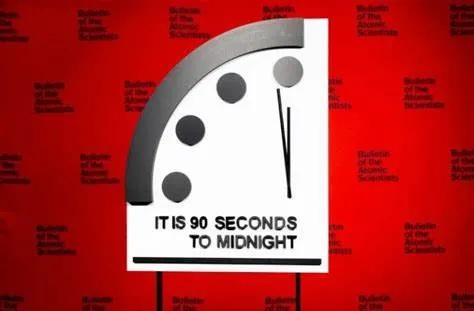
It is now 85 seconds to midnight
2026 Doomsday Clock Statement
Science and Security Board
Bulletin of the Atomic Scientists,Editor, John Mecklin, January 27, 2026
A year ago, we warned that the world was perilously close to global disaster and that any delay in reversing course increased the probability of catastrophe. Rather than heed this warning, Russia, China, the United States, and other major countries have instead become increasingly aggressive, adversarial, and nationalistic. Hard-won global understandings are collapsing, accelerating a winner-takes-all great power competition and undermining the international cooperation critical to reducing the risks of nuclear war, climate change, the misuse of biotechnology, the potential threat of artificial intelligence, and other apocalyptic dangers. Far too many leaders have grown complacent and indifferent, in many cases adopting rhetoric and policies that accelerate rather than mitigate these existential risks. Because of this failure of leadership, the Bulletin of the Atomic Scientists Science and Security Board today sets the Doomsday Clock at 85 seconds to midnight, the closest it has ever been to catastrophe.
Last year started with a glimmer of hope in regard to nuclear risks, as incoming US President Donald Trump made efforts to halt the Russia-Ukraine war and even suggested that major powers pursue “denuclearization.” Over the course of 2025, however, negative trends—old and new—intensified, with three regional conflicts involving nuclear powers all threatening to escalate. The Russia–Ukraine war has featured novel and potentially destabilizing military tactics and Russian allusions to nuclear weapons use. Conflict between India and Pakistan erupted in May, leading to cross-border drone and missile attacks amid nuclear brinkmanship. In June, Israel and the United States launched aerial attacks on Iranian nuclear facilities suspected of supporting the country’s nuclear weapons ambitions. It remains unclear whether the attacks constrained those efforts—or if they instead persuaded the country to pursue nuclear weapons covertly.
Meanwhile, competition among major powers has become a full-blown arms race, as evidenced by increasing numbers of nuclear warheads and platforms in China, and the modernization of nuclear delivery systems in the United States, Russia, and China. The United States plans to deploy a new, multilayered missile defense system, Golden Dome, that will include space-based interceptors, increasing the probability of conflict in space and likely fueling a new space-based arms race. As these worrying trends continued, countries with nuclear weapons failed to talk about strategic stability or arms control, much less nuclear disarmament, and questions about US extended deterrence commitments to traditional allies in Europe and Asia led some countries without nuclear weapons to consider acquiring them. As we publish this statement, the last major agreement limiting the numbers of strategic nuclear weapons deployed by the United States and Russia, New START, is set to expire, ending nearly 60 years of efforts to constrain nuclear competition between the world’s two largest nuclear countries. In addition, the US administration may be considering the resumption of explosive nuclear testing, further accelerating a renewed nuclear arms race……………………………………………………………………………………………………………………………………………………………………………………………………………..
Even as the hands of the Doomsday Clock move closer to midnight, there are many actions that could pull humanity back from the brink:
- The United States and Russia can resume dialogue about limiting their nuclear arsenals. All nuclear-armed states can avoid destabilizing investments in missile defense and observe the existing moratorium on explosive nuclear testing.
- Through both multilateral agreements and national regulations, the international community can take all feasible steps to prevent the creation of mirror life and cooperate on meaningful measures to reduce the prospect that AI be used to create biological threats.
- The United States Congress can repudiate President Trump’s war on renewable energy, instead providing incentives and investments that will enable rapid reduction in fossil fuel use.
- The United States, Russia, and China can engage in bilateral and multilateral dialogue on meaningful guidelines regarding the incorporation of artificial intelligence in their militaries, particularly in nuclear command and control systems.
Our current trajectory is unsustainable. National leaders—particularly those in the United States, Russia, and China—must take the lead in finding a path away from the brink. Citizens must insist they do so.
It is 85 seconds to midnight.
Editor’s note: Additional information on the threats posed by nuclear weapons, climate change, biological events, and the misuse of other disruptive technologies can be found elsewhere on this page and in the full PDF / print version of the Doomsday Clock statement.
Learn more about how each of the Bulletin‘s areas of concern contributed to the setting of the Doomsday Clock this year:
Nuclear Risk
The lack of arms control talks and a general dearth of leadership on nuclear issues has worsened the nuclear outlook. Read more…
Climate Change
Reducing the threat of climate catastrophe requires actions both to reduce the primary cause—the burning of fossil fuels—and to deal with the damage climate change is already causing. Read more…
Biological Threats
Four developments—research into self-replicating “mirror life”; AI tools that can design biological threats; state-sponsored biological weapons programs; and the dismantling of US public health efforts—have increased the possibility of bio-catastrophe. Read more…
Disruptive Technologies
The increasing sophistication and uncertain accuracy of AI models have generated significant concern about their application in critical processes, particularly in military programs. Read more… https://thebulletin.org/doomsday-clock/2026-statement/?utm_source=ActiveCampaign&utm_medium=email&utm_content=The%202026%20Doomsday%20Clock%20statement&utm_campaign=20260129%20Thursday%20Newsletter%20copy1%20%20%28Copy%29
A High-Stakes Effort to Relax Radiation Limits and Restart Nuclear Growth
Oil Price, By Haley Zaremba – Jan 28, 2026
- The Trump administration wants the NRC to reconsider core radiation safety models to accelerate nuclear development.
- Critics warn that weakening safety standards may erode public trust without meaningfully speeding up new reactor construction………………………..
Next month, the United States Nuclear Regulatory Commission (NRC) is slated to overhaul the level of radiation that Americans can legally be exposed to in response to an executive order issued by Donald Trump in May of 2025. The Trump administration is seeking to loosen regulations related to the nuclear energy industry in the United States in order to jumpstart the struggling sector.
The United States generates more nuclear energy than any other country, but it won’t hold that distinction for long if current domestic and global trends hold true. The domestic nuclear energy sector has been in near-terminal decline for decades now, and the United States is now home to an aging fleet and very few plans for new and expanded nuclear energy projects.
In large part, this is due to the reality that building a new nuclear reactor is extremely expensive and logistically and bureaucratically nightmarish, leading to long and frequently delayed timelines. Plant Vogtle, the only new nuclear energy plant to be brought online in the United States in decades, was enormously over budget and years behind schedule. When its final reactor finally came online in Waynesboro, Georgia, in 2024, the plant had taken $35 billion and 14 years to reach completion.
In order to avoid such issues, the Trump administration is seeking to minimize the prodigious amount of red tape involved in developing a new nuclear power plant. And it’s targeting public safety measures to do so. The May 23 executive order mandates that the NRC “reconsider reliance on the linear no-threshold (LNT) model for radiation exposure and the ‘as low as reasonably achievable’ standard,” among other requirements, in order to “reestablish the United States as the global leader in nuclear energy.”
However, experts contend that loosening or doing away with the NRC’s licensing and review process could have some major downsides for public health and for the Trump administration’s own aims. “The [Trump] administration may be working against its own long-term goals by short-circuiting the public arbitration process moderated by the NRC that is critical to building and maintaining public acceptance and confidence in nuclear energy,” warned a recent column from the Carnegie Endowment for International Peace.
Moreover, the executive order may not even result in an acceleration of nuclear production while unduly and unnecessarily increasing risk factors for Americans, argues a recent op-ed by Katy Huff for Scientific American. “As a nuclear energy advocate and former Department of Energy official,” Huff writes, “I want to see more nuclear energy on the grid soon. But loosening the protections of the linear no-threshold (LNT) model is not supported by current research.”
In the past, such suggestions to the NRC have been tabled because of insufficient evidence to support such a relaxation of radiation protections. Huff argued that, by ignoring these precedents based on rigorous research findings, the executive order is asking the NRC to act politically rather than scientifically. She called for more evidence-gathering on the topic, especially to validate or complicate early findings that raising radiation exposure could pose a particular risk to women and children. …………………………………………………………….https://oilprice.com/Energy/Energy-General/A-High-Stakes-Effort-to-Relax-Radiation-Limits-and-Restart-Nuclear-Growth.html
Since 2021, EDF has detected more than 80 significant cracks on its French nuclear reactors.
Since 2021, EDF has detected more than 80 significant cracks on its French
nuclear reactors, and will likely find more in the future, officials from
the Nuclear Safety and Radiation Protection Authority (ASNR) said on
Tuesday.
Montel 27th Jan 2026, https://montelnews.com/fr/news/a5e4816f-9e51-4039-bfa6-ee32fcafb6b4/edf-a-repare-plus-de-80-fissures-sur-ses-reacteurs-asnr
Brian Goodall concerned about nuclear subs at Rosyth
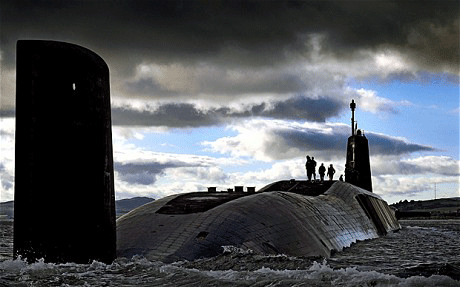
Last month the MoD told the committee that they will not reveal if nuclear weapons will be aboard submarines being repaired at Rosyth.
28th January
A ROSYTH councillor is calling for a public consultation on plans to temporarily base the UK’s new nuclear submarine fleet at the dockyard.
Brian Goodall highlighted the “seriousness of the implications” of providing a contingency dock for the Dreadnought class of vessels that will carry Trident missiles.
He said emergency plans to be put in place in the event of a radiological accident “could require urgent protective actions, like arrangements for sheltering local people and the distribution of potassium iodide tablets to the local community”.
He has submitted a motion to next week’s South and West Fife area committee, calling on the convener to write to the “Secretary of State for Defence requesting that a public consultation be held on the proposals”.
Cllr Goodall also wants the committee to acknowledge the “seriousness of the implications of these plans and the impact any radiological accident or event would have on the local population”.
Rosyth will “bridge a gap” by offering a temporary home for the new subs and Babcock said the dock needs to be ready by 2029.
Long term the vessels will be maintained at Faslane, however the site on the Clyde won’t be ready until the mid 2030s.
The UK Government are investing £340 million in the dockyard which includes funding for the contingency dock.
Cllr Goodall’s motion explains the dock will be used for the “Dreadnought-class nuclear submarines from the UK’s continuous at-sea nuclear Trident missile programme”.
He said the UK Government plans included information on the need for a “Detailed Emergency Planning Zone” which was still being calculated but was likely to include parts of the town within 1.5km.
The SNP councillor added that “emergency plans both on and off site will also be needed to reduce and/or prevent the escalation of the impact of any radiological accident or event”.
Last month the MoD told the committee that they will not reveal if nuclear weapons will be aboard submarines being repaired at Rosyth.
They also confirmed residents would be given potassium iodate tablets to block radiation in the event of an emergency.
The MoD was giving an update on the plans for Rosyth to be the temporary repair base for the UK’s new fleet of nuclear deterrent submarines.
This work would be alongside the submarine dismantling project, which is cutting up an old nuclear sub, Swiftsure, at the dockyard and removing the radioactive waste left within it.
There are another six decommissioned subs laid up at Rosyth – and 15 at Devonport – still to be dismantled and although no decision has been made, local Labour MP Graeme Downie has called for that work to be done here.
He said the yard could become a “centre of excellence” for submarine dismantling which would secure highly paid skilled jobs for decades to come.
This week Cllr Goodall posted: “I’ve said that this (motion) should include an update from Babcock and the Ministry of Defence, following the local Labour MP’s really concerning call for all of the UK’s decommissioned nuclear submarines to be brought to Rosyth for the dismantling, and so, the storage of radioactive materials that goes with it, to go on in Rosyth indefinitely.”
1 This Month

of the week – Shut Down Drone Warfare!


Tell the Ukrainian Government to Drop Prosecution of Peace Activist Yurii Sheliazhenko

Petition to revoke the licensing of the Near Surface Nuclear Disposal Facility (NSDF) at Chalk River. https://www.ourcommons.ca/petitions/en/Petition/Details?Petition=e-7247
To see nuclear-related stories in greater depth and intensity – go to https://nuclearinformation.wordpress.com
-
Archives
- March 2026 (237)
- February 2026 (268)
- January 2026 (308)
- December 2025 (358)
- November 2025 (359)
- October 2025 (376)
- September 2025 (257)
- August 2025 (319)
- July 2025 (230)
- June 2025 (348)
- May 2025 (261)
- April 2025 (305)
-
Categories
- 1
- 1 NUCLEAR ISSUES
- business and costs
- climate change
- culture and arts
- ENERGY
- environment
- health
- history
- indigenous issues
- Legal
- marketing of nuclear
- media
- opposition to nuclear
- PERSONAL STORIES
- politics
- politics international
- Religion and ethics
- safety
- secrets,lies and civil liberties
- spinbuster
- technology
- Uranium
- wastes
- weapons and war
- Women
- 2 WORLD
- ACTION
- AFRICA
- Atrocities
- AUSTRALIA
- Christina's notes
- Christina's themes
- culture and arts
- Events
- Fuk 2022
- Fuk 2023
- Fukushima 2017
- Fukushima 2018
- fukushima 2019
- Fukushima 2020
- Fukushima 2021
- general
- global warming
- Humour (God we need it)
- Nuclear
- RARE EARTHS
- Reference
- resources – print
- Resources -audiovicual
- Weekly Newsletter
- World
- World Nuclear
- YouTube
-
RSS
Entries RSS
Comments RSS
 nuclear-news