The non-corporate nuclear news, week to 27 December

TOP STORIES.
Trump’s Nuclear Obsession.
Palantir’s Palestine: How AI Gods Are Building Our Extinction.
The Sovereign Hook – How Australia and its Jewish Community are Played in a Foreign Game.
Gun vs Keffiyeh- One kills, the other gets you death threats.
“Make Iran like Gaza”: Chilling insider view from Israel weapons expo.
Israel Is Preparing for a Permanent Presence in Gaza,
Satellite Images Reveal. Fukushima Now (29) – Part 1: What Constitutes Responsibility?
Climate. Out of a superhero movie: Companies are coming up with plans to block out the sun.
ECONOMICS. It was blindingly obvious that Europe wasn’t going to agree to the reparations loan.
EDF faces the financial equation: Bernard Fontana is considering massive asset sales to generate 20 billion euros –
Instead of buying Venezuelan heavy crude…Trump just steals it.
Trump row threatens to delay Britain’s nuclear renaissance
Trump’s Son-in-Law Pitches$112B Tech Utopia on Gaza Rubble. Profiting From Genocide .
Studsvik Calls Extraordinary Meeting to Add UK Nuclear Executive Julia Pyke to Board. EU launches inquiry intoCzech funding plan for new nuclear. Sweden’s VattenfallSeeks State Funding for New Nuclear Reactors. Politico: Despite the war, France will build nuclear fuel in Germany with the help of a Russian company. Trump Floundering Efforts to Shore Up US Hegemony. Turkey Makes Another $9 Billion Bet on Russian Nuclear Power.
EMPLOYMENT. Fears raised that specialist Vulcan MoD work could shift to Sellafield
ENVIRONMENT. UK’s largest planned data centre ‘could use 50 times more water’ than developer claims. Biodiversity Net Gain: can developers be trusted?
ETHICS and RELIGION. Why Are Pedophiles the Most Successful Capitalists?
HISTORY. European Russophobia and Europe’s Rejection of Peace: A Two-Century Failure. The Real Story Behind the Russia–Ukraine War—and What Happens Next.
LEGAL. Keir Starmer’s attempt to send Abramovich’s billions to Ukraine is illegal. The Problem with Machado: Assange Sues the Nobel Foundation
MEDIA. How reporting facts can now land you in jail for 14 years as a terrorist.
OPPOSITION to NUCLEAR . 15 years after Fukushima disaster locals fear return of Japan’s nuclear power.
PERSONAL STORIES. One excavator, 10,000 bodies, a sea of rubble: inside Gaza’s effort to retrieve and bury its dead.
POLITICS. Israeli Cabinet Approves 19 New Apartheid Colonies in Occupied West Bank.
Japan set to restart world’s biggest nuclear power plant. Former Japanese PM Ishiba again criticizes remarks advocating nuclear armament. Hiroshima urges Japanese government to uphold non-nuclear principles.
Japan set to restart world’s biggest nuclear power plant. Former Japanese PM Ishiba again criticizes remarks advocating nuclear armament. Hiroshima urges Japanese government to uphold non-nuclear principles.
Iran, UK foreign ministers discuss nuclear issue in phone call. Hawai‘i Has a Rare Opportunity to Reclaim Land From the US Military.
The 2025 nuclear year in review: Back to the Future Atomic Age. India’s Dept of Atomic Energy seeks sops to put nuclear power on a par with renewable energy.
POLITICS INTERNATIONAL and DIPLOMACY. Kushner, Witkoff draft $112B proposal to develop Gaza into ‘smart city’ with luxury resorts.
Report: Netanyahu To Ask Trump To Support Another Attack on Iran. Global nuclear arms control under pressure in 2026. Iran rejects inspections of bombed nuclear sites without IAEA framework.
RADIATION. Canada’s double standard on tritium emissions
SAFETY. Warning Chernobyl nuclear plant radiation shield is at risk of collapse.
Incident. Radioactive substance leaks from Fukui nuclear power plant in Japan. Occupied and Imperiled: Charting a Path for Zaporizhzhia’s Nuclear Future.
SECRETS and LIES. The EU’s top diplomat casually rewrites WWII history on her way to WWIII. 58 Years of Occupation — And the Shocking Report Israel Doesn’t Want You to Read
SPACE. EXPLORATION, WEAPONS. Trump orders return to Moon by 2028, lunar base with nuclear power by 2030. Russia wants to build a nuclear power plant on the moon in the next few years .
TECHNOLOGY. Why Nuclear Fusion Will Not Solve the AI Power Problem. Scottish Government urged to intervene in Edinburgh AI data centre plans.
The Reality of SMR Timelines for AI Data Centers: A Veteran’s View.
URANIUM. Canada must acknowledge the implications of selling uranium to India.
WASTES. The cost of eternity. UK to restart nuclear submarine defuelling in 2026.
WAR and CONFLICT. Trump’s Peace? More Like Bombs, Blockades, and Bullying. US Launches Christmas Strikes on Nigeria—the 9th Country Bombed by Trump. The“President of Peace” Prepares for War.
Israeli Cabinet Approves 19 New Apartheid Coloniesin Occupied West Bank. Israeli Occupation Intensifies: Defense Minister Vows Permanent Gaza Presence as Settler Violence Escalates in West Bank. Netanyahu plans to brief Trump on possible new Iran strikes.
WEAPONS and WEAPONS SALES. Europe’snuclear sites on high alert for drone threats in the year ahead . Israel’s growing role in Taiwan’s air defense alarms Beijing. France is to build a nuclear-powered aircraft carrier that will be the largest warship in Europe.
How Corporations View (and Own) the U.S. Military. Trump Announces Nuclear-Armed Battleships for the U.S. Navy. Revealed: Trump’s secret $264 million plot to put nuclear doomsday weapons in Britain to face down Putin. $264million scheme could transform RAF Lakenheath in Suffolk into a nuclear facility.
Trump’s Nuclear Obsession

Karl Grossman – Harvey Wasserman, December 24, 2025 , https://www.counterpunch.org/2025/12/24/trumps-nuclear-obsession/
The Trump family is now directly investing in atomic energy. Its money-losing Truth Social company has become a part owner of a major fusion nuclear power project.
Among much more, the investments mean the Trump family stands to profit directly from White House attacks on wind, solar and other cheap, clean renewable energies which for decades have been driving fusion, fission and fossil fuels toward economic oblivion.
“A Trump-sponsored business is once again betting on an industry that the president has championed, further entwining his personal fortunes in sectors that his administration is both supporting and overseeing,” reported an article on the front page of the business section of the New York Times last week. “This one is in the nuclear power sector. TAE Technologies, which is developing fusion energy, said on Thursday that it planned to merge with Trump Media & Technology Group. President Trump is the largest shareholder of the money-losing social media and crypto investment firm that bears his name, and he will remain a major investor in the combined company.”
The headline of the piece: “Trump’s Push Into Nuclear Is Raising Questions.”
The primary asks have to do with economic conflicts of interest, and public safety.
“The deal, should it be completed,” the article continued, “would put Mr. Trump in competition with other energy companies over which his administration holds financial and regulatory sway. Already, the president has sought to gut safety oversight of nuclear power plants and lower thresholds for human radiation exposure.”
CNN reported: “Nuclear fusion companies are regulated by the federal government and will likely need Uncle Sam’s deep research and even deeper pockets to become commercially viable. The merger needs to be approved by federal regulators—some of whom were nominated by Trump.”
CNN quoted Richard Painter, chief White House ethics lawyer under President George W. Bush, as saying: “There is a clear conflict of interest here. Every other president since the Civil War has divested from business interests that would conflict with official duties. President Trump has done the opposite.” Painter is now a professor at the University of Minnesota Law School.
“Having the president and his family have a large stake in a particular energy source is very problematic,” said Peter A. Bradford, who previously served on the Nuclear Regulatory Commission, the agency meant to oversee the nuclear industry in the United States, in the Times article.
“The Trump administration has sought to accelerate nuclear power technology—including fusion, which remains unproven,” Bradford said. “That support has come in the form of federal loans and grants, as well as executive orders directing the NRC to review and approve applications more quickly.”
Still, the White House press secretary, Karoline Leavitt, said in a statement that “neither the president nor his family have ever engaged, or will ever engage, in conflicts of interest.” And the Times piece continued, “a spokeswoman for Trump Media” said the company was “scrupulously following all applicable rules and regulations, and any hypothetical speculation about ethics violations is wholly unsupported by the facts.”
It went on that “Trump’s stake in Trump Media, recently valued at $1.6 billion, is held in a trust managed by Donald Trump Jr., his eldest son. Trump Media is the parent company of Truth Social, the struggling social-media platform. The merger would set Trump Media in a new strategic direction, while giving TAE a stock market listing as it continues to develop its nuclear fusion technology.”
The Guardian quoted the CEO of Trump Media, Devin Nunes, the arch-conservative former member of the House of Representatives from California and close to Trump, who is currently chair of the President’s Intelligence Advisory Board, saying Trump Media has “built un-cancellable infrastructure to secure free expression online for Americans. And now we’re taking a big step forward toward a revolutionary technology that will cement America’s global energy dominance for generations.” Nunes is the would be co-CEO of the merged company.
A current member of the US House, Don Beyer, a Democrat from Virginia, said in a statement quoted in Politico that the deal raises “significant concerns” about conflicts of interest and avenues for potential corruption. “The President has consistently used both government powers and taxpayer money to benefit his own financial interests and those of his family and political allies. This merger will necessitate congressional oversight to ensure that the U.S. government and public funds are properly directed towards fusion research and development in ways that benefit the American people, as opposed to the Trump family and their corporate holdings.”
By federal law (the Price-Anderson Act of 1957) the US commercial atomic power industry has been shielded from liability in major accidents it might cause. The “Nuclear Clause” in every US homeowner’s insurance policy explicitly denies coverage for losses or damages caused, directly or indirectly, caused by a nuclear reactor accident.
As his company fuses with the atomic industry, Trump acquires a direct financial interest in gutting atomic oversight—which he has already been busy doing. In June Trump fired NRC Chairman Christopher T. Hanson. No other president has ever fired an NRC Commissioner.
. Earlier, more than 100 NRC staff were purged by Elon Musk’s DOGE operation. There has been a stream of Trump executive orders calling for a sharp reduction in radiation standards, expedited approval by the NRC of nuclear plant license applications, and a demand to quadruple nuke power in the United States—from the current 100 gigawatts to 400 gigawatts in 2050. Such a move would require huge federal subsidies and the virtual obliteration of safety regulations. Trump has essentially ordered the NRC to “rubber stamp” all requests from a nuclear industry in which he is now directly invested.
Trump’s Truth Social’s fusion ownership stake removes all doubt about any regulatory neutrality. No presently operating or proposed US atomic reactor can be considered certifiably safe.
Trump’s fusion investments are also bound to escalate Trump’s war against renewable energy and battery storage, the primary competitors facing the billionaire fossil/nuke army in which the Trump family is now formally enlisting. That membership blows to zero the credibility of any claim nuclear reactor backers might make that atomic energy can officially be considered safe.
Continue readingIsrael Is Preparing for a Permanent Presence in Gaza, Satellite Images Reveal
Since the ceasefire, Israel has constructed at least 13 new military outposts inside Gaza, consolidated existing military infrastructure, built roads, and destroyed more Palestinian property.
Forensic Architecture and Drop Site News. Dec 21, 2025
Since the so-called ceasefire came into effect in Gaza on October 10, Israel has been consolidating its control of over 50% of Gaza and—according to new research by Forensic Architecture—physically altering the geography of the land. Through a combination of the construction of military infrastructure alongside the destruction of existing buildings, Israel appears to be laying the groundwork to establish a permanent presence in the majority of the Gaza Strip.
Israel has constructed at least 13 new military outposts inside Gaza since the ceasefire—primarily located along the yellow line, in eastern Khan Younis, and near the border with Israel, according to analysis of satellite imagery by Forensic Architecture.
“Israel is doing what it always does, and what it historically has done best: establish ‘facts on the ground,’ incrementally rather than spectacularly, and make them permanent once those with influence to force it to reverse course either lose interest, decide that the cost of confronting Israel is not worth the price, or come out in open support of Israeli violations. Israel is in no rush and prepared to play the long game,” Mouin Rabbani, co-editor of Jadaliyya and a former UN official who worked as a senior analyst on Israel-Palestine for the International Crisis Group, told Drop Site after reviewing a summary of the Forensic Architecture findings.
The analysis also shows that, between October 10 and December 2, 2025, Israel has:
- Accelerated the growth and infrastructure development of 48 existing military outposts inside Gaza.
- Expanded a network of roads connecting military outposts inside Gaza to the Israeli road network, bases and settlements outside of Gaza.
- Continued construction that began in September 2025 of a new road in Khan Younis, re-routing the Magen Oz corridor to run within Israel’s area of control.
- Engaged in the systematic demolition and destruction of Palestinian property, particularly in eastern Khan Younis, targeting areas which haven’t already been destroyed. New military outposts and roads have emerged across this area.
………………………………………………………………………………………………………………………………………………………………………………………………………………………………………https://www.dropsitenews.com/p/gaza-israel-building-military-outposts-roads-permanent-presence-yellow-line
Israeli Cabinet Approves 19 New Apartheid Colonies in Occupied West Bank
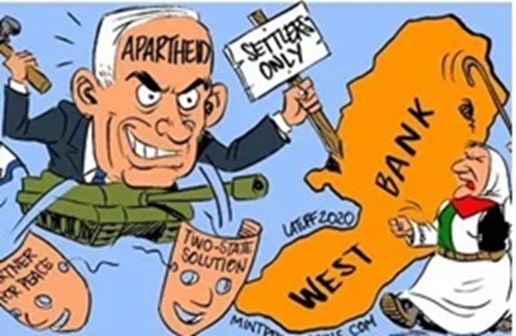
“The ONLY reason Israel gets away with this naked thievery is US military and political support,” said one observer.
Brett Wilkins, Dec 21, 2025, https://www.commondreams.org/news/israel-19-new-settlements
Israel’s Cabinet on Sunday finalized approval of 19 new Jewish-only settler colonies in the illegally occupied West Bank, a move the apartheid state’s far-right finance minister said was aimed at thwarting Palestinian statehood.
Cabinet ministers approved the legalization of the previously unauthorized settler outposts throughout the occupied Palestinian territory, bringing the total number of new settlements in recent years to 69.
The move will bring the overall total number of exclusively or overwhelmingly Jewish settlements—which are illegal under international law—to more than 200, up from around 140 just three years ago.
Included in the new approval are two former settlements—Kadim and Ganim—that were evacuated in compliance with the now effectively repealed 2005 Disengagement Law, under which Israel dismantled all of its colonies in the Gaza Strip and four in the West Bank.
“This is righting a historic injustice of expulsion from 20 years ago,” Israeli Finance Minister Bezalel Smotrich—who is a settler—said on Sunday. “We are putting the brakes on the rise of a Palestinian terror state.”
“We will continue to develop, build, and settle the inherited land of our ancestors, with faith in the righteousness of our path,” Smotrich added.
Following an earlier round of approval for the new settlements last week, Palestinian presidential spokesperson Nabil Abu Rudeineh said, “All Israeli settlement activity is illegal and constitutes a violation of international law and international legitimacy resolutions.”
United Nations Secretary-General António Guterres earlier this month denounced Israel’s “relentless” settlement expansion.
Such colonization, said Guterres, “continues to fuel tensions, impede access by Palestinians to their land, and threaten the viability of a fully independent, democratic, contiguous, and sovereign Palestinian state.”
Israeli Prime Minister Benjamin Netanyahu and other Israeli officials—some of whom, including Smotrich, deny the very existence of the Palestinian people—have vowed that such a state will not be established.
While Netanyahu—who is wanted by the International Criminal Court for alleged war crimes and crimes against humanity in Gaza—is under pressure from right-wing and far-right government officials, settlers, and others to annex all of the West Bank, US President Donald Trump recently said that “Israel would lose all of its support from the United States if that happened.”
Some doubted Trump’s threat, with Democracy for the Arab World Now (DAWN) executive director Sarah Leah Whitson reacting to the new settlements’ approval by posting on X that “the ONLY reason Israel gets away with this naked thievery is US military and political support.”
Israel seized and occupied the West Bank including East Jerusalem along with Gaza in 1967, ethnically cleansing around 300,000 Palestinians. Many of these forcibly displaced people were survivors of the Nakba, the Jewish terror and ethnic cleansing campaign that saw more than 750,000 Palestinians flee or be forced from Palestine during the foundation of the modern state of Israel.
Since 1967, Israel has steadily seized more and more Palestinian land in the West Bank while building and expanding colonies there. Settlement population has increased exponentially from around 1,500 colonists in 1970 to roughly 140,000 at the time of the Oslo Accords in 1993—under which Israel agreed to halt new settlement activity—to around 770,000 today.
Settlers often attack Palestinians and their property, including in deadly pogroms, in order to terrorize them into leaving so their land can be stolen. Israeli colonists have also attacked Israel Defense Forces soldiers they view as standing in the way of their expansion.
In July 2024, the International Court of Justice—where Israel is currently facing a genocide case related to the Gaza war—found the occupation of Palestine to be an illegal form of apartheid that must be ended as soon as possible. The ICJ also ruled that Israeli settler colonization of the West Bank amounts to annexation, also a crime under international law. Article 49 of the Fourth Geneva Convention states that an “occupying power shall not deport or transfer parts of its own civilian population into the territory it occupies.”
As the world’s attention focused on Gaza during the past two years, Israeli soldiers and settlers have killed at least 1,039 Palestinians—at least 225 of them children—in the West Bank. This year, at least 233 Palestinians, including at least 52 children, have been killed so far, according to the United Nations Relief and Works Agency for Palestinian Refugees in the Near East.
On Saturday, Israeli occupation forces shot and killed two Palestinians in the northern West Bank, including a 16-year-old boy, Rayan Abu Muallah, who the Israel Defense Forces said was shot after he threw an object at its troops.
One excavator, 10,000 bodies, a sea of rubble: inside Gaza’s effort to retrieve and bury its dead
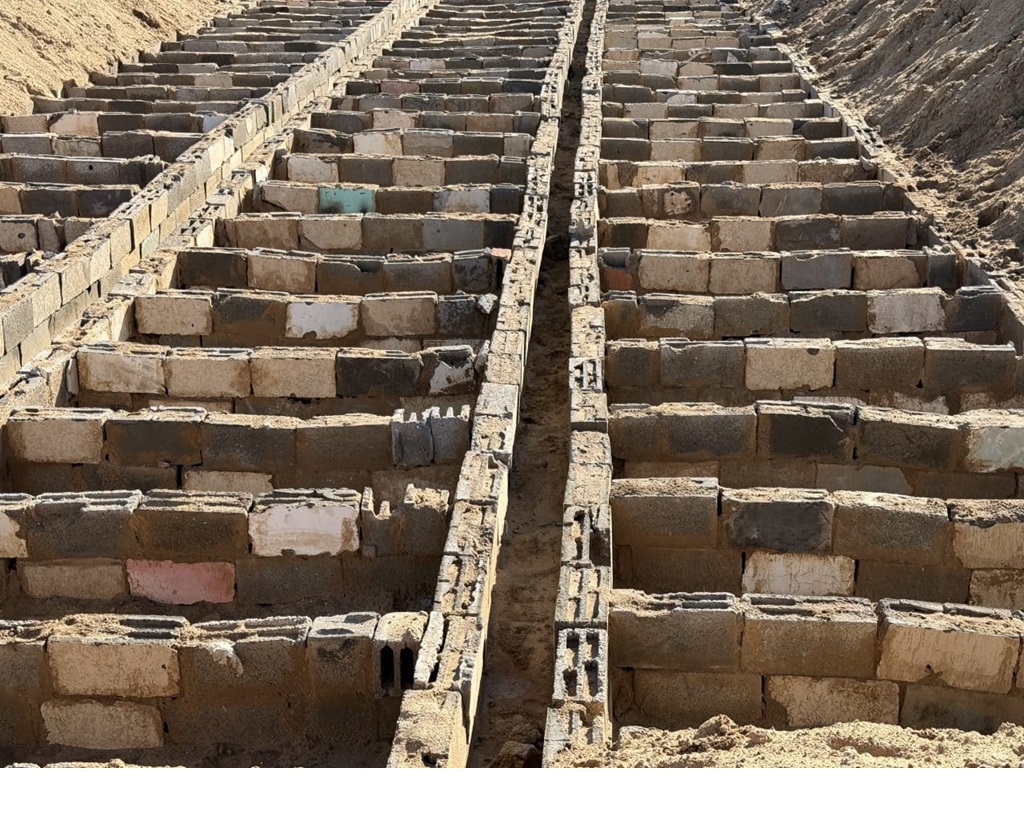
Under the relative calm of a ceasefire, Civil Defense crews in Gaza are undertaking the monumental feat of recovering thousands of bodies still trapped under the rubble.
By Tareq S. Hajjaj December 25, 2025 https://mondoweiss.net/2025/12/one-excavator-10000-bodies-a-sea-of-rubble-inside-gazas-effort-to-retrieve-and-bury-its-dead/
Fatima Salem waits outside anxiously, as rescue crews dig through the rubble of her family’s home in Gaza City on December 15th. With bated breath, she clings to the hope that all 60 of her family members – brothers, sisters, nieces, nephews, and grandchildren – who were buried under the rubble after an Israeli airstrike targeted their building, will be rescued.
But this was not a typical rescue operation, and Fatima was not waiting for signs of life. She knew everyone was dead. That’s because the airstrike on her family’s home happened almost exactly two years ago, on December 19, 2023, just two months into the genocide.
The 60 members of the Salem family are some of an estimated 10,000 Palestinians whose bodies remain trapped under the extensive rubble across the Gaza Strip. Due to two years of active Israeli bombardment, the targeting and killing of civil defense crews, and the lack of heavy duty machinery required to excavate the tons of concrete rubble, rescue missions in Gaza have been largely stalled.
But on December 15, the Civil Defense in the Gaza Strip announced the start of a long recovery process of bodies that have remained under the rubble for two years. The operations are focused only on the areas in the Gaza Strip not actively being occupied by the Israeli military, which accounts for roughly half of the territory.
The first rescue mission was for the Salem family in Gaza City.
“Here I lost every person dear to me; they are the closest people to me—my brothers and sisters and their families. I lost everyone in this place,” Fatima Salem cried. When she heard about the rescue mission, she rushed to the scene of the destroyed building, where the souls of her relatives had remained trapped for two years.
She said that her family was targeted on December 19, 2023, after they fled from northern Gaza to Gaza City due to the intensification of shelling and fighting in their residential area. They found refuge in a building whose residents had evacuated, and gathered there with their children and families. No one who was in the building at the time of the bombing survived.
“I want to see them, to embrace them, to bid them farewell,” she said as she stood before rows of bones and skulls wrapped in white plastic shrouds, laid out on the ground in front of her. Some have been identified by their present surviving relatives, while others have not yet been identified.
Omar Suleiman, a member of the forensic department at the Civil Defense, was working at the scene of the Salem family. He described a painstaking process of trying to identify and record the identities of the deceased, saying that crews are documenting descriptions of the condition of the bodies in terms of form, height, and the level of decomposition they have reached, along with preserving a DNA sample when possible.
According to videos published by the Civil Defense on its Telegram channel, what is recovered from the remains of the martyrs is sometimes only bones, not always complete skulls, but rather bones from the chest and the feet, making identification a difficult matter.
According to Suleiman, the level of decomposition in the bodies was very high, which made it difficult for families to identify them. The lack of tools and technology for advanced DNA testing has also made the identification process more difficult. He said that crews were working “with very limited tools and under difficult and exhausting conditions.”
Civil Defense crews say they recovered all the bodies from the building, all belonging to the martyrs of the Salem family, in addition to 17 more bodies buried in the vicinity around the building. After two years, Fatima Salem was finally able to bid farewell.
Thousands of bodies, limited resources
In Khan Younis in southern Gaza, on December 20, recovery operations began in areas of the city, starting with the martyrs of the Abu Hilal family. They were killed on August 13, 2025.
Huda Abu Hilal, in her 20s, was the sole survivor of a strike that targeted her family’s home on August 13, 2025. Though she was inside the building at the time, just before the airstrike, Huda’s mom had asked her to go downstairs for something. At that moment, the home was bombed, and everyone except Huda was killed.
“All my family was killed except me—my mother and father, my sisters, and their children—all of them were martyred,” she told Mondoweiss, adding that because her neighborhood remained under an evacuation order after the bombing, crews were not able to access her home to rescue her family.
At the site, Samah Hamad, head of the forensic department of the Civil Defense, described the challenge ahead for crews.
He said that in Khan Younis alone, there are 75 destroyed buildings with hundreds of bodies buried under the rubble that need to be recovered. Many of the buildings, he said, are located in the area behind the ‘yellow line’ that are inaccessible to Palestinian crews. But even in the areas that they can access, the rescue mission is slow moving.
Hamad notes that the slowdown in these operations is due to the fact that all crews in the Gaza Strip are working with very limited equipment, as only one large excavator is being used in multiple cities and areas in the Strip.
For the past two months since the ceasefire was announced, Huda said she would pass by the rubble of the home often, even if just to recite a prayer for her family still trapped beneath the rubble, hoping that they would be rescued soon.
“Now I can honor my martyred family by burying them, and we can move them to graves and make visiting them a habit,” Huda said.
Out of a superhero movie: Companies are coming up with plans to block out the sun.

Private companies are jumping into the race to deploy particles to the atmosphere to reduce global warming, prompting enthusiasm from investors and concerns from some scientists, Josh Marcus reports
Independent, 25 December 2025
A secretive team of scientists is working on an unprecedented plan to fill the atmosphere with tiny particles that imitate a volcanic eruption and block out the sun. It might save humanity, or it could spiral out of control. Thousands stand opposed to such a scheme, but these plans may move forward anyway.
This is not the plot of the next Marvel movie, but solar geoengineering, one of the very non-fictional frontiers of climate research.
In October, a start-up called Stardust Solutions announced it had raised $60 million to pursue technology that will bounce the sun’s light back into space using reflective, airborne particles.
It is the largest investment ever for a company pursuing such a strategy to cool our rapidly overheating planet, according to Politico, and builds off the firm’s previous $15 million funding series.
Stardust Solutions is one of a small but closely-watched group of companies and researchers pursuing such ideas in the hopes of making rapid gains on the climate crisis as international action remains perilously insufficient.
The basic idea is to limit how much of the sun’s energy reaches the Earth’s surface. While this won’t tackle the root cause of the climate crisis — still-rising greenhouse gas emissions from fossil fuels — “solar radiation modification” could reduce the global temperature and slow the melting of the polar ice caps, buying us all some much-needed time.
While the idea has been around since the mid-Sixties, small-scale outdoor experiments have only begun in the last two decades, including cloud seeding in Switzerland and testing salt spray’s impacts on the clouds above the Great Barrier Reef.
For every fledgling experiment, another project has been canceled in the face of public opposition. A 2024 effort spraying sea salt aerosols from a decommissioned air craft carrier in Alameda, California, was quickly shut down because of outrage from community members who said they were not consulted, while the Indigenous Saami people of Scandinavia were among those who opposed the aborted 2021 SCoPEx project in Sweden, arguing the plan to spray calcium carbonate dust into the atmosphere violated both their philosophy towards the Earth and would not be an impactful scientific strategy to stop the root causes of the climate crisis’
Despite these concerns, the daily glut of increasingly dire climate updates – including the recent news of the likely irreversible decline of ocean corals – has given new momentum to this once fringe idea.
A ‘human-safe’ particle spray
Stardust Solutions was founded in 2023 by Yanai Yedvab and Amyad Spector, nuclear physicists who met at an Israeli national laboratory, and particle physicist Eli Waxman, former chief scientist at the Israeli Atomic Energy Commission……………………………………………………………………………………………………………………………………………………………………………………… https://www.independent.co.uk/climate-change/dim-sun-climate-change-b2877722.html
Politico: Despite the war, France will build nuclear fuel in Germany with the help of a Russian company
Can the ambitious plan to phase out Russian nuclear fuel succeed with Russian expertise? Paris believes it can and is pressing Berlin for approval
Protothema, Newsroom, December 22, 2025
Takeawaysby Protothema AI
- A Franco-Russian joint venture plans to produce nuclear fuel components in Lingen, Germany, operated by Framatome
- The project faces scrutiny from German authorities due to security concerns and potential espionage risks
- Framatome is lobbying German officials for approval, arguing it is a European solution despite Russian components
- German regional authorities remain skeptical, citing past energy vulnerabilities with Russia
- A final decision on the Lingen plant’s approval is expected in the coming weeks.
A triangular relationship that is close to becoming a reality, despite the war in Ukraine and the sanctions imposed on Russia, will help France produce nuclear fuel for its reactors.
The Franco-Russian joint venture will manufacture nuclear fuel rods and other components in Lingen, Germany.
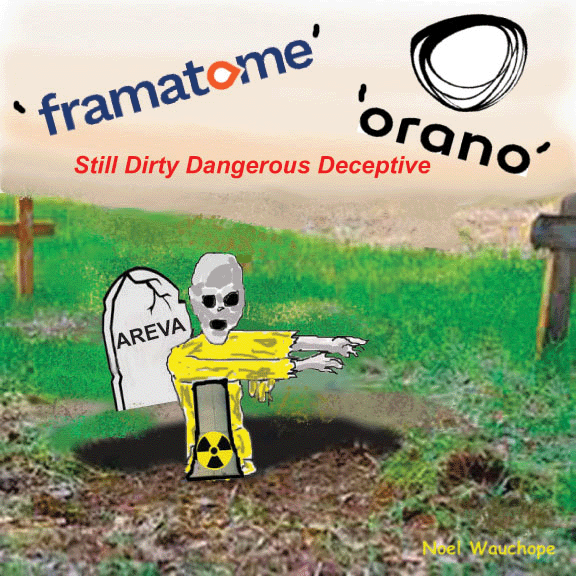
The plant will be operated by Framatome, a subsidiary of the French state-owned energy company EDF, using Russian components supplied by TVEL, part of the Kremlin-controlled nuclear giant Rosatom. TVEL will not be directly involved in the operation of the plant but will provide the Russian-made components necessary for producing the nuclear fuel.
The plant will not supply electricity directly; it will focus solely on producing nuclear fuel.
Framatome is putting intense pressure on the German authorities to approve the project, mobilizing the French government at the highest levels. The company argues that what is good for Framatome is good for Europe.
However, as Politico points out, the project comes at a time when the EU is attempting to ban all energy imports from Russia in response to Russia’s invasion of Ukraine. At the same time, the plan raises concerns among state and federal authorities about potential espionage and other security risks.
The French-Russian joint venture has not yet received approval from Berlin. A final decision is expected in the coming weeks, but no timetable has been set……………………………………………………
France–Russia Nuclear Cooperation
The cooperation between Framatome and Rosatom began in 2021, when the two parties signed a long-term partnership and established a joint venture in which Framatome owns 75% and TVEL 25%……………….. https://en.protothema.gr/2025/12/22/politico-despite-the-war-france-will-build-nuclear-fuel-in-germany-with-the-help-of-a-russian-company/
Canada must acknowledge the implications of selling uranium to India

Gordon Edwards and Erika Simpson, The Globe and Mail, December 23, 2025, https://www.theglobeandmail.com/opinion/article-uranium-india-nuclear-canada-carney-npt-non-proliferation-cameco/
Gordon Edwards, PhD, is a science educator, nuclear safety consultant and president of the Canadian Coalition for Nuclear Responsibility https://www.ccnr.org/index.html.
Erika Simpson, PhD, is an associate professor of international politics in the department of political science at Western University and president of the Canadian Peace Research Association https://cpra-acrp.com/past-call-for-papers.
Every so often, Canada arrives at a moment when foreign policy, ethics and national interest intersect. Thepending $3.94-billion sale https://t.co/KY1HWdvsQk of Canadian uranium to India is one of those moments – though we seem inclined to move past it with minimal reflection.
India is not a routine customer. It is a nuclear-armed state that has never https://treaties.unoda.org/t/npt/participants signed the Nuclear Non-Proliferation Treaty (NPT), the agreement meant to anchor global efforts against the spread of nuclear weapons. In selling it uranium, Canada appears willing to extend to India the kinds of benefits normally reserved for states that accept international inspections on all nuclear facilities and abide by NPT treaty obligations. What, then, is the message this sends to the 93 countries that signed the NPT and continue to respect it?
It is difficult to avoid the conclusion that one can remain outside that treaty system, develop nuclear weapons – initially with foreign technological assistance, including Canada’s – and still secure privileged access to trade in nuclear materials.
Supporters of the deal may note that uranium supplied by Cameco Corp. will be used forpeaceful https://t.co/PevPro2wOy purposes. The fuel is destined for India’s civilian reactors, but supplying uranium for “peaceful” use frees up India’s limited domestic uranium supply for other purposes, including military ones.
There is also the question of plutonium.
India possesses one of the world’s largest stockpiles of civilian plutonium, separated from spent reactor fuel. The designation of such plutonium as civilian rather than military offers limited reassurance, given how readily such material can be repurposed.
Analysts warn that if India chose to militarize this stockpile, its nuclear arsenal could surpass Pakistan’s, exceed Britain’s and approach China’s. Estimates diverge sharply https://t.co/hwIFSPWqHc: 2016 research from Pakistan’s Center for International Strategic Studies estimates India could produce 356–492 plutonium-based weapons; in a 2017 discussion paper, researcher Mansoor Ahmed puts the potential far higher, at up to 2,686.
The range reflects an often-overlooked possibility: that India could use civilian reactor-grade plutonium in its weapons. Doing so would require only a political decision. The risk is not hypothetical. It sits just outside the boundaries of our public policy discussion.
What is striking is how little of this appears in Canada’s public record. The focus on the proposed sale has been on export revenue https://t.co/KY1HWdvsQk and the prospect of advancing broader https://t.co/RSTQ7aJoir trade discussions. Few Canadians may recall that Canada supplied one of India’s first reactors – and that the plutonium used in India’s first nuclear weapons test came from that reactor.
Ignorance is not a sound basis for nuclear policy. And Canada seems content to discuss nuclear policy out of earshot, and out of context, whether that’s the sale of uranium to India or a plan to transport Canada’s own stock of plutonium-laden high-level radioactive waste to a proposed deep geological repository in northern Ontario.
It is true that Canada’s domestic radioactive waste challenge – couched in the language of environmental responsibility and intergenerational stewardship – is distinct from our unwittingly assisting in expanding India’s nuclear arsenal. Each warrants careful attention on its own terms.
But treating these conversations as entirely separate can obscure the broader picture. Once created, plutonium remains weapons-usable for tens of thousands of years
Canada’s nuclear policy landscape has become layered and, at times, inconsistent. Federal officials often describe radioactive waste management https://www.nwmo.ca/Canadas-used-nuclear-fuel/Monitoring-emerging-technologies as if it were a fully resolved engineering issue with no present or future proliferation concerns. Meanwhile, Prime Minister Mark Carney’s meeting with his Indian counterpart, Narendra Modi, at the G20 summit in Johannesburg on Nov. 23 presented uranium exports as if they existed in a geopolitical vacuum, offering only an economic and diplomatic upside https://t.co/42G1CySVUm.
Canada continues to insist that treaties matter, even as we deepen commercial ties with a state that has chosen to remain outside the NPT treaty system.
The waste problem and the proliferation problem differ in scale and consequence, but they share a common feature: both tend to be discussed out of earshot, if at all. If Canada is bound to sell uranium to a non-NPT nuclear weapons state, it should do so with full acknowledgment of the implications. And as we attempt to address the long-term management of our own radioactive waste legacy, we must confront that problem with clarity.
Avoiding unpleasant realities does not make Canada safer. It simply narrows the space for honest debate at a time when the stakes demand it
Netanyahu plans to brief Trump on possible new Iran strikes

Israeli officials believe Iran is expanding its ballistic missile program. They are preparing to make the case during an upcoming meeting with Trump that it poses a new threat.
Dec. 21, 2025, By Gordon Lubold, Courtney Kube, Dan De Luce and Carol E. Lee
WASHINGTON — Israeli officials have grown increasingly concerned that Iran is expanding production of its ballistic missile program, which was damaged by Israeli military strikes earlier this year, and are preparing to brief President Donald Trump about options for attacking it again, according to a person with direct knowledge of the plans and four former U.S. officials briefed on the plans.
Israeli officials also are concerned that Iran is reconstituting nuclear enrichment sites the U.S. bombed in June, the sources said. But, they added, the officials view Iran’s efforts to rebuild facilities where they produce the ballistic missiles and to repair its crippled air defense systems as more immediate concerns.
Trump and Israeli Prime Minister Benjamin Netanyahu are expected to meet later this month in Florida at the president’s Mar-a-Lago estate. At that meeting, the sources said, Netanyahu is expected to make the case to Trump that Iran’s expansion of its ballistic missile program poses a threat that could necessitate swift action.
They said part of his argument is expected to be that Iran’s actions present perils not only to Israel but also to the broader region, including U.S. interests. The Israeli leader is expected to present Trump with options for the U.S. to join or assist in any new military operations, the sources said.
Asked Thursday about a Dec. 29 meeting with Netanyahu, Trump told reporters, “We haven’t set it up formally, but he’d like to see me.” Israeli officials have announced a Dec. 29 meeting.
The Israeli government declined to comment. The Iranian Mission at the United Nations did not respond to a request for comment…………………..
Israel’s plans to brief Trump on — and give him the option to join — possible additional military strikes in Iran come as the president is considering military strikes in Venezuela, which would open a new warfront for the U.S., and as he is touting his administration’s bombing campaign against Iran’s nuclear program and success negotiating a ceasefire between Israel and Hamas.
In an address to the nation on Wednesday, Trump said told Americans he’s “destroyed the Iran nuclear threat and ended the war in Gaza, bringing for the first time in 3,000 years, peace to the Middle East.”
The Israeli concerns about Iran come as Tehran has expressed interest in resuming diplomatic talks with the U.S. aimed at curtailing its nuclear deal, which could potentially complicate Israel’s approaching Trump about new strikes………………….
The strikes the U.S. conducted in June against Iran, known as Operation Midnight Hammer, included more than 100 aircraft, a submarine and seven B-2 bombers. Trump has said they “obliterated” Iran’s nuclear enrichment sites, though some early assessments indicated the damage may not have been as extensive as the president has said.
Israeli forces at the same time struck several of Iran’s ballistic missile sites.
Israeli military strikes in April and October 2024 also damaged all of Iran’s S-300 air defense systems, the most advanced system the country operates, clearing the way for manned flights into Iranian airspace months later by dramatically reducing the threat to pilots………………………………………………….. https://www.nbcnews.com/politics/white-house/netanyahu-plans-brief-trump-possible-new-iran-strikes-rcna250112
EU launches inquiry into Czech funding plan for new nuclear
WNN, Tuesday, 23 December 2025
The European Commission “has doubts” that the proposed Czech funding plan for its proposed new nuclear units “is fully in line with EU State aid rules”.
In April last year the European Commission (EC), which is the executive arm of the European Union (EU), approved the funding plan for a single new nuclear reactor at the Dukovany nuclear power plant site in the Czech Republic.
In July last year Korea Hydro & Nuclear Power (KHNP) was selected for the project, and in October this year the Czech Republic officially notified the EC it had expanded its plans to two new nuclear units, each with a capacity of 976 MWe
What is the funding plan?
The EC says: “Czechia plans to support the construction of the new nuclear units through three measures: a low-interest repayable State loan of an initial amount currently estimated between EUR23 billion (USD27.1 billion) and EUR30 billion, which will cover the full construction costs; a two-way contract for difference with a proposed duration of 40 years to ensure stable revenues for the nuclear power plant; and a mechanism to protect EDU II in case of policy changes and adverse impacts, to address the risk arising from the longevity of exposure to policy changes.”
EDU II is Elektrárna Dukovany II, a company set up to develop and operate the new nuclear units, which is owned by the Czech state (80%) and the Czech Republic’s nuclear power plant operator ČEZ (20%).
The contract for difference effectively means that if electricity prices are below the agreed level, the nuclear project will receive a subsidy to make it up to the agreed price, and if electricity prices are above the agreed price, the nuclear project would pay money back to the government…………………………………………………..
The EC has doubts about whether it is fully in line with EU State aid rules and wants to ensure that “no more aid than necessary is ultimately granted. In particular, the Commission has doubts on whether the proposed package achieves an appropriate balance between reducing risks to enable the investment and maintaining incentives for efficient behaviour, while avoiding excessive risk transfer to the State”.
It also wants to look at the impact of the State aid measures on competition in the market “in particular, the Commission has concerns that several essential design elements of the CfD remain insufficiently specified, preventing the Commission from fully assessing whether the mechanism maintains efficient operational and maintenance incentives”.
…………………………………….. Asked about the status of any investigation into foreign state aid, a European Commission spokesperson told World Nuclear News on Tuesday: “The Commission’s assessment of a complaint by EDF under the Foreign Subsidies Regulation regarding the award of a tender to KNHP is ongoing. We do not comment on ongoing investigations.” https://www.world-nuclear-news.org/articles/eu-launches-inquiry-into-czech-new-nuclear-funding-plan
Warning Chernobyl nuclear plant radiation shield is at risk of collapse

By PERKIN AMALARAJ, FOREIGN NEWS REPORTER, 24 December 2025
A Russian strike could collapse the internal radiation shelter at the defunct Chernobyl nuclear power station in Ukraine, the plant’s director has warned.
Kyiv has accused Russia of repeatedly targeting the facility, the site of a 1986 meltdown that is still the world’s worst ever nuclear disaster, since Moscow invaded in February 2022.
A hit earlier this year punched a hole in the outer radiation shell, triggering a warning from the International Atomic Energy Agency (IAEA) that it had ‘lost its primary safety functions.’
In an interview with AFP, plant director Sergiy Tarakanov said fully restoring that shelter could take three to four years, and warned that another Russian hit could see the inner shell collapse.
‘If a missile or drone hits it directly, or even falls somewhere nearby, for example, an Iskander, God forbid, it will cause a mini-earthquake in the area,’ Tarakanov said.
The Iskander is Russia’s short-range ballistic missile system that can carry a variety of conventional warheads, including those to destroy bunkers.
‘No one can guarantee that the shelter facility will remain standing after that. That is the main threat,’ he added.
The remnants of the nuclear power plant are covered by an inner steel-and-concrete radiation shell – known as the Sarcophagus and built hastily after the disaster – and a modern, high-tech outer shell, called the New Safe Confinement (NSC) structure.
Our NSC has lost several of its main functions. And we understand that it will take us at least three or four years to restore these functions,’ Tarakanov added.
The IAEA said earlier this month an inspection mission found the shelter had ‘lost its primary safety functions, including the confinement capability, but also found that there was no permanent damage to its load-bearing structures or monitoring systems.’
Director Tarakanov said that radiation levels at the site remained ‘stable and within normal limits.’
Daily Mail 23rd Dec 2025, https://www.dailymail.co.uk/news/article-15409149/Warning-Chernobyl-nuclear-plant-radiation-shield-risk-collapse.html
Radioactive substance leaks from Fukui nuclear power plant in Japan
Jen Mills, Metro 24 Dec 2025
Radioactive water leaked from a disused power plant in Japan today during work to decommission it.
Parts of the Fugen nuclear plant in Fukui Prefecture are being dismantled, and while this took place, around around 20ml of water containing a ‘high’ amount of the radioactive isotope tritium leaked from a pipe.
Japanese broadcaster NHK One reported earlier that detailed investigations were underway to see if any workers were splashed with the water, though internal exposure via inhalation had been ruled out.
Citing the Nuclear Regulation Authority, they said no radioactive material had leaked outside the controlled area of the plant.
1 This Month

10 March A LIVE WEBINAR THE REAL EFFECTS OF NUCLEAR POWER
What the Industry Isn’t Telling Us
1:00 PM Mountain, 2 pm Central, 3 pm Eastern. Live on the Keepers of the Water Facebook page


18 March Webinar @ 1 PM EST: An Assessment of SMR Projects: The Case of Canada
register for the zoom:
https://us02web.zoom.us/webinar/register/WN_o8BIIOUvQ2ONJR1nta65DQ#/registration


of the week – STOP SMALL MODULAR REACTORS IN CANADA
To see nuclear-related stories in greater depth and intensity – go to https://nuclearinformation.wordpress.com
-
Archives
- March 2026 (9)
- February 2026 (268)
- January 2026 (308)
- December 2025 (358)
- November 2025 (359)
- October 2025 (376)
- September 2025 (258)
- August 2025 (319)
- July 2025 (230)
- June 2025 (348)
- May 2025 (261)
- April 2025 (305)
-
Categories
- 1
- 1 NUCLEAR ISSUES
- business and costs
- climate change
- culture and arts
- ENERGY
- environment
- health
- history
- indigenous issues
- Legal
- marketing of nuclear
- media
- opposition to nuclear
- PERSONAL STORIES
- politics
- politics international
- Religion and ethics
- safety
- secrets,lies and civil liberties
- spinbuster
- technology
- Uranium
- wastes
- weapons and war
- Women
- 2 WORLD
- ACTION
- AFRICA
- Atrocities
- AUSTRALIA
- Christina's notes
- Christina's themes
- culture and arts
- Events
- Fuk 2022
- Fuk 2023
- Fukushima 2017
- Fukushima 2018
- fukushima 2019
- Fukushima 2020
- Fukushima 2021
- general
- global warming
- Humour (God we need it)
- Nuclear
- RARE EARTHS
- Reference
- resources – print
- Resources -audiovicual
- Weekly Newsletter
- World
- World Nuclear
- YouTube
-
RSS
Entries RSS
Comments RSS
 nuclear-news