The cost of eternity
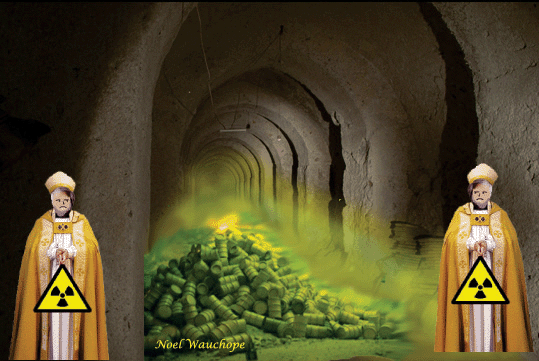
While the hype for nuclear energy is taking over Europe, radioactive waste remains a challenge: it takes billions to store it safely.
Guillaume Amouret | 17/12/2025,
https://europeancorrespondent.com/en/r/the-cost-of-eternity
The world’s first deposit of nuclear waste lies 430 meters underground, beneath a dense pine forest on the peninsula of Olkiluoto, on the shores of western Finland. It should store up to 6,500 tonnes of waste.
Finland opted for a deep geological deposit to permanently and securely dispose of radioactive spent nuclear fuel. Carved in the granite bedrock, deep below the surface, the storage is conceived to protect the surface from radioactivity for at least 100,000 years.
After a one-year delay due to technical difficulties, the Onkalo (“cave” in Finnish) is now awaiting final approval from the Finnish Nuclear Security Agency, STUK.
Contacted by The European Correspondent, the operator of the Onkalo, Posiva, reaffirmed its goal to start operations in 2026.
Safe until the world’s end?
For now, spent fuel elements are usually stored in temporary above-ground facilities next to the reactors or collected in a central storage facility such as La Hague in France.
However, the disposal of radioactive materials has not always been well-thought-out. After the war and until the 1990s, 200,000 barrels of nuclear waste were dumped in the deep sea without consideration for the environmental consequences by the Nuclear Energy Agency.
Today, the Onkalo is pioneering the ”permanent” underground disposal method. Posiva adopted the Swedish KBS-3 system: spent fuel rods are placed in an 8-meter-long copper canister, which is then embedded in bentonite clay and inserted in holes drilled directly into the crystalline rock deep underground.
The remaining free tunnels are eventually filled with bentonite too. All combined, copper bentonite and granite constitute a three-stage protection against radiation.
Billions for projects that locals don’t like
The construction of the Onkalo site has cost around €1 billion so far, Posiva told TEC. The operations and the site’s closing, in a hundred years from now, are further evaluated at an additional €4 billion, bringing the total cost to €5.5 billion. For context, decommissioning a wind turbine in Finland costs between €10,000 and €85,000.
In Forsmark, on the Swedish side of the Gulf of Bothnia, SKB started the construction of a similar deposit in January this year.
The Swedish project should have twice the storage capacity of the Onkalo. And so does its budget. In a recent calculation update, SKB mentioned a global cost of €11 billion from cradle to final closing.
The Swedish and Finnish repositories are not the only ongoing projects in Europe – France and Germany have the most (running or shut down) nuclear reactors in Europe, 71 and 33 respectively. Things get a bit trickier there, however, when it comes to waste storage.
Exit the granite in France, the spent nuclear fuel will be buried in clay rock in Bure, a small village situated in a rural area of eastern France. Originally estimated at €25 billion, the global budget of the French deposit has been recently revised to between €26 and 37 billion.
Asked by TEC, the operator, Andra, justifies the increase through “the extension of schedule, and extra costs due to additional workforce in management and the security of the site”.
This summer, Andra started the construction of a dedicated building for the police squad in charge of monitoring and cracking down on local opposition to the project since 2019.
So far, the trophy for the most chaotic process goes to Germany. In 1973, the first site was selected to build a final repository: Gorleben’s salt mine in Northern Germany. But after decades of fierce opposition from environmental activists against the infrastructure, the site was declared unsuitable five years ago.
In fact, the search for an adequate location restarted from zero at the beginning of the 2010s. And while the search process is still ongoing for a few more years, the German authority for nuclear security, BASE, hopes to open a new site by 2050.
Who pays?
Following the principle ”polluter pays”, nuclear energy companies should fully fund the permanent storage construction. In addition, they are subject to two different taxes to fund the construction of the deposit site: a research and a design tax.
Finland and Sweden work with a relatively similar finance concept. In both Scandinavian countries, the nuclear industry contributes to a dedicated nuclear waste fund every year.
In both cases, the annual fee is determined by the costs of the remaining work for the final disposal. In Finland, this accounts for about 9% of the production cost of nuclear electricity, and around 6% in Sweden.
Germany tried to create a unique public foundation to finance nuclear waste management: KENFO. In 2017, the energy companies E.ON, Vattenfall, EnBW and RWE transferred together €24 billion to the fund.
KENFO then should have developed the fund further by investing parts of it in financial products, but registered a loss of €3 billion in 2023, due to the loss in value of governmental bonds and real estate investment trusts (REIT).
No comments yet.
1 This Month

of the week – Shut Down Drone Warfare!


Tell the Ukrainian Government to Drop Prosecution of Peace Activist Yurii Sheliazhenko

Petition to revoke the licensing of the Near Surface Nuclear Disposal Facility (NSDF) at Chalk River. https://www.ourcommons.ca/petitions/en/Petition/Details?Petition=e-7247
To see nuclear-related stories in greater depth and intensity – go to https://nuclearinformation.wordpress.com
-
Archives
- April 2026 (7)
- March 2026 (251)
- February 2026 (268)
- January 2026 (308)
- December 2025 (358)
- November 2025 (359)
- October 2025 (376)
- September 2025 (257)
- August 2025 (319)
- July 2025 (230)
- June 2025 (348)
- May 2025 (261)
-
Categories
- 1
- 1 NUCLEAR ISSUES
- business and costs
- climate change
- culture and arts
- ENERGY
- environment
- health
- history
- indigenous issues
- Legal
- marketing of nuclear
- media
- opposition to nuclear
- PERSONAL STORIES
- politics
- politics international
- Religion and ethics
- safety
- secrets,lies and civil liberties
- spinbuster
- technology
- Uranium
- wastes
- weapons and war
- Women
- 2 WORLD
- ACTION
- AFRICA
- Atrocities
- AUSTRALIA
- Christina's notes
- Christina's themes
- culture and arts
- Events
- Fuk 2022
- Fuk 2023
- Fukushima 2017
- Fukushima 2018
- fukushima 2019
- Fukushima 2020
- Fukushima 2021
- general
- global warming
- Humour (God we need it)
- Nuclear
- RARE EARTHS
- Reference
- resources – print
- Resources -audiovicual
- Weekly Newsletter
- World
- World Nuclear
- YouTube
-
RSS
Entries RSS
Comments RSS
 nuclear-news
Leave a comment