Over the Moon and Down to Earth
15 December 2025, https://www.banng.info/news/regional-life/over-the-moon-and-down-to-earth/
Varrie Blowers writes for the December 2025 issue of Regional Life magazine
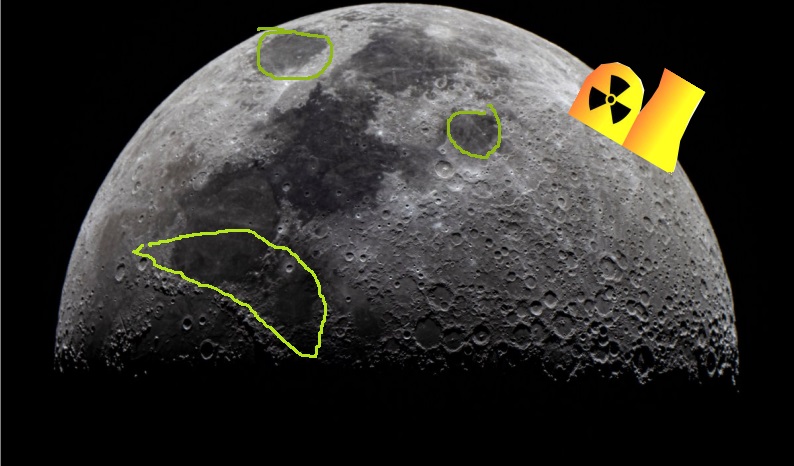
If Bradwell is an unsuitable site for nuclear development……what about the Moon? Although it can be seen shining over the Blackwater and appear quite close, the Moon is actually almost 239,000 miles away. But Sean Duffy, the Acting Administrator of NASA, is over the Moon at the idea of such development.
A new space race is starting between the USA and Russia in collaboration with China planning to build nuclear reactors on the Moon, in 2030 and 2035 respectively, to power bases. No doubt other members of the space club will wish to follow where they lead. Is this a case of the unbelievable becoming believable?
A key problem for building nuclear reactors on the Moon is getting them up there in the first place – in the hope that the transporting rockets do not explode (not unknown!) and shower radioactive particles on populated areas below.
Another is that a stable power supply would be required to sustain the astronauts who would have to get the reactors up and running. This would seem to be impossible; the location for the proposed bases is the Moon’s dark South Pole, where solar power could not provide a consistent supply.
Among other serious problems are:
the Moon’s very environment with its extreme thermal cycles, abrasive dust, reduced gravity, cosmic radiation, the lack of atmosphere;- astronauts in space suits, it seems, would be unable to maintain the reactors regularly meaning that electronic components that could last for a very long time without being replaced would be needed;
- the vast expense and need for sustained funding with cost and time overruns
So why would any nation wish to attempt to undertake a project that appears to be a non-starter? To undertake space exploration…… or space exploitation?
The motive behind the bases is the desire to exploit what are regarded as the Moon’s vast resources of minerals, including rare earths, metals and helium.
All of this prompts the question of ‘Who owns the Moon?’. The answer according to the UN Outer Space Treaty of 1967 is that space, including the Moon, belongs to us all and should be used peacefully for the benefit of all nations. It is, however, unlikely that any nation with a base would regard the resources as ‘belonging to us all’.
History should warn us that in this grab for the Moon’s riches, likely clashes between nations would arise, perhaps even leading to military conflict in space.
We are in danger of transporting our problems to the Moon. Back down to Earth, we have enough problems to cope with.
No comments yet.
1 This Month

of the week – Shut Down Drone Warfare!


Tell the Ukrainian Government to Drop Prosecution of Peace Activist Yurii Sheliazhenko

Petition to revoke the licensing of the Near Surface Nuclear Disposal Facility (NSDF) at Chalk River. https://www.ourcommons.ca/petitions/en/Petition/Details?Petition=e-7247
To see nuclear-related stories in greater depth and intensity – go to https://nuclearinformation.wordpress.com
-
Archives
- April 2026 (103)
- March 2026 (251)
- February 2026 (268)
- January 2026 (308)
- December 2025 (358)
- November 2025 (359)
- October 2025 (376)
- September 2025 (257)
- August 2025 (319)
- July 2025 (230)
- June 2025 (348)
- May 2025 (261)
-
Categories
- 1
- 1 NUCLEAR ISSUES
- business and costs
- climate change
- culture and arts
- ENERGY
- environment
- health
- history
- indigenous issues
- Legal
- marketing of nuclear
- media
- opposition to nuclear
- PERSONAL STORIES
- politics
- politics international
- Religion and ethics
- safety
- secrets,lies and civil liberties
- spinbuster
- technology
- Uranium
- wastes
- weapons and war
- Women
- 2 WORLD
- ACTION
- AFRICA
- Atrocities
- AUSTRALIA
- Christina's notes
- Christina's themes
- culture and arts
- Events
- Fuk 2022
- Fuk 2023
- Fukushima 2017
- Fukushima 2018
- fukushima 2019
- Fukushima 2020
- Fukushima 2021
- general
- global warming
- Humour (God we need it)
- Nuclear
- RARE EARTHS
- Reference
- resources – print
- Resources -audiovicual
- Weekly Newsletter
- World
- World Nuclear
- YouTube
-
RSS
Entries RSS
Comments RSS
 nuclear-news
Leave a comment