Ethics matter more than ever – even in Israel

19 December 25, https://theaimn.net/ethics-matter-more-than-ever-even-in-israel/
Who’d have thought, in this time of crisis, lies and propaganda, that it might be the Jerusalem Post that showed us an ethical direction?
And, on another matter of ethics – the Jerusalem Post, again.
I’m pretty used to the pro-Zionist propaganda that spills out from the Israeli media, the American media, and the Australian media.
I don’t know if it’s Hannukah, Christmas, or what, but in the usual cacophony of news and opinion, – that normally unfashionable subject of ethics is now standing out.

The Jerusalem Post spelt out its horror at the new, and murderous symbolism, of the lapel image now worn by ultranationalist Israeli politicians. Closely resembling the previous symbol, which called for the return of the Israeli hostages, their new symbol calls for continued killing of Palestinians, as the lapel image morphs from a ribbon into a noose.
A golden noose around Israel’s soul – says the paper – “The golden noose goes far beyond poor taste. It represents a theology of death, a reverence for vengeance that distorts the face of Judaism and deals a severe blow to Israeli society.”
“Jews around the world would be hard-pressed to defend and embrace the Jewish state.“
And indeed, this noose-wearing thing might backfire – as Jews in Israel and beyond reflect on the ethics of the Netanyahu government’s war on Palestinians.
Almost simultaneously, came the news of the massacre of Jews at Bondi Beach. The mainstream corporate news outlets have, predictably, latched on to this, to engender more vengefulness and hatred, and to blame Australia’s Prime Minister for his support of Palestinian state rights.
There is much coverage and genuine concern for the victims of this cruel outrage and their families. In amongst this, some sentimental coverage of the brave man who tackled an armed killer. As the ABC pointed out, media coverage treated this man as an oddity – as being a Muslim, one would not expect such decency. – a media attitude that is subtly Islamophobic.
” Ahmed al-Ahmed a 43-year-old Sydney fruit shop owner and father of two, moved toward the attacker, wrapped him from behind, wrestled away the long gun, and forced the shooter to retreat. He was shot and hospitalized, but his split-second decision is widely credited with preventing even greater carnage.”
And commented – “There is something profoundly Hanukkah about that moment.”
The Post goes on to reflect on those non-Jews of history, who risked everything to save Jews, – Raoul Wallenberg. Oskar Schindler. Chiune Sugihara and more
“These stories are not only about the Holocaust, but they are also about moral clarity under pressure, the choice to see a fellow human being and refuse to look away.”
This man’s courage and generosity of spirit has impressed people world-wide, and his actions have been praised in the media, cutting through the general tone of anger and hatred
The author, ZVIKA KLEIN, reminds that Hannukah means “a demand that human beings choose decency over cruelty“
Which is pretty much what Christmas is supposed to mean, too.
While the merchants of hate, revenge, and political opportunism hold sway in the corporate media, voices for compassion and decency are being heard too. These are hopes to cling to for the coming year, and bring some positive meaning to Hannukah and Christmas,
After the First 70,669 Deaths
By Patrick Lawrence / Consortium News, December 19, 2025
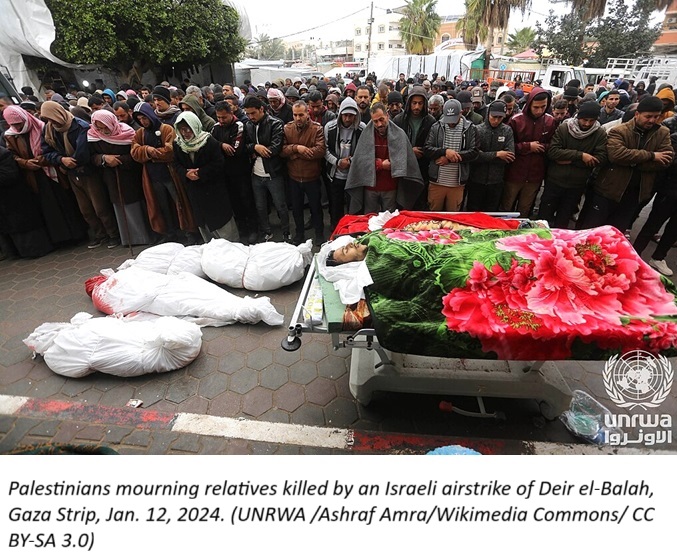
I take the 15 victims at Bondi Beach and divide them by the 71,000 deaths in Gaza as of this writing. I get a fraction of 0.0002143.
I read in a BBC report that the victims of the Dec. 14 shooting at Bondi Beach, along the coast a few miles from central Sydney, were “generous, joyful and talented.”
These were Jews who had gathered, a sizable group, to celebrate Hanukkah under Australia’s summer sun. Immediately this is cast across the West as a case of out-of-control, come-from-nowhere anti–Semitism having nothing to do with the conduct of “the Jewish state.”
Two of the victims, Sofia and Boris Gurman, “were people of deep kindness, quiet strength and unwavering care for others,” the family said in a statement the Australian Broadcasting Corporation published Tuesday.
I read that Reuven Morrison, another of the 15 victims, was “the most beautiful, generous man who had a gorgeous smile that would light up the room.” I read that the friends of Dan Elkayam, a French Jew marking the holiday in Australia, “described him as a down-to-earth, happy-to-lucky individual who was warmly embraced by those he met.”
You can read about these victims of the Bondi Beach shooting, too. The ABC published commemorations of 12 of the 15. There are photographs, the intimate remembrances of those who knew the deceased, some boilerplate describing how Australia’s state broadcaster is reporting the story. The New York Times published similar items on 13 of the victims under the headline, “What to Know About the Victims of the Bondi Beach Shooting.”
The ABC report is here, and The New York Times’s is here. If you study them briefly you find the themes common to both. Individuation is the essential point. We must know the names and see the faces of all of those killed. Innocence and virtue are the other running themes.
The Times ran a similar feature after Sept. 11, 2001. Under the headline, “Profiles in Grief,” it published thumbnail biographies of the 2,977 victims of the World Trade Center attacks, a half-dozen or so a day all through that strange autumn. I studied those short pieces carefully, and it is the same now as then: Everyone is uniquely himself or herself, everyone innocent, everyone generous, everyone happy and caring. Every life precious, in a word.
I do not know how to continue writing this commentary other than bluntly and honestly. The Bondi Beach killings bring us to a transformative moment and warrant no less.
The 15 people who perished at Bondi last Sunday — and there may be more casualties to come among those hospitalized with wounds — did not deserve to die at the hands of a father-and-son act reportedly inspired by the remnants of the Islamic State. These were senseless murders by any conceivable judgment — so senseless I am stating the obvious by saying so.
The Dishonesty of Official Grief
But I cannot enter into the responses officials and the media serving them have urged incessantly since last weekend. Out of the question for any number of reasons, chief among them the dishonesty at the core of what I may as well call “official grief.”
Read in the larger context of these awful events, the obsessive humanization of the Bondi Beach victims is an upside-down exercise in dehumanization. This is first, straight off the top. Jewish lives count, white lives count, names, faces, generous smiles — all this counts.
But the names, faces and lives of those the Zionist regime has terrorized and brutalized for the past two years or eight decades, depending on how you reckon history: No, no need for any of this because they do not count.
This is an obscenity, in my view — obscene for what it is and because it has a 500-year history. Since the opening of the imperial era in the late 15th century, the West has aggrandized itself with its never-to-be-questioned claims to civilization, decency, law and moral superiority, while the rest of the world consists of unruly, racially inferior, not-quite-human barbarians. The horrors of the mission civilisatrice — inhumanity in the name of humanity — were the inevitable outcome and so they remain.
Indulge in official grief as it is now more or less forced upon us and you are a 21st century participant in this self-serving… as I say, this obscenity. I do not see that it is any more complicated.
The New York Times published an especially egregious case in point a day after the attacks. “I no longer want to hear, after a mass shooting, of the remarkable ways a community came together,” Sharon Brous, a rabbi in Los Angeles, wrote in the paper’s opinion section. “I don’t want platitudes and pieties. I want justice…. I don’t want to celebrate resiliency. I want reform” — reform, that is, to combat the anti–semitism she understands to be the beginning and the end of the Bondi Beach story.
Rabbi Brous went on to explain that, post–Bondi, she struggles against despair. But she found great humanity, on the other hand, in “the vibrancy of the worldwide Jewish community that immediately rallied in solidarity, reminding us that when one limb is struck the whole body is unwell.”
Simply typing these brief passages leaves me incredulous. Justice, reform, rallies in solidarity with the 15, nothing for the 71,000 (the Gaza Health Ministry’s count at this writing), who evidently do not even enter Rabbi Brous’s head. And the Zionist terror machine’s daily strikes in Gaza and the West Bank as we speak? No, nothing, for they are not part of any “whole body,” however this is conceived.
Yes, I can grieve for those who died last Sunday, but it is a question of recognition, of keeping things in proportion. Here is my admittedly simplified formula: I take the 15 victims at Bondi Beach and divide them by the 71,000 deaths in Gaza as of this writing. I get a fraction of 0.0002143 and this is the extent of my grief for the 15.
I have called the Bondi Beach attack transformative. Two reasons.
One, these awful events mark a major step in the erasure not only of history and memory but of sheer cognition. I have heard or read no mention from any mainstream quarter of the campaign of terror and dehumanization the Zionist state now wages not just in Gaza and in the West Bank but against Muslim populations across much of West Asia.
This is hardly new. Apartheid Israel and its too-numerous, too-powerful enablers have sought to erase and otherwise obscure the truth of the Zionist project since there was a Zionist project to speak of. But Bondi Beach looks set not merely to normalize the human mind’s incapacity to see, think and judge but to enforce this damage to the collective consciousness by means of those “reforms” Rabbi Brous proposes.
Two, Zionists and their fellow travelers instantly began to use the events of last Sunday to condemn the Palestinian cause altogether. This is again nothing new.
Utter “From the river to the sea…” or “Globalize the intifada,” and you risk your job, your professorship, your visa; arrest in Britain; profess support for Palestine Action, the British protest group, and you will be arrested and tried under the U.K.’s draconian terrorism laws.
But Bondi Beach already serves to license Zionists to advance a blanket condemnation of the Palestinian cause. Predictably enough, the Zionist-supervised New York Times gives us another case in point. ………………………………………………………………………………..
Judaism Versus Zionism
Just as I was thinking through the events at Bondi Beach and wondering why my sympathies came to 0.0002143 percent of what they were officially supposed to be, I began reading the book Yakov Rabkin, the distinguished professor of history at the University of Montreal, just published.
Israel in Palestine: Jewish Rejection of Palestine (Aspect Editions), is a brief, superbly lucid essay on the difference between Judaism and Zionism — the former embodying an excellently humanist tradition and the latter its violent perversion into a limitlessly vicious ethno-nationalist ideology.
Some pages in I came to this sentence:
“Across Israel and worldwide, Jews grapple with contradictions between the Judaism they profess and the Zionist ideology that has in fact taken hold of them.”
This simply stated reality landed squarely. I immediately went back to those brief biographies the Australian Broadcasting Corp. and The New York Times just published. Yes, I thought. Generous, kind toward others, compassionate: They put the victims exactly in the Judaic tradition as Rabkin described it.
Rabkin gives an excellent précis of the long history of animosity most Jews felt toward Zionism during its emergent phase in the late 19th and early 20th century. They, especially Jews residing in Palestine prior to the arrival of the first Zionist settlers, who lived peaceably side-by side with indigenous Arabs, wanted nothing to do with it.
…………………………………………………………………………………………………………….. the possibility of a Mossad provocation cannot be dismissed. The historical record suggests this. (Mossad is now assisting Australian investigators into the attack). And given the use Zionists make of the Bondi Beach events, the cui bono argument cannot be thrown out of court.
Already there are Zionists in Australia and elsewhere asserting that anyone who has until now stood for the Palestinian cause bears responsible for the gruesome events at an Australian beach last Sunday. Reflecting this sentiment—and the political influence of militant Zionism in Australia—federal and state governments are now considering legislation that would, among much else, allow authorities to ban demonstrations and even speech in support of a free Palestine.
I take the opposite view as to where responsibility lies: Mossad op or no Mossad op, it is fairer to say it is Zionists who are responsible, directly or by way of the war they wage against Palestinians — and against morality and ordinary decency, against our public discourse, our laws and civil liberties, our consciences, our faculties of reason — for the deaths at Bondi Beach.
Post–Bondi, it follows immediately, it is ever more imperative that Jews the world over declare themselves either as Jews in the Judaic tradition or as Zionists. The urgency of mass denunciations of Zionism could hardly be more evident. https://consortiumnews.com/2025/12/19/patrick-lawrence-after-the-first-70669-deaths/
‘Huge conflict of interest’: Trump’s $600 million windfall after nuclear deal.

ByMatt O’Brien and Jennifer McDermott, Sydney Morning Herald, December 19, 2025
The parent company of US President Donald Trump’s Truth Social media platform is merging with a fusion power company, an unusual pairing of the Trump name with a futuristic clean energy venture that aims to power the next wave of artificial intelligence. Trump Media & Technology announced its merger with TAE Technologies in an all-stock deal that the companies said was valued at more than $US6 billion ($9.1 billion).
The combined company says it plans to find a site and begin construction next year on the “world’s first utility-scale fusion power plant,” with aims to provide the electricity needed for artificial intelligence.
Nuclear fusion is seen as a promising solution to climate change caused by burning fossil fuels, but one that is a long way off compared to today’s clean technologies like wind and solar. It will need huge investment as well as regulation to advance, which makes Trump’s ties a major conflict, said Richard Painter, a former White House ethics lawyer in the George W. Bush administration.
“He’s jumping into this industry just like he jumped into cryptocurrency a couple of years ago,” Painter said. “Just as the United States government is gonna get all involved in it. And it’s so obvious that there’s a huge conflict of interest.”
Devin Nunes, the Republican congressman who resigned in 2021 to become the chief executive of Trump Media, will be co-CEO of the new company with TAE CEO Michl Binderbauer.
Shares of Trump Media & Technology have tumbled 70 per cent this year but jumped 34 per cent in afternoon trading on Thursday.
Trump is by far the largest stakeholder in Trump Media, owning 41 per cent of all outstanding shares. The share surge has added about $US400 million ($605 million) to Trump’s net worth, according to Forbes.
Backed by Google and other investors, TAE is a private company and the merger with Trump Media would create one of the first publicly traded nuclear fusion companies.
“We’re taking a big step forward toward a revolutionary technology that will cement America’s global energy dominance for generations,” Nunes said in a prepared statement.
TAE focuses on nuclear fusion, a technology that combines two light atomic nuclei to form a single heavier one. It releases enormous amount of energy, a process that occurs on the sun and other stars, according to the United Nations’ International Atomic Energy Agency.
TAE and Trump Media shareholders will each own approximately 50 per cent of the combined company.
In October, the US Department of Energy released what it called a “road map” for fusion technology, with the aim of fostering “a burgeoning fusion private sector industry in the US toward maturity on the most rapid timeline.” A number of tech companies, including Google, Microsoft and OpenAI chief executive Sam Altman, have shown interest in fusion technology as a way of powering the energy-hungry data centres needed to build and run their AI products…………………………………………
Holland said the Trump administration has said it strongly supports fusion, but has yet to make any new financial support available.
In the association’s surveys of the industry, companies are saying they expect to see fusion energy on the electricity grid in the 2030s, with most saying they expect it in the first half of the 2030s, Holland said.
TAE and Trump Media say the transaction values each TAE common stock at $US53.89 per share.
At closing, Trump Media & Technology Group will be the holding company for Truth Social and TAE, along with its subsidiaries TAE Power Solutions and TAE Life Sciences. https://www.smh.com.au/business/companies/huge-conflict-of-interest-trump-media-to-merge-with-nuclear-fusion-company-in-9-1-billion-deal-20251219-p5nowl.html
Fearing risks in using Russian assets, EU agrees €90bn Ukraine war loan.
Friday, 19 December 2025, https://www.presstv.ir/Detail/2025/12/19/760887/EU-agrees-%E2%82%AC90bn-Ukraine-a-legal-fears-block-use-of-Russian-assets
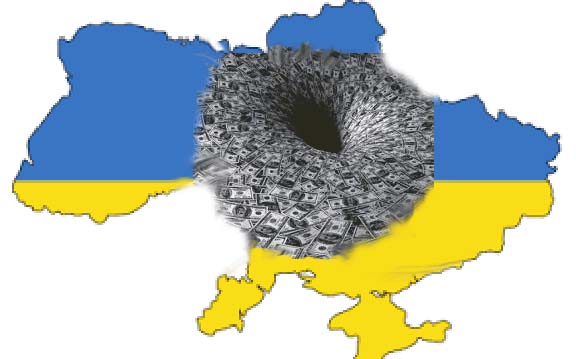
EU leaders have agreed to provide Ukraine with a €90 billion ($98 billion) loan backed by the bloc’s common budget, while shelving plans to use frozen Russian state assets amid legal and financial concerns and repeated warnings from Moscow.
The agreement was reached early on Friday after overnight talks at a summit in Brussels, as the EU sought to secure funding to continue the war in Ukraine over the next two years.
Under the deal, the EU will raise funds through loans guaranteed by its shared budget, abandoning proposals backed by some member states to leverage around €200 billion in Russian central bank assets frozen in the bloc.
The plan failed to win consensus, largely due to objections from Belgium, where most of the assets are held. Belgian officials warned of legal risks and the potential for retaliatory measures that would disproportionately affect the country.
Belgian Prime Minister Bart De Wever welcomed the outcome, saying it avoided significant legal and financial exposure.
“This was extremely risky and raised many unanswered questions,” De Wever told reporters. “Rationality has prevailed.”
Russia has repeatedly warned the EU against using its frozen assets, calling any such move illegal.
On Thursday, Russia’s central bank said it would seek compensation through a Russian arbitration court over the freezing and potential use of its assets held in EU financial institutions, including claims for lost profits.
“In connection with ongoing attempts by EU authorities to seize and illegally use the assets of the Bank of Russia, we declare that compensation will be sought,” the central bank said in a statement, adding that damages of up to $230 billion would be claimed from Euroclear, where most of the assets are held.
EU member states have agreed to maintain an indefinite freeze on Russian central bank assets imposed after the outbreak of the Ukraine war in 2022.
Kremlin spokesman Dmitry Peskov said on Friday that any expropriation of Russian assets would not go unanswered.
“All possible legal mechanisms will be used,” he was quoted by state news agency Tass as saying.
Separately, Russia warned against any deployment of European troops to Ukraine, saying such forces would be considered “legitimate targets.”
In a statement, Russia’s foreign ministry accused the EU of planning to “occupy” Ukraine rather than seeking a settlement.
Russian President Vladimir Putin has previously said foreign troops sent to Ukraine would be treated as legitimate military targets.
The developments come amid divisions within the EU over the war and its role in possible peace talks. French President Emmanuel Macron said Europe should engage directly with Moscow.
“It is in our interest as Europeans and Ukrainians to re-engage discussions,” Macron said, adding talks should begin “in the coming weeks.”
Ukrainian President Volodymyr Zelensky said Ukrainian and US delegations were due to hold further talks in Washington on Friday and Saturday, while US President Donald Trump urged Kiev to move quickly towards a deal.
The Kremlin said it was preparing contacts with Washington on a revised peace proposal.
Earlier talks in Berlin involving US, Ukrainian and European officials ended without a breakthrough, with Russia opposing NATO membership for Ukraine and Kiev rejecting territorial concessions.
Hi-tech holocaust: How Microsoft aids the Gaza genocide

| Alan Macleod, MintPress News, 2025-10-27 |
Israel’s genocide is being powered by Microsoft.
From creating a massive digital dragnet, aiding in the production of A.I.-generated kill lists, hiring hundreds of Israeli spies to run its internal affairs, and suppressing figures opposing the slaughter, the Seattle-based tech corporation has played a key role in the violence.
MintPress has detailed the deep collaboration between the Israeli Defense Forces (IDF) and Amazon, Google, TikTok, Apple, Palantir, and Oracle, but Microsoft’s relationship with the government and armed forces of Israel is potentially the closest,leading then-CEO Steve Ballmer tostatethat “Microsoft is as much an Israeli company as an American company.” MintPress explores the decades-long partnership between Microsoft and Israel, and the employees trying to break that marriage from the inside.
Turning Code Into Carnage
“Among U.S. tech firms,” the Associated Press wrote, “Microsoft has had an especially close relationship with the Israeli military.” That relationship, it notes, massively expanded after the October 7, 2023, attacks.
In the months following October 7, the IDF’s usage of Microsoft’s Azure cloud service surged more than 200-fold. The amount of data from surveillance cameras, drones, checkpoints, biometric scanners, phone calls, and intercepted Palestinian personal data stored by the IDF on Microsoft servers doubledin the next nine months,reaching13.6 petabytes by July 2024 – equivalent to 23,000 years of audio, or seven trillion pages of text.
The point of all this was to create an enormous digital dragnet, where Palestinians’ every move, word, and keystroke was recorded in monitored in the greatest and most dystopian digital dragnet ever created. In the words of Yossi Sariel, the head of Unit 8200, the IDF’s surveillance division, the plan was to “track everyone, all of the time.”
Sariel argued that big data was the solution to Israel’s problems, envisaging a future where Israel intercepted and stored “a million calls an hour” from Palestine, and used A.I. to search for keywords and identify threats.
There was no way, however, that Israel could do this alone, as it did not possess the expertise or anything like the storage capacity needed for such a project. To this end, Sarieltravelledto Seattle in 2021 to meet with Microsoft CEO Satya Nadella, to pitch him on the surveillance partnership whereby Microsoft would build Unit 8200 a customized and segregated area within its Azure platform.
The Israeli military uses Microsoft Azure to transcribe, translate, and otherwise process intelligence garnered via mass surveillance, which is then linked to Israel’s A.I.-based weapons systems.
The largest and most controversial organization within the Israeli military, Unit 8200 has long been the centerpiece of Israel’s hi-tech spying operation. The unit is dedicated to surveillance, cyberwarfare, and online manipulation operations. Last year, it carried out the Lebanese Pager Attack, an act that wounded thousands of civilians. Unit 8200 agents were also behind many of the most infamous international spyware and hacking cases, including the Pegasus software, that was used to surveil tens of thousands of the world’s most prominent political leaders, journalists, and human rights campaigners.
Sariel’s policy of mass surveillance changed the internal attitude at Unit 8200. “Suddenly the entire public was our enemy,”said one officer. The gargantuan trove of information compiled in Microsoft Azure amounted to a vast repository on the entire Palestinian population – a giant database of kompromat that is used to extort and blackmail the region’s indigenous people. If a person was secretly gay, or cheating on their spouse, for example, that information was readily available to Unit 8200 agents, who would then use it to turn their targets into informants. One former Unit 8200 member revealed that, as part of their training, they were made to memorize different Arabic slang words for “gay”, so that they could identify them in conversations.
Palestinian man passes through a biometric gate at the Qalandia crossing near JerusalemThe cloud database is also used to provide after-the-fact justification for arrests of innocent peoples. Off-hand, out-of-context comments made years agocan be used to portray anyone as a member of Hamas, Palestinian Islamic Jihad, or another armed resistance force.
…………………………………………………………………………………………….Of course, the vast majority of the deaths have been civilians – around 70% were women and children. But Israeli officials can also go back after the fact and scour their digital dragnet to justify any killing, finding connections or any other incriminating evidence. A senior Israeli military officer described the cloud technology as “a weapon in every sense of the word.” Other officials, however, have gone so far as to raise concerns that Israel’s overreliance on Microsoft as a service is a strategic vulnerability that should be corrected.
Microsoft Sees No Evil, Only Profits
Throughout all this, Microsoft has protested its innocence – and ignorance – of Israeli crimes. A spokesperson for the company stated:
“At no time during this engagement or since that time has Microsoft been aware of the surveillance of civilians or collection of their cell phone conversations using Microsoft’s services, including through the external review it commissioned.
“Any allegations about Microsoft leadership involvement and support of this project … are false.”
But leaked documents suggest Microsoft engineers understood exactly what sort of data was being stored in Azure, and what their clients hoped to achieve……………………………………………………………………………………………………………………………………………
Corporate Zionism: Roots in Israel’s War Economy
The Azure/IDF partnership is the result of a decades-long relationship between Microsoft and the State of Israel, one which has helped both entities. Microsoft established its first branch in Israel in 1989, and two years later, opened a research and development center in the city of Herzliya near Tel Aviv. The first of its kind outside the United States, the center has continued to expand, and now directly employs an estimated 2,700 workers.
Throughout the 1990s and 2000s, Microsoft began signing deals with Israeli firms and government agencies, and, by the 2010s, was an integral part of the Israeli security state. In 2017, it inked a lucrative contract with the Israeli Prison Service, providing cloud services to the entity responsible for jailing tens of thousands of Palestinians without trial. Today, it maintains over 600 active subscriptions with the Israeli military.
The company has also moved to acquire at least 21 Israeli tech firms. Among these include cybersecurity group, Hexadite, purchased for $100 million in 2017, and Oribi, a web analytics business founded by a former Israeli intelligence agent.
sectorEvery CEO in Microsoft’s history has flown to Israel to meet with Prime Minister Benjamin Netanyahu, including Bill Gates, who, in 2016, stated that hi-tech Israeli security was “improving the world.”
In short, Microsoft is a cornerstone of Israel’s burgeoning hi-tech sector, which accounts for 20% of the country’s GDP and more than half of its total exports. Netanyahu himself has showered praise on the corporation, describing the Microsoft/Israel partnership as “a marriage made in heaven.”
Others have been less enthused by this union.In June, Iran deliberately targeted a Microsoft center in Be’ersheva, carrying out a missile strike against it. Iran’s Revolutionary Guard justified their actions, citing Microsoft’s “close cooperation with the Israeli army and its being part of the system supporting aggression, and not just a civilian entity.” “The cyber area that was attacked also includes the residences of people from the espionage and artificial intelligence fields, who operate in direct cooperation with the enemy army and its security apparatus,” it concluded.
Cracking Down on Internal Resistance
A greater threat than Iran to Microsoft, however, is its own employees, hundreds of whom have organized to oppose its role in the genocide. Under the banner of No Azure for Apartheid, workers demand that:
Microsoft terminates all Azure contracts with Israel; disclose all ties to the Israeli national security state; publicly call for a ceasefire, and stop persecuting employees who speak out about the genocide.
This fourth demand is particularly salient, as the corporation has shown little to no tolerance for dissent. In October 2024, it fired two workers for organizing a vigil for Palestinian refugees at its corporate headquarters near Seattle………………………………………………………………………
Targeting Enemies
Company employees are far from the only target of Microsoft’s wrath, however. In May, Karim Khan, chief prosecutor of the International Criminal Court,announcedthat Microsoft had locked him out of his official ICC email account, just as he was formalizing charges against Netanyahu and other top Israeli leaders. For many, the timing was not a coincidence, but rather a message.
The British lawyer joined a vast plethora of Palestinians who have complained that Microsoft has terminated their accounts without warning. A BBC investigationfounddozens of Palestinians who, after attempting to use Microsoft services to contact relatives in Gaza, were banned for life. “I’ve had this Hotmail account for 15 years. They banned me for no reason, saying I violated their terms — what terms? Tell me,” one Palestinian-American user said.
IBM’s brand has forever been tarnished by its collaboration with Nazi Germany, aiding Hitler’s slaughter of millions of people. In much the same way, No Azure for Apartheid believe that Microsoft’s name will forever be linked with the destruction in Gaza. Microsoft has enjoyed a decades-long partnership with Israel, which has seen them slowly integrate themselves into the state, becoming a fundamental part of the system of oppression. From servicing the Israeli war machine, to hiring hundreds of Israeli spies to run its affairs, to cracking down on internal and external dissent against it, Israel’s mass killing of Palestinians is aided by Microsoft, whose technological prowess has helped Israel carry out the world’s first A.I.-powered genocide. https://www.mintpressnews.com/microsoft-israel-surveillance-azure-idf-gaza-genocide/290534/
In 2025, The Israeli Army Was The ‘Worst Enemy Of Journalists’

Kevin Gosztola, The Dissenter, 19 Dec 25
“The Israeli army is the worst enemy of journalists,” according to a year-end analysis of attacks on global press freedom from Reporters Without Borders (RSF).
RSF stated in their 2025 report [PDF], “Over the last 12 months, the Israeli army has been responsible for nearly half (43%) of all journalists killed worldwide.” Military forces specifically targeted 29 media professionals.
To emphasize this staggering statistic, RSF highlighted a double-tap strike on Gaza’s Nasser Hospital that occurred on August 25, 2025. Israeli forces targeted the part of the hospital that was known to “house a workspace for journalists.”
Reuters photojournalist Hossam al-Masri was killed. Mariam Abu Daqqa, a freelance journalist who was contracted by the Associated Press, arrived at the scene to “report on rescue operations.” Eight minutes after the first strike, Abu Daqqa and Al Jazeera photojournalist Mohamed Salama were killed.
The double-tap strike, a war crime, also killed Moaz Abu Taha a journalist contracted by NBC, and Abu Aziz, a freelance journalist who contributed reporting to Middle East Eye.
As of December 19, 2025, at least 260 journalists have been killed by Israeli military forces carrying out an ethnic cleansing campaign against the people of Gaza. Military operations began in October 2023 following an attack by Hamas operatives, which the Israeli government knew about a year before it occurred but did not prevent.
In RSF’s report on 2025, Claudia Sheinbaum’s “failure to protect journalists” in Mexico and Russian drone attacks on reporters in Ukraine were described as the next biggest cause of deaths.
Nine media professionals were killed in Mexico, and three journalists in Ukraine were killed by Russia. Yet compared to Mexico and Russia’s war in Ukraine, the Israeli army killed more than twice as many journalists.
Sixty-seven journalists in 22 countries were specifically targeted due to their work as media professionals……………………………………………………………………………………………………………..https://thedissenter.org/in-2025-the-israeli-army-was-the-worst-enemy-of-journalists/
Exposure to protracted low-dose ionizing radiation and incident dementia in a cohort of Ontario nuclear power plant workers.

Brianna Frangione 1, Ian Colman, Franco Momoli, Estelle Davesne, Robert Talarico, Chengchun Yu, Paul J Villeneuve
Scand J Work Environ Health
Abstract
Objectives: Emerging evidence suggests that low-dose ionizing radiation increases the risk of neurodegenerative diseases. Past studies have relied on death data to identify dementia, and these are prone to under-ascertainment and complicate the estimation of health risks as individuals tend to live with dementia for many years following onset. We present findings from the first occupational cohort to investigate dementia risk from low-dose radiation using incident outcomes.
Methods: This is a retrospective cohort of 60 874 Ontario Nuclear Power Plant workers from the Canadian National Dose Registry. Personal identifiers were linked to Ontario population-based administrative health data. Incident dementias between 1996 and 2022 were identified using a validated algorithm based on physician, hospital, and prescription drug data. Individual-level annual estimates of whole-body external ionizing radiation were derived from personal workplace monitoring. The incidence of dementia among these workers was compared to a random sample of Ontario residents matched by sex, age, and residential area. Internal cohort analysis using Poisson and linear excess relative risk (ERR) models, adjusted for sex, attained age, calendar period, and neighborhood income quintile, were used to characterize the shape of the exposure-response curve between low-dose cumulative radiation (lagged 10 years) and incident dementia.
Results: There were 476 incident dementias and 867 028 person-years of follow-up. The mean whole-body lifetime accumulated exposure at the end of follow-up was 11.7 millisieverts (mSv). Workers with cumulative exposure between 50-100 mSv had an increased risk of dementia [RR 1.50, 95% confidence interval (CI) 0.99-2.28] compared to those unexposed. Spline analysis suggested that the dose-response relationship was non-linear. The linear ERR per 100 mSv increase in exposure was 0.704 (95% CI 0.018-1.390).
Conclusion: Our findings suggest that low-dose exposure to ionizing radiation increases the risk of incident dementia.
A Serious Proposal: Russia and China Call for Global Strategic Stability

By Alice Slater, World BEYOND War, October 8, 2025
It’s ironic that the arms control community is protesting the idea of resuming nuclear test detonations. The nuclear test detonations have never stopped.
Although Bill Clinton signed the Comprehensive Test Ban Treaty (CTBT) in 1996, he swiftly funded the “Stockpile Stewardship” program at the US nuclear weapons complex, allowing the Dr. Strangeloves in their labs to continue to perform laboratory tests as well as blowup plutonium with chemical explosives,1,000 feet below the desert floor at the Nevada Test Site on Western Shoshone holy land.
Since there was no chain reaction causing criticality, Clinton claimed these “sub-critical” tests were not nuclear tests and didn’t violate the new treaty. Of course, Russia and China swiftly followed the US lead; the Russians continued to test at Novaya Zemlya, and China at Lop Nor.
Indeed, it was the US’s refusal to promise that the Comprehensive Test Ban Treaty would be truly “comprehensive” that caused India and Pakistan to test their nuclear arsenals after the US rejected their pleas to include prohibitions against “sub-critical” and laboratory tests in the CTBT. Although Clinton signed the CTBT, the US, unlike Russia and China, never ratified it. Sadly, Russia announced during the Ukraine war that it was leaving the CTBT.
People of goodwill who are alarmed at new reports of proliferating nuclear weapons and would like to put the nuclear genie back in the bottle, stop the endless wars and huge budgets for useless atomic weapons, would do well to take some advice from Russia and China. On May 8, they issued a “Joint Statement by the Russian Federation and the People’s Republic of China on Global Strategic Stability” in the context of the 80th anniversary of the end of World War II.
They note “the serious challenges facing the international community” and lay out several recommendations that would strengthen “global strategic security”, acknowledging that “the destinies of all countries are interrelated” and urging that states not “seek to ensure their own security at the expense and to the detriment of the security of other states.”
U.S. “Golden Dome”

They proceed to explain a whole series of provocative actions that threaten the peace, including states deploying nuclear weapons and missiles outside their territories. They are particularly critical of the US “Golden Dome” program, which is expected to create a new battleground in space. Reiterating their pleas over many years to keep space for peace, they state the following:
The two sides oppose the attempts of individual countries to use outer space for armed confrontation. They will counter security policies and activities aimed at achieving military superiority, as well as at officially defining and using outer space as a ” warfighting domain”. The two Sides confirm the need to start negotiations on a legally binding instrument based on the Russian-Chinese draft of the treaty on the Prevention of the Placement of Weapons in Outer Space and of the Threat or Use of Force Against Outer Space Objects as soon as possible, that would provide fundamental and reliable guarantees for preventing an arms race in outer space, weaponization of outer space and the threat or use of force against outer space objects or with their help. To safeguard world peace, ensure equal and indivisible security for all, and improve the predictability and sustainability of the exploration and peaceful use of outer space by all States, the two Sides agree to promote on a global scale the international initiative/political commitment not to be the first to deploy weapons in outer space.
The US and its allies, sheltering under the US nuclear umbrella, would do well to take Russia and China up on their offers for making a more peaceful world! With Mother Earth sending cascading warnings about the need for nations to cooperate, we can ill afford business as usual. Time to change course!
*Alice Slater serves on the Boards of World BEYOND War and the Global Network Against Weapons and Nuclear Power in Space. She is an NGO representative at the UN for the Nuclear Age Peace Foundation.
Trump Admits He Wants To Take Venezuela’s Oil – and Give It to US Corporations
Donald Trump imposed a naval blockade on Venezuela and admitted he wants to take its oil and give it to US corporations: “We had a lot of oil there. They threw our companies out, and we want it back”.
GeoPolitical Economy, By Ben Norton 19 Dec 25
Donald Trump has openly admitted that he wants to take Venezuela’s oil. Top US officials have made it clear that this is a key reason for their war on the South American nation.
Trump declared an illegal naval blockade of Venezuela on December 16. The US government aims to prevent Venezuela from selling oil to China, to starve Caracas of export revenue.
The Trump administration is also illegally blocking Venezuela from importing crucial goods, including the light crude and chemicals needed to process and refine its own heavy crude.
The US goal is to bring about an extreme crisis in Venezuela — to “make the economy scream” — hoping it leads to regime change.
Trump says US corporations should control Venezuela’s oil
On December 17, a journalist asked the US president, “Is the goal of the blockade of Venezuela regime change?”
Trump replied:
It’s just a blockade. We’re not going to let anybody going through that shouldn’t be going through.
You remember, they took all of our energy rights. They took all of our oil, from not that long ago. And we want it back.
Another reporter then asked Trump, “On Venezuela, sir, you mentioned getting land back from Venezuela. What land is that?”
The US president stated:
Getting land, oil rights, whatever we had. They took it away, because we had a president that maybe wasn’t watching. But they’re not going to do that. We want it back.
They took our oil rights. We had a lot of oil there. As you know, they threw our companies out, and we want it back.
Trump imposes a naval blockade on Venezuela
In these questions, the journalists were referencing a December 16 post on Trump’s website Truth Social, in which the US president announced “A TOTAL AND COMPLETE BLOCKADE OF ALL SANCTIONED OIL TANKERS going into, and out of, Venezuela”.
These US sanctions on Venezuela’s oil industry are unilateral coercive measures and do not have the approval of the UN Security Council, and are therefore illegal under international law………………………………………………………………………………………………………………………………………………….
US naval blockade cuts off Venezuelan exports and imports
The Trump administration launched a war against Venezuela in September. As of December 19, the US military had killed more than 100 people in strikes on boats in the Caribbean Sea and eastern Pacific Ocean.
Throughout this war, the Trump administration gradually escalated its aggressive tactics, seeking to destabilize and overthrow Venezuelan President Nicolás Maduro.
In December, the US government started to seize oil tankers off the coast of Venezuela, in blatant violation of international law.
When Trump was asked what the US government would do with the Venezuelan oil in these tankers, his response was, “We keep it”. This is piracy…………………………………………………………………………………….
The US government’s imperial strategy: “make the economy scream”
In other words, Trump is bringing back the infamous US imperial strategy known as “make the economy scream”. This phrase originated with Richard Nixon and Henry Kissinger………………………………………………………………………………………………..
US coup attempts, illegal sanctions, and economic war on Venezuela
This is precisely the imperial strategy that the US empire has used to try to topple Venezuela’s left-wing government, over more than two decades……………………………………………………………………………………………………………………………………
The coup attempt that Trump initiated in 2019 failed. So in his second term, under Secretary of State Marco Rubio, Trump launched another putsch.
This time, they used the US military to try to directly force President Maduro from power. https://geopoliticaleconomy.com/2025/12/19/trump-take-venezuela-oil-us-corporations/
Is the UN Ready for a Non-Renewable 7-YearTerm for the Secretary-General?

By Thalif Deen
UNITED NATIONS, Dec 19 2025 (IPS) – A long-standing proposal going back to 1996—to establish a single non-renewable seven-year term for the Secretary-General of the United Nations—has been resurrected by former UN Secretary-General Ban Ki-moon.
The original proposal was part of a study sponsored by the Dag Hammarskjold and Ford Foundations. According to the proposal, the seven-year term “ would give the SG the opportunity to undertake far-reaching plans free from undesirable pressures.”
Ban has said a single, nonrenewable seven-year term will strengthen the independence of the office. The current practice of two five-year terms, he said, leaves Secretaries-General “overly dependent on this Council’s Permanent Members for an extension.”
A former Secretary-General Boutros Boutros-Ghali of Egypt was deprived of a second five-year term when the US was the only permanent member state to veto his second term despite the fact that he received 14 of the 15 votes in the Security Council.
As the highest policy-making organ of the United Nations, and as the ultimate appointing body, the General Assembly should adopt a comprehensive resolution establishing a single seven-year term and all key features of an improved process of appointing the Secretary-General,” the study said.
The same seven-year term, according to the 1996 study authored by Sir Brian Urquhart and Erskine Childers, should also apply to heads of UN agencies and UN programmes.
The study was titled “A World in Need of Leadership: Tomorrow’s United Nations. A Fresh Appraisal.” Sir Brian was a former UN Under-Secretary-General (USG) for Special Political Affairs and Childers was a former Senior Advisor to the UN Director-General for Development and International Economic Affairs.
Ambassador Anwarul K. Chowdhury, former Under-Secretary-General and High Representative of the United Nations and Permanent Representative of Bangladesh to the UN, told IPS that, in keeping with the best interest of the operational credibility of the world’s most universal multilateral body with a global mandate, and as a conscientious UN insider, “I believe very strongly and quite comfortably that there is substantive merit in the long-standing, but surprisingly undervalued, proposal to establish a single non-renewable seven-year term of office for the Secretary-General of the United Nations.”
………………………………………………………………………………………….. Recounting his IPS op-ed, Ambassador Chowdhury said he had underscored that “Another important idea to ensure independence of the Secretary-General would be to make the office restricted to one term for each incumbent.”
The seven-year term is adequate for any leader worth the name to deliver positive results and show what can be achieved for any global institution. Any change in the tenure of office and in the re-election process will require the amendment of the UN Charter and therefore the concurrence of the P5, said Ambassador Chowdhury, initiator of the UNSCR 1325 as President of the UN Security Council in March 2000, Chairman of the UN General Assembly’s Main Committee on Administrative and Budgetary Matters and Founder of the Global Movement for The Cultural of Peace (GMCoP).
On 30 October 2023, in another op-ed in IPS, Ambassador Chowdhury recommended that “… in the future the Secretary-General would have only one term of seven years, as opposed to the current practice of automatically renewing the Secretary-General’s tenure for a second five-year term, without even evaluating his performance.”
Netanyahu is exploiting the Bondi Beach massacre to build support for the Gaza genocide and is fueling antisemitism in the process

Benjamin Netanyahu is blaming the attack at Bondi Beach on Australia’s support for Palestinian statehood. He conflates Jewish safety with Zionism to garner support for Israel, but in doing so, he enlists all Jews as agents of Palestinian oppression.
By Jonathan Ofir December 18, 2025, https://mondoweiss.net/2025/12/netanyahu-is-exploiting-the-bondi-beach-massacre-to-build-support-for-the-gaza-genocide-and-is-fueling-antisemitism-in-the-process/
On September 21, Australia officially recognized the State of Palestine. This recognition coincided with that of several other Western countries, including France, Canada, and the United Kingdom. This is, of course, a problem for an Israeli government that “flatly rejects the establishment of a Palestinian Arab state west of the Jordan River.”
So what better than a massacre of Jews on Hanukkah to undermine this effort?
At an Israeli government meeting following the Bondi Beach massacre, Netanyahu admonished the Australian government and its Prime Minister, Anthony Albanese, for its supposed role. This rhetorical attack aimed not only to delegitimize support for Palestinian statehood but also to garner support for the continuing genocide in Gaza. It does not seem to matter that the shooters, a father and a son of Pakistani Muslim background, are reported to have been inspired by ISIS and not a Palestinian cause as such. Israel never misses an opportunity to incite against Palestinians.
This is what Netanyahu said during the three and half minute long rant, in English. He started like this:
“On August 17th, about four months ago, I sent Prime Minister Albanese of Australia a letter, in which I gave him warning, that the Australian government’s policy was promoting and encouraging antisemitism in Australia. I wrote: ‘Your call for a Palestinian state pours fuel on the antisemitic fire. It rewards Hamas terrorists. It emboldens those who menace Australian Jews, and encourages the Jew hatred now stalking your streets. Antisemitism is a cancer. It spreads when leaders stay silent. It retreats when leaders act. I call upon you to replace weakness with action, appeasement with resolve’.
Instead, Prime Minister, you replaced weakness with weakness, and appeasement with more appeasement. Your government did nothing to stop the spread of antisemitism in Australia, you did nothing to curb the cancer cells that were growing inside your country, you took no action, you let the disease spread, and the result is the horrific attacks on Jews we saw today.”
So, following the Bondi Beach attack, Netanyahu is basically saying, “I told you so.”
The “appeasement” narrative is one that Netanyahu likes a lot, because it alludes to the appeasement policy of Britain towards Nazi Germany under PM Neville Chamberlain, who sought at the time to play soft with Hitler. The analogy turns Palestinians into Nazis, and those who seek to ‘appease’ them, weaklings and antisemites. For Netanyahu, antisemitism is a cancer, and who embodies it? Palestinians.
Netanyahu continued to apply pressure on Albanese, and in turn, any other leaders in the West who are considering supporting the Palestinians:
“We saw an action of a brave man, turns out a Muslim brave man [Netanyahu first claimed he was Jewish], that stopped one of these terrorists from killing innocent Jews. But it requires the action of your government, which you’re not taking, and you have to, because history will not forgive hesitation and weakness – it will honor action and strength. That’s what Israel expects of each of your governments in the West, and elsewhere. Because the disease spreads, and it will consume you as well. But we are worrying right now about our people, our safety, and we do not remain silent”.
And he then expanded his analogy to lump the Bondi Beach attack in with recent news from Syria, Gaza, and Lebanon:
“We fight those who try to annihilate us. They’re not only trying to annihilate us, they attack us because they attack the West. In Syria, we saw yesterday two American soldiers killed, and one American interpreter killed as well, killed because they represent our common culture. Now as a result of this, Secretary of War Pete Hegseth said the following. He said ‘let it be known, that if you target Americans anywhere in the world, you will spend the rest of your brief, anxious life, knowing the United States will hunt you, find you, and ruthlessly kill you’. We send our condolences to the people of America, and I want to say that our policy is exactly that policy. That’s why those who target Israelis, target our soldiers, try to kill them, or try to hurt them and wound them, as happened in Gaza yesterday – we take action. They will spend the rest of their brief, anxious lives knowing that Israel will hunt them, find them, and ruthlessly dispose of them. That is American policy, this is Israel’s policy. It’s our policy in Gaza, Lebanon, anywhere around us. We do not sit by and let these killers kill us.”
This is thus also a message to the U.S., we are one in our imperialist alliance. Netanyahu is signaling to Albanese, Australia, and anyone else who is thinking about aligning with the Palestinians in any form or shape, that they will be aligning with those who seek to annihilate Jews.
Netanyahu is playing an all-or-nothing game, and it’s forcing governments that seek to be liberal to choose a side – with Israel, or with the Palestinians, since Israel is so clearly bent on their destruction. Albanese was asked about Netanyahu’s accusations on ABC. Sarah Ferguson asked:
“Let me just talk to you about antisemitism. I want to bring up what Prime Minister Netanyahu said today. He singled you out personally, he said, for ‘pouring fuel on the antisemitism fire by recognising a Palestinian State’. Do you accept any link between that recognition and the massacre in Bondi?”
Albanese: “No, I don’t. And overwhelmingly, most of the world recognises a two-state solution as being the way forward in the Middle East.”
Albanese is clearly trying not to respond with fury to Netanyahu’s demeaning provocations, but Netanyahu is seeking to divide the world, are you with us or against us – and with us is against the Palestinians.
And it is exactly this rhetoric from Israel that arguably fuels antisemitism, or at least anti-Jewish animus.
This is because it seems impossible to protect Palestinians or even offer symbolic support for their national aspirations without being labeled a coward, an appeaser, or an antisemite seeking the destruction of the Jewish people. When these accusations set the terms, many feel that proving their worth against Israel’s claims is pointless. This dynamic also sustains hostility toward the Jewish community.
In 2015, after an attack in France on a Jewish supermarket, Netanyahu said to French Jews: “Israel is your home”. It caused considerable discontent among the Jewish community at the time, which is probably why he didn’t repeat it now. But he’s still posing as the strong leader of all Jews, whom the “weak” leaders should take example from, as it were. When such self-appointed ‘Jewish leaders’ conflate Judaism with Zionism and insist on unquestioning support for Palestinian destruction as proof of solidarity, people will often side with humanity—supporting those facing genocide, not those perpetrating it—and grow resentful of anyone demanding support for such actions.
We are already seeing the Zionist exploitation of the massacre to target Palestine solidarity in Australia, as well as internationally. We will likely also see a further crackdown on Palestinians from the river to the sea.
Following the massacre, mourners descended upon Bondi Beach to remember the victims. Jews waving Israeli flags were permitted, while anti-Zionist Jews wearing a kuffiyeh were distanced by the police. It was a message to all that the lessons drawn from this will likely be the Zionist ones.
Many are now once again listening to Netanyahu’s violent incitement, as if he weren’t wanted by the ICC for crimes against humanity. He has been granted moral authority once again, even if for a fleeting moment, as head of the self-proclaimed Jewish state. He is using it to berate the world about how to be on the right side of history, while actively commanding a genocide.
Gaza is being carved up. Palestinians are being written out.
As governments and billionaires design a “new Gaza,” most corporate media treat it as a technical project, not a colonial mandate that denies Palestinians the right to govern themselves. The basic fact of Palestinian self-determination is pushed to the margins or erased
Nuclear power’s role in Japan is fading. The myths of reactor safety and energy needs can’t change that reality.

By Tadahiro Katsuta , Bulletin of Atomic Scientists 11th Dec 2025
On November 24, the Niigata Prefecture approved the partial restart of the seven-unit Kashiwazaki-Kariwa Nuclear Power Plant—the world’s largest, with a 7,965-megawatt-electric capacity—the first time it would be operated since the 2011 Fukushima Daiichi accident. The decision follows a series of efforts by the Japanese government to revive its nuclear industry since the Fukushima disaster led to the temporary shutdown of all its reactors.
In February, the Japanese government unveiled the country’s latest revised strategic energy plan with one significant shift: It no longer includes the commitment to “reduce dependence on nuclear power as much as possible.” Since the 2011 Fukushima accident, this objective has been reaffirmed in all three revisions preceding the 2022 plan. Its removal marks a clear departure from the government’s previously cautious stance on Japan’s nuclear policy.
Decommissioning work of the Fukushima Daiichi plant is still falling behind schedule, and there are no prospects for fully lifting the evacuation orders in the Fukushima Prefecture. This uncertainty surrounding post-accident Fukushima casts doubt on the government’s ability to manage another nuclear crisis. Meanwhile, the government’s plan actively promotes the “effective use” of plutonium through the reprocessing of spent nuclear fuel and the “usefulness” of nuclear power as a decarbonized power source in its newest plan.
The Japanese government had consistently maintained a strong policy of promoting nuclear power since the initial planning stage in the 1950s until the Fukushima accident. Its current position, therefore, comes as little surprise. But in the nearly 15 years since the accident, Japan’s energy structure and society have changed—and all evidence shows that nuclear power cannot simply be switched on again, despite what the government claims.
Displaced by renewable energy. As a result of new safety regulations that the Nuclear Regulation Authority (NRA) established in 2012, nuclear power plants with inadequate accident prevention measures are still unable to operate.
Japan used to operate 54 commercial nuclear power plants before the Fukushima accident, but so far only 14 have obtained operating permits and resumed operations. This translated into nuclear power’s share of electricity supply dropping to just over 5 percent from the 29 percent before the accident. The government is seeking a 20-percent share by fiscal 2040 but has not presented any specific measures to achieve this goal.
Meanwhile, renewable energy has increased rapidly since the Fukushima accident, partially filling the vacuum of the shutdown reactors. Renewable energy now supplies 226 terawatt-hours of electricity—more than twice the 84 terawatt-hours supplied by nuclear power. And renewables will continue to dominate the electricity market with a target share of 40 to 50 percent by 2040, also more than double that of nuclear power……………..
While nuclear power lacks competitiveness in the electricity market, Japan’s electricity demand has already plateaued. Demand has decreased by more than 10 percent since 2010,[2] according to the latest figures. The government insists that electricity consumption will increase sharply over the next 10 years due to the growing demand in data centers and semiconductor factories. However, even if this happens, it will still result in a lower electricity demand compared to 2010.
Unlike France, Japan does not allow output adjustments for nuclear power generation, and being an island nation, it cannot export electricity overseas. Moreover, with a slowing economy and a shrinking population, electricity demand has already peaked. In a market that seeks to maximize profits by anticipating short-term electricity demand and avoiding excess power generation, nuclear power is not an attractive option.
Does Japan need MOX fuel?
……………………………………………..Power companies and the government have not disclosed what the cost will be for Japan of manufacturing this MOX fuel abroad and then importing it. But trade statistics indicate that the MOX fuel commissioned at a French reprocessing plant cost approximately $11,000 per kilogram of heavy metal (primarily plutonium and uranium), while uranium fuel imported from the United States cost approximately $1,000 per kilogram of heavy metal. In other words, MOX fuel is more than 10 times as expensive as imported non-reprocessed reactor fuel.[3]………………….
Does nuclear power mean fewer CO2 emissions?
……………………………………………………………………………………………………………………………………………..As spent nuclear fuel continues to accumulate in Japan, the government claims that it can be reduced by reprocessing. If so, the reduction cost can be estimated as ¥488 million ($3.3 million) per ton.[5] That’s an emission reduction cost per ton 300,000 times higher than for other mitigation measures indicated by the IPCC. Moreover, spent nuclear fuel does not disappear through reprocessing. Even at the end of a closed fuel cycle, the reprocessed and recycled used fuel will require permanent geological disposal, which comes with its own set of challenges. That’s particularly the case with MOX fuel, which generates high decay heat associated with plutonium and accumulated minor actinides.
Advocates of nuclear power argue that combining fast reactors and transmutation technology after reprocessing can reduce the volume of high-level radioactive waste. But, beyond their many scientific and economic challenges, those measures will not be available in time to solve the climate change crisis, which requires immediate solutions. The only way to stop the generation of spent nuclear fuel is to stop operating nuclear reactors in the first place.
The myth of nuclear power disappears. The Fukushima accident demonstrated—once again—that the claimed inherent safety of nuclear power is a myth. Japan’s reduced reliance on nuclear power since the accident has now also debunked a second myth—that the Japanese society needs nuclear energy. The government’s reversal of its passive stance in favor of a proactive nuclear power policy goes against the current facts. It should revise its energy plan accordingly.
Unfortunately, the new Japanese cabinet formed this October, like its predecessors, is sidestepping the many current and future challenges of nuclear power………………………… As long as the government continues to avoid confronting the difficult reality of nuclear power in Japan, the myth will go on. Until it doesn’t.
They are calling fast-track Ukraine EU bid ‘nonsense.’ So why dangle it?
It’s supposed to soften the blow for lost NATO membership. But Kyiv is hardly ready and not all members are enthusiastic.
Ian Proud, Responsible Statecraft, Dec 18, 2025
Trying to accelerate Ukraine’s entry into the European Union makes sense as part of the U.S.-sponsored efforts to end the war with Russia. But there are two big obstacles to this happening by 2027: Ukraine isn’t ready, and Europe can’t afford it.
As part of ongoing talks to end the war in Ukraine, the Trump administration had advanced the idea that Ukraine be admitted into the European Union by 2027. On the surface, this appears a practical compromise, given Ukrainian President Volodymyr Zelensky’s concession that Ukraine will drop its aspiration to join NATO.
However, the idea of accelerated entry for Ukraine has not been met with widespread enthusiasm in Europe itself. Diplomats in Brussels dismissed the notion as “nonsense: There needs to be an appetite for enlargement that isn’t there.”
There are two big problems with Ukraine’s rapid accession, the first being readiness and the second cost.
Firstly, Ukraine is nowhere near ready to meet the EU’s exacting requirements for membership. The process of joining the bloc is long and complex. At the start of November, in presenting its enlargement report, the EU said that it could admit new members as early as 2030, with Montenegro the most advanced in negotiations.
After it was formally granted candidate status in June 2022, Ukraine this year passed screening of its progress against the various chapters of the acquis (regulations) that it needs to pass before accession is granted. However, the EU enlargement report on Ukraine downgraded the country’s status from A+ to B, largely in light of the corruption scandal that first erupted in the summer and that rumbles on today.
The report indicated that Ukraine had made good progress on just 11 of the 33 chapters required for accession. It has made limited progress on 7 of the chapters, including on corruption, public procurement, company law and competition policy. It has yet to finalize negotiations on any of the chapters. And, of course, with war still raging, it is incredibly difficult to both agree and put in place the reforms needed to align itself with EU rules and standards. So, even if the war ended by Christmas, which despite the progress still appears optimistic, it would be unlikely to do all of the necessary work in the space of a year to be ready for accession.
The second, possibly more insurmountable challenge is cost.
In July, German Chancellor Friedrich Merz commented that Ukraine was unlikely to join before 2034. The EU has already formalized its next seven year budget through to that time, coming in at $2.35 trillion.
As I pointed out for Responsible Statecraft last year, Ukrainian membership of the EU would come with an enormous price tag……………………………………………. So the economic cost of delivering Ukrainian membership may not be politically viable any time soon, and certainly not before 2034, as the German premier has indicated.
……………………………………With practically all Russia-Ukraine economic ties severed over the past decade, Russian President Vladimir Putin has dropped his opposition to EU membership for Ukraine. An end to the war would allow Ukraine, finally, to start to reform and rebuild its bankrupt economy, and EU membership could accelerate that process.
That’s why Zelensky’s decision to drop the aspiration to NATO membership is such an important stepping stone. It has been abundantly clear since the start of the war that Russia’s NATO red line will never change. Russia has verbalized its opposition at least since Putin’s Munich Security Conference speech in 2007, when he said that NATO expansion “represents a serious provocation that reduces the level of mutual trust.”
……………………………………..https://responsiblestatecraft.org/ukraine-european-union/
Memory as Resistance: Why Hibakusha Testimonies Matter for Nuclear Justice Today
By Monalisa Hazarika
ICAN Australia and Monalisa Hazarika, Dec 19, 2025, https://icanaustralia.substack.com/p/memory-as-resistance-why-hibakusha?utm_source=post-email-title&publication_id=6291617&post_id=181742900&utm_campaign=email-post-title&isFreemail=true&r=1ise1&triedRedirect=true&utm_medium=email
How do we live with memories of discrimination when they are woven into our earliest or most defining experiences? How do we find the strength to speak about encounters we would rather protect our loved ones from? And how do we ensure that the injustices we faced are never repeated? For hibakusha, these questions are not rhetorical; their testimonies turn memory into resistance—insisting that lived experience remains central to struggles for nuclear justice today.
The Story of Lee Jong Keun
The following tells the story of Lee Jong Keun, a non-Japanese hibakusha, as shared by his legacy successor, Mozume Megumi—who has been entrusted to convey his testimony. Mr. Lee, born in 1928, was a Zainichi (residing in Japan) Korean with the Japanese name Egawa Masaichi. He, like many other Koreans at that time, was forced to adopt Japanese-style family names as part of Soshi Kaimei—a Japanese colonial policy aimed at broader assimilation efforts. As a Zainichi, he experienced persistent discrimination from childhood, including being targeted for something as simple as bringing Korean food in his lunchbox. He noted that in school, he was routinely singled out and blamed for wrongdoing, reflecting the broader social prejudice faced by Korean minorities in Japan.
At sixteen, Mr. Lee was a mechanic living in the suburbs of Hiroshima, taking the train each day to his workshop. But on the morning of August 6, 1945, he missed his usual stop and boarded a tram instead—a small change that, as he later said, ended up saving his life. He recalled seeing a sudden pika (a blinding flash), thinking it was a flare bomb, and instinctively covered his eyes, nose, and ears, and crouched on the ground. When he opened his eyes again, the previously sunny morning had turned into pitch-black darkness. People were running for shelter, others trapped under rubble were crying for help. The city was unrecognisable. He described seeing people with peeling skin, charred bodies, and desperate cries for assistance; images that left him feeling helpless, confused, and overwhelmed by fear and pain.
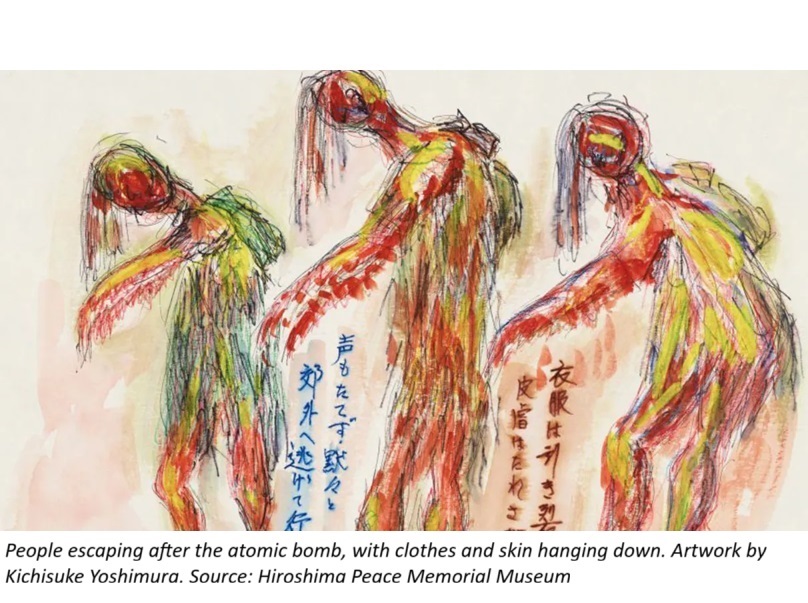
As a railroad worker, he received the limited medical care available, mostly Mercurochrome—a red antiseptic containing mercury—which his family used to treat his burns. He remembered his mother quietly crying as she cleaned the wounds each day, removing maggot eggs and tending to the foul-smelling injuries on his back. Her whispered fear that death might have been kinder than such suffering stayed with him. Yet amid the devastation, he also remembered the kindness of his neighbours. One family, despite having very little themselves, shared a small jar of vegetable oil each week to soothe his burns—an act of generosity that stood in stark contrast to the stigma and isolation survivors faced during that time.
Hibakusha and Non-Japanese Hibakusha
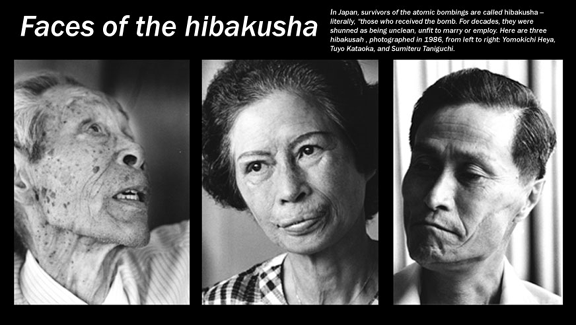
Hibakusha—atomic bomb survivors—faced profound social, economic, and psychological discrimination rooted in widespread misconceptions about radiation sickness. In post-war Japan, many believed that radiation-related conditions were contagious or hereditary, resulting in exclusion from employment, healthcare, marriage prospects, and community life. For non-Japanese hibakusha such as Mr. Lee, this marginalisation was compounded by ethnic discrimination. They endured both the trauma of the bombings and the persistent stigma of being perceived as “outsiders,” leading some, including Mr. Lee, to conceal their survivor status from even close family members for decades. They faced social stigma linked to radiation’s visible effects and persistent institutional neglect tied to their nationality and residency status
Beyond social prejudice, non-Japanese hibakusha have continued to confront bureaucratic obstacles, limited political recognition, and inconsistent access to state support. Restrictions on eligibility for medical subsidies, complex residency verification processes, and legal battles over compensation have left many without adequate care. Their exclusion from formal policymaking spaces has further limited their ability to advocate for their rights. Despite incremental progress, these survivors remain on the margins of disarmament and public health policy, underscoring the need for sustained diplomatic attention, inclusive historical acknowledgment, and equitable survivor support frameworks.
Stories like Mr. Lee’s are not alone and stand as stark reminders of the human cost of misguided policies pursued in the name of national or global security. Across Japan and around the world, thousands of hibakusha, their descendants, and dedicated activists continue to shoulder the burden of history while working tirelessly to ensure its lessons are not forgotten with a collective message: never again!
Hibakusha testimonies are not only records of past violence—they are acts of resistance. By insisting on truth, dignity, and accountability, they challenge systems that normalise nuclear harm and demand justice in the present.
Under Article 6 of the United Nations Treaty on the Prohibition of Nuclear Weapons (TPNW), states must provide age and gender sensitive assistance to victims of nuclear weapons use or testing. This must be enacted without discrimination, including medical care, rehabilitation, and psychological support, and provide for their social and economic inclusion. Countries must be obligated to assist survivors, many of whom share a similar story to Mr Lee, and ensure that nuclear weapons use and testing are prohibited in the future, possible through the advocacy of the TPNW.
About the Author
Monalisa Hazarika is the Strategic Communication and Partnership Officer at the SCRAP Weapons Project. She is one of the UN Youth Champions for Disarmament under the United Nations Office for Disarmament Affairs’ #Youth4Disarmament programme. She is an emerging voice in conventional arms control and meaningful youth engagement, featuring most recently at a UNGA-ECOSOC Joint Meeting. Her areas of expertise and research focus include small arms and light weapons, especially non-industrial weapons and their trends in illicit manufacture and trade, transnational organised crime, and the proliferation of 3D-printed weapons.
Book -Secretary Of Perpetual War

by Caitlin Johnstone (Author), Timothy P Foley (Author)
Part of: JOHNSTONE (28 books) https://www.amazon.com/dp/1923372157?utm_source=substack&utm_medium=email
As the US murder machine ramps up for yet another war of aggression against yet another oil-rich nation in Venezuela, Secretary of War Pete Hegseth has been trying to meme his way out of a major scandal after he was exposed as having authorized the “double-tap” murder of men who survived a US missile strike on a boat in the Caribbean.
In mockery of the uproar over the news, Hegseth posted a meme on Twitter featuring an AI-generated image of the children’s book character Franklin the Turtle with the caption “Franklin Targets Narco Terrorists”. The phrase “narco terrorists” is the slogan the Trump administration has come up with to justify its extrajudicial executions of alleged drug traffickers which it has been using as a pretense to amass a major military presence in the waters near Venezuela.
I personally am glad the US has swapped out the name Department of Defense for the far more honest name Department of War. When was the last time the American military was used to defend the United States? It never happens. Call it what it is. Only thing more honest would be to call it the Department of Perpetual War.
1 This Month

of the week – Shut Down Drone Warfare!


Tell the Ukrainian Government to Drop Prosecution of Peace Activist Yurii Sheliazhenko

Petition to revoke the licensing of the Near Surface Nuclear Disposal Facility (NSDF) at Chalk River. https://www.ourcommons.ca/petitions/en/Petition/Details?Petition=e-7247
To see nuclear-related stories in greater depth and intensity – go to https://nuclearinformation.wordpress.com
-
Archives
- April 2026 (114)
- March 2026 (251)
- February 2026 (268)
- January 2026 (308)
- December 2025 (358)
- November 2025 (359)
- October 2025 (376)
- September 2025 (257)
- August 2025 (319)
- July 2025 (230)
- June 2025 (348)
- May 2025 (261)
-
Categories
- 1
- 1 NUCLEAR ISSUES
- business and costs
- climate change
- culture and arts
- ENERGY
- environment
- health
- history
- indigenous issues
- Legal
- marketing of nuclear
- media
- opposition to nuclear
- PERSONAL STORIES
- politics
- politics international
- Religion and ethics
- safety
- secrets,lies and civil liberties
- spinbuster
- technology
- Uranium
- wastes
- weapons and war
- Women
- 2 WORLD
- ACTION
- AFRICA
- Atrocities
- AUSTRALIA
- Christina's notes
- Christina's themes
- culture and arts
- Events
- Fuk 2022
- Fuk 2023
- Fukushima 2017
- Fukushima 2018
- fukushima 2019
- Fukushima 2020
- Fukushima 2021
- general
- global warming
- Humour (God we need it)
- Nuclear
- RARE EARTHS
- Reference
- resources – print
- Resources -audiovicual
- Weekly Newsletter
- World
- World Nuclear
- YouTube
-
RSS
Entries RSS
Comments RSS
 nuclear-news