Trump’s rush to build nuclear reactors across the U.S. raises safety worries
NPR, December 17, 2025
In May, President Trump sat in the Oval Office flanked by executives from America’s nuclear power industry.
“It’s a hot industry. It’s a brilliant industry,” the president said from behind the Resolute desk.
It’s also an industry that’s having a moment. Billions of dollars in capital are currently flowing into dozens of companies chasing new kinds of nuclear technologies. These are small modular designs that can potentially be mass produced in the hundreds or even thousands. Their proponents say these advanced designs promise to deliver megawatts of power safely and cheaply.
But there’s a problem, Joseph Dominguez, the CEO of Constellation Energy, told the president.
New nuclear plants keep getting caught up in safety regulations.
“Mr. President, you know this because you’re the best at building things,” Dominguez, whose company runs about a quarter of America’s existing nuclear reactors, said. “Delay in regulations and permitting will absolutely kill you. Because if you can’t get the plant on, you can’t get the revenue.”
Now, a new Trump administration program is sidestepping the regulatory system that’s overseen the nuclear industry for half a century. The program will fast-track construction of new and untested reactor designs built by private firms, with an explicit goal of having at least three nuclear test reactors up and running by the United States’ 250th birthday, July 4, 2026.
If that goal is met, it will be without the direct oversight of America’s primary nuclear regulator. Since the 1970s, safety for commercial reactors has been the purview of the Nuclear Regulatory Commission. But the NRC is only consulting on the new Reactor Pilot Program, which is being run by the Department of Energy’s Office of Nuclear Energy……………………………………………………………………………………………………
Sites across the country will host new reactor designs
The new pilot program may be an unproven regulatory path run by an agency with limited experience in the commercial sector, but supporters say it’s energizing an industry that’s been moribund for decades.
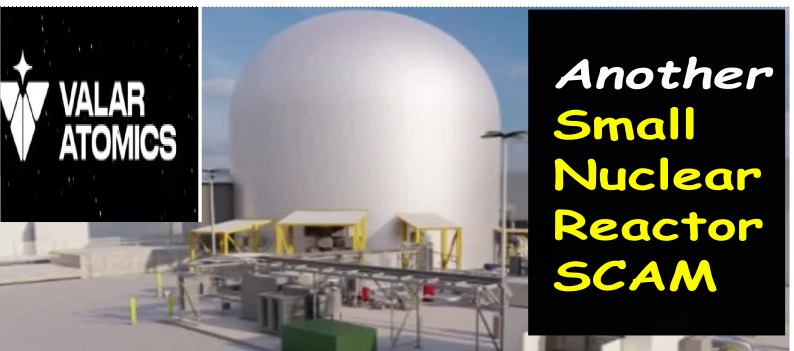
“This is exactly what we need to do,” said Isaiah Taylor, founder and CEO of Valar Atomics, a small nuclear startup headquartered in Hawthorne, Calif. “We need to make nuclear great again.”
Valar and other companies plan to build smaller reactors than those currently used in the nuclear industry, and that makes a Chernobyl or Fukushima-type accident impossible, noted Nick Touran, an independent nuclear consultant. “The overall worst-case scenario is definitely less when you’re a smaller reactor,” he said.
Critics, however, worry that the tight July 4 deadline, political pressure and a lack of transparency are all compromising safety. Even a “small” release of radioactive material could cause damage to people and the environment around the test sites.
“This is not normal, and this is not OK, and this is not going to lead to success,” warned Allison Macfarlane, a professor at the University of British Columbia who served as chairman of the NRC under President Barack Obama. “This is how to have an accident.”
AI’s need for speed
……………………………………………………………………………………………………………. Right from the start it was clear that, unlike the slow and deliberate safety culture that has dominated nuclear power for decades, this new program would be all about speed.
…………officials responsible for overseeing safety would do “whatever we need to ensure that the government is not stopping you from reaching [nuclear] criticality on or before July 4, 2026.”
A new regulator
Before the executive order, the Energy Department did not regulate the safety of commercial nuclear reactors. That job fell to another body: the Nuclear Regulatory Commission.
The commission was set up in 1975 by Congress as an independent safety watchdog, said Allison Macfarlane, the former NRC chair. Part of the reason the NRC was formed was because the predecessor to the DOE, known as the Atomic Energy Commission, oversaw both safety and promotion of nuclear power at the same time.
“This was a very strong conflict of interest,” Macfarlane said.
But in recent years, companies, particularly those trying to build new kinds of reactors, had become frustrated with the NRC, Macfarlane said. “The promoters of these small modular reactors were becoming very vociferous about the NRC being the problem,” she said.

In 2022, the NRC rejected a combined license application for Oklo, a new nuclear startup. Oklo had submitted an application to build and operate its small reactor, called the Aurora powerhouse. But the NRC denied the application because it contained “significant information gaps in its description of Aurora’s potential accidents as well as its classification of safety systems and components.”
Oklo was told it could resubmit its application to the NRC, but it never did.
Then at the May signing of the executive order, Oklo’s CEO Jacob DeWitte appeared behind President Trump applauding the new reactor program at DOE.
“Changing the permitting dynamics is going to help things move faster,” DeWitte said to the president. “It’s never been more exciting.”
Oklo had another connection to the Energy Department — the secretary of energy, Chris Wright, was a member of Oklo’s board of directors until he took the helm at the DOE. Wright stepped down following his confirmation in February.
In August, a little over a month after that initial meeting between industry executives and the DOE, the Office of Nuclear Energy announced the 11 advanced reactor projects had been selected for the Reactor Pilot Program. Three of Oklo’s reactors were part of the new pilot program, including a test version of the reactor design rejected by the NRC…………………………………………………………………………………………………………
Valar’s design looks far different from the reactors that are running today. It will use a special type of fuel together with a high-temperature gas to generate heat and electricity. Taylor said gathering real data will speed development and increase safety over the long-term….
(Valar is also party to a lawsuit against the NRC arguing the commission does not have the authority to regulate small reactors. In his interview, Taylor told NPR the company intends to file for an NRC license “when we’re ready.”)
………………………………………………….. critics question whether the pilot program will really produce safe nuclear reactors.
The July 4, 2026, deadline puts enormous pressure on the program, said Heidy Khlaaf, the chief AI scientist at the AI Now Institute, which recently published a report warning that AI development could undermine nuclear safety.
“I think these manufactured timelines are actually incredibly concerning,” Khlaaf said. “There’s no timeline for assessing a new design and making sure it’s safe, especially something we haven’t seen before.”
Then there’s the question of public transparency. The NRC makes many of the documents around its decisions available publicly. It also frequently allows the public to comment as well, added Edwin Lyman, director of nuclear power safety at the nonprofit Union of Concerned Scientists. The new pilot program is far more opaque and “is really an attempt to subvert the laws and regulations that go around commercial nuclear power,” he said.
While many of the test reactors are small and tout themselves as inherently safer than existing nuclear power plants, they are still capable of leaking radiation in an accident, Lyman noted. “If they are located closer to populated areas, if there aren’t any provisions for offsite radiological emergency planning … then you are potentially putting the public at greater risk, even if the reactors are small,” he said.
Perhaps most worrying, said former NRC Chair Macfarlane, is how the DOE’s safety assessment might be used to build more small reactors across the country, once the pilot reactors are built.
………………………………………..Macfarlane is unconvinced. She said relying on the hasty DOE analysis for the construction of potentially dozens or even hundreds of small reactors around the U.S. is the real risk.
“They can look at what the DOE did, they can take it as a piece of input, but they have to do their own separate analysis,” she warned. “Otherwise, none of us are safe.” https://www.npr.org/2025/12/17/nx-s1-5608371/trump-executive-order-new-nuclear-reactors-safety-concerns
No comments yet.
1 This Month


18 March Webinar @ 1 PM EST: An Assessment of SMR Projects: The Case of Canada
register for the zoom:
https://us02web.zoom.us/webinar/register/WN_o8BIIOUvQ2ONJR1nta65DQ#/registration


of the week – STOP SMALL MODULAR REACTORS IN CANADA
To see nuclear-related stories in greater depth and intensity – go to https://nuclearinformation.wordpress.com
-
Archives
- March 2026 (146)
- February 2026 (268)
- January 2026 (308)
- December 2025 (358)
- November 2025 (359)
- October 2025 (376)
- September 2025 (258)
- August 2025 (319)
- July 2025 (230)
- June 2025 (348)
- May 2025 (261)
- April 2025 (305)
-
Categories
- 1
- 1 NUCLEAR ISSUES
- business and costs
- climate change
- culture and arts
- ENERGY
- environment
- health
- history
- indigenous issues
- Legal
- marketing of nuclear
- media
- opposition to nuclear
- PERSONAL STORIES
- politics
- politics international
- Religion and ethics
- safety
- secrets,lies and civil liberties
- spinbuster
- technology
- Uranium
- wastes
- weapons and war
- Women
- 2 WORLD
- ACTION
- AFRICA
- Atrocities
- AUSTRALIA
- Christina's notes
- Christina's themes
- culture and arts
- Events
- Fuk 2022
- Fuk 2023
- Fukushima 2017
- Fukushima 2018
- fukushima 2019
- Fukushima 2020
- Fukushima 2021
- general
- global warming
- Humour (God we need it)
- Nuclear
- RARE EARTHS
- Reference
- resources – print
- Resources -audiovicual
- Weekly Newsletter
- World
- World Nuclear
- YouTube
-
RSS
Entries RSS
Comments RSS
 nuclear-news
Leave a comment